HDPE Seam Quality Control Night Installation 2026 | Lighting & Quality Assurance
Application Guide 2026-07-28
Author: Senior Geomembrane Engineer, P.E. — 15+ years field experience in geomembrane welding quality management, night installation supervision, and CQA across landfill, mining, and wastewater projects
Reviewer: Geosynthetics Materials Specialist
Last Updated: July 16, 2026
Read Time: 13 minutes
📅 Review Cycle: This guide is updated quarterly. Last verified: July 16, 2026
📋 Executive Summary — For Engineers in a Hurry
- Night installation presents unique quality challenges, including reduced visibility, moisture (dew/condensation), temperature drops, and increased operator fatigue
- Lighting requirements are critical — minimum of 150–200 lux at the weld zone, with additional lighting for seam inspection and testing
- Parameter adjustments for night conditions require slower welding speed (5–10% reduction) and 5–10°C temperature increase to compensate for cooler ambient conditions
- Moisture management is essential — dew and condensation must be removed from weld zones immediately before welding using heat guns or drying methods
- CQA requirements must be enhanced — increased inspection frequency, additional destructive testing, and documented lighting verification are essential for nighttime operations
- Operator fatigue management — shorter shifts (4–6 hours), frequent breaks, and rotation of inspection personnel maintain quality standards
⚠️ Critical Engineering Statement — Night Installation is Not the Same as Day Installation
Night installation requires modified procedures, enhanced lighting, and increased quality control. Assuming day procedures work at night is a recipe for quality failure.
- Visibility is the primary difference — welding defects visible in daylight are often missed at night
- Moisture (dew) is a constant threat — condensation on cold sheets creates contamination
- Temperature drops of 5–15°C require parameter adjustments and can create stress in cooled sheets
- Operator fatigue increases significantly — night shifts require shorter work periods and more frequent breaks
- Quality verification must be increased — more frequent inspections and destructive testing are essential
A weld that passes visual inspection at night may be defective. Visual inspection must be supplemented with enhanced testing and documentation to ensure quality.
📑 Table of Contents
1️⃣ Search Intent Introduction
2️⃣ Common Engineering Questions About Night Installation
3️⃣ Why HDPE Is Used — Material Science Focus
4️⃣ Night Installation Challenges
5️⃣ Lighting Requirements and Equipment
6️⃣ Parameter Adjustments for Night Conditions
7️⃣ Moisture Management — Dew and Condensation
8️⃣ Real Engineering Failure Cases
9️⃣ Comparison With Alternative Liner Systems
🔟 Quality Control and CQA Requirements
1️⃣1️⃣ Professional Engineering Recommendation
1️⃣2️⃣ FAQ Section
1️⃣3️⃣ Technical Conclusion
1️⃣ Search Intent Introduction
This guide addresses the engineering question of how to maintain HDPE seam quality during night installation and what modifications to procedures, lighting, and quality control are required. The primary audience includes welding supervisors, CQA engineers, EPC contractors, installation managers, and quality control personnel responsible for seam quality during nighttime construction operations.
Understanding night installation challenges and mitigation strategies is essential for achieving consistent seam quality, meeting acceptance criteria, and preventing seam failures in nighttime operations. This is not an introductory overview — it is a data-driven engineering reference for professionals responsible for welding quality during night shifts.
Real-world challenges of night installation include:
- ✅ Reduced visibility — inability to see weld defects, contamination, and surface conditions
- ✅ Moisture (dew and condensation) — contamination of weld zones, reduced bond strength
- ✅ Temperature drops — changes in welding parameters, sheet stiffness, thermal contraction
- ✅ Operator fatigue — reduced performance, increased errors, safety concerns
- ✅ Equipment performance — lighting failures, welding equipment temperature stability
- ✅ Inspection limitations — difficulty in visual inspection, reduced CQA effectiveness
2️⃣ Common Engineering Questions About Night Installation
Q1: Can HDPE welding be done at night?
Yes, HDPE welding can be done at night with proper lighting, parameter adjustments, and enhanced quality control. Many projects require night shifts to meet deadlines or work around weather constraints.
Q2: What are the main challenges of night installation?
The main challenges are: reduced visibility for defect detection, moisture (dew) on sheets, temperature drops requiring parameter adjustments, operator fatigue, and difficulty in quality verification.
Q3: What lighting is required for night installation?
Minimum lighting of 150–200 lux at the weld zone is required. Additional lighting (300–500 lux) is recommended for seam inspection and destructive testing. Lighting must be positioned to avoid shadows and glare.
Q4: How does temperature change at night affect welding?
Night temperatures can drop 5–15°C below daytime temperatures, requiring: speed reduction of 5–10%, temperature increase of 5–10°C, and management of thermal contraction stress. GRI-GM19 addresses temperature effects on welding.
Q5: How does dew affect welding quality?
Dew (condensation) on sheets creates contamination at the weld interface. Moisture turns to steam during welding, creating voids and reduced bond strength. All moisture must be removed before welding.
Q6: How should moisture be removed before welding?
Moisture is removed by: heating the weld zone with a heat gun (to just below melting temperature), wiping with clean, dry rags, using forced air, and allowing sufficient time for drying.
Q7: How does operator fatigue affect night welding?
Operator fatigue increases at night due to disrupted circadian rhythms. Fatigue causes: reduced attention to weld quality, slower reactions, increased errors, and decreased safety. Shorter shifts (4–6 hours) and frequent breaks are recommended.
Q8: What CQA requirements are different for night installation?
CQA requirements for night installation include: enhanced lighting for inspection, increased destructive testing frequency, documented lighting verification, moisture inspection before each weld, and additional visual inspection with high-intensity lighting.
Q9: How should destructive testing be scheduled at night?
Destructive testing should be performed within 24 hours of welding, with samples clearly marked. Testing can be done at night or during the day. Results should be reviewed before continuing installation.
Q10: Is night installation more expensive than day installation?
Night installation is typically 10–20% more expensive due to: lighting equipment costs, additional supervision, enhanced quality control, and potential productivity reductions. However, it may be necessary for schedule or weather reasons.
3️⃣ Why HDPE Is Used — Material Science Focus
HDPE dominates containment liner applications due to its excellent chemical resistance, low permeability, high tensile strength, and weldability. Understanding the material’s behaviour at night is essential for quality control.
Thermal Conductivity and Heat Loss: HDPE has low thermal conductivity (approximately 0.4–0.5 W/m·K). Night temperature drops increase heat loss from the weld zone. The cooling rate in night conditions (5–10°C below daytime) is significantly faster than during the day.
Moisture Sensitivity: HDPE surfaces can absorb moisture from condensation. Moisture at the weld interface creates voids and reduces bond strength. Moisture must be completely removed before welding.
Condensation Conditions: Dew point is the temperature at which moisture condenses. Night temperatures often drop below the dew point, creating condensation on cold sheet surfaces. This is most common in humid climates and during temperature transitions.
Thermal Expansion and Contraction: Night temperature drops create thermal contraction. Sheets cool and contract, creating stress in seamed areas. Seams welded at night may be under tension during daytime expansion.
Stress Crack Resistance (NCTL per ASTM D5397): Night welding defects (contamination, cold welds, moisture voids) can reduce the stress crack resistance of the seam. Resins with NCTL ≥ 1000 hours provide greater margin against weld-related ESC. GRI-GM13 requires NCTL ≥ 500 hours.
Oxidative Induction Time (OIT vs HP-OIT): Moisture at the weld interface can create oxidation during welding, reducing HP-OIT at the weld zone. GRI-GM13 requires HP-OIT ≥ 400 minutes for new material.
Alternatives Comparison: HDPE vs Other Liner Materials for Night Installation
| Property | HDPE | LLDPE | fPP | PVC | GCL |
|---|---|---|---|---|---|
| Night installation suitability | Good (with precautions) | Good | Fair | Good (solvent) | N/A |
| Lighting required | High | High | High | Moderate | N/A |
| Temperature adjustment required | Yes | Yes | Yes | No | N/A |
| Moisture sensitivity | Moderate | Moderate | High | Low | N/A |
| Operator fatigue impact | High | High | High | Moderate | N/A |
| CQA enhancement required | Yes | Yes | Yes | Yes | N/A |
| Field weldability at night | Good (with precautions) | Good | Fair | Good | N/A |
| Cost relative to HDPE | 1.0x | 1.0–1.1x | 1.5–2.0x | 1.2–1.5x | 0.6–0.8x |
4️⃣ Night Installation Challenges
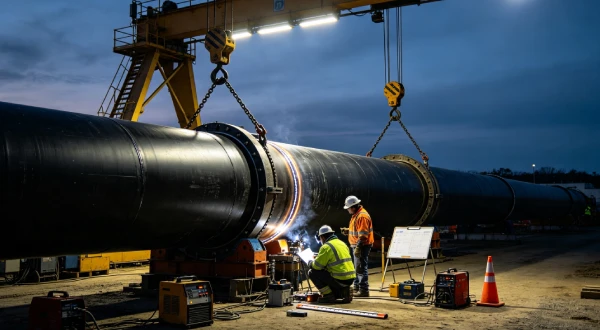
Night installation presents unique challenges that require specific mitigation strategies.
Visibility Challenges:
| Challenge | Impact | Mitigation |
|---|---|---|
| Reduced light levels | Missed defects, poor inspection | High-intensity lighting |
| Shadows | Masked defects | Multiple light sources |
| Glare | Eye strain, missed defects | Proper positioning |
| Colour perception | Difficulty seeing contamination | Colour-corrected lighting |
Table scrolls horizontally on mobile
Moisture Challenges:
| Challenge | Impact | Mitigation |
|---|---|---|
| Dew formation | Contamination of weld zone | Heat guns, wiping |
| Condensation on sheets | Moisture at weld interface | Pre-weld drying |
| Humidity | Slow moisture evaporation | Forced air, heating |
| Rain (unexpected) | Sheet contamination | Covering, drying |
Table scrolls horizontally on mobile
Temperature Challenges:
| Challenge | Impact | Mitigation |
|---|---|---|
| Temperature drop | Parameter adjustment needed | Slow speed, high temp |
| Sheet stiffness | Handling difficulty | Preheat sheets |
| Thermal contraction | Seam stress | Manage slack |
| Rapid cooling | Brittle welds | Reduce cooling rate |
Table scrolls horizontally on mobile
Operator Fatigue Challenges:
| Challenge | Impact | Mitigation |
|---|---|---|
| Disrupted circadian rhythm | Reduced alertness | Shorter shifts |
| Eye strain | Missed defects | Breaks, lighting |
| Decision fatigue | Errors | Rotation, supervision |
| Safety concerns | Accidents | Increased safety focus |
5️⃣ Lighting Requirements and Equipment
Proper lighting is essential for night installation quality.
Minimum Lighting Requirements:
| Area | Minimum Lux | Recommended Lux |
|---|---|---|
| Weld zone | 150–200 | 200–300 |
| Seam inspection | 200–300 | 300–500 |
| Destructive testing | 300–500 | 500+ |
| General work area | 100–150 | 200–300 |
| Subgrade inspection | 150–200 | 300+ |
Table scrolls horizontally on mobile
Lighting Equipment:
| Equipment | Application | Specifications |
|---|---|---|
| Flood lights | General area lighting | LED, 1000–5000W equivalent |
| Work lights | Weld zone lighting | LED, 500–2000W equivalent |
| Headlamps | Operator lighting | LED, 300–500 lumens |
| Inspection lights | Detailed inspection | LED, 500–1000 lumens |
| Colour-corrected lights | Defect detection | 5000–6000K colour temperature |
Lighting Positioning:
- ✅ Avoid shadows: Position lights to eliminate shadows on the weld zone
- ✅ Avoid glare: Position lights to avoid reflecting off the sheet surface
- ✅ Provide backup lighting: Have spare lights and generators
- ✅ Inspect lighting: Verify lighting levels before each shift
Lighting Verification:
| Frequency | Action |
|---|---|
| Start of shift | Verify lighting levels |
| Hourly | Check for light failures |
| After movement | Verify repositioned lighting |
| Before testing | Verify inspection lighting |
6️⃣ Parameter Adjustments for Night Conditions
Night conditions require parameter adjustments for temperature drops and moisture.
Parameter Adjustments by Temperature Drop:
| Temperature Drop | Speed Adjustment | Temperature Adjustment |
|---|---|---|
| 0–5°C | Reduce speed 5% | Increase 5°C |
| 5–10°C | Reduce speed 5–10% | Increase 5–10°C |
| 10–15°C | Reduce speed 10–15% | Increase 10–15°C |
| > 15°C | Reduce speed 15–20% | Increase 15–20°C |
Table scrolls horizontally on mobile
Parameter Adjustments by Liner Thickness at Night:
| Thickness | Day Speed/Temp | Night (5–10°C drop) | Night (> 10°C drop) |
|---|---|---|---|
| 1.5mm | 2.0–3.0 / 420–450°C | 1.8–2.7 / 430–460°C | 1.6–2.4 / 440–470°C |
| 2.0mm | 1.5–2.5 / 440–470°C | 1.3–2.3 / 450–480°C | 1.1–2.0 / 460–490°C |
| 2.5mm | 1.0–2.0 / 460–490°C | 0.9–1.8 / 470–500°C | 0.7–1.5 / 480–510°C |
Table scrolls horizontally on mobile
Additional Night Adjustments:
- ✅ Roller pressure: Increase 5–10% to compensate for sheet stiffness
- ✅ Overlap width: Increase 10–20mm to provide wider weld zone
- ✅ Preheat time: Allow longer preheat for wedge to reach stable temperature
- ✅ Cooling rate: Use slower cooling to prevent brittle welds
7️⃣ Moisture Management — Dew and Condensation
Moisture management is the most critical night installation challenge.
Dew Point and Condensation Relationship:
Dew point is the temperature at which moisture condenses. Night temperatures often drop below the dew point, creating condensation on sheets. The temperature difference between the sheet surface and the dew point determines the rate of condensation. The greater the temperature difference (sheet temperature below dew point), the faster condensation forms. In humid climates, sheet temperatures can drop below dew point within 30–60 minutes of sunset. Condensation forms first on the top surface of sheets, which cools faster than the bottom surface due to radiative cooling. The moisture must be completely removed before welding, as even microscopic moisture at the weld interface creates voids and reduces bond strength.
Moisture Detection:
| Method | Application |
|---|---|
| Visual inspection | Look for visible moisture |
| Touch test | Check for dampness |
| Absorbent paper | Press on surface, check for moisture |
| Heat test | Heat small area, check for steam |
Table scrolls horizontally on mobile
Moisture Removal Methods:
| Method | Application | Effectiveness |
|---|---|---|
| Heat gun | Weld zone drying | Very High |
| Wiping | General drying | Moderate |
| Forced air | Area drying | Moderate |
| Preheating | Sheet heating | High |
Table scrolls horizontally on mobile
Moisture Removal Procedure:
- Inspect the weld zone for visible moisture
- Apply heat with a heat gun to the weld zone (just below melting temperature)
- Wipe with clean, dry rags to remove any remaining moisture
- Verify dryness with absorbent paper or touch test
- Weld immediately after drying to prevent re-condensation
Moisture Prevention:
- ✅ Cover sheets: Protect from dew and rain
- ✅ Preheat sheets: Raise sheet temperature above dew point
- ✅ Monitor dew point: Know when condensation is likely
- ✅ Schedule: Avoid welding during high-humidity periods
8️⃣ Real Engineering Failure Cases
Case 1: Moisture Contamination Failure — Southeast Asian Wastewater Lagoon, 2019
Specification used: 2.0mm HDPE, night welding with no moisture removal. Dew formed on sheets before welding.
Observed failure: Moisture contamination at weld interface. Peel strength tested at 60–80 N/25mm. Seam failure under stress.
Timeline:
2019: 2.0mm HDPE installed at night, dew present
2019: No moisture removal performed
2019: Destructive testing showed moisture contamination
2019: Seams replaced, moisture removal implemented
Cost: $1.2M (seam replacement + investigation)
Root cause: Dew formed on sheets before welding. No moisture removal was performed. Moisture at the weld interface created voids and reduced bond strength. Peel strength was below acceptance criteria.
Engineering lesson: Inspect for moisture before each weld. Remove moisture with heat gun and wiping. Weld immediately after drying. Destructive testing at 75m intervals in night conditions.
Case 2: Inadequate Lighting Failure — US Midwest Landfill, 2020
Specification used: 2.0mm HDPE, night welding with inadequate lighting (50–70 lux). Operator unable to see contamination and defects.
Observed failure: Contamination and fishmouth defects in seams. Visual inspection missed defects. Destructive testing identified multiple defects.
Timeline:
2020: 2.0mm HDPE installed at night, 50-70 lux lighting
2020: Visual inspection missed contamination and fishmouths
2020: Destructive testing revealed multiple defects
2020: Seams replaced, lighting upgraded
Cost: $1.0M (seam replacement + lighting upgrade)
Root cause: Inadequate lighting (50–70 lux) prevented visual detection of contamination and defects. Operator could not see the weld zone clearly. Defective welds were not identified.
Engineering lesson: Minimum lighting of 150–200 lux required for night welding. Position lights to eliminate shadows. Regular lighting verification. Enhanced destructive testing in night conditions.
Case 3: Operator Fatigue Failure — Australian Tailings Facility, 2021
Specification used: 2.0mm HDPE, night shift of 12 hours. No breaks. Operator fatigue led to welding parameter errors.
Observed failure: Inconsistent welding parameters (speed and temperature variation). Seam peel strength ranged from 80–180 N/25mm. Multiple seam failures.
Timeline:
2021: 2.0mm HDPE installed at night, 12-hour shift
2021: Operator fatigue, inconsistent parameters
2021: Destructive testing showed variable quality
2021: Seams replaced, shift schedule revised
Cost: $1.5M (seam replacement + investigation + shift changes)
Root cause: 12-hour night shift with no breaks led to operator fatigue. Inconsistent welding parameters (speed and temperature variation) created variable weld quality. Peel strength was inconsistent.
Engineering lesson: Night shifts should be 4–6 hours with frequent breaks. Rotate operators to maintain alertness. Enhanced monitoring of welding parameters. Destructive testing at 75m intervals.
Failure Case Cost Summary
| Case | Location | Failure Mode | Cost | Primary Lesson |
|---|---|---|---|---|
| Case 1 | SE Asia | Moisture contamination | $1.2M | Remove moisture before welding |
| Case 2 | US Midwest | Inadequate lighting | $1.0M | Minimum 150-200 lux lighting |
| Case 3 | Australia | Operator fatigue | $1.5M | 4-6 hour night shifts, frequent breaks |
9️⃣ Comparison With Alternative Liner Systems
| Property | HDPE (2.0mm) | LLDPE (1.5mm) | fPP (1.5mm) | PVC (1.5mm) | GCL |
|---|---|---|---|---|---|
| Night installation suitability | Good (with precautions) | Good | Fair | Good (solvent) | N/A |
| Lighting required | High | High | High | Moderate | N/A |
| Temperature adjustment required | Yes | Yes | Yes | No | N/A |
| Moisture sensitivity | Moderate | Moderate | High | Low | N/A |
| Operator fatigue impact | High | High | High | Moderate | N/A |
| CQA enhancement required | Yes | Yes | Yes | Yes | N/A |
| Field weldability at night | Good (with precautions) | Good | Fair | Good | N/A |
| Cost relative to HDPE | 1.0x | 1.0–1.1x | 1.5–2.0x | 1.2–1.5x | 0.6–0.8x |
Table scrolls horizontally on mobile
🔟 Quality Control and CQA Requirements
Lighting Verification:
- ✅ Lux meter: Measure lighting levels at start of shift
- ✅ Positioning: Verify lights positioned to avoid shadows
- ✅ Backup: Ensure backup lights and generators available
- ✅ Documentation: Record lighting levels hourly
Moisture Inspection:
- ✅ Pre-weld inspection: Check for moisture before each weld
- ✅ Drying: Remove moisture with heat gun and wiping
- ✅ Verification: Confirm dryness before welding
- ✅ Documentation: Record moisture inspection results
Parameter Verification:
- ✅ Speed: Verify welding speed at start and hourly
- ✅ Temperature: Verify wedge temperature before each weld
- ✅ Pressure: Verify roller pressure at start of shift
- ✅ Documentation: Record all parameters
Destructive Testing Frequency:
| Condition | Testing Frequency |
|---|---|
| Day installation (standard) | Every 150m |
| Night installation | Every 75m |
| Night + moisture risk | Every 50m |
| Night + temperature drop > 10°C | Every 50m |
Table scrolls horizontally on mobile
Acceptance Criteria:
| Thickness | Peel Strength | Shear Strength |
|---|---|---|
| 1.5mm | ≥ 150 N/25mm | ≥ 200 N/25mm |
| 2.0mm | ≥ 150 N/25mm | ≥ 200 N/25mm |
| 2.5mm | ≥ 250 N/25mm | ≥ 200 N/25mm |
1️⃣1️⃣ Professional Engineering Recommendation
Night Installation Checklist:
| Item | Requirement |
|---|---|
| Lighting | ≥ 150–200 lux at weld zone |
| Lighting backup | Spare lights and generators |
| Moisture inspection | Before each weld |
| Moisture removal | Heat gun + wiping |
| Parameter adjustment | For temperature drop |
| Operator breaks | Every 2 hours |
| Shift duration | 4–6 hours |
| Destructive testing | Every 75m |
Table scrolls horizontally on mobile
When to Stop Night Installation:
- ✅ Lighting failure: Stop until lighting restored
- ✅ Heavy moisture: Stop until drying complete
- ✅ Operator fatigue: Stop if fatigue is evident
- ✅ Destructive test failure: Stop and investigate
- ✅ Safety concerns: Stop if unsafe conditions
Documentation Requirements:
- ✅ Shift log: Times, weather, conditions
- ✅ Lighting verification: Lux measurements
- ✅ Moisture inspection: Pre-weld inspection results
- ✅ Parameter records: Speed, temperature, pressure
- ✅ Destructive testing: All results
- ✅ QA sign-off: CQA engineer signature
1️⃣2️⃣ FAQ Section
Q1: Can HDPE welding be done at night?
Yes, HDPE welding can be done at night with proper lighting, parameter adjustments, and enhanced quality control. Many projects require night shifts to meet deadlines or work around weather constraints.
Q2: What are the main challenges of night installation?
The main challenges are: reduced visibility for defect detection, moisture (dew) on sheets, temperature drops requiring parameter adjustments, operator fatigue, and difficulty in quality verification.
Q3: What lighting is required for night installation?
Minimum lighting of 150–200 lux at the weld zone is required. Additional lighting (300–500 lux) is recommended for seam inspection and destructive testing. Lighting must be positioned to avoid shadows and glare.
Q4: How does temperature change at night affect welding?
Night temperatures can drop 5–15°C below daytime temperatures, requiring: speed reduction of 5–10%, temperature increase of 5–10°C, and management of thermal contraction stress.
Q5: How does dew affect welding quality?
Dew (condensation) on sheets creates contamination at the weld interface. Moisture turns to steam during welding, creating voids and reduced bond strength. All moisture must be removed before welding.
Q6: How should moisture be removed before welding?
Moisture is removed by: heating the weld zone with a heat gun (to just below melting temperature), wiping with clean, dry rags, using forced air, and allowing sufficient time for drying.
Q7: How does operator fatigue affect night welding?
Operator fatigue increases at night due to disrupted circadian rhythms. Fatigue causes: reduced attention to weld quality, slower reactions, increased errors, and decreased safety. Shorter shifts (4–6 hours) and frequent breaks are recommended.
Q8: What CQA requirements are different for night installation?
CQA requirements for night installation include: enhanced lighting for inspection, increased destructive testing frequency, documented lighting verification, moisture inspection before each weld, and additional visual inspection with high-intensity lighting.
Q9: How should destructive testing be scheduled at night?
Destructive testing should be performed within 24 hours of welding, with samples clearly marked. Testing can be done at night or during the day. Results should be reviewed before continuing installation.
Q10: Is night installation more expensive than day installation?
Night installation is typically 10–20% more expensive due to: lighting equipment costs, additional supervision, enhanced quality control, and potential productivity reductions. However, it may be necessary for schedule or weather reasons.
1️⃣3️⃣ Technical Conclusion
Night installation presents unique challenges for HDPE geomembrane seam quality that require specific modifications to procedures, lighting, and quality control. Reduced visibility prevents detection of weld defects, contamination, and surface conditions that would be visible during the day. Minimum lighting of 150–200 lux at the weld zone is essential, with additional lighting (300–500 lux) for seam inspection and destructive testing.
Moisture management is the most critical night installation challenge. Dew and condensation on sheets create contamination at the weld interface, reducing bond strength and creating voids. Moisture must be removed before each weld using heat guns and wiping. Weld zones must be inspected for moisture immediately before welding, and welding must occur promptly after drying to prevent re-condensation.
Temperature drops of 5–15°C at night require parameter adjustments: speed reduction of 5–10%, temperature increase of 5–10°C, and roller pressure increase of 5–10%. These adjustments compensate for heat loss and sheet stiffness. Thermal contraction stress must be managed through appropriate slack and seam orientation.
Operator fatigue is a significant concern in night installation. Night shifts should be limited to 4–6 hours with frequent breaks. Operators should be rotated to maintain alertness. Enhanced monitoring of welding parameters and increased destructive testing frequency (every 75m instead of 150m) are essential.
The cost of night installation ($0.5–1.5M additional quality costs) is often justified by schedule requirements or weather constraints. However, the cost of quality failures from inadequate night procedures ($1–5M) far exceeds the cost of proper night installation procedures ($10,000–50,000 per project). Proper lighting, moisture management, parameter adjustment, and enhanced CQA are essential for maintaining seam quality during night installation.
📚 Related Technical Guides
HDPE Geomembrane Night Installation: A CQA Engineer's Field ManualLighting Requirements for Geomembrane Installation and Quality ControlMoisture Management in HDPE Welding: Dew, Condensation, and Contamination PreventionParameter Adjustment for Environmental Conditions: Temperature, Time of Day, and HumidityHDPE Geomembrane Failure Investigation: Night Installation-Related Root Cause Analysis