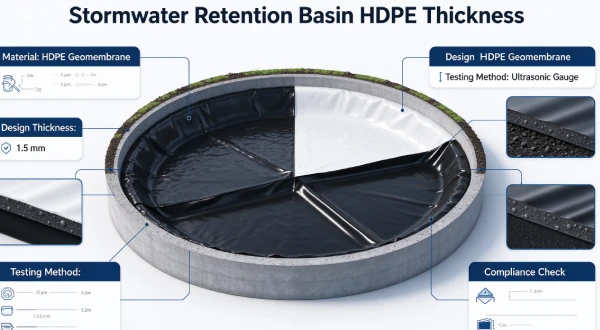
Stormwater Retention Basin HDPE Thickness & Specification Guide
Application Guide 2026-10-10
📌 Article Positioning
This guide focuses on HDPE thickness selection and material specification for stormwater retention basins — 1.0mm vs 1.5mm vs 2.0mm, NCTL/HP-OIT requirements, welding parameters, and first-flush/UV considerations. For NPDES compliance and regulatory requirements (EPA permit conditions, groundwater protection, BMP design), refer to the companion guide on stormwater basin NPDES design.
📋 Executive Summary — For Engineers in a Hurry
- 1.0–1.5mm HDPE is the standard thickness range for stormwater retention basins, with 1.5mm recommended for basins receiving industrial runoff or where extended service life is required
- NCTL ≥ 750 hours is recommended for stormwater basins with hydrocarbon exposure; NCTL ≥ 1000 hours for basins receiving industrial runoff or high pollutant loads
- HP-OIT ≥ 450 minutes is recommended for basins in warm climates (25–35°C); HP-OIT ≥ 500 minutes for basins with elevated temperatures or extended design life
- First-flush concentration and dry-period UV exposure are the unique stormwater challenges — not the water itself
- CQA requirements include 100% non-destructive seam testing, destructive testing every 150m, and leak location survey for critical applications
⚠️ Critical Engineering Statement — Stormwater Chemistry, Not Water, Determines Liner Specification
Stormwater runoff carries pollutants that are more aggressive than clean water. Liner specification must account for the chemical profile of the catchment area and the unique first-flush phenomenon.
- Hydrocarbons from parking lots, roads, and industrial areas reach 10–100 mg/L and attack antioxidants
- Heavy metals (lead, zinc, copper) from vehicle wear and industrial processes create chemical exposure
- Chlorides from de-icing salts reach 1,000–5,000 mg/L in cold climates
- First-flush concentration — the first 12–25mm of runoff contains the highest pollutant loads
- Dry-period UV exposure — shallow basins expose the liner to direct solar radiation for months
- NCTL ≥ 750 hours and HP-OIT ≥ 450 minutes are minimum specifications for standard stormwater basins
A 1.5mm liner with NCTL ≥ 1000 hours and HP-OIT ≥ 500 minutes will outperform a 2.0mm liner with standard specifications for industrial runoff basins. Specification quality outweighs thickness alone.
⚠️ First Flush — Stormwater Basin Unique Requirement
The first flush phenomenon is a unique stormwater basin consideration that does not apply to most other lined containment applications.
First Flush Mechanism:
The first 12–25mm of runoff after a dry period contains the highest pollutant concentrations. This is because pollutants accumulate on impervious surfaces during dry periods and are washed off rapidly during the initial rainfall.
Pollutant Concentrations in First Flush:
| Pollutant | Typical Concentration | Source |
|---|---|---|
| Hydrocarbons (oil, grease) | 10–100 mg/L | Parking lots, roads |
| Heavy metals (Pb, Zn, Cu) | 0.05–1.0 mg/L | Vehicle wear, industrial |
| Chlorides | 1,000–5,000 mg/L | De-icing salts |
| Nutrients (N, P) | 1–10 mg/L | Landscaping, fertilizers |
| Total suspended solids | 50–500 mg/L | Surface erosion |
Table scrolls horizontally on mobile
Design Requirements for First Flush:
- ✅ Industrial first flush: Specify NCTL ≥ 1000 hours and HP-OIT ≥ 500 minutes
- ✅ First flush diversion: Consider diverting first 12–25mm to treatment
- ✅ Pretreatment: Sediment forebay or vegetated swale before main basin
- ✅ Sediment accumulation: Design basin bottom for sediment storage and removal access
- ✅ Monitoring: Sample first flush for hydrocarbon and heavy metal concentrations
Case Reference: US Midwest industrial basin received 80 mg/L hydrocarbons from parking lot runoff. With NCTL = 550 hours (below recommended 1000 hours), ESC occurred within 5 years, causing $1.4M in damage.
⚠️ Dry-Period UV Exposure — Shallow Basin Unique Requirement
Shallow stormwater basins present a unique UV exposure risk during dry periods that does not apply to deeper water storage facilities.
Dry-Period UV Mechanism:
Shallow basins (< 1m depth) may completely expose the liner surface during extended dry periods. Direct solar UV radiation degrades the exposed liner surface, causing embrittlement and cracking.
UV Exposure Risk Factors:
- Climate: Arid and semi-arid climates with extended dry periods
- Basin depth: Shallow basins (< 1m) expose more liner surface
- Exposure duration: Dry periods > 3 months significantly increase risk
- Carbon black content: Below 2.5% provides insufficient UV protection
- Dispersion quality: Rating ≥ 1 is essential for uniform protection
Design Requirements for Dry-Period UV Exposure:
| Parameter | Requirement |
|---|---|
| Carbon black content | 2.5–3.0% (ASTM D4218) |
| Carbon black dispersion | Rating ≥ 1 (ASTM D5596) |
| Liner thickness | 1.5mm minimum for sacrificial surface layer |
| Cover protection | Optional: shade structures or sand cover |
| Inspection frequency | Annual visual inspection for surface cracking |
Implementation Guidance:
- ✅ Carbon black specification: 2.5–3.0% with dispersion rating ≥ 1
- ✅ Sacrificial layer: Consider 1.5mm thickness to provide sacrificial surface layer
- ✅ Cover options: Shade structures, sand cover, or floating covers for extended dry periods
- ✅ Inspection: Annual visual inspection for surface embrittlement and cracking
- ✅ Monitoring: HP-OIT testing of surface samples every 3–5 years
Case Reference: Australian shallow basin used 1.0mm HDPE with 2.0% carbon black and dispersion rating 2. After 2 years of intermittent exposure (8-month dry period), surface embrittlement and cracking occurred, causing $0.9M in damage.
📑 Table of Contents
1️⃣ Search Intent Introduction
2️⃣ Common Engineering Questions About Stormwater Basin Liners
3️⃣ Why HDPE Is Used — Material Science Focus
4️⃣ Recommended Thickness Ranges
5️⃣ Environmental Factors and Aging Mechanisms
6️⃣ Subgrade Preparation and Support Layer Design
7️⃣ Welding and Installation Risks
8️⃣ Real Engineering Failure Cases
9️⃣ Comparison With Alternative Liner Systems
🔟 Cost Considerations
1️⃣1️⃣ Professional Engineering Recommendation
1️⃣2️⃣ FAQ Section
1️⃣3️⃣ Technical Conclusion
1️⃣ Search Intent Introduction
This guide addresses the specification-level decision making for HDPE geomembrane thickness selection and material properties in stormwater retention basin applications. The primary audience includes municipal engineers, stormwater management consultants, EPC contractors, environmental regulators, and facility owners evaluating liner systems for stormwater containment.
Understanding stormwater pollutant profiles is essential for thickness selection, resin specification, and CQA program design. This is not an introductory overview — it is a data-driven engineering reference for professionals specifying stormwater containment systems.
Real-world stress conditions unique to stormwater retention basins include:
- ✅ Hydrocarbon exposure — oil and grease from parking lots and roads at 10–100 mg/L
- ✅ Heavy metal accumulation — lead, zinc, copper from vehicle wear and industrial processes
- ✅ Chloride exposure — 1,000–5,000 mg/L from de-icing salts in cold climates
- ✅ First-flush concentration — highest pollutant loads in first 12–25mm of runoff
- ✅ Fluctuating water levels — rapid fill/drawdown cycles during storm events
- ✅ Dry-period UV exposure — shallow basins with exposed liner during dry periods
2️⃣ Common Engineering Questions About Stormwater Basin Liners
Q1: What HDPE thickness is required for stormwater retention basins?
Standard thickness is 1.0–1.5mm, with 1.5mm recommended for basins receiving industrial runoff or where extended service life is required. For large basins (> 1 hectare) or high pollutant loads, 2.0mm may be specified.
Q2: What NCTL value should be specified for stormwater basins?
NCTL ≥ 750 hours is recommended for residential/commercial stormwater. NCTL ≥ 1000 hours is recommended for industrial runoff or high hydrocarbon exposure. GRI-GM13 requires NCTL ≥ 500 hours.
Q3: What is the expected service life of an HDPE stormwater basin liner?
With proper specification (NCTL ≥ 750 hours, HP-OIT ≥ 450 minutes), HDPE stormwater basin liners can achieve 30–50 years of service. Temperature and pollutant exposure are the dominant factors.
Q4: How does temperature affect liner service life?
Arrhenius kinetics dictate that oxidation rate doubles per 10°C increase. At 30°C (typical shallow basin temperature), service life reduces by approximately 30% compared to 20°C.
Q5: What geotextile is required beneath the HDPE liner?
A nonwoven geotextile of 400–600 gsm is recommended for subgrade protection. For basins with equipment access requirements, 600 gsm provides optimal protection.
Q6: What are the primary failure mechanisms for stormwater basin liners?
Primary failure mechanisms include: ESC from hydrocarbon exposure (30–40%), seam failure (25–30%), puncture from subgrade particles (20–25%), and UV degradation during dry periods (10–15%).
Q7: What CQA requirements apply to stormwater basin liners?
CQA requirements include: 100% non-destructive seam testing, destructive testing every 150m, 100% leak location survey for critical applications, and subgrade verification every 500m².
Q8: When is a composite liner (HDPE + GCL) required?
Composite liners are recommended for basins within 300m of water bodies, areas with high groundwater, and where regulatory requirements mandate composite construction. GCL provides secondary containment.
Q9: How does first-flush concentration affect liner specification?
First-flush runoff contains the highest pollutant loads (hydrocarbons, heavy metals). For basins receiving first-flush from industrial areas, specify NCTL ≥ 1000 hours and HP-OIT ≥ 500 minutes.
Q10: What is the cost of a stormwater basin liner system?
Total installed cost ranges from $18–30/m² depending on thickness, geotextile, and site conditions. Material cost is $10–20/m² for 1.0–1.5mm HDPE.
3️⃣ Why HDPE Is Used — Material Science Focus
HDPE dominates stormwater basin liner applications due to its excellent chemical resistance, low permeability, and weldability. However, its susceptibility to ESC and oxidation requires careful specification.
Chemical Resistance in Stormwater Basins: HDPE resists the full range of stormwater constituents, including hydrocarbons, heavy metals, and chlorides. The combination of hydrocarbons, chlorides, and temperature fluctuations creates a challenging environment for ESC resistance.
Stress Crack Resistance (NCTL per ASTM D5397): GRI-GM13 requires NCTL ≥ 500 hours. For stormwater basins with hydrocarbon exposure, NCTL ≥ 750 hours is recommended. For industrial runoff, NCTL ≥ 1000 hours. For detailed NCTL specification and interpretation, see the dedicated HDPE stress crack resistance guide.
Oxidative Induction Time (OIT vs HP-OIT): HP-OIT (ASTM D5885) measures remaining antioxidant capacity. GRI-GM13 requires HP-OIT ≥ 400 minutes. For stormwater basins at 25–35°C, HP-OIT ≥ 450 minutes is recommended.
Carbon Black Content: Carbon black (2–3%, ASTM D4218) provides UV protection. Proper dispersion (ASTM D5596 rating ≥ 1) ensures uniform UV protection — critical for shallow basins with exposed liner during dry periods. For detailed UV protection specification, see the Geomembrane UV resistance guide.
Alternatives Comparison: HDPE vs Other Liner Materials for Stormwater Basins
| Property | HDPE | LLDPE | fPP | PVC | GCL |
|---|---|---|---|---|---|
| Key limitation | ESC susceptibility | Lower NCTL | Lower tensile strength | Plasticizer loss | Shear sensitivity |
| UV resistance | Excellent | Moderate | Good | Poor | N/A |
| Field weldability | Excellent | Excellent | Fair | Good (solvent) | N/A |
| Cost relative to HDPE | 1.0x | 1.0–1.1x | 1.5–2.0x | 1.2–1.5x | 0.6–0.8x |
4️⃣ Recommended Thickness Ranges
Thickness selection for stormwater basins balances pollutant exposure, puncture resistance, and service life.
📋 HDPE Thickness Selection for Stormwater Basins
| Thickness | Typical Application | Puncture Resistance | Service Life @ 30°C | Cost per m² Installed |
|---|---|---|---|---|
| 1.0mm | Residential/commercial basins, low pollutant loads | ≥ 200 N (ASTM D4833) | 20–30 years | $18–24 |
| 1.5mm | Standard basins, industrial runoff, moderate pollutants | ≥ 300 N | 30–45 years | $22–30 |
| 2.0mm | Large basins (> 1 ha), high pollutant loads | ≥ 400 N | 40–55 years | $28–38 |
Table scrolls horizontally on mobile
Drivers for Thicker Liners:
- Puncture Resistance: Equipment access and subgrade conditions require thicker liners. For detailed puncture risk analysis, see the HDPE liner puncture risk guide.
- Pollutant Exposure: Industrial runoff with hydrocarbons requires thicker liners for chemical resistance.
- Service Life: Longer design life requires thicker liners with greater antioxidant reservoirs.
- Equipment Access: Basins requiring maintenance access need thicker liners for puncture resistance.
⚠️ Why Thicker Is Not Always Safer:
- Thermal Contraction: Thicker liners generate higher contraction forces, requiring stronger anchorage.
- Handling Difficulty: 2.0mm rolls weigh approximately 2,000 kg, requiring heavier equipment.
- Seam Quality: Greater thermal mass of thicker liners requires higher heat input for welding.
5️⃣ Environmental Factors and Aging Mechanisms
Understanding aging mechanisms is essential for service life prediction.
UV Exposure and Photo-Oxidation: Shallow stormwater basins may expose the liner to direct solar UV radiation during dry periods. Carbon black (2–3%) attenuates UV penetration. Surface embrittlement from prolonged exposure can create stress raisers. For detailed UV degradation mechanisms, see the HDPE UV degradation guide.
Thermo-Oxidative Degradation — Arrhenius Kinetics: HDPE oxidation follows Arrhenius kinetics: k = A × exp(-Ea/RT). Reaction rate doubles per 10°C increase. At 30°C basin temperature, degradation is approximately 1.7x faster than at 20°C.
Four-Phase Degradation Model:
- Induction Phase: Antioxidants neutralize free radicals. Duration depends on antioxidant package and temperature.
- Depletion Phase: Antioxidant concentration declines. HP-OIT monitoring during this phase provides early warning.
- Oxidation Phase: Uninhibited oxidation leads to chain scission and embrittlement.
- Embrittlement Phase: Polymer loses ductility. Stress cracks initiate at flaws.
Published Aging Study Reference:
Koerner, R.M., Hsuan, Y.G., and Koerner, G.R. (2017). “Lifetime prediction of HDPE geomembranes in landfill applications using Arrhenius modelling.” Geotextiles and Geomembranes, 45(5), 425–435. DOI: 10.1016/j.geotexmem.2017.05.001.
Stormwater-Specific Chemical Exposure:
| Chemical | Concentration | Impact on HDPE |
|---|---|---|
| Hydrocarbons (oil, grease) | 10–100 mg/L | Accelerates antioxidant depletion |
| Lead, zinc, copper | 0.05–1.0 mg/L | Minimal impact on HDPE |
| Chlorides (de-icing salts) | 1,000–5,000 mg/L | Minimal impact below 50°C |
| Nutrients (N, P) | 1–10 mg/L | Promotes biological activity |
| pH | 6.0–8.5 | Minimal impact |
Table scrolls horizontally on mobile
6️⃣ Subgrade Preparation and Support Layer Design
Subgrade quality directly influences liner performance and puncture risk.
Particle Size Limits: GRI-GM13 requires subgrade particles passing the 9.5mm sieve. Recommend 6mm maximum for stormwater basins. Angular aggregates concentrate stress and increase puncture risk.
Subgrade Compaction: Target ≥ 95% Standard Proctor density. This provides uniform support and minimises differential settlement.
Geotextile Protection Layer Guidance:
- 400 gsm: Standard recommendation for stormwater basins with uniform subgrade
- 600 gsm: Required for angular subgrade, equipment access areas, or subgrades with CBR < 3
- 200–300 gsm: Suitable only for uniform, well-compacted fine-grained subgrades
Field Insight — Success Story:
Midwestern US municipal basin (2018), 1.5mm HDPE with 400 gsm geotextile over compacted clay subgrade. Subgrade particles ≤ 6mm. Eight-year monitoring shows zero punctures, with biennial leak location survey confirming barrier integrity.
Field Insight — Failure Case:
Southeast Asian industrial basin (2016), 1.0mm HDPE with 200 gsm geotextile over 20mm crushed stone. Site experienced multiple punctures within 3 years during maintenance access. Angular stone and equipment loading caused liner damage.
7️⃣ Welding and Installation Risks
Installation quality determines liner performance more than material specification.
Hot Wedge Welding Parameters by Thickness:
| Thickness | Temperature (°C) | Wedge Speed (m/min) | Pressure (kPa) | Peel Strength (N/25mm) |
|---|---|---|---|---|
| 1.0mm | 400–430 | 2.5–3.5 | 200–250 | ≥ 100 |
| 1.5mm | 420–450 | 2.0–3.0 | 200–250 | ≥ 150 |
| 2.0mm | 440–470 | 1.5–2.5 | 250–300 | ≥ 200 |
Table scrolls horizontally on mobile
Climate and Installation Risks:
- Cold weather (< 5°C): Sheet stiffness, thermal contraction, welding parameter adjustment
- Hot weather (> 35°C): Wrinkling, slack management, seam stress
- Wind (> 20 km/h): Heat loss from weld zone, parameter adjustment or protection
- Night installation: Visibility, moisture, temperature drop, operator fatigue
Common Seam Failures:
| Failure Type | Cause | Prevention |
|---|---|---|
| Cold weld | Insufficient temperature | Verify wedge temperature |
| Burn-through | Excessive temperature | Adjust speed and temperature |
| Contaminated seam | Dirt, moisture at interface | Clean weld zone |
| Stress concentration | Sharp corners, wrinkles | Radius ≥ 1m, thermal slack |
Table scrolls horizontally on mobile
⚠️ Critical Statement:
Improper installation causes more failures than under-specification. CQA must include 100% non-destructive testing and destructive testing every 150m. For detailed welding speed optimization, see the HDPE seam welding speed guide.
8️⃣ Real Engineering Failure Cases
Case 1: ESC from Hydrocarbon Exposure — US Midwest Industrial Basin, 2017
Specification used: 1.0mm HDPE, NCTL = 550 hours, HP-OIT = 420 minutes. Hydrocarbon concentration 80 mg/L from parking lot runoff. Temperature range 10–32°C.
Observed failure: ESC cracks at wrinkle apexes after 5 years. Cracks propagated through liner. Leakage detected in groundwater monitoring wells.
Timeline:
text
2017 (Year 0): 1.0mm HDPE installed, NCTL=550h, HP-OIT=420min
2017-2019 (Years 0-2): Hydrocarbon exposure, antioxidant depletion phase
2019-2022 (Years 2-5): Oxidation phase, surface embrittlement at wrinkles
2022 (Year 5): ESC cracks propagate through liner, leakage detected
2022-2023: Liner replacement and groundwater remediation
Cost: $1.4M (liner replacement + groundwater remediation + monitoring)
Root cause: Insufficient NCTL (550 hours) and HP-OIT (420 minutes) for hydrocarbon exposure at 32°C. Hydrocarbons accelerated ESC at stress concentrators. For detailed ESC mechanisms, see the HDPE environmental stress cracking guide.
Engineering lesson: Specify NCTL ≥ 1000 hours and HP-OIT ≥ 500 minutes for industrial runoff basins. Temperature management is critical.
Case 2: UV Degradation During Dry Period — Australian Basin, 2019
Specification used: 1.0mm HDPE, carbon black 2.0%, dispersion rating 2. Shallow basin exposed during extended dry period (8 months).
Observed failure: Surface embrittlement after 2 years of intermittent exposure. Cracking at exposed liner surface. Leakage through cracks during subsequent storm events.
Timeline:
text
2019 (Year 0): 1.0mm HDPE installed, carbon black 2.0%
2019-2021 (Years 0-2): Intermittent dry periods, 8-month exposure
2021 (Year 2): Surface embrittlement detected, cracking
2021-2022: Liner replacement with 1.5mm + carbon black 2.5%
Cost: $0.9M (liner replacement + monitoring)
Root cause: Insufficient carbon black (2.0%) and poor dispersion (rating 2) for extended UV exposure. Surface embrittlement occurred during dry periods.
Engineering lesson: Specify carbon black 2.5–3.0% with dispersion rating ≥ 1 for shallow basins with extended dry exposure. Consider 1.5mm thickness for sacrificial surface layer.
Case 3: Puncture from Equipment Access — European Basin, 2020
Specification used: 1.0mm HDPE, 200 gsm geotextile. Subgrade particles up to 20mm. Heavy equipment access for sediment removal.
Observed failure: Multiple punctures within 2 years during sediment removal. Leakage through puncture points.
Timeline:
text
2020 (Year 0): 1.0mm HDPE installed, 200gsm geotextile
2020-2022 (Months 0-24): Equipment access for sediment removal
2022 (Month 24): Multiple punctures detected, leakage
2022-2023: Liner replacement with 1.5mm + 400gsm geotextile
Cost: $0.8M (liner replacement + geotextile upgrade + remediation)
Root cause: Subgrade particles exceeded specification (20mm vs required ≤ 6mm). 200 gsm geotextile provided insufficient protection. Equipment access increased puncture risk.
Engineering lesson: Enforce subgrade particle size ≤ 6mm. Specify 400–600 gsm geotextile for basins with equipment access. Consider 1.5mm thickness for heavy access requirements.
Failure Case Cost Summary
| Case | Location | Failure Mode | Cost | Primary Lesson |
|---|---|---|---|---|
| Case 1 | US Midwest | ESC from hydrocarbons | $1.4M | NCTL ≥ 1000h, HP-OIT ≥ 500min |
| Case 2 | Australia | UV degradation | $0.9M | Carbon black ≥ 2.5%, dispersion ≥ 1 |
| Case 3 | Europe | Puncture from equipment | $0.8M | Subgrade ≤ 6mm, 400-600 gsm geotextile |
9️⃣ Comparison With Alternative Liner Systems
| Property | HDPE (1.5mm) | LLDPE (1.5mm) | PVC (1.5mm) | EPDM (1.5mm) | GCL |
|---|---|---|---|---|---|
| Equivalent puncture resistance | ≥ 300 N | ≥ 200 N | ≥ 150 N | ≥ 150 N | ≤ 100 N |
| Chemical durability (stormwater) | Excellent | Good | Poor | Fair | Good |
| Temperature tolerance | -40°C to 80°C | -40°C to 70°C | -20°C to 60°C | -40°C to 80°C | -40°C to 70°C |
| Flexibility (modulus, MPa) | 800–1000 | 400–600 | 50–150 | 5–15 | N/A |
| Field weldability | Excellent | Excellent | Good (solvent) | Poor | N/A |
| UV resistance | Excellent | Moderate | Poor | Good | N/A |
| Cost relative to HDPE | 1.0x | 1.0–1.1x | 1.2–1.5x | 2.0–3.0x | 0.6–0.8x |
Table scrolls horizontally on mobile
🔟 Cost Considerations
Material Cost per m² by Thickness:
| Thickness | Material Cost | Geotextile (400 gsm) | Installed Cost |
|---|---|---|---|
| 1.0mm | $10–14 | $3–5 | $18–24 |
| 1.5mm | $14–20 | $3–5 | $22–30 |
| 2.0mm | $20–28 | $3–5 | $28–38 |
Lifecycle Cost Comparison (30-year):
| Thickness | Initial Cost per ha | 30-year Maintenance | 30-year Risk Cost | Total 30-year Cost |
|---|---|---|---|---|
| 1.0mm | $200,000 | $25,000 | $150,000 | $375,000 |
| 1.5mm | $250,000 | $15,000 | $50,000 | $315,000 |
| 2.0mm | $320,000 | $10,000 | $25,000 | $355,000 |
Risk Cost of Failure:
- Minor leak (< 10 L/day): $30,000–100,000
- Moderate leak (10–100 L/day): $150,000–400,000
- Major failure (> 100 L/day): $500,000–1,500,000
Maintenance Cost Implications: Thicker liners generally require less maintenance due to reduced puncture risk. However, repairs on 2.0mm liners are more complex and costly than 1.0mm repairs. Regular leak location surveys (biennial) are recommended regardless of thickness. For detailed liner cost analysis, see the HDPE liner cost guide.
1️⃣1️⃣ Professional Engineering Recommendation
Decision Matrix for Stormwater Basin Liners:
| Condition | Thickness | Geotextile | NCTL | HP-OIT |
|---|---|---|---|---|
| Low risk: Residential runoff, no industrial input | 1.0mm | 400 gsm | ≥ 500 hours | ≥ 400 min |
| Moderate risk: Commercial runoff, parking lots | 1.0–1.5mm | 400 gsm | ≥ 750 hours | ≥ 450 min |
| High risk: Industrial runoff, hydrocarbons | 1.5mm | 400–600 gsm | ≥ 1000 hours | ≥ 500 min |
| Extreme risk: Heavy industrial, high pollutants, critical | 1.5–2.0mm | 600 gsm | ≥ 1000 hours | ≥ 500 min |
Table scrolls horizontally on mobile
When Composite Liner (HDPE + GCL) Required:
- Basins within 300m of water bodies
- Areas with high groundwater. For detailed high groundwater design, see the high groundwater HDPE liner design guide.
- Regulatory mandate (some jurisdictions)
- Critical containment (drinking water protection)
QA Requirements:
- ✅ Third-party CQA: Independent engineer on-site during installation
- ✅ Subgrade verification: Photographic documentation every 500 m², compaction testing
- ✅ Material certification: GRI-GM13 compliance certificate, HP-OIT test results
- ✅ Seam testing: 100% non-destructive + destructive every 150m (GRI-GM19)
- ✅ Leak location survey: Electrical leak location (ASTM D7703) for critical applications
- ✅ Documentation retention: All records for lifetime of facility
Critical Statement: Quality assurance outweighs thickness alone. A 1.0mm liner with rigorous CQA will outperform a 2.0mm liner with substandard installation.
1️⃣2️⃣ FAQ Section
Q1: What is the minimum HDPE thickness for a stormwater retention basin?
The minimum recommended thickness is 1.0mm for residential and commercial basins with low pollutant loads. For industrial runoff, 1.5mm is recommended. Large basins and high pollutant loads require 2.0mm.
Q2: What NCTL value should be specified for stormwater basins?
NCTL ≥ 750 hours is recommended for residential/commercial stormwater. NCTL ≥ 1000 hours is recommended for industrial runoff or high hydrocarbon exposure. GRI-GM13 requires NCTL ≥ 500 hours.
Q3: How does temperature affect stormwater basin liner service life?
Arrhenius kinetics dictate that oxidation rate doubles per 10°C increase. At 30°C (typical shallow basin temperature), service life reduces by 30–40% compared to 20°C.
Q4: What HP-OIT should be specified for stormwater basins?
HP-OIT ≥ 450 minutes is recommended for standard basins. HP-OIT ≥ 500 minutes is recommended for industrial runoff basins or extended design life. GRI-GM13 requires HP-OIT ≥ 400 minutes.
Q5: How can I evaluate antioxidant depletion in an existing liner?
HP-OIT testing (ASTM D5885) on samples taken from the liner. Compare to original material certification. HP-OIT below 100 minutes indicates significant depletion.
Q6: What geotextile weight should be specified for stormwater basins?
400–600 gsm nonwoven geotextile is recommended. 400 gsm is standard for uniform subgrade; 600 gsm is required for angular subgrade, equipment access areas, or soft subgrades.
Q7: What are the seam acceptance criteria for stormwater basin liners?
GRI-GM19 requires peel strength ≥ 100 N/25mm for 1.0mm, ≥ 150 N/25mm for 1.5mm, and ≥ 200 N/25mm for 2.0mm liners. Shear strength ≥ 200 N/25mm for all thicknesses.
Q8: When is a composite liner (HDPE + GCL) mandated?
Composite liners are recommended for basins within 300m of water bodies, areas with high groundwater, and where regulatory requirements mandate composite construction.
Q9: How does first-flush concentration affect liner specification?
First-flush runoff contains the highest pollutant loads. For basins receiving first-flush from industrial areas, specify NCTL ≥ 1000 hours and HP-OIT ≥ 500 minutes.
Q10: What CQA documentation is required for stormwater basin liners?
Documentation includes: material certificates, subgrade inspection reports, welding parameter logs, seam test results, leak location survey results, and final certification. Retain for facility lifetime.
1️⃣3️⃣ Technical Conclusion
Stormwater retention basin liner design requires specification discipline that accounts for the pollutant profile of the catchment area. The combination of hydrocarbons, heavy metals, and chlorides creates a challenging environment for HDPE geomembranes, with ESC and oxidation being the dominant failure mechanisms.
Specification quality outweighs thickness alone. NCTL ≥ 750 hours and HP-OIT ≥ 450 minutes are minimum specifications for standard stormwater basins. For industrial runoff with hydrocarbon exposure, NCTL ≥ 1000 hours and HP-OIT ≥ 500 minutes are required. A 1.5mm liner with these specifications will outperform a 2.0mm liner with standard specifications.
Subgrade preparation and geotextile protection are critical for preventing puncture damage. Subgrade particles must be ≤ 6mm, with 400–600 gsm geotextile protection. Compaction to ≥ 95% Standard Proctor ensures uniform support and minimises differential settlement.
UV exposure during dry periods is a unique consideration for shallow stormwater basins. Carbon black content of 2.5–3.0% with dispersion rating ≥ 1 provides maximum UV protection. For basins with extended dry exposure, consider 1.5mm thickness to provide a sacrificial surface layer.
Lifecycle cost analysis demonstrates that enhanced specifications are cost-effective. The incremental cost of NCTL ≥ 1000 hours, HP-OIT ≥ 500 minutes, and 600 gsm geotextile is typically 10–20% of material cost. This investment extends service life by 30–50% and reduces failure risk by 60–80%.
📚 Related Technical Guides
- Stormwater Retention Basin Liner NPDES Design Guide: EPA Compliance & BMP Requirements — for NPDES compliance and regulatory requirements
- Geomembrane UV Resistance Guide: Specification and Testing for Exposed Liners — for UV degradation mechanisms
- HDPE Environmental Stress Cracking: Organic Acid and Hydrocarbon Mechanisms — for ESC from hydrocarbons
- HDPE Liner Puncture Risk: Subgrade, Loading, and Equipment Factors — for puncture resistance fundamentals
- HDPE Liner Cost: Material, Installation, and Lifecycle Analysis — for cost comparison