What Thickness HDPE Geomembrane Is Required for Landfill Base Liners?
Application Guide 2026-03-01
Why Thickness Matters in Landfill Base Design
If you’re reading this, you’re likely facing a practical engineering decision: What thickness of HDPE geomembrane should I specify for this landfill cell base?
This is not a theoretical question. The thickness you choose directly impacts:
- Puncture resistance during drainage layer installation
- Long-term stress crack performance under waste loading
- Weldability and construction quality assurance (CQA)
- Regulatory compliance and liability exposure
- Project capital costs vs lifecycle risks
This guide provides data-driven answers based on field experience, ASTM standards, and real failure case histories.
HDPE Geomembrane Thickness Options: 1.5mm vs 2.0mm vs 2.5mm
Before diving into selection criteria, let’s establish the standard thickness options available for HDPE landfill base liners.
1.5mm (60 mil) HDPE – Applications and Limitations
Common applications:
- Municipal solid waste (MSW) cells with low leachate heads (<1m)
- Sites with excellent subgrade preparation (smooth, rounded particles)
- Temporary cells or closure caps (not primary base)
Limitations:
- Marginal puncture resistance against angular drainage aggregate
- Lower safety factor against installation damage
- Not accepted for hazardous waste in most jurisdictions
- Requires rigorous CQA to ensure long-term performance
2.0mm (80 mil) HDPE – Industry Standard for MSW Landfills
Common applications:
- MSW landfill base liners (default specification)
- Hazardous waste cells (minimum in many regulations)
- Sites with standard drainage aggregate (20-40mm gravel)
- Leachate heads up to 3m
Advantages:
- Proven track record across thousands of installations
- Optimal balance of puncture resistance and weldability
- Acceptable to most regulatory agencies (US EPA, EU, local authorities)
- Provides safety factor against subgrade irregularities
2.5mm (100 mil) HDPE – When Is Thicker Required?
Common applications:
- Hazardous waste landfills
- Bioreactor landfills with elevated temperatures (40-60°C)
- Very high leachate mounds (>3m)
- Problematic subgrade conditions
- Deep landfills (>30m waste height)
Trade-offs:
- Higher material cost (+25-30% vs 2.0mm)
- Heavier rolls → increased handling cost
- Requires more heat for welding → wider welding window but risk of residual stress
- Stiffer → may bridge over subgrade irregularities instead of conforming
How to Select Landfill Base Liner Thickness: 5 Key Factors
Thickness selection is not a one-size-fits-all decision. Here are the five engineering factors that should drive your specification.
Factor 1: Waste Type – Hazardous vs Municipal Solid Waste
This is the primary regulatory driver.
| Waste Classification | Minimum Recommended Thickness | Regulatory Context |
|---|---|---|
| Inert / Construction & Demolition | 1.5mm | Low risk; short-term leachate |
| Municipal Solid Waste (MSW) | 2.0mm | GRI-GM13 default; US EPA Subtitle D accepts composite liners without specifying thickness but state regulations typically require 1.5mm minimum, with 2.0mm becoming standard |
| Hazardous Waste | 2.0mm – 2.5mm | RCRA facilities typically require 2.0mm minimum; many engineers specify 2.5mm for added safety |
| Bioreactor / High-strength Leachate | 2.5mm | Elevated temperatures accelerate antioxidant depletion |
Field note: I have seen 1.5mm specified for hazardous waste to cut costs. This is false economy. The remediation cost for a single leak exceeds the material savings for the entire cell.
Factor 2: Leachate Head Height Impact on Thickness Selection
Leachate head directly affects the stress on the liner. Higher head means:
- Increased hydraulic pressure pushing leachate through any defects
- Greater stress on liner wrinkles and folds
- Higher potential for stress cracking at seams
Engineering guideline:
- <1m leachate head → 1.5mm possible with good CQA
- 1-3m leachate head → 2.0mm recommended
- 3m leachate head → 2.5mm should be evaluated
Factor 3: Subgrade Conditions and Puncture Risk
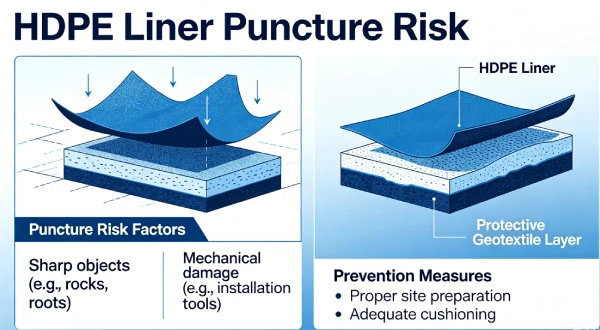
In 15+ years of field investigations, I have traced more liner leaks to subgrade problems than to material defects.
Subgrade preparation直接影响 thickness requirement:
| Subgrade Condition | Recommended Thickness | Additional Requirements |
|---|---|---|
| Prepared clay with smooth surface, no particles >6mm | 1.5mm possible | 400gsm geotextile cushion recommended |
| Standard compacted subgrade with some angular particles | 2.0mm | Geotextile (600gsm) if drainage aggregate is angular |
| Poor subgrade, variable conditions, or time constraints | 2.5mm | Geotextile mandatory; consider additional separation layer |
The 6mm rule: If your subgrade contains particles larger than 6mm (1/4 inch), you need either:
- A geotextile cushion (minimum 400gsm, preferably 600gsm)
- Thicker liner (2.0mm+)
- Or both
Factor 4: Temperature Effects on HDPE Performance
Temperature impacts HDPE in two ways relevant to thickness selection:
Installation phase:
- Cold weather (<5°C): Thicker liners (2.5mm) become stiff and difficult to handle; thermal contraction stresses increase
- Hot weather (>35°C): Thinner liners (1.5mm) may wrinkle excessively, complicating welding
Operational phase:
- Standard MSW landfills: Base temperatures typically 10-30°C → 2.0mm adequate
- Bioreactor landfills: Temperatures can reach 40-60°C → 2.5mm recommended
- Elevated temperatures accelerate antioxidant depletion by factor of 2-3× per 10°C (Arrhenius relationship)
Service life implication: At 40°C, a 2.5mm liner may retain antioxidants 30-50% longer than 1.5mm under identical conditions due to:
- Greater volume of antioxidant package
- Longer diffusion path for antioxidant migration
- Higher resistance to thermal oxidation at the exposed surface
Factor 5: Installation and Welding Constraints by Thickness
Thicker is not always easier to install. Here’s what field crews face:
1.5mm (60 mil):
- Lightweight rolls → easier handling
- Conforms well to subgrade contours
- Welds quickly with standard equipment
- Risk: Thin material can overheat during welding if operator is inexperienced
2.0mm (80 mil):
- Standard handling (typical roll weight 800-1000kg)
- Good conformity to prepared subgrade
- Wide welding window → forgiving for wedge welders
- Sweet spot: Most experienced installers prefer 2.0mm for consistent seam quality
2.5mm (100 mil):
- Heavy rolls (1200kg+) → requires heavier equipment
- Stiff → may bridge over small subgrade voids
- Requires more heat input for welding
- Risk: If welder power is insufficient, cold welds can occur; thermal contraction stress higher
- Risk: Thicker material more susceptible to residual stress at seams

HDPE 1.5mm vs 2.0mm vs 2.5mm – Technical Comparison
Puncture Resistance Test Data by Thickness
Based on ASTM D4833 (pyramidal puncture) and ASTM D5514 (large-scale puncture testing):
| Thickness | Typical Puncture Resistance (N) | Relative to 1.5mm | Field Implication |
|---|---|---|---|
| 1.5mm | 280-320 N | Baseline | Adequate for sand drainage layers; marginal for angular gravel |
| 2.0mm | 420-480 N | +50-60% | Handles standard drainage aggregate (20-40mm) with geotextile |
| 2.5mm | 550-650 N | +90-110% | Suitable for recycled aggregate (tire-derived, crushed concrete) |
Field correlation: In large-scale tests (ASTM D5514) using 40mm angular gravel under 200kPa pressure, 1.5mm liners showed indentation depths of 4-6mm after 1000 hours, while 2.0mm showed 2-3mm indentation. 2.5mm showed <2mm indentation with no fiber-optic detected damage.
Stress Crack Resistance (NCTL) Requirements
GRI-GM13 requires a minimum of 500 hours in the Notched Constant Tensile Load (NCTL) test (ASTM D5397). However:
- 1.5mm liners: Must meet the same SCR standard as thicker materials (resin quality, not thickness, drives SCR)
- 2.0mm liners: More forgiving of minor stress raisers due to thicker cross-section
- 2.5mm liners: Provide highest safety factor against stress cracking, particularly important at:
- Seams (where residual stress exists)
- Penetrations (pipe boots, sumps)
- Wrinkles (where leachate can concentrate stress)
Important: Stress crack resistance is a function of resin formulation (branching, molecular weight distribution), not thickness. However, given identical resin, a thicker cross-section will take longer to crack through under sustained stress.
Long-Term Creep Performance at 40°C-60°C
Creep (time-dependent deformation under load) accelerates at elevated temperatures. For landfill base liners:
- 1.5mm under 250kPa load at 40°C: May show 10-15% strain after 10 years
- 2.0mm under same conditions: 8-12% strain
- 2.5mm: 6-10% strain
The practical implication: Thicker liners maintain greater dimensional stability under sustained waste loading, reducing the risk of localized thinning at stress concentration points.
Weldability and Installation Risk Comparison
| Parameter | 1.5mm | 2.0mm | 2.5mm |
|---|---|---|---|
| Wedge welding speed (m/min) | 4-6 | 3-5 | 2-4 |
| Extrusion welding required? | Rarely | Occasionally | For details and repairs |
| Thermal contraction stress | Low | Moderate | High |
| Wrinkle tendency in hot weather | High | Moderate | Low |
| Conformity to subgrade | Excellent | Good | Moderate (bridging risk) |
| Repair difficulty | Easy | Easy | Moderate (more heat required) |
Regulatory Requirements for Landfill Liner Thickness
US EPA Subtitle D Minimum Thickness Requirements
Important clarification: 40 CFR Part 258 (Subtitle D) does not specify a numeric thickness requirement for HDPE geomembranes. It requires a composite liner consisting of:
- A top liner (flexible membrane liner – FML) with a thickness of at least 30 mil (0.75mm) , and
- A compacted clay liner or GCL
However, most states have adopted more stringent requirements through their Solid Waste Permitting Programs. In practice:
- 30 mil (0.75mm): Technically allowed by federal rule but almost never accepted by state regulators for MSW base liners
- 40 mil (1.0mm): Occasionally seen in older permits; rare for new cells
- 60 mil (1.5mm): Minimum accepted in most jurisdictions for MSW
- 80 mil (2.0mm): Default standard for MSW; minimum for hazardous waste (RCRA) in most regions
GRI-GM13 Specifications for HDPE Geomembranes
GRI-GM13 is the de facto industry standard for HDPE geomembranes. Key thickness-related requirements:
| Property | Test Method | 1.5mm | 2.0mm | 2.5mm |
|---|---|---|---|---|
| Minimum average thickness | ASTM D5199 | 1.35mm | 1.80mm | 2.25mm |
| Lowest individual reading | ASTM D5199 | 1.20mm | 1.65mm | 2.10mm |
| Carbon black content | ASTM D4218 | 2.0-3.0% | 2.0-3.0% | 2.0-3.0% |
| Std OIT (min) | ASTM D3895 | 100 min | 100 min | 100 min |
| HP OIT (min) | ASTM D5885 | 400 min | 400 min | 400 min |
| SCR (NCTL) | ASTM D5397 | 500 hr min | 500 hr min | 500 hr min |
Note: The OIT and SCR requirements are resin-dependent, not thickness-dependent. A 1.5mm liner with premium resin can outperform a 2.5mm liner with poor resin. Do not assume thicker equals better stress cracking resistance—check the resin certification.
EU Landfill Directive Thickness Standards
The EU Landfill Directive (1999/31/EC) and EN 13493 (Geosynthetic barriers for liquid waste containment) specify:
- Hazardous waste: Minimum 2.5mm HDPE
- Non-hazardous waste: Minimum 2.0mm HDPE
- Inert waste: Minimum 1.5mm HDPE
This is more prescriptive than US regulations and reflects a risk-averse approach to long-term containment.
Common Thickness Selection Mistakes (With Failure Cases)
Case 1: 1.5mm Liner Failure from Subgrade Puncture
Location: Southeast Asia, hazardous waste cell
Specification: 1.5mm HDPE over GCL
Failure detected: 18 months after waste placement
Findings: Hydrocarbon staining detected beneath liner during monitoring well sampling
Root cause analysis:
- Subgrade contained angular laterite particles up to 10mm
- GCL overlapped areas created thickness variation
- Drainage layer (40mm crushed rock) placed directly on liner without geotextile
- Point loading from rock concentrated stress at GCL overlap
- 1.5mm liner punctured at multiple locations
Lesson: For hazardous waste, 1.5mm provides insufficient safety factor against installation damage and point loading. 2.0mm minimum with geotextile cushion would have prevented this failure. Remediation cost exceeded $2M.
Case 2: 2.5mm Liner Welding Failures in Cold Weather
Location: Northern Europe, MSW landfill expansion
Specification: 2.5mm textured HDPE (specified for “absolute security”)
Failure detected: During CQA (Construction Quality Assurance)
Findings: 30% of wedge welds failed peel adhesion testing
Root cause analysis:
- Installation in November, ambient temperature 2-8°C
- Contractor’s wedge welder under-powered for 2.5mm textured material
- Cold wind caused rapid heat loss from welding zone
- Result: “Cold welds” that visually appeared fused but failed peel tests
- Required cutting out and patching 800m of seam
Lesson: 2.5mm requires more heat input and experienced operators. In cold conditions, 2.0mm is easier to weld consistently. The “absolute security” of thicker material was compromised by poor weld quality.
Case 3: Chemical Attack on Under-Specified Thickness
Location: Industrial waste landfill, high COD leachate
Specification: 1.5mm HDPE
Failure detected: 7 years after installation (leachate breakout)
Findings: Liner embrittlement in sump area; stress cracks radiating from welds
Root cause analysis:
- Leachate contained 15% organics (solvents)
- Elevated temperatures (45°C) from exothermic reactions
- 1.5mm liner experienced accelerated antioxidant depletion
- After antioxidant depletion, stress cracking initiated at weld zones
- Thinner liner provided less sacrificial material before cracking
Lesson: For aggressive chemical environments with elevated temperatures, thickness provides a “sacrificial layer” that delays the onset of brittle failure. 2.5mm would have provided 30-50% longer service life under identical conditions.
HDPE vs Alternative Liners: Thickness Comparison
HDPE vs LLDPE: Thickness Equivalency for Base Applications
| Property | HDPE (2.0mm) | LLDPE (2.0mm) | Implication |
|---|---|---|---|
| Puncture resistance | 450N | 350N | HDPE provides ~30% higher puncture resistance at same thickness |
| Chemical resistance | Excellent | Moderate | LLDPE swells more in hydrocarbons |
| Stress crack resistance | Good (with proper resin) | Better | LLDPE inherently more flexible, but lower stiffness |
| Required thickness for equivalent puncture | Baseline | 2.5mm+ | To match 2.0mm HDPE puncture, need 2.5mm LLDPE |
Verdict: For base applications where puncture from drainage aggregate is the primary risk, HDPE at 2.0mm outperforms LLDPE at the same thickness. LLDPE is better suited for side slopes requiring flexibility or applications with high differential settlement.
HDPE vs fPP: Chemical Resistance by Thickness
Flexible Polypropylene (fPP) is sometimes proposed as an alternative. Key thickness considerations:
- fPP typically requires 10-20% greater thickness to achieve equivalent puncture resistance to HDPE
- Chemical resistance to hydrocarbons is lower; for aggressive leachate, fPP at 2.0mm may perform worse than HDPE at 1.5mm
- fPP welds at lower temperatures → easier installation in cold weather
Recommendation: If specifying fPP for landfill base, increase thickness by one grade (e.g., 2.5mm fPP to match 2.0mm HDPE performance).
Why PVC Is Not Recommended for Landfill Base
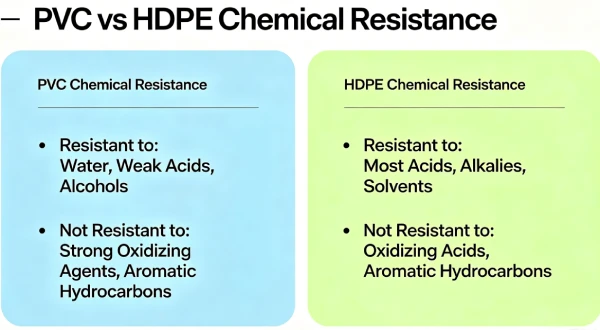
PVC geomembranes (typically 1.0-1.5mm) are unsuitable for landfill base applications because:
- Plasticizer migration in leachate leads to embrittlement within 5-10 years
- Chemical resistance to organics is poor
- Cannot meet OIT requirements for long-term service life
- Thicker PVC (2.0mm+) still suffers from plasticizer loss
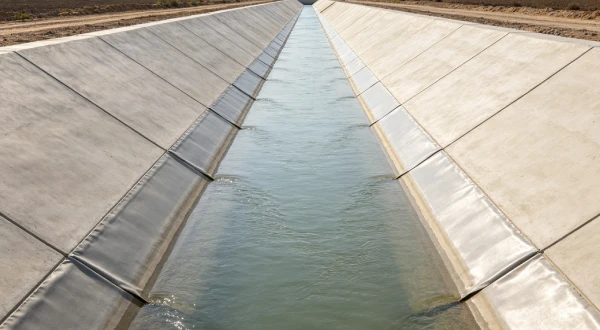
Industry consensus: PVC is acceptable for canals and water containment, but not for landfills where leachate chemistry is unpredictable and service life requirements exceed 30 years.
Cost Analysis: Thickness vs Service Life
Material Cost Comparison: 1.5mm to 2.5mm
| Thickness | Relative Material Cost (per m²) | Roll Weight (typical 7m x 100m) |
|---|---|---|
| 1.5mm | Baseline (1.0x) | 950 kg |
| 2.0mm | 1.3x – 1.4x | 1,250 kg |
| 2.5mm | 1.7x – 1.8x | 1,550 kg |
Installed Cost per Square Meter by Thickness
Installed cost includes:
- Material
- Shipping
- Deployment labor
- Welding (linear meters)
- CQA testing
| Thickness | Material % | Installation % | Total Installed Cost (relative) |
|---|---|---|---|
| 1.5mm | 45% | 55% | Baseline |
| 2.0mm | 52% | 48% | +15-20% vs 1.5mm |
| 2.5mm | 60% | 40% | +30-40% vs 1.5mm |
Key insight: The cost delta between 1.5mm and 2.0mm is approximately 15-20% of total installed cost. For a 5-hectare cell, this might represent $50,000-80,000 additional investment.
Lifecycle Cost: Is Thicker Always More Economical?
Consider a 30-year design life:
- 1.5mm scenario: Lower initial cost, but higher risk of:
- Puncture during construction (repair costs)
- Premature stress cracking (remediation at year 20-25)
- Regulatory non-compliance (potential cell closure orders)
- 2.0mm scenario: Moderate initial cost, proven track record of 30+ year performance with good CQA
- 2.5mm scenario: Highest initial cost, but:
- Greater safety factor against installation damage
- Longer antioxidant depletion time (potentially 50+ year service life)
- Reduced regulatory risk
Economic analysis: The additional $50,000-80,000 for upgrading from 1.5mm to 2.0mm represents <1% of total landfill development cost for a typical cell. Given that a single leak investigation and repair can cost $500,000+, the 2.0mm specification is economically justified for any MSW cell with a design life exceeding 15 years.
Frequently Asked Questions About HDPE Liner Thickness
Is 1.5mm HDPE allowed for hazardous waste landfills?
In most jurisdictions, no. US EPA RCRA regulations typically require 60 mil (1.5mm) minimum for hazardous waste, but many state and local regulators require 80 mil (2.0mm) as a condition of permitting. For high-consequence facilities, 2.5mm is increasingly specified. The additional thickness provides a safety factor against the unknown—undetected installation damage, chemical interactions, and stress concentrations.
Does 2.0mm HDPE last longer than 1.5mm?
Not automatically—service life depends primarily on resin quality (antioxidant package, carbon black dispersion) and stress crack resistance. A premium 1.5mm resin can outlast a poor 2.5mm resin. However, given identical resin formulation, 2.0mm provides:
- Greater puncture resistance (reduces installation damage)
- More sacrificial material for UV exposure
- Longer antioxidant depletion time (thicker cross-section)
- Higher safety factor against localized stress
What thickness is required by US EPA for MSW landfills?
US EPA Subtitle D (40 CFR 258) requires a flexible membrane liner but does not specify a minimum thickness. However, most state regulations have effectively established 60 mil (1.5mm) as the minimum acceptable, with 80 mil (2.0mm) becoming the default standard for new cells. Always check your state’s Solid Waste Management Regulations—many are more stringent than federal requirements.
How does temperature affect HDPE thickness selection?
Elevated temperatures accelerate:
- Antioxidant depletion (Arrhenius relationship: rate doubles every 10°C)
- Stress cracking (polymer chains mobilize faster)
- Chemical extraction (higher diffusion rates)
For standard MSW (base temperatures 10-30°C), 2.0mm is adequate. For bioreactor landfills or cells receiving high-strength leachate (40-60°C), 2.5mm with enhanced SCR resin is recommended. The thickness provides a longer diffusion path for antioxidants, extending depletion time by approximately 30-50% compared to 1.5mm.
Can I use 1.0mm HDPE for landfill base?
Not recommended for permanent waste containment. 1.0mm HDPE:
- Lacks puncture resistance against drainage aggregate
- Has minimal safety factor against installation damage
- Provides insufficient sacrificial thickness for long-term UV exposure during construction
- May not meet regulatory minimums in any jurisdiction
1.0mm HDPE is appropriate for canals, decorative ponds, and temporary containment—not for landfills where failure means groundwater contamination.
What is the puncture resistance difference between 1.5mm and 2.0mm?
Based on ASTM D4833 (pyramidal puncture):
- 1.5mm: 280-320 N typical
- 2.0mm: 420-480 N typical
- 2.5mm: 550-650 N typical
This 50-60% increase from 1.5mm to 2.0mm is critical when drainage aggregate (especially recycled materials like tire-derived aggregate or crushed concrete) is placed directly on the liner. In large-scale tests (ASTM D5514), 2.0mm consistently shows lower indentation depths and no fiber-optic detected damage under 200kPa loading, while 1.5mm may show incipient damage with angular aggregate.
Does textured HDPE require different thickness considerations?
Yes. Textured liners (produced by co-extrusion or impingement) have:
- Slightly reduced tensile properties due to the texturing process
- Stress concentrations at the textured/smooth interface
- Different welding characteristics (requires more heat)
For base applications, textured HDPE is rarely needed (smooth is standard). For side slopes requiring texture, maintain the same nominal thickness as base (2.0mm minimum) but be aware that textured 2.0mm may have slightly lower puncture resistance than smooth 2.0mm due to thickness variation in the texturing process.
Professional Recommendation: HDPE Thickness Selection Guide
After 15+ years of field experience investigating liner failures and successful installations, here is my thickness selection framework:
Decision Matrix for Thickness Selection
| Application | 1.5mm (60 mil) | 2.0mm (80 mil) | 2.5mm (100 mil) |
|---|---|---|---|
| Inert waste landfill | ✓ Acceptable with good CQA | ✓ Recommended | ✗ Over-specified |
| MSW – dry climate, sand drainage | ✓ Acceptable | ✓✓ Recommended | ✗ Over-specified |
| MSW – standard aggregate drainage | ✗ Marginal | ✓✓ Recommended | ✓ Acceptable |
| MSW – high leachate head (>3m) | ✗ Not recommended | ✓ Acceptable | ✓✓ Recommended |
| Hazardous waste | ✗ Not accepted | ✓ Minimum standard | ✓✓ Recommended |
| Bioreactor / Elevated temperature | ✗ Not recommended | ✗ Marginal | ✓✓ Required |
| Problematic subgrade | ✗ High risk | ✓ Acceptable with geotextile | ✓✓ Recommended |
| Constrained budget / low risk | ✓ Possible | ✓✓ Sweet spot | ✗ Cost prohibitive |
When to Specify 1.5mm (60 mil)
Consider 1.5mm only when ALL of these conditions are met:
- Waste is non-hazardous MSW or inert
- Leachate head will remain below 1m
- Subgrade preparation is excellent (smooth, rolled, no particles >6mm)
- Drainage layer is sand or geocomposite (not angular gravel)
- Construction quality assurance (CQA) team has impeccable track record
- Design life is 20 years or less
- Regulatory authority accepts 1.5mm (verify first)
Risk acknowledgment: Even with all conditions met, 1.5mm provides less safety factor against installation damage and long-term creep than 2.0mm. You are accepting higher long-term risk for lower initial cost.
When to Specify 2.0mm (80 mil) – Default Recommendation
Specify 2.0mm as your baseline for all MSW landfill base applications. It is:
- The most tested thickness globally
- The most reliably welded (forgiving welding window)
- Accepted by virtually all regulatory authorities
- Proven in thousands of installations over 30+ years
- Cost-effective (only 15-20% more than 1.5mm installed)
The 2.0mm rule: If you’re uncertain which thickness to specify, choose 2.0mm. It has never been the wrong answer for an MSW landfill base.
When 2.5mm (100 mil) Is Non-Negotiable
Require 2.5mm in these specific scenarios:
- Hazardous waste landfills – The consequences of failure justify the additional safety factor
- Bioreactor landfills – Elevated temperatures (40-60°C) accelerate aging; thickness provides sacrificial layer
- Very deep landfills (>30m waste) – Higher overburden pressure increases stress on liner
- Aggressive leachate – High COD, solvents, or extreme pH (especially low pH)
- Problematic subgrade – If you cannot guarantee smooth, prepared surface despite best efforts
- High leachate heads (>3m) – Increased hydraulic pressure drives defects
- Critical infrastructure – Landfills above sensitive aquifers or drinking water sources
Final Field Note: Thickness vs Quality Assurance
After investigating failures across four continents, I can state this with confidence:
Thickness provides puncture resistance, but Construction Quality Assurance (CQA) provides security.
I have seen:
- 1.5mm liners perform flawlessly for 25 years under rigorous CQA
- 2.5mm liners fail within 5 years due to poor welding and subgrade neglect
Your thickness specification must be matched by:
- Third-party CQA monitoring
- Comprehensive seam testing (destructive and non-destructive)
- Subgrade certification before liner deployment
- Proper drainage layer placement protocols
- Leak location surveys (electrical methods) after installation
The bottom line: Specify 2.0mm HDPE as your default for MSW landfill bases. Move to 1.5mm only with full risk acknowledgment and exceptional CQA. Move to 2.5mm for hazardous waste, elevated temperatures, or high-consequence facilities.
The cost difference between thicknesses is small compared to the cost of failure. Choose defensibly, document thoroughly, and inspect rigorously.