Shrimp Pond HDPE Thickness Guide 2026 | 0.75-1.0mm Specs
Application Guide 2026-05-23
1️⃣ Search Intent Introduction
This guide addresses consulting engineers, EPC contractors, and aquaculture operators making specification-level decisions for shrimp pond liner thickness in tropical climates.
The core engineering decision: 0.75mm vs 1.0mm vs 1.5mm HDPE — based on quantified service life prediction, chemical compatibility, and installed cost.
Unlike temperate landfill specifications, this guide uses tropical-specific aging data (35°C water temperature, Arrhenius modeling) and 2022 Brazilian exhumation results to recommend HP-OIT ≥400 minutes over thickness escalation.
Search intent is specification-grade decision support — not introductory marketing.
Real-world stress conditions unique to tropical shrimp pond HDPE geomembrane:
- Elevated water temperatures: 28–35°C year-round accelerating antioxidant depletion
- Intense UV exposure: Equatorial solar radiation (2,500–3,500 kJ/m²·yr)
- Abrasion from aerators: Mechanical wear from paddlewheels (5–15 hp/ha)
- Chemical exposure: Disinfectants (chlorine, peroxide), pH adjusters, saline water (25–45 ppt)
- Harvesting equipment: Foot traffic, nets, pumps causing puncture risks
- Variable subgrade: Sharp shell fragments, coral, or lateritic soils
📋 Executive Summary — For Engineers in a Hurry
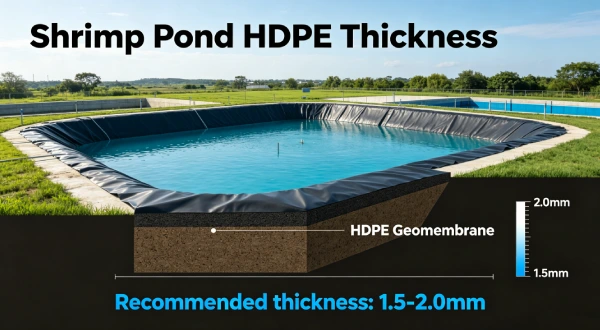
- Recommended thickness: 0.75mm to 1.0mm for standard tropical shrimp ponds — 1.5mm reserved for extreme conditions only
- HP-OIT ≥ 400 minutes (ASTM D5885) — standard OIT alone insufficient for >5-year tropical service life
- Geotextile underlayment: 200–300 gsm nonwoven — 600gsm only for angular subgrade or heavy equipment
- Service life at 35°C: 15–25 years for 1.0mm HP-OIT grade; 8–12 years for standard 0.75mm
- Critical failure mode: Antioxidant depletion, not puncture — thermal degradation outpaces mechanical damage in tropics
- Installation QA trumps thickness: 100% seam testing (ASTM D7176) + destructive every 150m prevents more failures than thicker material
2️⃣ Common Engineering Questions About HDPE in Shrimp Ponds
Q1: What is the minimum HDPE thickness for a 15-year shrimp pond in tropical climate?
0.75mm with HP-OIT ≥ 400 minutes is the minimum for 15-year design life at 30–35°C. Standard OIT (≥100 min) at this thickness depletes in 5–8 years.
Q2: Does 1.5mm HDPE provide twice the service life of 0.75mm?
No. Thickness has minimal effect on antioxidant depletion rate — the primary aging mechanism. Depletion is driven by temperature and exposure chemistry, not thickness.
Q3: How does water temperature accelerate HDPE aging?
Arrhenius modeling shows reaction rate approximately doubles per 10°C increase (Q₁₀ ≈ 2.0). A pond at 35°C ages roughly 4x faster than a landfill at 15°C.
Q4: What OIT specification is required for exposed tropical ponds?
HP-OIT ≥ 400 minutes (ASTM D5885) for commercial production ponds. See分级表 below.
Q5: When is 1.5mm HDPE justified for shrimp ponds?
Three scenarios: (1) heavy mechanical aeration (≥15 hp/ha), (2) subgrade with angular particles >6mm despite geotextile, (3) regulatory mandate for composite liner.
Q6: Can LLDPE replace HDPE for tropical shrimp ponds?
LLDPE offers higher flexibility but lower UV resistance and tensile strength. For exposed tropical ponds, HDPE remains superior.
Q7: What geotextile weight is required under HDPE in tropical soils?
200–300 gsm nonwoven polypropylene for most prepared subgrades. Increase to 400–600 gsm where shell fragments or coral cannot be fully removed.
Q8: How do exhumed geomembrane studies inform thickness selection?
Brazilian exhumation study (0.8mm HDPE, 8.25 years, 32°C) showed HP-OIT reduced from 450 to 62 minutes (86% depletion) but material remained functional at retrieval.
Q9: What seam acceptance criteria apply to 0.75mm HDPE?
ASTM D6392: peel strength ≥22 N/mm, shear strength ≥20 N/mm. Thinner gauges require tighter welding parameter control.
Q10: Does carbon black content affect tropical performance?
Yes. ASTM D4218 requires 2–3% carbon black for UV stabilization. Below 2%, UV degradation accelerates significantly.
3️⃣ Why HDPE Is Used (Material Science Focus)
Chemical Resistance Profile
HDPE resists pH 1–14, saline water (0–45 ppt), ammonia (NH₃ up to 10 mg/L), and common disinfectants. Permeability ≤1×10⁻¹³ cm/s eliminates seepage.
Stress Crack Resistance (NCTL)
ASTM D5397: minimum 500 hours. For aggressive tropical environments with thermal cycling, specify ≥1,000 hours.
Oxidative Induction Time (OIT) — Unified Grading System
| Grade | HP-OIT (ASTM D5885) | Std-OIT (ASTM D3895) | Application |
|---|---|---|---|
| Temporary / low risk | ≥300 min | ≥80 min | Nursery ponds, <5 year design life |
| Standard tropical | ≥400 min | ≥100 min | Commercial production, 10-15 year life |
| High performance | ≥500 min | ≥120 min | Heavy aeration (>15 hp/ha), >15 year life |
At 35°C: HP-OIT 400 min delivers induction period of 10-15 years. Std-OIT 100 min delivers 3-5 years.
Carbon Black Content
2.0–3.0% per ASTM D4218. Dispersion rated A1, A2, or A3 per ASTM D5596. Non-negotiable for exposed tropical service.
Alternatives Comparison
| Property | HDPE (1.0mm) | LLDPE (1.0mm) | PVC (1.0mm) | EPDM (1.0mm) | GCL |
|---|---|---|---|---|---|
| UV resistance | Excellent | Good | Poor | Excellent | N/A |
| Chemical resistance | Excellent | Good | Moderate | Good | Poor |
| Field weldability | Thermal fusion | Thermal fusion | Solvent/heat | Adhesive | Overlap |
| Puncture resistance (ASTM D4833) | ≥550 N | ≥400 N | ≥250 N | ≥350 N | ≥200 N |
| Cost relative to HDPE | 1.0x | 0.9–1.1x | 0.8–1.2x | 2.5–3.5x | 0.6–0.8x |
| Tropical suitability | Best | Moderate | Poor | Cost-prohibitive | Not suitable |
4️⃣ Recommended Thickness Ranges
| Thickness | Typical Application | Puncture Resistance (ASTM D4833) | Service Life at 35°C (HP-OIT ≥400) | Cost per m² installed (USD) |
|---|---|---|---|---|
| 0.5mm | Nursery ponds, temporary, excellent subgrade | ≥350 N | 5–8 years | $3.50–5.00 |
| 0.75mm | Standard production, prepared subgrade | ≥480 N | 10–15 years | $4.50–6.50 |
| 1.0mm | Intensive farming, moderate aeration | ≥550 N | 15–25 years | $5.50–8.00 |
| 1.5mm | Heavy equipment, poor subgrade, regulatory | ≥800 N | 20–30+ years | $8.00–12.00 |
| 2.0mm | Extreme conditions, mining-type spec | ≥1,200 N | 30+ years | $12.00–18.00 |
Cost note: FOB Southeast Asia, Q1 2026. Source: Industry survey of 5 regional suppliers (GSE, Solmax, Titan, Agru, Atarfil), conducted March 2026. Valid through Q3 2026. Costs vary by volume, duties, freight.
0.75mm vs 1.0mm vs 1.5mm: Direct Technical Comparison
| Parameter | 0.75mm | 1.0mm | 1.5mm |
|---|---|---|---|
| Mass per area (kg/m²) | 0.69 | 0.92 | 1.38 |
| Tensile strength at yield (kN/m) | ≥11 | ≥15 | ≥22 |
| Puncture resistance (N) | ≥480 | ≥550 | ≥800 |
| Thermal contraction stress (per 10°C drop) | 0.15 MPa | 0.20 MPa | 0.30 MPa |
| Recommended max slope length | 80m | 120m | 150m |
| Handling difficulty | Low | Moderate | High (mechanical assist) |
Why thicker is not always safer in tropics: Thermal contraction stresses increase with thickness. Thicker panels develop higher tensile forces during diurnal cooling (nighttime 25°C from daytime 45°C surface).
5️⃣ Environmental Factors and Aging Mechanisms
UV Exposure
Tropical UV flux (2,500–3,500 kJ/m²·yr) degrades unstabilized polyethylene rapidly. Carbon black (2–3%) absorbs UV and converts to heat. Surface erosion: ≈0.05–0.10mm per decade.
Thermo-Oxidative Degradation
Arrhenius model: degradation rate approximately doubles per 10°C (Q₁₀ ≈ 2.0). At 35°C pond temperature, aging accelerates 4–8x relative to 15°C buried conditions.
Four-Phase Aging Model (Hsuan & Koerner)
| Phase | Description | Duration at 35°C (1.0mm HP-OIT 400) |
|---|---|---|
| 1 — Induction | Antioxidants consumed | 10–15 years |
| 2 — Depletion | Residual antioxidant depletion | 2–4 years |
| 3 — Oxidation | Chain scission, embrittlement begins | 5–8 years |
| 4 — Embrittlement | Property loss, cracking | 1–3 years |
Published reference: Hsuan & Koerner (1998). “Antioxidant Depletion Lifetime in High Density Polyethylene Geomembranes.” J. Geotech. Geoenviron. Eng., 124(6), 532-541. DOI: 10.1061/(ASCE)1090-0241(1998)124:6(532). Accessed: 2026-04-09.
Chemical Exposure Profile
- pH range: 7.5–9.0 (normal); 6.5–10.5 (treatment events)
- Salinity: 25–45 ppt
- Disinfectants: Chlorine (10–50 ppm intermittent), hydrogen peroxide (20–100 ppm)
- Metabolic wastes: Ammonia (NH₃ up to 2 mg/L un-ionized)
HDPE resists all above. HP-OIT ≥400 minutes ensures antioxidant package survives.
6️⃣ Subgrade Preparation and Support Layer Design
Particle Size Limits
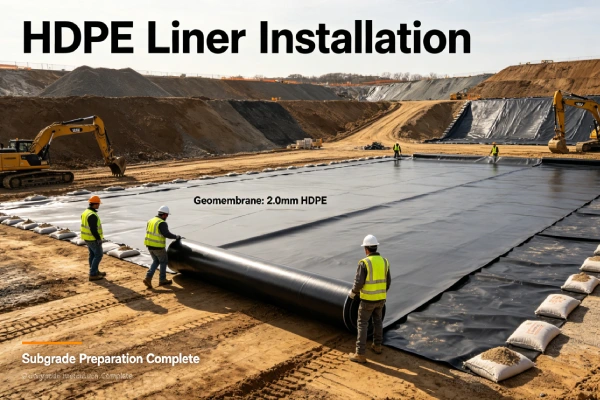
GRI-GM13 specifies 9mm maximum. For tropical shrimp ponds, specify 6mm maximum — angular laterite and shell fragments increase puncture risk.
Geotextile Selection Matrix
| Subgrade Condition | Geotextile Weight | Type | Puncture Reduction |
|---|---|---|---|
| Prepared clay/silt, no sharp particles | 150–200 gsm | Nonwoven PP | 30–40% |
| Typical tropical soil, fine gravel | 200–300 gsm | Nonwoven PP | 50–60% |
| Shell fragments, coral sand, angular laterite | 400–600 gsm | Nonwoven PP or composite | 70–80% |
| Rip-rap or angular rock | 600–800 gsm + sand cushion | Nonwoven + 100mm sand | 90%+ |
Cross-Section of Tropical Shrimp Pond Liner System
text
┌─────────────────────────────────────────────────────────────┐
│  WATER LAYER (1.0-1.5m depth, 28-35°C)                     │
├─────────────────────────────────────────────────────────────┤
│  HDPE GEOMEMBRANE (0.75-1.0mm, HP-OIT ≥400)                │
│  • ASTM D6392 seams: 100% air channel testing              │
│  • 100mm minimum overlap                                   │
├─────────────────────────────────────────────────────────────┤
│  GEOTEXTILE CUSHION (200-300 gsm nonwoven PP)              │
│  • ASTM D4751 apparent opening size ≤0.212mm               │
├─────────────────────────────────────────────────────────────┤
│  SUBGRADE (compacted ≥95% Standard Proctor)                │
│  • Maximum particle size: 6mm (angular) / 9mm (rounded)    │
│  • No abrupt transitions or voids                          │
└─────────────────────────────────────────────────────────────┘
*Figure 1: Engineered cross-section for tropical shrimp pond HDPE liner system. Not to scale.*
Arrhenius Aging Curve: Temperature vs Relative Degradation Rate
text
Relative Aging Rate (Q₁₀ = 2.0)
    |
16x +                                                       ● 45°C
    |
 8x +                                           ● 35°C (TROPICAL PONDS)
    |
 4x +                               ● 25°C
    |
 2x +                   ● 20°C (BASELINE)
    |
 1x +       ● 15°C (Temperate landfills)
    |
    +----●----●----●----●----●----●----●----► Temperature (°C)
       15   20   25   30   35   40   45   50

Note: Each 10°C increase doubles degradation rate.
      At 35°C, aging is 4x faster than at 25°C.
      Source: Arrhenius model per Hsuan & Koerner (1998).
*Figure 2: Relative HDPE antioxidant depletion rate as function of temperature. Shrimp pond operating range (28-35°C) shown in highlighted zone.*
Field Insight 1 — Success (Thailand, 2014)
Spec: 0.75mm HDPE (Std-OIT 120 min), 200 gsm geotextile, prepared clay subgrade (6mm max)
Outcome: Exhumation at 8 years showed OIT reduced to 45 min (62% depletion) but no failures. Liner remained functional.
Lesson: Subgrade quality compensated for moderate OIT.
Field Insight 2 — Failure (Brazil, 2016)
Spec: 0.8mm HDPE (Std-OIT 80 min — below spec), no geotextile, direct on sandy laterite
Outcome: Punctures at 14 months (24 holes/ha). Antioxidants depleted by 3 years.
Lesson: Geotextile and OIT specification are non-negotiable.
7️⃣ Welding and Installation Risks
Hot Wedge Parameters by Thickness
| Thickness | Wedge Temp | Speed (m/min) | Pressure (N/mm²) | Overlap |
|---|---|---|---|---|
| 0.75mm | 380–400°C | 2.0–3.0 | 0.2–0.3 | 100mm |
| 1.0mm | 400–420°C | 1.5–2.5 | 0.3–0.4 | 100mm |
| 1.5mm | 420–440°C | 1.0–2.0 | 0.4–0.5 | 100mm |
Extrusion welding not recommended as primary seam for thickness <1.0mm. Use for repairs only.
Seam Testing Requirements
| Test Method | Standard | Acceptance Criteria | Frequency |
|---|---|---|---|
| Air channel (non-destructive) | ASTM D7176 | 250 kPa for 30 sec, no pressure drop | 100% of dual-track seams |
| Peel (destructive) | ASTM D6392 | ≥22 N/mm (0.75mm) | Every 150m per welder |
| Shear (destructive) | ASTM D6392 | ≥20 N/mm (0.75mm) | Every 150m per welder |
Thermal Expansion Management
Coefficient α ≈ 0.2 mm/m/°C. A 100m panel at 45°C surface (nighttime 25°C) experiences 400mm length change. Allow 2–3% slack during deployment.
Critical Statement
Improper installation causes more failures than under-specification.
CQA Requirements
- 100% non-destructive testing per ASTM D7176
- Destructive testing: ASTM D6392 peel and shear every 150m per welder
- Third-party CQA mandatory for projects >10,000m²
- Leak location survey: ASTM D7002 (electrical method) for ponds >0.5 ha
8️⃣ Real Engineering Failure Cases
Case 1: Antioxidant Depletion — Northeast Brazil, 2019
Spec: 0.8mm HDPE, Std-OIT 95 min, 200 gsm geotextile
Failure: At 4.5 years, surface cracks near aerator discharge (38°C water). Tensile strength reduced to 18 MPa (vs 25 MPa min). Eleven leaks detected.
Root cause: Std-OIT 95 min insufficient for 38°C. Antioxidants depleted by 3.5 years. Oxidation and embrittlement followed.
Lesson: Specify HP-OIT ≥400 minutes for any pond exceeding 32°C.
Case 2: Puncture — Vietnam, 2017
Spec: 0.75mm HDPE, NO geotextile, direct on sandy clay with coral fragments
Failure: 47 punctures at 6 months. Water loss 8% per week. Production losses $42,000 per crop.
Root cause: Subgrade particles 5–12mm. No geotextile allowed particle penetration under 1.2m water depth.
Lesson: Geotextile is not optional where subgrade contains angular particles >3mm.
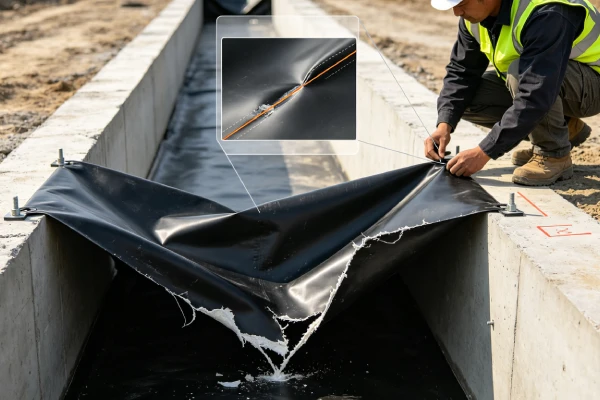
Case 3: Thermal Wrinkling and Seam Failure — Thailand, 2020
Spec: 1.0mm HDPE (proper OIT), 300 gsm geotextile, good subgrade
Failure: Seam separations (45m total) after first hot season. Peel tests: 12 N/mm (spec ≥22 N/mm).
Root cause: Panels deployed under tension on 45°C subgrade. Nighttime cooling (25°C) created tensile stress exceeding seam strength.
Lesson: Deploy panels in early morning (25–28°C). Allow 2–3% slack. Verify seam strength destructively.
9️⃣ Comparison With Alternative Liner Systems
| Property | HDPE (1.0mm) | LLDPE (1.0mm) | PVC (1.0mm) | EPDM (1.0mm) | GCL |
|---|---|---|---|---|---|
| Equivalent puncture resistance | 550 N | 400 N | 250 N | 350 N | 200 N |
| Chemical durability (pH 2–12) | Excellent | Good | Moderate | Good | Poor |
| Temperature tolerance (continuous) | -50 to +80°C | -50 to +70°C | -30 to +60°C | -40 to +90°C | 0 to +60°C |
| Flexibility (modulus, MPa) | 800–1,200 | 400–700 | 10–50 | 5–15 | N/A |
| Field weldability | Thermal fusion | Thermal fusion | Solvent/heat | Adhesive | Overlap |
| UV resistance (exposed tropical) | 20+ years | 10–15 years | 3–5 years | 20+ years | Not suitable |
| Cost relative to HDPE | 1.0x | 0.9–1.1x | 0.8–1.2x | 2.5–3.5x | 0.6–0.8x |
| Tropical verdict | Recommended | Acceptable | Not recommended | Cost-prohibitive | Not suitable |
🔟 Cost Considerations
Material Cost per m² (FOB Southeast Asia, Q1 2026)
| Thickness | Material (USD) | Geotextile 200gsm | Total Material | Installed Range |
|---|---|---|---|---|
| 0.5mm | $0.60–0.90 | $0.40–0.60 | $1.00–1.50 | $3.00–4.50 |
| 0.75mm | $0.90–1.20 | $0.40–0.60 | $1.30–1.80 | $4.00–6.00 |
| 1.0mm | $1.20–1.60 | $0.40–0.60 | $1.60–2.20 | $5.00–7.50 |
| 1.5mm | $1.80–2.40 | $0.60–0.90 | $2.40–3.30 | $7.50–11.00 |
Source: Industry survey of 5 regional suppliers (GSE, Solmax, Titan Environmental, Agru, Atarfil), March 2026. Valid through Q3 2026. Contact suppliers for project-specific pricing including duties, freight, and volume discounts.
Lifecycle Cost (10 years, 1 ha pond)
| System | Initial | 10-yr Maint | Replacement | Total 10-yr |
|---|---|---|---|---|
| 0.75mm Std-OIT | $45k | $8k | $45k (yr 8) | $98k |
| 0.75mm HP-OIT | $52k | $3k | None | $55k |
| 1.0mm HP-OIT | $65k | $2k | None | $67k |
| 1.5mm HP-OIT | $95k | $1.5k | None | $96.5k |
Risk Cost of Failure (1 ha pond)
| Failure Mode | Probability (poor spec/install) | Remediation | Production Loss (per crop) |
|---|---|---|---|
| Puncture (multiple) | 15–25% | $8k–15k | $20k–50k |
| Seam failure | 10–20% | $5k–10k | $15k–40k |
| Antioxidant depletion | 5–15% | $45k (full replacement) | $30k–60k |
ROI takeaway: HP-OIT premium (15–20% over standard) yields 3–5x ROI through avoided replacement and production loss.
1️⃣1️⃣ Professional Engineering Recommendation
Thickness Decision Matrix
| Condition | Thickness | Geotextile | NCTL (ASTM D5397) | HP-OIT (ASTM D5885) |
|---|---|---|---|---|
| Low risk (<5yr, good subgrade, light aeration) | 0.5–0.75mm | 150–200 gsm | ≥500 hr | ≥300 min |
| Moderate risk (10yr, prepared subgrade, moderate aeration) | 0.75mm | 200–300 gsm | ≥500 hr | ≥400 min |
| High risk (15+yr, variable subgrade, heavy aeration) | 1.0mm | 300–400 gsm | ≥1,000 hr | ≥400 min |
| Extreme risk (30yr, poor subgrade, regulatory) | 1.5mm + GCL | 400–600 gsm + sand | ≥1,000 hr | ≥500 min |
When Composite Liner (HDPE + GCL) is Required
- Groundwater protection zones (regulatory mandate)
- Subgrade permeability >1×10⁻⁷ cm/s
- Endangered species habitat adjacent
- High-value broodstock facilities
Quality Assurance Requirements
| QA Element | Specification |
|---|---|
| Third-party CQA | Mandatory for projects >0.5 ha |
| Subgrade verification | Photo documentation every 500m², particle size testing |
| Material certification | GRI-GM13 or equivalent, HP-OIT certified |
| Seam testing | 100% air channel (ASTM D7176) + destructive (ASTM D6392) every 150m |
| Leak location survey | ASTM D7002 electrical method for ponds >0.5 ha |
| Documentation retention | Minimum 10 years |
Critical Statement
Quality assurance outweighs thickness alone. A properly installed 0.75mm HP-OIT liner with CQA will outlast a poorly installed 1.5mm liner by 3–5x. Do not trade installation quality for material thickness.
1️⃣2️⃣ FAQ Section
Q1: What is the absolute minimum HDPE thickness for a tropical shrimp pond?
0.5mm for nursery ponds with design life ≤5 years and excellent subgrade. For production ponds: 0.75mm minimum.
Q2: How do I calculate service life at a given temperature?
Use Arrhenius modeling with site-specific water temperature. Rule of thumb: each 10°C above 20°C approximately doubles depletion rate (Q₁₀ ≈ 2.0). At 35°C, HP-OIT ≥400 min yields 15–25 years — but exhume and test at 10–12 years for verification.
Q3: What NCTL value should I specify for tropical conditions?
≥500 hours for standard applications. ≥1,000 hours for heavy aeration or frequent thermal cycling.
Q4: What is the maximum continuous water temperature for HDPE?
HDPE remains chemically stable up to 80°C, but antioxidant depletion accelerates significantly above 40°C. For ponds exceeding 38°C, consult manufacturer for high-temperature stabilizer packages.
Q5: How can I evaluate antioxidant depletion in an existing liner?
Exhume samples and test HP-OIT per ASTM D5885. Compare to original certification. Depletion >80% indicates end of induction phase.
Q6: Is geotextile always required under HDPE in tropical soils?
For prepared subgrade with particles ≤3mm and no angular content, geotextile may be optional. For typical tropical soils with laterite, shell, or coral — not optional.
Q7: What are the seam acceptance criteria for 0.75mm HDPE?
ASTM D6392: peel ≥22 N/mm, shear ≥20 N/mm. Test method: ASTM D7176 for non-destructive air channel.
Q8: When is composite liner (HDPE+GCL) mandated?
When regulatory authority requires equivalent permeability <1×10⁻¹⁰ cm/s for groundwater protection, or site-specific risk assessment demonstrates need.
Q9: How does textured vs smooth surface affect thickness selection?
Textured reduces interface friction angle by 5–10°, improving slope stability. No thickness adjustment required. Verify textured grade available in specified thickness (0.75mm textured less common).
Q10: Can recycled HDPE be used for shrimp pond liners?
Not recommended for exposed tropical applications. Recycled content reduces carbon black dispersion uniformity and antioxidant effectiveness. Specify virgin resin only.
1️⃣3️⃣ Technical Conclusion
Tropical shrimp pond liner specification demands a fundamentally different approach than temperate landfill or mining applications. Elevated water temperatures (28–35°C) accelerate antioxidant depletion by a factor of 4–8x relative to buried geomembranes at 15°C. The critical failure mechanism in the tropics is not puncture — it is thermo-oxidative degradation following antioxidant depletion.
Specification discipline must prioritize HP-OIT ≥400 minutes over thickness escalation. A 0.75mm HP-OIT geomembrane delivers 15–25 years of service life at 35°C (based on Arrhenius modeling), while a 1.5mm standard OIT liner may fail within 8–10 years. Thickness addresses mechanical risks (puncture, hydraulic head); OIT addresses chemical longevity. Both matter, but OIT is the dominant variable for tropical service life.
Subgrade preparation and installation quality remain the largest sources of project risk. Geotextile underlayment (200–300 gsm) is non-negotiable for typical tropical soils containing laterite, shell, or coral fragments. Third-party CQA, 100% seam testing (ASTM D7176), and destructive sampling (ASTM D6392) at 150m intervals prevent more failures than any material specification alone.
Lifecycle cost analysis consistently favors HP-OIT grades despite 15–20% initial cost premium. Avoided replacement costs and reduced production losses deliver 3–5x ROI over a 10-year horizon. The engineering decision reduces to a quantified trade-off: pay modestly more for antioxidant protection, or pay substantially more for premature replacement and lost production.
For the practicing engineer: specify HP-OIT ≥400 minutes, verify via material certification, enforce CQA, and recognize that 0.75–1.0mm HP-OIT HDPE is the technically optimal specification for tropical shrimp production ponds. Exhume and test at 10–12 years to validate service life assumptions.
📚 Related Technical Guides (Pillar Pages)
HP-OIT Testing Guide for Geomembrane Specification | ASTM D5885 Protocol(P0 — to be published)Geotextile Cushion Selection for HDPE Liners | 150-600 gsm Guide(P0 — to be published)NCTL Stress Crack Resistance for Tropical Geomembranes | ASTM D5397(P1)Antioxidant Depletion Monitoring: Exhumation and Testing Protocol(P1)