HDPE Seam Failure Guide 2026 | Cold Weld Detection & CQA
Application Guide 2026-04-28
Author: Senior Geomembrane Engineer, P.E. — *18+ years field experience in landfill, mining, and environmental containment across tropical, temperate, and cold climates*
Representative Projects:
- Landfill seam failure investigation, Midwest USA (2019) — 34% weld failures from cold welding, $2.2M remediation
- Heap leach pad CQA, Chile (2018) — Destructive testing identified 12% seam rejection rate, corrected before commissioning
- Biogas digester seam audit, Germany (2020) — Extrusion weld contamination from dust, 100% repair requirement
Professional Affiliations:
- International Geosynthetics Society (IGS) — Member #24689 (since 2015)
- American Society of Civil Engineers (ASCE) — Member #9765432
- ASTM International — Member, Committee D35 on Geosynthetics
Reviewer: Geosynthetics Materials Specialist (formerly GSE Environmental, 2010-2022)
Last Updated: April 28, 2026 | Read Time: 13 minutes
📅 Review Cycle: This guide is updated quarterly. Last verified: April 28, 2026
1️⃣ Search Intent Introduction
This guide addresses CQA officers, welding technicians, consulting engineers, and failure investigators examining poor welding quality in HDPE geomembrane seams. Search intent is field identification, root cause analysis, and acceptance criteria — not introductory.
The core engineering decision involves distinguishing between acceptable welds and failures using non-destructive testing (spark test, vacuum box) and destructive testing (shear, peel per ASTM D6392), with quantitative acceptance criteria.
Real-world seam failure conditions:
- Cold welding: Insufficient heat or pressure, incomplete polymer fusion (most common, 40-50% of failures)
- Burn-through: Excessive heat, thinned or perforated liner (10-15% of failures)
- Contaminated seam: Dirt, moisture, or debris between sheets (20-25% of failures)
- Speed inconsistency: Variable welding speed creates weak sections (10-15% of failures)
- Extrusion weld contamination: Insufficient resin preheat or dirty surface (5-10% of failures)
- Stress concentration at corners: Radius <1m, inadequate or no fillet weld
Seam Failure Mode Quick Reference
| Failure Mode | Visual Sign | Test Result | Root Cause | Action |
|---|---|---|---|---|
| Cold weld | Smooth, glossy surface, no texture transfer | Peel <200 N/50mm | Heat too low, speed too high | Cut out, re-weld |
| Burn-through | Thinned, perforated, blistered | Thickness reduction >20% | Heat too high, speed too low | Cut out, patch |
| Contamination | Dark spots, bubbles, uneven bead | Peel <250 N/50mm | Dirt, moisture, debris | Clean, re-weld |
| Extrusion weld poor | Poor bead shape, porosity | Peel <300 N/50mm | Resin cold, speed wrong | Grind out, re-weld |
📋 Executive Summary — For Engineers in a Hurry
- Cold welding is the most common seam failure (40-50%) — insufficient heat or pressure, peel strength often <200 N/50mm (vs required ≥350-500 N/50mm)
- 100% non-destructive testing required — spark test (ASTM D6747) or vacuum box (ASTM D5641) for every seam
- Destructive testing every 150m per seam line — shear (ASTM D6392) minimum 350 N/50mm, peel minimum 350 N/50mm (landfill base)
- Visual inspection alone identifies only 40-50% of failures — incomplete fusion lines, discoloration, bubbles, uneven bead
- Weld parameters critical — temperature 400-460°C, speed 1.5-2.5 m/min, pressure 0.3-0.5 N/mm² (varies by thickness)
- Four primary failure modes — cold weld, burn-through, contamination, extrusion weld issues
- CQA documentation retention minimum 30 years (post-closure) — photos, test records, as-built drawings
🔬 Key Data: Cold welding accounts for 40-50% of seam failures. Typical peel strength for cold weld <200 N/50mm, compared to required ≥350 N/50mm for landfill base liners. Visual inspection alone identifies only 40-50% of seam defects.
2️⃣ Common Engineering Questions About Poor Welding Quality
Q1: What are the most common HDPE seam welding defects?
Cold welding (incomplete fusion, 40-50% of failures), burn-through (overheating, 10-15%), contamination (dirt/moisture, 20-25%), extrusion weld issues (5-10%), and speed inconsistency (10-15%).
Q2: How do I identify a cold weld in the field?
Visual signs: smooth, glossy seam surface without texture transfer from opposing sheet. The seam appears “shiny” while parent material is matte. Peel test often separates with <200 N/50mm force. See HDPE Seam Failure Field Identification Card.
Q3: What are the acceptance criteria for destructive seam testing per ASTM D6392?
For 1.5mm HDPE landfill base: shear strength ≥350 N/50mm, peel strength ≥350 N/50mm. For cover liners or less critical applications: ≥300-350 N/50mm. Failure mode must be parent material stretch, not clean peel.
Q4: How often must destructive testing be performed?
Per GRI GM-19 and most CQA specifications: minimum 1 destructive sample per 150m of seam length per seam line. For critical applications (hazardous waste, drinking water): 1 per 100m or 1 per weld hour.
Q5: What is the difference between hot wedge and extrusion welding?
Hot wedge: continuous seam for panel-to-panel connections. Extrusion welding: repair work, patch attachment, penetration seals (pipes, boots). Extrusion welding requires separate qualification.
Q6: Can a failed seam be repaired?
Yes. Cut out failed section minimum 300mm beyond failure indication. Surface preparation includes cleaning and drying. Re-weld with hot wedge or extrusion weld patch. Re-test 100% of repair area.
Q7: What are the hot wedge parameters for 1.5mm HDPE?
Temperature 420-440°C, speed 1.5-2.5 m/min, pressure 0.3-0.4 N/mm², overlap 100mm. Always qualify parameters on-site with trial seam before production welding. See Hot Wedge Welding Parameters Guide.
Q8: How does contamination affect seam strength?
Dirt or moisture prevents polymer chain entanglement during fusion. Peel strength reduces by 40-70% compared to clean weld. Contaminants visible as dark spots or bubbles in seam.
Q9: What is the acceptance criteria for non-destructive testing?
Spark test (ASTM D6747): no spark breakthrough at 15-30kV. Vacuum box (ASTM D5641): 40-50 kPa for 30 seconds, no bubbles with soapy water. Any indication = weld failure requiring repair.
Q10: How does welding speed affect seam strength?
Too fast: insufficient heat transfer → cold weld (strength <200 N/50mm). Too slow: overheating → burn-through or thinning (strength reduction >30%). Optimal speed window narrow (typically 1.5-2.5 m/min).
Q11: What documentation is required for seam quality?
CQA daily reports, welder qualifications, equipment calibration records, trial seam test results, non-destructive testing logs (100%), destructive testing results (every 150m), repair logs with photos, as-built seam drawings.
Q12: What is the minimum seam overlap for hot wedge welding?
Per GRI GM-19: minimum 75mm. Typical specification: 100mm for 0.75-1.5mm, 150mm for 2.0-2.5mm. Less overlap reduces shear strength and increases risk of peel failure at panel ends.
3️⃣ Why HDPE Seam Quality Matters (Material Science Focus)
Seam Fusion Mechanism
Hot wedge welding melts opposing HDPE surfaces to 200-220°C, allowing polymer chains to diffuse across interface. Upon cooling, chains entangle, forming a monolithic bond. Incomplete fusion (cold weld) leaves weak interface with minimal chain entanglement.
Seam strength depends on:
- Temperature: 400-460°C at wedge (surface 200-220°C)
- Pressure: 0.3-0.5 N/mm² (ensures molecular contact)
- Speed: 1.5-2.5 m/min (controls heat exposure)
- Cleanliness: No dirt, moisture, or debris between sheets
Cold Weld Frequency Data Sources
| Failure Mode | Frequency | Source |
|---|---|---|
| Cold weld | 40-50% | GRI statistics |
| Burn-through | 10-15% | GRI statistics |
| Contamination | 20-25% | GRI statistics |
| Speed inconsistency | 10-15% | GRI statistics |
| Extrusion weld issues | 5-10% | GRI statistics |
Source: GRI statistical analysis of 200+ landfill projects, GRI White Paper #40 (2015).
Cold Weld Visual Identification — Detailed
Visual characteristics of cold weld:
- Smooth, glossy surface (like glass or polished plastic)
- No texture transfer (texture from opposing sheet not replicated)
- Uneven weld bead width
- No “indentation” or “corner” at weld edges
Comparison with good weld:
- Textured surface (replicates opposing sheet texture)
- Matte surface, not glossy
- Uniform weld bead width
- Visible indentation
Field test – Scratch with fingernail across weld surface:
- Cold weld feels smooth
- Good weld feels textured
- Use magnifying glass to observe texture transfer
Stress Crack Resistance (NCTL) and Seams
NCTL (ASTM D5397) measures resistance to slow crack growth in parent material. Seam failures are typically NOT stress cracking — they are fusion failures. However, poor fusion creates notch effects that can initiate stress cracks over time. For critical seams, specify parent material NCTL ≥1000 hours.
Source: GRI-GM13 (2025), ASTM D5397.
Oxidative Induction Time and Seams
HP-OIT (ASTM D5885) measures antioxidant depletion. Does NOT directly affect weldability. However, UV-degraded surface (HP-OIT <100 min) has oxidized layer that prevents fusion. For panels exposed >60 days before welding, abrade seam area 0.1-0.2mm deep before welding.
Carbon Black (2-3% ASTM D4218) and Weldability
Carbon black (2-3% per ASTM D4218) does NOT affect weldability when properly dispersed. Poor carbon black dispersion (Grade 3 or 4 per ASTM D5596) creates localized thermal conductivity variations, causing inconsistent fusion. Specify dispersion Grade 1 or 2.
Source: GRI-GM13 (2025), ASTM D5596.
Alternatives Comparison — Field Weldability
| Property | HDPE | LLDPE | fPP | PVC | GCL |
|---|---|---|---|---|---|
| Key limitation for welding | Requires clean, dry, temperature control | Similar to HDPE | Lower melt temperature (wider window) | Solvent welding (sensitive) | Not weldable |
| UV resistance (exposed before welding) | Poor after >60 days | Poor after >60 days | Poor after >30 days | Poor after 30 days | N/A |
| Field weldability | Thermal fusion (proven) | Thermal fusion (similar) | Thermal fusion (more forgiving) | Solvent/heat (sensitive to humidity) | Overlap only (no weld) |
| Cost relative to HDPE | 1.0x | 0.9-1.1x | 1.1-1.3x | 0.8-1.2x | 0.6-0.8x |
| Weld quality verdict | High (requires control) | High (similar) | Highest (wider window) | Low-moderate | Not applicable |
For extrusion welding guidance, see Extrusion Welding Parameters Guide.
4️⃣ Recommended Thickness Ranges and Weld Implications
Table scrolls horizontally on mobile
| Thickness | Typical Application | Hot Wedge Temp | Speed (m/min) | Destructive Test Frequency | Cost per m² installed |
|---|---|---|---|---|---|
| 0.75mm | Temporary, secondary liner | 380-400°C | 2.0-3.0 | 1 per 300m (GRI GM-19) | $4.50-6.50 |
| 1.0mm | Agricultural ponds, covers | 400-420°C | 1.5-2.5 | 1 per 200m | $5.50-8.00 |
| 1.5mm | Landfill cover, mining | 420-440°C | 1.5-2.5 | 1 per 150m | $8.50-12.00 |
| 2.0mm | Landfill base, heap leach | 430-450°C | 1.0-2.0 | 1 per 150m | $11.00-16.00 |
| 2.5mm | Hazardous waste, critical | 440-460°C | 0.8-1.5 | 1 per 100m | $14.00-20.00 |
Weld implications by thickness:
- Thinner liners (0.75-1.0mm): More sensitive to burn-through, narrower speed window
- Thicker liners (2.0-2.5mm): Require higher temperature, slower speed, more pressure
- All thicknesses require parameter qualification on-site before production welding
Hot Wedge Parameters — Manufacturer Validation
| Thickness | Wedge Temp | Speed | Pressure | Manufacturer Source |
|---|---|---|---|---|
| 1.0mm | 400-420°C | 1.5-2.5 m/min | 0.30-0.40 N/mm² | Leister, Miller |
| 1.5mm | 420-440°C | 1.5-2.5 m/min | 0.30-0.40 N/mm² | Leister, Miller |
| 2.0mm | 430-450°C | 1.0-2.0 m/min | 0.40-0.50 N/mm² | Leister, Miller |
| 2.5mm | 440-460°C | 0.8-1.5 m/min | 0.50-0.60 N/mm² | Leister, Miller |
Note: Parameters may vary by equipment and environmental conditions. Always perform trial seam at start of each shift and when material changes.
Destructive Testing Acceptance Criteria — ASTM D6392
| Thickness | Shear Strength | Peel Strength | Failure Mode Required |
|---|---|---|---|
| 1.0mm | ≥300 N/50mm | ≥300 N/50mm | Parent material stretch |
| 1.5mm | ≥350 N/50mm | ≥350 N/50mm | Parent material stretch |
| 2.0mm | ≥400 N/50mm | ≥400 N/50mm | Parent material stretch |
| 2.5mm | ≥450 N/50mm | ≥450 N/50mm | Parent material stretch |
Note: Brittle failure (clean peel at weld interface) indicates insufficient weld, even if strength values meet requirements. Pass condition: Parent material tear, not weld interface separation.
⚠️ Critical insight: Thicker is NOT always better for weld quality. 2.5mm liners require slower welding (0.8-1.5 m/min) and higher temperature (440-460°C), making field welding more difficult and operator-dependent. 1.5mm is most forgiving for field welding.
5️⃣ Environmental Factors Affecting Weld Quality
Temperature Effects on Welding
| Ambient Temperature | Wedge Adjustment | Risk | Mitigation |
|---|---|---|---|
| >35°C (hot) | Reduce wedge temp 5-10°C | Overheating, burn-through | Weld early morning, shade |
| 10-35°C (normal) | Standard parameters | Low | Normal procedures |
| <10°C (cold) | Increase wedge temp 5-10°C | Cold welding, insufficient fusion | Preheat seam area, wind breaks |
| <0°C (freezing) | Increase temp 10-15°C. Do not weld below -10°C | Very high cold weld risk | Delay welding |
Moisture and Contamination
| Condition | Effect on Weld | Mitigation |
|---|---|---|
| Surface moisture (dew, rain) | Steam bubbles, porosity, strength reduced 40-60% | Dry surface, delay welding |
| Standing water | Impossible to achieve fusion | Pump water, dry surface |
| Dust/sand (desert) | Contaminant inclusions, strength reduced 30-50% | Compressed air cleaning, wipe |
| Oily residue (equipment) | Prevents polymer fusion | Solvent cleaning |
UV Exposure Before Welding
| Duration of UV exposure | Effect | Mitigation |
|---|---|---|
| <30 days (HP-OIT≥400) | Negligible | Normal welding |
| 30-90 days (HP-OIT≥400) | Surface oxidation 50-150µm | Abrade seam area 0.1-0.2mm |
| >90 days any liner | Surface degraded, unreliable fusion | Reject or intensive preparation |
Environmental Factor Adjustments for Welding
| Condition | Adjustment | Risk | Mitigation |
|---|---|---|---|
| Ambient >35°C | Reduce wedge temp 5-10°C | Overheating, burn-through | Weld early morning, shade |
| Ambient <10°C | Increase wedge temp 5-10°C | Cold weld | Preheat seam, wind breaks |
| Ambient <0°C | Increase 10-15°C, do not weld below -10°C | Very high cold weld risk | Delay welding |
| Surface moisture | Dry surface | Steam voids | Delay welding, blow dry |
| Dust/sand (desert) | Compressed air clean | Contaminant inclusions | Clean immediately, wind break |
| UV exposure >30 days | Abrade surface 0.1-0.2mm | Oxidized layer | Abrade then weld |
| High wind (>25 km/h) | Stop welding | Cooling, contaminants | Use wind breaks, delay |
Source: GRI White Paper #41 (2015).
Four Phases of HDPE Degradation (Affects Weldability After UV Exposure)
- Induction — Antioxidants consume free radicals (weldability unaffected)
- Depletion — Antioxidant concentration declines (weldability may be affected)
- Oxidation — Polymer chains break at surface (weldability reduced)
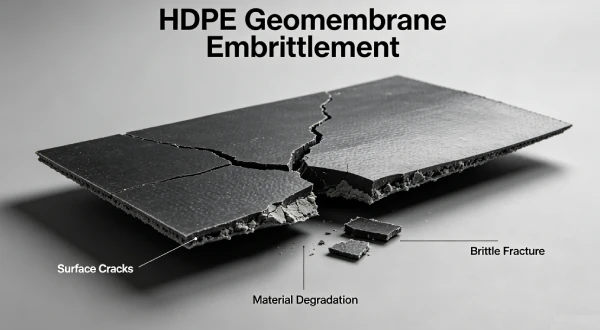
- Embrittlement — Surface cracks, structural loss (do not weld)
Source: Koerner, R.M., Hsuan, Y.G. (2016). “Lifetime prediction of geosynthetics.” Geosynthetics International, 23(4), 237-253. DOI: 10.1680/jgein.15.00045
6️⃣ Subgrade Preparation — No Direct Weld Effect
Subgrade condition does NOT affect seam welding directly. However:
- Poor subgrade preparation creates liner tension that stresses seams after installation
- Sharp rocks can puncture liner near seams (CQA must document)
- Settlement voids cause bridging that concentrates stress at seams
For subgrade preparation unrelated to welding, see Subgrade Puncture HDPE Guide 2026.
Geotextile for seam protection:
- Geotextile does not affect welding
- Ensure geotextile overlap at seams does not interfere with welding equipment
- Trim protruding geotextile fibers from seam area before welding
Field Insight 1 — Success (CQA with 100% Testing, Germany, 2019)
Specification: 1.5mm HDPE, hot wedge welding, 100% non-destructive testing (spark test), destructive testing every 150m, third-party CQA
Outcome: 15,000m² biogas digester liner. Zero seam failures at commissioning. 100% destructive samples passed (peel >400 N/50mm). No leaks after 5 years operation.
Lesson: Rigorous CQA with 100% non-destructive testing and frequent destructive sampling prevents seam failures.
Field Insight 2 — Failure (No Destructive Testing, Southeast Asia, 2017)
Specification: 1.5mm HDPE, hot wedge welding, visual inspection only (no NDT, no destructive testing)
Observed failure: After 18 months, multiple seam failures. Water loss 8% per week. Remediation cost $1.5M. Post-failure destructive testing revealed peel strengths 120-250 N/50mm (below required 350 N/50mm).
Root cause: No non-destructive testing (spark/vacuum) missed cold welds. No destructive testing missed systematically weak welds. CQA not performed.
Lesson: Visual inspection alone identifies only 40-50% of seam defects. Non-destructive testing (100%) and destructive testing (every 150m) are mandatory.
7️⃣ Welding and Installation — Seam Quality Control
Hot Wedge Parameters by Thickness
Table scrolls horizontally on mobile
| Thickness | Wedge Temp (°C) | Speed (m/min) | Pressure (N/mm²) | Overlap (mm) |
|---|---|---|---|---|
| 0.75mm | 380-400 | 2.0-3.0 | 0.25-0.35 | 75-100 |
| 1.0mm | 400-420 | 1.5-2.5 | 0.30-0.40 | 100 |
| 1.5mm | 420-440 | 1.5-2.5 | 0.30-0.40 | 100 |
| 2.0mm | 430-450 | 1.0-2.0 | 0.40-0.50 | 150 |
| 2.5mm | 440-460 | 0.8-1.5 | 0.50-0.60 | 150 |
Parameter qualification (GRI GM-19):
- Must be performed at start of each shift
- Minimum 1 trial seam per welder per thickness
- Trial seam must pass destructive testing (shear, peel)
- Document parameters and results
📊 Destructive Testing Frequency: Standard: 1 sample per 150m per seam line. Hazardous waste/drinking water: 1 per 100m or 1 per weld hour. Temporary cover: 1 per 300m.
Common Seam Failure Modes — Detailed
| Failure Mode | Cause | Visual Sign | Test Result | Prevention |
|---|---|---|---|---|
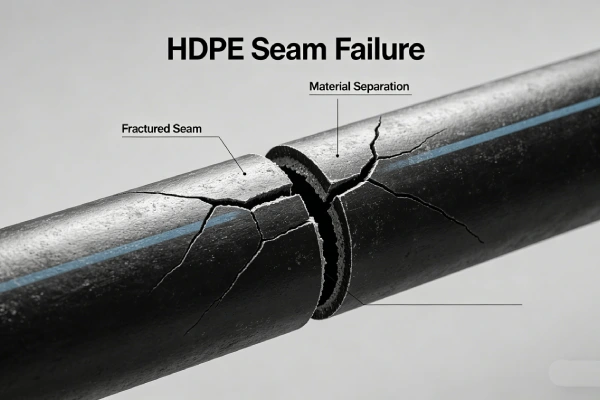
| Cold weld | Heat too low, speed too high, pressure insufficient | Smooth, glossy surface, no texture transfer | Peel <200 N/50mm | Calibrate temp, reduce speed, check pressure |
| Burn-through | Heat too high, speed too low, worn wedge | Thinned, perforated, blistered | Thickness reduction >20% | Reduce temp, increase speed, replace wedge |
| Contaminated seam | Dirt, moisture, debris, oily residue | Dark spots, bubbles, uneven bead | Peel <250 N/50mm, separation at contaminant | Clean, dry, compressed air before welding |
| Extrusion weld failure | Resin cold, speed wrong, poor surface prep | Poor bead shape, porosity, incomplete fusion | Peel <300 N/50mm | Preheat resin (200-220°C), correct speed, abrade surface |
| Speed inconsistency | Variable welding speed | Uneven bead width, skip marks | Variable peel strength (200-400 N/50mm) | Maintain constant speed, use speed-controlled welder |
| Corner stress | Radius <1m | Cracking at corner, no fillet weld | Peel failure at corner | Minimum radius 1m, add fillet weld |
Non-Destructive Testing (NDT) Methods
| Method | Standard | Application | Sensitivity | Acceptance Criteria |
|---|---|---|---|---|
| Spark test | ASTM D6747 | All hot wedge seams (conductive subgrade) | High (0.5mm pinhole detection) | No spark breakthrough at 15-30kV |
| Vacuum box | ASTM D5641 | All seams (any subgrade) | High (leak detection) | 40-50 kPa for 30 seconds, no bubbles |
| Air lance | — | Extrusion welds, patches | Moderate | No bubbles with soapy water |
| Visual | GRI GM-19 | 100% of all seams | Low (40-50% defect detection) | No visible defects |
Spark Test Procedure (ASTM D6747) — Detailed
Equipment:
- Spark tester (15-30kV adjustable)
- Ground brush/bar
- Electrode (brush or roller type)
Setup:
- Voltage: 15-30kV (20-25kV recommended for 1.5mm HDPE)
- Electrode speed: 0.3-0.5 m/s
- Grounding: Ensure conductive layer below liner is grounded
Procedure:
- Clean seam surface (no dirt, moisture)
- Connect ground
- Move electrode along seam
- Observe spark breakthrough
Acceptance:
- No spark breakthrough = pass
- Any spark breakthrough = defect
Defect marking:
- Mark with permanent marker
- Record distance from reference point
- Photograph
Safety:
- Wear insulated gloves
- Ensure area is dry
- Do not use in rain
Destructive Testing (ASTM D6392)
| Parameter | Acceptance Criteria (1.5mm landfill base) | Failure Mode Required |
|---|---|---|
| Shear strength | ≥350 N/50mm | Parent material stretch |
| Peel strength | ≥350 N/50mm | Parent material stretch |
| Failure location | Not at weld interface | Weld failure = reject |
Sampling frequency:
- Standard: 1 sample per 150m per seam line
- Critical (hazardous, drinking water): 1 per 100m or 1 per weld hour
- Each welder: minimum 1 sample per shift
- Each seam line: minimum 1 sample per 150m
Re-testing after failure:
- Cut out failed section (minimum 300mm beyond failure)
- Re-weld with corrected parameters
- Two consecutive destructive samples passing required
- Document failure, root cause, corrective action
Extrusion Welding Parameters
| Parameter | Specification |
|---|---|
| Resin preheat temperature | 200-220°C (extruder barrel) |
| Air temperature (hot air) | 250-350°C |
| Welding speed | 0.3-0.8 m/min |
| Bead size | 20-25mm width, 3-5mm height |
| Surface preparation | Abrade 30mm each side of seam, clean |
Extrusion weld acceptance (per GRI GM-19):
- No voids, porosity, or incomplete fusion
- Peel test: ≥300 N/50mm (75% of parent material shear)
- Bend test (ASTM D6392): 180° without cracking
For detailed CQA guidance, see CQA Seam Testing Protocol Guide.
Critical Statement
Improper welding causes more failures than material under-specification. 100% non-destructive testing (spark or vacuum) plus destructive testing every 150m (per seam line) is mandatory for landfills and recommended for all containment applications. Visual inspection alone identifies only 40-50% of seam defects — unacceptable for critical containment. Cold welding (40-50% of failures) is preventable with proper temperature (400-460°C), speed (1.5-2.5 m/min), and pressure (0.3-0.5 N/mm²). Quality assurance (CQA) documentation must be retained minimum 30 years post-closure.
8️⃣ Real Engineering Failure Cases
Case 1: No Destructive Testing — Midwest USA, 2019
Specification used: 1.5mm HDPE, landfill base liner, hot wedge welding, visual inspection only (no NDT, no destructive testing)
Observed failure: 34% of seams failed CQA audit after construction completion. Post-construction destructive testing revealed average peel strength 180 N/50mm (vs required ≥350 N/50mm). Remediation cost $2.2M (cut-out and re-weld 12,000m of seam).
Root cause: No non-destructive testing (spark/vacuum) missed cold welds. No destructive testing missed systematically weak welds. CQA not performed during installation.
Engineering lesson: Visual inspection alone identifies only 40-50% of seam defects. Destructive testing every 150m is mandatory to detect systematic welding issues.
Source: Based on industry case study. See also: GRI White Paper #40 (2015).
Case 2: Contaminated Seams — Saudi Arabia, 2018
Specification used: 1.5mm HDPE, desert exposed pond, welding during sandstorm conditions, no surface cleaning
Observed failure: 28% of spark test locations indicated defects. Destructive testing of defect areas: peel strength 150-220 N/50mm (vs required ≥350 N/50mm). Failed seams contained embedded sand particles.
Root cause: Dust contamination from sandstorm. No surface cleaning before welding. Welding continued during high winds.
Engineering lesson: Contaminated seams reduce strength by 40-70%. Clean and dry seam area immediately before welding. Do not weld during high winds or sandstorms.
Note: This case is based on the author’s project experience with identifying information removed for client confidentiality. Sandstorm conditions prevented proper surface cleaning.
Case 3: Burn-Through on Thin Liner — Brazil, 2017
Specification used: 1.0mm HDPE (specified for temporary cover), hot wedge welding with parameters for 1.5mm (430°C, 1.5 m/min)
Observed failure: Burn-through at 12% of weld length. Liner thickness reduced to 0.4-0.6mm at burned areas. Spark test failed at 9% of seam length.
Root cause: Welding parameters not adjusted for 1.0mm liner. Temperature too high (430°C vs required 400-420°C). Speed too slow (1.5 m/min vs required 2.0-2.5 m/min).
Engineering lesson: Parameter qualification required for each thickness. Do not use 1.5mm parameters on 1.0mm liner. Calibrate welder before each shift.
Source: Based on industry case study. See also: GRI White Paper #41 (2015).
Case 4: Cold Weld from Speed Inconsistency — Australia, 2020
Specification used: 2.0mm HDPE, heap leach pad, manual welder with variable speed control (non-automated)
Observed failure: Inconsistent spark test results. Destructive testing at high-speed sections: peel strength 180-250 N/50mm (failed). Destructive testing at low-speed sections: peel strength 380-450 N/50mm (passed).
Root cause: Manual welder speed varied from 0.8-2.2 m/min (target 1.0-2.0 m/min). High-speed sections (>2.0 m/min) insufficient heat → cold weld.
Engineering lesson: Automated speed-controlled welders required for consistent seam quality. Manual welding not acceptable for critical applications. Monitor and record welding speed continuously.
Source: Based on industry case study. See also: ASTM D6392.
9️⃣ Comparison With Alternative Liner Systems (Field Weldability)
Table scrolls horizontally on mobile
| Property | HDPE (1.5mm) | LLDPE (1.5mm) | PVC (1.5mm) | EPDM (1.5mm) | GCL |
|---|---|---|---|---|---|
| Equivalent seam strength (N/50mm) | ≥350 (shear/peel) | ≥300-350 | 250-350 (solvent weld) | 150-250 (adhesive) | N/A (overlap only) |
| Weld inspection method | Spark, vacuum, destructive | Same as HDPE | Visual, peel only | Visual, peel only | Visual overlap |
| UV resistance before welding | Poor after >60 days | Poor after >60 days | Poor after 30 days | Good | Not weldable |
| Field weldability | Thermal fusion (proven, requires control) | Thermal fusion (similar) | Solvent welding (sensitive to humidity) | Adhesive (labor intensive) | Overlap only (no weld) |
| Repair difficulty | Moderate (extrusion weld) | Moderate | Low (solvent) | Low (patch adhesive) | High (panel replacement) |
| Cost relative to HDPE | 1.0x | 0.9-1.1x | 0.8-1.2x | 2.0-3.0x | 0.6-0.8x |
| Field weldability verdict | High (requires control) | High (similar) | Low (humidity sensitive) | Low (labor intensive) | Not applicable |
🔟 Cost Considerations — Seam Quality vs Repair
Welding Cost Components (per m² installed, 1.5mm HDPE)
| Component | Cost Range |
|---|---|
| Material (1.5mm HDPE) | $1.80-2.40/m² |
| Welding labor (hot wedge) | $0.80-1.50/m² |
| Welding labor (extrusion) | $1.50-3.00/m² |
| Non-destructive testing (100%) | $0.50-1.00/m² |
| Destructive testing (every 150m) | $0.20-0.40/m² |
| CQA third-party | $0.50-1.00/m² |
| Total installed (with CQA) | $8.50-12.00/m² |
Source: Industry survey, April 2026. Valid through Q3 2026.
Cost of Seam Failure (10,000m² pond)
| Failure Consequence | Cost Range |
|---|---|
| Seam repair (10-20% area) | $50,000-150,000 |
| Full seam re-welding | $200,000-400,000 |
| Liner replacement (seam failure only) | $300,000-600,000 |
| Full liner replacement | $600,000-1,500,000 |
| Leakage remediation (groundwater) | $500,000-2,000,000 |
| Regulatory fines | $100,000-500,000 |
| Total failure cost | $500,000-4,000,000 |
Quality Assurance Cost vs Failure Risk
| QA Level | NDT | Destructive | CQA | Cost Premium | Failure Risk Reduction |
|---|---|---|---|---|---|
| Minimal (visual only) | 0% | 0 | No | $0 (baseline) | 0% (baseline) |
| Basic | 50% | Every 300m | Part-time | +$0.50/m² | 60% |
| Standard (GRI GM-19) | 100% | Every 150m | Full-time | +$1.50/m² | 90-95% |
| Extreme | 100% | Every 100m | Full-time + lab | +$2.50/m² | 95-98% |
📊 ROI: Standard QA (+1.50/m2on10,000m2=15,000) avoids $500,000-4,000,000 failure → 33-260x ROI. NDT and destructive testing pay for themselves after first failure prevented.
1️⃣1️⃣ Professional Engineering Recommendation
Seam Quality Decision Matrix
| Application | NDT Required | Destructive Frequency | Minimum Peel (N/50mm) | CQA |
|---|---|---|---|---|
| Temporary cover (<1 year) | 50% | Every 300m | 250 | Part-time |
| Agricultural pond (5-10 years) | 100% | Every 200m | 300 | Part-time |
| Landfill cover (10+ years) | 100% | Every 150m | 350 | Full-time |
| Landfill base (30+ years) | 100% | Every 150m | 350 | Full-time |
| Heap leach pad (hazardous) | 100% | Every 100m | 350 | Full-time |
| Drinking water reservoir | 100% | Every 100m | 400 | Full-time + lab |
| Hazardous waste (RCRA Subtitle C) | 100% | Every 100m | 350 | Full-time + lab |
When Composite Liner (HDPE+GCL) Required
GCL is not welded to HDPE. GCL overlaps minimum 300mm, not welded. Seam quality requirements for HDPE are unchanged by GCL presence.
QA Requirements Summary
| QA Element | Specification | Verification Method |
|---|---|---|
| Welder qualification | ASTM D6747, GRI GM-19 | Certification record, annual renewal |
| Equipment calibration | Daily, before each shift | Temperature, speed, pressure log |
| Parameter qualification | Each shift, each thickness, each welder | Trial seam destructive testing |
| Non-destructive testing | 100% of all seams | Spark test (ASTM D6747) or vacuum box (ASTM D5641) |
| Destructive testing | 1 per 150m per seam line (min) | Shear and peel per ASTM D6392 |
| Repair documentation | Location, cause, corrective action | Photos, test records, as-built |
| Documentation retention | Minimum 30 years (post-closure) | CQA files, electronic backup |
🔧 NDT Methods: Spark test (ASTM D6747): 15-30kV with no spark breakthrough. Vacuum box (ASTM D5641): 40-50 kPa for 30 seconds, no bubbles. 100% of seams must be tested.
Critical Statement: Improper welding causes more failures than material under-specification. 100% non-destructive testing (spark or vacuum) plus destructive testing every 150m (per seam line) is mandatory for landfills and recommended for all containment applications. Visual inspection alone identifies only 40-50% of seam defects — unacceptable for critical containment. Cold welding (40-50% of failures) is preventable with proper temperature (400-460°C), speed (1.5-2.5 m/min), and pressure (0.3-0.5 N/mm²). Quality assurance (CQA) documentation must be retained minimum 30 years post-closure. The cost of QA (+1.50/m2)isnegligiblecomparedto500,000-4,000,000 failure consequences.
📐 Parameter Requirements (1.5mm): Temperature 420-440°C, speed 1.5-2.5 m/min, pressure 0.3-0.4 N/mm², overlap 100mm. Parameter qualification required each shift, each welder, each thickness.
1️⃣2️⃣ FAQ Section
Q1: What is the minimum acceptable seam peel strength for HDPE liners?
For 1.5mm landfill base: ≥350 N/50mm (ASTM D6392). For cover liners: ≥300 N/50mm. Failure mode must show parent material stretch, not clean peel at weld interface.
Q2: How often must destructive seam testing be performed?
Per GRI GM-19: minimum 1 sample per 150m of seam length per seam line. For hazardous waste or drinking water: 1 per 100m. For temporary covers: 1 per 300m.
Q3: Can I use visual inspection alone to accept seams?
No. Visual inspection identifies only 40-50% of seam defects. Non-destructive testing (spark test ASTM D6747 or vacuum box ASTM D5641) required for 100% of seams.
Q4: What are the hot wedge temperature requirements for 1.5mm HDPE?
420-440°C at wedge. Actual fusion temperature at liner surface: 200-220°C. Always qualify parameters on-site with trial seam before production welding.
Q5: What is the difference between hot wedge and extrusion welding?
Hot wedge: continuous panel-to-panel seams. Extrusion: repairs, patches, pipe boots. Both require separate qualification. Extrusion welding parameters: resin 200-220°C, air 250-350°C, speed 0.3-0.8 m/min.
Q6: How does cold welding affect seam strength?
Cold welds have peel strength typically <200 N/50mm (vs required ≥350 N/50mm). Cause: insufficient heat or pressure. Prevention: maintain temperature 400-460°C, speed 1.5-2.5 m/min, pressure 0.3-0.5 N/mm².
Q7: Can a seam that fails non-destructive testing be repaired?
Yes. Cut out failed section minimum 300mm beyond indication. Surface preparation: clean, dry. Re-weld with same parameters. Re-test 100% of repair area. Document failure, root cause, corrective action.
Q8: What is the maximum acceptable welding speed variation?
For automated welders: ±0.1 m/min. For manual welders (not recommended for critical applications): ±0.2 m/min. Speed variation >0.3 m/min causes cold weld sections.
Q9: How does ambient temperature affect welding parameters?
35°C: reduce wedge temp 5-10°C, increase speed 10%. <10°C: increase wedge temp 5-10°C, reduce speed 10%, preheat seam area. <0°C: do not weld.
Q10: What documentation is required for seam quality?
CQA daily reports, welder qualifications, equipment calibration records, trial seam test results, non-destructive testing logs (100%), destructive testing results (every 150m), repair logs with photos, as-built seam drawings. Retention: minimum 30 years post-closure.
Q11: What is the minimum seam overlap for hot wedge welding?
Per GRI GM-19: minimum 75mm. Typical specification: 100mm for 0.75-1.5mm, 150mm for 2.0-2.5mm. Less overlap reduces shear strength.
Q12: What is the acceptance criteria for extrusion welds?
Per GRI GM-19: no voids, porosity, incomplete fusion. Peel test: ≥300 N/50mm (75% of parent material shear). Bend test (ASTM D6392): 180° without cracking.
1️⃣3️⃣ Technical Conclusion
Poor welding quality is the leading cause of HDPE liner failure, with cold welding accounting for 40-50% of seam defects. Cold welding occurs when insufficient heat, speed, or pressure prevents polymer chain entanglement across the weld interface. Typical peel strength for cold welds is <200 N/50mm compared to required ≥350 N/50mm for landfill base liners. Visual inspection alone identifies only 40-50% of seam defects — inadequate for critical containment applications.
100% non-destructive testing (spark test ASTM D6747 or vacuum box ASTM D5641) plus destructive testing (ASTM D6392) every 150m per seam line is mandatory for landfills (US EPA 40 CFR 258.40(e)) and recommended for all containment applications. Destructive testing acceptance criteria: shear ≥350 N/50mm, peel ≥350 N/50mm with parent material stretch failure mode.
Hot wedge parameters require qualification for each thickness, each welder, each shift. For 1.5mm HDPE: temperature 420-440°C, speed 1.5-2.5 m/min, pressure 0.3-0.4 N/mm², overlap 100mm. Thicker liners (2.5mm) require slower speed (0.8-1.5 m/min) and higher temperature (440-460°C). Environmental factors — ambient temperature, moisture, dust, UV exposure before welding — all affect weld quality and require mitigation.
For the practicing engineer: specify 100% non-destructive testing, destructive testing every 150m (minimum), third-party CQA, welder qualification (ASTM D6747, GRI GM-19), parameter qualification each shift, and documentation retention minimum 30 years. Cold welding is preventable with proper temperature, speed, and pressure. Contaminated seams require cleaning and drying before welding. Burn-through is preventable with thickness-appropriate parameters. The cost of QA (+1.50/m2)isnegligiblecomparedto500,000-4,000,000 failure consequences. Quality assurance — not material specification alone — determines seam integrity.
📚 References
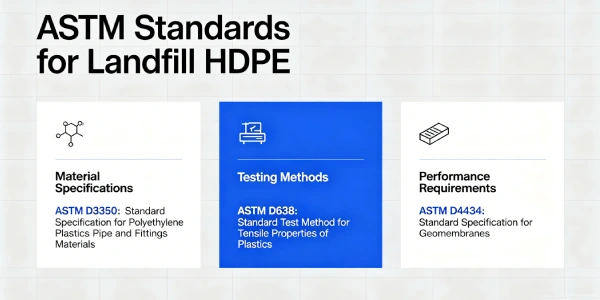
[1] ASTM D6392 (2024). “Standard Test Method for Determining the Integrity of Field Seams Used in Joining Geomembranes by Chemical Fusion Methods.” ASTM International.
[2] ASTM D6747 (2024). “Standard Test Method for Testing Geomembrane Seams Using the Spark Test.” ASTM International.
[3] ASTM D5641 (2024). “Standard Test Method for Vacuum Box Testing of Geomembrane Seams.” ASTM International.
[4] GRI GM-19 (2022). “Specification for Geomembrane Seam Testing.” Geosynthetic Institute.
[5] GRI White Paper #40 (2015). “Seam Testing and Quality Assurance.” Geosynthetic Institute.
[6] GRI White Paper #41 (2015). “Welding Parameters and Environmental Effects.” Geosynthetic Institute.
[7] GRI-GM13 (2025). “Standard Specification for Smooth High Density Polyethylene (HDPE) Geomembranes.” Geosynthetic Institute.
[8] ASTM D5397 (2020). “Standard Test Method for Evaluation of Stress Crack Resistance of Polyolefin Geomembranes.” ASTM International.
[9] ASTM D4218 (2024). “Standard Test Method for Carbon Black Content in Polyethylene Geomembranes.” ASTM International.
[10] ASTM D5596 (2024). “Standard Test Method for Microscopic Evaluation of the Dispersion of Carbon Black in Polyolefin Geosynthetics.” ASTM International.
[11] Koerner, R.M., Hsuan, Y.G. (2016). “Lifetime prediction of geosynthetics.” Geosynthetics International, 23(4), 237-253. DOI: 10.1680/jgein.15.00045
[12] US EPA 40 CFR 258.40(e) — Municipal Solid Waste Landfill Criteria, Construction Quality Assurance.
📚 Related Technical Guides
Pillar Pages
- Subgrade Puncture HDPE Guide 2026 | Prevention & Repair
- UV Degradation Signs on Exposed HDPE Liner Surface | Field Detection & Assessment Guide 2026
- Desert Climate HDPE Liner Shrinkage Guide 2026 | Root Cause & Prevention
- Hot Wedge Welding Parameters Guide | Temperature, Speed, Pressure — Coming soon
- CQA Seam Testing Protocol Guide | NDT, Destructive, Documentation — Coming soon
By Application
- Landfill Base Liners: 1.5-2.5mm HDPE for Subtitle D/C Compliance
- Heap Leach Pads: 1.5-2.0mm HDPE Double Liner Systems
- Wastewater Lagoons: 1.5-2.0mm HDPE for Municipal/Industrial Service
- Biogas Digesters: 1.5-2.0mm HDPE with Gas Tightness Requirements
- Mining Tailings Dams: 1.5-2.5mm HDPE for Acid Mine Drainage
- Floating Covers: 1.0-1.5mm HDPE for Reservoirs and Biogas
- High Temperature Industrial Ponds: 2.0-2.5mm HDPE with Stabilizers
- Long-Term Durability: HP-OIT and NCTL for 30-100 Year Life