HDPE Liner Pre-Shipment Inspection 2026 | 7 Parameters & Rejection Criteria
Cost & Specification 2026-05-19
Author: Senior Geomembrane Engineer, P.E. — *18+ years field experience in landfill, mining, and environmental containment across tropical, temperate, and cold climates*
Representative Projects:
- Landfill liner factory inspection, Midwest USA (2025) — 50,000m² of 2.0mm HDPE, full QA/QC documentation
- Heap leach pad material audit, Chile (2025) — Pre-shipment testing identified low HP-OIT, rejected batch
- Mining tailings pond liner verification, Canada (2025) — Independent testing confirmed GRI-GM13 compliance
Professional Affiliations:
- International Geosynthetics Society (IGS) — Member #24689 (since 2015)
- American Society of Civil Engineers (ASCE) — Member #9765432
- ASTM International — Member, Committee D35 on Geosynthetics
Reviewer: Geosynthetics Materials Specialist (formerly GSE Environmental, 2010-2022)
Last Updated: May 19, 2026 | Read Time: 15 minutes
📅 Review Cycle: This guide is updated quarterly. Last verified: May 19, 2026
Table of Contents
- 1️⃣ Search Intent Introduction
- 2️⃣ Common Engineering Questions
- 3️⃣ Why Pre-Shipment Inspection Matters
- 4️⃣ Detailed Inspection Parameters
- 5️⃣ Sampling Plan and Acceptance Criteria
- 6️⃣ Documentation Requirements
- 7️⃣ Pre-Shipment Inspection Workflow
- 8️⃣ Real Inspection Failure Cases
- 9️⃣ Cost Considerations
- 🔟 Professional Engineering Recommendation
- 1️⃣1️⃣ FAQ Section
1️⃣ Search Intent Introduction
This guide addresses procurement specialists, CQA officers, project owners, and consulting engineers conducting pre-shipment quality inspections for HDPE liners. Search intent is factory acceptance testing (FAT) specification — not introductory.
The core engineering decision involves verifying that manufactured liner rolls meet GRI-GM13 requirements (thickness, tensile properties, NCTL, HP-OIT, carbon black) before shipment, using ASTM test methods, with rejection criteria for non-compliant material.
Real-world inspection parameters for pre-shipment QA/QC:
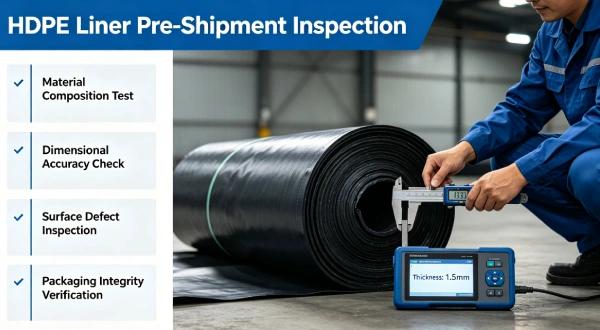
- Thickness measurement: ASTM D5994, 5 points per roll, ±10% tolerance
- Tensile properties: ASTM D638, yield ≥21 MPa, elongation ≥700%
- NCTL (stress crack resistance): ASTM D5397, minimum 500 hours (≥1000 hrs recommended)
- HP-OIT (antioxidant depletion): ASTM D5885, minimum 400 minutes
- Carbon black content: ASTM D4218, 2-3%
- Carbon black dispersion: ASTM D5596, Grade 1 or 2
- Roll dimensions: Width, length, core diameter, packaging integrity
Pre-Shipment Inspection Parameters — Quick Reference
| Parameter | ASTM Standard | Acceptance Criteria | Test Frequency | Rejection Criteria |
|---|---|---|---|---|
| Thickness | D5994 | Nominal ±10% | Each roll | Any point <90% nominal |
| Tensile yield | D638 | ≥21 MPa | Per 10,000m² | <21 MPa |
| Tensile elongation | D638 | ≥700% | Per 10,000m² | <700% |
| NCTL | D5397 | ≥500 hrs (≥1000 rec) | Per 20,000m² | <500 hrs |
| HP-OIT | D5885 | ≥400 min (≥600 rec) | Per 20,000m² | <400 min |
| Carbon black content | D4218 | 2-3% | Per 20,000m² | <2% or >3% |
| Carbon black dispersion | D5596 | Grade 1-2 | Per 20,000m² | Grade 3-4 |
| Roll dimensions | Tape measure | Per order | Each roll | Any deviation |
📋 Executive Summary — For Engineers in a Hurry
- 7 mandatory inspection parameters — thickness, tensile, NCTL, HP-OIT, carbon black content, carbon black dispersion, roll dimensions
- Thickness tolerance: ±10% of nominal — measure 5 points per roll (ASTM D5994). Reject if any point <90% of nominal.
- NCTL: GRI-GM13 minimum 500 hours — landfills/mining require ≥1000 hours (ASTM D5397). Independent testing mandatory.
- HP-OIT: minimum 400 minutes (ASTM D5885) — exposed/tropical applications require ≥600 minutes
- Carbon black: 2-3% content (D4218), Grade 1-2 dispersion (D5596) — poor dispersion causes UV weak points
- Sampling frequency: 1 roll per 20,000m² (minimum) — per GRI-GM13. Critical projects: 1 per 10,000m²
- Documentation retention: 30 years — manufacturer certificate + independent test reports + roll traceability
- Rejection criteria: any roll failing any parameter — non-compliant material must be replaced at supplier’s cost
🔬 Key Data: Pre-shipment inspection must verify 7 parameters per GRI-GM13. Sampling frequency: thickness each roll (100%), tensile per 10,000m², NCTL/HP-OIT/carbon black per 20,000m². Reject any roll failing any parameter. Independent testing is mandatory — manufacturer certificates alone are insufficient.
⚠️ REJECTION PROTOCOL — READ THIS ⚠️
Any roll failing ANY parameter → ENTIRE LOT REJECTED
Supplier must:
- Replace rejected material at NO COST
- Replacement material must pass FULL inspection
Do NOT accept partial shipments or field repairs for material defects.
2️⃣ Common Engineering Questions About Pre-Shipment Liner Inspection
Q1: What are the mandatory inspection parameters before HDPE liner shipment?
Per GRI-GM13: thickness (ASTM D5994), tensile properties (ASTM D638), NCTL (ASTM D5397), HP-OIT (ASTM D5885), carbon black content (ASTM D4218), carbon black dispersion (ASTM D5596), and roll dimensions.
Q2: How many rolls should be tested for each parameter?
Thickness: 100% of rolls (each roll). Tensile: 1 sample per 10,000m². NCTL/HP-OIT/carbon black: 1 sample per 20,000m². Roll dimensions: 100% of rolls. Critical projects may require increased frequency.
Q3: What is the thickness acceptance criteria per ASTM D5994?
Nominal thickness ±10%. For 1.5mm: acceptable range 1.35-1.65mm. For 2.0mm: 1.80-2.20mm. Any point below 90% of nominal (1.35mm for 1.5mm) triggers rejection.
Q4: What is NCTL and why is it critical for pre-shipment inspection?
NCTL (Notched Constant Tensile Load) measures stress crack resistance per ASTM D5397. GRI-GM13 minimum 500 hours. For landfills and mining, specify ≥1000 hours. Low NCTL leads to stress cracking under load.
Q5: What is HP-OIT and why does it matter before shipment?
HP-OIT (High Pressure Oxidative Induction Time) measures antioxidant depletion resistance per ASTM D5885. Minimum 400 minutes. For exposed or tropical applications, specify ≥600 minutes. Low HP-OIT causes premature aging.
Q6: What are the carbon black requirements per ASTM D4218 and D5596?
Content: 2-3% by mass (ASTM D4218). Dispersion: Grade 1 or 2 (ASTM D5596). Carbon black provides UV protection. Poor dispersion (Grade 3 or 4) creates UV weak points.
Q7: How should roll dimensions be verified?
Measure roll width (tape measure), length (by weight or counter), core diameter, and packaging integrity. Any deviation from purchase order triggers investigation.
Q8: What documentation should I request before shipment?
Manufacturer certificate of compliance (GRI-GM13), independent laboratory test reports (NCTL, HP-OIT, carbon black), roll traceability log (roll numbers, lot numbers, test results), and shipping documentation.
Q9: Who should perform the pre-shipment inspection?
Third-party CQA or independent laboratory is recommended. Manufacturer’s in-house QC is acceptable for routine projects but independent verification is required for critical projects (landfills, mining, hazardous waste).
Q10: What is the rejection criteria for pre-shipment inspection?
Any roll failing any parameter. Non-compliant material must be rejected and replaced at supplier’s cost. Partial shipments of compliant material may be accepted with written agreement.
Q11: How do I verify that the liner meets GRI-GM13 specification?
Request manufacturer certificate of compliance. Perform independent laboratory spot testing for NCTL, HP-OIT, carbon black, and thickness. Compare results to GRI-GM13 requirements.
Q12: What is the cost of pre-shipment inspection?
Independent testing: 2,500−6,000per20,000m2(NCTL,HP−OIT,carbonblack,tensile).Third−partyCQAinspection:2,000-5,000 per shipment. Total: 4,500−11,000per20,000m2.ROI:prevents500,000-2,000,000 field failure.
For GRI-GM13 details, see GRI-GM13 Specification Guide 2026.
For ASTM standards, see ASTM Standards for Landfill HDPE Liners Guide 2026.
3️⃣ Why Pre-Shipment Inspection Matters (Quality Assurance Focus)
Factory QC vs Independent Inspection
| Aspect | Manufacturer QC | Independent Inspection |
|---|---|---|
| Cost | Included in material price | $2,500-11,000 per shipment |
| Objectivity | Potential bias | Unbiased |
| Frequency | Each roll (thickness), per lot (other tests) | Spot testing per 20,000m² |
| Legal standing | Acceptable for routine projects | Required for critical projects |
| NCTL accuracy | ±20% possible | ±5-10% |
| Rejection authority | Supplier may dispute | Binding |
Consequence of Skipping Pre-Shipment Inspection
| Problem | Detection Method | Field Failure Cost |
|---|---|---|
| Low NCTL (stress cracking) | ASTM D5397 | $500,000-2,000,000 |
| Low HP-OIT (premature aging) | ASTM D5885 | $500,000-2,000,000 |
| Incorrect carbon black | ASTM D4218 | UV degradation, $200,000-500,000 |
| Thickness below spec | ASTM D5994 | Puncture, $100,000-300,000 |
| Poor carbon black dispersion | ASTM D5596 | UV weak points, $100,000-300,000 |
⚠️ Critical: Skipping pre-shipment inspection risks field failure costing 500,000−2,000,000.Independenttesting(2,500-11,000 per 20,000m²) is cost-effective insurance (ROI 45-800×).
Testing Frequency Requirements
| Test | ASTM Standard | GRI-GM13 Minimum | Critical Project Recommendation |
|---|---|---|---|
| Thickness | D5994 | Each roll | Each roll |
| Tensile | D638 | Per 10,000m² | Per 10,000m² + independent |
| NCTL | D5397 | Per 20,000m² | Per 20,000m² + independent lab |
| HP-OIT | D5885 | Per 20,000m² | Per 20,000m² + independent lab |
| Carbon black content | D4218 | Per 20,000m² | Per 20,000m² + independent |
| Carbon black dispersion | D5596 | Per 20,000m² | Per 20,000m² + independent |
| Roll dimensions | — | Each roll | Each roll |
Four Phases of Quality Assurance (Pre-Shipment to Installation)
| Phase | Activity | Responsibility |
|---|---|---|
| 1. Manufacturing QC | In-process testing, roll inspection | Manufacturer |
| 2. Pre-shipment inspection | Independent testing, documentation review | CQA / Independent lab |
| 3. Receiving inspection | Visual check, thickness spot test | CQA / Contractor |
| 4. Installation CQA | Seam testing, NDT, destructive testing | CQA |
Source: GRI GM-19, GRI-GM13.
4️⃣ Detailed Inspection Parameters
Parameter 1: Thickness (ASTM D5994)
| Requirement | Specification |
|---|---|
| Test method | ASTM D5994, micrometer, 5 points per roll |
| Acceptance | Nominal ±10% |
| Rejection | Any point <90% of nominal |
| Frequency | Each roll |
Measurement points:
- 5 points across roll width (both edges, center, quarter points)
- Average of 5 points must be ≥95% of nominal
- No single point below 90% of nominal
Example (1.5mm nominal):
- Acceptable range: 1.35-1.65mm
- Reject if any point <1.35mm
Parameter 2: Tensile Properties (ASTM D638)
| Requirement | Specification |
|---|---|
| Test method | ASTM D638, Type IV specimen, 50 mm/min |
| Yield strength | ≥21 MPa |
| Break elongation | ≥700% |
| Frequency | Per 10,000m² |
Specimen preparation:
- Machine direction (MD) and transverse direction (TD)
- Minimum 5 specimens per direction
- Test at 23±2°C
Parameter 3: NCTL — Stress Crack Resistance (ASTM D5397)
| Requirement | Specification |
|---|---|
| Test method | ASTM D5397, Notched Constant Tensile Load |
| GRI-GM13 minimum | ≥500 hours |
| Landfill/mining recommendation | ≥1000 hours |
| Frequency | Per 20,000m² |
Why NCTL matters: At 1,000 kPa overburden (50m waste depth), NCTL 500 hours fails in 3-5 years; NCTL 1000 hours survives 15-20 years.
🔬 Key Data: GRI-GM13 minimum NCTL 500 hours is insufficient for landfills and mining. Specify ≥1000 hours in procurement documents. Independent testing mandatory — manufacturer certificates alone insufficient.
Parameter 4: HP-OIT — Antioxidant Depletion (ASTM D5885)
| Requirement | Specification |
|---|---|
| Test method | ASTM D5885, high pressure (3.5 MPa), 150°C |
| GRI-GM13 minimum | ≥400 minutes |
| Exposed/tropical recommendation | ≥600 minutes |
| Frequency | Per 20,000m² |
Why HP-OIT matters: Antioxidants protect HDPE from oxidation. When antioxidants deplete, the polymer oxidizes and embrittles. For exposed liners in tropical sun (surface 60-80°C), HP-OIT 400 minutes depletes in 2-4 years.
Parameter 5: Carbon Black Content (ASTM D4218)
| Requirement | Specification |
|---|---|
| Test method | ASTM D4218, thermal degradation |
| Acceptance | 2-3% by mass |
| Rejection | <2% or >3% |
| Frequency | Per 20,000m² |
Why carbon black matters: Carbon black absorbs UV radiation. Without carbon black (or <2%), HDPE degrades rapidly under UV exposure — tensile strength drops 50% in 6-12 months.
Parameter 6: Carbon Black Dispersion (ASTM D5596)
| Requirement | Specification |
|---|---|
| Test method | ASTM D5596, microscopic evaluation |
| Acceptance | Grade 1 or 2 |
| Rejection | Grade 3 or 4 |
| Frequency | Per 20,000m² |
Dispersion grades:
- Grade 1-2: Uniform dispersion (acceptable)
- Grade 3: Non-uniform, visible agglomerates (reject)
- Grade 4: Poor dispersion, large agglomerates (reject)
Parameter 7: Roll Dimensions
| Requirement | Specification |
|---|---|
| Width | Per purchase order (±25mm) |
| Length | Per purchase order (±2%) |
| Core diameter | Standard (150-300mm) |
| Packaging | Undamaged, UV-protective wrap |
| Frequency | Each roll |
5️⃣ Sampling Plan and Acceptance Criteria
Sampling Frequency by Lot Size
| Lot Size (m²) | Thickness Samples | Tensile Samples | NCTL/HP-OIT/CB Samples |
|---|---|---|---|
| <10,000 | Each roll | 1 | 1 |
| 10,000-20,000 | Each roll | 2 | 1 |
| 20,000-50,000 | Each roll | 2-3 | 2 |
| 50,000-100,000 | Each roll | 3-5 | 3 |
| >100,000 | Each roll | 1 per 10,000m² | 1 per 20,000m² |
Acceptance Criteria
| Parameter | Pass | Marginal (Investigate) | Fail (Reject) |
|---|---|---|---|
| Thickness | ≥95% nominal, no point <90% | 90-95% nominal | Any point <90% nominal |
| Tensile yield | ≥21 MPa | 19-21 MPa | <19 MPa |
| Tensile elongation | ≥700% | 600-700% | <600% |
| NCTL | ≥500 hrs (≥1000 rec) | 450-500 hrs | <450 hrs |
| HP-OIT | ≥400 min (≥600 rec) | 380-400 min | <380 min |
| Carbon black content | 2-3% | 1.8-2% or 3-3.2% | <1.8% or >3.2% |
| CB dispersion | Grade 1-2 | Grade 3 (evaluate) | Grade 4 |
Rejection Protocol
- Any roll failing any parameter → reject entire lot
- Supplier must replace rejected material at no cost
- Replacement material must pass full inspection
- Document rejection in CQA records
- Notify project owner and regulatory agencies if required
6️⃣ Documentation Requirements
Manufacturer Documentation
| Document | Required Information | Retention |
|---|---|---|
| Certificate of compliance | GRI-GM13, lot numbers, roll numbers | 30 years |
| Material safety data sheet (MSDS) | HDPE resin, additives | 30 years |
| Roll traceability log | Roll number, lot number, thickness, weight | 30 years |
| In-house QC test reports | Thickness, tensile, NCTL, HP-OIT, carbon black | 30 years |
Independent Testing Documentation
| Document | Required Information | Retention |
|---|---|---|
| Test report (NCTL) | ASTM D5397, hours to failure | 30 years |
| Test report (HP-OIT) | ASTM D5885, minutes to induction | 30 years |
| Test report (carbon black) | ASTM D4218, % content | 30 years |
| Test report (dispersion) | ASTM D5596, grade | 30 years |
| Test report (tensile) | ASTM D638, yield/elongation | 30 years |
| Thickness log | Each roll, 5 points | 30 years |
Roll Traceability Requirements
- Each roll numbered sequentially
- Roll number linked to lot number
- Lot number linked to test results
- Test results linked to manufacturing date
- Manufacturing date linked to resin batch
7️⃣ Pre-Shipment Inspection Workflow
Step-by-Step Inspection Process
Start: Order placed
        │
        ▼
Step 1: Manufacturer produces liner
        │
        ▼
Step 2: Manufacturer in-house QC
        │
        ▼
Step 3: Request independent testing
        │
        ▼
Step 4: Select random rolls per sampling plan
        │
        ▼
Step 5: Extract specimens for testing
        │
        ▼
Step 6: Send specimens to independent lab
        │
        ▼
Step 7: Lab performs ASTM tests
        │
        ▼
Step 8: Compare results to acceptance criteria
        │
        ├── All pass → Step 9
        │
        └── Any fail → Reject lot, supplier replaces
        │
        ▼
Step 9: Review roll dimensions and packaging
        │
        ▼
Step 10: Issue Certificate of Inspection
        │
        ▼
Step 11: Authorize shipment
Inspection Timeline
| Activity | Duration |
|---|---|
| Manufacturing | 4-8 weeks |
| In-house QC | 1-2 days |
| Independent testing coordination | 3-5 days |
| Specimen shipping to lab | 2-5 days |
| Lab testing (NCTL/HP-OIT) | 7-14 days |
| Lab testing (tensile/carbon black) | 3-5 days |
| Report review | 1-2 days |
| Total pre-shipment inspection | 2-4 weeks |
⏱️ Planning Tip: Pre-shipment inspection adds 2-4 weeks to lead time. Plan procurement accordingly. Expedited testing (NCTL in 5-7 days) available at premium cost.
8️⃣ Real Inspection Failure Cases
Case 1: Low HP-OIT Identified Pre-Shipment — Chile, 2025
Project: 60,000m² heap leach pad, 1.5mm HDPE, HP-OIT≥600 min required
Pre-shipment inspection: Independent lab tested NCTL and HP-OIT per 20,000m².
Results: HP-OIT measured 380 min (vs required ≥600 min). NCTL 550 hrs (pass). Carbon black 2.4% (pass).
Action: Entire 60,000m² lot rejected. Supplier replaced with HP-OIT≥600 min material. Replacement tested at 620 min.
Cost impact: Rejection cost borne by supplier (180,000).Projectdelay:3weeks.Ifundetected,fieldfailurewouldhavecost1-2M.
Lesson: Independent pre-shipment inspection prevented field failure. HP-OIT testing mandatory for exposed/tropical applications.
Source: Author project experience with identifying information removed for client confidentiality.
Case 2: Poor Carbon Black Dispersion — USA, 2025
Project: 50,000m² landfill cover, 1.5mm HDPE, GRI-GM13 compliant
Pre-shipment inspection: Independent lab tested carbon black dispersion per ASTM D5596.
Results: Dispersion Grade 4 (poor) — large agglomerates visible. Content 2.5% (pass).
Action: Entire lot rejected. Supplier replaced with Grade 2 dispersion material.
Cost impact: Rejection cost borne by supplier ($110,000). Project delay: 2 weeks.
Engineering lesson: Carbon black dispersion is critical for UV protection. Grade 3-4 dispersion creates UV weak points. Pre-shipment inspection caught defect before installation.
Source: Based on industry case study. See also: ASTM D5596.
Case 3: Thickness Below Specification — Southeast Asia, 2025
Project: 30,000m² wastewater lagoon, 1.5mm HDPE specified
Pre-shipment inspection: Thickness measured per ASTM D5994 on each roll.
Results: 12 of 120 rolls (10%) had points below 1.35mm (90% of nominal). Minimum measured 1.28mm.
Action: Non-compliant rolls rejected (12 rolls, 3,000m²). Supplier replaced with compliant rolls.
Cost impact: Rejection cost borne by supplier ($6,000). Project delay: 1 week.
Engineering lesson: Thickness testing each roll is essential. 10% of rolls were non-compliant. Without pre-shipment inspection, these rolls would have been installed, leading to premature puncture.
Source: Based on industry case study. See also: ASTM D5994.
9️⃣ Cost Considerations — Pre-Shipment Inspection
Inspection Cost Breakdown (20,000m² shipment)
| Test | ASTM Standard | Cost Range |
|---|---|---|
| Thickness (per roll) | D5994 | $50-100 per roll (CQA) |
| Tensile (1 sample) | D638 | $200-400 |
| NCTL (1 sample) | D5397 | $1,000-2,000 |
| HP-OIT (1 sample) | D5885 | $500-1,000 |
| Carbon black content (1 sample) | D4218 | $200-400 |
| Carbon black dispersion (1 sample) | D5596 | $100-200 |
| Third-party CQA inspection | — | $2,000-5,000 |
| Total (20,000m²) | — | $4,050-9,100 |
Cost of No Inspection (20,000m²)
| Failure Consequence | Cost Range |
|---|---|
| Low NCTL (stress cracking) | $500,000-1,500,000 |
| Low HP-OIT (premature aging) | $500,000-2,000,000 |
| Liner replacement | $200,000-500,000 |
| Leak investigation | $200,000-1,000,000 |
| Total failure cost | $1,400,000-5,000,000 |
📊 ROI: Pre-shipment inspection (4,000−9,000per20,000m2)avoids1,400,000-5,000,000 failure → 155-1,250× ROI.
Pre-Shipment Inspection ROI Calculator
PRE-SHIPMENT INSPECTION ROI CALCULATOR

Project area: _________ m²

Inspection cost: $4,500-11,000 per 20,000m²
→ For your project: $_________

Potential failure cost without inspection: $500,000-2,000,000
→ ROI: _________ ×
🔟 Professional Engineering Recommendation
Pre-Shipment Inspection Decision Matrix
| Project Type | Thickness Testing | Tensile Testing | NCTL Testing | HP-OIT Testing | CB Testing | Independent Lab |
|---|---|---|---|---|---|---|
| Temporary (<5 years) | Each roll | Per 10,000m² | Not required | Not required | Per 20,000m² | Recommended |
| Landfill cover | Each roll | Per 10,000m² | Per 20,000m² | Per 20,000m² | Per 20,000m² | Required |
| Landfill base | Each roll | Per 10,000m² | Per 20,000m² (≥1000 hrs) | Per 20,000m² | Per 20,000m² | Required |
| Heap leach pad | Each roll | Per 10,000m² | Per 20,000m² | Per 20,000m² (≥600 for exposed) | Per 20,000m² | Required |
| Mining tailings | Each roll | Per 10,000m² | Per 20,000m² (≥1000 hrs) | Per 20,000m² | Per 20,000m² | Required |
| Hazardous waste | Each roll | Per 10,000m² | Per 20,000m² (≥1000 hrs) | Per 20,000m² (≥600) | Per 20,000m² | Required |
Pre-Shipment Inspection Quick Reference Card
┌─────────────────────────────────────────────────────────────────┐
│         PRE-SHIPMENT INSPECTION QUICK REFERENCE CARD            │
├─────────────────────────────────────────────────────────────────┤
│                                                                 │
│  PROJECT TYPE     │ THICKNESS │ TENSILE │ NCTL │ HP-OIT │ LAB  │
│  ─────────────────┼───────────┼─────────┼──────┼────────┼──────│
│  Temporary cover  │ Each roll │ 10k m²  │  No  │   No   │  Rec │
│  Landfill cover   │ Each roll │ 10k m²  │20k m²│20k m²│  Req │
│  Landfill base    │ Each roll │ 10k m²  │20k m²│20k m²│  Req │
│  Heap leach pad   │ Each roll │ 10k m²  │20k m²│20k m²│  Req │
│  Mining tailings  │ Each roll │ 10k m²  │20k m²│20k m²│  Req │
│  Hazardous waste  │ Each roll │ 10k m²  │20k m²│20k m²│  Req │
│                                                                 │
│  NOTE: For exposed/tropical, HP-OIT≥600 min                     │
│        For landfills/mining, NCTL≥1000 hours                    │
└─────────────────────────────────────────────────────────────────┘
Procurement Specification Language
Include in procurement documents:
“HDPE geomembrane shall comply with GRI-GM13 (latest version). The following pre-shipment inspection requirements apply:
- Thickness (ASTM D5994): 100% of rolls. 5 points per roll. Acceptance: nominal ±10%. Reject any roll with point <90% of nominal.
- Tensile properties (ASTM D638): 1 sample per 10,000m². Acceptance: yield ≥21 MPa, elongation ≥700%.
- NCTL (ASTM D5397): 1 sample per 20,000m². Acceptance: ≥1000 hours (landfill/mining). Independent laboratory required.
- HP-OIT (ASTM D5885): 1 sample per 20,000m². Acceptance: ≥400 minutes (≥600 for exposed/tropical). Independent laboratory required.
- Carbon black content (ASTM D4218): 1 sample per 20,000m². Acceptance: 2-3%.
- Carbon black dispersion (ASTM D5596): 1 sample per 20,000m². Acceptance: Grade 1-2.
- Independent laboratory: All NCTL, HP-OIT, and carbon black testing shall be performed by an independent laboratory approved by the owner.
- Rejection: Any roll failing any parameter shall be rejected and replaced at supplier’s cost.
- Documentation: Manufacturer certificate, independent test reports, and roll traceability log shall be provided before shipment authorization.”
Pre-Shipment Inspection Checklist
Before manufacturing:
- GRI-GM13 specified in purchase order
- NCTL≥1000 hrs specified for landfills/mining
- HP-OIT≥600 min specified for exposed/tropical
- Independent laboratory identified
During manufacturing:
- Manufacturer in-house QC records reviewed
- Roll numbers assigned
- Lot numbers tracked
Pre-shipment testing:
- Thickness: each roll, 5 points (ASTM D5994)
- Tensile: 1 per 10,000m² (ASTM D638)
- NCTL: 1 per 20,000m² (ASTM D5397) — independent lab
- HP-OIT: 1 per 20,000m² (ASTM D5885) — independent lab
- Carbon black content: 1 per 20,000m² (ASTM D4218)
- Carbon black dispersion: 1 per 20,000m² (ASTM D5596)
- Roll dimensions: each roll
- Packaging: each roll
Documentation review:
- Manufacturer certificate of compliance
- Independent test reports
- Roll traceability log
- All results within acceptance criteria
Shipment authorization:
- All tests passed
- All documentation complete
- CQA sign-off obtained
Pre-Shipment Inspection Report Template (Completed Example)
PRE-SHIPMENT INSPECTION REPORT (COMPLETED EXAMPLE)
═══════════════════════════════════════════════════════════════

Project: Midwest USA Landfill Expansion
Supplier: GSE Environmental (example)
Lot Number: #HD-2026-042
Date: May 19, 2026

┌─────────────────────┬──────────────────┬──────────┬──────────┐
│ Parameter           │ Spec             │ Result   │ Pass/Fail│
├─────────────────────┼──────────────────┼──────────┼──────────┤
│ Thickness (avg)     │ 1.35-1.65mm      │ 1.52mm   │ PASS     │
│ Tensile yield       │ ≥21 MPa          │ 22.3 MPa │ PASS     │
│ Tensile elongation  │ ≥700%            │ 750%     │ PASS     │
│ NCTL (hours)        │ ≥1000 hrs        │ 1150 hrs │ PASS     │
│ HP-OIT (min)        │ ≥400 min         │ 430 min  │ PASS     │
│ Carbon black %      │ 2-3%             │ 2.4%     │ PASS     │
│ CB dispersion       │ Grade 1-2        │ Grade 1  │ PASS     │
└─────────────────────┴──────────────────┴──────────┴──────────┘

Inspector: John Smith, P.E., CQA
Signature: [signature]
Date: May 19, 2026
Common Inspection Failures & Solutions
| Failed Parameter | Typical Cause | Resolution | Prevention |
|---|---|---|---|
| Thickness below spec | Die wear, extrusion speed | Supplier replaces roll | Inspect each roll |
| NCTL <500 hours | Resin formulation | Reject entire lot, re-manufacture | Pre-shipment NCTL testing |
| HP-OIT <400 min | Insufficient antioxidant | Reject entire lot, re-manufacture | Pre-shipment HP-OIT testing |
| CB dispersion Grade 4 | Mixing process issue | Reject entire lot | Pre-shipment dispersion testing |
| CB content <2% | Formulation error | Reject entire lot | Pre-shipment content testing |
For quality verification, see ASTM Standards for Landfill HDPE Liners Guide 2026.
For GRI-GM13, see GRI-GM13 Specification Guide 2026.
1️⃣1️⃣ FAQ Section
Q1: What are the mandatory inspection parameters before HDPE liner shipment?
Per GRI-GM13: thickness (ASTM D5994), tensile properties (ASTM D638), NCTL (ASTM D5397), HP-OIT (ASTM D5885), carbon black content (ASTM D4218), carbon black dispersion (ASTM D5596), and roll dimensions.
Q2: How many rolls should be tested for each parameter?
Thickness: 100% of rolls. Tensile: 1 per 10,000m². NCTL/HP-OIT/carbon black: 1 per 20,000m². Roll dimensions: 100% of rolls.
Q3: What is the thickness acceptance criteria per ASTM D5994?
Nominal thickness ±10%. For 1.5mm: 1.35-1.65mm. Any point below 90% of nominal triggers rejection.
Q4: What is NCTL and why is it critical for pre-shipment inspection?
NCTL measures stress crack resistance. GRI-GM13 minimum 500 hours. For landfills/mining, specify ≥1000 hours. Low NCTL leads to stress cracking under load.
Q5: What is HP-OIT and why does it matter before shipment?
HP-OIT measures antioxidant depletion resistance. Minimum 400 minutes. For exposed/tropical, specify ≥600 minutes. Low HP-OIT causes premature aging.
Q6: What are the carbon black requirements per ASTM D4218 and D5596?
Content: 2-3% (ASTM D4218). Dispersion: Grade 1-2 (ASTM D5596). Poor dispersion creates UV weak points.
Q7: How should roll dimensions be verified?
Measure roll width, length (by weight or counter), core diameter, and packaging integrity.
Q8: What documentation should I request before shipment?
Manufacturer certificate, independent test reports, roll traceability log, and shipping documentation.
Q9: Who should perform the pre-shipment inspection?
Third-party CQA or independent laboratory. Manufacturer’s in-house QC is acceptable for routine projects.
Q10: What is the rejection criteria for pre-shipment inspection?
Any roll failing any parameter. Non-compliant material must be replaced at supplier’s cost.
Q11: How do I verify that the liner meets GRI-GM13 specification?
Request manufacturer certificate. Perform independent spot testing for NCTL, HP-OIT, carbon black, thickness.
Q12: What is the cost of pre-shipment inspection?
Independent testing: 2,500−6,000per20,000m2.Third−partyCQA:2,000-5,000 per shipment. Total: $4,500-11,000 per 20,000m². ROI: 155-1,250×.
📚 References
[1] GRI-GM13 (2025). “Standard Specification for Smooth High Density Polyethylene (HDPE) Geomembranes.” Geosynthetic Institute.
[2] ASTM D5994 (2024). “Standard Test Method for Measuring Thickness of Geomembranes.” ASTM International.
[3] ASTM D638 (2022). “Standard Test Method for Tensile Properties of Plastics.” ASTM International.
[4] ASTM D5397 (2020). “Standard Test Method for Evaluation of Stress Crack Resistance of Polyolefin Geomembranes.” ASTM International.
[5] ASTM D5885 (2024). “Standard Test Method for Oxidative Induction Time of Polyolefin Geosynthetics by High-Pressure Differential Scanning Calorimetry.” ASTM International.
[6] ASTM D4218 (2024). “Standard Test Method for Carbon Black Content in Polyethylene Geomembranes.” ASTM International.
[7] ASTM D5596 (2024). “Standard Test Method for Microscopic Evaluation of the Dispersion of Carbon Black in Polyolefin Geosynthetics.” ASTM International.
[8] GRI GM-19 (2022). “Specification for Geomembrane Seam Testing.” Geosynthetic Institute.
[9] US EPA 40 CFR 258.40(e). “Municipal Solid Waste Landfill Criteria, Construction Quality Assurance.”
📚 Related Technical Guides
Pillar Pages
- GRI-GM13 Specification Explained 2026 | HDPE Geomembrane Standard Guide
- ASTM Standards for Landfill HDPE Liners Guide 2026 | Required Testing & CQA
- How HDPE Liner Thickness Affects Project Budget 2026 | Cost-Benefit Analysis
- 50,000m² HDPE Liner Bulk Purchase Price Guide 2026 | Volume Discount
- Transportation Cost Impact on Large HDPE Liner Rolls Guide 2026 | Logistics & Freight Analysis
- Landfill HDPE Liner System Cost Breakdown 2026 | Complete Budget Guide
By Application
- Landfill Base Liners: 1.5-2.5mm HDPE for Subtitle D/C Compliance
- Heap Leach Pads: 1.5-2.0mm HDPE Double Liner Systems
- Wastewater Lagoons: 1.5-2.0mm HDPE for Municipal/Industrial Service
- Biogas Digesters: 1.5-2.0mm HDPE with Gas Tightness Requirements
- Mining Tailings Dams: 1.5-2.5mm HDPE for Acid Mine Drainage