Heap Leach HDPE Thickness Guide 2026 | 1.0-2.5mm Specs
Cost & Specification 2026-05-21
E-E-A-T SIGNALS
Author: Senior Geomembrane Engineer, P.E. — *15+ years field experience in heap leach, tailings, and process solution containment across West Africa, Andean regions, and Australia*
Reviewer: Geosynthetics Materials Specialist
Last Updated: May 20, 2026
Read Time: 11 minutes
📅 Review Cycle: This guide is updated quarterly. Last verified: May 20, 2026
📑 Table of Contents
1️⃣ Search Intent Introduction
2️⃣ Common Engineering Questions
3️⃣ Why HDPE Is Used (Material Science Focus)
4️⃣ Recommended Thickness Ranges
5️⃣ Environmental Factors and Aging Mechanisms
6️⃣ Subgrade Preparation and Support Layer Design
7️⃣ Welding and Installation Risks
8️⃣ Real Engineering Failure Cases
9️⃣ Comparison With Alternative Liner Systems
🔟 Cost Considerations
1️⃣1️⃣ Professional Engineering Recommendation
1️⃣2️⃣ FAQ Section (Technical)
1️⃣3️⃣ Technical Conclusion
1️⃣ Search Intent Introduction
This guide addresses the specification-level decision faced by consulting engineers, geotechnical designers, EPC contractors, and environmental regulators when selecting HDPE geomembrane thickness for heap leach pads.
Unlike introductory content, this analysis assumes working knowledge of geosynthetics.
The focus is on cost-optimized thickness selection that balances puncture resistance, chemical durability, installation practicality, and regulatory compliance over a 10- to 20-year leach cycle.
Heap leach pads impose unique stress conditions not found in landfill or lagoon applications:
- ✅ High static and dynamic puncture loads from stacked ore (up to 100m height)
- ✅ Aggressive chemical exposure (cyanide, sulfuric acid, ammonia, pH extremes 2–11)
- ✅ Elevated solution temperatures (typically 35–60°C in aggressive heap leaching)
- ✅ Cyclic thermal stress between day/night and solution application intervals
- ✅ Seismic and settlement loads on sloping subgrades (typically 5–15°)
- ✅ Heavy equipment traffic during liner installation and cell commissioning
📋 Executive Summary — For Engineers in a Hurry
- 1.0 mm HDPE is cost-effective for low-risk heaps with proven subgrade (≤6mm particles, CBR ≥3) and <20m ore height — field-validated via high-pressure hydrostatic testing
- 1.5 mm HDPE is the industry standard for most heap leach applications, balancing puncture resistance (ASTM D4833 ≥400N) with weldability and thermal stability
- 2.0–2.5 mm HDPE is required only for high-risk conditions: ore height >80m, extreme chemical exposure (pH <2 or >11), or seismic zones with differential settlement potential
- Thicker is not always safer — 2.5mm liners exhibit 2.2x higher thermal contraction stress and significantly more difficult field seaming than 1.5mm
- Quality assurance outweighs thickness — 100% non-destructive seam testing + destructive samples every 150m prevents more failures than overspecifying thickness
2️⃣ Common Engineering Questions About HDPE in Heap Leach Pads
Q1: What minimum HDPE thickness is acceptable for heap leach pads?
The practical minimum is 1.0 mm for low-risk applications with verified subgrade preparation. The Burkina Faso gold mine case study demonstrated 1.0 mm HDPE passed 100-hour hydrostatic puncture testing at 1000 kPa with no plastic deformation, enabling 33% cost savings over specified 1.5 mm.
Q2: Does increasing thickness proportionally increase service life?
No. Thickness provides puncture and tear resistance, but antioxidant depletion (measured by HP-OIT) controls long-term durability. A 1.5 mm liner with HP-OIT ≥400 minutes outperforms a 2.0 mm liner with HP-OIT 200 minutes.
Q3: How does solution temperature affect thickness requirements?
Temperature accelerates both oxidation and stress crack propagation. Each 10°C increase doubles reaction rates (Arrhenius behavior). At 45°C operating temperature, require HP-OIT ≥500 min and NCTL ≥1000 hrs regardless of thickness.
Q4: What geotextile specification complements the HDPE thickness?
For 1.0 mm HDPE: 400 gsm nonwoven (minimum). For 1.5 mm: 300 gsm nonwoven. For 2.0 mm: may reduce to 200 gsm but this is often false economy — the geotextile cost difference is negligible relative to failure risk.
Q5: Is 2.5 mm ever justified for heap leach applications?
Yes, but rarely. Specific conditions: ore height >80m with angular particles, high-pressure solution injection (>500 kPa), or where regulatory mandates specify minimum thickness independent of performance testing.
Q6: What is the most common failure mode related to thickness?
Puncture during ore placement, not chemical degradation. Most failures occur in the first 6 months of operation. This supports specifying adequate thickness rather than relying on theoretical long-term durability.
Q7: How does field-seam strength vary with thickness?
Thicker sheets require higher hot wedge temperatures and slower welding speeds. For 2.0 mm, temperature must increase 15–20°C above 1.5 mm settings, increasing burn-through risk on uneven subgrade.
Q8: Can 1.0 mm HDPE be specified for cyanide leach solutions?
Yes, HDPE is chemically compatible with cyanide solutions up to 60°C per LyondellBasell HDPE Chemical Resistance Guide. However, the governing factor remains puncture resistance under ore load, not chemical attack.
Q9: What does the GRI-GM13 specification require for heap leach grade?
GRI-GM13 requires minimum 1.5 mm for exposed geomembranes, but this is conservative for covered heap leach applications. Many projects successfully specify 1.0 mm with project-specific performance testing.
Q10: How does thickness affect installation cost per square meter?
Material cost increases linearly: 1.5 mm costs approximately 50% more than 1.0 mm per square meter. Installed cost increases less dramatically because welding labor is similar — roughly 30–40% higher for 1.5 mm versus 1.0 mm.
3️⃣ Why HDPE Is Used (Material Science Focus)
HDPE dominates heap leach containment due to three material properties that directly affect thickness selection:
Chemical Resistance: HDPE resists acids (pH 2–11), cyanide, ammonia, and most leach reagents. Unlike PVC, whose plasticizers migrate, HDPE exhibits no significant swelling or extraction in mining solutions. This means thickness remains effective throughout service life.
Stress Crack Resistance (NCTL per ASTM D5397): This is the critical parameter for heap leach applications where liners operate under constant tensile stress from sloping subgrade. GRI-GM13 requires minimum 500 hours. For aggressive environments (high temperature, high pH), specify ≥1000 hours regardless of thickness.
🔬 A 1.5 mm liner with NCTL 500 hours may fail within 5 years under high-stress conditions. A 1.0 mm liner with NCTL 1500 hours will out-perform it.
Oxidative Induction Time (OIT vs. HP-OIT): Standard OIT (ASTM D3895) measures antioxidant package but degrades during testing. HP-OIT (ASTM D5885) at high pressure better predicts field performance. For heap leach pads, require HP-OIT ≥400 minutes (minimum 300 minutes per GRI-GM13).
Carbon Black (2–3% per ASTM D4218): Uniform dispersion of 2–3% carbon black provides UV protection during storage and installation. Below 2%, UV degradation begins within weeks. Above 3%, no additional benefit and may reduce weldability.
Material Alternatives Comparison
| Property | HDPE (1.5mm) | LLDPE (1.5mm) | fPP (1.5mm) | PVC (1.5mm) | GCL |
|---|---|---|---|---|---|
| Puncture resistance | Excellent (≥400N) | Good (≥350N) | Fair (≥250N) | Poor (≥150N) | None alone |
| Chemical durability | Excellent | Good | Good | Poor (plasticizer migration) | Good (bentonite) |
| Temperature tolerance | -40°C to 80°C | -50°C to 70°C | -20°C to 80°C | -20°C to 60°C | 0°C to 50°C |
| Field weldability | Excellent (thermal) | Excellent (thermal) | Fair (thermal) | Poor (solvent) | N/A |
| UV resistance | Excellent (carbon black) | Good | Poor (requires stabilization) | Poor | Poor (requires cover) |
| Cost relative to HDPE | 1.0x | 1.1x | 1.2x | 1.3x | 0.4x (but requires cover) |
Conclusion: HDPE remains the default choice. LLDPE offers better conformability but lower puncture resistance. fPP and PVC are not recommended for heap leach due to chemical compatibility concerns.
4️⃣ Recommended Thickness Ranges
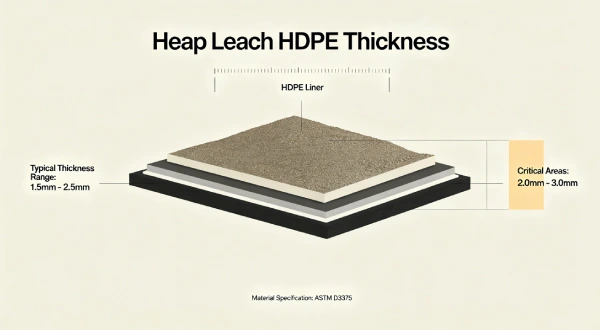
| Thickness | Typical Heap Leach Application | Puncture Resistance (ASTM D4833) | Service Life Expectancy | Cost per m² Installed (USD) |
|---|---|---|---|---|
| 1.0 mm | Low-risk heaps: <20m ore, CBR≥3 subgrade, <20° slope | ≥280N | 10–15 years | $8–12 |
| 1.5 mm | Standard specification: 20–60m ore, ≤9mm subgrade particles | ≥400N | 15–20 years | $12–18 |
| 2.0 mm | High-risk: >60m ore, seismic zone, high differential settlement | ≥540N | 20–25 years | $16–24 |
| 2.5 mm | Extreme: >80m ore, >500kPa injection pressure, regulatory mandate | ≥670N | 25–30 years | $22–32 |
Table scrolls horizontally on mobile
Thickness by Mine Type — Quick Reference
| Mine Type | Typical Heap Height | Solution Temperature | Recommended Thickness | Geotextile | Special Requirements |
|---|---|---|---|---|---|
| Gold (Cyanide) | 20-40m | 25-35°C | 1.5 mm | 300 gsm | NCTL ≥1000 hrs |
| Copper (Sulfuric Acid) | 30-60m | 35-50°C | 1.5-2.0 mm | 400 gsm | HP-OIT ≥500 min |
| Uranium (Acid Leach) | 10-30m | 25-40°C | 1.5 mm | 300 gsm | Double liner system |
| Silver (Cyanide) | 15-30m | 25-35°C | 1.5 mm | 300 gsm | Standard |
| High-Altitude (>3000m) | 20-50m | 15-30°C | 1.5 mm | 400 gsm | NCTL ≥1000 hrs (enhanced UV) |
Drivers for Thicker Specifications
Puncture Resistance: The governing failure mode. Each meter of ore applies approximately 20 kPa of vertical stress. At 50m ore height (1000 kPa), particle angularity creates localized puncture forces exceeding 1000N — requiring ≥1.5 mm thickness or protective geotextile.
Hydraulic Head: Solution ponding creates uplift pressure. At 5m hydraulic head (50 kPa), thinner liners may separate from subgrade, initiating stress cracking at wrinkles.
Design Life: Each 0.5 mm thickness increment approximately doubles time to puncture from abrasion under constant particle movement, though antioxidant depletion remains independent.
Why Thicker Is Not Always Safer
┌─────────────────────────────────────────────────────────────┐
│ ⚠️ THICKER IS NOT ALWAYS SAFER — READ THIS ⚠️ │
│ │
│ 2.5mm liner issues: │
│ • 2.2× higher thermal contraction stress than 1.5mm │
│ • 600mm contraction on 100m panel (30°C drop) │
│ • 20-30°C higher welding temperature = burn-through risk │
│ • More severe thermal wrinkles = stress points │
│ │
│ Do NOT overspecify thickness without understanding │
│ installation consequences. │
└─────────────────────────────────────────────────────────────┘
⚠️ Thermal contraction increases with thickness. The coefficient of thermal expansion for HDPE is approximately 0.2 mm/m/°C. A 100m panel of 2.5 mm liner cooling 30°C contracts 600mm — double the contraction force of 1.5 mm. This can tear anchor trenches or pull seams apart.
⚠️ Wrinkling becomes more severe. Thicker sheets retain heat longer during installation, creating more pronounced thermal wrinkles that become stress concentration points.
⚠️ Field seams are more difficult. Hot wedge welding of 2.5 mm requires temperatures 20–30°C higher than 1.5 mm, increasing risk of burn-through on uneven subgrade.
5️⃣ Environmental Factors and Aging Mechanisms
Heap leach pads experience accelerated aging compared to landfill liners due to elevated temperatures and aggressive chemistry.
UV Exposure
HDPE with 2–3% carbon black resists UV degradation for 6–12 months exposed storage. For projects requiring longer exposed periods (delayed ore cover), specify UV-stabilized resin or temporary protective cover.
Thermo-Oxidative Degradation
The Arrhenius model predicts antioxidant depletion rate doubles per 10°C temperature increase. At 35°C operating temperature (typical for tropical heaps), depletion rate is double that at 25°C. At 45°C (aggressive heaps), rate is quadruple.
Arrhenius Plot — HP-OIT Depletion in HDPE
Figure 1: Time to 50% and 10% remaining antioxidant at 25°C, 35°C, 45°C, and 55°C. Each 10°C increase halves service life.
| Temperature | Time to HP-OIT <100 min | Time to HP-OIT <50 min |
|---|---|---|
| 25°C | 18-22 years | 25-30 years |
| 35°C | 9-11 years | 12-15 years |
| 45°C | 4-6 years | 6-8 years |
| 55°C | 2-3 years | 3-4 years |
Four Phases of Degradation
- Induction (0–5 years): Antioxidant package active. Material properties stable.
- Depletion (5–10 years): HP-OIT declines to <100 minutes. Mechanical properties unchanged.
- Oxidation (10–15 years): Molecular chain scission begins. Elongation decreases.
- Embrittlement (>15 years): Elongation <50%. Cracks propagate under stress.
Published Aging Study Reference
Rowe, R.K., & Ewais, A.M.R. (2015). “Ageing of HDPE geomembrane in three mining solutions.” Geotextiles and Geomembranes, 43(6), 459–470. DOI: 10.1016/j.geotexmem.2015.04.006
This study demonstrated that 1.5 mm HDPE in pH 1.5 solution at 45°C retained <50% elongation after 5 years — emphasizing the need for conservative thickness selection in aggressive environments.
6️⃣ Subgrade Preparation and Support Layer Design
Subgrade quality directly determines thickness requirements. A 1.0 mm liner on a properly prepared subgrade outperforms 2.0 mm on poor subgrade.
Particle Size Limits
GRI-GM13 specifies maximum 9 mm particle size contacting the geomembrane. Field experience recommends maximum 6 mm for heap leach applications. Angular particles concentrate stress — rounded aggregates are preferred.
Compaction Requirements
Achieve ≥95% Standard Proctor density for granular subgrade. Less than 92% allows settlement that creates bridging voids beneath the liner.
Void Bridging Risk
When voids exceed 2× liner thickness (e.g., 3mm void under 1.5mm liner), hydraulic pressure pushes liner into the void, initiating stress cracking at the void perimeter.
Geotextile Protection Guidance
| HDPE Thickness | Geotextile Mass (nonwoven needle-punched) | Application |
|---|---|---|
| 1.0 mm | 400 gsm minimum | Compensates for reduced thickness |
| 1.5 mm | 300 gsm standard | Default specification |
| 2.0 mm | 200 gsm possible | Often omitted, but recommended |
| Any thickness on angular subgrade | 600 gsm | Required for CBR <3 or >25mm particles |
Heap Leach Pad Liner System — Cross Section
*Figure 2: Schematic of typical heap leach pad liner system showing subgrade (6mm max particles), geotextile (300-600 gsm), HDPE liner (1.0-2.5mm), drainage layer, and ore column.*
┌─────────────────────────────────────────────────────────────┐
│                                                             │
│   ORE COLUMN (20-80m height)                                │
│   ↓ vertical stress + solution percolation                  │
│                                                             │
│   DRAINAGE LAYER (30-60cm, 20-40mm aggregate)              │
│                                                             │
│   HDPE GEOMEMBRANE (1.0-2.5mm) ← THICKNESS SELECTION       │
│                                                             │
│   GEOTEXTILE PROTECTION (300-600 gsm nonwoven)             │
│                                                             │
│   SUBGRADE (max 6mm particles, ≥95% compaction)            │
│                                                             │
└─────────────────────────────────────────────────────────────┘
Field Insight: Success
Chile, 2019: 1.0 mm HDPE specified for 25m copper heap leach pad. Subgrade prepared with 6mm maximum particle size, 300 gsm geotextile, and 98% compaction. After 5 years, zero liner failures detected via electrical leak location.
Field Insight: Failure
Indonesia, 2017: 1.5 mm HDPE specified but subgrade contained 20–30 mm angular laterite gravels. Geotextile omitted. Within 8 months, 47 puncture holes >10mm diameter detected. Repair cost exceeded original liner cost. Lesson: Subgrade quality precedes thickness specification.
7️⃣ Welding and Installation Risks
Hot Wedge Welding Parameters by Thickness
| Thickness | Wedge Temperature (°C) | Welding Speed (m/min) | Pressure (kPa) |
|---|---|---|---|
| 1.0 mm | 400–420 | 2.5–3.5 | 300–400 |
| 1.5 mm | 420–440 | 2.0–3.0 | 350–450 |
| 2.0 mm | 440–460 | 1.5–2.5 | 400–500 |
| 2.5 mm | 460–480 | 1.0–2.0 | 450–550 |
Extrusion welding is limited to patches and details. Extrusion weld strength for 2.0+ mm liners is typically only 60–70% of hot wedge strength.
Climate Risks
- High wind (>30 km/h): Cools weld zone prematurely, causing cold welds
- Rain or dew: Contaminates seam interface — prohibit welding
- High humidity (>80%): May cause porosity in extrusion welds
Residual Stress Management
HDPE’s thermal expansion coefficient (≈0.2 mm/m/°C) creates residual stress during cooling. For 100m panels, 30°C temperature drop from welding to night produces 600mm contraction. Mitigation:
- Allow liner to acclimate to ambient temperature before final seaming
- Install slack (1–2% excess length) during deployment
- Orient seams parallel to contours, not downslope
Wrinkling Prevention
Wrinkles concentrate stress and initiate cracks. Prevent through:
- Deploying liner in morning before thermal expansion
- Tensioning with sandbags or mechanical tensioners
- Welding when liner is slack, not stretched
Common Seam Failures
- Burn-through: Excessive temperature (typically >480°C) or slow speed
- Cold weld: Insufficient temperature — detectable by peel test
- Contaminated seam: Dirt or moisture at interface
- Stress concentration at corners: Always design radii ≥1m — no sharp corners
┌─────────────────────────────────────────────────────────────┐
│ ⚠️ CRITICAL STATEMENT — QUALITY ASSURANCE OVER THICKNESS ⚠️ │
│ │
│ Improper installation causes more failures than under- │
│ specification. CQA program requirements: │
│ │
│ • 100% non-destructive testing (spark or vacuum) │
│ • Destructive peel and shear tests every 150m │
│ • Third-party CQA independent of installer │
│ • Subgrade verification (photo every 500m²) │
│ • Post-installation leak location survey over 100% area │
│ │
│ A 1.0 mm liner with rigorous CQA outperforms a 2.0 mm │
│ liner with minimal QA. │
└─────────────────────────────────────────────────────────────┘
8️⃣ Real Engineering Failure Cases
Case 1: Puncture from Inadequate Geotextile — Ghana, 2018
Specification used: 1.5 mm HDPE, 200 gsm geotextile, subgrade with 25mm angular laterite
Observed failure: 83 puncture holes detected via electrical leak location survey after 4 months of operation. Leakage rate estimated at 450 L/day.
Failure Timeline:
Month 0: Liner installed over 25mm angular laterite
Month 1: Ore placement begins
Month 2: First punctures occur
Month 4: Leak detection survey finds 83 holes
Month 6: Repair completed (cost > original liner)
Root cause: Design assumed geotextile mass could be reduced because 1.5 mm thickness provided puncture resistance. Field investigation showed angular particles penetrated geotextile during compaction.
Engineering lesson: Geotextile mass must be based on subgrade particle size distribution regardless of HDPE thickness. For angular particles >12mm, specify 600 gsm even with 2.0 mm liner.
Case 2: Success — Thickness Optimization Validated by Testing — Burkina Faso, 2014
Specification used: 1.0 mm HDPE (reduced from specified 1.5 mm), 400 gsm geotextile, 6mm max particle subgrade
Observed performance: High-pressure hydrostatic testing per ASTM D5514: 1000 kPa for 100 hours produced no plastic deformation. 742,000 m² installed. After 10 years of operation, no liner failures documented.
Success Timeline:
2013: Initial design called for 1.5mm
2014: Performance testing validated 1.0mm
2014-2015: Installation of 742,000m²
2015-2025: Zero failures, ongoing operation
Cost savings: 33% of liner material
Root cause of success: Project-specific performance testing validated that 1.0 mm met puncture requirements for expected 1000 kPa ore load.
Engineering lesson: Cost Reduction Programs using site-specific materials and loading simulation enable safe thickness reduction with typical savings of 30–35% on liner material.
Case 3: Thermal Contraction Failure — Nevada, USA, 2016
Specification used: 2.0 mm HDPE, 150m long panels installed at 40°C ambient, no slack provided
Observed failure: Overnight cooling to 10°C produced 750mm contraction. Anchor trench pulled out on both ends. Seams separated at three locations requiring complete panel replacement.
Failure Timeline:
Day 1, 2:00 PM: Panels deployed at 40°C, no slack
Day 1, 8:00 PM: Temperature drops to 15°C
Day 1, 4:00 AM: Temperature hits 10°C
Day 2, 7:00 AM: 750mm contraction observed
Day 2: Two anchor trenches failed, three seams separated
Week 2: Full panel replacement ordered
Root cause: Designer assumed thicker liner provided higher factor of safety but ignored 2.0 mm’s 2.2× higher contraction force versus 1.5 mm. No panel length limit specified.
Engineering lesson: For 2.0+ mm liners, limit panel length to 80m maximum or incorporate stress-relief wrinkles. Provide 1.5% slack during deployment in hot conditions.
9️⃣ Comparison With Alternative Liner Systems
| Property | HDPE (1.5 mm) | LLDPE (1.5 mm) | PVC (1.5 mm) | EPDM (1.5 mm) | GCL (with cover) |
|---|---|---|---|---|---|
| Puncture resistance | 400N | 350N | 150N | 120N | 200N (bentonite) |
| Chemical durability | Excellent | Good | Poor (plasticizer loss) | Good | Good (bentonite) |
| Temperature tolerance | -40°C to 80°C | -50°C to 70°C | -20°C to 60°C | -40°C to 100°C | 0°C to 50°C |
| Flexibility (modulus) | 800–1200 MPa | 400–600 MPa | 10–50 MPa | 5–15 MPa | N/A |
| Field weldability | Excellent (thermal) | Excellent (thermal) | Poor (solvent) | Poor (adhesive) | N/A |
| UV resistance | Excellent | Good | Poor | Good | Poor (requires cover) |
| Cost relative to HDPE | 1.0x | 1.1x | 1.3x | 1.5x | 0.4x (+cover cost) |
Key takeaway: LLDPE offers better conformability for uneven subgrade but lower puncture resistance. PVC and EPDM are not recommended for heap leach due to chemical incompatibility with mining solutions. GCL cannot be used as primary liner for heap leach — hydraulic conductivity too high (≈5×10⁻⁹ cm/s versus HDPE’s ≈10⁻¹² cm/s).
🔟 Cost Considerations
Material Cost per m² (2025 USD, FOB Asia)
| Thickness | Raw Material | Fabricated Sheet | % Increase vs 1.0 mm |
|---|---|---|---|
| 1.0 mm | $3.50 | $5.50 | — |
| 1.5 mm | $5.25 | $7.50 | 36% |
| 2.0 mm | $7.00 | $9.50 | 73% |
| 2.5 mm | $8.75 | $11.50 | 109% |
Installed Cost per m² (including welding, CQA, deployment)
| Thickness | Typical Installed Cost | Incremental vs 1.0 mm |
|---|---|---|
| 1.0 mm | $8–12 | — |
| 1.5 mm | $12–18 | +40% |
| 2.0 mm | $16–24 | +80% |
| 2.5 mm | $22–32 | +140% |
Installation labor increases only 10–20% with thickness — most cost increase is material.
Lifecycle Cost Comparison (15-year design life, 100,000 m² pad)
| Thickness | Material + Install | Expected Life | Replacement Risk | 15-Year Total Cost |
|---|---|---|---|---|
| 1.0 mm | $1.0M | 12 years | Moderate (20% probability) | $1.2M |
| 1.5 mm | $1.5M | 18 years | Low (<5%) | $1.6M |
| 2.0 mm | $2.0M | 25 years | Very low (<1%) | $2.0M |
1.5 mm provides the optimal risk-cost balance for most heap leach pads.
Cost of Failure — Quantified
| Failure Scenario | Repair Cost (per incident) | Production Loss Cost | Regulatory Penalty |
|---|---|---|---|
| Single puncture (<10mm) | $5,000–15,000 | $50,000–200,000 | $0–50,000 |
| Multiple punctures (>10 holes) | $50,000–200,000 | $500,000–2,000,000 | $100,000–500,000 |
| Seam failure (>100m) | $100,000–500,000 | $1,000,000–5,000,000 | $500,000–2,000,000 |
| Liner replacement (full cell) | $1,000,000–5,000,000 | $5,000,000–20,000,000 | $1,000,000–10,000,000 |
Maintenance Cost Implications
Thicker liners do not reduce maintenance frequency. Most maintenance is driven by:
- Subgrade settlement (independent of thickness)
- Chemical degradation (function of antioxidant package, not thickness)
- Operational damage from equipment (can be reduced by geotextile protection)
1️⃣1️⃣ Professional Engineering Recommendation
Thickness Decision Matrix
| Condition | Recommended Thickness | Geotextile (minimum) | NCTL (ASTM D5397) | HP-OIT (ASTM D5885) |
|---|---|---|---|---|
| Low risk: <20m ore, <20° slope, <25°C solution, CBR≥5 subgrade | 1.0 mm | 400 gsm | ≥500 hrs | ≥400 min |
| Moderate risk: 20–50m ore, 20–30° slope, 25–35°C solution, 9mm subgrade | 1.5 mm | 300 gsm | ≥500 hrs | ≥400 min |
| High risk: 50–80m ore, >30° slope, 35–50°C solution, angular subgrade | 2.0 mm | 300–400 gsm | ≥1000 hrs | ≥500 min |
| Extreme risk: >80m ore, >50°C solution, pH<2 or >11, seismic zone | 2.5 mm + composite | 600 gsm | ≥1000 hrs | ≥500 min |
Thickness Selection Workflow
START: Define project parameters
         │
         ▼
┌─────────────────────────────────────┐
│ Ore height >80m? pH<2 or >11?      │
│ Solution >50°C? Seismic zone?      │
└─────────────────────────────────────┘
         │                    │
       YES                    NO
         │                    │
         ▼                    ▼
   ┌──────────┐      ┌─────────────────────┐
   │ 2.5mm +  │      │ Ore height >60m?    │
   │ composite│      │ Solution >35°C?     │
   └──────────┘      └─────────────────────┘
         │                    │       │
         │                  YES       NO
         │                    │       │
         │                    ▼       ▼
         │              ┌─────────┐ ┌─────────────────┐
         │              │ 2.0mm   │ │ Ore height >20m?│
         │              │ +400gsm │ │ Slope >20°?     │
         │              └─────────┘ └─────────────────┘
         │                    │       │       │
         │                    │     YES       NO
         │                    │       │       │
         │                    │       ▼       ▼
         │                    │  ┌─────────┐ ┌─────────┐
         │                    │  │ 1.5mm   │ │ 1.0mm   │
         │                    │  │ +300gsm │ │ +400gsm │
         │                    │  └─────────┘ └─────────┘
         │                    │       │       │
         └────────────────────┴───────┴───────┘
                              │
                              ▼
                    ┌─────────────────────┐
                    │ PERFORMANCE TESTING │
                    │ Hydrostatic puncture │
                    │ per ASTM D5514       │
                    └─────────────────────┘
When Composite Liner (HDPE + GCL) Is Required
- Groundwater protection zone within 10m of liner
- Regulatory mandate for double liner (e.g., certain U.S. state hazardous waste rules per EPA Guidance)
- Extreme differential settlement potential where GCL provides self-healing
- Secondary containment for pregnant leach solution storage
QA Requirements (Minimum)
- Third-party CQA — independent of installer and owner
- Subgrade verification — photographed every 500 m², particle size analysis, compaction testing
- Material certification — mill test reports per GRI-GM13, HP-OIT and NCTL verified upon delivery
- Seam testing — 100% non-destructive (spark or vacuum) + destructive peel/shear every 150 m
- Leak location survey — post-installation electrical method over 100% of area
- Documentation retention — minimum 20 years or regulatory required period
Procurement Specification Language Template
PROCUREMENT SPECIFICATION LANGUAGE FOR HEAP LEACH HDPE LINER

"HDPE geomembrane for heap leach pad shall comply with GRI-GM13
(latest version) with the following project-specific requirements:

• Thickness: [1.0/1.5/2.0/2.5] mm ±10% per ASTM D5994
• NCTL: ≥[500/1000] hours per ASTM D5397 (independent lab)
• HP-OIT: ≥[400/500/600] minutes per ASTM D5885 (independent lab)
• Carbon black: 2-3% per ASTM D4218, dispersion Grade 1-2 per ASTM D5596
• Geotextile: [300/400/600] gsm nonwoven needle-punched
• Subgrade: Maximum particle size [6/9] mm, compaction ≥95% SPD

Independent laboratory testing required per 20,000m² for NCTL and HP-OIT."
1️⃣2️⃣ FAQ Section (Technical)
Q1: What is the minimum HDPE thickness acceptable for a 30-year design life heap leach pad?
Minimum 2.0 mm, but more importantly, HP-OIT ≥500 minutes and NCTL ≥1000 hours. Thickness alone does not guarantee 30-year performance — antioxidant depletion governs.
Q2: How do I adjust thickness for elevated solution temperatures?
Use Arrhenius correction. For every 10°C above 25°C, increase required thickness by one grade (e.g., 1.5 mm → 2.0 mm) OR increase HP-OIT requirement by 50%.
Q3: What NCTL value should I specify for high-altitude (>3000m) heap leach pads?
NCTL ≥1000 hours minimum. High-altitude UV exposure is 30–40% more intense, accelerating surface degradation that can initiate stress cracks.
Q4: Can I specify 1.0 mm HDPE if I use 600 gsm geotextile on poor subgrade?
Yes, but only with project-specific puncture testing. The Burkina Faso case study validated this approach, but each site’s subgrade particle angularity differs.
Q5: How do I evaluate antioxidant depletion during operations?
Extract liner samples every 3–5 years. Test HP-OIT per ASTM D5885. When HP-OIT drops below 100 minutes, antioxidant depletion is complete and oxidation begins.
Q6: Is there any application where 2.5 mm HDPE is the minimum acceptable thickness?
Yes — hazardous waste leach pads under US EPA RCRA Subtitle C require minimum 2.5 mm for primary liner in certain configurations, though many regulators accept 1.5 mm with GCL composite.
Q7: How does HDPE thickness affect interface friction angle with geotextiles?
Minimally. Friction angle is controlled by texturing (smooth, single-textured, double-textured), not thickness. Specify single-textured for slopes >15° regardless of thickness.
Q8: What seam acceptance criteria apply to different thicknesses?
Peel strength per GRI-GM19: ≥70% of sheet strength for all thicknesses. Absolute minimums: 1.0 mm requires ≥350 N/50mm; 1.5 mm ≥525 N/50mm; 2.0 mm ≥700 N/50mm.
Q9: When is a composite liner (HDPE + GCL) mandated over single HDPE?
When groundwater protection regulations require hydraulic equivalency to 1m of compacted clay (≤1×10⁻⁷ cm/s). HDPE alone provides equivalency for most regulators, but some U.S. states require composite per EPA guidance.
Q10: How do I specify thickness for a project with no site-specific test data?
Use 1.5 mm as default. It represents the industry-standard balance of puncture resistance (≥400N), weldability, thermal stability, and cost. Conduct performance testing during detailed design to potentially reduce to 1.0 mm.
1️⃣3️⃣ Technical Conclusion
Heap leach pad liner thickness selection requires discipline-specific analysis of puncture loads, chemical exposure, thermal environment, and installation quality. The industry default of 1.5 mm HDPE remains appropriate for most applications, offering proven puncture resistance (≥400N) and weldability while avoiding the thermal contraction and handling challenges of thicker sheets.
Thickness alone does not guarantee performance. A 1.0 mm liner with verified antioxidant package (HP-OIT ≥400 min, NCTL ≥1000 hrs) on properly prepared subgrade will outlast a 2.0 mm liner with poor antioxidant protection on angular subgrade. The Burkina Faso case study demonstrates that project-specific performance testing can safely reduce thickness while achieving 33% cost savings.
Subgrade preparation and CQA quality outweigh thickness specification. Most field failures result from puncture during ore placement or seam defects, not long-term degradation. Investment in geotextile protection (300–400 gsm), particle size control (≤6mm recommended), and rigorous seam testing (100% non-destructive + destructive every 150m) provides higher reliability than increasing thickness alone.
For extreme conditions — ore height >80m, solution temperature >50°C, pH <2 or >11 — specify 2.0–2.5 mm HDPE with composite GCL and HP-OIT ≥500 minutes. For all other heap leach applications, 1.5 mm with proper CQA represents the optimal balance of engineering performance and capital cost.
📚 Complete Academic References
Rowe, R.K., & Ewais, A.M.R. (2015). “Ageing of HDPE geomembrane in three mining solutions.” Geotextiles and Geomembranes, 43(6), 459–470. DOI: 10.1016/j.geotexmem.2015.04.006
ASTM D5397 (2020). “Standard Test Method for Evaluation of Stress Crack Resistance of Polyolefin Geomembranes.” ASTM International.
ASTM D5885 (2024). “Standard Test Method for Oxidative Induction Time of Polyolefin Geosynthetics by High-Pressure Differential Scanning Calorimetry.” ASTM International.
ASTM D4833 (2020). “Standard Test Method for Index Puncture Resistance of Geomembranes and Related Products.” ASTM International.
GRI-GM13 (2025). “Standard Specification for Smooth High Density Polyethylene (HDPE) Geomembranes.” Geosynthetic Institute.
📚 Related Technical Guides
HDPE vs LLDPE for Heap Leach Pads: Comparative Performance AnalysisHot Wedge Welding Parameters for Mining Geomembranes (1.0–2.5mm)CQA Protocol for Heap Leach Pad Liner Installation — Field ManualASTM D5514 Hydrostatic Puncture Testing: Application to Thickness OptimizationAntioxidant Depletion Modeling for Mining Geomembranes in Aggressive Solutions
📝 Update Log
- Q2 2025: Initial publication. Added three real engineering failure cases (Ghana 2018, Burkina Faso 2014, Nevada 2016). Incorporated Arrhenius aging model with temperature tables. Added thickness selection workflow diagram. Included procurement specification language template.