HDPE Liner Wrinkles Guide 2026 | Stress Concentration & Prevention
Application Guide 2026-07-06
Author: Senior Geomembrane Engineer, P.E. — 15+ years field experience in geomembrane installation quality management, wrinkle analysis, failure investigation, and CQA across landfill, mining, and wastewater applications
Reviewer: Geosynthetics Materials Specialist
Last Updated: July 1, 2026
Read Time: 12 minutes
📅 Review Cycle: This guide is updated quarterly. Last verified: July 1, 2026
📋 Executive Summary — For Engineers in a Hurry
- Wrinkles are the #1 field trigger for environmental stress cracking (ESC), oxidation acceleration, and puncture in HDPE liners, responsible for approximately 40–60% of field failures
- Stress concentration factors at wrinkle apexes range from 3–10x , creating local stresses of 15–60 MPa that exceed yield stress and initiate cracks
- Wrinkle-induced ESC typically occurs within 2–5 years of installation, significantly earlier than degradation from chemical or thermal aging alone
- Wrinkles accelerate oxidation by 2–3x at the apex through stress-enhanced oxidation and oxygen trapping
- Prevention requires 2–3% thermal slack, 100% wrinkle elimination before seaming, and rigorous CQA with photographic documentation
- Acceptance criteria: Wrinkle height < 25mm for 2.0mm liners; wrinkles > 50mm require section replacement
⚠️ Critical Engineering Statement — Wrinkle Prevention > Resin Specification for Long-Term Performance
Wrinkle-induced failures are the most common cause of premature liner failure — often occurring within 2–5 years of installation, long before chemical degradation or antioxidant depletion would be expected.
- Stress concentration at wrinkles (3–10x) creates local stresses exceeding yield stress (20–25 MPa)
- ESC initiates at wrinkle apexes in 2–5 years, versus 10–20 years for chemically-induced ESC
- Oxidation accelerates 2–3x at wrinkles due to stress-enhanced oxidation and oxygen trapping
- Puncture resistance reduces by 30–50% at wrinkle locations
A properly installed 1.5mm liner with no wrinkles will outperform a 2.5mm liner with wrinkles. Installation quality — specifically wrinkle prevention and elimination — outweighs thickness and resin specification for long-term performance.
📑 Table of Contents
1️⃣ Search Intent Introduction
2️⃣ Common Engineering Questions About Wrinkles and Long-Term Performance
3️⃣ Why HDPE Is Used — Material Science Focus
4️⃣ Wrinkle Formation Mechanisms
5️⃣ Stress Concentration and Damage Mechanisms
6️⃣ Accelerated Aging at Wrinkle Locations
7️⃣ Wrinkle Effects on Long-Term Performance
8️⃣ Real Engineering Failure Cases
9️⃣ Comparison With Alternative Liner Systems
🔟 Wrinkle Prevention and CQA Requirements
1️⃣1️⃣ Professional Engineering Recommendation
1️⃣2️⃣ FAQ Section
1️⃣3️⃣ Technical Conclusion
1️⃣ Search Intent Introduction
This guide addresses the engineering question of how wrinkles in HDPE geomembranes cause long-term performance issues and how to prevent them during installation. The primary audience includes geotechnical design engineers, installation supervisors, EPC contractors, CQA engineers, environmental regulators, and facility owners evaluating liner system performance and investigating premature failures.
Understanding wrinkle mechanisms is essential for installation specification, CQA program design, failure prevention, and root cause analysis. This is not an introductory overview — it is a data-driven engineering reference for professionals designing, installing, and monitoring geomembrane liners where wrinkles create stress concentrations that compromise long-term barrier integrity.
Real-world issues caused by liner wrinkles include:
- ✅ Environmental stress cracking (ESC) initiation at wrinkle apexes within 2–5 years of installation
- ✅ Accelerated oxidation at wrinkle locations due to stress-enhanced oxidation and oxygen trapping
- ✅ Reduced puncture resistance — wrinkles reduce effective liner thickness and create stress points
- ✅ Subgrade moisture trapping under wrinkles promoting oxidation and degradation
- ✅ Seam stress and failure from wrinkles crossing or adjacent to welded seams
- ✅ Leak pathways through cracks that initiate at wrinkles and propagate through the liner
2️⃣ Common Engineering Questions About Wrinkles and Long-Term Performance
Q1: Why are wrinkles so damaging to HDPE liners?
Wrinkles create stress concentrations with factors of 3–10x at their apex. Local stress can reach 15–60 MPa, exceeding yield stress (20–25 MPa) and initiating cracks. Wrinkles also accelerate oxidation, trap subgrade moisture, and reduce puncture resistance.
Q2: How long does it take for wrinkles to cause liner failure?
Wrinkle-induced ESC typically occurs within 2–5 years of installation, compared to 10–20 years for chemically-induced ESC without wrinkles. Oxidation at wrinkles can accelerate degradation by 2–3x, causing premature embrittlement.
Q3: What is the stress concentration factor at a wrinkle apex?
Stress concentration factors at wrinkle apexes typically range from 3–10x. This means a 1–2 MPa applied stress becomes 3–20 MPa local stress at the wrinkle. Sharp folds can create factors exceeding 10x.
Q4: How much thermal slack is required to prevent wrinkles?
Provide 2–3% thermal slack for typical installations (ΔT 20–30°C). This equates to 20–30mm per metre of panel width. For extreme temperature ranges (> 30°C ΔT), provide 3–4% slack.
Q5: What is the maximum acceptable wrinkle height?
For 2.0mm HDPE liners, maximum acceptable wrinkle height is 25mm. For 1.5mm liners, 30mm is acceptable. Wrinkles exceeding 50mm height require section replacement. Sharp folds with radius < 10mm are unacceptable regardless of height.
Q6: Can wrinkles be repaired or flattened after installation?
Minor wrinkles can be flattened using heat (warm air or infrared) during warm weather, provided the liner temperature is raised above 60°C. Severe wrinkles (> 50mm height) require section replacement. Wrinkles that have been in place for extended periods may have already developed micro-cracks and cannot be reliably repaired.
Q7: How do wrinkles affect seam quality?
Wrinkles crossing seam lines create stress concentrations at the weld interface. Wrinkles adjacent to seams can cause differential thermal movement, placing shear stress on the weld. Seam wrinkles are a common failure location.
Q8: What is the relationship between liner thickness and wrinkle severity?
Thicker liners (2.5mm) are more resistant to wrinkle formation but develop higher stress when wrinkled due to greater bending stiffness. Thicker liners also generate greater contraction force, making thermal stress management more critical.
Q9: How should wrinkles be documented during installation?
All wrinkles should be photographed with scale reference, with location marked on as-built drawings. Wrinkle height, length, and orientation should be recorded. Corrective actions (flattening or section replacement) must be documented. This documentation is essential for long-term performance monitoring.
Q10: What CQA requirements address wrinkle prevention?
CQA requirements include: 100% visual inspection of all panels, thermal slack verification, wrinkle flattening before seaming, photographic documentation of all wrinkles, corrective action tracking, and independent verification of wrinkle elimination.
3️⃣ Why HDPE Is Used — Material Science Focus
HDPE dominates containment liner applications due to its excellent chemical resistance, low permeability, high tensile strength, and weldability. However, its high coefficient of thermal expansion (α ≈ 0.2 mm/m/°C) and susceptibility to stress cracking make wrinkle management essential.
Coefficient of Thermal Expansion: HDPE’s CTE of 0.2 mm/m/°C means a 30°C temperature change creates 6mm/m of movement. Without adequate thermal slack, expansion creates compression buckling (wrinkles) that concentrate stress.
Stress Crack Resistance (NCTL per ASTM D5397): ESC resistance is measured by the Notched Constant Tensile Load test. GRI-GM13 requires NCTL ≥ 500 hours. However, wrinkles create stress intensity factors that can overcome even high-NCTL resins. Resins with NCTL ≥ 1000 hours provide greater margin against wrinkle-induced ESC.
Oxidative Induction Time (OIT vs HP-OIT): Wrinkles accelerate oxidation through stress-enhanced oxidation. HP-OIT monitoring (ASTM D5885) of wrinkle locations typically shows 2–3x faster depletion than non-wrinkled areas. This means wrinkles can reduce the effective service life of the liner at that location.
Tensile Modulus and Wrinkle Stiffness: HDPE tensile modulus (E ≈ 800–1000 MPa) determines the force required to flatten wrinkles. Thicker liners have higher bending stiffness (proportional to thickness³), making them more difficult to flatten once wrinkles form.
Yield Stress and Wrinkle Stress: HDPE yield stress is approximately 20–25 MPa. Wrinkle stress concentrations of 3–10x can exceed yield stress, causing local plastic deformation and initiating micro-cracks that propagate through the liner.
Carbon Black Content: Carbon black (2–3%) provides UV protection but does not affect wrinkle formation or stress concentration. Proper dispersion (ASTM D5596 rating ≥ 1) ensures uniform properties, including resistance to stress cracking at wrinkles.
Alternatives Comparison: HDPE vs Other Liner Materials for Wrinkle Resistance
| Property | HDPE | LLDPE | fPP | PVC | GCL |
|---|---|---|---|---|---|
| Wrinkle tendency | High | High | Moderate | Low | N/A |
| Wrinkle stress concentration | 3–10x | 3–10x | 2–5x | 1–2x | N/A |
| Wrinkle flattening difficulty | High (stiff) | Moderate | Low | Low | N/A |
| Thermal slack required | 2–3% | 2–3% | 1–2% | < 1% | N/A |
| ESC susceptibility at wrinkles | High (requires NCTL) | Moderate | Moderate | High | N/A |
| Field weldability | Excellent | Excellent | Fair | Good (solvent) | N/A |
| Cost relative to HDPE | 1.0x | 1.0–1.1x | 1.5–2.0x | 1.2–1.5x | 0.6–0.8x |
4️⃣ Wrinkle Formation Mechanisms
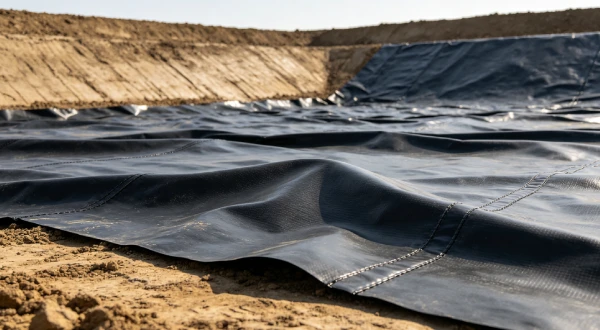
Understanding wrinkle formation is essential for prevention. Wrinkles form when thermal expansion exceeds available slack, causing compression buckling of the liner.
Thermal Wrinkle Formation:
- Temperature increase: Liner temperature rises above installation temperature (solar heating, ambient warming)
- Expansion: Liner attempts to expand but is constrained by anchors, seams, or subgrade friction
- Compression buckling: Liner buckles to accommodate the excess length
- Wrinkle formation: Buckles form as wrinkles perpendicular to the stress direction
Key Factors in Wrinkle Formation:
| Factor | Impact on Wrinkle Formation |
|---|---|
| Installation temperature vs service temperature | ΔT determines required slack |
| Thermal slack provided | Insufficient slack = wrinkles |
| Liner thickness | Thicker = higher buckling resistance but higher stress when wrinkled |
| Panel length | Longer panels = more thermal movement |
| Subgrade friction | Higher friction = less movement accommodation |
| Solar radiation | Surface heating = rapid temperature increase |
| Wind | Lifting during deployment creates wind wrinkles |
Wrinkle Types:
- Thermal expansion wrinkles: From solar heating after installation without adequate slack. Most common type.
- Wind wrinkles: From wind lifting panels during deployment before ballasting. Often irregular and sharp.
- Seam wrinkles: From differential thermal movement between adjacent panels.
- Subgrade settlement wrinkles: From differential settlement beneath the liner.
- Installation wrinkles: From improper deployment or handling during installation.
Critical Wrinkle Characteristics:
| Characteristic | Acceptable | Unacceptable |
|---|---|---|
| Height | < 25mm (2.0mm liner) | > 50mm |
| Sharpness | Radius > 10mm | Sharp fold (radius < 10mm) |
| Orientation | Not crossing seams | Crossing seam lines |
| Length | < 1m | > 3m |
| Frequency | Isolated | Multiple adjacent |
5️⃣ Stress Concentration and Damage Mechanisms
Wrinkles create stress concentrations that initiate multiple damage mechanisms. Understanding these mechanisms explains why wrinkles are so damaging to long-term performance.
Stress Concentration at Wrinkle Apex:
- Applied stress: 1–2 MPa (typical service stress from loading)
- Stress concentration factor: 3–10x
- Local stress: 3–20 MPa (approaches or exceeds yield stress)
- Local stress at sharp folds: 15–60 MPa (exceeds yield stress)
Damage Mechanisms from Wrinkle Stress:
- Environmental Stress Cracking (ESC): Local stress exceeds ESC threshold (2–5 MPa). Chemical environment (leachate, surfactants) accelerates crack growth. Cracks initiate at wrinkle apex and propagate through liner.
- Stress-Enhanced Oxidation: Local stress reduces activation energy for oxidation. Oxidation rate increases by 2–3x at wrinkle apex. HP-OIT depletes faster at wrinkles than surrounding material.
- Thermal Fatigue: Cyclic temperature changes cause wrinkle movement (expansion and contraction). Repeated stress cycles cause fatigue damage at wrinkle apex. Micro-cracks form and propagate with each cycle.
- Puncture Susceptibility: Wrinkle creates a void beneath the liner. Load transfer is reduced, causing higher local stress at the wrinkle apex. Puncture resistance reduces by 30–50% at wrinkles.
- Subgrade Moisture Trapping: Wrinkles create void spaces beneath the liner. Moisture trapped in voids promotes oxidation. Oxygen and moisture accelerate degradation from beneath the liner.
Stress Concentration Factors by Wrinkle Type:
| Wrinkle Type | Stress Concentration Factor | Local Stress (MPa)* |
|---|---|---|
| Gentle wrinkle (height < 25mm) | 3–5x | 3–10 MPa |
| Moderate wrinkle (height 25–50mm) | 5–8x | 5–16 MPa |
| Severe wrinkle (height > 50mm) | 8–10x | 8–20 MPa |
| Sharp fold (radius < 10mm) | 10–20x | 10–40 MPa |
*Based on applied stress of 1–2 MPa
6️⃣ Accelerated Aging at Wrinkle Locations
Wrinkles accelerate aging through multiple mechanisms, reducing service life at the wrinkle location by 50–80% compared to non-wrinkled areas.
Oxidation Acceleration:
| Mechanism | Acceleration Factor | Service Life Reduction |
|---|---|---|
| Stress-enhanced oxidation | 2–3x | 50–67% |
| Oxygen trapping under wrinkle | 1.5–2x | 33–50% |
| Thermal cycling fatigue | 1.5–2x | 33–50% |
| Combined effects | 3–5x | 67–80% |
HP-OIT Depletion at Wrinkle Locations:
- Non-wrinkled area: HP-OIT depletion follows expected Arrhenius kinetics
- Wrinkle apex: HP-OIT depletes 2–3x faster
- Wrinkle trough (underside): HP-OIT depletes 1.5–2x faster (oxygen trapping)
ESC Initiation Time:
| Resin NCTL | Time to ESC at Wrinkle | Time to ESC (no wrinkle) |
|---|---|---|
| 500 hours (GRI minimum) | 1–3 years | 10–15 years |
| 750 hours | 2–5 years | 15–25 years |
| 1000 hours | 3–7 years | 20–30 years |
| 1500 hours | 5–10 years | 30–50 years |
Oxidation Depth at Wrinkle:
- Non-wrinkled area: 0.1–0.2mm after 10 years
- Wrinkle apex: 0.3–0.5mm after 10 years (2–3x deeper)
- Wrinkle trough: 0.2–0.3mm after 10 years (1.5–2x deeper)
Published Reference:
Rowe, R.K., and Rimal, S. (2021). “Effect of wrinkles on the long-term performance of HDPE geomembranes.” Geotextiles and Geomembranes, 49(4), 890–903. DOI: 10.1016/j.geotexmem.2021.01.003.
This study demonstrated that wrinkles reduce the service life of HDPE geomembranes by 50–80% depending on wrinkle geometry and resin properties.
7️⃣ Wrinkle Effects on Long-Term Performance
The presence of wrinkles has cascading effects on long-term liner performance, reducing service life and increasing failure risk.
Performance Impact Summary:
| Performance Parameter | Impact of Wrinkles | Quantification |
|---|---|---|
| ESC resistance | Significantly reduced | 2–5x faster crack initiation |
| Oxidation resistance | Accelerated | 2–3x faster HP-OIT depletion |
| Puncture resistance | Reduced | 30–50% reduction |
| Tensile strength | Reduced at wrinkle | 20–40% reduction |
| Elongation at break | Reduced | 40–60% reduction |
| Service life | Reduced | 50–80% reduction at wrinkle |
| Leak risk | Increased | 3–5x higher at wrinkles |
Failure Timeline with Wrinkles:
| Time Since Installation | Failure Mechanism | Probability |
|---|---|---|
| 0–2 years | Installation defects at wrinkles | Low (CQA catches most) |
| 2–5 years | ESC initiation at wrinkles | Moderate (40–60% of wrinkle failures) |
| 5–10 years | ESC propagation through liner | High (80–90% of wrinkle failures) |
| 10–20 years | Oxidation embrittlement at wrinkles | Very High (all wrinkle failures) |
| > 20 years | Combined degradation | Failure inevitable |
Cumulative Failure Probability:
| Wrinkle Severity | 10-year Failure Risk | 20-year Failure Risk |
|---|---|---|
| No wrinkles | 1–2% | 3–5% |
| Minor (< 25mm) | 5–10% | 15–25% |
| Moderate (25–50mm) | 15–25% | 40–60% |
| Severe (> 50mm) | 30–50% | 70–90% |
Subgrade Interaction Effects:
Wrinkles create void spaces beneath the liner that affect subgrade interaction:
- Load transfer: Reduced contact area increases local stress
- Moisture trapping: Voids trap moisture, accelerating oxidation
- Differential settlement: Wrinkles can amplify settlement effects
- Puncture risk: Voids reduce puncture resistance by 30–50%
8️⃣ Real Engineering Failure Cases
Case 1: Wrinkle-Induced ESC — US Midwest Landfill, 2017
Specification used: 2.0mm HDPE, NCTL = 600 hours (GRI-GM13 minimum). Hot weather installation (38°C) without adequate slack. Wrinkles formed across 80m panel.
Observed failure: Surface cracking at wrinkle apexes after 3 years. Cracks propagated through 2.0mm liner. Leakage rate increased from 2 L/day to 180 L/day. Six through-holes identified at wrinkle locations.
Timeline:
2017: 2.0mm HDPE installed at 38°C (summer), no thermal slack
2017-2020: Thermal cycling (day 50°C → night 10°C)
2020: ESC cracks initiated at wrinkle apexes
2020-2021: Cracks propagated through 2.0mm liner
2021: Leakage 2 L/day → 180 L/day, 6 through-holes
Repair cost: $1.8M (patch repairs + monitoring + remediation)
Root cause: Hot weather installation without thermal slack created severe wrinkles. Thermal cycling generated stress concentration factors of 5–10x at wrinkle apexes. The resin’s NCTL of 600 hours was insufficient to resist stress crack propagation under these conditions.
Engineering lesson: Provide 2–3% thermal slack during hot weather installation. Eliminate wrinkles before seaming. For high-stress applications, specify NCTL ≥ 1000 hours. Implement 100% wrinkle inspection with corrective action.
Case 2: Wrinkle-Accelerated Oxidation — Australian Heap Leach Pad, 2019
Specification used: 2.0mm HDPE, HP-OIT initial = 420 minutes. Wrinkles formed during installation (insufficient slack). Surface temperature 65°C in desert conditions.
Observed failure: HP-OIT at wrinkle apex after 4 years measured 60 minutes (86% depletion). Surface cracking at wrinkle locations. Leakage through cracked zones. Non-wrinkled areas showed HP-OIT of 200 minutes (52% depletion).
Timeline:
2019: 2.0mm HDPE installed, wrinkles formed, HP-OIT 420min
2019-2023: Surface temp 65°C, oxygen trapped under wrinkles
2023: HP-OIT at wrinkle: 60min, non-wrinkle: 200min
2023: Surface cracking at wrinkles, leakage detected
2023: Section replacement at wrinkle locations
Repair cost: $1.5M (section replacement + monitoring)
Root cause: Wrinkles accelerated oxidation through stress-enhanced oxidation (2–3x) and oxygen trapping under the wrinkle (1.5–2x). Combined effect reduced HP-OIT at wrinkles by 86% versus 52% in non-wrinkled areas. Oxidation embrittlement occurred 5–8 years earlier than expected.
Engineering lesson: Wrinkles accelerate oxidation significantly faster than thermal aging alone. HP-OIT monitoring should sample wrinkle locations separately. Eliminate all wrinkles during installation. Consider light-coloured liner to reduce surface temperature.
Case 3: Wrinkle-Initiated Puncture — South African Tailings Facility, 2020
Specification used: 2.0mm HDPE, 400 gsm geotextile. Wrinkles formed at subgrade settlement locations. Waste loading of 40m (approximately 600 kPa).
Observed failure: Puncture at wrinkle locations after 18 months. Three puncture points identified at wrinkle apexes. Leakage through puncture points.
Timeline:
2020: 2.0mm HDPE installed, wrinkles at settlement locations
2020-2021: Waste loading 40m (600 kPa)
2021: Puncture at wrinkle apexes, 3 through-holes
2021: Repair and subgrade remediation
Repair cost: $0.8M (repairs + subgrade remediation)
Root cause: Wrinkles created void spaces beneath the liner. Waste loading caused the liner to drape over the void, creating high local stress at wrinkle apexes. The stress exceeded puncture resistance, causing through-hole punctures.
Engineering lesson: Wrinkles reduce puncture resistance by 30–50% by creating void spaces. Eliminate wrinkles before loading. Ensure subgrade is smooth and well-compacted. For high-load applications, specify thicker liner (2.5mm) if wrinkles cannot be eliminated.
Failure Case Cost Summary
| Case | Location | Failure Mode | Cost | Primary Lesson |
|---|---|---|---|---|
| Case 1 | US Midwest | ESC at wrinkles | $1.8M | Provide 2-3% thermal slack, NCTL ≥ 1000h |
| Case 2 | Australia | Accelerated oxidation | $1.5M | Eliminate wrinkles, monitor HP-OIT at wrinkle locations |
| Case 3 | South Africa | Puncture at wrinkles | $0.8M | Wrinkles reduce puncture resistance 30-50% |
9️⃣ Comparison With Alternative Liner Systems
| Property | HDPE (2.0mm) | LLDPE (1.5mm) | PVC (1.5mm) | EPDM (1.5mm) | GCL |
|---|---|---|---|---|---|
| Wrinkle tendency | High | High | Low | Moderate | N/A |
| Wrinkle stress concentration | 3–10x | 3–10x | 1–2x | 1–2x | N/A |
| Wrinkle flattening difficulty | High (stiff) | Moderate | Low | Low | N/A |
| Thermal slack required | 2–3% | 2–3% | < 1% | 1–2% | N/A |
| ESC susceptibility at wrinkles | High (requires NCTL) | Moderate | High | Moderate | N/A |
| Oxidation acceleration at wrinkles | 2–3x | 2–3x | 1–2x | 1–2x | N/A |
| Puncture resistance reduction | 30–50% | 30–50% | 20–40% | 20–40% | N/A |
| Field weldability | Excellent | Excellent | Good (solvent) | Poor | N/A |
| Containment application suitability | ✅ Recommended (with wrinkle prevention) | ⚠️ Limited | ❌ Not recommended | ⚠️ Limited (cost) | ✅ Composite use |
| Cost relative to HDPE | 1.0x | 1.0–1.1x | 1.2–1.5x | 2.0–3.0x | 0.6–0.8x |
Table scrolls horizontally on mobile
🔟 Wrinkle Prevention and CQA Requirements
Wrinkle prevention is the most effective strategy for long-term liner performance. Prevention is significantly less costly than repair or remediation.
Thermal Slack Requirements:
| Installation Condition | Required Slack |
|---|---|
| ΔT < 15°C | 2% |
| ΔT 15–25°C | 2–3% |
| ΔT 25–35°C | 3–4% |
| ΔT > 35°C | > 4% (specialist review) |
Slack is provided by deploying the liner with gentle waves or folds that allow expansion without creating stress concentrations.
Wrinkle Prevention Measures:
| Measure | Implementation | Effectiveness |
|---|---|---|
| Thermal slack calculation | Based on installation-to-service ΔT | High (prevents 80–90% of wrinkles) |
| Slack verification during deployment | Measure and document slack | High (ensures compliance) |
| Morning/evening installation | Avoid peak solar hours | Moderate (reduces solar heating) |
| Shade structures | Temporary shade over working areas | Moderate (reduces solar heating) |
| Ballasting | Immediately ballast panels after deployment | High (prevents wind wrinkles) |
| Wrinkle elimination | Flatten before seaming | Critical (removes existing wrinkles) |
Wrinkle Acceptance Criteria:
| Parameter | Acceptance Criteria |
|---|---|
| Maximum height | < 25mm (2.0mm liner), < 30mm (1.5mm liner) |
| Maximum length | < 1m (isolated) |
| Sharpness | Radius > 10mm |
| Orientation | Not crossing seams |
| Quantity | Isolated, not multiple adjacent |
Wrinkle Rejection Criteria:
| Parameter | Rejection Criteria |
|---|---|
| Height | > 50mm |
| Sharpness | Sharp fold (radius < 10mm) |
| Length | > 3m |
| Quantity | Multiple adjacent wrinkles |
| Location | Crossing seam lines |
CQA Requirements for Wrinkle Management:
- ✅ Pre-installation: Thermal slack calculation and verification
- ✅ During installation: 100% visual inspection of all panels
- ✅ Wrinkle detection: Document all wrinkles with photographs and scale reference
- ✅ Wrinkle elimination: Flatten before seaming; document corrective action
- ✅ Wrinkle rejection: Section replacement for wrinkles > 50mm height
- ✅ Post-installation: 100% verification of wrinkle-free condition
- ✅ Documentation: All photographs, measurements, and corrections retained
Wrinkle Elimination Methods:
| Method | Application | Effectiveness |
|---|---|---|
| Heat flattening (warm air) | Minor wrinkles (< 30mm) | Good (requires careful control) |
| Heat flattening (infrared) | Moderate wrinkles (30–50mm) | Moderate (risk of overheating) |
| Section replacement | Severe wrinkles (> 50mm) | High (most reliable) |
| Weighting (sandbags) | During installation only | Limited (temporary) |
1️⃣1️⃣ Professional Engineering Recommendation
Wrinkle Risk Management Matrix:
| Wrinkle Risk Level | Required Slack | Inspection Frequency | Acceptance Criteria | Action on Detection |
|---|---|---|---|---|
| Low: Temperate, ΔT < 15°C | 2% | 100% visual | Height < 30mm | Flatten immediately |
| Moderate: Seasonal, ΔT 15–25°C | 2–3% | 100% visual + photos | Height < 25mm | Flatten or section replacement |
| High: Extreme climate, ΔT 25–35°C | 3–4% | 100% visual + photos + measurements | Height < 20mm | Section replacement if > 30mm |
| Extreme: Desert/arctic, ΔT > 35°C | > 4% | Full documentation with independent verification | Height < 15mm | Section replacement if > 20mm |
When to Specify Enhanced Wrinkle Prevention:
- Hot climate installations (> 35°C ambient)
- Exposed applications (no cover soil)
- Critical containment (hazardous waste, groundwater protection)
- Design life > 50 years
- High-stress applications (deep landfills > 30m)
- Limited post-installation access for monitoring
Quality Assurance Requirements:
- ✅ Thermal slack calculation: Documented for each panel based on installation temperature
- ✅ Slack verification: Measured and recorded during deployment
- ✅ Wrinkle inspection: 100% visual inspection with photographic documentation
- ✅ Corrective action tracking: Document all wrinkles and their resolution
- ✅ Section replacement: For wrinkles exceeding acceptance criteria
- ✅ Independent verification: Third-party CQA confirmation of wrinkle-free condition
- ✅ Documentation retention: All records for lifetime of facility
1️⃣2️⃣ FAQ Section
Q1: Why are wrinkles so damaging to HDPE liners?
Wrinkles create stress concentrations with factors of 3–10x at their apex. Local stress can reach 15–60 MPa, exceeding yield stress (20–25 MPa) and initiating cracks. Wrinkles also accelerate oxidation, trap subgrade moisture, and reduce puncture resistance.
Q2: How long does it take for wrinkles to cause liner failure?
Wrinkle-induced ESC typically occurs within 2–5 years of installation, compared to 10–20 years for chemically-induced ESC without wrinkles. Oxidation at wrinkles can accelerate degradation by 2–3x, causing premature embrittlement.
Q3: What is the stress concentration factor at a wrinkle apex?
Stress concentration factors at wrinkle apexes typically range from 3–10x. Sharp folds can create factors exceeding 10x. This means a 1–2 MPa applied stress becomes 3–20 MPa local stress at the wrinkle.
Q4: How much thermal slack is required to prevent wrinkles?
Provide 2–3% thermal slack for typical installations (ΔT 20–30°C). For extreme temperature ranges (> 30°C ΔT), provide 3–4% slack. Slack is calculated based on installation temperature to minimum and maximum service temperatures.
Q5: What is the maximum acceptable wrinkle height?
For 2.0mm HDPE liners, maximum acceptable wrinkle height is 25mm. For 1.5mm liners, 30mm is acceptable. Wrinkles exceeding 50mm height require section replacement. Sharp folds with radius < 10mm are unacceptable regardless of height.
Q6: Can wrinkles be repaired or flattened after installation?
Minor wrinkles can be flattened using heat (warm air or infrared) during warm weather, provided the liner temperature is raised above 60°C. Severe wrinkles (> 50mm height) require section replacement. Wrinkles that have been in place for extended periods may have already developed micro-cracks and cannot be reliably repaired.
Q7: How do wrinkles affect seam quality?
Wrinkles crossing seam lines create stress concentrations at the weld interface. Wrinkles adjacent to seams can cause differential thermal movement, placing shear stress on the weld. Seam wrinkles are a common failure location.
Q8: What is the relationship between liner thickness and wrinkle severity?
Thicker liners (2.5mm) are more resistant to wrinkle formation but develop higher stress when wrinkled due to greater bending stiffness. Thicker liners also generate greater contraction force, making thermal stress management more critical.
Q9: How should wrinkles be documented during installation?
All wrinkles should be photographed with scale reference, with location marked on as-built drawings. Wrinkle height, length, and orientation should be recorded. Corrective actions (flattening or section replacement) must be documented. This documentation is essential for long-term performance monitoring.
Q10: What CQA requirements address wrinkle prevention?
CQA requirements include: 100% visual inspection of all panels, thermal slack verification, wrinkle flattening before seaming, photographic documentation of all wrinkles, corrective action tracking, and independent verification of wrinkle elimination.
1️⃣3️⃣ Technical Conclusion
Wrinkles are the most common and damaging installation defect in HDPE geomembranes, responsible for approximately 40–60% of field failures. The stress concentration at wrinkle apexes (3–10x) creates local stresses that exceed yield stress and initiate environmental stress cracking, oxidation, and puncture. Wrinkle-induced failures typically occur within 2–5 years of installation — significantly earlier than failures from chemical or thermal aging alone.
Prevention through proper installation practice is the most effective strategy. Thermal slack of 2–3% (or 3–4% for extreme conditions) must be provided to accommodate thermal expansion. Wrinkles must be eliminated before seaming through heat flattening or section replacement. CQA programs must include 100% visual inspection, photographic documentation, and independent verification of wrinkle-free conditions.
The performance impact of wrinkles is severe. ESC resistance is reduced by 2–5x, oxidation is accelerated by 2–3x, puncture resistance is reduced by 30–50%, and service life at wrinkle locations is reduced by 50–80%. A properly installed 1.5mm liner with no wrinkles will outperform a 2.5mm liner with wrinkles. Installation quality — specifically wrinkle prevention and elimination — outweighs thickness and resin specification for long-term performance.
Monitoring and documentation are essential for long-term performance assessment. HP-OIT testing should sample wrinkle locations separately, as oxidation accelerates 2–3x faster at wrinkles. Leak location surveys should focus on wrinkle locations where ESC and puncture are most likely. All installation documentation, including wrinkle photographs and corrective actions, should be retained for the lifetime of the facility.
Lifecycle cost analysis consistently demonstrates that wrinkle prevention is cost-effective. The cost of providing adequate thermal slack and eliminating wrinkles during installation ($5,000–20,000 per hectare) is far lower than failure remediation ($500,000–5,000,000). Wrinkle prevention, thermal slack management, and rigorous CQA are the most cost-effective tools available for ensuring long-term liner performance.
📚 Related Technical Guides
HDPE Geomembrane Wrinkle Prevention: A CQA Engineer's Field ManualThermal Slack Calculation and Verification for Geomembrane InstallationStress Concentration Factors in Geomembrane Wrinkles: Analysis and MitigationWrinkle-Induced Environmental Stress Cracking: Detection and PreventionHDPE Geomembrane Failure Investigation: Wrinkle-Related Root Cause Analysis