Ambient Temperature Effect on HDPE Seam Quality 2026 | Adjustments & Control
Application Guide 2026-08-19
Author: Senior Geomembrane Engineer, P.E. — 15+ years field experience in geomembrane welding quality management, seam failure investigation, and CQA across extreme climate conditions from arctic to desert environments
Reviewer: Geosynthetics Materials Specialist
Last Updated: July 14, 2026
Read Time: 13 minutes
📅 Review Cycle: This guide is updated quarterly. Last verified: July 14, 2026
📋 Executive Summary — For Engineers in a Hurry
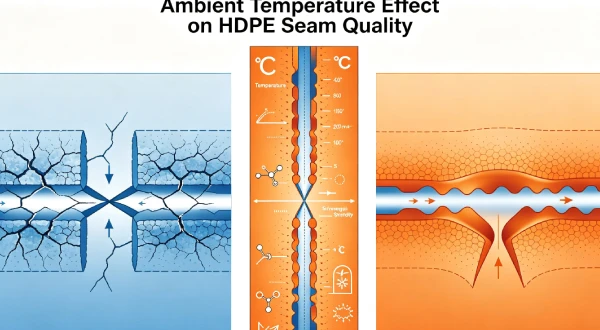
- Ambient temperature is a critical factor in HDPE seam quality — temperature variations of 20°C require 10–20% adjustments in welding speed and 15–30°C adjustments in wedge temperature
- Cold weather (< 5°C) requires speed reduction of 10–20% and temperature increase of 10–20°C to overcome heat loss to the environment
- Hot weather (> 35°C) requires speed increase of 10–20% and temperature reduction of 10–20°C to prevent burn-through from excess heat retention
- Destructive testing must be conducted under actual ambient conditions — test results from one temperature are not valid for another
- Daily parameter logging is essential — temperature, speed, and wedge temperature must be recorded and adjusted throughout the day
- The most critical temperature period is the transition — morning to midday temperature changes of 15–20°C require immediate parameter adjustments
⚠️ Critical Engineering Statement — Temperature is a Dynamic Variable, Not a Set Point
Ambient temperature changes continuously throughout the day. Welding parameters must be adjusted continuously to maintain seam quality.
- A 10°C ambient temperature change requires 5–10% speed adjustment and 10–15°C wedge temperature adjustment
- Morning-to-afternoon temperature changes of 15–20°C are common and require multiple parameter adjustments during the day
- Destructive testing must be conducted at the current temperature — parameters that pass in the morning may fail in the afternoon
- Wind and shade affect the effective ambient temperature — these factors require additional parameter adjustments
- Temperature logging is essential — without records, quality issues cannot be traced to temperature-related causes
A weld performed at 2.0 m/min and 450°C at 20°C ambient may need to be performed at 2.2 m/min and 440°C at 30°C ambient. The operator who does not adjust for temperature will produce defective welds.
📑 Table of Contents
1️⃣ Search Intent Introduction
2️⃣ Common Engineering Questions About Temperature Effects on Seams
3️⃣ Why HDPE Is Used — Material Science Focus
4️⃣ Temperature Effects on HDPE Welding
5️⃣ Cold Weather Welding — Challenges and Adjustments
6️⃣ Hot Weather Welding — Challenges and Adjustments
7️⃣ Transition Periods — Morning and Seasonal Changes
8️⃣ Real Engineering Failure Cases
9️⃣ Comparison With Alternative Liner Systems
🔟 Quality Control and CQA Requirements
1️⃣1️⃣ Professional Engineering Recommendation
1️⃣2️⃣ FAQ Section
1️⃣3️⃣ Technical Conclusion
1️⃣ Search Intent Introduction
This guide addresses the engineering question of how ambient temperature affects HDPE geomembrane seam quality and how to adjust welding parameters to maintain quality across temperature variations. The primary audience includes welding supervisors, CQA engineers, EPC contractors, installation managers, and quality control personnel responsible for seam quality in varying climate conditions.
Understanding temperature effects is essential for achieving consistent seam quality, meeting acceptance criteria, and preventing seam failures. This is not an introductory overview — it is a data-driven engineering reference for professionals responsible for welding quality across temperature extremes from arctic to desert conditions.
Real-world temperature-related challenges affecting seam quality include:
- ✅ Cold weather (< 5°C) — rapid heat loss, sheet stiffness, equipment performance
- ✅ Hot weather (> 35°C) — excess heat retention, burn-through risk, sheet softening
- ✅ Morning-to-afternoon temperature changes — 15–20°C variation requiring continuous adjustments
- ✅ Seasonal temperature changes — 30–50°C variation between summer and winter
- ✅ Wind and shade effects — localised cooling of the weld zone
- ✅ Solar radiation effects — sheet heating independent of ambient temperature
2️⃣ Common Engineering Questions About Temperature Effects on Seams
Q1: How does ambient temperature affect HDPE welding?
Ambient temperature affects heat loss from the weld zone. Cold weather increases heat loss (requiring higher temperature or slower speed), while hot weather reduces heat loss (requiring lower temperature or faster speed). The goal is consistent heat input for proper fusion.
Q2: What is the maximum ambient temperature for welding?
The maximum ambient temperature for reliable welding is typically 40°C. Above this, sheet temperatures can exceed 60–70°C, creating burn-through risk. Welding should be avoided during the hottest part of the day (> 35°C) or shade/shelter provided.
Q3: What is the minimum ambient temperature for welding?
The minimum ambient temperature for reliable welding is typically 0°C. Below this, heat loss is too rapid for consistent welds. Preheating sheets and using welding shelters can extend the minimum to -5°C. Below -5°C, welding is not recommended.
Q4: How much should welding parameters change with temperature?
For each 10°C ambient temperature change: speed should change by 5–10% (faster for hot, slower for cold), and wedge temperature should change by 10–15°C (lower for hot, higher for cold).
Q5: How does wind affect the effective ambient temperature?
Wind increases heat loss from the weld zone. The effective temperature is 5–15°C lower than the actual ambient temperature in windy conditions. Wind speeds > 20 km/h require windbreaks or welding shelters.
Q6: How does solar radiation affect welding?
Solar radiation heats the sheet surface, reducing the heat required for welding. Direct sunlight can increase sheet temperature by 20–30°C above ambient. Welding in direct sun requires faster speed or lower temperature than welding in shade.
Q7: When should welding parameters be adjusted?
Parameters should be adjusted: at the start of each day, at each significant temperature change (> 5°C), when moving from sun to shade, when wind conditions change, and when destructive testing indicates parameter adjustment is needed.
Q8: How is welding quality verified across temperature variations?
Quality is verified through: destructive testing (peel and shear) at the current temperature, non-destructive testing (air lance/vacuum) of all seams, continuous parameter logging, and daily calibration of equipment.
Q9: What happens if parameters are not adjusted for temperature?
Failure to adjust for temperature causes: cold welds in cold weather (incomplete fusion), burn-through in hot weather (thermal degradation), inconsistent weld strength, and seam failure under stress.
Q10: What is the most critical temperature-related challenge?
The most critical challenge is the morning-to-afternoon temperature transition. A 15–20°C temperature rise from morning to afternoon requires significant parameter adjustments that operators often fail to make.
3️⃣ Why HDPE Is Used — Material Science Focus
HDPE dominates containment liner applications due to its excellent chemical resistance, low permeability, high tensile strength, and weldability. Understanding the material’s thermal properties is essential for managing temperature effects on welding.
Thermal Conductivity and Heat Loss: HDPE has low thermal conductivity (approximately 0.4–0.5 W/m·K). Heat loss to the environment is significant in cold weather, requiring higher heat input. Conversely, heat retention is high in hot weather, requiring lower heat input.
Glass Transition Temperature: HDPE’s glass transition temperature (Tg) is approximately -120°C. Below this, the material becomes brittle. While this is well below typical welding temperatures, stiffness increases at low temperatures, affecting sheet handling and weld quality.
Melting Temperature: HDPE melts at 120–130°C. The welding temperature (420–490°C) is significantly higher to overcome heat loss to the environment and ensure fusion at the weld interface.
Specific Heat Capacity: HDPE has a specific heat capacity of approximately 2.0–2.2 kJ/kg·K. This determines the heat energy required to raise the sheet temperature to melting point. Cold sheets require more energy input.
Thermal Expansion Coefficient: HDPE’s CTE (0.2 mm/m/°C) affects seam stress and geometry. Temperature changes during welding can create stress in the seam as sheets expand and contract. GRI-GM19 addresses welding stress management.
Oxidative Induction Time (OIT vs HP-OIT): Excessive heat from welding (burn-through) can degrade antioxidants at the weld interface. HP-OIT testing of weld zones can detect thermal degradation. GRI-GM13 requires HP-OIT ≥ 400 minutes for new material.
Carbon Black Content: Carbon black (2–3%) affects heat absorption from solar radiation. Higher carbon black content increases solar heat absorption, requiring parameter adjustments in direct sunlight.
Alternatives Comparison: HDPE vs Other Liner Materials for Temperature Tolerance
| Property | HDPE | LLDPE | fPP | PVC | GCL |
|---|---|---|---|---|---|
| Minimum welding temperature | 0°C (with precautions) | 0°C | 5°C | Solvent weld | N/A |
| Maximum welding temperature | 40°C | 35°C | 35°C | 40°C | N/A |
| Temperature sensitivity | Moderate | Moderate | High | Low (solvent) | N/A |
| Cold weather welding difficulty | Moderate | Moderate | High | Low | N/A |
| Hot weather welding difficulty | Moderate | Moderate | High | Low | N/A |
| Field weldability in temperature extremes | Good (with precautions) | Good | Fair | Good | N/A |
| Cost relative to HDPE | 1.0x | 1.0–1.1x | 1.5–2.0x | 1.2–1.5x | 0.6–0.8x |
4️⃣ Temperature Effects on HDPE Welding
Temperature affects every aspect of HDPE welding. Understanding these effects is essential for quality control.
Temperature Zones and Required Adjustments:
| Ambient Temperature | Speed Adjustment | Temperature Adjustment | Reason |
|---|---|---|---|
| < 0°C | Reduce speed 15–20% | Increase wedge 15–20°C | Welding not recommended |
| 0–5°C | Reduce speed 10–15% | Increase wedge 10–15°C | High heat loss |
| 5–15°C | Reduce speed 5–10% | Increase wedge 5–10°C | Moderate heat loss |
| 15–25°C | Baseline speed | Baseline temperature | Optimal conditions |
| 25–35°C | Increase speed 5–10% | Decrease wedge 5–10°C | Heat retention |
| 35–40°C | Increase speed 10–15% | Decrease wedge 10–15°C | High heat retention |
| > 40°C | Increase speed 15–20% | Decrease wedge 15–20°C | Welding not recommended |
Table scrolls horizontally on mobile
Heat Input Requirements:
| Temperature Condition | Heat Input Required | Parameter Change |
|---|---|---|
| Cold (0–5°C) | High | Slow speed, high temp |
| Moderate (15–25°C) | Moderate | Baseline speed, temp |
| Hot (30–35°C) | Low | Fast speed, low temp |
| Hot (35–40°C) | Very Low | Very fast speed, low temp |
Sheet Temperature vs Ambient Temperature:
| Ambient Temperature | Sheet Temperature (sun) | Sheet Temperature (shade) |
|---|---|---|
| 0°C | 5–10°C | 0–5°C |
| 10°C | 20–30°C | 10–15°C |
| 20°C | 35–45°C | 20–25°C |
| 30°C | 50–60°C | 30–35°C |
| 40°C | 65–75°C | 40–45°C |
Table scrolls horizontally on mobile
5️⃣ Cold Weather Welding — Challenges and Adjustments
Cold weather welding presents unique challenges that require specific adjustments and precautions.
Cold Weather Challenges:
| Challenge | Effect | Mitigation |
|---|---|---|
| Rapid heat loss | Weld cools too quickly | Increase temperature, reduce speed |
| Sheet stiffness | Difficult to handle and overlap | Store sheets indoors, preheat |
| Moisture/ice on sheets | Contamination of weld | Clean and dry sheets |
| Wind chill | Increased heat loss | Wind protection required |
| Equipment performance | Wedge temperature instability | Preheat equipment |
Table scrolls horizontally on mobile
Cold Weather Parameter Adjustments:
| Parameter | 10°C | 5°C | 0°C |
|---|---|---|---|
| Speed (2.0mm) | 1.8–2.2 m/min | 1.5–1.8 m/min | 1.2–1.5 m/min |
| Wedge temperature | 455–470°C | 465–480°C | 475–490°C |
| Preheat required | No | Yes (sheets) | Yes (sheets + equipment) |
| Wind protection | Recommended | Required | Required |
Table scrolls horizontally on mobile
Cold Weather Precautions:
- ✅ Store sheets in heated area before installation (if possible)
- ✅ Clean and dry sheets before welding (no moisture or ice)
- ✅ Preheat equipment to operating temperature before starting
- ✅ Use windbreaks or welding shelters for wind > 10 km/h
- ✅ Reduce speed to allow more heat penetration
- ✅ Increase wedge temperature to compensate for heat loss
- ✅ Perform more frequent destructive testing
6️⃣ Hot Weather Welding — Challenges and Adjustments
Hot weather welding presents different challenges that require specific adjustments and precautions.
Hot Weather Challenges:
| Challenge | Effect | Mitigation |
|---|---|---|
| Excess sheet heating | Burn-through risk | Reduce temperature, increase speed |
| Sheet softening | Deformation under rollers | Adjust pressure, reduce speed |
| UV exposure | Surface degradation | Limit exposure time |
| Heat stress on operators | Reduced performance | Shade, hydration, rotation |
| Equipment overheating | Wedge temperature instability | Shade equipment, monitor |
Table scrolls horizontally on mobile
Hot Weather Parameter Adjustments:
| Parameter | 30°C | 35°C | 40°C |
|---|---|---|---|
| Speed (2.0mm) | 1.8–2.2 m/min | 2.0–2.5 m/min | 2.2–2.8 m/min |
| Wedge temperature | 440–460°C | 430–450°C | 420–440°C |
| Sheet pre-cooling | No | Recommended | Required (shade) |
| Shade required | Recommended | Required | Required |
Table scrolls horizontally on mobile
Hot Weather Precautions:
- ✅ Weld during cooler parts of the day (morning/evening)
- ✅ Provide shade for sheets and welding equipment
- ✅ Use lighter-coloured or white liners (if feasible)
- ✅ Reduce wedge temperature to prevent burn-through
- ✅ Increase speed to reduce heat exposure
- ✅ Monitor sheet temperature with infrared thermometer
- ✅ Perform more frequent destructive testing
7️⃣ Transition Periods — Morning and Seasonal Changes
Transition periods are the most critical times for parameter adjustment.
Morning Temperature Rise:
| Time | Ambient Temp | Parameter Adjustment |
|---|---|---|
| 07:00 | 10°C | Baseline speed, high temp |
| 09:00 | 15°C | Slight speed increase, temp decrease |
| 11:00 | 20°C | Moderate speed increase, temp decrease |
| 13:00 | 25°C | Significant speed increase, temp decrease |
| 15:00 | 30°C | Maximum speed, minimum temp |
Table scrolls horizontally on mobile
Seasonal Temperature Changes:
| Season | Temperature Range | Adjustment Strategy |
|---|---|---|
| Winter | -5 to 10°C | Slow speed, high temp |
| Spring | 5 to 20°C | Moderate speed, moderate temp |
| Summer | 20 to 40°C | Fast speed, low temp |
| Autumn | 10 to 25°C | Moderate adjustments |
Table scrolls horizontally on mobile
Temperature Change Speed:
| Condition | Speed of Change | Action Required |
|---|---|---|
| Gradual (> 1 hour) | Slow | Adjust parameters gradually |
| Moderate (30–60 minutes) | Moderate | Monitor and adjust |
| Rapid (< 30 minutes) | Fast | Immediate adjustment |
| Weather front | Very Fast | Stop welding until stable |
8️⃣ Real Engineering Failure Cases
Case 1: Cold Weather Cold Weld — Canadian Landfill, 2016
Specification used: 2.0mm HDPE, standard speed (2.0 m/min) and temperature (450°C) at 2°C ambient with 20 km/h wind.
Observed failure: Cold welds at seams after first winter. Seam peel strength tested at 60–80 N/25mm. Seam separation under thermal contraction.
Timeline:
2016: 2.0mm HDPE installed, 2°C ambient, 20 km/h wind
2016: Standard parameters, no cold weather adjustment
2016-2017: Winter thermal contraction
2017: Seam separation, peel strength 60-80 N/25mm
2017: Seam replacement
Cost: $1.5M (seam replacement + remediation)
Root cause: No cold weather adjustment for 2°C ambient and 20 km/h wind. Standard parameters (2.0 m/min, 450°C) were insufficient. Required adjustments: speed 1.5–1.8 m/min, temperature 465–480°C.
Engineering lesson: Cold weather (< 5°C) requires speed reduction (10–20%) and temperature increase (15–20°C). Wind requires additional adjustment. Destructive testing at actual ambient conditions.
Case 2: Hot Weather Burn-Through — Australian Heap Leach Pad, 2019
Specification used: 2.0mm HDPE, standard speed (2.0 m/min) and temperature (450°C) at 38°C ambient in direct sunlight.
Observed failure: Burn-through at weld zones after 6 months. Weld brittleness and cracking. Leakage through burned zones.
Timeline:
2019: 2.0mm HDPE installed, 38°C ambient, direct sunlight
2019: Burn-through detected, brittleness at weld
2019-2020: Seam repair, parameter adjustment
Cost: $1.2M (seam repair + remediation)
Root cause: No hot weather adjustment for 38°C ambient and direct sunlight. Standard parameters (2.0 m/min, 450°C) were excessive. Required adjustments: speed 2.2–2.8 m/min, temperature 420–440°C.
Engineering lesson: Hot weather (> 35°C) requires speed increase (10–20%) and temperature decrease (15–20°C). Direct sunlight requires additional adjustments. Weld during cooler parts of the day.
Case 3: Morning-to-Afternoon Failure — US Midwest Landfill, 2020
Specification used: 2.0mm HDPE, parameters set in the morning (10°C, 1.8 m/min, 465°C). Afternoon temperature rose to 28°C with no parameter adjustment.
Observed failure: Burn-through and cold welds in the same day. Inconsistent weld quality across the project. Seam failures identified by destructive testing.
Timeline:
2020: Morning: 10°C, parameters set
2020: Afternoon: 28°C, no parameter adjustment
2020: Burn-through and cold welds detected
2020: Seam repair, parameter logging implemented
2020-2021: Comprehensive quality control
Cost: $1.8M (seam repair + rework + monitoring)
Root cause: Parameters were set for morning temperature (10°C) but not adjusted for afternoon temperature (28°C). Morning parameters (1.8 m/min, 465°C) were too slow and too hot for afternoon conditions.
Engineering lesson: Parameters must be adjusted continuously throughout the day. Log temperature and parameters hourly. Destructive testing at multiple times during the day.
Failure Case Cost Summary
| Case | Location | Failure Mode | Cost | Primary Lesson |
|---|---|---|---|---|
| Case 1 | Canada | Cold weather cold weld | $1.5M | Adjust speed/temp for cold (< 5°C) |
| Case 2 | Australia | Hot weather burn-through | $1.2M | Adjust speed/temp for hot (> 35°C) |
| Case 3 | US Midwest | Morning-to-afternoon failure | $1.8M | Continuous parameter adjustment required |
9️⃣ Comparison With Alternative Liner Systems
| Property | HDPE (2.0mm) | LLDPE (1.5mm) | fPP (1.5mm) | PVC (1.5mm) | GCL |
|---|---|---|---|---|---|
| Minimum welding temperature | 0°C (with precautions) | 0°C | 5°C | Solvent weld | N/A |
| Maximum welding temperature | 40°C | 35°C | 35°C | 40°C | N/A |
| Temperature sensitivity | Moderate | Moderate | High | Low (solvent) | N/A |
| Cold weather adjustment required | Yes | Yes | Yes | No | N/A |
| Hot weather adjustment required | Yes | Yes | Yes | No | N/A |
| Wind protection required | Yes (> 20 km/h) | Yes (> 15 km/h) | Yes (> 10 km/h) | No | N/A |
| Field weldability in temperature extremes | Good (with precautions) | Good | Fair | Good | N/A |
| Cost relative to HDPE | 1.0x | 1.0–1.1x | 1.5–2.0x | 1.2–1.5x | 0.6–0.8x |
Table scrolls horizontally on mobile
🔟 Quality Control and CQA Requirements
Temperature Monitoring:
- ✅ Ambient temperature: Record at start of each weld and hourly
- ✅ Sheet temperature: Measure with infrared thermometer
- ✅ Wedge temperature: Check before each weld
- ✅ Wind speed: Record when > 10 km/h
Parameter Adjustment Log:
| Parameter | Recorded Data |
|---|---|
| Time | At each adjustment |
| Ambient temperature | At start and hourly |
| Sheet temperature | Before each weld |
| Wedge temperature | Before each weld |
| Welding speed | During each weld |
| Destructive test results | For each temperature condition |
Table scrolls horizontally on mobile
Destructive Testing Frequency:
| Temperature Condition | Testing Frequency |
|---|---|
| Standard (15–25°C) | Every 150m |
| Cold (5–15°C) | Every 100m |
| Cold (< 5°C) | Every 75m |
| Hot (25–35°C) | Every 100m |
| Hot (> 35°C) | Every 75m |
Table scrolls horizontally on mobile
Acceptance Criteria:
| Thickness | Peel Strength | Shear Strength |
|---|---|---|
| 1.5mm | ≥ 150 N/25mm | ≥ 200 N/25mm |
| 2.0mm | ≥ 150 N/25mm | ≥ 200 N/25mm |
| 2.5mm | ≥ 250 N/25mm | ≥ 200 N/25mm |
Table scrolls horizontally on mobile
1️⃣1️⃣ Professional Engineering Recommendation
Temperature-Based Parameter Matrix:
| Ambient Temperature | Speed Adjustment | Wedge Temperature Adjustment | Destructive Testing Frequency |
|---|---|---|---|
| < 0°C | Reduce speed 15–20% | Increase 15–20°C | Welding not recommended |
| 0–5°C | Reduce speed 10–15% | Increase 10–15°C | Every 75m |
| 5–15°C | Reduce speed 5–10% | Increase 5–10°C | Every 100m |
| 15–25°C | Baseline speed | Baseline temperature | Every 150m |
| 25–35°C | Increase speed 5–10% | Decrease 5–10°C | Every 100m |
| 35–40°C | Increase speed 10–15% | Decrease 10–15°C | Every 75m |
| > 40°C | Increase speed 15–20% | Decrease 15–20°C | Welding not recommended |
Table scrolls horizontally on mobile
When to Adjust Parameters:
- ✅ Temperature change > 5°C — immediate adjustment
- ✅ Morning to afternoon — continuous monitoring
- ✅ Sun to shade — immediate adjustment
- ✅ Wind > 10 km/h — speed reduction
- ✅ Destructive test failure — parameter investigation
Critical Quality Requirements:
- ✅ Temperature logging: Continuous, hourly records
- ✅ Parameter adjustment: Document all changes
- ✅ Destructive testing: Under actual ambient conditions
- ✅ Equipment calibration: Daily verification
- ✅ Operator training: Cold and hot weather procedures
1️⃣2️⃣ FAQ Section
Q1: How does ambient temperature affect HDPE welding?
Ambient temperature affects heat loss from the weld zone. Cold weather increases heat loss (requiring higher temperature or slower speed), while hot weather reduces heat loss (requiring lower temperature or faster speed). The goal is consistent heat input for proper fusion.
Q2: What is the maximum ambient temperature for welding?
The maximum ambient temperature for reliable welding is typically 40°C. Above this, sheet temperatures can exceed 60–70°C, creating burn-through risk. Welding should be avoided during the hottest part of the day (> 35°C) or shade/shelter provided.
Q3: What is the minimum ambient temperature for welding?
The minimum ambient temperature for reliable welding is typically 0°C. Below this, heat loss is too rapid for consistent welds. Preheating sheets and using welding shelters can extend the minimum to -5°C. Below -5°C, welding is not recommended.
Q4: How much should welding parameters change with temperature?
For each 10°C ambient temperature change: speed should change by 5–10% (faster for hot, slower for cold), and wedge temperature should change by 10–15°C (lower for hot, higher for cold).
Q5: How does wind affect the effective ambient temperature?
Wind increases heat loss from the weld zone. The effective temperature is 5–15°C lower than the actual ambient temperature in windy conditions. Wind speeds > 20 km/h require windbreaks or welding shelters.
Q6: How does solar radiation affect welding?
Solar radiation heats the sheet surface, reducing the heat required for welding. Direct sunlight can increase sheet temperature by 20–30°C above ambient. Welding in direct sun requires faster speed or lower temperature than welding in shade.
Q7: When should welding parameters be adjusted?
Parameters should be adjusted: at the start of each day, at each significant temperature change (> 5°C), when moving from sun to shade, when wind conditions change, and when destructive testing indicates parameter adjustment is needed.
Q8: How is welding quality verified across temperature variations?
Quality is verified through: destructive testing (peel and shear) at the current temperature, non-destructive testing (air lance/vacuum) of all seams, continuous parameter logging, and daily calibration of equipment.
Q9: What happens if parameters are not adjusted for temperature?
Failure to adjust for temperature causes: cold welds in cold weather (incomplete fusion), burn-through in hot weather (thermal degradation), inconsistent weld strength, and seam failure under stress.
Q10: What is the most critical temperature-related challenge?
The most critical challenge is the morning-to-afternoon temperature transition. A 15–20°C temperature rise from morning to afternoon requires significant parameter adjustments that operators often fail to make.
1️⃣3️⃣ Technical Conclusion
Ambient temperature is a critical factor in HDPE geomembrane seam quality. Temperature variations of 20°C require 10–20% adjustments in welding speed and 15–30°C adjustments in wedge temperature. Cold weather (< 5°C) requires speed reduction of 10–20% and temperature increase of 10–20°C to overcome heat loss. Hot weather (> 35°C) requires speed increase of 10–20% and temperature reduction of 10–20°C to prevent burn-through.
The most critical temperature-related challenge is the morning-to-afternoon temperature transition. A 15–20°C temperature rise from morning to afternoon requires significant parameter adjustments that operators often fail to make. Morning parameters that pass destructive testing may fail in the afternoon without adjustment.
Quality verification through destructive testing must be conducted under actual ambient conditions. Test results from one temperature are not valid for another. Destructive testing frequency should be increased in temperature extremes — every 75m in conditions < 5°C or > 35°C, compared to every 150m in standard conditions.
Wind, solar radiation, and shade affect the effective ambient temperature and require additional parameter adjustments. Wind speeds > 20 km/h require windbreaks or welding shelters. Direct sunlight can increase sheet temperature by 20–30°C above ambient, requiring faster speed or lower temperature than welding in shade.
Daily temperature logging is essential. Ambient temperature, sheet temperature, wedge temperature, speed, and destructive test results must be recorded. Without temperature records, quality issues cannot be traced to temperature-related causes. Parameter adjustments must be documented and verified through destructive testing. The cost of temperature-related seam failure ($1–5M) far exceeds the cost of temperature monitoring and parameter adjustment ($10,000–50,000 per project).
📚 Related Technical Guides
HDPE Geomembrane Welding: A CQA Engineer's Field Manual for Temperature ManagementCold Weather Welding Procedures for HDPE Liners: Techniques and PrecautionsHot Weather Welding Procedures for HDPE Liners: Burn-Through PreventionTemperature Logging and Parameter Adjustment for HDPE Seam WeldingHDPE Geomembrane Failure Investigation: Temperature-Related Seam Failures