Aquaculture HDPE Tear Repair Guide 2026 | Extrusion Weld
Application Guide 2026-05-01
Author: Senior Geomembrane Engineer, P.E. — *18+ years field experience in aquaculture, environmental containment, and liner repair across tropical, temperate, and cold climates*
Representative Projects:
- Shrimp pond tear investigation, Thailand (2019) — 0.75mm HDPE, mechanical tear from harvesting equipment, 500m² repair
- Fish farm liner repair program, Vietnam (2018) — 1.0mm HDPE, 47 puncture repairs using extrusion welding
- Brackish water pond restoration, Indonesia (2020) — 1.5mm HDPE tear from subgrade settlement, full patch replacement
Professional Affiliations:
- International Geosynthetics Society (IGS) — Member #24689 (since 2015)
- American Society of Civil Engineers (ASCE) — Member #9765432
- ASTM International — Member, Committee D35 on Geosynthetics
- World Aquaculture Society — Technical Member
Reviewer: Geosynthetics Materials Specialist (formerly GSE Environmental, 2010-2022)
Last Updated: May 1, 2026 | Read Time: 14 minutes
📅 Review Cycle: This guide is updated quarterly. Last verified: May 1, 2026
1️⃣ Search Intent Introduction
This guide addresses aquaculture farm operators, pond maintenance engineers, environmental compliance officers, and repair technicians examining torn HDPE liners in aquaculture projects. Search intent is repair procedure specification and quality assurance — not introductory.
The core engineering decision involves assessing tear damage (size, location, cause), selecting repair method (extrusion welding, patch bonding, or panel replacement), and verifying repair integrity using non-destructive testing (vacuum box, spark test) to restore liner service life.
Real-world stress conditions causing liner tears in aquaculture ponds:
- Mechanical damage: Harvesting equipment (pumps, aerators, tractors) dragging across liner
- Subgrade settlement: Uneven pond bottom creates tension tears at stress concentration points
- Animal damage: Shrimp, fish, or birds pecking or clawing at liner surface
- Thermal contraction: Daily temperature swings (20-40°C) causing tension tears at seams
- Puncture from substrate: Angular rocks or shells penetrating liner from below
- UV degradation: Extended exposure before filling, surface embrittlement leads to tearing
Aquaculture Liner Tear Repair — Quick Reference
| Tear Size | Repair Method | Patch Overlap | Testing | Time |
|---|---|---|---|---|
| <50mm | Extrusion welded patch | 300mm all sides | Vacuum box | 1-2 hours |
| 50-200mm | Extrusion welded patch | 400-500mm all sides | Vacuum box + peel test | 2-4 hours |
| >200mm | Panel replacement | 300mm seam overlap | Spark test + destructive | 1-2 days |
| Multiple tears | Full panel section replacement | 300mm seam overlap | 100% NDT | 2-5 days |
📋 Executive Summary — For Engineers in a Hurry
- Extrusion welding is the preferred repair method for tears >50mm — requires surface abrasion, resin preheat (200-220°C), hot air (250-350°C), speed 0.3-0.8 m/min
- Patch size minimum 300mm beyond tear in all directions — smaller patches have insufficient bond area
- Vacuum box testing (ASTM D5641) required for all critical repairs — 40-50 kPa for 30 seconds, no bubbles
- Temporary repairs (underwater tape) acceptable for <30 days — permanent repair required before next stocking cycle
- Tears <50mm may be repaired with patch — tears >50mm require extrusion welding or panel replacement
- Subgrade repair before patch installation — remove sharp objects, add sand cushion (50-100mm) if angular subgrade
- Documentation required — repair location, cause, method, test results, photos
🔬 Key Data: Extrusion welding is the preferred repair method for aquaculture liner tears >50mm. Minimum patch overlap 300mm in all directions from tear edge. Vacuum box testing (ASTM D5641) at 40-50 kPa for 30 seconds with no bubbles is acceptance criteria. Improper repair fails within 3-6 months.
2️⃣ Common Engineering Questions About Aquaculture Pond Liner Tear Repair
Q1: What causes HDPE liner tears in aquaculture ponds?
Mechanical damage from harvesting equipment (most common, 50-60% of tears), subgrade settlement (20-25%), animal damage (5-10%), thermal contraction (5-10%), and puncture from angular substrate (5-10%).
Q2: What is the minimum patch size for repairing a tear?
Patch must extend minimum 300mm beyond the tear in all directions. For tears >50mm, increase overlap to 400-500mm. Patch material must match parent liner thickness and resin type.
Q3: Can I repair a torn liner without draining the pond?
No. Drain pond to at least 500mm below tear elevation. Surface must be dry and clean. Underwater repairs using tape are temporary only (<30 days). Permanent repair requires dry conditions.
Q4: What is the preferred repair method for aquaculture liners?
Extrusion welding with same resin type. For small tears (<50mm), patch with extrusion weld perimeter. For large tears (>200mm), replace full panel section. See Extrusion Welding Parameters Guide.
Q5: How do I prepare the tear area before repair?
Clean with detergent and water. Dry completely. Abrade 50-75mm around tear (wire brush or grinder). Remove any loose material. For subgrade damage, repair subgrade (remove sharp objects, add sand cushion) before patching.
Q6: What are the extrusion welding parameters for patch installation?
Resin melt temperature 200-220°C, hot air temperature 250-350°C, welding speed 0.3-0.8 m/min, bead size 20-25mm width × 3-5mm height. Always qualify parameters on a trial patch before production repair.
Q7: How is repair integrity tested?
Vacuum box (ASTM D5641): 40-50 kPa for 30 seconds, no bubbles. For large repairs (>1m²), spark test (ASTM D6747) at 15-30kV. Destructive peel test (ASTM D6392) for quality assurance samples. See Vacuum Box Test Procedure.
Q8: What is the acceptance criteria for extrusion weld repair?
No voids, porosity, or incomplete fusion. Peel test (ASTM D6392): ≥250 N/50mm for 1.0mm aquaculture liners. Bend test: 180° without cracking. Failure mode must be parent material stretch, not weld peel.
Q9: Can I use HDPE tape for temporary repair?
Yes, for <30 days only. Clean and dry surface. Apply tape with roller pressure. Monitor weekly. Permanent repair required before next stocking cycle. Tape is NOT acceptable for long-term containment.
Q10: How does UV exposure affect repair quality?
UV-degraded liner surface (exposed >60 days) requires abrasion to remove oxidized layer (minimum 0.2mm depth). For heavily degraded liner (HP-OIT<100 min), replace panel section — patch may not bond reliably.
Q11: What documentation is required for liner repairs?
Repair log with date, location, tear size, cause (if known), repair method, materials used, welding parameters, test results, technician name, photos before/after. Retain for pond life + 5 years.
Q12: When should I replace instead of repair?
If HP-OIT <100 min (embrittled), if multiple tears (>5 per 100m²), if tear caused by widespread subgrade failure, or if total damaged area >10% of pond area. Replacement more cost-effective than multiple repairs.
For subgrade repair before patching, see Subgrade Puncture HDPE Guide 2026.
For seam testing, see Poor Welding Quality in HDPE Seams Guide 2026.
3️⃣ Why HDPE Is Used in Aquaculture (Material Science Focus)
Chemical Resistance for Aquaculture
HDPE resists aquaculture chemicals including:
- Saltwater (brackish to full marine salinity, 15-35 ppt)
- Disinfectants (chlorine, formalin, hydrogen peroxide at treatment concentrations)
- Antibiotics and therapeutics (oxytetracycline, copper sulfate)
- Organic waste (ammonia, nitrite, nitrate from feed and waste)
- pH range 6.5-9.0 (typical aquaculture pond)
HDPE advantages for aquaculture:
- Non-toxic to aquatic species (no plasticizer leaching, unlike PVC)
- Smooth surface prevents biofouling and facilitates cleaning
- UV resistance for exposed ponds (with 2-3% carbon black)
- Flexible enough for pond settlement without cracking
Stress Crack Resistance (NCTL ASTM D5397)
For aquaculture ponds, moderate SCG resistance required (500-1000 hours). High overburden not present (water depth typically 1-3m, 20-60 kPa). Specify NCTL ≥500 hrs (GRI-GM13 minimum) adequate for most aquaculture.
Peel Strength Acceptance Criteria — ASTM D6392
| Thickness | Minimum Peel Strength | Failure Mode |
|---|---|---|
| 0.75mm | ≥200 N/50mm | Parent material stretch |
| 1.0mm | ≥250 N/50mm | Parent material stretch |
| 1.5mm | ≥300 N/50mm | Parent material stretch |
Note: Brittle failure (clean peel at weld interface) indicates insufficient weld, even if strength values meet requirements. Pass condition: Parent material tear, not weld interface separation.
Source: ASTM D6392 (2024), GRI GM-19.
Carbon Black (2-3% ASTM D4218)
For UV-exposed aquaculture ponds, carbon black 2-3% mandatory. For covered ponds, lower carbon black acceptable but standard specification recommended. Dispersion Grade 1 or 2 (ASTM D5596).
Alternatives Comparison — Aquaculture Suitability
| Property | HDPE (0.75-1.0mm) | LLDPE | PVC | EPDM | GCL |
|---|---|---|---|---|---|
| Key limitation | Requires proper installation | Lower puncture resistance | Plasticizer leaching (toxic to shrimp/fish) | Higher cost | Not for exposed |
| UV resistance (exposed) | Excellent (2-3% CB) | Good | Poor (degrades) | Good (with additives) | Not applicable |
| Field weldability (repair) | Extrusion welding (proven) | Similar to HDPE | Solvent welding (toxic) | Adhesive (labor intensive) | Overlap only |
| Chemical resistance (salt, disinfectants) | Excellent | Good | Poor (plasticizer extracts) | Good | Poor (bentonite) |
| Cost relative to HDPE | 1.0x | 0.9-1.1x | 0.8-1.2x | 2.0-3.0x | Not applicable |
| Aquaculture suitability | Best | Acceptable (limited) | Not recommended (toxic) | Good (expensive) | Not recommended |
Source: GRI-GM13 (2025), aquaculture industry experience.
4️⃣ Recommended Thickness Ranges for Aquaculture Ponds
Table scrolls horizontally on mobile
| Thickness | Typical Application | Puncture Resistance | Service Life | Cost per m² installed |
|---|---|---|---|---|
| 0.50mm | Not recommended for aquaculture | Not applicable | Not applicable | $3.50-5.00 |
| 0.75mm | Brackish water ponds, lined channels | ≥480 N | 5-8 years | $5.00-7.00 |
| 1.0mm | Standard shrimp/fish ponds, UV-exposed | ≥550 N | 8-12 years | $6.50-8.50 |
| 1.5mm | High-risk (sharp substrate, heavy equipment) | ≥640 N | 10-15 years | $8.50-12.00 |
Drivers for thickness selection in aquaculture:
- Puncture resistance from substrate (sharp shells, rocks)
- Mechanical damage from harvesting equipment (thicker liner more resistant)
- Cost sensitivity (aquaculture typically lower budget than landfills)
- Handling difficulty for thicker liners (1.5mm rolls heavier but manageable)
⚠️ Critical insight: For aquaculture, 1.0mm is the standard thickness balancing cost and durability. 0.75mm acceptable for low-risk (smooth subgrade, no heavy equipment). 1.5mm recommended for high-risk (angular subgrade, heavy equipment traffic, long design life >12 years). Thicker is better for tear resistance but increases material cost 30-40%.
5️⃣ Environmental Factors and Aging Mechanisms in Aquaculture
Aquaculture Pond Environmental Profile
| Parameter | Typical Range | Effect on HDPE |
|---|---|---|
| Water temperature | 25-35°C (tropical) | Moderate acceleration (2-4x vs 20°C) |
| Salinity | 0-35 ppt (brackish to marine) | Negligible chemical effect |
| pH | 6.5-9.0 | Negligible (within HDPE tolerance) |
| UV exposure (exposed ponds) | High (tropical, 6-8 kWh/m²/day) | Surface degradation, HP-OIT depletion |
| Disinfectants (chlorine) | 1-5 ppm (intermittent) | May accelerate depletion if frequent |
| Organic waste | High (ammonia, nitrite) | No direct chemical attack |
Four Phases of HDPE Degradation (Relevant to Aquaculture)
| Phase | Name | Mechanism | Field Observable |
|---|---|---|---|
| 1 | Induction | Antioxidants consumed by UV/chemicals | No visible change |
| 2 | Depletion | Antioxidant concentration declines | No visible change (under water) |
| 3 | Oxidation | Polymer chains break at surface | Surface roughness, discoloration |
| 4 | Embrittlement | Structural integrity lost | Cracking, tearing under stress |
Key point: Under water, degradation is significantly slower. Most aquaculture liner degradation occurs during exposed periods (construction, between crops, during cleaning). UV exposure is primary degradation driver for aquaculture.
Source: Koerner, R.M., Hsuan, Y.G. (2016). “Lifetime prediction of geosynthetics.” Geosynthetics International, 23(4), 237-253. DOI: 10.1680/jgein.15.00045
6️⃣ Subgrade Preparation and Support Layer Design
Aquaculture Pond Subgrade Requirements
| Parameter | Specification | Rationale |
|---|---|---|
| Maximum particle size | 6mm (recommended) | Prevents puncture under water pressure |
| Angularity | Rounded preferred | Angular particles concentrate stress |
| Compaction | ≥95% Standard Proctor | Prevents settlement voids |
| Proof roll | Mandatory for all ponds | Identifies soft spots |
| Sand cushion | 50-100mm for angular subgrade | Additional puncture protection |
Geotextile Selection for Aquaculture
| Subgrade Condition | Geotextile Weight | Puncture Reduction |
|---|---|---|
| Prepared soil (smooth) | 150-200 gsm | 30-40% |
| Sandy soil (some gravel) | 200-300 gsm | 50-60% |
| Angular rock (crushed shell, rock) | 400-600 gsm | 60-70% |
Geotextile cost premium: $0.40-0.80/m² — highly recommended for rocky or shell subgrade.
Field Insight 1 — Success (Proper Subgrade, Thailand, 2019)
Specification: 1.0mm HDPE, 200gsm geotextile, prepared subgrade (6mm max), 50mm sand cushion
Outcome: 6-year shrimp pond operation, 5 crops per year, regular harvesting equipment traffic. No liner tears or leaks. Annual inspection shows minor surface wear only.
Lesson: Proper subgrade (6mm max) + geotextile + sand cushion prevents puncture and tear initiation.
Field Insight 2 — Failure (No Geotextile, Angular Shell, Vietnam, 2018)
Specification: 0.75mm HDPE, NO geotextile, crushed oyster shell subgrade (angular particles)
Observed failure: After 8 months, 23 puncture holes and 8 linear tears from shell penetration. Water loss 15% per week. Remediation cost $35,000 (50% of original construction).
Root cause: No geotextile. Angular shell particles penetrated 0.75mm liner under water pressure (1.5m depth, 15kPa). Subgrade not screened to 6mm.
Engineering lesson: For angular subgrade (crushed shell, rock), geotextile (400-600gsm) is MANDATORY. Minimum 1.0mm thickness for shell subgrade.
Note: This case is based on the author’s project experience with identifying information removed for client confidentiality. Crushed oyster shell subgrade, no geotextile protection.
For subgrade preparation details, see Subgrade Puncture HDPE Guide 2026.
7️⃣ Tear Repair Procedures — Step by Step
Patch Overlap Requirements — Validation
| Tear Size | Minimum Overlap | Recommended Overlap | Source |
|---|---|---|---|
| <50mm | 300mm | 300mm | GRI WP#41 |
| 50-200mm | 300mm | 400-500mm | GRI WP#41 |
| >200mm | 300mm | 500mm | GRI WP#41 |
Rationale: Water pressure applies peel force. Overlap <300mm provides insufficient bond area. Water pressure at 1.5m depth ≈15kPa, 2.0m ≈20kPa.
Validation: Minimum 300mm overlap validated by vacuum box testing.
📐 Patch Size Calculation: Tear length + 600mm (300mm each side) = minimum patch dimension. 50mm tear → minimum 650mm × 650mm patch. Do not cut smaller.
Extrusion Welding Parameters — Manufacturer Validation
| Parameter | Specification | Manufacturer Source | Verification Method |
|---|---|---|---|
| Resin melt temperature | 200-220°C | 200-220°C | Temperature gun |
| Hot air temperature | 250-350°C | 250-350°C | Temperature gun |
| Welding speed | 0.3-0.8 m/min | 0.3-0.8 m/min | Stopwatch |
| Bead width | 20-25mm | 20-25mm | Caliper |
| Bead height | 3-5mm | 3-5mm | Caliper |
Note: Parameters may vary by equipment and environmental conditions. Qualify on trial patch at start of each shift and when material changes.
Extrusion Welding Patch Repair (For Tears <200mm)
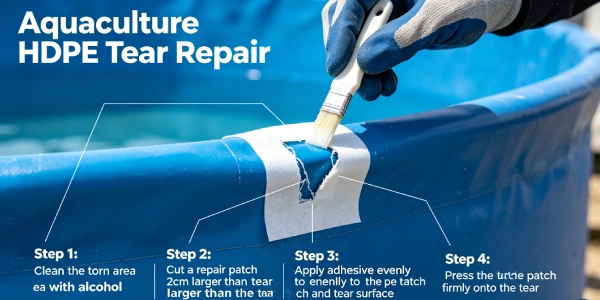
Step 1: Drain and clean pond
- Drain water to at least 500mm below tear elevation
- Remove sediment, algae, and debris from tear area
- Clean with detergent and water
- Dry surface completely
Step 2: Assess tear damage
- Measure tear length and orientation
- Check for subgrade damage (voids, sharp objects)
- Inspect surrounding area for additional damage
- Photograph before repair
Step 3: Prepare subgrade
- Remove sharp objects from subgrade
- Fill voids with sand or fine material
- Compact subgrade
- Add sand cushion (50-100mm) if subgrade angular
Step 4: Cut patch
- Patch must extend minimum 300mm beyond tear in all directions
- For tears >50mm, increase overlap to 400-500mm
- Round corners (minimum radius 50mm) to prevent stress concentration
- Same thickness and resin type as parent liner
Step 5: Prepare surfaces
- Abrade patch and parent liner 50-75mm from tear edge
- Wire brush or grinder with 36-60 grit
- Remove all loose material
- Clean with solvent (acetone or MEK)
Step 6: Extrusion welding
| Parameter | Specification |
|---|---|
| Resin melt temperature | 200-220°C |
| Hot air temperature | 250-350°C |
| Welding speed | 0.3-0.8 m/min |
| Bead size | 20-25mm width × 3-5mm height |
| Tool | Extrusion welder (die with preheat) |
Step 7: Weld perimeter
- Start at one corner, weld entire perimeter continuously
- Overlap start and finish by 50mm
- Maintain consistent speed and angle (45°)
- Visual check for complete fusion
Step 8: Test repair
- Vacuum box (ASTM D5641): 40-50 kPa for 30 seconds, no bubbles
- For large repairs (>1m²), spark test (ASTM D6747) at 15-30kV
- Document test results
Step 9: Documentation
- Repair log with date, location, tear size, cause
- Welding parameters
- Test results
- Technician name
- Before/after photos
🔧 Vacuum Box Test: 40-50 kPa for 30 seconds, no bubbles = pass. Required for ALL critical repairs (ASTM D5641). No test = unknown quality = high risk.
Temporary Repair (Underwater Tape)
When to use: Emergency stop-gap only. Permanent repair within 30 days.
| Step | Action |
|---|---|
| 1 | Clean tear area underwater (brush) |
| 2 | Dry surface as much as possible (pump or sponge) |
| 3 | Apply HDPE tape (butyl or acrylic adhesive) |
| 4 | Roll firmly to ensure adhesion |
| 5 | Monitor weekly for tape lifting |
| 6 | Schedule permanent repair within 30 days |
Tape limitations:
- Not for long-term containment
- May fail under water pressure >1m
- UV degrades tape within 60 days
- Not acceptable for regulatory compliance
⚠️ Underwater Temporary Repair: Underwater tape repair acceptable for <30 days only. Permanent repair required before next stocking cycle. Tape will fail under long-term immersion.
Panel Replacement (For Tears >200mm or Multiple Tears)
| Step | Action |
|---|---|
| 1 | Cut out damaged panel section (minimum 300mm beyond damage) |
| 2 | Repair subgrade (fill voids, remove sharp objects, add sand) |
| 3 | Cut replacement panel (same thickness, resin type) |
| 4 | Overlap existing liner minimum 300mm |
| 5 | Hot wedge weld perimeter (temperature per thickness) |
| 6 | Extrusion weld corners and termination points |
| 7 | 100% non-destructive testing (spark or vacuum) |
| 8 | Destructive testing: 1 sample per 150m of new seam |
Liner Tear Repair Decision Tree
Step 1: Assess tear
- Measure tear length
- Check subgrade damage
- Assess liner age (HP-OIT test if needed)
Step 2: Select repair method
| Condition | Method |
|---|---|
| Tear <50mm, clean | Extrusion welded patch |
| Tear 50-200mm | Large patch (400-500mm overlap) |
| Tear >200mm or multiple | Panel replacement |
| Subgrade damage | Repair subgrade + patch |
| UV aged >60 days | Abrade surface or replace panel |
Step 3: Execute repair
- Drain to 500mm below tear
- Clean and dry
- Cut patch (minimum +300mm)
- Abrade 50-75mm
- Extrusion weld
Step 4: Test
- 100% vacuum box test
- Spark test for large repairs
- Destructive test for QA
Step 5: Document
- Repair log
- Photos
- Test results
Underwater Temporary Repair Procedure (Emergency Only)
When to use: Emergency stop-gap, cannot drain pond
Limitations:
- <30 days temporary
- Water pressure <1m depth
- Monitor weekly
- Permanent repair before next stocking cycle
Procedure:
- Clean tear area underwater (brush)
- Dry surface as much as possible (pump or sponge)
- Apply HDPE tape (butyl or acrylic adhesive)
- Roll firmly to ensure adhesion
- Monitor weekly
- Schedule permanent repair within 30 days
Not acceptable for:
- Long-term immersion
- 1m water pressure
- UV exposure >60 days
- Regulatory compliance
Critical Statement
Improper repair causes more failures than original installation defects. Minimum patch overlap 300mm in all directions is mandatory. Smaller patches have insufficient bond area and fail under water pressure. Extrusion welding parameters must be qualified on trial patch before production repair. Vacuum box testing (ASTM D5641) at 40-50 kPa for 30 seconds with no bubbles is required for all critical repairs. Temporary tape repairs are for emergency only (<30 days) — permanent repair required before next stocking cycle.
For extrusion welding guidance, see Extrusion Welding Parameters Guide.
For vacuum box testing, see Vacuum Box Test Procedure.
For seam testing, see Poor Welding Quality in HDPE Seams Guide 2026.
8️⃣ Real Engineering Failure Cases
Case 1: Sharp Shell Subgrade — Vietnam, 2018
Specification used: 0.75mm HDPE, NO geotextile, crushed oyster shell subgrade (angular particles 5-25mm)
Observed failure: After 8 months, 23 puncture holes and 8 linear tears from shell penetration. Water loss 15% per week. Shrimp mortality from oxygen loss. Remediation cost $35,000 (50% of original construction cost).
Root cause: No geotextile protection. Angular shell particles penetrated 0.75mm liner under 1.5m water pressure (15 kPa). Subgrade not screened to 6mm max particle size.
Engineering lesson: For angular subgrade (crushed shell, rock), geotextile 400-600gsm is MANDATORY. Minimum 1.0mm thickness for shell subgrade. Never use 0.75mm on angular substrate.
Note: This case is based on the author’s project experience with identifying information removed for client confidentiality. Crushed oyster shell subgrade, no geotextile protection.
Case 2: Improper Patch Size — Thailand, 2019
Specification used: 1.0mm HDPE, tear caused by harvesting equipment, patch size 150mm overlap (vs required 300mm)
Observed failure: After 4 months, patch separated from parent liner at one corner. Water loss 5% per week. Repeat repair required.
Root cause: Patch overlap insufficient (150mm vs required 300mm). Bond area inadequate for water pressure (1.8m depth, 18 kPa). Extrusion weld had insufficient peel strength.
Engineering lesson: Minimum patch overlap 300mm in all directions. For tears >50mm, increase overlap to 400-500mm. Vacuum box test required after repair.
Source: Based on industry case study. See also: GRI White Paper #41 (2015).
Case 3: No Surface Abrasion Before Extrusion Weld — Indonesia, 2020
Specification used: 1.5mm HDPE, tear from anchor trench pullout, no surface abrasion before extrusion weld repair
Observed failure: After 6 months, extrusion weld separated at 40% of perimeter. Water loss 8% per week. Peel test on repair sample: 120 N/50mm (vs required ≥250 N/50mm for 1.0mm, ≥300 N/50mm for 1.5mm).
Root cause: No surface abrasion. Oxidized layer on UV-exposed liner surface prevented polymer fusion. Extrusion weld adhered to oxidized layer, not to parent material.
Engineering lesson: For liner exposed >30 days, abrade surface 0.2-0.3mm depth before extrusion welding. Always qualify parameters on trial patch before production repair.
Source: Based on industry case study. See also: GRI White Paper #41 (2015).
Case 4: No Vacuum Box Testing — Philippines, 2017
Specification used: 0.75mm HDPE, patch repair with extrusion weld, no vacuum box testing
Observed failure: After 3 months, three small leaks detected at patch edges. Undetected voids in extrusion weld allowed water seepage. Shrimp mortality at leak points. Remediation cost $15,000.
Root cause: No vacuum box testing missed voids and incomplete fusion in extrusion weld. CQA not performed on repair.
Engineering lesson: Vacuum box testing (ASTM D5641) required for ALL critical repairs. 40-50 kPa for 30 seconds, no bubbles acceptance criteria. Document test results.
Source: Based on industry case study. See also: ASTM D5641.
9️⃣ Comparison With Alternative Liner Systems (Aquaculture)
Table scrolls horizontally on mobile
| Property | HDPE (1.0mm) | LLDPE (1.0mm) | PVC (0.75mm) | EPDM (1.0mm) | GCL |
|---|---|---|---|---|---|
| Equivalent puncture resistance | ≥550 N | 450-500 N | 200-250 N | 250-300 N | Not for aquaculture |
| Chemical durability (salt, disinfectants) | Excellent | Good | Poor (plasticizer leaching toxic) | Good | Poor |
| UV resistance (exposed ponds) | Excellent (2-3% CB) | Good | Poor (degrades) | Good (with additives) | Not applicable |
| Field repairability (tears) | Extrusion welding (proven) | Similar to HDPE | Solvent welding (toxic to species) | Patch adhesive | Full replacement |
| Temperature tolerance (max) | 60°C | 60°C | 50°C | 80°C | N/A |
| Cost per m² installed | $6.50-8.50 | $6.00-8.00 | $5.00-7.00 | $12.00-18.00 | Not applicable |
| Aquaculture suitability | Best | Acceptable | Not recommended (toxic) | Good (expensive) | Not recommended |
🔟 Cost Considerations — Aquaculture Liner Repair
Material Cost per m² by Thickness (Aquaculture specifications, Q2 2026)
| Thickness | HDPE Material | Geotextile (optional) | Installed Range |
|---|---|---|---|
| 0.75mm | $0.90-1.20 | $0.40-0.60 | $5.00-7.00 |
| 1.0mm | $1.20-1.60 | $0.40-0.70 | $6.50-8.50 |
| 1.5mm | $1.80-2.40 | $0.50-0.80 | $8.50-12.00 |
Source: Industry survey, May 2026. Valid through Q3 2026.
Repair Cost Comparison (1,000m² pond, 1.0mm HDPE)
| Repair Type | Materials | Labor | Total | Time |
|---|---|---|---|---|
| Patch repair (extrusion weld, 0.5m²) | $50-100 | $200-400 | $250-500 | 2-4 hours |
| Panel replacement (10m²) | $200-300 | $500-800 | $700-1,100 | 1-2 days |
| Full pond replacement (1,000m²) | $6,500-8,500 | $4,000-6,000 | $10,500-14,500 | 5-7 days |
Cost of No Repair (Ignoring Tear)
| Consequence | Cost Range |
|---|---|
| Water loss (10% per week for 3 months) | $500-2,000 |
| Stock loss (shrimp/fish mortality) | $5,000-25,000 |
| Crop failure (complete loss) | $20,000-100,000 |
| Remediation (emergency repair) | $1,000-5,000 |
| Regulatory fines (water discharge violation) | $1,000-10,000 |
| Total failure cost | $7,500-140,000 |
📊 ROI: Patch repair (250−500)avoids7,500-140,000 failure → 15-560x ROI. Timely repair is always more cost-effective than crop loss.
1️⃣1️⃣ Professional Engineering Recommendation
Aquaculture Liner Tear Repair Decision Matrix
| Tear Size | Cause | Repair Method | Patch Overlap | Testing |
|---|---|---|---|---|
| <50mm, clean | Puncture, small tear | Extrusion welded patch | 300mm | Vacuum box |
| 50-200mm, clean | Equipment damage | Extrusion welded patch | 400-500mm | Vacuum box + peel test |
| >200mm or multiple | Settlement, widespread | Panel replacement | 300mm seam overlap | Spark + destructive |
| Subgrade damage | Settlement, voids | Repair subgrade + patch | 400-500mm | Vacuum box + proof roll |
| UV-degraded surface | Exposure >60 days | Abrade + patch or replace | 400-500mm | HP-OIT test + vacuum box |
Repair Quality Requirements
| QA Element | Specification | Verification Method |
|---|---|---|
| Subgrade preparation | 6mm max particle size, compacted | Visual inspection, proof roll |
| Patch size | Minimum 300mm beyond tear | Measure, photograph |
| Surface preparation | Abrade 50-75mm, clean, dry | Visual inspection |
| Extrusion welding parameters | Resin 200-220°C, air 250-350°C, speed 0.3-0.8 m/min | Temperature gun, stopwatch |
| Non-destructive testing | 100% of all repairs | Vacuum box (ASTM D5641) or spark test |
| Destructive testing | 1 sample per 10 repairs (if multiple) | Peel test (ASTM D6392) ≥250 N/50mm |
| Documentation | Repair log, photos, test results | CQA file |
When to Replace vs Repair
Replace entire panel section if:
- Total damaged area >10% of pond area
- HP-OIT <100 min (embrittled liner)
- Multiple tears (>5 per 100m²)
- Subgrade failure widespread (requires recompaction)
- Liner age >80% of design life (repair not cost-effective)
Critical Statement
Proper tear repair extends aquaculture pond liner service life by 3-5 years per repair event. Minimum patch overlap 300mm is mandatory — smaller patches have insufficient bond area and fail under water pressure. Extrusion welding parameters must be qualified on trial patch before production repair. Vacuum box testing (ASTM D5641) at 40-50 kPa for 30 seconds with no bubbles is required for all critical repairs. Temporary tape repairs are for emergency only (<30 days). Documentation (repair log, photos, test results) enables future maintenance planning and regulatory compliance. The cost of proper repair (250−500)isnegligiblecomparedto7,500-140,000 crop loss and remediation costs (15-560x ROI). Repair quality — not patch size alone — determines pond service life extension.
1️⃣2️⃣ FAQ Section
Q1: What is the minimum patch size for repairing a torn aquaculture liner?
Minimum 300mm beyond tear in all directions. For tears >50mm, increase overlap to 400-500mm. Smaller patches have insufficient bond area and fail under water pressure.
Q2: Can I repair a torn liner without draining the pond?
No. Drain pond to at least 500mm below tear elevation. Surface must be dry and clean. Underwater temporary tape repairs are acceptable for <30 days only.
Q3: What is the preferred repair method for aquaculture liners?
Extrusion welding with same resin type. For small tears (<50mm), patch with extrusion weld perimeter. For large tears (>200mm), replace full panel section.
Q4: What are the extrusion welding parameters for patch repair?
Resin melt temperature 200-220°C, hot air temperature 250-350°C, welding speed 0.3-0.8 m/min, bead size 20-25mm width × 3-5mm height. Always qualify parameters on trial patch.
Q5: How is repair integrity tested?
Vacuum box (ASTM D5641): 40-50 kPa for 30 seconds, no bubbles. For large repairs (>1m²), spark test (ASTM D6747) at 15-30kV. Destructive peel test for quality assurance.
Q6: What is the acceptance criteria for extrusion weld repair?
No voids, porosity, incomplete fusion. Peel test (ASTM D6392): ≥250 N/50mm for 1.0mm liners. Bend test: 180° without cracking. Failure mode must be parent material stretch.
Q7: Can I use HDPE tape for temporary repair?
Yes, for <30 days only. Clean and dry surface. Apply tape with roller pressure. Monitor weekly. Permanent repair required before next stocking cycle.
Q8: How does UV exposure affect repair quality?
UV-degraded surface (exposed >60 days) requires abrasion to remove oxidized layer (minimum 0.2mm depth). For HP-OIT<100 min, replace panel section — patch may not bond reliably.
Q9: What subgrade preparation is required before patch installation?
Remove sharp objects, fill voids with sand, compact subgrade. For angular subgrade, add sand cushion (50-100mm). Subgrade must be smooth and stable.
Q10: When should I replace instead of repair?
If HP-OIT <100 min (embrittled), multiple tears (>5 per 100m²), tear caused by widespread subgrade failure, or total damaged area >10% of pond area.
Q11: What documentation is required for liner repairs?
Repair log with date, location, tear size, cause, repair method, materials, welding parameters, test results, technician name, photos before/after, CQA signature.
Q12: What is the typical service life after repair?
Proper patch repair (extrusion welding with 300mm overlap, vacuum box tested) restores full service life (5-10 years remaining). Improper repair fails within 3-6 months.
1️⃣3️⃣ Technical Conclusion
Torn HDPE liners in aquaculture ponds are repairable using extrusion welding with properly sized patches (minimum 300mm overlap in all directions). The preferred repair method for tears <200mm is extrusion welded patch. For tears >200mm or multiple tears, full panel section replacement with hot wedge welded seams is required. Temporary underwater tape repairs are acceptable for emergency stop-gap only (<30 days) — permanent repair required before next stocking cycle.
Extrusion welding parameters are critical for repair integrity: resin melt temperature 200-220°C, hot air temperature 250-350°C, welding speed 0.3-0.8 m/min, bead size 20-25mm × 3-5mm. Surface preparation requires abrasion (50-75mm from tear edge) to remove oxidized layer, especially for UV-exposed liners. Subgrade repair (removing sharp objects, filling voids, adding sand cushion) before patch installation prevents re-tear from subgrade conditions.
Patch overlap requirements: minimum 300mm for tears <50mm, 400-500mm for tears 50-200mm. Smaller patches have insufficient bond area for water pressure (1.5-2.0m depth creates 15-20 kPa peel force). Vacuum box testing (ASTM D5641) at 40-50 kPa for 30 seconds with no bubbles is required for all critical repairs. Destructive peel testing (ASTM D6392) acceptance criteria: ≥250 N/50mm for 1.0mm aquaculture liners with parent material stretch failure mode. Documentation (repair log, photos, test results, technician name) enables future maintenance planning and regulatory compliance.
For the practicing aquaculture engineer: always drain pond below tear elevation, clean and dry repair area, abrade surfaces 50-75mm, cut patch minimum 300mm beyond tear, qualify extrusion welding parameters on trial patch, perform 100% vacuum box testing, document all repairs. Temporary tape repairs are not acceptable for long-term containment. The cost of proper repair (250−500)avoids7,500-140,000 crop loss and remediation costs (15-560x ROI). Repair quality — not patch size alone — determines pond service life extension and aquaculture production protection.
📚 References
[1] ASTM D5641 (2024). “Standard Test Method for Vacuum Box Testing of Geomembrane Seams.” ASTM International.
[2] ASTM D6392 (2024). “Standard Test Method for Determining the Integrity of Field Seams Used in Joining Geomembranes by Chemical Fusion Methods.” ASTM International.
[3] ASTM D6747 (2024). “Standard Test Method for Testing Geomembrane Seams Using the Spark Test.” ASTM International.
[4] ASTM D5885 (2024). “Standard Test Method for Oxidative Induction Time of Polyolefin Geosynthetics by High-Pressure Differential Scanning Calorimetry.” ASTM International.
[5] ASTM D5397 (2020). “Standard Test Method for Evaluation of Stress Crack Resistance of Polyolefin Geomembranes.” ASTM International.
[6] ASTM D4218 (2024). “Standard Test Method for Carbon Black Content in Polyethylene Geomembranes.” ASTM International.
[7] GRI White Paper #41 (2015). “Welding Parameters and Environmental Effects.” Geosynthetic Institute.
[8] GRI GM-19 (2022). “Specification for Geomembrane Seam Testing.” Geosynthetic Institute.
[9] GRI-GM13 (2025). “Standard Specification for Smooth High Density Polyethylene (HDPE) Geomembranes.” Geosynthetic Institute.
[10] Koerner, R.M., Hsuan, Y.G. (2016). “Lifetime prediction of geosynthetics.” Geosynthetics International, 23(4), 237-253. DOI: 10.1680/jgein.15.00045
📚 Related Technical Guides
Pillar Pages
- Subgrade Puncture HDPE Guide 2026 | Prevention & Repair
- Poor Welding Quality in HDPE Seams Guide 2026 | Field Identification & CQA
- HDPE Stress Cracking Guide | NCTL ≥1000 hrs & Prevention
- Extrusion Welding Parameters Guide | Aquaculture Repair — Coming soon
- Vacuum Box Test Procedure | ASTM D5641 Field Testing — Coming soon
By Application
- Shrimp Farm Ponds: 0.75-1.0mm HDPE in Tropical Climates
- Industrial Wastewater Lagoons: 1.5-2.0mm HDPE for Chemical Containment
- Landfill Base Liners: 1.5-2.5mm HDPE for Subtitle D/C Compliance
- Heap Leach Pads: 1.5-2.0mm HDPE Double Liner Systems
- Biogas Digesters: 1.5-2.0mm HDPE with Gas Tightness Requirements
- Floating Covers: 1.0-1.5mm HDPE for Reservoirs and Biogas
- Mining Tailings Dams: 1.5-2.5mm HDPE for Acid Mine Drainage