Textured HDPE Liner Installation Guide 2026 | Procedures & Quality Control
Application Guide 2026-08-15
Author: Senior Geomembrane Engineer, P.E. — 15+ years field experience in textured geomembrane installation, slope stability design, and CQA across landfill, mining, and wastewater projects
Reviewer: Geosynthetics Materials Specialist
Last Updated: August 12, 2026
Read Time: 14 minutes
📅 Review Cycle: This guide is updated quarterly. Last verified: August 12, 2026
📋 Executive Summary — For Engineers in a Hurry
- Textured liners provide 2–3x higher interface friction than smooth liners, essential for slope stability in steep applications (> 3H:1V)
- Installation of textured liners presents unique challenges — texture wears off during handling, welding is more difficult, and damage is harder to detect
- Welding parameters require adjustment — textured liners need 10–20% higher temperature and 15–25% slower welding speed than smooth liners
- Surface preparation is critical — texture height must be verified (typically 0.25–0.50mm) and contamination removed before welding
- Damage detection is more difficult — visual inspection is less effective on textured surfaces; leak location surveys are essential
- CQA requirements are more stringent — increased inspection frequency, texture verification, and specialised welding oversight are required
⚠️ Critical Engineering Statement — Textured Liners Are Not Smooth Liners With Texture
Textured liners require fundamentally different installation approaches. The texture changes handling, welding, inspection, and quality control procedures. Treating textured liners as smooth liners with texture leads to installation failures.
- Texture wears off during handling — damage to the texture reduces slope stability and creates weak points
- Welding is more difficult — texture creates air pockets and contamination risks; welding parameters must be adjusted
- Damage is harder to detect — texture hides punctures and abrasion; visual inspection alone is insufficient
- CQA must be more stringent — texture verification, specialised welding inspection, and leak location surveys are essential
- Cost is higher — material cost is 20–40% higher than smooth liners, and installation requires more time and oversight
A textured liner installed with smooth liner procedures will fail. Textured liners demand specialised installation expertise and rigorous quality control.
📑 Table of Contents
1️⃣ Search Intent Introduction
2️⃣ Common Engineering Questions About Textured Liner Installation
3️⃣ Why Textured HDPE Is Used — Material Science Focus
4️⃣ Texture Types and Specifications
5️⃣ Handling and Deployment Challenges
6️⃣ Welding Textured Liners — Parameters and Procedures
7️⃣ Quality Control and CQA Requirements
8️⃣ Real Engineering Failure Cases
9️⃣ Comparison With Alternative Liner Systems
🔟 Cost Considerations
1️⃣1️⃣ Professional Engineering Recommendation
1️⃣2️⃣ FAQ Section
1️⃣3️⃣ Technical Conclusion
1️⃣ Search Intent Introduction
This guide addresses the engineering question of how to install textured HDPE geomembranes correctly, what unique challenges they present, and what quality control measures are required. The primary audience includes geotechnical design engineers, installation supervisors, CQA engineers, EPC contractors, and facility owners specifying and installing textured liners for slope stability.
Understanding textured liner installation requirements is essential for achieving slope stability, maintaining weld quality, and ensuring long-term performance. This is not an introductory overview — it is a data-driven engineering reference for professionals installing textured geomembranes.
Real-world challenges in textured liner installation include:
- ✅ Texture wear — surface texture can be damaged during handling, reducing interface friction
- ✅ Welding difficulty — texture creates air pockets and contamination risks
- ✅ Damage detection — texture hides punctures and defects
- ✅ Handling complexity — textured liners are stiffer and more difficult to deploy
- ✅ CQA intensity — more inspections and testing are required
- ✅ Cost — material and installation costs are higher than smooth liners
2️⃣ Common Engineering Questions About Textured Liner Installation
Q1: What is the primary benefit of textured liners?
Textured liners provide 2–3x higher interface friction than smooth liners, essential for slope stability in steep applications (> 3H:1V). The texture increases the coefficient of friction between the liner and subgrade (or overlying materials).
Q2: What are the common texture types for HDPE liners?
Common texture types include: structured (raised studs or bumps), co-extruded (textured layer bonded during manufacturing), and spray-applied (texture applied after manufacturing). Structured textures are most common for slope stability applications.
Q3: How does texture affect welding?
Texture creates air pockets and contamination risks at the weld interface. Welding requires: 10–20% higher temperature, 15–25% slower welding speed, and 10–15% higher roller pressure. The texture must be removed (ground or scraped) from the weld zone.
Q4: How much texture is typically required for slope stability?
Texture height typically ranges from 0.25–0.50mm for standard applications. Interface friction angles increase from 10–15° (smooth) to 25–35° (textured). Higher texture heights provide greater friction.
Q5: How should textured liners be handled to prevent texture damage?
Handling requirements include: use spreader bars for lifting, avoid dragging across subgrade, protect edges, use padded slings, and avoid stacking rolls that could damage texture. Texture damage reduces interface friction and creates weak points.
Q6: How does textured liner installation cost compare to smooth liner?
Textured liner material cost is 20–40% higher than smooth liner. Installation cost is 15–25% higher due to slower welding, more handling care, and increased CQA requirements. Total installed cost is 25–50% higher.
Q7: What CQA requirements are different for textured liners?
CQA requirements include: texture height verification (before and after handling), specialised welding inspection (texture removal verification), increased destructive testing frequency (every 100m vs 150m), and 100% leak location survey.
Q8: How should textured liners be inspected for damage?
Damage detection on textured liners is more difficult. Inspection methods include: visual inspection (with bright light), touch inspection (feeling for defects), leak location surveys (100% after installation), and destructive testing of suspect areas.
Q9: Can textured liners be repaired?
Repairs on textured liners are more difficult. The texture must be removed around the repair zone (50–100mm), and the repair must be welded or patched. Texture cannot be restored after repair — the repaired area will be smooth.
Q10: What is the service life of textured liners?
Textured liners have similar service life to smooth liners (50–100+ years) if properly installed. However, texture wear can reduce slope stability over time. Texture height should be monitored during the design life.
3️⃣ Why Textured HDPE Is Used — Material Science Focus
Textured HDPE combines the chemical resistance and durability of HDPE with enhanced interface friction for slope stability.
Interface Friction Enhancement: Textured surfaces increase interface friction by 2–3x compared to smooth surfaces. The texture creates mechanical interlock with soil, geotextile, or other materials. Interface friction angles increase from 10–15° (smooth) to 25–35° (textured) with GCLs and from 15–20° to 30–40° with soils.
Texture Durability: Texture durability depends on the manufacturing method (structured, co-extruded, or spray-applied). Structured textures are most durable; spray-applied textures are most susceptible to wear. GRI-GM13 provides texture specifications.
Stress Crack Resistance (NCTL per ASTM D5397): Texture can affect stress crack resistance. Specifying NCTL ≥ 1000 hours is recommended for textured liners. GRI-GM13 requires NCTL ≥ 500 hours.
Oxidative Induction Time (OIT vs HP-OIT): Texture does not significantly affect antioxidant depletion. HP-OIT testing should be on base material, not texture. GRI-GM13 requires HP-OIT ≥ 400 minutes.
Tensile Strength: Textured liners have similar tensile strength to smooth liners (20–25 MPa). The texture does not significantly affect tensile properties but can create stress concentrations if damaged.
Alternatives Comparison: Textured HDPE vs Other Liner Materials for Slope Stability
| Property | Textured HDPE | Smooth HDPE | LLDPE | PVC | GCL |
|---|---|---|---|---|---|
| Interface friction | 25–35° | 10–15° | 10–15° | 10–15° | 20–30° |
| Slope stability | Excellent | Poor | Poor | Poor | Good |
| Texture durability | Good | N/A | N/A | N/A | N/A |
| Welding difficulty | High | Low | Low | Moderate | N/A |
| Handling difficulty | High | Low | Low | Low | High |
| Cost relative to HDPE | 1.2–1.4x | 1.0x | 1.0–1.1x | 1.2–1.5x | 0.6–0.8x |
4️⃣ Texture Types and Specifications
Understanding texture types and specifications is essential for proper installation.
Texture Types:
| Type | Description | Durability | Application |
|---|---|---|---|
| Structured | Raised studs or bumps | High | Slope stability |
| Co-extruded | Textured layer bonded during manufacturing | High | General textured applications |
| Spray-applied | Texture applied after manufacturing | Moderate | Limited applications |
| Embossed | Rolled texture during manufacturing | Moderate | General applications |
Table scrolls horizontally on mobile
Texture Specifications:
| Parameter | Typical Value | GRI-GM13 Reference |
|---|---|---|
| Texture height | 0.25–0.50mm | ASTM D7466 |
| Texture density | Variable | Manufacturer specification |
| Texture pattern | Studs, diamonds, or random | Manufacturer specification |
| Texture uniformity | ± 20% of nominal | Manufacturer specification |
Table scrolls horizontally on mobile
Texture Verification:
- ✅ Height measurement: ASTM D7466 — measure texture height
- ✅ Visual inspection: Check for uniform texture
- ✅ Damage assessment: Check for worn or missing texture
- ✅ Documentation: Record texture measurements
5️⃣ Handling and Deployment Challenges
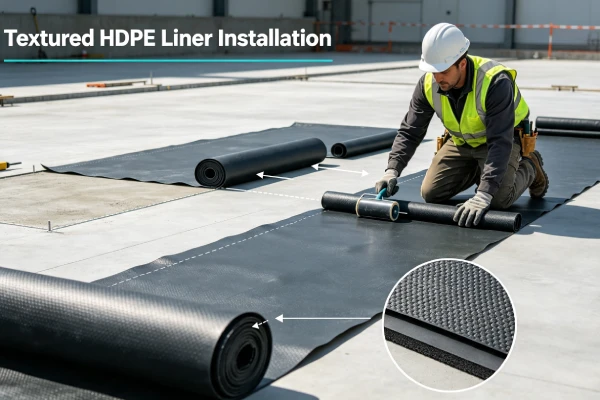
Textured liners require careful handling to prevent texture damage.
Handling Requirements:
| Requirement | Purpose |
|---|---|
| Use spreader bars for lifting | Prevent stress concentrations |
| Avoid dragging across subgrade | Prevent texture wear |
| Use padded slings | Prevent edge damage and texture wear |
| Protect edges | Prevent edge damage |
| Avoid stacking rolls that could damage texture | Prevent texture compression |
Table scrolls horizontally on mobile
Deployment Challenges:
| Challenge | Impact | Mitigation |
|---|---|---|
| Texture wear from dragging | Reduced interface friction | Use spreader bars, avoid dragging |
| Texture damage from equipment | Weak points, reduced friction | Protect equipment, use mats |
| Texture contamination | Welding issues | Clean weld zones thoroughly |
| Stiffness | Handling difficulty | Slow, careful deployment |
Table scrolls horizontally on mobile
Texture Wear Prevention:
- ✅ Handling: Use spreader bars, padded slings, and care
- ✅ Deployment: Avoid dragging across subgrade
- ✅ Equipment: No equipment on unprotected liner
- ✅ Foot traffic: Walkways, shoe cleaning
- ✅ Storage: Protect texture from damage
6️⃣ Welding Textured Liners — Parameters and Procedures
Welding textured liners requires specialised parameters and procedures.
Welding Parameter Adjustments:
| Parameter | Smooth Liner | Textured Liner | Adjustment |
|---|---|---|---|
| Wedge temperature | 440–470°C | 460–490°C | +10–20°C |
| Welding speed | 1.5–2.5 m/min | 1.0–2.0 m/min | -15–25% |
| Roller pressure | 250–300 kPa | 300–350 kPa | +10–15% |
| Overlap width | 100–150mm | 125–175mm | +25mm |
Table scrolls horizontally on mobile
Texture Removal Before Welding:
| Requirement | Purpose |
|---|---|
| Remove texture from weld zone | Prevent air pockets and contamination |
| Grind or scrape 100–150mm zone | Ensure clean welding surface |
| Remove all texture | Achieve proper fusion |
| Clean area | Remove debris |
Table scrolls horizontally on mobile
Texture Removal Methods:
| Method | Application | Effectiveness |
|---|---|---|
| Grinding | Large areas | High |
| Scraping | Small areas | Moderate |
| Heat gun + scraping | Texture removal | Moderate |
Table scrolls horizontally on mobile
Welding Challenges:
| Challenge | Impact | Mitigation |
|---|---|---|
| Air pockets | Reduced bond strength | Remove texture, proper pressure |
| Contamination | Reduced bond strength | Clean thoroughly |
| Texture debris | Welding defects | Remove all debris |
| Variable texture | Inconsistent welds | Verify texture removal |
7️⃣ Quality Control and CQA Requirements
CQA requirements for textured liners are more stringent than for smooth liners.
Texture Verification:
| Test | Frequency | Acceptance Criteria |
|---|---|---|
| Texture height | Every roll | Within specification |
| Texture uniformity | Every roll | Uniform pattern |
| Texture damage | Continuous | No damage |
| Pre-weld texture removal | Each weld zone | All texture removed |
Table scrolls horizontally on mobile
Welding Quality Control:
| Test | Frequency | Acceptance Criteria |
|---|---|---|
| Non-destructive testing | 100% of seams | No leaks |
| Destructive peel | Every 100m (vs 150m for smooth) | ≥ 150 N/25mm |
| Destructive shear | Every 100m | ≥ 200 N/25mm |
| Visual inspection | Continuous | No defects |
Table scrolls horizontally on mobile
Leak Location Survey:
- ✅ 100% of liner: Required for textured liners
- ✅ Post-installation: After all repairs are complete
- ✅ Documentation: All leaks identified and repaired
CQA Documentation:
- ✅ Texture verification: Height measurements
- ✅ Weld parameters: Temperature, speed, pressure
- ✅ Texture removal: Verification of weld zone preparation
- ✅ Destructive testing: All results
- ✅ Leak location: Survey results
8️⃣ Real Engineering Failure Cases
Case 1: Welding Failure from Incomplete Texture Removal — US Midwest Landfill, 2018
Specification used: 2.0mm textured HDPE, standard welding parameters for smooth liner (440°C, 2.0 m/min). Texture not removed from weld zone.
Observed failure: Weld failure under stress. Peel strength tested at 60–80 N/25mm. Seam separation at weld interface.
Timeline:
2018: 2.0mm textured HDPE installed
2018: Standard welding parameters, no texture removal
2018: Weld failure, peel strength 60-80 N/25mm
2018-2019: Seam replacement, texture removal implemented
Cost: $1.8M (seam replacement + investigation)
Root cause: Texture not removed from the weld zone before welding. Air pockets and contamination at the weld interface. Standard welding parameters (for smooth liner) were insufficient.
Engineering lesson: Remove all texture from the weld zone before welding (100–150mm zone). Adjust welding parameters: higher temperature (460–490°C), slower speed (1.0–2.0 m/min). Destructive testing at 100m intervals.
Case 2: Texture Wear from Handling — Australian Heap Leach Pad, 2019
Specification used: 2.0mm textured HDPE, dragged across subgrade during deployment. No spreader bars used.
Observed failure: Texture worn from large areas. Reduced interface friction (estimated 15–20° vs required 30–35°). Slope stability failure after 2 years.
Timeline:
2019: 2.0mm textured HDPE installed, dragged across subgrade
2019: Texture wear observed
2019-2021: Slope stability failure
2021: Liner replacement
Cost: $3.2M (liner replacement + slope remediation)
Root cause: Texture worn from dragging across subgrade during deployment. No spreader bars used. Reduced interface friction caused slope stability failure.
Engineering lesson: Use spreader bars for handling. Avoid dragging across subgrade. Protect texture during deployment. Verify texture height before and after installation.
Case 3: Damage Detection Failure — South African Tailings Facility, 2020
Specification used: 2.0mm textured HDPE, visual inspection only. Texture hid punctures and defects.
Observed failure: Multiple punctures not detected during visual inspection. Leakage through undetected punctures. Leak location survey identified 12 punctures.
Timeline:
2020: 2.0mm textured HDPE installed
2020: Visual inspection only (no leak location survey)
2020-2021: Leakage detected
2021: Leak location survey identified 12 punctures
Cost: $1.5M (repairs + leak location survey + monitoring)
Root cause: Texture hid punctures and defects. Visual inspection alone was insufficient. Leak location survey was not performed after installation.
Engineering lesson: Leak location survey required for all textured liners (100%). Use bright light and touch inspection in addition to visual inspection. Increased inspection frequency for textured liners.
Failure Case Cost Summary
| Case | Location | Failure Mode | Cost | Primary Lesson |
|---|---|---|---|---|
| Case 1 | US Midwest | Welding failure | $1.8M | Remove texture from weld zone, adjust parameters |
| Case 2 | Australia | Texture wear | $3.2M | Use spreader bars, avoid dragging |
| Case 3 | South Africa | Damage detection | $1.5M | Leak location survey required |
9️⃣ Comparison With Alternative Liner Systems
| Property | Textured HDPE (2.0mm) | Smooth HDPE (2.0mm) | LLDPE (1.5mm) | PVC (1.5mm) | GCL |
|---|---|---|---|---|---|
| Interface friction | 25–35° | 10–15° | 10–15° | 10–15° | 20–30° |
| Slope stability | Excellent | Poor | Poor | Poor | Good |
| Welding difficulty | High | Low | Low | Moderate | N/A |
| Handling difficulty | High | Low | Low | Low | High |
| Damage detection | Difficult | Easy | Easy | Easy | N/A |
| Texture durability | Good | N/A | N/A | N/A | N/A |
| Cost relative to HDPE | 1.2–1.4x | 1.0x | 1.0–1.1x | 1.2–1.5x | 0.6–0.8x |
Table scrolls horizontally on mobile
🔟 Cost Considerations
Cost Components:
| Component | Smooth Liner | Textured Liner | Difference |
|---|---|---|---|
| Material cost | $10–15/m² | $12–20/m² | +20–40% |
| Installation cost | $10–15/m² | $12–20/m² | +15–25% |
| CQA cost | $2–3/m² | $3–5/m² | +50–100% |
| Total installed cost | $22–33/m² | $27–45/m² | +25–50% |
Table scrolls horizontally on mobile
Productivity Impact:
| Factor | Smooth Liner | Textured Liner |
|---|---|---|
| Welding speed | 1.5–2.5 m/min | 1.0–2.0 m/min |
| Deployment rate | 500–1,000 m²/day | 300–600 m²/day |
| Destructive testing | 150m intervals | 100m intervals |
| CQA inspection | Standard | Enhanced |
Table scrolls horizontally on mobile
1️⃣1️⃣ Professional Engineering Recommendation
Textured Liner Installation Checklist:
| Phase | Item | Verification |
|---|---|---|
| Pre-installation | Texture verification | Height measurement |
| Pre-installation | Handling equipment | Spreader bars, slings |
| Installation | Texture protection | Avoid dragging |
| Installation | Weld zone preparation | Texture removed (100–150mm) |
| Installation | Welding parameters | Higher temp, slower speed |
| Installation | Welding inspection | 100% non-destructive |
| Post-installation | Damage inspection | Visual + touch |
| Post-installation | Leak location | 100% survey |
| Documentation | All tests | Complete records |
Table scrolls horizontally on mobile
Critical Requirements:
- ✅ Texture verification: Height measured before installation
- ✅ Texture removal: 100–150mm zone cleared before welding
- ✅ Welding parameters: 460–490°C, 1.0–2.0 m/min, 300–350 kPa
- ✅ Destructive testing: Every 100m (not 150m)
- ✅ Leak location: 100% survey required
- ✅ Documentation: Complete CQA records
1️⃣2️⃣ FAQ Section
Q1: What is the primary benefit of textured liners?
Textured liners provide 2–3x higher interface friction than smooth liners, essential for slope stability in steep applications (> 3H:1V). The texture increases the coefficient of friction between the liner and subgrade.
Q2: What are the common texture types for HDPE liners?
Common texture types include: structured (raised studs or bumps), co-extruded (textured layer bonded during manufacturing), and spray-applied (texture applied after manufacturing).
Q3: How does texture affect welding?
Texture creates air pockets and contamination risks at the weld interface. Welding requires: 10–20% higher temperature, 15–25% slower welding speed, and 10–15% higher roller pressure. The texture must be removed from the weld zone.
Q4: How much texture is typically required for slope stability?
Texture height typically ranges from 0.25–0.50mm for standard applications. Interface friction angles increase from 10–15° (smooth) to 25–35° (textured).
Q5: How should textured liners be handled to prevent texture damage?
Handling requirements include: use spreader bars for lifting, avoid dragging across subgrade, protect edges, use padded slings, and avoid stacking rolls that could damage texture.
Q6: How does textured liner installation cost compare to smooth liner?
Textured liner material cost is 20–40% higher than smooth liner. Installation cost is 15–25% higher. Total installed cost is 25–50% higher.
Q7: What CQA requirements are different for textured liners?
CQA requirements include: texture height verification, specialised welding inspection, increased destructive testing frequency (every 100m vs 150m), and 100% leak location survey.
Q8: How should textured liners be inspected for damage?
Damage detection on textured liners is more difficult. Inspection methods include: visual inspection (with bright light), touch inspection, leak location surveys (100%), and destructive testing.
Q9: Can textured liners be repaired?
Repairs on textured liners are more difficult. The texture must be removed around the repair zone, and the repair must be welded or patched. Texture cannot be restored after repair.
Q10: What is the service life of textured liners?
Textured liners have similar service life to smooth liners (50–100+ years) if properly installed. Texture wear can reduce slope stability over time. Texture height should be monitored.
1️⃣3️⃣ Technical Conclusion
Textured HDPE liners provide essential slope stability for steep applications through 2–3x higher interface friction than smooth liners. However, their installation requires specialised procedures, adjusted welding parameters, and more stringent quality control. The texture changes handling, welding, inspection, and quality control — treating textured liners as smooth liners leads to installation failures.
Welding textured liners requires: 10–20% higher temperature (460–490°C), 15–25% slower speed (1.0–2.0 m/min), 10–15% higher roller pressure (300–350 kPa), and complete texture removal from the weld zone (100–150mm). Destructive testing frequency must be increased to every 100m (vs 150m for smooth liners). Leak location surveys are essential — visual inspection alone is insufficient for textured liners.
Handling and deployment require care to prevent texture wear. Spreader bars, padded slings, and avoiding dragging across subgrade are essential. Texture damage reduces interface friction and creates weak points. Texture height should be verified before and after installation.
CQA requirements for textured liners are more stringent than for smooth liners. Texture verification, specialised welding inspection, increased destructive testing, and 100% leak location surveys are required. Documentation must be comprehensive.
Lifecycle cost analysis shows that textured liners are cost-effective for applications where slope stability is critical. The higher material and installation cost (25–50% more than smooth liners) is justified by improved slope stability and reduced risk of failure. Proper installation, texture management, and rigorous CQA are essential for textured liner performance and long-term containment integrity.
📚 Related Technical Guides
Textured HDPE Liner Installation: A CQA Engineer's Field ManualWelding Textured Geomembranes: Parameter Adjustment and Quality ControlTexture Management for HDPE Liners: Handling, Protection, and VerificationSlope Stability Design with Textured Liners: Interface Friction and Design ConsiderationsHDPE Geomembrane Failure Investigation: Textured Liner Installation Issues