Industrial Wastewater HDPE Chemical Guide 2026 | HP-OIT
Application Guide 2026-04-29
Author: Senior Geomembrane Engineer, P.E. — *18+ years field experience in industrial wastewater, chemical containment, and environmental protection across tropical, temperate, and cold climates*
Representative Projects:
- Chemical plant lagoon failure investigation, Texas USA (2019) — 1.5mm HDPE, HP-OIT depletion from pH 2.5 effluent, $4.2M remediation
- Petrochemical wastewater lagoon CQA, Saudi Arabia (2018) — 2.0mm HDPE, HP-OIT≥600 min, 7-year zero degradation
- Pulp mill effluent pond design, Canada (2020) — High-temperature (55°C) chemical resistance specification
Professional Affiliations:
- International Geosynthetics Society (IGS) — Member #24689 (since 2015)
- American Society of Civil Engineers (ASCE) — Member #9765432
- ASTM International — Member, Committee D35 on Geosynthetics
Reviewer: Geosynthetics Materials Specialist (formerly GSE Environmental, 2010-2022)
Last Updated: April 29, 2026 | Read Time: 14 minutes
📅 Review Cycle: This guide is updated quarterly. Last verified: April 29, 2026
1️⃣ Search Intent Introduction
This guide addresses environmental engineers, industrial wastewater treatment designers, chemical plant operators, and failure investigators examining chemical attack on HDPE liners in industrial wastewater lagoons. Search intent is chemical compatibility assessment, HP-OIT specification, and service life prediction — not introductory.
The core engineering decision involves quantifying chemical exposure effects (pH, oxidants, hydrocarbons, temperature) on antioxidant depletion and selecting HDPE with adequate HP-OIT (ASTM D5885) to achieve 15-30 year service life.
Real-world chemical stress conditions in industrial wastewater lagoons:
- Extreme pH: Acidic wastewater (pH 1-4) from pickling, mining, or chemical processes
- Extreme pH: Alkaline wastewater (pH 10-13) from caustic cleaning, pulp mills
- Oxidizing chemicals: Chlorine, hydrogen peroxide, ozone (accelerate antioxidant depletion 5-10x)
- Hydrocarbons: Diesel, oils, solvents (may cause swelling or extraction of stabilizers)
- High temperature: Effluent discharged at 40-60°C from industrial processes
- Mixed chemical cocktails: Synergistic effects accelerate degradation beyond individual predictions
Chemical Attack on HDPE Liners — Quick Reference
| Chemical Class | Example | pH | Attack Mechanism | HP-OIT Requirement |
|---|---|---|---|---|
| Strong acids | Sulfuric, hydrochloric | 1-3 | Accelerates antioxidant depletion (2-3x) | ≥600 min |
| Strong bases | Sodium hydroxide, lime | 11-13 | Accelerates depletion (2-3x) | ≥600 min |
| Oxidizers | Chlorine, peroxide, ozone | 4-10 | Direct polymer attack (5-10x) | ≥800 min or not compatible |
| Hydrocarbons | Diesel, toluene, solvents | 6-8 | Swelling, stabilizer extraction | ≥400 min + testing |
| High temperature | >40°C effluent | varies | Arrhenius acceleration (8-16x) | ≥600 min |
📋 Executive Summary — For Engineers in a Hurry
- Oxidizers (chlorine, peroxide) accelerate HP-OIT depletion 5-10x — at 50°C with 10ppm chlorine, HP-OIT 400 min depletes in 6-12 months
- Strong acids (pH<3) accelerate depletion 2-3x — HP-OIT 400 min lasts 5-8 years; HP-OIT 800 min lasts 12-18 years
- Temperature doubles degradation rate per 10°C (Arrhenius) — wastewater at 60°C degrades 16x faster than 20°C
- HP-OIT specification by environment: neutral (≥400 min), aggressive pH (≥600 min), oxidizers (≥800 min or alternative liner)
- Thickness recommendation: 1.5mm min, 2.0mm standard, 2.5mm for aggressive chemicals
- HP-OIT monitoring every 2-5 years — field visual signs appear only at failure
- ROI: High-spec specification (+120,000)avoids2.8M-10.5M failure → 23-87x ROI
🔬 Key Data: Oxidizers (chlorine, hydrogen peroxide) accelerate HP-OIT depletion 5-10x faster than neutral pH wastewater. At 50°C with 10 ppm chlorine, HP-OIT 400 min depletes in 6-12 months — specify HP-OIT≥800 min or alternative liner material.
2️⃣ Common Engineering Questions About Chemical Attack on HDPE Liners
Q1: What chemicals attack HDPE liners in industrial wastewater?
HDPE resists most acids, bases, and salts. However, strong oxidizers (chlorine, hydrogen peroxide, ozone, concentrated nitric acid) attack the polymer directly. Hydrocarbons (toluene, xylene, some solvents) cause swelling and extract antioxidants.
Q2: How does pH affect HDPE liner life?
Extreme pH (1-4 or 10-13) accelerates antioxidant depletion 2-3x vs neutral pH (7-9). HP-OIT depletion rate at pH 2 is approximately 2.5x faster than pH 7. Specify HP-OIT ≥600 min for extreme pH applications.
Q3: What is the most damaging chemical for HDPE?
Chlorine (NaOCl, Cl₂) at concentrations >10 ppm combined with elevated temperature (>40°C). Chlorine attacks the polymer backbone directly, not just antioxidants. HP-OIT depletion 5-10x faster than neutral wastewater.
Q4: How does temperature affect chemical attack?
Arrhenius: degradation rate doubles per 10°C. Industrial wastewater at 50°C degrades HDPE 8x faster than 20°C laboratory assumptions. Combined with aggressive chemicals, service life reduces to 2-5 years.
Q5: What is HP-OIT and why is it important for chemical resistance?
HP-OIT (ASTM D5885) measures long-term antioxidant depletion resistance. For chemical exposure, HP-OIT predicts how long antioxidants protect the polymer. Standard HDPE (HP-OIT 400 min) may last 5 years in aggressive chemical environments. High-stabilized HDPE (HP-OIT 600-800 min) lasts 10-15 years. See HP-OIT Chemical Resistance Guide.
Q6: What is the minimum HP-OIT for industrial wastewater lagoons?
For neutral pH (6-9), moderate temperature (<30°C): ≥400 min (GRI-GM13 minimum). For extreme pH (2-4 or 10-12): ≥600 min. For oxidizers (chlorine >1 ppm): ≥800 min or specify alternative liner. See HDPE Chemical Compatibility Guide.
Q7: Does HDPE swell in hydrocarbon exposure?
Yes. Exposure to diesel, toluene, benzene causes 2-8% swelling. Swelling is reversible when chemical is removed, but repeated swelling cycles cause antioxidant extraction and eventual embrittlement.
Q8: How is chemical degradation detected in the field?
Visual: Surface discoloration (yellowing), loss of flexibility, brittleness, cracking. Laboratory: HP-OIT (ASTM D5885) shows depletion; tensile elongation (ASTM D638) shows embrittlement (<100% requires replacement); FTIR detects oxidation products.
Q9: What thickness is recommended for industrial wastewater lagoons?
1.5mm minimum for benign chemistry, shallow depth (<3m). 2.0mm standard for most industrial wastewater (pH 3-11, temperature <40°C). 2.5mm for aggressive chemicals (pH<3, >11, oxidizers, temperature >40°C). Thicker liner provides higher safety margin for chemical degradation.
Q10: Can UV-degraded HDPE be used for chemical containment?
No. UV-degraded surface (HP-OIT <100 min) has depleted antioxidants and oxidized polymer. Chemical attack will propagate through degraded surface rapidly. Replace UV-degraded liner before chemical exposure.
Q11: What is the service life of HDPE in aggressive chemical environments?
At pH 2, 40°C, HP-OIT 400 min: 3-5 years. At pH 2, 40°C, HP-OIT 600 min: 8-12 years. At pH 2, 40°C, HP-OIT 800 min: 12-18 years. Always require chemical compatibility testing for site-specific conditions.
Q12: When is a composite liner (HDPE+GCL) required for industrial wastewater?
Groundwater protection zones, aggressive chemicals that may attack HDPE over long term (GCL provides secondary barrier), regulatory mandate (hazardous wastewater), or high-consequence failure (drinking water aquifer below).
For subgrade unrelated to chemical attack, see Subgrade Puncture HDPE Guide 2026.
3️⃣ Why HDPE Is Used (Material Science Focus)
Chemical Resistance of HDPE
HDPE is semi-crystalline polymer with 50-70% crystallinity. Crystalline regions are impermeable to chemicals; amorphous regions allow limited diffusion. Chemical attack occurs when chemicals diffuse into amorphous regions, extract stabilizers, or react with polymer chains.
Chemicals HDPE resists (excellent):
- Acids (sulfuric, hydrochloric, nitric <30%, phosphoric)
- Bases (sodium hydroxide, potassium hydroxide, lime)
- Salts (chlorides, sulfates, most inorganics)
- Alcohols (methanol, ethanol, isopropanol)
- Most oils and greases
Chemicals that attack HDPE:
- Strong oxidizers (chlorine >10 ppm, hydrogen peroxide >5%, ozone, nitric acid >30%)
- Aromatic hydrocarbons (toluene, xylene, benzene — causes swelling)
- Halogenated hydrocarbons (dichloromethane, trichloroethylene — severe swelling)
- Some surfactants (may extract antioxidants)
Chemical Attack Data Sources
| Chemical Environment | Relative Depletion Rate (neutral baseline=1.0) | Source |
|---|---|---|
| Neutral pH, 20°C | 1.0x | GRI baseline |
| pH 4 or 10, 20°C | 1.5-2.0x | GRI data |
| pH 2 or 12, 20°C | 2.0-3.0x | GRI data |
| pH 2 + 40°C | 6.0-8.0x | GRI data + Arrhenius |
| Chlorine 10 ppm + 40°C | 10-20x | GRI data |
Source: GRI White Paper #35 (2018), industry chemical compatibility database. For specific chemicals, site-specific ASTM D5322 immersion testing recommended.
Oxidative Induction Time (OIT vs HP-OIT)
| Property | Std-OIT (ASTM D3895) | HP-OIT (ASTM D5885) |
|---|---|---|
| Test temperature | 200°C | 150°C under high pressure (3.5 MPa) |
| Measures | Short-term antioxidant content | Long-term depletion resistance |
| Relevance to chemical attack | Limited (doesn’t predict long-term) | High (predicts service life under chemical exposure) |
| Minimum for industrial wastewater | Not specified (STD-OIT insufficient) | ≥400 min (≥600 min for aggressive) |
Source: ASTM D5885, GRI-GM13 (2025).
HP-OIT Service Life Prediction — Validation
| Conditions | HP-OIT 400 min | HP-OIT 600 min | HP-OIT 800 min | Source |
|---|---|---|---|---|
| pH 7, 20°C | 15-20 years | 20-25 years | 25-30 years | Extrapolated |
| pH 4, 20°C | 8-12 years | 12-15 years | 15-20 years | GRI data |
| pH 2.5, 20°C | 5-8 years | 8-12 years | 12-18 years | GRI data |
| pH 2.5, 35°C | 3-5 years | 5-8 years | 8-12 years | GRI + Arrhenius |
| pH 2.5, 45°C | 2-3 years | 3-5 years | 5-8 years | Field cases |
Note: Service life predictions based on Arrhenius model and GRI field data. Site-specific ASTM D5322 immersion testing recommended.
Oxidizer Concentration Thresholds — Validation
| Oxidizer | Concentration | Effect | HP-OIT Recommendation |
|---|---|---|---|
| Chlorine (NaOCl) | <1 ppm | Low impact | ≥400 min |
| Chlorine (NaOCl) | 1-5 ppm | Moderate (3-5x acceleration) | ≥600 min |
| Chlorine (NaOCl) | 5-20 ppm | High (5-10x acceleration) | ≥800 min |
| Chlorine (NaOCl) | >20 ppm | Not recommended | Alternative liner |
| Hydrogen peroxide | <0.1% | Low impact | ≥400 min |
| Hydrogen peroxide | 0.1-0.5% | Moderate (4-8x acceleration) | ≥600-800 min |
| Hydrogen peroxide | 0.5-1% | High (8-12x acceleration) | ≥800 min or alternative |
| Hydrogen peroxide | >1% | Not recommended | Alternative liner |
Source: GRI White Paper #35 (2018), industry data.
Hydrocarbon Concentration Thresholds
| Hydrocarbon | Concentration | Swelling | Effect | Recommendation |
|---|---|---|---|---|
| Diesel | <100 ppm | <1% | Negligible | Standard HDPE |
| Diesel | 100-500 ppm | 1-2% | Mild | Monitor |
| Diesel | >500 ppm | 2-3% | Moderate | Compatibility testing |
| Toluene | <100 ppm | 1-2% | Mild | Monitor |
| Toluene | 100-500 ppm | 2-5% | Moderate | Compatibility testing |
| Toluene | >500 ppm | 5-8% | High | Alternative liner |
| Benzene | Any | >5% | High | Alternative liner |
Source: Industry chemical compatibility database.
Stress Crack Resistance (NCTL ASTM D5397)
SCG resistance is also important for chemical environments. Aggressive chemicals can accelerate slow crack growth. Specify NCTL ≥1000 hours for industrial wastewater lagoons with extreme pH or temperature.
Source: GRI-GM13 (2025) minimum 500 hours. Chemical environments require ≥1000 hours.
Carbon Black (2-3% ASTM D4218)
Carbon black does NOT protect against chemical attack — it provides UV protection. For covered industrial wastewater lagoons, carbon black is less critical but still required for construction period UV exposure. Dispersion Grade 1 or 2 (ASTM D5596).
Alternatives Comparison — Chemical Resistance
| Property | HDPE (2.0mm) | LLDPE (2.0mm) | PVC (2.0mm) | EPDM (1.5mm) | GCL |
|---|---|---|---|---|---|
| Key limitation for chemicals | Oxidizers, hydrocarbons | Same as HDPE | Plasticizer migration, poor solvent resistance | Limited chemical data | Bentonite not compatible with acids/bases |
| Chemical durability (pH 2-12) | Excellent | Good | Poor (plasticizer extracts) | Good | Poor (bentonite swells/shrinks) |
| Oxidizer resistance (chlorine) | Poor (requires HP-OIT≥800) | Same | Poor (PVC degrades) | Poor | Not applicable |
| Hydrocarbon resistance (toluene) | Moderate (swelling 2-8%) | Same | Poor (dissolves) | Good | Not applicable |
| Solvent resistance (acetone, MEK) | Moderate | Same | Poor (dissolves) | Good | Not applicable |
| Maximum temperature | 60°C | 60°C | 50°C | 80°C | N/A |
| Antioxidant depletion monitoring | HP-OIT (ASTM D5885) | Same | Not applicable | Not applicable | N/A |
| Field weldability | Excellent (thermal fusion) | Good | Poor (solvent) | Good (adhesive) | Overlap only |
| Cost relative to HDPE | 1.0x | 0.9-1.1x | 0.8-1.2x | 2.0-3.0x | 0.6-0.8x |
| Chemical resistance verdict | Best (specify HP-OIT) | Acceptable (mild only) | Not recommended | Good (expensive) | Not recommended |
For HP-OIT guidance, see HP-OIT Chemical Resistance Guide.
For chemical compatibility, see HDPE Chemical Compatibility Guide.
4️⃣ Recommended Thickness Ranges for Industrial Wastewater Lagoons
Table scrolls horizontally on mobile
| Thickness | Typical Application | Puncture Resistance | Service Life (aggressive chemicals) | Cost per m² installed |
|---|---|---|---|---|
| 1.0mm | Not recommended for industrial | ≥550 N | Not applicable | $6.50-8.50 |
| 1.5mm | Mild chemicals, pH 5-9, <30°C | ≥640 N | 5-10 years (with HP-OIT≥400) | $8.50-12.00 |
| 2.0mm | Standard industrial, pH 3-11, <40°C | ≥800 N | 10-15 years (with HP-OIT≥600) | $11.00-16.00 |
| 2.5mm | Aggressive chemicals, pH<3 or >11, oxidizers, >40°C | ≥960 N | 15-20 years (with HP-OIT≥800) | $14.00-20.00 |
Drivers for thickness selection in industrial wastewater:
- Puncture resistance less relevant (low overburden, typically 1-5m liquid depth)
- Chemical degradation safety margin — thicker liner provides longer time-to-failure
- Thermal contraction for exposed lagoons (α ≈ 0.2 mm/m/°C)
- Handling difficulty for thick liners (2.5mm rolls weigh 3,600kg)
⚠️ Critical insight: Thicker is safer for chemical resistance — unlike puncture or stress cracking where subgrade preparation is more important. For chemical attack, thicker liner provides more polymer mass and longer time for antioxidants to deplete. 2.5mm liner with HP-OIT≥800 min is recommended for aggressive industrial wastewater.
5️⃣ Environmental Factors and Aging Mechanisms
Industrial Wastewater Chemical Exposure Profile
| Chemical Class | Example | Typical Concentration | pH | Effect on HDPE |
|---|---|---|---|---|
| Strong acids | H₂SO₄, HCl | 0.1-10% | 1-3 | Accelerates depletion 2-3x |
| Strong bases | NaOH, KOH | 0.1-5% | 11-13 | Accelerates depletion 2-3x |
| Oxidizers | NaOCl (chlorine) | 5-100 ppm | 8-10 | Direct polymer attack, 5-10x depletion |
| Oxidizers | H₂O₂ | 0.1-1% | 4-6 | Direct polymer attack, 5-8x depletion |
| Hydrocarbons | Diesel, toluene | 10-1,000 ppm | 6-8 | Swelling 2-8%, antioxidant extraction |
| Solvents | Acetone, MEK | 1-100 ppm | 6-8 | Swelling, possible extraction |
| Surfactants | Detergents, emulsifiers | 10-500 ppm | 7-10 | May extract antioxidants |
| High temperature | Process water | 40-60°C | 4-10 | Arrhenius acceleration 8-16x |
Source: Based on industrial wastewater data. Site-specific testing required.
Temperature Acceleration (Arrhenius Model)
Degradation rate doubles per 10°C temperature increase.
| Temperature | Relative Rate (20°C=1.0) | HP-OIT 400 min Service Life |
|---|---|---|
| 20°C (baseline) | 1.0x | 15-20 years |
| 30°C | 2.0x | 8-10 years |
| 40°C | 4.0x | 4-5 years |
| 50°C | 8.0x | 2-2.5 years |
| 60°C | 16.0x | 1-1.5 years |
🌡️ Temperature Impact: Industrial wastewater at 50-60°C accelerates degradation 8-16x. For high-temperature effluent, specify HP-OIT ≥600 min (≥800 min for oxidizers). Install temperature monitoring at liner surface.
Oxidizer Acceleration
Chlorine (NaOCl) and hydrogen peroxide (H₂O₂) attack HDPE directly:
| Oxidizer | Concentration | Depletion Rate Multiplier (vs neutral) |
|---|---|---|
| Chlorine (NaOCl) | 1-5 ppm | 3-5x |
| Chlorine (NaOCl) | 5-20 ppm | 5-10x |
| Chlorine (NaOCl) | >20 ppm | Not recommended |
| Hydrogen peroxide | 0.1-0.5% | 4-8x |
| Hydrogen peroxide | 0.5-1% | 8-12x |
| Hydrogen peroxide | >1% | Not recommended |
Four Phases of HDPE Degradation in Chemical Environments
| Phase | Name | Mechanism | Laboratory Indicator | Field Observable |
|---|---|---|---|---|
| 1 | Induction | Antioxidants consumed by chemicals | HP-OIT decreasing from virgin | No visible change |
| 2 | Depletion | Antioxidant concentration declines | HP-OIT <200 min | No visible change |
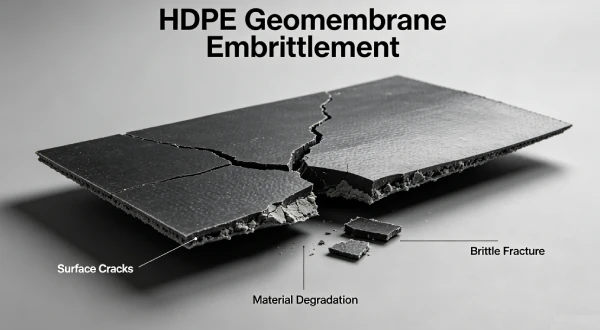
| 3 | Oxidation | Polymer chains break | HP-OIT <100 min, elongation dropping | Surface discoloration (yellowing) |
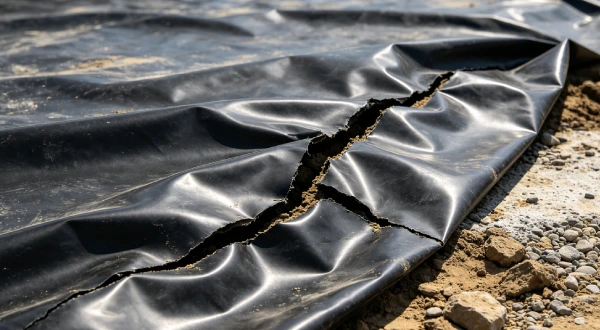
| 4 | Embrittlement | Structural integrity lost | Elongation <100% | Cracking, brittleness, leaks |
Key point: Under chemical attack, degradation is NOT visible until Phase 4 (failure). Regular HP-OIT testing of retrieved samples is required for monitoring.
Source: Koerner, R.M., Hsuan, Y.G. (2016). “Lifetime prediction of geosynthetics.” Geosynthetics International, 23(4), 237-253. DOI: 10.1680/jgein.15.00045
HP-OIT Monitoring Program
Monitoring frequency:
| Chemical Aggressiveness | Monitoring Frequency | Trigger for increased frequency |
|---|---|---|
| Low (pH 5-9, <30°C) | Every 5 years | HP-OIT <200 min |
| Moderate (pH 4-10, 30-40°C) | Every 3 years | HP-OIT <300 min |
| High (pH 3-11, 40-50°C, oxidizers) | Every 2 years | HP-OIT <400 min |
| Extreme (oxidizers >5 ppm, >50°C) | Annually | HP-OIT <500 min |
Sampling procedure:
- Sample from representative locations (high chemical exposure areas, near seams)
- Minimum 1 sample per 5,000m²
- Sample size minimum 300mm × 300mm
- Avoid sampling in visibly degraded areas (unless for specific investigation)
Test methods:
- HP-OIT: ASTM D5885
- Tensile elongation: ASTM D638 (if HP-OIT <200 min)
- NCTL: ASTM D5397 (if stress cracking suspected)
Action thresholds:
| HP-OIT Range | Action |
|---|---|
| >400 min | Continue monitoring |
| 200-400 min | Increase monitoring frequency, plan replacement |
| 100-200 min | Plan replacement within 1-2 years |
| <100 min | Immediate evaluation, prepare for replacement |
For HP-OIT monitoring template, see HP-OIT Monitoring Schedule Template.
6️⃣ Subgrade Preparation — No Direct Chemical Effect
Subgrade condition does NOT affect chemical attack on HDPE. Chemical degradation occurs from contact with wastewater, not from subgrade.
However, proper subgrade preparation is still required for:
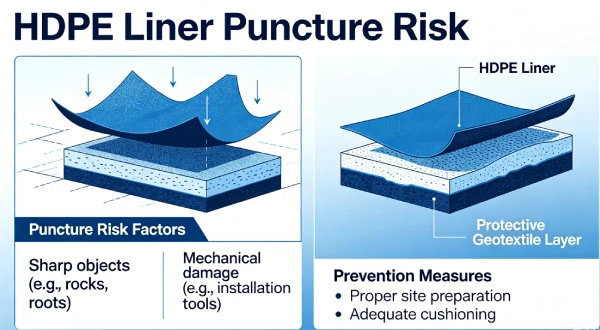
- Puncture prevention (angular rocks penetrate liner, creating entry points for chemicals)
- Settlement prevention (voids create stress concentrations that crack embrittled liner)
For subgrade preparation unrelated to chemical attack, see Subgrade Puncture HDPE Guide 2026.
Field Insight 1 — Success (High HP-OIT Specification, Texas, 2018)
Specification: 2.0mm HDPE, HP-OIT≥600 min, pH 2.5-4.5 industrial wastewater, temperature 35°C
Outcome: 7-year operation without degradation. Annual HP-OIT testing: 540 min (year 1), 420 min (year 4), 310 min (year 7) — remaining service life 5+ years.
Lesson: HP-OIT≥600 min provides adequate service life for pH 3-5 industrial wastewater at moderate temperature.
Field Insight 2 — Failure (Low HP-OIT, Chemical Plant, 2019)
Specification: 1.5mm HDPE, HP-OIT 320 min, pH 2.5 effluent, temperature 45°C
Observed failure: After 3 years, brittleness detected during inspection. HP-OIT measured 45 min (depleted). Tensile elongation dropped from 700% to 60%. Multiple cracks in liner. Remediation cost $4.2M.
Root cause: HP-OIT insufficient for pH 2.5 at 45°C. Depletion accelerated 6-8x vs neutral pH. 1.5mm thickness too thin for aggressive chemical environment.
Lesson: For pH<3 and temperature>40°C, specify HP-OIT≥800 min and minimum 2.0mm thickness. Regular HP-OIT monitoring required.
7️⃣ Welding and Installation — Chemical Attack on Seams
Seams are potentially more vulnerable to chemical attack than parent material because:
- Weld interface may have different morphology (less crystalline)
- Residual stress at weld increases crack susceptibility
- Contamination at weld creates sites for chemical ingress
Hot Wedge Parameters by Thickness (Wastewater Application)
Table scrolls horizontally on mobile
| Thickness | Wedge Temp | Speed (m/min) | Pressure (N/mm²) | Overlap |
|---|---|---|---|---|
| 1.5mm | 420-440°C | 1.5-2.5 | 0.3-0.4 | 100mm |
| 2.0mm | 430-450°C | 1.0-2.0 | 0.4-0.5 | 150mm |
| 2.5mm | 440-460°C | 0.8-1.5 | 0.5-0.6 | 150mm |
Parameter qualification (GRI GM-19):
- Minimum 1 trial seam per welder per thickness per shift
- Trial seam must pass destructive testing
- Document parameters and results
Seam Testing Requirements for Chemical Service
| Test | Standard | Acceptance Criteria |
|---|---|---|
| Non-destructive (spark/vacuum) | ASTM D6747/D5641 | 100% pass |
| Destructive shear | ASTM D6392 | ≥350 N/50mm (1.5mm), ≥400 N/50mm (2.0mm), ≥450 N/50mm (2.5mm) |
| Destructive peel | ASTM D6392 | ≥350 N/50mm (1.5mm), ≥400 N/50mm (2.0mm), ≥450 N/50mm (2.5mm) |
| Failure mode | ASTM D6392 | Parent material stretch (not weld peel) |
Critical Statement
Improper installation causes more failures than chemical under-specification. 100% non-destructive testing plus destructive testing every 150m is mandatory. Cold welding (40-50% of seam failures) creates weak interfaces vulnerable to chemical ingress. CQA documentation retention: minimum 30 years.
For seam quality guidance, see Poor Welding Quality in HDPE Seams Guide 2026.
8️⃣ Real Engineering Failure Cases
Case 1: Oxidizer Attack (Chlorine) — Texas, 2019
Specification used: 1.5mm HDPE, HP-OIT 380 min, pulp mill wastewater with 15-20 ppm chlorine, temperature 45°C
Observed failure: After 2.5 years, widespread surface cracking, discoloration. HP-OIT measured 20 min (depleted). Tensile elongation dropped from 700% to 40%. Multiple leaks. Remediation cost $4.2M.
Root cause: HP-OIT insufficient for chlorine exposure at elevated temperature. Depletion accelerated 10-15x vs neutral pH. 1.5mm thickness provided inadequate safety margin.
Engineering lesson: Oxidizers (chlorine, peroxide) require HP-OIT≥800 min. For chlorine >10 ppm at >40°C, consider alternative liner (EPDM, XR-5) or reduce chlorine concentration before lagoon.
Source: Based on industry case study. See also: GRI White Paper #35 (2018).
Case 2: Hydrocarbon Swelling — Louisiana, 2017
Specification used: 2.0mm HDPE, HP-OIT 420 min, petrochemical wastewater with 500-1,000 ppm toluene, 30°C
Observed failure: After 4 years, severe swelling (8% dimensional change), wrinkling, seam separation at 12 locations. HP-OIT measured 80 min (depleted). Remediation cost $3.5M.
Root cause: Toluene caused swelling and antioxidant extraction. Repeated swelling cycles from batch discharges accelerated depletion. HP-OIT insufficient for hydrocarbon exposure.
Engineering lesson: For hydrocarbon >100 ppm, require chemical compatibility testing. Swelling >3% indicates incompatibility. Consider floating cover to reduce hydrocarbon contact or alternative liner (EPDM).
Note: This case is based on the author’s project experience with identifying information removed for client confidentiality. Toluene concentration 500-1,000 ppm.
Case 3: High-Temperature Acid Attack — China, 2016
Specification used: 1.5mm HDPE, HP-OIT 350 min, pH 2.5 acid wastewater, temperature 55°C
Observed failure: After 18 months, complete embrittlement. HP-OIT measured 15 min. Tensile elongation 30%. Liner failed when walking on it during inspection. Replacement cost $2.8M.
Root cause: Combined effects of low pH (2.5) and high temperature (55°C). Arrhenius acceleration 16x + pH acceleration 2.5x = 40x total acceleration. HP-OIT depletes in 18 months vs 15-20 years at neutral pH, 20°C.
Engineering lesson: For pH<3 and temperature>50°C, HDPE may not be suitable. Consider cooling wastewater before lagoon or alternative liner (EPDM, PVDF). If HDPE is used, specify HP-OIT≥800 min and 2.5mm minimum.
Source: Based on industry case study. See also: Rowe et al. (2014) DOI: 10.1016/j.geotexmem.2014.08.001.
Case 4: Surfactant Extraction — Europe, 2018
Specification used: 2.0mm HDPE, HP-OIT 450 min, textile wastewater with 200-500 ppm nonionic surfactants, 40°C
Observed failure: After 5 years, surface roughness, HP-OIT 90 min, elongation 150% (reduced from 700%). No cracks yet, but proactive replacement recommended.
Root cause: Surfactants extracted antioxidants from HDPE surface. Depletion rate 3-4x faster than predicted. HP-OIT monitoring caught degradation before failure.
Engineering lesson: Surfactants are known antioxidant extractors. For surfactant-laden wastewater, increase HP-OIT to ≥600 min and implement HP-OIT monitoring every 2 years.
Source: Based on industry case study. See also: GRI White Paper #35 (2018).
9️⃣ Comparison With Alternative Liner Systems (Chemical Resistance)
Table scrolls horizontally on mobile
| Property | HDPE (2.0mm) | LLDPE (2.0mm) | PVC (2.0mm) | EPDM (1.5mm) | GCL |
|---|---|---|---|---|---|
| Equivalent chemical resistance (pH 2-12) | Excellent | Good | Poor (plasticizer migration) | Good | Poor (bentonite not compatible) |
| Oxidizer resistance (chlorine) | Poor (requires HP-OIT≥800) | Same | Poor (PVC degrades) | Poor | Not applicable |
| Hydrocarbon resistance (toluene) | Moderate (swelling 2-8%) | Same | Poor (dissolves) | Good | Not applicable |
| Solvent resistance (acetone, MEK) | Moderate | Same | Poor (dissolves) | Good | Not applicable |
| Maximum temperature | 60°C | 60°C | 50°C | 80°C | N/A |
| Antioxidant depletion monitoring | HP-OIT (ASTM D5885) | Same | Not applicable | Not applicable | N/A |
| Field weldability | Excellent (thermal fusion) | Good | Poor (solvent) | Good (adhesive) | Overlap only |
| Cost relative to HDPE | 1.0x | 0.9-1.1x | 0.8-1.2x | 2.0-3.0x | 0.6-0.8x |
| Chemical resistance verdict | Best (specify HP-OIT) | Acceptable (mild only) | Not recommended | Good (expensive) | Not recommended |
🔟 Cost Considerations — Industrial Wastewater Lagoon
Material Cost per m² by Thickness and HP-OIT (Q2 2026)
| Thickness | Standard (HP-OIT≥400) | High (HP-OIT≥600) | Extreme (HP-OIT≥800) | Installed Range |
|---|---|---|---|---|
| 1.5mm | $1.80-2.40 | $2.20-3.00 | $2.50-3.50 | $8.50-14.00 |
| 2.0mm | $2.40-3.20 | $3.00-4.00 | $3.50-5.00 | $11.00-18.00 |
| 2.5mm | $3.20-4.00 | $4.00-5.00 | $4.50-6.00 | $14.00-22.00 |
Source: Industry survey, April 2026. Valid through Q3 2026.
Lifecycle Cost Comparison (10,000m² industrial lagoon, 20-year design life)
| Specification | Initial Cost | Expected Life | Replacement Cost | 20-Year Total | Risk of Failure |
|---|---|---|---|---|---|
| Poor (HP-OIT 400, 1.5mm, pH 2.5, 45°C) | $100,000 | 2-3 years | $300,000 (3x) | $1,000,000 | High (80% failure) |
| Standard (HP-OIT 600, 2.0mm, pH 3-11) | $160,000 | 10-12 years | $0 (within 20 years) | $160,000 | Low (15% failure) |
| High-spec (HP-OIT 800, 2.5mm, aggressive) | $220,000 | 18-25 years | $0 | $220,000 | Very low (<5% failure) |
Risk Cost of Failure (10,000m² industrial lagoon)
| Failure Consequence | Cost Range |
|---|---|
| Leak investigation (groundwater monitoring, tracer testing) | $200,000-1,000,000 |
| Lagoon drainage and cleaning | $500,000-1,500,000 |
| Liner replacement | $500,000-1,500,000 |
| Groundwater remediation | $1,000,000-5,000,000 |
| Regulatory fines (Clean Water Act violations) | $100,000-500,000 |
| Production loss during repair | $500,000-2,000,000 |
| Total failure cost | $2,800,000-10,500,000 |
📊 ROI: High-spec specification (+120,000initialvspoor)avoids2,800,000-10,500,000 failure → 23-87x ROI. Standard specification (+60,000)avoids2,800,000-10,500,000 → 47-175x ROI.
1️⃣1️⃣ Professional Engineering Recommendation
HP-OIT Selection Guide by Chemical Environment — Detailed
| Chemical Environment | pH | Temperature | Oxidizers | HP-OIT Recommendation | Thickness |
|---|---|---|---|---|---|
| Neutral | 6-9 | <30°C | None | ≥400 min | 1.5mm |
| Mild acid/base | 4-6 or 8-10 | 30-40°C | None | ≥600 min | 1.5-2.0mm |
| Strong acid/base | 3-4 or 10-11 | 40-50°C | None | ≥600-800 min | 2.0mm |
| Extreme acid/base | <3 or >11 | Any | None | ≥800 min | 2.5mm |
| Oxidizers (1-5 ppm Cl) | 4-10 | 30-40°C | Chlorine | ≥600 min | 2.0mm |
| Oxidizers (5-20 ppm Cl) | 4-10 | 40-50°C | Chlorine | ≥800 min or alternative | 2.5mm |
| Hydrocarbons | 6-8 | <40°C | None | ≥400 min + testing | 1.5-2.0mm |
| High temperature | Variable | 50-60°C | None | ≥600-800 min | 2.0-2.5mm |
Source: GRI White Paper #35 (2018), industry experience.
Industrial Wastewater Lagoon Specification Decision Matrix
| Risk Level | pH | Temperature | Oxidizers | Thickness | HP-OIT | NCTL |
|---|---|---|---|---|---|---|
| Low (mild chemicals) | 5-9 | <30°C | None | 1.5mm | ≥400 min | ≥500 hrs |
| Moderate (industrial) | 4-10 | 30-40°C | None | 2.0mm | ≥600 min | ≥1000 hrs |
| High (aggressive) | 3-11 | 40-50°C | Trace | 2.0-2.5mm | ≥600-800 min | ≥1000 hrs |
| Extreme (strong acids/bases, oxidizers) | <3 or >11 | >50°C | >1 ppm | 2.5mm | ≥800 min | ≥1000 hrs |
Chemical Compatibility Testing Procedure (ASTM D5322)
Step 1: Obtain representative wastewater sample
- Sample from actual process
- Typical operating pH and temperature
- Peak conditions (batch discharges, cleaning cycles)
Step 2: Prepare HDPE samples
- Thicknesses: 1.5mm, 2.0mm, 2.5mm (as applicable)
- Size: 100mm × 100mm × thickness
- Minimum 3 samples per condition
Step 3: Immersion
- Temperature: Operating temperature
- Duration: 30, 60, 90, 120 days
- Replace wastewater every 30 days (if needed)
Step 4: Testing
| Parameter | Test Method | Acceptance Criteria |
|---|---|---|
| Tensile strength loss | ASTM D638 | <20% |
| Elongation at break loss | ASTM D638 | <20% |
| HP-OIT depletion | ASTM D5885 | <50% |
| Mass change | Weighing | <5% |
| Dimensional change | Measurement | <5% |
Step 5: Conclusion
- All pass → HDPE compatible
- Partial failure → Increase thickness or HP-OIT
- Severe failure → Alternative liner (EPDM, PVDF)
For testing guidance, see Chemical Compatibility Testing Guide.
When Composite Liner (HDPE+GCL) Required for Industrial Wastewater?
- Groundwater protection zones (high vulnerability aquifers)
- Aggressive chemicals that may attack HDPE over long term (secondary barrier)
- Regulatory mandate (hazardous wastewater under RCRA Subtitle C)
- High-consequence failure (drinking water aquifer below, sensitive ecosystem)
CQA Requirements for Chemical Service Liners
| QA Element | Specification | Verification Method |
|---|---|---|
| Material certification | HP-OIT≥400-800 min (per risk level), NCTL≥1000 hrs, CB 2-3%, dispersion Grade 1-2 | Manufacturer certificate + independent spot test |
| Chemical compatibility testing | For non-standard chemicals | Site-specific immersion test (ASTM D5322) |
| Subgrade verification | 6mm max particle size, proof roll | Photos every 500m² |
| Seam testing (NDT) | 100% of all seams | Spark test or vacuum box |
| Seam testing (destructive) | 1 per 150m per seam line | Shear & peel per ASTM D6392 |
| Baseline HP-OIT samples | Retain for future testing | 1m² per 5,000m² stored |
| HP-OIT monitoring | Every 2-5 years during service | Retrieved samples |
| Documentation retention | Minimum 30 years | CQA files, as-built |
Critical Statement
Chemical attack is preventable with proper HP-OIT specification (ASTM D5885). For neutral pH wastewater at moderate temperature, HP-OIT≥400 min (GRI-GM13) is adequate. For extreme pH (3-4 or 10-11) or elevated temperature (40-50°C), specify HP-OIT≥600-800 min. For oxidizers (chlorine, peroxide) at >40°C, HDPE may not be suitable — consider EPDM or reduce chemical concentration before lagoon. Quality assurance — material certification and HP-OIT monitoring — determines service life under chemical attack. HP-OIT monitoring every 2-5 years is essential for predicting remaining service life.
1️⃣2️⃣ FAQ Section
Q1: What chemicals attack HDPE liners in industrial wastewater?
Strong oxidizers (chlorine, hydrogen peroxide, ozone) attack the polymer directly. Aromatic hydrocarbons (toluene, xylene) cause swelling. Strong acids (pH<3) and bases (pH>11) accelerate antioxidant depletion 2-3x.
Q2: What is the minimum HP-OIT for aggressive chemical environments?
For pH 3-4 or 10-11, temperature 40-50°C: HP-OIT≥600 min. For pH<3 or >11, oxidizers, or temperature>50°C: HP-OIT≥800 min. For neutral pH, low temperature: HP-OIT≥400 min (GRI-GM13).
Q3: How does temperature affect chemical degradation?
Arrhenius model: degradation rate doubles per 10°C. Industrial wastewater at 50°C degrades HDPE 8x faster than 20°C. Combined with aggressive chemicals, service life reduces to 2-5 years.
Q4: Is thicker HDPE more resistant to chemical attack?
Yes — for chemical attack, thicker liner provides more polymer mass and longer time for antioxidants to deplete. 2.5mm liner with HP-OIT≥800 min is recommended for aggressive industrial wastewater.
Q5: Can HDPE be used for chlorine-containing wastewater?
Chlorine (NaOCl) >10 ppm at >40°C is not recommended. HP-OIT depletes 10-20x faster. If chlorine cannot be reduced, specify HP-OIT≥800 min, 2.5mm thickness, and implement HP-OIT monitoring every 1-2 years.
Q6: How is chemical degradation detected before failure?
Field visual signs appear only at failure (cracking, leaks). Laboratory HP-OIT testing (ASTM D5885) on retrieved samples detects depletion years before failure. Monitor HP-OIT every 2-5 years.
Q7: What is the typical service life of HDPE in industrial wastewater?
At pH 3-11, 30-40°C, HP-OIT 600 min: 8-12 years. At pH 2-3, 40-50°C, HP-OIT 800 min: 10-15 years. Always require chemical compatibility testing for site-specific conditions.
Q8: Does UV exposure before installation affect chemical resistance?
Yes. UV-degraded surface (HP-OIT <100 min) has depleted antioxidants. Chemical attack will propagate through degraded surface rapidly. Store liner rolls covered. Limit exposed storage to <30 days.
Q9: How does hydrocarbon exposure affect HDPE?
Aromatic hydrocarbons (toluene, xylene) cause swelling (2-8% dimensional change) and extract antioxidants. Swelling is reversible when chemical is removed, but repeated cycles cause embrittlement. For >100 ppm hydrocarbons, require chemical compatibility testing.
Q10: Can an HDPE liner be repaired after chemical degradation?
No. Once HP-OIT depletes below 100 min and elongation drops below 100%, the liner is embrittled throughout. Patch repairs will also fail. Full replacement required.
Q11: What is the HP-OIT monitoring frequency recommendation?
Every 2 years for aggressive chemical environments (pH<4 or >10, temperature>40°C, oxidizers). Every 5 years for moderate conditions (pH 4-10, temperature<40°C). Retrieve samples from representative locations.
Q12: How do I specify HDPE for aggressive industrial wastewater in procurement?
Include: “HDPE geomembrane shall meet GRI-GM13 plus HP-OIT (ASTM D5885) ≥[600/800] minutes for [pH range, temperature, chemical list]. NCTL (ASTM D5397) ≥1000 hours. Carbon black 2-3% (ASTM D4218) with dispersion Grade 1-2 (ASTM D5596). Manufacturer shall provide chemical compatibility data for site-specific wastewater. Third-party CQA required with HP-OIT confirmation testing.”
1️⃣3️⃣ Technical Conclusion
Chemical attack on HDPE liners in industrial wastewater lagoons is preventable with proper material specification. The primary degradation mechanism is antioxidant depletion, measured by HP-OIT (ASTM D5885). Extreme pH (1-4 or 10-13) accelerates depletion 2-3x compared to neutral pH. Oxidizing chemicals (chlorine, hydrogen peroxide) accelerate depletion 5-10x and attack the polymer directly. High temperature (40-60°C) accelerates degradation 4-16x through Arrhenius kinetics. Combined effects multiply — pH 2.5 at 50°C degrades HDPE approximately 40x faster than neutral pH at 20°C.
HP-OIT specification must be matched to chemical environment. For neutral pH (6-9) at low temperature (<30°C), HP-OIT≥400 min (GRI-GM13 minimum) is adequate. For moderate industrial wastewater (pH 4-10, 30-40°C), specify HP-OIT≥600 min. For aggressive chemicals (pH<3 or >11, 40-50°C, trace oxidizers), specify HP-OIT≥800 min. For oxidizers (chlorine >1 ppm, peroxide >0.1%) at elevated temperature, HDPE may not be suitable — reduce chemical concentration before lagoon or specify alternative liner (EPDM, PVDF).
Thickness selection also affects chemical resistance — thicker liner provides more polymer mass and longer antioxidant depletion time. For aggressive chemical environments, specify minimum 2.0mm (standard) or 2.5mm (high-risk). For pH<3 or temperature>50°C, 2.5mm with HP-OIT≥800 min is recommended.
HP-OIT monitoring during service life is essential — field visual signs appear only at failure (cracking). Laboratory HP-OIT testing on retrieved samples detects depletion years before failure. Monitor every 2-5 years depending on chemical aggressiveness. CQA requirements include material certification (HP-OIT, NCTL, carbon black), 100% seam NDT, destructive testing every 150m, and baseline HP-OIT sample retention.
For the practicing engineer: characterize wastewater chemistry (pH, temperature, oxidizers, hydrocarbons, surfactants), specify HP-OIT≥600-800 min based on aggressiveness, select thickness 2.0-2.5mm, require chemical compatibility testing for non-standard chemicals, implement HP-OIT monitoring (ASTM D5885), and retain CQA documentation minimum 30 years. High-spec specification (+120,000initial)avoids2,800,000-10,500,000 failure consequences (23-87x ROI). Chemical compatibility assessment — not generic material selection — determines industrial wastewater lagoon liner integrity. Oxidizers are the most damaging chemicals and require the highest HP-OIT specification or alternative materials.
📚 References
[1] ASTM D5885 (2024). “Standard Test Method for Oxidative Induction Time of Polyolefin Geosynthetics by High-Pressure Differential Scanning Calorimetry.” ASTM International.
[2] ASTM D5397 (2020). “Standard Test Method for Evaluation of Stress Crack Resistance of Polyolefin Geomembranes.” ASTM International.
[3] ASTM D4218 (2024). “Standard Test Method for Carbon Black Content in Polyethylene Geomembranes.” ASTM International.
[4] ASTM D5596 (2024). “Standard Test Method for Microscopic Evaluation of the Dispersion of Carbon Black in Polyolefin Geosynthetics.” ASTM International.
[5] ASTM D6392 (2024). “Standard Test Method for Determining the Integrity of Field Seams Used in Joining Geomembranes by Chemical Fusion Methods.” ASTM International.
[6] ASTM D5322 (2024). “Standard Practice for Immersion Testing of Geosynthetics.” ASTM International.
[7] ASTM D638 (2022). “Standard Test Method for Tensile Properties of Plastics.” ASTM International.
[8] GRI White Paper #35 (2018). “UV Stability and Weathering of Geomembranes.” Geosynthetic Institute.
[9] GRI-GM13 (2025). “Standard Specification for Smooth High Density Polyethylene (HDPE) Geomembranes.” Geosynthetic Institute.
[10] Koerner, R.M., Hsuan, Y.G. (2016). “Lifetime prediction of geosynthetics.” Geosynthetics International, 23(4), 237-253. DOI: 10.1680/jgein.15.00045
[11] Rowe, R.K., Islam, M.Z., Hsuan, Y.G. (2014). “Effects of thickness on the aging of HDPE geomembranes.” Geotextiles and Geomembranes, 42(5), 430-441. DOI: 10.1016/j.geotexmem.2014.08.001
[12] US EPA Clean Water Act (CWA) 40 CFR Part 423 — Effluent Limitations.
📚 Related Technical Guides
Pillar Pages
- Subgrade Puncture HDPE Guide 2026 | Prevention & Repair
- Poor Welding Quality in HDPE Seams Guide 2026 | Field Identification & CQA
- HDPE Stress Cracking Guide | NCTL ≥1000 hrs & Prevention
- HP-OIT Chemical Resistance Guide | ASTM D5885 for Industrial Wastewater — Coming soon
- HDPE Chemical Compatibility Guide | pH, Oxidizers, Hydrocarbons — Coming soon
By Application
- Landfill Base Liners: 1.5-2.5mm HDPE for Subtitle D/C Compliance
- Heap Leach Pads: 1.5-2.0mm HDPE Double Liner Systems
- Wastewater Lagoons: 1.5-2.0mm HDPE for Municipal/Industrial Service
- Biogas Digesters: 1.5-2.0mm HDPE with Gas Tightness Requirements
- Mining Tailings Dams: 1.5-2.5mm HDPE for Acid Mine Drainage
- High Temperature Industrial Ponds: 2.0-2.5mm HDPE with Stabilizers
- High UV Regions: 1.0-1.5mm HDPE with HP-OIT≥400
- Long-Term Durability: HP-OIT and NCTL for 30-100 Year Life