Field Quality Assurance HDPE Liner Projects 2026 | Procedures & Compliance
Application Guide 2026-08-13
Author: Senior Geomembrane Engineer, P.E. — 15+ years field experience in quality assurance management, CQA program development, and compliance across landfill, mining, and wastewater projects
Reviewer: Geosynthetics Materials Specialist
Last Updated: August 12, 2026
Read Time: 14 minutes
📅 Review Cycle: This guide is updated quarterly. Last verified: August 12, 2026
📋 Executive Summary — For Engineers in a Hurry
- Field Quality Assurance (FQA) is a systematic process encompassing material verification, installation inspection, testing, documentation, and regulatory compliance — not just final inspection
- Third-party CQA is the industry standard — independent verification of installation quality reduces failure risk by 70–90%
- Documentation is essential — all inspections, tests, and deviations must be recorded; documentation is the basis for regulatory compliance and liability protection
- Key QA activities include — material certification, subgrade inspection, seam testing (100% non-destructive + destructive every 150m), leak location survey, and final certification
- QA/QC roles must be clearly separated — the installer’s QC program and the owner’s QA program are independent and complementary
- Regulatory compliance requires — adherence to GRI-GM13/GM19, ASTM standards, and site-specific permit requirements
⚠️ Critical Engineering Statement — QA is Not QC — And Both Are Essential
Quality Assurance (QA) and Quality Control (QC) are distinct but complementary functions. QA is the owner’s system to ensure quality is built in; QC is the installer’s system to control quality during construction.
- QA is independent verification — the owner’s representative verifies that QC procedures are followed and that the final installation meets specifications
- QC is the installer’s responsibility — the installer performs inspections and tests to control quality during construction
- QA documents the entire process — QA records provide evidence of compliance for regulatory agencies and legal protection
- Confusion between QA and QC leads to gaps in quality management and increased failure risk
- Both are essential — without QC, quality is not controlled; without QA, quality is not verified
A successful liner project requires both rigorous QC by the installer and independent QA by the owner. Neither can substitute for the other.
📑 Table of Contents
1️⃣ Search Intent Introduction
2️⃣ Common Engineering Questions About Field Quality Assurance
3️⃣ Why HDPE Is Used — Material Science Focus
4️⃣ QA vs QC — Roles and Responsibilities
5️⃣ Pre-Installation QA Activities
6️⃣ Installation QA Activities
7️⃣ Post-Installation QA Activities
8️⃣ Real Engineering Failure Cases
9️⃣ Comparison With Alternative Liner Systems
🔟 Documentation and Record Keeping
1️⃣1️⃣ Professional Engineering Recommendation
1️⃣2️⃣ FAQ Section
1️⃣3️⃣ Technical Conclusion
1️⃣ Search Intent Introduction
This guide addresses the engineering question of how to implement effective field quality assurance for HDPE liner projects and what procedures, documentation, and compliance measures are required. The primary audience includes CQA engineers, project managers, EPC contractors, environmental regulators, facility owners, and compliance auditors responsible for ensuring liner installation quality.
Understanding QA procedures is essential for achieving regulatory compliance, ensuring long-term liner performance, and protecting against liability. This is not an introductory overview — it is a data-driven engineering reference for professionals implementing or overseeing QA programs for geomembrane installations.
Real-world QA challenges include:
- ✅ Material verification — confirming that delivered materials meet specifications
- ✅ Installation inspection — verifying that installation follows approved procedures
- ✅ Testing and documentation — ensuring that all required tests are performed and recorded
- ✅ Regulatory compliance — meeting EPA, state, and local requirements
- ✅ Non-conformance management — identifying and correcting deviations
- ✅ Final certification — providing documentation for regulatory approval
2️⃣ Common Engineering Questions About Field Quality Assurance
Q1: What is the difference between QA and QC?
QA (Quality Assurance) is the owner’s system to ensure quality is built in — independent verification that QC procedures are followed. QC (Quality Control) is the installer’s system to control quality during construction — inspections and tests performed by the installer.
Q2: What are the key QA activities for a liner project?
Key QA activities include: material certification review, subgrade inspection, panel layout verification, welding parameter monitoring, non-destructive testing oversight, destructive testing witness, leak location survey oversight, and final documentation review.
Q3: What are the key QC activities for a liner project?
Key QC activities include: material inspection upon receipt, subgrade preparation, panel layout, welding (parameters, execution), non-destructive testing (100% of seams), destructive testing (every 150m), and repair of defects.
Q4: What standards apply to geomembrane QA/QC?
Key standards include: GRI-GM13 (specification), GRI-GM19 (seam testing), ASTM D5397 (NCTL), ASTM D5885 (HP-OIT), ASTM D4218 (carbon black), and ASTM D5596 (dispersion).
Q5: What documentation is required for QA/QC?
Documentation includes: material test certificates, inspection reports, welding parameter logs, seam test results (non-destructive and destructive), repair records, leak location survey results, and final certification.
Q6: What is a non-conformance and how is it managed?
A non-conformance is any deviation from specifications or approved procedures. Management includes: identification, documentation, investigation, correction, verification, and closure with QA sign-off.
Q7: What is the role of third-party CQA?
Third-party CQA provides independent verification of installation quality. The CQA engineer works for the owner (not the installer) to verify that QC procedures are followed and that the installation meets specifications.
Q8: How often should QA inspections be performed?
QA inspections should be: continuous (welding, visual inspection), daily (subgrade, panel layout), and periodic (destructive testing witness, leak location survey oversight). Frequency should be defined in the QA/QC plan.
Q9: What is the cost of QA/QC for a liner project?
QA/QC costs typically range from 3–7% of the total installation cost, depending on project size, complexity, and regulatory requirements. Larger projects may have lower percentage costs due to economies of scale.
Q10: What happens if QA identifies a non-conformance?
If QA identifies a non-conformance, the issue is documented and the installer is required to correct it. QC performs the correction, and QA verifies the correction. All non-conformances and corrections are documented.
3️⃣ Why HDPE Is Used — Material Science Focus
HDPE dominates liner applications due to its excellent chemical resistance, low permeability, high tensile strength, and weldability. QA/QC procedures are designed to verify these properties.
Material Properties to Verify:
| Property | Test Method | Acceptance Criteria |
|---|---|---|
| Thickness | ASTM D5994 | Specification ± 10% |
| Density | ASTM D1505 | 0.940–0.948 g/cm³ |
| Melt Index | ASTM D1238 | ≤ 1.0 g/10min |
| Tensile strength | ASTM D638 | ≥ 20 MPa |
| Elongation | ASTM D638 | ≥ 400% |
| Carbon black | ASTM D4218 | 2.0–3.0% |
| Carbon black dispersion | ASTM D5596 | Rating ≥ 1 |
| HP-OIT | ASTM D5885 | ≥ 400 min |
| NCTL | ASTM D5397 | ≥ 500 hours |
| Puncture resistance | ASTM D4833 | ≥ 300 N |
Table scrolls horizontally on mobile
Material Certification Requirements:
- ✅ Certificate of compliance: Manufacturer certifies material meets specifications
- ✅ Test reports: Independent laboratory test results
- ✅ Batch/lot identification: Traceability to production
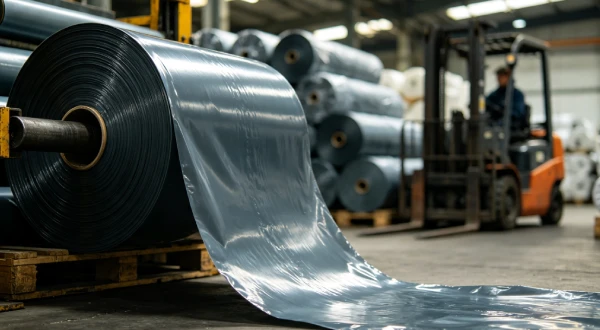
- ✅ Roll identification: Unique roll numbers
4️⃣ QA vs QC — Roles and Responsibilities
Clear separation of QA and QC roles is essential for effective quality management.
Quality Control (QC) — Installer’s Responsibility:
| Activity | Responsibility |
|---|---|
| Material inspection | Installer QC |
| Subgrade preparation | Installer QC |
| Panel layout | Installer QC |
| Welding execution | Installer QC |
| Non-destructive testing | Installer QC |
| Destructive testing | Installer QC |
| Defect repair | Installer QC |
| Internal documentation | Installer QC |
Table scrolls horizontally on mobile
Quality Assurance (QA) — Owner’s Responsibility:
| Activity | Responsibility |
|---|---|
| QC program approval | Owner/QA |
| Material certification review | Owner/QA |
| Subgrade inspection | Owner/QA |
| Welding oversight | Owner/QA |
| Test witnessing | Owner/QA |
| Non-conformance management | Owner/QA |
| Final documentation review | Owner/QA |
| Certification | Owner/QA |
Table scrolls horizontally on mobile
Third-Party CQA:
| Role | Responsibility |
|---|---|
| Independent verification | Verify QC procedures are followed |
| Technical expertise | Provide specialised knowledge |
| Documentation | Maintain QA records |
| Regulatory interface | Liaise with regulatory agencies |
| Final certification | Provide certification of compliance |
5️⃣ Pre-Installation QA Activities
Pre-installation QA activities establish the foundation for quality.
Material Verification:
| Activity | QA Role |
|---|---|
| Review material test certificates | Confirm compliance with GRI-GM13 |
| Verify roll identification | Confirm batch/lot traceability |
| Inspect rolls for damage | Document any damage |
| Confirm storage conditions | Verify UV protection, moisture protection |
Table scrolls horizontally on mobile
Subgrade Inspection:
| Activity | QA Role |
|---|---|
| Verify compaction | Review QC compaction test results |
| Verify particle size | Observe sieve analysis |
| Verify proof-rolling | Witness proof-rolling |
| Document subgrade condition | Photographs and inspection reports |
Table scrolls horizontally on mobile
QA/QC Plan Review:
| Activity | QA Role |
|---|---|
| Review QC plan | Confirm compliance with requirements |
| Approve QC personnel | Verify qualifications |
| Establish QA procedures | Define inspection and testing frequency |
| Define non-conformance procedure | Establish correction and verification process |
6️⃣ Installation QA Activities
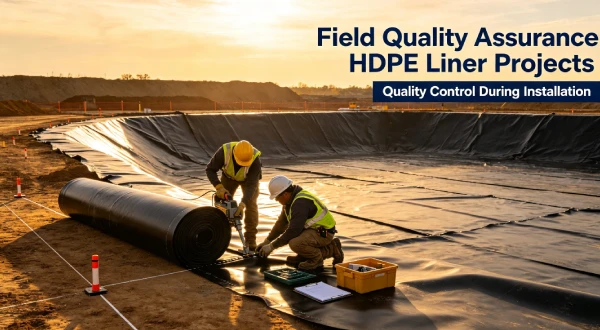
Installation QA activities verify that the installation follows approved procedures.
Welding Oversight:
| Activity | QA Role |
|---|---|
| Verify welding parameters | Witness temperature, speed, pressure |
| Observe weld preparation | Confirm cleanliness, texture removal |
| Review QC non-destructive testing | Verify 100% seam testing |
| Witness destructive testing | Observe peel and shear testing |
| Document results | Record welding parameters and test results |
Table scrolls horizontally on mobile
Panel Layout Verification:
| Activity | QA Role |
|---|---|
| Verify panel layout | Confirm alignment with drawings |
| Check T-junction offsets | Verify 3–5m offsets |
| Check seam orientation | Confirm parallel to contours |
| Verify thermal slack | Confirm 2–3% slack |
Table scrolls horizontally on mobile
Non-Conformance Management:
| Activity | QA Role |
|---|---|
| Identify non-conformances | Document deviations |
| Require correction | Issue non-conformance report |
| Verify correction | Inspect corrected work |
| Document closure | Sign off on correction |
7️⃣ Post-Installation QA Activities
Post-installation QA activities verify the final installation.
Leak Location Survey:
| Activity | QA Role |
|---|---|
| Oversee survey execution | Witness leak location survey |
| Review results | Confirm all leaks identified |
| Verify repairs | Witness repair and retest |
| Document results | Record survey and repair results |
Table scrolls horizontally on mobile
Final Inspection:
| Activity | QA Role |
|---|---|
| Perform final walk-through | Inspect entire liner area |
| Verify documentation | Review all QA/QC records |
| Identify outstanding issues | Document any remaining non-conformances |
| Prepare final report | Summarise QA activities and results |
Table scrolls horizontally on mobile
Certification:
| Activity | QA Role |
|---|---|
| Prepare certification | Document compliance with specifications |
| Submit to owner | Provide certification package |
| Submit to regulators | Provide required documentation |
| Archive records | Retain records for facility lifetime |
8️⃣ Real Engineering Failure Cases
Case 1: Inadequate QA Oversight — US Southwest Landfill, 2017
Specification used: 2.0mm HDPE, QC program in place but QA oversight limited to final inspection. No independent verification of welding parameters or destructive testing.
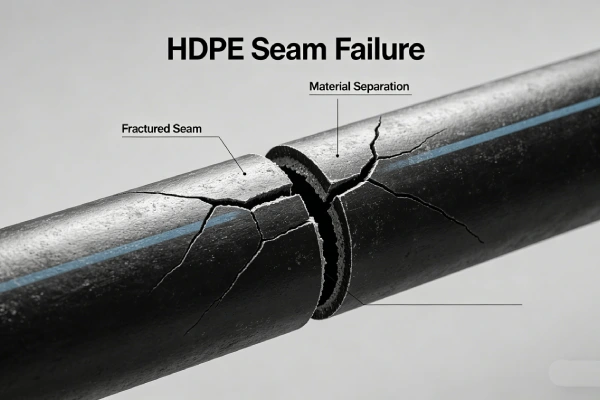
Observed failure: Multiple seam failures after 2 years. Destructive testing of failed seams showed peel strength 60–100 N/25mm. Seam failures at multiple locations.
Timeline:
2017: 2.0mm HDPE installed, QC only
2017: Limited QA oversight
2017-2019: Seam failures at multiple locations
2019: Investigation revealed inadequate welding
2019-2020: Seam replacement, QA implemented
Cost: $3.5M (seam replacement + investigation + remediation)
Root cause: Inadequate QA oversight. QC welding parameters were not verified. Destructive testing was not witnessed. Welding defects were not identified before cover placement.
Engineering lesson: QA oversight must be continuous, not just final inspection. Witness welding parameters and destructive testing. Independent verification of all QC activities.
Case 2: Documentation Failure — European Hazardous Waste Landfill, 2018
Specification used: 2.0mm HDPE, QA program in place but documentation incomplete. Test results not properly recorded. Regulatory compliance audit identified gaps.
Observed failure: Regulatory compliance audit identified missing test records. Facility at risk of non-compliance. Required additional testing to fill gaps.
Timeline:
2018: 2.0mm HDPE installed, QA program in place
2018: Documentation incomplete
2018-2019: Regulatory audit identified gaps
2019: Additional testing required
2019-2020: Documentation completed
Cost: $500,000 (additional testing + documentation + regulatory fees)
Root cause: QA documentation was incomplete. Test results were not properly recorded. Regulatory compliance audit identified gaps in the QA record.
Engineering lesson: Documentation is essential for regulatory compliance. Maintain complete QA records. Review documentation regularly during installation.
Case 3: Confusion Between QA and QC — Australian Heap Leach Pad, 2019
Specification used: 2.0mm HDPE, QA and QC roles not clearly defined. Installer performed both QC and QA functions. No independent verification.
Observed failure: Welding defects not identified. Leakage from seam failures. Investigation revealed no independent QA.
Timeline:
2019: 2.0mm HDPE installed, no independent QA
2019: Welding defects not identified
2019-2020: Leakage from seam failures
2020: Investigation revealed QA/QC confusion
Cost: $2.8M (seam replacement + investigation + remediation)
Root cause: QA and QC roles were not clearly defined. The installer performed both QC and QA functions. No independent verification of quality.
Engineering lesson: QA and QC roles must be clearly separated. QA must be independent of QC. Third-party CQA provides independent verification.
Failure Case Cost Summary
| Case | Location | Failure Mode | Cost | Primary Lesson |
|---|---|---|---|---|
| Case 1 | US Southwest | Inadequate QA oversight | $3.5M | Continuous QA oversight required |
| Case 2 | Europe | Documentation failure | $500k | Complete QA documentation essential |
| Case 3 | Australia | QA/QC confusion | $2.8M | QA must be independent of QC |
9️⃣ Comparison With Alternative Liner Systems
| Property | HDPE | LLDPE | PVC | EPDM | GCL |
|---|---|---|---|---|---|
| QA/QC complexity | High | High | Moderate | Moderate | Moderate |
| Material testing requirements | Extensive (GRI-GM13) | Extensive | Moderate | Moderate | Moderate |
| Seam testing requirements | Extensive (GRI-GM19) | Extensive | Moderate | Low | N/A |
| Documentation requirements | High | High | Moderate | Moderate | Moderate |
| Third-party CQA required | Recommended | Recommended | Recommended | Recommended | Recommended |
| Regulatory compliance | High | High | Moderate | Moderate | Moderate |
| Cost of QA/QC | 3–7% | 3–7% | 2–5% | 2–5% | 2–5% |
Table scrolls horizontally on mobile
🔟 Documentation and Record Keeping
Documentation is the foundation of QA/QC and regulatory compliance.
Required Documentation:
| Document | Purpose |
|---|---|
| Material test certificates | Verify material compliance |
| Material inspection reports | Document condition on receipt |
| Subgrade inspection reports | Document subgrade preparation |
| Welding parameter logs | Document welding conditions |
| Non-destructive test records | Document seam integrity |
| Destructive test records | Document seam strength |
| Repair records | Document defect correction |
| Leak location survey | Document liner integrity |
| Final QA report | Summarise QA activities |
Table scrolls horizontally on mobile
Document Retention:
- ✅ Minimum retention: 10 years (or facility lifetime)
- ✅ Electronic and hard copies: Both recommended
- ✅ Organised format: Easy retrieval for audits
- ✅ QA sign-off: All documents signed by QA engineer
1️⃣1️⃣ Professional Engineering Recommendation
QA Program Components:
| Component | Description |
|---|---|
| QA/QC plan | Document defining roles, procedures, and frequency |
| QC program | Installer’s quality control procedures |
| QA oversight | Independent verification of QC activities |
| Non-conformance management | Identification, correction, verification |
| Documentation | Complete records of all activities |
| Final certification | Compliance verification |
Table scrolls horizontally on mobile
QA Inspector Requirements:
- ✅ Qualifications: Certified CQA engineer or equivalent
- ✅ Experience: Minimum 3–5 years in geomembrane QA
- ✅ Training: GRI-GM13/GM19 training
- ✅ Independence: Not employed by the installer
Critical QA Activities:
- ✅ Material certification review: Verify compliance
- ✅ Subgrade inspection: Verify preparation
- ✅ Welding oversight: Witness parameters and testing
- ✅ Non-conformance management: Identify and correct
- ✅ Documentation: Complete records
1️⃣2️⃣ FAQ Section
Q1: What is the difference between QA and QC?
QA (Quality Assurance) is the owner’s system to ensure quality is built in — independent verification that QC procedures are followed. QC (Quality Control) is the installer’s system to control quality during construction.
Q2: What are the key QA activities for a liner project?
Key QA activities include: material certification review, subgrade inspection, panel layout verification, welding parameter monitoring, non-destructive testing oversight, destructive testing witness, leak location survey oversight, and final documentation review.
Q3: What are the key QC activities for a liner project?
Key QC activities include: material inspection upon receipt, subgrade preparation, panel layout, welding (parameters, execution), non-destructive testing (100% of seams), destructive testing (every 150m), and repair of defects.
Q4: What standards apply to geomembrane QA/QC?
Key standards include: GRI-GM13 (specification), GRI-GM19 (seam testing), ASTM D5397 (NCTL), ASTM D5885 (HP-OIT), ASTM D4218 (carbon black), and ASTM D5596 (dispersion).
Q5: What documentation is required for QA/QC?
Documentation includes: material test certificates, inspection reports, welding parameter logs, seam test results (non-destructive and destructive), repair records, leak location survey results, and final certification.
Q6: What is a non-conformance and how is it managed?
A non-conformance is any deviation from specifications or approved procedures. Management includes: identification, documentation, investigation, correction, verification, and closure with QA sign-off.
Q7: What is the role of third-party CQA?
Third-party CQA provides independent verification of installation quality. The CQA engineer works for the owner (not the installer) to verify that QC procedures are followed and that the installation meets specifications.
Q8: How often should QA inspections be performed?
QA inspections should be: continuous (welding, visual inspection), daily (subgrade, panel layout), and periodic (destructive testing witness, leak location survey oversight). Frequency should be defined in the QA/QC plan.
Q9: What is the cost of QA/QC for a liner project?
QA/QC costs typically range from 3–7% of the total installation cost, depending on project size, complexity, and regulatory requirements. Larger projects may have lower percentage costs.
Q10: What happens if QA identifies a non-conformance?
If QA identifies a non-conformance, the issue is documented and the installer is required to correct it. QC performs the correction, and QA verifies the correction. All non-conformances and corrections are documented.
1️⃣3️⃣ Technical Conclusion
Field quality assurance is a systematic process that encompasses material verification, installation inspection, testing, documentation, and regulatory compliance. QA is independent verification that QC procedures are followed and that the final installation meets specifications. QC is the installer’s system to control quality during construction. Both are essential and complementary.
Clear separation of QA and QC roles is essential. The installer performs QC (material inspection, subgrade preparation, welding, testing, repair). The owner’s QA representative provides independent verification (material certification review, subgrade inspection, welding oversight, test witnessing, non-conformance management). Third-party CQA provides additional independence and technical expertise.
Documentation is the foundation of QA/QC and regulatory compliance. All inspections, tests, and deviations must be recorded. Documentation provides evidence of compliance for regulatory agencies and legal protection. Records should be retained for the facility lifetime (minimum 10 years).
QA/QC costs typically range from 3–7% of the total installation cost. This investment is justified by reduced failure risk and regulatory compliance. The cost of QA/QC ($50,000–200,000 per project) is far lower than the cost of failure remediation ($1–5M).
Lifecycle cost analysis demonstrates that QA/QC is cost-effective. Proper QA/QC reduces failure risk by 70–90%. The investment in QA/QC is the most cost-effective strategy for ensuring long-term liner integrity and regulatory compliance.
📚 Related Technical Guides
CQA Program Development for Geomembrane Installations: A Project Manager's GuideGRI-GM13 and GM19: A Specification and Testing Reference for QA EngineersNon-Conformance Management: Identification, Correction, and DocumentationQA Documentation and Record Keeping: Requirements and Best PracticesHDPE Geomembrane Failure Investigation: QA/QC-Related Root Cause Analysis