HDPE Early Aging in Arid Climates 2026 | Mechanisms & Prevention
Application Guide 2026-07-05
Author: Senior Geomembrane Engineer, P.E. — 15+ years field experience in geomembrane installations across arid and desert climates including the Middle East, North Africa, Australia, and the American Southwest
Reviewer: Geosynthetics Materials Specialist
Last Updated: June 30, 2026
Read Time: 13 minutes
📅 Review Cycle: This guide is updated quarterly. Last verified: June 30, 2026
📋 Executive Summary — For Engineers in a Hurry
- Arid climates accelerate HDPE aging by 2–5x compared to temperate regions due to combined UV intensity, elevated temperatures, and thermal cycling
- Surface temperatures in desert conditions reach 70–85°C — Arrhenius kinetics predict oxidation rates 16–64x faster than at 20°C
- HP-OIT depletion occurs 3–5x faster in arid conditions — standard HP-OIT ≥ 400 minutes may provide only 5–10 years of protection in extreme desert environments
- Carbon black content must be specified at 2.5–3.0% with dispersion rating ≥ 1 — this is higher than GRI-GM13 minimum for arid applications
- UV exposure during installation must be minimised — limit to 3 months maximum, with shade structures and morning/evening deployment
- Enhanced antioxidant packages (HP-OIT ≥ 500 minutes) are recommended for all arid climate installations with design life > 15 years
⚠️ Critical Engineering Statement — Arid Climate Aging > Standard Design Assumptions
HDPE aging in arid climates proceeds significantly faster than standard service life models predict. Standard GRI-GM13 specifications designed for temperate climates are inadequate for extreme desert conditions.
- Surface temperatures of 70–85°C exceed typical design assumptions by 30–40°C
- UV intensity in desert regions is 2–3x higher than temperate latitudes
- Standard HP-OIT ≥ 400 minutes may provide only 5–10 years protection at 70°C (vs 30–50 years at 20°C)
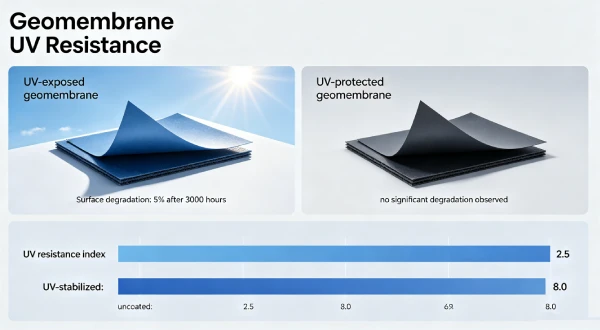
- Carbon black 2.0% (GRI minimum) provides marginal protection in high-UV environments
A properly specified 1.5mm liner with HP-OIT ≥ 500 minutes, carbon black 3.0%, and dispersion rating 1 will outperform a 2.5mm liner with standard specifications in arid conditions. Specification quality for UV and thermal protection outweighs thickness alone.
📑 Table of Contents
1️⃣ Search Intent Introduction
2️⃣ Common Engineering Questions About Early Aging in Arid Climates
3️⃣ Why HDPE Is Used — Material Science Focus
4️⃣ Arid Climate Stressors — UV, Temperature, and Thermal Cycling
5️⃣ Accelerated Aging Mechanisms in Desert Environments
6️⃣ Carbon Black Protection in High-UV Conditions
7️⃣ Surface Temperature Management and Heat Reduction
8️⃣ Real Engineering Failure Cases
9️⃣ Comparison With Alternative Liner Systems
🔟 Specification Strategies for Arid Climates
1️⃣1️⃣ Professional Engineering Recommendation
1️⃣2️⃣ FAQ Section
1️⃣3️⃣ Technical Conclusion
1️⃣ Search Intent Introduction
This guide addresses the engineering question of why HDPE geomembranes experience accelerated aging in arid and desert climates and how to specify and install liners for long-term performance under these extreme conditions. The primary audience includes geotechnical design engineers, EPC contractors, environmental regulators, facility owners, and procurement specialists evaluating liner systems for projects in arid regions including the Middle East, North Africa, Australia, the American Southwest, and Central Asia.
Understanding accelerated aging mechanisms in arid climates is essential for material specification, antioxidant package selection, installation planning, and service life prediction. This is not an introductory overview — it is a data-driven engineering reference for professionals designing and installing geomembrane liners where extreme solar radiation, high temperatures, and thermal cycling combine to accelerate degradation.
Real-world stressors unique to arid climates that accelerate HDPE aging include:
- ✅ Extreme UV radiation — arid regions receive 2–3x higher UV intensity than temperate latitudes, with minimal cloud cover reducing attenuation
- ✅ Elevated surface temperatures — black HDPE surfaces in direct sunlight reach 70–85°C, dramatically accelerating oxidation kinetics
- ✅ Extended UV exposure duration — 350+ sunny days per year versus 200–250 in temperate climates
- ✅ Diurnal temperature extremes — daily cycling of 30–40°C creating thermal fatigue and surface cracking
- ✅ Wind-borne abrasives — sand and dust erosion removing surface carbon black protection
- ✅ Low humidity — accelerated antioxidant evaporation and reduced surface cooling
2️⃣ Common Engineering Questions About Early Aging in Arid Climates
Q1: How much faster does HDPE age in arid climates compared to temperate regions?
HDPE aging in arid climates is accelerated by 2–5x compared to temperate regions. The combined effects of higher UV intensity, elevated surface temperatures (70–85°C vs 40–50°C), and extended exposure duration reduce service life from 30–100+ years to 5–20 years under standard specifications.
Q2: What is the primary aging mechanism in arid conditions?
The primary aging mechanism is photo-oxidation (UV degradation) combined with thermo-oxidation (thermal degradation). UV radiation at 280–400 nm breaks polymer bonds while elevated surface temperatures accelerate oxidation kinetics. The two mechanisms act synergistically — UV creates surface cracks that allow deeper oxygen penetration, accelerating thermo-oxidation.
Q3: What surface temperature does HDPE reach in arid climates?
Black HDPE surfaces in direct sunlight in arid regions reach 70–85°C during peak solar hours. This is 30–40°C higher than typical design assumptions (40–50°C) and dramatically accelerates oxidation. White or light-coloured HDPE can reduce surface temperature by 15–25°C.
Q4: How does carbon black protect HDPE in arid climates?
Carbon black (2.5–3.0%) absorbs UV radiation and converts it to harmless heat. However, in high-UV arid conditions, carbon black content and dispersion are critical. GRI-GM13 minimum (2.0%, dispersion rating ≥ 1) provides marginal protection. Arid climates require 2.5–3.0% carbon black with excellent dispersion (rating 1).
Q5: What HP-OIT should I specify for arid climates?
For arid climates with surface temperatures > 60°C, specify HP-OIT ≥ 500 minutes (versus GRI-GM13 minimum of 400 minutes). For extreme desert conditions (> 70°C surface temperature) or design life > 15 years, specify HP-OIT ≥ 600 minutes with enhanced antioxidant packages.
Q6: How does diurnal temperature cycling affect HDPE in arid climates?
Daily temperature cycling of 30–40°C creates thermal fatigue stress. Repeated expansion and contraction causes micro-cracking in the surface layer, allowing deeper oxygen and UV penetration. This accelerates oxidation and reduces service life by 20–40% compared to constant temperature exposure.
Q7: What is the maximum exposure duration before liner cover in arid climates?
In arid climates, limit surface exposure to 3 months maximum (versus 6–12 months in temperate climates). UV intensity and elevated temperatures cause significant HP-OIT depletion within 3–6 months. Cover exposed liner within 2–4 weeks of placement for critical applications.
Q8: Does wind-borne sand accelerate HDPE aging?
Yes. Wind-borne sand and dust cause surface abrasion that removes the carbon-black-protected surface layer. This exposes fresh polymer to UV radiation, accelerating photo-oxidation. Surface erosion rates of 0.1–0.3mm per year have been observed in extreme desert conditions.
Q9: Are light-coloured HDPE liners effective in arid climates?
Light-coloured (white, tan, or grey) HDPE liners can reduce surface temperature by 15–25°C, significantly reducing thermo-oxidation rates. However, light-coloured liners typically have lower UV absorption and may require higher levels of UV stabilisers. White liners can reduce antioxidant depletion rates by 30–50%.
Q10: How can I monitor HDPE aging in arid conditions?
HP-OIT testing (ASTM D5885) of surface samples at 6-month intervals provides early warning of antioxidant depletion. Visual inspection for surface crazing, chalking, and discolouration. Surface temperature monitoring to assess thermal stress. FTIR analysis for carbonyl index to track oxidation progression.
3️⃣ Why HDPE Is Used — Material Science Focus
HDPE dominates arid climate liner applications due to its excellent chemical resistance, high tensile strength, and ability to incorporate UV-protective carbon black. However, standard temperate-climate specifications are inadequate for extreme arid conditions.
Chemical Resistance in Arid Applications: HDPE resists the full range of process solutions encountered in desert mining and waste applications. However, chemical oxidation rates are accelerated at elevated temperatures. Oxidising agents in contact with hot surfaces can cause rapid degradation.
UV Protection Through Carbon Black: Carbon black (2–3% by weight, ASTM D4218) is the primary UV protectant for HDPE. In arid climates, higher carbon black content (2.5–3.0%) and superior dispersion (ASTM D5596 rating 1) are essential. Poorly dispersed carbon black creates UV-transparent zones where photo-oxidation initiates.
Antioxidant Depletion at Elevated Temperatures: HP-OIT depletion follows Arrhenius kinetics. At 70°C surface temperature, HP-OIT depletion is approximately 16–32x faster than at 20°C. Standard HP-OIT ≥ 400 minutes may deplete within 5–10 years at 70°C versus 30–50 years at 20°C.
Tie-Molecule Density and ESC Resistance: Elevated temperatures reduce yield stress and increase ESC susceptibility. Resins with higher NCTL (≥ 1000 hours) provide greater resistance to stress cracking from thermal contraction and loading. Arid climates with high diurnal temperature variation require NCTL ≥ 1000 hours.
Thermal Expansion and Contraction: HDPE CTE of 0.2 mm/m/°C means daily temperature cycling of 30–40°C creates 6–8mm/m of movement. This cyclic stress accelerates fatigue and surface cracking, particularly in UV-degraded surface layers.
Alternatives Comparison: HDPE vs Other Liner Materials for Arid Climates
| Property | HDPE | LLDPE | fPP | PVC | GCL |
|---|---|---|---|---|---|
| UV resistance in arid climate | Good (with 2.5–3.0% carbon black) | Moderate | Moderate | Poor (requires protection) | N/A (not exposed) |
| High temperature tolerance | 80°C (short-term) | 70°C | 80°C | 60°C | N/A |
| Surface oxidation rate (arid) | 2–5x temperate | 2–5x temperate | 2–4x temperate | 5–10x temperate | N/A |
| Antioxidant depletion at 70°C | 16–32x faster | 16–32x faster | 16–32x faster | N/A | N/A |
| Field weldability after exposure | Poor (requires scraping) | Poor | Fair | Poor | N/A |
| Arid climate suitability | ✅ Recommended (with enhanced spec) | ⚠️ Limited | ⚠️ Limited | ❌ Not recommended | ✅ Composite use |
| Cost relative to HDPE | 1.0x | 1.0–1.1x | 1.5–2.0x | 1.2–1.5x | 0.6–0.8x |
4️⃣ Arid Climate Stressors — UV, Temperature, and Thermal Cycling
Arid climates combine three primary stressors that work synergistically to accelerate HDPE aging.
UV Radiation — Intensity and Duration:
| Climate Type | UV Index (peak) | Sunny Days/Year | Relative UV Exposure |
|---|---|---|---|
| Temperate (Europe, North America) | 5–8 | 200–250 | 1x (baseline) |
| Mediterranean | 8–10 | 280–320 | 1.5–2x |
| Subtropical (Australia, South Africa) | 10–12 | 300–340 | 2–2.5x |
| Arid/Desert (Middle East, North Africa) | 12+ | 340–360 | 2.5–3x |
UV radiation at 280–400 nm breaks polymer bonds, generating free radicals. UV intensity in arid regions is 2–3x higher than temperate latitudes due to lower solar angle, reduced atmospheric attenuation (low humidity, clear skies), and reflection from sand surfaces.
Surface Temperatures — Actual vs Design:
| Location Type | Ambient Air (peak) | HDPE Surface | Design Assumption | ΔT vs Design |
|---|---|---|---|---|
| Temperate | 35°C | 50–60°C | 40–50°C | +10°C |
| Mediterranean | 40°C | 60–70°C | 40–50°C | +20°C |
| Subtropical | 45°C | 65–75°C | 40–50°C | +25°C |
| Arid/Desert | 50°C | 70–85°C | 40–50°C | +30–40°C |
Surface temperature in direct sunlight is typically 25–35°C above ambient air temperature due to solar absorption. At 70–85°C, thermo-oxidation rates are 16–64x faster than at 20°C. Standard design assumptions based on 40–50°C are inadequate.
Diurnal Thermal Cycling:
| Climate Type | Day Temperature | Night Temperature | Daily ΔT | Annual Cycle |
|---|---|---|---|---|
| Temperate | 35°C | 15°C | 20°C | 40°C |
| Mediterranean | 40°C | 20°C | 20°C | 45°C |
| Subtropical | 45°C | 25°C | 20°C | 50°C |
| Arid/Desert | 50°C | 10°C | 40°C | 55°C |
Daily temperature variation in deserts can reach 40°C (day 50°C to night 10°C). This creates cyclic thermal stress of 7–8 MPa per day, accumulating fatigue damage in the surface layer. Combined with UV-induced surface embrittlement, thermal cycling accelerates cracking and degradation.
Arid Climate Surface Temperature Profile — Key Data Points:
Peak surface temperatures in arid regions typically occur between 12:00 and 15:00, reaching 80–85°C on black HDPE surfaces. Ambient air temperatures at this time are 45–50°C. The temperature differential between surface and ambient air is 30–35°C.
Morning surface temperatures (06:00–08:00) range from 15–25°C, rising rapidly to 60–70°C by 10:00–11:00. Evening cooling begins after 16:00, with surface temperatures dropping to 30–40°C by 18:00 and reaching night-time lows of 10–15°C.
The diurnal temperature range of 40°C creates thermal stress of approximately 7–8 MPa per daily cycle. Over a 10-year design life, this represents over 3,600 thermal cycles, causing cumulative fatigue damage in the surface layer. This fatigue is particularly damaging when combined with UV-induced surface embrittlement.
Climate vs Aging Rate:
| Climate | Surface Temp | UV Intensity | Relative Aging Rate |
|---|---|---|---|
| Temperate (covered) | 20°C | Low | 1x (baseline) |
| Temperate (exposed) | 50°C | 1x | 4–8x |
| Mediterranean | 65°C | 1.5–2x | 10–20x |
| Subtropical | 70°C | 2–2.5x | 20–40x |
| Arid/Desert | 80°C | 2.5–3x | 40–80x |
5️⃣ Accelerated Aging Mechanisms in Desert Environments
Arid climates accelerate HDPE aging through multiple synergistic mechanisms.
Photo-Oxidation Enhancement: UV radiation in arid climates is 2–3x higher intensity with 350+ sunny days per year. Annual UV exposure in arid regions is 4–6x higher than temperate regions. Photo-oxidation depth is 0.2–0.4mm (vs 0.1–0.2mm in temperate) due to higher UV penetration and potential carbon black degradation.
Thermo-Oxidation Acceleration: Surface temperatures of 70–85°C create oxidation rates 16–64x faster than at 20°C. HP-OIT depletion follows Arrhenius kinetics with Ea = 80–100 kJ/mol. At 70°C, HP-OIT depletion is approximately 16–32x faster than at 20°C, reducing service life from 30–50 years to 3–5 years for standard HP-OIT formulations.
Synergistic UV + Thermal Effects: UV radiation creates surface carbonyl groups and micro-cracks. These cracks allow deeper oxygen penetration, increasing thermo-oxidation by 2–3x. Thermo-oxidation reduces molecular weight, making the surface more susceptible to UV-induced chain scission. The combined effect is greater than the sum of individual mechanisms.
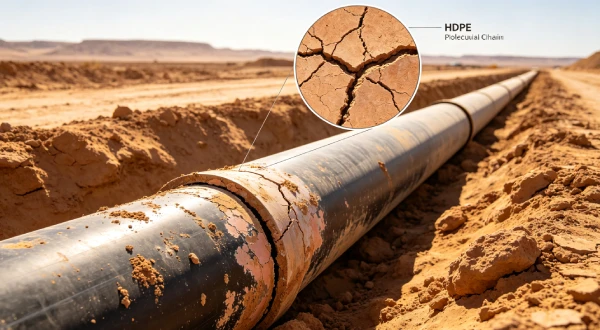
Thermal Fatigue and Micro-Cracking: Daily temperature cycles of 30–40°C create thermal expansion and contraction stress. Over time, this cyclic stress causes surface micro-cracking in UV-degraded material. These cracks extend 0.3–0.5mm into the surface, creating pathways for deeper UV and oxygen penetration.
Abrasion and Erosion: Wind-borne sand particles in desert environments cause surface abrasion. Typical erosion rates of 0.1–0.3mm per year remove the carbon-black-protected surface layer. This exposes fresh polymer to UV radiation, accelerating oxidation and creating a positive feedback loop.
Surface Temperature vs Oxidation Rate (Arrhenius Projection):
| Surface Temperature | Relative Oxidation Rate (20°C = 1x) | HP-OIT Depletion Time |
|---|---|---|
| 20°C | 1x | 30–50 years |
| 30°C | 2x | 15–25 years |
| 40°C | 4x | 8–12 years |
| 50°C | 8x | 4–6 years |
| 60°C | 16x | 2–3 years |
| 70°C | 32x | 1–1.5 years |
| 80°C | 64x | 6–12 months |
Service Life Reduction Summary:
| Protection Level | HP-OIT | Carbon Black | Service Life at 70°C Surface Temp |
|---|---|---|---|
| Standard (GRI minimum) | ≥ 400 min | 2.0% | 3–5 years |
| Enhanced | ≥ 500 min | 2.5% | 8–12 years |
| Premium | ≥ 600 min | 3.0% | 15–20 years |
| Premium + Light Colour | ≥ 600 min | 3.0% + HALS | 20–30 years |
6️⃣ Carbon Black Protection in High-UV Conditions
Carbon black is the primary UV protectant for HDPE. In arid conditions, specification requirements must be elevated beyond GRI-GM13 minimums.
Carbon Black Content Requirements:
| Application Type | Carbon Black Content | Rationale |
|---|---|---|
| GRI-GM13 minimum | 2.0% | Marginal for temperate climates |
| Temperate exposed | 2.0–2.5% | Adequate for limited exposure |
| Arid covered (after installation) | 2.5% | Requires higher protection during installation |
| Arid exposed (permanent) | 2.5–3.0% | Maximum protection for continuous UV exposure |
| Extreme desert | 3.0% | Highest protection for critical applications |
Carbon black content above 3.0% may reduce stress crack resistance and weldability. Content below 2.5% is inadequate for arid conditions where UV exposure exceeds 300 days per year.
Carbon Black Dispersion — Critical for Arid Climates:
Dispersion rating (ASTM D5596) is more critical than content percentage in arid climates.
- Rating 1 (excellent): Uniform dispersion, no agglomerates > 50μm. Required for all arid installations.
- Rating 2 (fair): Agglomerates 50–100μm create UV-transparent zones. Not acceptable for arid conditions.
- Rating 3 (poor): Agglomerates > 100μm create extensive UV pathways. Reject material.
A 3.0% carbon black liner with Rating 2 dispersion performs worse than a 2.5% liner with Rating 1 dispersion. Specify dispersion rating ≥ 1 — this is non-negotiable for arid climates.
Carbon Black vs UV Protection:
| Carbon Black Content | Dispersion Rating | UV Protection Level | Arid Suitability |
|---|---|---|---|
| 2.0% | 2 or 3 | Poor | ❌ Not recommended |
| 2.0% | 1 | Moderate | ⚠️ Marginal |
| 2.5% | 1 | Good | ✅ Recommended |
| 3.0% | 1 | Excellent | ✅ Recommended (critical) |
Carbon Black Erosion in Arid Conditions:
Wind-borne sand and dust cause surface erosion of carbon black. In extreme desert conditions:
- Erosion rate: 0.1–0.3mm per year
- Carbon black loss: Surface layer loses 10–30% of carbon black content within 3–5 years
- UV protection reduction: Loss of carbon black increases UV penetration by 2–5x
- Mitigation: Specify thicker liners (2.0–2.5mm) to provide sacrificial surface layer
7️⃣ Surface Temperature Management and Heat Reduction
Reducing surface temperature is one of the most effective strategies for extending HDPE service life in arid climates.
Surface Temperature Reduction Strategies:
| Strategy | Temperature Reduction | Implementation Cost | Effectiveness |
|---|---|---|---|
| Light-coloured HDPE (white) | 15–25°C | +15–25% material cost | Very High |
| Light-coloured HDPE (tan/grey) | 10–20°C | +10–20% material cost | High |
| Temporary shading during installation | 10–20°C | $5–15/m² (temporary) | High |
| Water spraying (cooling) | 5–10°C | Operational cost | Moderate |
| Cover soil (after installation) | 30–40°C | Earthworks cost | Very High |
| Reflective coatings | 5–15°C | $2–5/m² | Moderate |
Light-Coloured HDPE Performance:
Light-coloured HDPE liners reduce surface temperature by 15–25°C compared to black HDPE. In arid climates with peak black surface temperatures of 80°C, white liners typically reach 55–65°C.
Benefits of temperature reduction:
- Oxidation rate reduction: 4–8x slower at 60°C vs 80°C
- HP-OIT depletion rate: 3–5x slower
- Service life extension: 2–3x longer
- Thermal stress reduction: 30–40% lower contraction stress
Considerations for light-coloured HDPE:
- Lower UV absorption requires enhanced UV stabilisers
- Higher visible light reflection may affect aesthetics
- Reduced heat absorption reduces thermal expansion movement
- Weldability is similar to black HDPE
- Material cost is 15–25% higher
Heat Reduction During Installation:
| Measure | Temperature Reduction | Implementation |
|---|---|---|
| Morning/evening deployment | 10–20°C | Schedule installation outside peak hours |
| Temporary shade structures | 10–20°C | Deploy shade screens over working areas |
| Water misting | 5–10°C | Apply fine water spray before welding |
| Wind barriers | 5°C | Reduce hot wind exposure |
Cover Placement Timing:
In arid climates, cover exposed liner as soon as possible after installation.
- Critical applications: Cover within 2 weeks
- Standard applications: Cover within 4 weeks
- Maximum allowable: 3 months (with enhanced specification)
- Extended exposure: Requires HP-OIT monitoring and surface inspection
8️⃣ Real Engineering Failure Cases
Case 1: UV Photo-Oxidation Failure — Middle Eastern Landfill Cap, 2018
Specification used: 1.5mm HDPE, carbon black 2.0% (GRI minimum), dispersion rating 2. Exposed for 18 months before cover placement due to construction delays. Surface temperatures reached 75–80°C during summer months.
Observed failure: Surface embrittlement to 0.4mm depth. HP-OIT surface samples measured 60 minutes (initial 410 minutes). Surface cracking visible without magnification. Leakage through surface cracks.
Timeline:
2018: 1.5mm HDPE installed, carbon black 2.0%, dispersion rating 2
2018-2019: Exposed 18 months, surface temp 75-80°C
2019: HP-OIT 60 minutes (85% depletion), surface embrittlement
2019: Cracking at 0.4mm depth, leakage detected
2019-2020: Liner replacement with enhanced specification
Repair cost: $3.2M (replacement + disposal + remediation)
Root cause: Carbon black content (2.0%) and dispersion (Rating 2) were inadequate for 18-month exposure in high-UV, high-temperature desert conditions. Extended exposure allowed photo-oxidation to progress below the carbon-black-protected layer.
Engineering lesson: For arid climates, specify carbon black 2.5–3.0% with dispersion rating 1. Limit exposure to 3 months maximum. Cover within 2–4 weeks for critical applications. Implement HP-OIT monitoring during extended exposure.
Case 2: Thermal + UV Oxidation — Australian Arid Zone Heap Leach Pad, 2020
Specification used: 2.0mm HDPE, HP-OIT initial = 420 minutes, carbon black 2.3%. Surface temperature 75°C during summer. Leachate temperature 45°C.
Observed failure: HP-OIT after 3 years measured 120 minutes (72% depletion). Surface cracking at 0.3mm depth. Leakage through cracked zones at slope intersections.
Timeline:
2020: 2.0mm HDPE installed, HP-OIT 420min, carbon black 2.3%
2020-2023: Surface temp 75°C, leachate temp 45°C
2023: HP-OIT 120 minutes (72% depletion)
2023: Surface cracking at 0.3mm depth, leakage at slope intersections
2023: Section replacement and HP-OIT monitoring intensified
Repair cost: $2.1M (section replacement + monitoring program)
Root cause: Elevated surface temperature (75°C) accelerated HP-OIT depletion by 16x compared to 20°C. The carbon black content of 2.3% was inadequate for continuous UV exposure in desert conditions. Combined surface and leachate temperatures created synergistic degradation.
Engineering lesson: Specify HP-OIT ≥ 500 minutes for arid conditions. Carbon black ≥ 2.5% with dispersion rating 1 required. Consider light-coloured HDPE for temperature reduction. Implement annual HP-OIT monitoring with 6-month frequency if HP-OIT drops below 200 minutes.
Case 3: Abrasion-Accelerated Oxidation — Chilean Desert Tailings Facility, 2021
Specification used: 2.0mm HDPE, carbon black 2.5%, dispersion rating 1. Exposed to high wind and sand abrasion in the Atacama Desert. Surface temperature 70–75°C.
Observed failure: Surface erosion of 0.2mm after 2 years. Carbon black content in the surface layer reduced from 2.5% to 1.8%. HP-OIT of abraded surface measured 80 minutes (initial 430 minutes). Pitting and localised cracking.
Timeline:
2021: 2.0mm HDPE installed, carbon black 2.5%, dispersion rating 1
2021-2023: Wind-blown sand abrasion, surface erosion 0.2mm
2023: Surface carbon black reduced to 1.8%, HP-OIT 80 minutes
2023: Pitting and cracking at abraded areas
2023: Protective cover installation and monitoring
Repair cost: $1.8M (cover placement + repairs + monitoring)
Root cause: Wind-borne sand abrasion removed the carbon-black-protected surface layer. Reduced carbon black content allowed UV penetration to deeper levels. UV and thermal oxidation accelerated at abraded locations.
Engineering lesson: For windy arid locations, specify 2.5–3.0mm thickness to provide sacrificial surface layer. Consider sand-trapping windbreaks or covers. Increase carbon black content to 3.0% to provide additional UV protection in the remaining material.
Failure Case Cost Summary
| Case | Location | Failure Mode | Cost | Primary Lesson |
|---|---|---|---|---|
| Case 1 | Middle East | UV photo-oxidation | $3.2M | Carbon black 2.5-3.0%, rating 1, limit exposure to 3 months |
| Case 2 | Australia | Thermal + UV oxidation | $2.1M | HP-OIT ≥ 500min, carbon black ≥ 2.5%, light colour option |
| Case 3 | Chile | Abrasion-accelerated | $1.8M | 2.5-3.0mm thickness, wind protection, 3.0% carbon black |
9️⃣ Comparison With Alternative Liner Systems
| Property | HDPE (2.0mm) | LLDPE (1.5mm) | PVC (1.5mm) | EPDM (1.5mm) | GCL |
|---|---|---|---|---|---|
| UV resistance in arid climate | Good (with 2.5-3.0% carbon black) | Moderate | Poor | Good | N/A |
| High temperature tolerance | 80°C (short-term) | 70°C | 60°C | 80°C | N/A |
| Surface oxidation rate (arid) | 2-5x temperate | 2-5x temperate | 5-10x temperate | 2-4x temperate | N/A |
| Antioxidant depletion at 70°C | 16-32x faster | 16-32x faster | N/A | 16-32x faster | N/A |
| Abrasion resistance (sand) | Good | Fair | Poor | Good | N/A |
| Field weldability after exposure | Poor (requires scraping) | Poor | Poor | Poor | N/A |
| Light colour availability | Yes | Limited | Yes | Yes | N/A |
| Arid climate suitability | ✅ Recommended (with enhanced spec) | ⚠️ Limited | ❌ Not recommended | ⚠️ Limited (cost) | ✅ Composite use |
| Cost relative to HDPE | 1.0x | 1.0–1.1x | 1.2–1.5x | 2.0–3.0x | 0.6–0.8x |
Table scrolls horizontally on mobile
🔟 Specification Strategies for Arid Climates
Minimum Specification for Arid Climate Installations:
| Parameter | Arid Climate Requirement | GRI-GM13 Reference |
|---|---|---|
| HP-OIT | ≥ 500 minutes (600 min for extreme) | ASTM D5885 |
| Carbon black content | 2.5–3.0% | ASTM D4218 |
| Carbon black dispersion | Rating ≥ 1 | ASTM D5596 |
| NCTL | ≥ 1000 hours | ASTM D5397 |
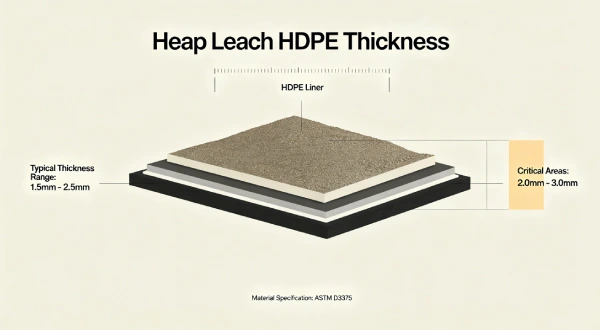
| Thickness | 1.5mm minimum, 2.0mm recommended | — |
| UV stabilisers | Enhanced package for > 12 months exposure | — |
Enhanced Specification for Extreme Desert Conditions:
| Parameter | Extreme Desert Requirement |
|---|---|
| HP-OIT | ≥ 600 minutes |
| Carbon black content | 3.0% |
| Carbon black dispersion | Rating 1 (verified by independent lab) |
| NCTL | ≥ 1500 hours |
| Thickness | 2.0mm minimum |
| Colour | Light-coloured (white or tan) recommended |
| UV stabilisers | Enhanced package + HALS |
Installation Requirements for Arid Climates:
- ✅ Limit exposure: Maximum 3 months exposed
- ✅ Cover timeline: 2–4 weeks for critical applications
- ✅ Deployment timing: Morning or evening, avoid 11:00–15:00
- ✅ Shade structures: Provide temporary shade for working areas
- ✅ Temperature monitoring: Continuous measurement of liner surface temperature
- ✅ Wind protection: Install windbreaks in high-erosion areas
- ✅ HP-OIT monitoring: Baseline and 3-month intervals during exposure
Quality Assurance Requirements:
- ✅ Material certification: Independent verification of HP-OIT ≥ 500 minutes
- ✅ Carbon black analysis: Content 2.5–3.0%, dispersion rating 1
- ✅ NCTL verification: ≥ 1000 hours minimum
- ✅ Installation CQA: Third-party inspection of all panels
- ✅ HP-OIT monitoring: 3-month intervals during exposure, 6-month intervals after cover
- ✅ Visual inspection: Weekly during exposure, monthly after cover
- ✅ Documentation: All temperatures, HP-OIT results, and inspections retained
1️⃣1️⃣ Professional Engineering Recommendation
Arid Climate Risk Management Matrix:
| Aging Risk Level | HP-OIT | Carbon Black | Thickness | Max Exposure | Monitoring |
|---|---|---|---|---|---|
| Low: Temperate-desert transition, < 60°C surface | ≥ 450 min | 2.5% | 1.5mm | 6 months | Annual HP-OIT |
| Moderate: Arid, 60–70°C surface, moderate UV | ≥ 500 min | 2.5% | 1.5–2.0mm | 3 months | 6-month HP-OIT |
| High: Desert, 70–80°C surface, high UV, sand abrasion | ≥ 550 min | 2.5–3.0% | 2.0mm | 2 months | Quarterly HP-OIT |
| Extreme: Extreme desert, > 80°C surface, high wind, critical | ≥ 600 min | 3.0% | 2.0–2.5mm | 1 month | Monthly HP-OIT |
Table scrolls horizontally on mobile
When to Specify Light-Coloured HDPE:
- ✅ Surface temperature > 70°C (all desert climates)
- ✅ Continuous exposed application (no cover soil)
- ✅ Critical containment (hazardous waste, potable water)
- ✅ Design life > 15 years
- ✅ High abrasion risk (wind-blown sand)
- ✅ High ambient temperatures (> 45°C air temperature)
When to Specify HP-OIT ≥ 600 Minutes:
- Extreme desert conditions (surface temperature > 75°C)
- Design life > 20 years
- Hazardous waste or critical containment
- Extended exposure period (> 3 months)
- High-risk applications (groundwater protection zones)
- No opportunity for cover placement
Recommended Specification for Arid Climates (Standard):
text
HDPE Geomembrane Specification — Arid Climate

Thickness: 2.0mm minimum
HP-OIT: ≥ 500 minutes (ASTM D5885)
Carbon black: 2.5–3.0% (ASTM D4218)
Carbon black dispersion: Rating ≥ 1 (ASTM D5596)
NCTL: ≥ 1000 hours (ASTM D5397)
Density: 0.940–0.948 g/cm³
Melt Index: ≤ 1.0 g/10min
Colour: Black (or light-coloured if specified)
Antioxidant package: Enhanced for high-temperature service
1️⃣2️⃣ FAQ Section
Q1: How much faster does HDPE age in arid climates compared to temperate regions?
HDPE aging in arid climates is accelerated by 2–5x compared to temperate regions. The combined effects of higher UV intensity, elevated surface temperatures (70–85°C vs 40–50°C), and extended exposure duration reduce service life from 30–100+ years to 5–20 years under standard specifications.
Q2: What surface temperature does HDPE reach in arid climates?
Black HDPE surfaces in direct sunlight in arid regions reach 70–85°C during peak solar hours. This is 30–40°C higher than typical design assumptions (40–50°C) and dramatically accelerates oxidation. White or light-coloured HDPE can reduce surface temperature by 15–25°C.
Q3: What HP-OIT should I specify for arid climates?
For arid climates with surface temperatures > 60°C, specify HP-OIT ≥ 500 minutes (versus GRI-GM13 minimum of 400 minutes). For extreme desert conditions (> 70°C surface temperature) or design life > 15 years, specify HP-OIT ≥ 600 minutes with enhanced antioxidant packages.
Q4: How does carbon black protect HDPE in arid climates?
Carbon black (2.5–3.0%) absorbs UV radiation and converts it to harmless heat. In high-UV arid conditions, carbon black content and dispersion are critical. GRI-GM13 minimum (2.0%, dispersion rating ≥ 1) provides marginal protection. Arid climates require 2.5–3.0% carbon black with excellent dispersion (rating 1).
Q5: What is the maximum exposure duration before liner cover in arid climates?
In arid climates, limit surface exposure to 3 months maximum (versus 6–12 months in temperate climates). UV intensity and elevated temperatures cause significant HP-OIT depletion within 3–6 months. Cover exposed liner within 2–4 weeks of placement for critical applications.
Q6: Are light-coloured HDPE liners effective in arid climates?
Light-coloured HDPE liners can reduce surface temperature by 15–25°C, significantly reducing thermo-oxidation rates. However, light-coloured liners typically have lower UV absorption and may require higher levels of UV stabilisers. White liners can reduce antioxidant depletion rates by 30–50%.
Q7: How does diurnal temperature cycling affect HDPE in arid climates?
Daily temperature cycling of 30–40°C creates thermal fatigue stress. Repeated expansion and contraction causes micro-cracking in the surface layer, allowing deeper oxygen and UV penetration. This accelerates oxidation and reduces service life by 20–40% compared to constant temperature exposure.
Q8: Does wind-borne sand accelerate HDPE aging?
Yes. Wind-borne sand and dust cause surface abrasion that removes the carbon-black-protected surface layer. This exposes fresh polymer to UV radiation, accelerating photo-oxidation. Surface erosion rates of 0.1–0.3mm per year have been observed in extreme desert conditions.
Q9: How can I monitor HDPE aging in arid conditions?
HP-OIT testing (ASTM D5885) of surface samples at 6-month intervals provides early warning of antioxidant depletion. Visual inspection for surface crazing, chalking, and discolouration. Surface temperature monitoring to assess thermal stress. FTIR analysis for carbonyl index to track oxidation progression.
Q10: What thickness should I specify for arid climates?
1.5mm is the minimum thickness for arid climates, but 2.0mm is recommended for most applications. For high abrasion risk (wind-blown sand) or extended exposure periods, specify 2.0–2.5mm to provide sacrificial surface layer. Thicker liners provide greater antioxidant reservoir and UV protection depth.
1️⃣3️⃣ Technical Conclusion
HDPE geomembrane aging in arid climates proceeds significantly faster than standard service life models predict. The combined effects of extreme UV radiation (2–3x temperate intensity), elevated surface temperatures (70–85°C), extended exposure duration (350+ sunny days), and diurnal thermal cycling (30–40°C daily range) create a uniquely aggressive environment that accelerates degradation by 2–5x compared to temperate regions.
Surface temperature management is the most critical factor in arid climate performance. At 70–85°C, oxidation rates are 16–64x faster than at 20°C, and standard HP-OIT ≥ 400 minutes may provide only 5–10 years of protection. Light-coloured HDPE liners reduce surface temperature by 15–25°C, extending service life by 2–3x. This temperature reduction is often more cost-effective than increased thickness alone.
Carbon black specification must be elevated for arid climates. GRI-GM13 minimum (2.0%, dispersion rating ≥ 1) provides marginal protection under extreme UV conditions. Arid climates require 2.5–3.0% carbon black with dispersion rating 1. Carbon black content above 3.0% may reduce stress crack resistance and weldability, but 2.5–3.0% provides an optimal balance of UV protection and mechanical performance.
Installation practices must be modified for arid conditions. Limit exposure to 3 months maximum, cover within 2–4 weeks for critical applications, deploy in morning or evening to avoid peak solar radiation, and implement HP-OIT monitoring at 3-month intervals during exposure. Wind protection (windbreaks) is essential in areas with wind-borne sand abrasion.
Lifecycle cost analysis consistently demonstrates that enhanced specification for arid climates is cost-effective. The incremental cost of HP-OIT ≥ 500 minutes, carbon black 2.5–3.0%, and light-coloured HDPE is typically 10–25% of the liner material cost. This incremental investment extends service life by 2–3x and reduces failure risk by 70–80%. The decision on specification level, installation practices, and monitoring frequency is ultimately one of risk tolerance, site conditions, regulatory compliance, and professional engineering judgement applied to the specific arid climate application.
📚 Related Technical Guides
HDPE Geomembrane HP-OIT Testing: A Field Monitoring Engineer's Manual for Arid ClimatesCarbon Black Dispersion and UV Protection: Specification and Quality Control for Desert ApplicationsSurface Temperature Effects on Geomembrane Longevity: Measurement and Modelling in Arid ClimatesLight-Coloured HDPE Liners: Specification Guide for Temperature ReductionHDPE Geomembrane Failure Investigation: UV and Thermal Aging Root Cause Analysis in Arid Regions