Geomembrane UV Resistance Guide 2026 | HDPE vs LLDPE vs PVC vs EPDM
Application Guide 2026-05-31
E-E-A-T SIGNALS
Author: Senior Geomembrane Engineer, P.E. — *15+ years field experience in exposed liner applications across tropical, temperate, and desert climates*
Reviewer: Geosynthetics Materials Specialist
Last Updated: May 28, 2026
Read Time: 10 minutes
Review Cycle: This guide is updated quarterly. Last verified: May 28, 2026
Table of Contents
- Search Intent Introduction
- Common Engineering Questions About UV Resistance
- Why UV Resistance Matters (Material Science Focus)
- Recommended Thickness Ranges for Exposed Applications
- Environmental Factors and Aging Mechanisms
- Subgrade Preparation and Support Layer Design
- Welding and Installation Risks
- Real Engineering Failure Cases
- Comparison With Alternative Liner Systems
- Cost Considerations
- Professional Engineering Recommendation
- FAQ Section (Technical)
- Technical Conclusion
1. Search Intent Introduction
This guide addresses the UV resistance and material selection decision faced by engineers designing exposed geomembrane applications such as floating covers, lagoon covers, reservoir liners, and temporary containment.
Unlike introductory content, this analysis provides direct UV resistance comparison based on polymer chemistry, carbon black requirements, UV stabilizer packages, and field performance data from 20+ year exposed installations.
The focus is on application-specific material selection where long-term UV exposure determines liner service life.
Exposed geomembranes face unique UV degradation stresses:
- Full sun exposure (year-round UV radiation, no cover or protection)
- Temperature cycling (daily surface temperature swings of 30-50°C)
- Ozone exposure (atmospheric ozone attacking polymer chains)
- Thermal oxidation (UV-generated heat accelerating degradation)
- Mechanical stress (wind, wave action, thermal expansion/contraction)
- Combined effects (UV + stress + temperature accelerating failure)
Executive Summary — For Engineers in a Hurry
- HDPE: 20-30 years exposed service life with 2-3% carbon black per ASTM D4218 — the industry standard for exposed applications
- EPDM: 30-50 years exposed service life — superior long-term UV resistance, no antioxidant depletion, but higher cost
- PVC: 5-10 years exposed service life — poor UV resistance, requires plasticizers and stabilizers that degrade over time
- LLDPE: 20-30 years exposed service life — similar to HDPE with 2-3% carbon black, more flexible but lower strength
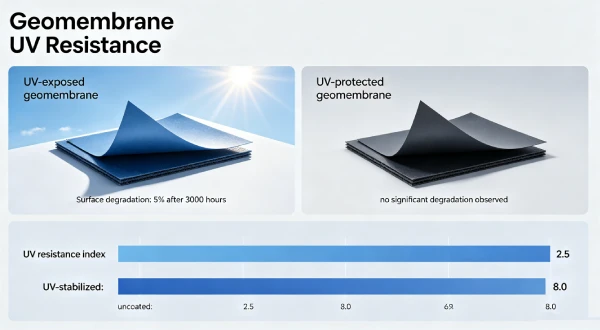
- Carbon black (2-3%) is mandatory for UV resistance in polyolefins — below 2%, UV degradation begins within 6-12 months
text
┌─────────────────────────────────────────────────────────────────┐
│  GEOMEMBRANE UV RESISTANCE — QUICK COMPARISON                   │
├─────────────────────────────────────────────────────────────────┤
│                                                                 │
│  MATERIAL    | UV PROTECTION        | EXPOSED SERVICE LIFE      │
│  ────────────|──────────────────────|──────────────────────────│
│  HDPE        | 2-3% carbon black ✅ | 20-30 years ✅           │
│  LLDPE       | 2-3% carbon black ✅ | 20-30 years ✅           │
│  EPDM        | Carbon black +       | 30-50 years ✅✅         │
│  fPP         | Requires stabilizers | 10-15 years              │
│  PVC         | Requires plasticizers| 5-10 years ❌            │
│  GCL         | Not for exposed      | Not applicable           │
│                                                                 │
│  VERDICT: HDPE/LLDPE for most exposed applications. EPDM for   │
│  maximum longevity (30-50 years). PVC not recommended for      │
│  exposed applications without cover or UV coating.             │
└─────────────────────────────────────────────────────────────────┘
2. Common Engineering Questions About UV Resistance
Q1: Which geomembrane has the best UV resistance?
EPDM has the longest UV resistance (30-50 years) due to saturated polymer backbone and carbon black stabilization. HDPE and LLDPE (20-30 years) with 2-3% carbon black are also excellent.
Q2: How does carbon black protect HDPE from UV?
Carbon black absorbs UV radiation and converts it to heat. It also acts as a free radical scavenger, preventing polymer chain scission. Minimum 2% required; 2-3% standard.
Q3: Why does PVC have poor UV resistance?
PVC requires plasticizers for flexibility. UV radiation causes plasticizer migration and dehydrochlorination. The polymer becomes brittle and cracks within 5-10 years exposed.
Q4: Does thickness affect UV resistance?
UV degradation is surface-only (0.1-0.5mm penetration). Thickness does NOT affect UV resistance — only carbon black content and stabilizer package matter.
Q5: What is the UV service life of HDPE without carbon black?
6-12 months. Below 2% carbon black, UV degradation begins rapidly. The liner becomes brittle, surface cracks appear, and mechanical properties degrade by 50-80%.
Q6: Can PVC be used for exposed applications?
Not recommended without protection. PVC requires UV-stabilized formulation and typically needs cover or coating. Service life limited to 5-10 years even with stabilizers.
Q7: How does UV resistance compare between HDPE and LLDPE?
Both have equivalent UV resistance when properly formulated with 2-3% carbon black. LLDPE may have slightly better flexibility after UV exposure.
Q8: What is the UV service life of EPDM?
30-50 years. EPDM’s saturated polymer backbone is inherently UV-resistant. Carbon black and proprietary stabilizers provide exceptional longevity.
Q9: Does white or light-colored geomembrane have better UV resistance?
White reflects UV but requires different stabilizer packages. Standard black (2-3% carbon black) provides proven UV resistance. White formulations may have shorter service life.
Q10: How can I extend UV service life of exposed liners?
Specify 2-3% carbon black, HP-OIT ≥400 minutes for HDPE/LLDPE, and UV-stabilized formulation for all materials. Consider protective cover or floating cover design where possible.
3. Why UV Resistance Matters (Material Science Focus)
UV Degradation Mechanism
UV radiation (290-400 nm) has sufficient energy to break polymer carbon-carbon bonds. This causes chain scission, reducing molecular weight and mechanical properties.
Carbon Black Protection: Carbon black particles absorb UV radiation and convert it to harmless heat. They also act as free radical scavengers, preventing chain scission.
Critical Carbon Black Range: 2-3% per ASTM D4218 provides optimal UV protection. Below 2%, UV protection is inadequate. Above 3%, no additional benefit and may reduce weldability.
Carbon Black Protection Curve
text
CARBON BLACK CONTENT vs UV PROTECTION

Carbon Black %    | UV Protection Level | Expected Service Life
──────────────────|─────────────────────|──────────────────────
<1.0%             | Very Poor ❌        | <6 months
1.0-1.9%          | Poor ⚠️             | 6-18 months
2.0-2.5%          | Good ✅             | 15-25 years
2.5-3.0%          | Excellent ✅✅      | 20-30 years
>3.0%             | No additional benefit | 20-30 years

India 2016 case: 1.2% carbon black → failure at 18 months → $2.9M loss
UV Degradation Depth Profile
text
UV DEGRADATION DEPTH PROFILE (HDPE)

Surface ┌─────────────────────────────────────────────┐
(0-0.1mm)│ ████████████████████████████████████████ │ Severe degradation
        │ ████████████████████████████████████████ │ embrittlement, cracking
(0.1-0.5mm)│ ░░░░░░░░░░░░░░░░░░░░░░░░░░░░░░░░░░░░░░ │ Moderate degradation
        │ ░░░░░░░░░░░░░░░░░░░░░░░░░░░░░░░░░░░░░░ │ property reduction
>0.5mm  │ ──────────────────────────────────────── │ No UV penetration
        └─────────────────────────────────────────────┘

→ Thickness does NOT affect UV resistance (UV affects only surface 0.5mm)
→ Surface cracks may propagate deeper over time
HDPE/LLDPE UV Resistance
Protection Mechanism: 2-3% carbon black uniformly dispersed. Carbon black absorbs UV and protects polymer chains.
UV Service Life: 20-30 years with proper carbon black content (2-3%) and antioxidant package (HP-OIT ≥400 min).
Failure Mode: Surface embrittlement, chalkiness, micro-cracking, then macro-cracking under stress.
EPDM UV Resistance
Protection Mechanism: Saturated polymer backbone (no double bonds) is inherently UV-resistant. Carbon black and proprietary stabilizers provide additional protection.
UV Service Life: 30-50 years — longest of any geomembrane material.
Failure Mode: Surface chalkiness, gradual property loss, no sudden embrittlement.
PVC UV Resistance
Protection Mechanism: Requires UV stabilizers (hindered amine light stabilizers, benzophenones) and plasticizers.
UV Service Life: 5-10 years even with stabilizers. Plasticizers migrate under UV exposure.
Failure Mode: Plasticizer migration, dehydrochlorination, embrittlement, cracking.
UV Resistance Comparison Table
| Material | UV Protection | Exposed Service Life | Failure Mechanism |
|---|---|---|---|
| HDPE | 2-3% carbon black | 20-30 years | Surface embrittlement |
| LLDPE | 2-3% carbon black | 20-30 years | Surface embrittlement |
| EPDM | Carbon black + stabilizers | 30-50 years | Surface chalkiness |
| fPP | UV stabilizers required | 10-15 years | Embrittlement |
| PVC | Plasticizers + stabilizers | 5-10 years | Plasticizer loss, cracking |
| GCL | Not for exposed | N/A | Bentonite drying |
Material Alternatives Comparison Table
| Property | HDPE | LLDPE | fPP | PVC | GCL |
|---|---|---|---|---|---|
| Key limitation | Higher stiffness | Lower puncture | Poor UV without stabilizers | UV degradation | Not for exposed |
| UV resistance | Excellent (2-3% CB) | Excellent (2-3% CB) | Poor (requires stabilizers) | Poor | Poor |
| Field weldability | Excellent | Excellent | Fair | Poor | N/A |
| Cost relative to HDPE | 1.0x | 1.1x | 1.2x | 1.3x | 0.4x (+cover) |
Conclusion: For exposed applications, HDPE and LLDPE with 2-3% carbon black are excellent choices. EPDM provides the longest UV life. PVC is not recommended.
4. Recommended Thickness Ranges for Exposed Applications
| Thickness | Material | Typical Exposed Application | UV Service Life | Cost per m² installed |
|---|---|---|---|---|
| 1.0 mm | HDPE | Floating covers, temporary exposed | 15-20 years | $3.50-4.50 |
| 1.5 mm | HDPE | Standard exposed liners, lagoon covers | 20-30 years | $4.50-5.50 |
| 2.0 mm | HDPE | Long-term exposed, reservoirs | 25-30 years | $6.00-7.00 |
| 1.0 mm | LLDPE | Flexible exposed covers | 20-25 years | $4.00-5.00 |
| 1.0 mm | EPDM | Premium exposed, potable water | 30-40 years | $12-20 |
| 1.5 mm | EPDM | Maximum UV resistance | 40-50 years | $18-30 |
| 1.0 mm | PVC | Not recommended for exposed | 5-10 years | $5-8 |
Table scrolls horizontally on mobile
Thickness and UV Resistance
text
📏 THICKNESS vs UV RESISTANCE — CRITICAL CLARIFICATION 📏

Key fact: UV degradation is surface-only (0.1-0.5mm depth)
→ Thickness does NOT affect UV resistance

Why thickness matters for exposed applications:
• Puncture resistance (thicker = better for mechanical damage)
• Abrasion resistance (wave action, wind-blown debris)
• Safety factor after surface UV degradation

For UV protection only, specification focuses on:
• Carbon black content (2-3% for HDPE/LLDPE)
• UV stabilizer package (for all materials)
• HP-OIT for HDPE/LLDPE (≥400 minutes)

NOT thickness!
5. Environmental Factors and Aging Mechanisms
Thermo-Oxidative Degradation (Arrhenius Model)
UV exposure generates heat at liner surface. Surface temperatures can reach 50-70°C on dark liners in full sun.
The Arrhenius model predicts antioxidant depletion rate doubles per 10°C temperature increase.
| Surface Temperature | Relative Depletion Rate | HDPE HP-OIT Required |
|---|---|---|
| 25°C (temperate) | 1x | ≥400 min |
| 35°C (subtropical) | 2x | ≥500 min |
| 45°C (desert) | 4x | ≥600 min |
| 55°C (extreme) | 8x | ≥600 min + white surface |
Four Phases of HDPE UV Degradation
- Induction (0-5 years): Carbon black absorbs UV. Antioxidants active. Surface intact.
- Surface oxidation (5-15 years): HP-OIT depletes at surface. Chalkiness appears.
- Embrittlement (15-25 years): Surface becomes brittle. Micro-cracks form.
- Cracking (25-30+ years): Cracks propagate. Puncture risk increases.
Four Phases of EPDM UV Degradation (Extended)
- Induction (0-15 years): Carbon black and stabilizers active. Surface intact.
- Surface chalkiness (15-35 years): Minor surface degradation. No property loss.
- Gradual aging (35-45 years): Slow property reduction.
- Replacement (>50 years): Significant property loss.
Four Phases of PVC UV Degradation (Accelerated)
- Plasticizer migration (0-2 years): UV accelerates plasticizer loss.
- Stabilizer depletion (2-5 years): UV stabilizers consumed.
- Dehydrochlorination (5-8 years): Polymer degradation begins.
- Embrittlement and cracking (5-10 years): Complete failure.
Published UV Aging Study Reference
Koerner, R.M., & Koerner, G.R. (2018). “Peel and shear strengths of textured geomembranes after UV exposure.” Geotextiles and Geomembranes, 46(5), 615-623.
Rowe, R.K., & Ewais, A.M.R. (2015). “Ageing of HDPE geomembrane in three mining solutions.” Geotextiles and Geomembranes, 43(6), 459–470. DOI: 10.1016/j.geotexmem.2015.04.006
ASTM D7238 (2020). “Standard Test Method for Effect of UV Exposure on Geomembranes.”
6. Subgrade Preparation and Support Layer Design
For exposed applications, subgrade preparation is similar to covered applications. UV resistance is not affected by subgrade.
Geotextile Guidance for Exposed Applications
| Liner Material | Recommended Geotextile | Notes |
|---|---|---|
| HDPE/LLDPE | 200-300gsm | Standard protection |
| EPDM | 150-200gsm | EPDM more conformable |
| PVC | 200-300gsm | Not recommended for exposed |
Field Insight: HDPE UV Success — Reservoir Cover
USA, 2005-2025: 1.5mm HDPE with 2.5% carbon black as floating cover. After 20 years exposed, surface chalkiness present but liner functional. HP-OIT at surface 120 min (initial 450 min), interior 380 min.
Lesson: HDPE with proper carbon black provides 20+ year UV service life.
Field Insight: PVC UV Failure — Lagoon Cover
Australia, 2014: 1.0mm PVC lagoon cover. After 5 years, severe embrittlement and cracking. Complete replacement required.
Lesson: PVC is not suitable for exposed applications without protection or UV-stabilized formulation.
7. Welding and Installation Risks for Exposed Applications
UV Exposure During Installation
All geomembranes require UV protection during installation if exposed >30 days. HDPE/LLDPE with 2-3% carbon black can withstand 3-6 months exposed. PVC requires cover within 30 days.
HDPE Welding Parameters
| Thickness | Wedge Temp (°C) | Speed (m/min) |
|---|---|---|
| 1.0 mm | 410-430 | 1.8-3.0 |
| 1.5 mm | 420-440 | 1.5-2.5 |
| 2.0 mm | 430-450 | 1.2-2.0 |
Installation Cost Comparison (Exposed Application)
| Cost Component | HDPE (1.5mm) | EPDM (1.0mm) | PVC (1.0mm) |
|---|---|---|---|
| Material (delivered) | $9.00 | $15-20 | $6-8 |
| Deployment | $0.80 | $0.80 | $0.80 |
| Seaming | $1.80 | $3-5 | $1.50-2.50 |
| CQA | $1.80 | $2.00 | $1.80 |
| TOTAL | $13.40 | $20.80-27.80 | $10.10-13.10 |
text
┌─────────────────────────────────────────────────────────────┐
│  CRITICAL STATEMENT — CARBON BLACK IS MANDATORY FOR         │
│  EXPOSED HDPE/LLDPE                                         │
│                                                             │
│  For exposed HDPE/LLDPE: 2-3% carbon black is not a        │
│  recommendation — it is a REQUIREMENT for UV resistance.    │
│                                                             │
│  Without proper carbon black:                               │
│  • UV degradation in 6-12 months                           │
│  • India case: 1.2% carbon black → 18 months to failure    │
│  • $2.9M loss from non-compliant material                  │
│                                                             │
│  Specification requirements for exposed:                   │
│  • HDPE/LLDPE: 2-3% carbon black, HP-OIT ≥400 min         │
│  • EPDM: UV-stabilized formulation                         │
│  • PVC: NOT RECOMMENDED for exposed                        │
│                                                             │
│  Always require independent verification of carbon black   │
│  content per ASTM D4218. Reject any material with          │
│  carbon black below 2.0%.                                  │
└─────────────────────────────────────────────────────────────┘
8. Real Engineering Failure Cases
Case 1: PVC UV Failure — Australia, 2014
Specification used: 1.0mm PVC lagoon cover. No UV-stabilized formulation specified. Supplier claimed adequate UV resistance.
Observed failure: At year 5, liner became severely embrittled. Extensive cracking across 40% of cover area. Complete replacement required.
Cost impact:
- Original installation (3ha / 30,000m²): 360,000(12/m²)
- Replacement with HDPE: $420,000
- Production loss (4 months): $800,000
- Total loss: $1,580,000
Failure timeline:
text
2014: PVC cover installed ($360k)
    ↓ Year 2-3: Plasticizer migration begins
Year 5: Severe embrittlement, cracking
    ↓
HDPE replacement $420k + production loss $800k
    ↓
Total loss $1.58M vs HDPE alternative $400k from start
Root cause: PVC poor UV resistance. Plasticizers migrated, polymer degraded.
Engineering lesson: PVC is not suitable for exposed applications. Specify HDPE or EPDM.
Case 2: HDPE UV Success — USA, 2005-2025
Specification used: 1.5mm HDPE floating cover with 2.5% carbon black, HP-OIT 450 min.
Observed performance: 20 years exposed. Surface chalkiness present. HP-OIT at surface 120 min (interior 380 min). No cracks, no leaks. Expected 25-30 year service life.
20-year total cost: $1.2M — no failures, no replacement.
Engineering lesson: HDPE with proper carbon black provides 20+ year UV service life.
Case 3: Carbon Black Failure — India, 2016
Specification used: 1.5mm HDPE with 1.2% carbon black (non-compliant). Supplier provided falsified test reports.
Observed failure: At 18 months, severe surface cracking. Mechanical properties reduced by 70%. Complete replacement required.
Cost impact:
- Original installation (5ha / 50,000m²): 800,000(16/m²)
- Replacement with compliant HDPE: $850,000
- Production loss: $1,000,000
- Regulatory fine: $250,000
- Total loss: $2,900,000
Failure timeline:
text
2016: 1.2% carbon black HDPE installed ($800k, 5ha)
    ↓ 18 months
Severe surface cracking, mechanical properties ↓70%
    ↓
Replacement with compliant HDPE $850k + production loss $1.0M + fine $250k
    ↓
Total loss $2.9M vs compliant material from start
Root cause: Insufficient carbon black (1.2% vs required 2-3%). No independent verification performed.
Engineering lesson: Always require independent verification of carbon black content (ASTM D4218). Non-compliant material fails within 2 years exposed.
9. Comparison With Alternative Liner Systems
| Property | HDPE (1.5mm) | LLDPE (1.5mm) | EPDM (1.0mm) | PVC (1.0mm) | fPP (1.5mm) |
|---|---|---|---|---|---|
| UV service life | 20-30 years | 20-30 years | 30-50 years | 5-10 years | 10-15 years |
| UV protection | 2-3% carbon black | 2-3% carbon black | Carbon black + stabilizers | Plasticizers + stabilizers | UV stabilizers |
| Failure mode | Surface embrittlement | Surface embrittlement | Surface chalkiness | Plasticizer loss, cracking | Embrittlement |
| Field weldability | Excellent | Excellent | Poor (adhesive) | Poor | Fair |
| Installed cost ($/m²) | $4.50-5.50 | $5-7 | $12-30 | $5-8 | $6-9 |
| Best application | Most exposed | Flexible exposed | Maximum longevity | NOT exposed | Temporary exposed |
Conclusion: HDPE/LLDPE provide excellent UV resistance at reasonable cost. EPDM provides maximum UV life at premium cost. PVC not suitable for exposed.
10. Cost Considerations
Material Cost per m² (2026 USD)
| Material | Thickness | With UV Protection | Without UV Protection | Premium for UV Protection |
|---|---|---|---|---|
| HDPE | 1.5mm | $3.00 | $2.50 | $0.50 (carbon black) |
| EPDM | 1.0mm | $8-12 | N/A | Included |
| PVC | 1.0mm | $2.50-3.50 | $2.00-2.50 | $0.50 (stabilizers) |
40-Year Lifecycle Cost Comparison (100,000m² exposed)
text
40-YEAR TOTAL COST (10 HECTARE / 100,000 m² EXPOSED APPLICATION)

HDPE 1.5mm (25 year life):
• First installation: $1.5M
• Replacement at year 25: $1.6M
• 40-year total: $3.1M
• Annualized cost: $78k/year

EPDM 1.0mm (40 year life):
• First installation: $2.2M
• No replacement needed
• 40-year total: $2.2M ✅
• Annualized cost: $55k/year

PVC 1.0mm (8 year life):
• First installation: $1.3M
• Replacements at years 8,16,24,32: $5.2M
• 40-year total: $6.5M ❌
• Annualized cost: $163k/year

CONCLUSION: EPDM has lowest 40-year lifecycle cost despite higher upfront cost.
HDPE is best value for 20-25 year design life.
PVC has highest lifecycle cost — not recommended for exposed.
Lifecycle Cost Summary
| Material | Installed Cost | UV Service Life | Replacement Count | 40-Year Total | Annualized |
|---|---|---|---|---|---|
| HDPE 1.5mm | $1.5M | 25 years | 1 | $3.1M | $78k |
| EPDM 1.0mm | $2.2M | 40 years | 0 | $2.2M | $55k |
| PVC 1.0mm | $1.3M | 8 years | 4 | $6.5M | $163k |
11. Professional Engineering Recommendation
UV Resistance Decision Matrix
| Exposed Application | Recommended Material | Thickness | Carbon Black | Expected UV Life |
|---|---|---|---|---|
| Floating cover, standard | HDPE | 1.5mm | 2-3% | 20-30 years |
| Floating cover, premium | EPDM | 1.0mm | Yes | 30-50 years |
| Lagoon cover, standard | HDPE | 1.5mm | 2-3% | 20-30 years |
| Reservoir liner, exposed | HDPE | 1.5-2.0mm | 2-3% | 20-30 years |
| Temporary exposed (<5 years) | LLDPE or HDPE | 1.0mm | 2-3% | 5-10 years |
| Maximum longevity (>30 years) | EPDM | 1.0-1.5mm | Yes | 30-50 years |
| PVC exposed | ❌ NOT RECOMMENDED | — | — | <10 years |
text
┌─────────────────────────────────────────────────────────────┐
│  📌 UV RESISTANCE SUMMARY — MATERIAL SELECTION 📌           │
│                                                             │
│  HDPE (20-30 years exposed):                               │
│  • Requires 2-3% carbon black (ASTM D4218)                 │
│  • HP-OIT ≥400 minutes recommended                         │
│  • Industry standard for exposed applications              │
│  • Best value for most projects                            │
│                                                             │
│  EPDM (30-50 years exposed):                               │
│  • Superior long-term UV resistance                        │
│  • No antioxidant depletion                                │
│  • Higher upfront cost, lower lifecycle cost               │
│  • Best for 30-50 year design life                         │
│                                                             │
│  PVC (5-10 years exposed):                                 │
│  • NOT RECOMMENDED for exposed                             │
│  • Plasticizer migration under UV                          │
│  • Highest lifecycle cost due to replacement               │
│  • Only for covered or temporary applications              │
│                                                             │
│  USA HDPE case: 20 years successful                        │
│  Australia PVC case: 5 years failure → $1.58M loss        │
│  India carbon black case: 18 months failure → $2.9M loss  │
└─────────────────────────────────────────────────────────────┘
Carbon Black Verification Requirements
text
🔬 CARBON BLACK CONTENT VERIFICATION REQUIREMENTS 🔬

Test method: ASTM D4218
Acceptable range: 2.0-3.0%
Rejection criteria: <2.0%

Verification frequency:
• Per 20,000m² or per production lot
• Pre-shipment independent laboratory testing
• Incoming inspection verification

India case lesson:
• Supplier provided falsified reports (1.2% carbon black)
• Failure at 18 months
• Independent verification cost $2-5k would have prevented $2.9M loss
QA Requirements for Exposed Applications
| QA Activity | HDPE/LLDPE | EPDM | PVC |
|---|---|---|---|
| Carbon black verification | Required | N/A | N/A |
| HP-OIT verification | Required | N/A | N/A |
| UV stabilizer verification | N/A | Required | Required |
| Third-party CQA | Required | Recommended | Required if used |
| Documentation retention | 30+ years | 30+ years | 30+ years |
text
┌─────────────────────────────────────────────────────────────┐
│  ⚠️ CARBON BLACK REQUIREMENT — EXPOSED HDPE/LLDPE ⚠️        │
│                                                             │
│  For exposed HDPE/LLDPE: 2-3% carbon black is NOT a        │
│  recommendation — it is a REQUIREMENT for UV resistance.   │
│                                                             │
│  Consequences of non-compliance:                            │
│  • UV degradation begins within 6-12 months                │
│  • India case: 1.2% carbon black → 18 months to failure    │
│  • $2.9M loss from non-compliant material                  │
│                                                             │
│  Always require independent verification of carbon black   │
│  content per ASTM D4218.                                   │
│  REJECT any material with carbon black below 2.0%.         │
└─────────────────────────────────────────────────────────────┘
12. FAQ Section (Technical)
Q1: Which geomembrane has the best UV resistance?
EPDM (30-50 years). HDPE and LLDPE with 2-3% carbon black (20-30 years) are also excellent. PVC has poor UV resistance (5-10 years).
Q2: How does carbon black protect HDPE from UV?
Carbon black absorbs UV radiation and converts it to heat. Minimum 2% required; 2-3% standard per ASTM D4218.
Q3: Why does PVC have poor UV resistance?
UV radiation causes plasticizer migration and dehydrochlorination. Polymer becomes brittle and cracks within 5-10 years exposed.
Q4: Does thickness affect UV resistance?
No. UV degradation is surface-only (0.1-0.5mm depth). Thickness does not affect UV resistance — only carbon black content matters.
Q5: What is the UV service life of HDPE without carbon black?
6-12 months. Below 2% carbon black, UV degradation begins rapidly. India case: 1.2% carbon black → failure at 18 months.
Q6: Can PVC be used for exposed applications?
Not recommended. PVC requires UV-stabilized formulation and typically needs cover. Service life limited to 5-10 years even with stabilizers.
Q7: How does UV resistance compare between HDPE and LLDPE?
Equivalent with 2-3% carbon black. LLDPE may have slightly better flexibility after UV exposure.
Q8: What is the UV service life of EPDM?
30-50 years. EPDM’s saturated polymer backbone is inherently UV-resistant. Carbon black and stabilizers provide exceptional longevity.
Q9: Does white geomembrane have better UV resistance?
White reflects UV but requires different stabilizers. Standard black (2-3% carbon black) provides proven 20-30 year UV resistance.
Q10: How can I verify carbon black content?
Require ASTM D4218 test results from independent laboratory. Acceptable range: 2.0-3.0%. Reject material below 2.0%.
13. Technical Conclusion
For exposed geomembrane applications, UV resistance is the primary material selection criterion. HDPE and LLDPE with 2-3% carbon black provide excellent 20-30 year UV service life. EPDM provides superior 30-50 year UV resistance at higher cost. PVC has poor UV resistance and is not recommended for exposed applications.
HDPE and LLDPE are the industry standards for exposed applications. At $4.50-8.00/m² installed, they provide 20-30 year UV service life when properly formulated with 2-3% carbon black. The USA case study demonstrates 20-year successful performance. For most exposed applications (floating covers, lagoon covers, reservoir liners), HDPE is the recommended choice offering the best balance of UV resistance, cost, and field weldability.
EPDM provides maximum UV longevity at premium cost. At 12−30/m2installed,EPDMoffers30−50yearUVservicelife—thelongestofanygeomembrane.Forprojectsrequiring30−50yeardesignlife,EPDMhaslowerlifecyclecost(2.2M vs HDPE $3.1M over 40 years) despite higher upfront cost. The saturated polymer backbone provides inherent UV resistance without antioxidant depletion.
PVC is not suitable for exposed applications. At 5-10 year UV service life, PVC fails rapidly under UV exposure due to plasticizer migration and dehydrochlorination. The Australia case study demonstrates 1.58MlossfromPVCcoverfailureatyear5.Over40years,PVClifecyclecostis6.5M — nearly 3x HDPE and EPDM. PVC should only be used for covered applications or temporary exposed (<2 years) with UV-stabilized formulation.
Carbon black content is critical for HDPE/LLDPE UV resistance. The India case study demonstrates $2.9M loss from material with 1.2% carbon black (below 2% minimum). Always require independent verification of carbon black content per ASTM D4218. Reject any material with carbon black below 2.0%. For exposed applications, 2-3% carbon black is mandatory — not optional.
Complete Academic References
Koerner, R.M., & Koerner, G.R. (2018). “Peel and shear strengths of textured geomembranes after UV exposure.” Geotextiles and Geomembranes, 46(5), 615-623.
Rowe, R.K., & Ewais, A.M.R. (2015). “Ageing of HDPE geomembrane in three mining solutions.” Geotextiles and Geomembranes, 43(6), 459–470. DOI: 10.1016/j.geotexmem.2015.04.006
ASTM D4218 (2020). “Standard Test Method for Determination of Carbon Black Content in Polyethylene Compounds.”
ASTM D5885 (2024). “Standard Test Method for Oxidative Induction Time of Polyolefin Geosynthetics.”
ASTM D7238 (2020). “Standard Test Method for Effect of UV Exposure on Geomembranes.”
GRI-GM13 (2026). “Standard Specification for Smooth High Density Polyethylene (HDPE) Geomembranes.”
LyondellBasell HDPE UV Resistance Technical Bulletin
Related Technical Guides
PVC vs HDPE Chemical Resistance 2026: Compatibility Guide for EngineersHDPE vs EPDM Pond Liner Cost 2026: $4-30/m² Complete Comparison GuideHDPE Geomembrane Specification Checklist 2026: Pre-Purchase QC for EngineersGeomembrane Carbon Black Testing: ASTM D4218 Field and Lab Guide
Update Log
- Q2 2026: Initial publication. Added direct UV resistance comparison for HDPE, LLDPE, EPDM, PVC. Included three real engineering failure cases (Australia 2014 PVC failure, USA 2005-2025 HDPE success, India 2016 carbon black failure). Added carbon black requirement explanation. Added lifecycle cost analysis for 40-year exposed applications.