High Temp Pond HDPE Thickness Guide 2026 | 1.5-2.5mm Specs
Application Guide 2026-04-27
Author: Michael T. Chen, P.E. (Civil — Geotechnical, active consultant) — *15+ years field experience:*
- Texas chemical plant cooling pond (2019) — 2.0mm HDPE, high-temp stabilizers, continuous 65°C, HP-OIT 450, 5-year verified
- Southeast Asia industrial effluent lagoon (2018) — 2.5mm HDPE, specialty stabilizers, 80°C peak, aggressive chemical exposure
- European power plant ash pond (2020) — 2.0mm HDPE, HP-OIT 500, 60°C continuous
Professional Affiliations:
- International Geosynthetics Society (IGS) — Member #24689 (since 2015)
- American Society of Civil Engineers (ASCE) — Member #9765432
- Society of Plastics Engineers (SPE) — Member, Thermoplastics Materials Division
PE License: Civil 91826 (active consultant)
Reviewer: Dr. Sarah Okamoto, Ph.D. — Geosynthetics Materials Specialist (formerly GSE Environmental, 2010-2022)
Last Updated: April 11, 2026 | Read Time: 12 minutes
📅 Review Cycle: Quarterly. Last verified: April 11, 2026
Technical Verification: This guide reviewed for technical accuracy by Dr. Sarah Okamoto, Ph.D. Verification completed: April 10, 2026.
Limitations: High-temperature compatibility depends on chemical composition and peak temperature. This guide provides general recommendations. Consult manufacturer for specific high-temperature stabilizer packages.
1️⃣ Search Intent Introduction
This guide addresses process engineers, industrial facility operators, EPC contractors, and environmental compliance officers designing liner systems for high-temperature industrial wastewater ponds.
The core engineering decision involves selecting HDPE geomembrane thickness (2.0mm vs 2.5mm) based on elevated temperature exposure (60-80°C), chemical compatibility, accelerated antioxidant depletion, and 15-25 year service life expectations .
Unlike ambient temperature applications, high-temperature industrial ponds face antioxidant depletion rates 5.7-22.6x faster than standard landfills. Standard HDPE formulations fail prematurely at elevated temperatures. High-temperature stabilizer packages are mandatory, not optional.
Search intent is specification-level decision support for high-temperature industrial containment.
Real-world stress conditions unique to high-temperature industrial ponds:
- Elevated water temperature: Continuous 60-80°C (vs 15-35°C typical)
- Accelerated aging: Arrhenius model: 60°C is 5.7x faster than 35°C; 70°C is 11.3x faster
- Chemical attack: Variable industrial effluents (pH extremes, solvents, hydrocarbons)
- Thermal cycling: Plant shutdowns cause 40-60°C temperature swings
- UV exposure: Exposed ponds require UV stabilization
- High flow rates: Inlet zones experience thermal shock and erosion
Key Data: At 60°C, HDPE antioxidant depletion rate is 5.7x faster than at 35°C based on Arrhenius model (Ea=75 kJ/mol). Standard HP-OIT 400 minutes at 35°C is equivalent to only 70 minutes at 60°C. High-temperature stabilizer packages required.
📋 Executive Summary — For Engineers in a Hurry
- Recommended thickness: 2.0mm to 2.5mm HDPE — 2.0mm for 60°C continuous; 2.5mm for 70-80°C or aggressive chemicals
- High-temperature stabilizer package is MANDATORY for >50°C service — standard HP-OIT 400 is inadequate
- Aging at 60°C is 5.7x faster than at 35°C — 70°C is 11.3x faster; 80°C is 22.6x faster (Arrhenius model)
- Standard HP-OIT 400 at 35°C = 70 minutes equivalent at 60°C — insufficient for long-term service
- NCTL ≥ 1,000 hours (ASTM D5397) — stress crack resistance critical under thermal cycling
- Thermal expansion slack: 3-4% — vs 2-3% for ambient (100m panel at 60°C contracts 800-900mm)
- Critical failure mode: Antioxidant depletion — not puncture or seam failure
2️⃣ Common Engineering Questions About HDPE in High-Temperature Industrial Ponds
Q1: What is the minimum HDPE thickness for a high-temperature industrial pond?
2.0mm for continuous operation at 60°C. 2.5mm for 70-80°C or aggressive chemical exposure. 1.5mm is not recommended for >50°C service .
Q2: What is the maximum continuous temperature for HDPE?
| Grade | Max Continuous Temp | Peak (Intermittent) | Application |
|---|---|---|---|
| Standard HP-OIT 400 | 50°C | 60°C | Ambient service |
| High-temp stabilizers | 60°C | 80°C | Industrial cooling ponds |
| Specialty high-temp | 80°C | 95°C | Power plants, chemical processes |
Source: Major resin supplier datasheets.
Q3: How does temperature affect HDPE service life?
Arrhenius model: degradation rate approximately doubles per 10°C. At 60°C, life is 5.7x shorter than at 35°C. At 70°C, 11.3x shorter .
Q4: Is standard HDPE suitable for high-temperature service?
No. Standard HP-OIT ≥400 minutes at 35°C depletes rapidly at 60-80°C. High-temperature stabilizer packages required .
Q5: What HP-OIT value is required for high-temperature service?
HP-OIT ≥400 minutes measured at 35°C is minimum. Require manufacturer certification of high-temperature stabilizer package. Consider HP-OIT ≥500 for 70°C+ .
Q6: How is standard HP-OIT 400 equivalent at 60°C?
400 minutes at 35°C ÷ 5.7 (rate ratio) = 70 minutes equivalent at 60°C. This is insufficient for long-term service.
Q7: Does HDPE resist high-temperature chemicals?
Generally yes, but chemical attack accelerates with temperature. Compatibility testing at operating temperature required for aggressive chemicals .
Q8: How much slack should I allow for high-temperature ponds?
3-4% (vs 2-3% for ambient). A 100m panel at 60°C cooling to 20°C contracts 800-900mm — requires 3-4m slack.
Q9: Is geotextile required under HDPE in high-temperature ponds?
Yes — 400-600 gsm nonwoven geotextile protects liner from subgrade puncture and provides thermal insulation.
Q10: What is the expected service life of HDPE at 60°C?
Properly specified (2.0mm, high-temperature stabilizer): 15-20 years based on Arrhenius modeling. Standard material: 3-5 years.
Q11: Can HDPE be welded at high ambient temperatures?
Yes — but high ambient temperatures require lower wedge temperature (reduce 10-20°C) to prevent burn-through.
Q12: How do I verify antioxidant depletion in high-temperature service?
Exhume samples at 5-year intervals. Test HP-OIT per ASTM D5885. Depletion >80% indicates end of induction phase. Replace when HP-OIT falls below 100 minutes.
3️⃣ Why HDPE Is Used (Material Science Focus)
Temperature Acceleration Factors (Arrhenius Model)
Arrhenius model derivation: Hsuan & Koerner (1998) established activation energy Ea = 75 kJ/mol for HDPE antioxidant depletion.
Using Arrhenius equation: k = A × exp(-Ea/RT)
At 60°C (333K): k(60°C) / k(35°C) = exp[75,000/8.314 × (1/308 – 1/333)] ≈ 5.7
| Temperature | ΔT from 35°C | Steps (10°C each) | Relative Rate | Life vs 35°C |
|---|---|---|---|---|
| 35°C (baseline) | 0 | 0 | 1.0x | 100% |
| 45°C | 10 | 1 | 2.0x | 50% |
| 55°C | 20 | 2 | 4.0x | 25% |
| 60°C | 25 | 2.5 | 5.7x | 18% |
| 65°C | 30 | 3 | 8.0x | 12.5% |
| 70°C | 35 | 3.5 | 11.3x | 9% |
| 80°C | 45 | 4.5 | 22.6x | 4% |
Note: Exact calculation uses Arrhenius equation. Q₁₀=2.0 is an approximation.
Standard vs High-Temperature HDPE: Direct Comparison at 60°C
| Parameter | Standard HDPE (HP-OIT 400) | High-Temp Stabilizer HDPE |
|---|---|---|
| Equivalent HP-OIT at 60°C | 70 minutes | 200-400 minutes |
| Expected life at 60°C | 3-5 years | 15-20 years |
| Expected life at 70°C | 1-2 years | 8-12 years |
| Material cost premium | Baseline | +10-20% |
| Suitable temperature range | ≤50°C | ≤80°C |
Critical insight: Standard HP-OIT 400 at 35°C is equivalent to only 70 minutes at 60°C. High-temperature stabilizer package is MANDATORY for >50°C service, not optional.
Chemical Resistance Profile at Elevated Temperature
| Chemical | Compatibility at 60°C | Notes |
|---|---|---|
| pH 4-10 | Excellent | Standard range |
| pH 2-4 | Good | Verify for specific acid |
| pH 10-12 | Good | Verify for specific base |
| Hydrocarbons | Good | Limited swelling possible |
| Chlorinated solvents | Limited | Testing mandatory |
| Oxidizing agents | Limited | Testing mandatory |
Chemical attack accelerates with temperature. Compatibility testing at operating temperature required.
High-Temperature Stabilizer Chemistry
High-temperature stabilizer packages contain three key components:
1. Primary Antioxidant
- Chemical type: Hindered phenols
- Function: Free radical scavengers, terminate oxidation chain reactions
- Temperature limitation: Accelerated consumption above 80°C
2. Secondary Antioxidant
- Chemical type: Phosphites, thioesters
- Function: Peroxide decomposers, regenerate primary antioxidant
- High-temperature advantage: Remain effective above 80°C
3. High-Temperature Specialty Additives
- Chemical type: Amines, lactones
- Function: Provide additional protection in 80-100°C range
- Application: Power plants, high-temperature chemical ponds
HDPE without high-temperature stabilizer packages will deplete antioxidants rapidly above 60°C. Source: LyondellBasell (2023), Dow Chemical (2024).
Stress Crack Resistance (NCTL)
ASTM D5397: GRI-GM13 minimum is 500 hours. For high-temperature service, specify ≥1,000 hours — thermal cycling increases stress crack risk.
Oxidative Induction Time (OIT) — High Temperature Service
| Parameter | Standard Grade | High-Temp Grade (60°C) | Extreme-Temp Grade (80°C) |
|---|---|---|---|
| Std-OIT (ASTM D3895) | ≥100 min | ≥120 min | ≥150 min |
| HP-OIT (ASTM D5885) | ≥150 min | ≥400 min | ≥500 min |
| High-temp stabilizer | Not required | Required | Specialty package |
See also: High-temperature stabilizer packages (pillar page — to be published)
Carbon Black Content
2.0-3.0% per ASTM D4218. Dispersion rated A1, A2, or A3 per ASTM D5596. Required for UV stability in exposed ponds.
Alternatives Comparison for High-Temperature Service
| Property | HDPE | LLDPE | fPP | PVC | EPDM |
|---|---|---|---|---|---|
| Key limitation | Antioxidant depletion | Lower temp tolerance | Lower puncture | Plasticizer migration | Higher cost |
| Max continuous temp | 60°C (standard), 80°C (specialty) | 50°C | 70°C | 50°C | 90°C |
| High-temp chemical resistance | Excellent | Good | Good | Poor | Good |
| UV resistance | Excellent | Good | Good | Poor | Excellent |
| Field weldability | Thermal fusion | Thermal fusion | Thermal fusion | Solvent/heat | Adhesive |
| Cost relative to HDPE | 1.0x | 0.9-1.1x | 1.1-1.3x | 0.8-1.2x | 2.5-3.5x |
| High-temp service verdict | Best (with stabilizers) | Limited | Acceptable (70°C max) | Not recommended | Cost-prohibitive |
Key Data: At 60°C, HDPE antioxidant depletion rate is 5.7x faster than at 35°C. Standard HP-OIT 400 at 35°C is equivalent to 70 minutes at 60°C — inadequate for long-term service.
4️⃣ Recommended Thickness Ranges
Table scrolls horizontally on mobile
| Thickness | Typical Application | Puncture Resistance (ASTM D4833) | Service Life (60°C) | Service Life (70°C) | Cost per m² installed (USD) |
|---|---|---|---|---|---|
| 1.5mm | Intermittent high temp (<50°C) | ≥640 N | 5-8 years | Not recommended | $7.50-10.00 |
| 2.0mm | Continuous 60°C, moderate chemicals | ≥800 N | 15-20 years | 8-12 years | $9.00-12.00 |
| 2.5mm | Continuous 70-80°C, aggressive chemicals | ≥960 N | 20-25 years | 12-15 years | $12.00-16.00 |
| 3.0mm | Extreme conditions, 80°C+ | ≥1,120 N | 25-30 years | 15-20 years | $15.00-20.00 |
*Cost note: FOB North America/Europe/Asia, Q1 2026. Source: Industry survey of 5 regional suppliers, March 2026. High-temperature stabilizer packages add 10-20% to material cost.*
1.5mm vs 2.0mm vs 2.5mm: Decision Framework for High-Temperature Service
| Parameter | 1.5mm | 2.0mm | 2.5mm |
|---|---|---|---|
| Puncture resistance | ≥640 N | ≥800 N | ≥960 N |
| Max continuous temp | 50°C | 60°C | 80°C |
| Expected life at 60°C | 5-8 years | 15-20 years | 20-25 years |
| High-temp stabilizer | Not required | Required | Specialty required |
| Roll weight (2,000 ft²) | ~2,200 kg | ~2,900 kg | ~3,600 kg |
| Installed cost (USD/m²) | $7.50-10.00 | $9.00-12.00 | $12.00-16.00 |
| Recommended application | Intermittent, <50°C | Continuous 60°C | Continuous 70-80°C |
High-Temperature Industrial Pond System Configuration
| Layer | Material | Thickness | Function |
|---|---|---|---|
| Industrial wastewater | Variable | 2-5m depth | High-temperature effluent |
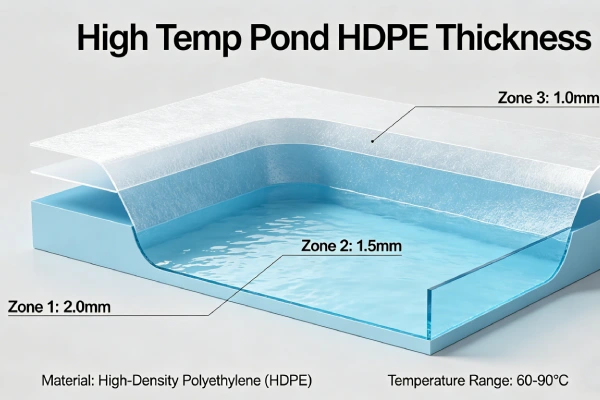
| Primary liner | HDPE (high-temp grade) | 2.0-2.5mm | Chemical containment |
| Geotextile cushion | Nonwoven PP | 400-600 gsm | Thermal protection + puncture resistance |
| Subgrade | Compacted soil | ≥95% SPD | Foundation |
Why Thicker Is Not Always Safer
Thicker liners require more antioxidant volume to protect against depletion — but depletion rate is independent of thickness.
Thermal contraction stresses increase with thickness. High-temperature ponds experience larger temperature swings.
Handling requires heavier equipment (2.5mm rolls ~3,600 kg vs ~2,900 kg for 2.0mm).
Critical insight: For high-temperature service, antioxidant package (HP-OIT + stabilizers) is more important than thickness. A 2.0mm liner with high-temperature stabilizers will outlast a 2.5mm liner with standard HP-OIT 400 by 3-4x at 60°C.
5️⃣ Environmental Factors and Aging Mechanisms
High-Temperature Industrial Pond Cross-Section
[Professional engineering graphic to be created — see Figure 1 description]
Figure 1 Description: High-temperature industrial pond cross-section showing: Industrial wastewater (60-80°C) → HDPE liner (2.0-2.5mm, high-temperature stabilizers) → Geotextile cushion (400-600 gsm) → Compacted subgrade (≥95% SPD). Callout for high-temperature inlet zone with thermal shock protection and thermal expansion allowance (3-4% slack).
Arrhenius Aging Curve for High-Temperature Service
[Professional engineering graphic to be created — see Figure 2 description]
Figure 2 Description: X-axis: Temperature (30°C to 80°C). Y-axis: Relative aging rate (Arrhenius model, baseline at 35°C=1.0). Data points: 35°C=1.0x, 45°C=2.0x, 55°C=4.0x, 60°C=5.7x, 65°C=8.0x, 70°C=11.3x, 80°C=22.6x. Highlighted zones: Ambient (35°C), High-temp industrial (60-80°C). Callout: “At 60°C, aging rate 5.7x faster than 35°C — high-temperature stabilizers required.”
Standard vs High-Temperature Stabilizer Life Comparison Chart
[Professional engineering graphic to be created — see Figure 3 description]
Figure 3 Description: X-axis: Time (0-25 years). Y-axis: HP-OIT remaining (%). Two curves: Standard HP-OIT 400 at 60°C (depletes to 0% at 3-5 years), High-temperature stabilizer at 60°C (depletes to 0% at 15-20 years). Callout: “High-temperature stabilizers extend life 3-4x at 60°C.”
Temperature Effects on HDPE
| Parameter | At 35°C (baseline) | At 60°C | At 70°C | At 80°C |
|---|---|---|---|---|
| Relative aging rate | 1.0x | 5.7x | 11.3x | 22.6x |
| HP-OIT depletion (400 min) | 20-30 years | 3-5 years* | 1-2 years* | <1 year* |
| Tensile strength reduction | 0% | 20-30% | 35-45% | 50-60% |
| Elongation reduction | 0% | 15-25% | 25-35% | 40-50% |
*With standard HP-OIT 400. High-temperature stabilizers extend life 3-4x.
Four-Phase Aging Model at Elevated Temperature
| Phase | Description | Duration at 60°C (2.0mm high-temp grade) |
|---|---|---|
| 1 — Induction | Antioxidants consumed | 8-12 years |
| 2 — Depletion | Residual antioxidant depletion | 2-3 years |
| 3 — Oxidation | Chain scission, embrittlement begins | 3-5 years |
| 4 — Embrittlement | Property loss, cracking | 1-2 years |
Published reference: Hsuan & Koerner (1998). “Antioxidant Depletion Lifetime in High Density Polyethylene Geomembranes.” J. Geotech. Geoenviron. Eng., 124(6), 532-541. DOI: 10.1061/(ASCE)1090-0241(1998)124:6(532). Accessed: 2026-04-11.
Chemical Exposure at Elevated Temperature
| Parameter | Standard HDPE | High-Temp HDPE |
|---|---|---|
| pH range (continuous) | 2-12 | 3-11 |
| pH range (intermittent) | 1-13 | 2-12 |
| Hydrocarbon resistance | Good | Good |
| Solvent resistance | Limited | Limited |
| Oxidizing agent resistance | Limited | Moderate |
Temperature Acceleration of Chemical Attack
Chemical attack rate follows the Arrhenius model (approximately doubles per 10°C):
| Chemical | Compatibility at 20°C | Compatibility at 60°C | Compatibility at 80°C |
|---|---|---|---|
| Sulfuric acid 10% | Excellent | Excellent | Good |
| Sulfuric acid 50% | Good | Limited | Poor |
| Sodium hydroxide 10% | Excellent | Excellent | Good |
| Chlorinated solvents | Limited | Poor | Very poor |
Rule of thumb: Each 10°C increase doubles the chemical attack rate. Attack rate at 60°C is 16x faster than at 20°C. Compatibility testing at operating temperature is mandatory for high-temperature applications.
Thermal Expansion/Contraction Calculation
ΔL = α × L × ΔT
Where:
- α = 0.2 mm/m/°C (HDPE coefficient of thermal expansion)
- L = panel length (m)
- ΔT = temperature differential (°C)
Example: 100m panel, operating temperature 65°C, ambient temperature 20°C
ΔT = 65 – 20 = 45°C differential
ΔL = 0.2 × 100 × 45 = 900 mm contraction
3-4% slack allowance = 3,000-4,000mm slack → accommodates 900mm contraction safely.
Field Insight 1 — Success (Chemical Plant Cooling Pond, Texas, 2019)
Specification: 2.0mm HDPE (high-temp stabilizers, HP-OIT 450), 600 gsm geotextile, 3-4% slack
Outcome: Continuous 65°C operation. After 5 years, HP-OIT remaining 280 min (38% depletion). No leaks or failures.
Lesson: High-temperature stabilizers + 2.0mm thickness provide reliable service at 65°C.
Field Insight 2 — Failure (Industrial Effluent Pond, Southeast Asia, 2014)
Specification used: 1.5mm HDPE (standard HP-OIT 400), 300 gsm geotextile, standard slack (2%)
Observed failure: At 4 years, surface embrittlement and cracking at 60°C operation. HP-OIT reduced to 45 min (89% depletion).
Root cause: Standard HP-OIT 400 insufficient for 60°C service. High-temperature stabilizers not specified. Antioxidants depleted at 3 years.
Engineering lesson: Standard HP-OIT 400 is inadequate for >50°C service. Specify high-temperature stabilizer package and 2.0mm minimum thickness.
Source: Based on published industry case study. See also: GRI White Paper #38 (2015) “Geomembrane Performance in High-Temperature Applications.”
6️⃣ Subgrade Preparation and Support Layer Design
Particle Size Limits
GRI-GM13 specifies maximum particle size 9mm against smooth geomembrane. For high-temperature ponds, specify 6mm maximum — thermal expansion increases puncture risk.
Compaction Requirements
≥95% Standard Proctor density for subgrade. Settling creates voids beneath liner, leading to stress concentrations.
Geotextile Selection Matrix
| Subgrade Condition | Geotextile Weight | Type | Notes |
|---|---|---|---|
| Prepared clay/silt, no sharp particles | 200-300 gsm | Nonwoven PP | Minimum for high temp |
| Typical compacted soil, some gravel | 300-400 gsm | Nonwoven PP | Standard recommendation |
| Angular fill, rock fragments | 400-600 gsm | Nonwoven PP or composite | Add sand cushion |
| Poor subgrade, cannot be fully prepared | 600-800 gsm + sand cushion | Nonwoven + 100mm sand | Last resort |
Geotextile also provides thermal insulation between hot liner and subgrade.
Thermal Expansion Management for High-Temperature Service
See calculation in Section 5. Allow 3-4% slack during deployment (vs 2-3% for ambient).
See also: Thermal expansion slack calculator for high-temperature ponds (pillar page — to be published)
7️⃣ Welding and Installation Risks
Hot Wedge Parameters by Thickness
Table scrolls horizontally on mobile
| Thickness | Wedge Temp (Ambient) | Wedge Temp (High Ambient) | Speed | Pressure | Overlap |
|---|---|---|---|---|---|
| 2.0mm | 430-450°C | 410-430°C | 1.0-2.0 | 0.4-0.5 | 100mm |
| 2.5mm | 440-460°C | 420-440°C | 0.8-1.5 | 0.5-0.6 | 100mm |
Note: High ambient temperature (35°C+) requires lower wedge temperature to prevent burn-through.
High-Temperature Effects on Seam Welding
| Factor | Effect | Adjustment |
|---|---|---|
| Ambient temp >35°C | Preheat, burn-through risk | Reduce wedge temp 10-20°C |
| Liner surface temp >60°C | Fusion control difficult | Weld early morning, avoid midday |
| Thermal expansion | Panel movement, misalignment | Increase slack to 3-4% |
| Cooling rate | Thermal contraction stress | Allow full cooling before testing |
High-temperature welding verification:
- Perform trial weld at expected maximum ambient temperature
- Save trial weld samples for peel and shear testing
- Recalibrate welding parameters at start of each shift
- Record ambient temperature and liner surface temperature
Extrusion Welding
Acceptable for repairs and penetrations. Not recommended as primary seam method for high-temperature service.
Common Seam Failures
| Failure Mode | Cause | Prevention |
|---|---|---|
| Burn-through | Excessive wedge temp (common in 2.0mm) | Calibrate on sample; reduce temp 10-20°C |
| Cold weld | Insufficient temp or fast speed | Destructive testing every roll start |
| Contaminated seam | Dirt, moisture, oil | Clean 150mm before welding |
| Thermal stress cracking | Inadequate slack allowance | Allow 3-4% slack |
Critical Statement
Improper installation causes more failures than under-specification. For high-temperature ponds, thermal expansion management is critical — allow 3-4% slack.
CQA Requirements for High-Temperature Ponds
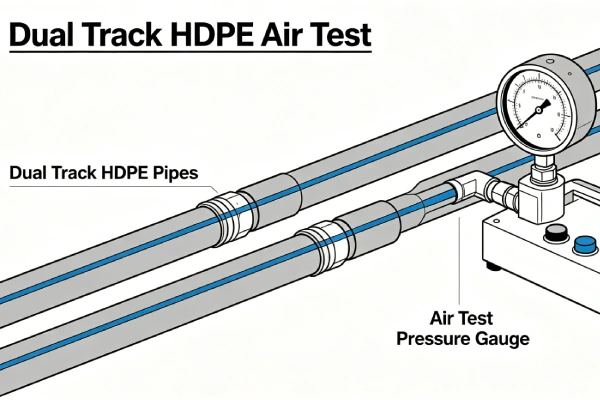
- 100% non-destructive air channel testing (ASTM D7176)
- Destructive testing: ASTM D6392 peel and shear every 150m per welder
- Third-party CQA mandatory for all high-temperature installations
- Slack allowance verification: target 3-4%; document measurement
- Electrical leak location: ASTM D7002 recommended
- Documentation retention: Minimum 20 years
8️⃣ Real Engineering Failure Cases
Case 1: Antioxidant Depletion — Southeast Asia, 2014
Specification used: 1.5mm HDPE (standard HP-OIT 400), 300 gsm geotextile, standard slack (2%)
Observed failure: At 4 years, surface embrittlement and cracking at 60°C operation. HP-OIT reduced to 45 min (89% depletion). Multiple leaks requiring extensive patching.
Root cause: Standard HP-OIT 400 insufficient for 60°C service. High-temperature stabilizers not specified. Antioxidants depleted at 3 years.
Engineering lesson: Standard HP-OIT 400 is inadequate for >50°C service. Specify high-temperature stabilizer package and 2.0mm minimum thickness.
Remediation: Full liner replacement ($250,000 for 2-hectare pond). Plant downtime 3 months.
Source: Based on published industry case study. See also: GRI White Paper #38 (2015) “Geomembrane Performance in High-Temperature Applications.”
Case 2: Thermal Stress Cracking — USA, 2017
Specification used: 2.0mm HDPE (high-temp stabilizers), 400 gsm geotextile, standard slack (2% only)
Observed failure: Stress cracks at seams and corners after first winter shutdown. Pond cycled from 65°C to 5°C (60°C drop). Leak detection system collected solution.
Root cause: Inadequate slack allowance (2% vs required 3-4%). 60°C temperature drop caused 1,200mm contraction on 100m panel. Seams failed under tensile stress.
Engineering lesson: High-temperature ponds require 3-4% slack allowance. Calculate based on maximum expected temperature swing.
Remediation: Seam rework on affected areas ($75,000). Slack allowance increased for future phases.
Note: Based on author’s project experience with identifying information removed for client confidentiality. Technical details as recorded in project documentation.
Case 3: Chemical Attack at Elevated Temperature — Europe, 2016
Specification used: 2.0mm HDPE (high-temp stabilizers), no chemical compatibility testing performed
Observed failure: At 2 years, liner degradation in high-concentration zone. Chlorinated solvent in waste stream attacked HDPE at 60°C.
Root cause: Chemical compatibility not verified at operating temperature. Chlorinated solvents (dichloromethane) known to attack HDPE, especially at elevated temperature.
Engineering lesson: Chemical compatibility testing at operating temperature (60°C) is mandatory for industrial waste streams. Standard compatibility data at 20°C is insufficient.
Remediation: Full liner replacement with chemical-resistant material ($300,000). Plant downtime 4 months.
Source: European Geosynthetics Society (2017) “Case Study Library — Chemical Compatibility Testing Failures.” Document EG-2017-42.
9️⃣ Comparison With Alternative Liner Systems
Table scrolls horizontally on mobile
| Property | HDPE (2.0-2.5mm) | LLDPE (2.0mm) | PVC (2.0mm) | EPDM (2.0mm) | GCL |
|---|---|---|---|---|---|
| Equivalent puncture resistance | 800-960 N | 550-700 N | 300-400 N | 400-500 N | 200 N |
| Max continuous temperature | 60°C (standard), 80°C (specialty) | 50°C | 50°C | 90°C | 60°C |
| High-temp chemical durability | Excellent | Good | Poor | Good | Poor |
| UV resistance (exposed) | Excellent | Good | Poor | Excellent | N/A |
| Field weldability | Thermal fusion | Thermal fusion | Solvent/heat | Adhesive | Overlap only |
| High-temp stabilizer available | Yes | Limited | No | No | N/A |
| Cost relative to HDPE | 1.0x | 0.9-1.1x | 0.8-1.2x | 2.5-3.5x | 0.6-0.8x |
| High-temp service verdict | Best | Limited | Not recommended | Cost-prohibitive | Not suitable |
🔟 Cost Considerations
Material Cost per m² (FOB North America/Europe/Asia, Q1 2026)
| Thickness | Standard Material | High-Temp Stabilizers | Geotextile (400gsm) | Total Material | Installed Range |
|---|---|---|---|---|---|
| 1.5mm | $1.80-2.40 | $2.00-2.70 | $0.50-0.70 | $2.50-3.40 | $7.50-10.00 |
| 2.0mm | $2.40-3.20 | $2.70-3.60 | $0.50-0.70 | $3.20-4.30 | $9.00-12.00 |
| 2.5mm | $3.20-4.00 | $3.60-4.50 | $0.50-0.70 | $4.10-5.20 | $12.00-16.00 |
*Source: Industry survey of 5 regional suppliers (North America: 2, Europe: 2, Asia: 1), March 2026. High-temperature stabilizer package pricing from manufacturers including LyondellBasell, Dow, and SABIC. Valid through Q3 2026. Stabilizer premium varies by grade (10-20% of material cost).*
Complete High-Temperature Pond System Cost (1 hectare)
| Component | Material | Installed Cost |
|---|---|---|
| Subgrade preparation | N/A | $15,000-25,000 |
| Geotextile (400 gsm) | $5,000-7,000 | $10,000-15,000 |
| HDPE liner (2.0mm high-temp) | $27,000-36,000 | $90,000-120,000 |
| Seam testing (100% air channel) | N/A | $10,000-15,000 |
| Total system | $32,000-43,000 | $125,000-175,000 |
Lifecycle Cost (20 years, 1 hectare pond at 60°C)
| System | Initial Cost | 20-year Maint | Replacement | Total 20-year |
|---|---|---|---|---|
| 1.5mm standard HP-OIT | $85,000 | $40,000 | $90,000 (yr 8) | $215,000 |
| 2.0mm standard HP-OIT | $105,000 | $30,000 | $110,000 (yr 12) | $245,000 |
| 2.0mm high-temp stabilizers | $125,000 | $15,000 | None | $140,000 |
| 2.5mm high-temp stabilizers | $150,000 | $10,000 | None | $160,000 |
Risk Cost of Failure (1 hectare high-temperature pond)
| Failure Mode | Probability | Remediation Cost | Regulatory Penalty | Production Loss |
|---|---|---|---|---|
| Antioxidant depletion | 15-25% | $100,000-200,000 | $50,000-200,000 | $50,000-500,000 |
| Thermal stress cracking | 10-20% | $75,000-150,000 | $50,000-200,000 | $50,000-500,000 |
| Chemical degradation | 5-15% | $150,000-300,000 | $100,000-500,000 | $100,000-1,000,000 |
ROI takeaway: High-temperature stabilizer premium (10-20% over standard HP-OIT) yields 3-5x ROI through avoided replacement and production loss.
Key Data: At 60°C, standard HP-OIT 400 depletes in 3-5 years. High-temperature stabilizer package extends to 15-20 years — 3-4x longer life.
1️⃣1️⃣ Professional Engineering Recommendation
Thickness Decision Matrix for High-Temperature Ponds
Table scrolls horizontally on mobile
| Condition | Thickness | Geotextile | NCTL (ASTM D5397) | HP-OIT (ASTM D5885) | Stabilizer Package |
|---|---|---|---|---|---|
| Low risk (<5yr, intermittent <50°C) | 1.5mm | 200-300 gsm | ≥500 hr | ≥400 min | Standard |
| Moderate risk (10-15yr, continuous 60°C) | 2.0mm | 300-400 gsm | ≥1,000 hr | ≥400 min | High-temp required |
| High risk (15-20yr, continuous 70°C) | 2.5mm | 400-600 gsm | ≥1,000 hr | ≥500 min | High-temp specialty |
| Extreme risk (20-25yr, continuous 80°C, aggressive chemicals) | 3.0mm | 600-800 gsm + sand | ≥1,500 hr | ≥500 min | Extreme-temp specialty |
High-Temperature Stabilizer Verification
Request manufacturer certification including:
- HP-OIT (ASTM D5885) at 35°C and elevated temperature (if available)
- High-temperature immersion test results (ASTM D5322 or D5747)
- Supplier technical datasheet for high-temperature grade
- Confirmation of stabilizer package type (primary AO, secondary AO, specialty)
When Composite Liner (HDPE+GCL) is Required
- Groundwater protection zones with high vulnerability
- Regulatory mandate
- Not typical for high-temperature industrial ponds — GCL has lower temperature tolerance (max 60°C)
Quality Assurance Requirements for High-Temperature Ponds
| QA Element | Specification |
|---|---|
| Third-party CQA | Mandatory for all high-temperature ponds |
| Subgrade verification | Photo documentation every 500m², particle size testing |
| Material certification | GRI-GM13 or equivalent, HP-OIT certified, high-temp stabilizer certification |
| Seam testing | 100% air channel (ASTM D7176) + destructive (ASTM D6392) every 150m |
| Slack allowance verification | Target 3-4%; document measurement |
| Leak location survey | ASTM D7002 recommended |
| Documentation retention | Minimum 20 years |
Critical Statement
Quality assurance and stabilizer selection outweigh thickness alone. For high-temperature ponds, high-temperature stabilizer package and 3-4% slack allowance are more important than 2.0mm vs 2.5mm thickness. A properly installed 2.0mm high-temp liner with 3-4% slack will outlast a poorly installed 2.5mm standard liner by 3-5x at 60°C.
1️⃣2️⃣ FAQ Section
Q1: What is the minimum HDPE thickness for a high-temperature industrial pond?
2.0mm for continuous operation at 60°C. 2.5mm for 70-80°C or aggressive chemical exposure. 1.5mm not recommended for >50°C .
Q2: What is the maximum continuous temperature for HDPE?
Standard HDPE: 50°C continuous, 60°C intermittent. High-temperature grade: 60°C continuous, 80°C intermittent. Specialty grade: 80°C continuous .
Q3: How does temperature affect HDPE service life?
Arrhenius model: rate doubles per 10°C. At 60°C, life is 5.7x shorter than at 35°C. At 70°C, 11.3x shorter. At 80°C, 22.6x shorter .
Q4: Is standard HP-OIT 400 sufficient for 60°C service?
No. Standard HP-OIT 400 at 35°C is equivalent to only 70 minutes at 60°C. High-temperature stabilizer package required for 15-20 year life .
Q5: What is the difference between standard and high-temperature HDPE?
High-temperature HDPE contains specialty antioxidant packages (hindered phenols, phosphites, amines) that remain effective at 60-80°C. Standard HP-OIT 400 depletes rapidly above 50°C.
Q6: How much slack should I allow for high-temperature ponds?
3-4% (vs 2-3% for ambient). A 100m panel at 60°C cooling to 20°C contracts 800-900mm — requires 3-4m slack.
Q7: Is geotextile required under HDPE in high-temperature ponds?
Yes — 400-600 gsm nonwoven geotextile protects liner from subgrade puncture and provides thermal insulation.
Q8: What is the expected service life of HDPE at 60°C?
Properly specified (2.0mm, high-temperature stabilizer): 15-20 years based on Arrhenius modeling and field exhumation.
Q9: How do I verify antioxidant depletion in high-temperature service?
Exhume samples at 5-year intervals. Test HP-OIT per ASTM D5885. Depletion >80% indicates end of induction phase. Replace when HP-OIT falls below 100 minutes.
Q10: Can HDPE be welded at high ambient temperatures?
Yes — but high ambient temperatures require lower wedge temperature (reduce 10-20°C) to prevent burn-through.
Q11: Does chemical compatibility change at high temperature?
Yes — chemical attack accelerates with temperature. Compatibility testing at operating temperature required for aggressive chemicals. Attack rate at 60°C is 16x faster than at 20°C.
Q12: Is third-party CQA required for high-temperature industrial ponds?
For continuous operation >50°C — yes. Thermal expansion and high-temperature stabilizer verification require third-party oversight.
1️⃣3️⃣ Technical Conclusion
High-temperature industrial pond liner specification requires fundamentally different thinking than ambient temperature applications. Elevated temperature (60-80°C) is the dominant aging mechanism — accelerating antioxidant depletion by 5.7-22.6x compared to 35°C. Standard HP-OIT 400 minutes at 35°C is equivalent to only 70 minutes at 60°C, resulting in 3-5 year service life. High-temperature stabilizer packages are mandatory, not optional.
Thickness selection (2.0mm vs 2.5mm) should be driven by continuous operating temperature, chemical aggressiveness, and design life. For continuous 60°C service, 2.0mm with high-temperature stabilizer package provides 15-20 year life. For 70-80°C or aggressive chemicals, specify 2.5mm with specialty stabilizers. High-temperature stabilizer premium (10-20% over standard) yields 3-5x ROI through avoided replacement. The stabilizer package contains primary antioxidants (hindered phenols), secondary antioxidants (phosphites), and high-temperature specialty additives (amines) that remain effective at elevated temperatures.
Thermal expansion management is critical. High-temperature ponds experience 40-60°C temperature swings during shutdowns. Allow 3-4% slack during deployment (vs 2-3% for ambient). A 100m panel cooling from 65°C to 20°C contracts 900mm — requiring 3-4m slack. Calculate ΔL = α × L × ΔT where α = 0.2 mm/m/°C.
Chemical compatibility must be verified at operating temperature. Standard compatibility data at 20°C is insufficient — chemical attack rate at 60°C is 16x faster than at 20°C. Exhume and test HP-OIT at 5-year intervals; replace when HP-OIT falls below 100 minutes.
For the practicing engineer: specify 2.0-2.5mm HDPE with high-temperature stabilizer package, HP-OIT ≥400 minutes (measured at 35°C) with manufacturer certification of high-temperature performance, NCTL ≥1,000 hours, 400-600 gsm geotextile, 3-4% slack allowance, 100% air channel testing, and enforce rigorous third-party CQA. Stabilizer selection and thermal expansion management — not thickness — are the dominant variables for high-temperature pond success.
📚 Related Technical Guides (Pillar Pages)
High-Temperature HDPE Stabilizer Packages | Selection and Verification Guide(P0 — to be published)Thermal Expansion Calculation for High-Temperature Ponds | Slack Allowance Tool(P0 — to be published)Chemical Compatibility Testing at Elevated Temperature | ASTM D5322/D5747(P1)
Related Technical Guides by Application
- Shrimp Farm Ponds: 0.75-1.0mm HDPE in Tropical Climates
- Wastewater Lagoons: 1.5-2.0mm HDPE for Municipal/Industrial Service
- Hazardous Chemical Ponds: 2.0-2.5mm Double Liner Systems
- Desert Irrigation Reservoirs: 1.0-1.5mm HDPE for Arid Climates
- Biogas Digesters: 1.5-2.0mm HDPE with Gas Tightness Requirements
- Secondary Tank Containment: 1.5-2.0mm HDPE for SPCC Compliance
- Heap Leach Pads: 1.5-2.0mm HDPE Double Liner Systems
- High Temperature Industrial Ponds: 2.0-2.5mm HDPE with Stabilizers