HDPE Geomembrane Embrittlement: Mechanisms, Detection, and Prevention in Landfill Liners
Application Guide 2026-07-01
Author: Senior Geomembrane Engineer, P.E. — 15+ years field experience in landfill liner systems, polymer degradation analysis, failure investigation, and CQA across temperate, tropical, and cold climates
Reviewer: Geosynthetics Materials Specialist
Last Updated: June 26, 2026
Read Time: 11 minutes
📅 Review Cycle: This guide is updated quarterly. Last verified: June 26, 2026
📋 Executive Summary — For Engineers in a Hurry
- Brittleness is the end-stage of oxidative degradation, following four phases: Induction → Depletion → Oxidation → Embrittlement
- Temperature accelerates embrittlement exponentially — reaction rate doubles per 10°C increase (Arrhenius kinetics)
- HP-OIT monitoring provides early warning — values below 100 minutes indicate significant antioxidant depletion and embrittlement risk
- NCTL ≥ 1000 hours is recommended for aggressive environments to resist stress crack propagation in the embrittlement phase
- Installation stress (wrinkles, sharp corners, poor seams) reduces time-to-embrittlement by creating stress raisers
- Prevention requires proper antioxidant package, temperature management, stress reduction, and regular monitoring
📑 Table of Contents
1️⃣ Search Intent Introduction
2️⃣ Common Engineering Questions About HDPE Embrittlement
3️⃣ Why HDPE Is Used — Material Science Focus
4️⃣ Recommended Thickness Ranges and Their Role in Embrittlement
5️⃣ Environmental Factors and Aging Mechanisms
6️⃣ Subgrade Preparation and Support Layer Design
7️⃣ Welding and Installation Risks
8️⃣ Real Engineering Failure Cases
9️⃣ Comparison With Alternative Liner Systems
🔟 Cost Considerations
1️⃣1️⃣ Professional Engineering Recommendation
1️⃣2️⃣ FAQ Section
1️⃣3️⃣ Technical Conclusion
1️⃣ Search Intent Introduction
This guide addresses the engineering question of why HDPE geomembranes become brittle over time in landfill containment applications. The primary audience includes geotechnical design engineers, EPC contractors, environmental regulators, compliance officers, facility owners, and failure investigators evaluating liner system performance over 30- to 100-year service lives.
Understanding embrittlement mechanisms is essential for service life prediction, antioxidant package specification, monitoring program design, and failure root cause analysis. This is not an introductory overview — it is a data-driven engineering reference for professionals investigating or preventing HDPE degradation in aggressive containment environments.
Real-world stress conditions that accelerate embrittlement in landfill liners include:
- ✅ Elevated leachate temperatures reaching 40–65°C from active waste decomposition
- ✅ Oxidative stress from oxygen diffusion through the liner and surrounding media
- ✅ Chemical exposure to aggressive leachate constituents (organic acids, VOCs, pH extremes)
- ✅ Sustained tensile stress from waste loading, thermal contraction, and subgrade settlement
- ✅ UV radiation during storage and installation causing surface photo-oxidation
- ✅ Stress concentrators from subgrade irregularities, drainage stone, and seam defects
⚠️ Critical Engineering Statement — HP-OIT Monitoring > Thickness for Embrittlement Prevention
HP-OIT monitoring is the most cost-effective embrittlement prevention tool. A $10,000 annual testing program provides early warning 5–10 years before failure, enabling proactive intervention.
- HP-OIT ≥ 400 minutes: Normal (new material baseline)
- HP-OIT 100–400 minutes: Depletion underway — increase monitoring frequency
- HP-OIT 50–100 minutes: Advanced depletion — high embrittlement risk
- HP-OIT < 50 minutes: Embrittlement imminent — plan for capping/replacement
Quality assurance and monitoring outweigh thickness specification alone in embrittlement prevention.
2️⃣ Common Engineering Questions About HDPE Embrittlement
Q1: What causes HDPE geomembranes to become brittle in landfills?
Brittleness results from oxidative degradation of the polymer molecular chains. Free radicals generated by heat, oxygen, and chemical exposure cause chain scission, reducing molecular weight and eliminating ductility. The material transitions from ductile to brittle behavior, allowing stress cracks to initiate and propagate under service loads.
Q2: How long does it take for HDPE to become brittle in a landfill?
Under typical MSW landfill conditions (20–30°C), HDPE liners can maintain ductility for 50–100+ years depending on antioxidant package. At elevated temperatures (40–50°C), embrittlement can occur within 10–30 years. Arrhenius modelling provides site-specific predictions based on temperature history.
Q3: What is the relationship between HP-OIT and embrittlement?
High-Pressure Oxidative Induction Time (HP-OIT) measures remaining antioxidant capacity. Initial HP-OIT ≥ 400 minutes (GRI-GM13). When HP-OIT declines below 100 minutes, antioxidant depletion is advanced and oxidation accelerates. Below 50 minutes, significant embrittlement is imminent or underway.
Q4: Can a brittle HDPE liner be repaired?
Brittle liners cannot be reliably welded or patched. The material lacks the ductility required for fusion welding. Repair attempts typically create additional stress concentrations and fail prematurely. Replacement or capping with a new liner system is the only reliable solution.
Q5: How does temperature affect embrittlement rate?
Arrhenius kinetics govern oxidation rate. Each 10°C temperature increase doubles the reaction rate. At 40°C, embrittlement occurs approximately four times faster than at 20°C. This is critical for landfills with leachate recirculation or active aerobic decomposition.
Q6: What role does stress play in embrittlement?
Stress accelerates embrittlement through stress-enhanced oxidation and stress crack propagation. Wrinkles, sharp corners, subgrade irregularities, and poor seams create stress concentrations that initiate cracks in brittle material. Thermal contraction stresses from 2.5mm liners can exceed 5 MPa.
Q7: How can I detect embrittlement in an installed liner?
Detection methods include: HP-OIT testing (ASTM D5885) on field samples, density gradient column analysis (molecular weight), tensile testing for elongation reduction, visual inspection for surface crazing and cracking, and leak location surveys to identify through-holes.
Q8: What antioxidant package should I specify for long-term performance?
Specify HP-OIT ≥ 400 minutes (GRI-GM13) with standard antioxidant package (primary hindered phenol + secondary phosphite/thioester). For high-temperature applications (>35°C), specify HP-OIT ≥ 500 minutes with enhanced antioxidant systems.
3️⃣ Why HDPE Is Used — Material Science Focus
HDPE dominates landfill liner applications due to its exceptional chemical resistance, low permeability, and high initial ductility. However, all HDPE grades are susceptible to oxidative degradation over time. Understanding this vulnerability is essential for specification and monitoring.
Chemical Resistance and Its Limits: HDPE resists the full range of municipal leachate constituents, including organic acids, ammonia, and heavy metals. However, oxidising agents (e.g., hydrogen peroxide, chlorine, ozone) and some VOCs (benzene, toluene, xylene) can accelerate degradation. The polymer’s non-polar nature limits chemical attack, but temperature and stress significantly influence degradation kinetics.
Stress Crack Resistance (NCTL per ASTM D5397): The Notched Constant Tensile Load test measures the intrinsic resistance of the resin to slow crack growth. GRI-GM13 requires NCTL ≥ 500 hours. For aggressive environments with elevated temperatures or stress, specify NCTL ≥ 1000 hours. Higher NCTL resins incorporate comonomers that reduce crystallinity and improve tie-molecule density, delaying brittle failure.
Oxidative Induction Time (OIT vs HP-OIT): Standard OIT (ASTM D3895) tests antioxidant activity at 200°C under nitrogen. High-Pressure OIT (ASTM D5885) tests at 150°C under 3.5 MPa oxygen. HP-OIT is more representative of service conditions and provides better correlation with long-term performance. GRI-GM13 requires OIT ≥ 100 minutes or HP-OIT ≥ 400 minutes for new material.
Antioxidant Depletion Mechanism: HDPE contains primary antioxidants (hindered phenols) that neutralize free radicals and secondary antioxidants (phosphites, thioesters) that decompose peroxides. These stabilisers are consumed over time through reaction with free radicals and thermal decomposition. Depletion kinetics follow first-order behaviour, with rate constants dependent on temperature and oxygen availability. HP-OIT monitoring tracks the remaining antioxidant concentration.
Carbon Black Dispersion (ASTM D4218): Carbon black content of 2–3% provides UV screening and prevents photo-oxidation during storage and installation. Proper dispersion (ASTM D5596 rating ≥ 1) ensures uniform protection. However, carbon black does not protect against thermo-oxidative degradation once the liner is covered.
🔬 Alternatives Comparison: HDPE vs Other Liner Materials for Brittleness Resistance
| Property | HDPE | LLDPE | fPP | PVC | GCL |
|---|---|---|---|---|---|
| Key limitation for embrittlement | Thermo-oxidative degradation | Lower NCTL | Lower oxidation resistance | Plasticizer loss and embrittlement | N/A (no polymer degradation) |
| UV resistance | Excellent (with carbon black) | Good | Good | Poor (requires protection) | N/A |
| Field weldability when embrittled | Poor (cannot weld brittle material) | Poor | Poor | Not applicable (solvent weld fails) | N/A |
| Antioxidant protection | Excellent (standard package) | Moderate | Moderate | None (plasticizer-dependent) | N/A |
| Landfill suitability | ✅ Recommended | ⚠️ Limited | ⚠️ Limited | ❌ Not recommended | ✅ Composite use |
| Cost relative to HDPE | 1.0x | 1.0–1.1x | 1.5–2.0x | 1.2–1.5x | 0.6–0.8x |
4️⃣ Recommended Thickness Ranges and Their Role in Embrittlement
Thickness does not prevent embrittlement — embrittlement is a material property change. However, thicker sections provide greater antioxidant reservoir and reduced stress intensity at flaw tips, delaying crack propagation once embrittlement occurs. The following table presents engineering guidance for thickness selection with embrittlement resistance in mind.
📋 HDPE Thickness Selection with Embrittlement Consideration
| Thickness | Typical Application | Antioxidant Reservoir | Time to Embrittlement @ 35°C | Installed Cost per m² |
|---|---|---|---|---|
| 1.5mm | Low-risk MSW (<15m, mild leachate) | Baseline (100%) | 20–40 years | $22–28 |
| 2.0mm | Standard MSW (20–40m, moderate leachate) | +33% (1.33x) | 30–60 years | $28–35 |
| 2.5mm | Hazardous waste, deep landfills (>40m) | +66% (1.66x) | 40–80 years | $35–45 |
| 3.0mm | Extreme conditions (rare) | +100% (2.0x) | 50–100+ years | $45–55 |
Table scrolls horizontally on mobile
Relationship Between Thickness and Embrittlement:
- Antioxidant Reservoir: Thicker sections contain more stabiliser per unit area, extending the induction and depletion phases
- Stress Intensity: Thicker sections reduce nominal stress for a given applied load, reducing stress-enhanced oxidation and crack propagation
- Flaw Tolerance: Thicker sections provide greater material volume to resist crack growth once embrittlement begins
⚠️ Why Thicker Is Not Always Safer for Embrittlement:
- Thermal Contraction Stress: Thicker (2.5mm) liners generate higher thermal contraction stresses than 2.0mm sheets, potentially increasing stress-enhanced oxidation rates
- Handling Damage: Heavier rolls increase installation damage risk, creating stress raisers that accelerate crack initiation
- Seam Quality: Greater thermal mass of 2.5mm material makes consistent welding more difficult, increasing seam defect risk
5️⃣ Environmental Factors and Aging Mechanisms
Landfill environments present complex physical, chemical, and thermal stressors that drive HDPE degradation from ductile to brittle behavior. This section details the mechanisms and provides engineering tools for service life prediction.
UV Exposure and Photo-Oxidation: During storage and installation, HDPE is exposed to solar UV radiation (280–400 nm). Photo-oxidation occurs in the surface layer (0.1–0.3mm depth), causing chain scission and surface embrittlement. Carbon black (2–3%) attenuates UV penetration, limiting subsurface damage. However, surface embrittlement from prolonged exposure (>6 months) can create stress raisers that propagate through the liner thickness once thermo-oxidation begins.
Thermo-Oxidative Degradation — Arrhenius Kinetics: HDPE oxidation occurs via free-radical chain reaction with the following mechanism:
- Initiation: Heat and oxygen generate free radicals on polymer chains
- Propagation: Radicals react with oxygen, forming peroxy radicals that abstract hydrogen from adjacent chains
- Termination: Radicals combine or are neutralised by antioxidants
The temperature dependence follows the Arrhenius equation: k = A × exp(-Ea/RT), where Ea is activation energy (80–100 kJ/mol for HDPE). The practical implication: reaction rate doubles per 10°C temperature increase. At 35°C, degradation proceeds at approximately twice the rate at 25°C. At 45°C, it proceeds at four times the rate at 25°C.
Published Aging Study Reference:
Koerner, R.M., Hsuan, Y.G., and Koerner, G.R. (2017). “Lifetime prediction of HDPE geomembranes in landfill applications using Arrhenius modelling.” Geotextiles and Geomembranes, 45(5), 425–435. DOI: 10.1016/j.geotexmem.2017.05.001.
This study established activation energy for antioxidant depletion at 80–90 kJ/mol and demonstrated good correlation between laboratory accelerated aging and field performance.
HDPE Four-Phase Degradation Model
text
┌─────────────────────────────────────────────────────────────────────────────┐
│                    HDPE FOUR-PHASE DEGRADATION MODEL                       │
│                                                                             │
│  ┌────────────────────────────────────────────────────────────────────────┐ │
│  │ PHASE 1: INDUCTION (0–10 years at 30°C)                               │ │
│  │ ├── Antioxidants active, neutralising free radicals                   │ │
│  │ ├── Material retains full ductility and mechanical properties         │ │
│  │ ├── HP-OIT: 400–600 minutes (stable)                                  │ │
│  │ └── → Monitoring: Annual HP-OIT testing                               │ │
│  └────────────────────────────────────────────────────────────────────────┘ │
│                                    ↓                                        │
│  ┌────────────────────────────────────────────────────────────────────────┐ │
│  │ PHASE 2: DEPLETION (10–25 years at 30°C)                              │ │
│  │ ├── Antioxidant concentration declines linearly                       │ │
│  │ ├── Material ductility begins to decrease                             │ │
│  │ ├── HP-OIT: 100–400 minutes (declining)                               │ │
│  │ └── → Monitoring: Semi-annual HP-OIT testing                          │ │
│  └────────────────────────────────────────────────────────────────────────┘ │
│                                    ↓                                        │
│  ┌────────────────────────────────────────────────────────────────────────┐ │
│  │ PHASE 3: OXIDATION (25–35 years at 30°C)                              │ │
│  │ ├── Uninhibited chain scission begins                                 │ │
│  │ ├── Molecular weight reduction, surface embrittlement                 │ │
│  │ ├── HP-OIT: 50–100 minutes (critically low)                           │ │
│  │ └── → Action: Evaluate remediation, plan for capping/replacement      │ │
│  └────────────────────────────────────────────────────────────────────────┘ │
│                                    ↓                                        │
│  ┌────────────────────────────────────────────────────────────────────────┐ │
│  │ PHASE 4: EMBRITTLEMENT (> 35 years at 30°C)                           │ │
│  │ ├── Polymer loses ductility, transitions to brittle behavior          │ │
│  │ ├── Stress cracks initiate at flaws and propagate                     │ │
│  │ ├── HP-OIT: < 50 minutes (negligible)                                 │ │
│  │ └── → Action: Replacement or capping required                         │ │
│  └────────────────────────────────────────────────────────────────────────┘ │
│                                                                             │
│  ⚠️ At 40°C, all phases accelerate by approximately 4x                     │
│  📊 HP-OIT threshold: < 100 minutes = high embrittlement risk              │
└─────────────────────────────────────────────────────────────────────────────┘
Arrhenius Projection — Time to HP-OIT Depletion (50 minutes)
| Temperature | 1.5mm Time | 2.0mm Time | 2.5mm Time | 3.0mm Time |
|---|---|---|---|---|
| 20°C | 40–60 years | 60–80 years | 80–100 years | 100–130 years |
| 30°C | 20–35 years | 35–50 years | 50–65 years | 65–85 years |
| 40°C | 12–18 years | 18–28 years | 28–38 years | 38–50 years |
| 50°C | 6–10 years | 10–15 years | 15–22 years | 22–30 years |
Table scrolls horizontally on mobile
Note: Times indicate when HP-OIT reaches 50 minutes (embrittlement threshold). Values based on Arrhenius modelling with Ea = 90 kJ/mol. Regulatory minimum service life (30 years) highlighted in bold.
HP-OIT Value and Embrittlement Risk Correlation
text
┌─────────────────────────────────────────────────────────────────────────────┐
│                    HP-OIT vs EMBRITTLEMENT RISK                            │
│                                                                             │
│  HP-OIT (minutes)                                                           │
│  │                                                                          │
│  600 ┤  ● ● ● New Material (GRI-GM13 ≥ 400 min)                            │
│      │     │                                                                │
│  500 ┤     │                                                                │
│      │     │                                                                │
│  400 ┤─────┼───── GRI-GM13 Minimum                                          │
│      │     │     │                                                          │
│  300 ┤     │     │                                                          │
│      │     │     │                                                          │
│  200 ┤     │     │    ⚠️ Monitoring Recommended                             │
│      │     │     │     │                                                    │
│  100 ┤─────┼─────┼─────┼───── HIGH RISK ZONE                               │
│      │     │     │     │     │                                              │
│   50 ┤─────┼─────┼─────┼─────┼───── EMBRITTLEMENT THRESHOLD                │
│      │     │     │     │     │     │                                        │
│    0 └─────┴─────┴─────┴─────┴─────┴──────────────────                     │
│      0    5    10   15   20   25   30                                       │
│                          Time (Years at 30°C)                               │
│                                                                             │
│  Risk Level:  │  Green  │ Yellow  │  Orange  │    Red     │                │
│  HP-OIT Range:│ ≥400 min│200-400  │ 100-200  │  <100 min  │                │
│  Action:      │ Monitor │ Increase│ Evaluate │  Replace/  │                │
│               │ Annually│ 6-month │  Remedy  │   Cap      │                │
└─────────────────────────────────────────────────────────────────────────────┘
Chemical Exposure Profile: Landfill leachate contains a complex mixture of organic acids, VOCs, ammonia, heavy metals, and salts. Specific chemicals that accelerate HDPE degradation include:
- Organic acids (acetic, propionic, butyric): Attack antioxidants and accelerate depletion
- VOCs (benzene, toluene, xylene): Sorb into HDPE, causing swelling and stress-enhanced degradation
- pH extremes (<4 or >10): Catalyse antioxidant decomposition and polymer hydrolysis
- Oxidising agents (peroxides, chlorine): Generate free radicals directly
Thermal History: Landfill temperature profiles vary significantly based on:
- MSW composition: Organic fraction and moisture content drive decomposition heat generation
- Leachate recirculation: Increases temperature by promoting biological activity (typically 35–45°C)
- Aerobic/anaerobic conditions: Aerobic decomposition generates more heat (40–65°C)
- Waste height: Greater depth increases thermal insulation and temperature retention
Stress-Enhanced Oxidation: Applied tensile stress reduces activation energy for chain scission, accelerating oxidation. This is particularly important for:
- Wrinkles: High residual stress at wrinkle tips (stress concentration factors of 3–5x)
- Subgrade irregularities: Localised stress concentrations from bridging over stones
- Thermal contraction: Cyclic thermal stress from daily temperature variations
- Waste loading: Sustained stress from overburden pressure
Stress-Enhanced Oxidation Mechanism
text
┌─────────────────────────────────────────────────────────────────────────────┐
│                    STRESS-ENHANCED OXIDATION MECHANISM                     │
│                                                                             │
│  Tensile Stress Applied                                                     │
│       ↓                                                                     │
│  ┌────────────────────────────────────────────────────────────────────────┐ │
│  │ Polymer chains align and experience bond strain                        │ │
│  │ ├── Chain scission activation energy reduced by 10-20%                │ │
│  │ ├── Oxidation rate increases by 2-3x at stress concentration points   │ │
│  │ └── HP-OIT depletion accelerates locally                              │ │
│  └────────────────────────────────────────────────────────────────────────┘ │
│       ↓                                                                     │
│  ┌────────────────────────────────────────────────────────────────────────┐ │
│  │ Stress concentration sources:                                          │ │
│  │ ├── Wrinkles (stress factor: 3-5x)                                    │ │
│  │ ├── Sharp corners (stress factor: 5-10x)                              │ │
│  │ ├── Subgrade protrusions (stress factor: 2-4x)                        │ │
│  │ └── Seam defects (stress factor: 5-20x)                               │ │
│  └────────────────────────────────────────────────────────────────────────┘ │
│       ↓                                                                     │
│  ┌────────────────────────────────────────────────────────────────────────┐ │
│  │ Result: Premature local embrittlement at stress concentration points  │ │
│  │ ├── Cracks initiate at stress raisers                                 │ │
│  │ ├── Crack propagation through embrittled material                     │ │
│  │ └── Leak or barrier failure                                           │ │
│  └────────────────────────────────────────────────────────────────────────┘ │
│                                                                             │
│  ⚠️ Stress-enhanced oxidation can reduce time-to-embrittlement by 50%      │
│  📌 Prevention: Eliminate stress raisers during installation              │
└─────────────────────────────────────────────────────────────────────────────┘
6️⃣ Subgrade Preparation and Support Layer Design
Subgrade quality directly influences liner stress levels and embrittlement resistance. A well-prepared subgrade minimizes stress concentrations and reduces the risk of stress-enhanced oxidation.
Particle Size Limits: GRI-GM13 requires subgrade particles passing the 9.5mm sieve to avoid puncture. Recommend 6mm maximum particle size for landfill applications, particularly where waste loads exceed 20m. Angular aggregates concentrate stress at contacts and increase stress raiser density. Rounded particles (e.g., river gravel) distribute loads more uniformly.
Subgrade Compaction: Target ≥ 95% Standard Proctor density for mineral subgrades. This provides sufficient bearing capacity and minimises differential settlement. Settlements create bridging and localised stress concentrations that accelerate oxidation.
Void Bridging Risk: When HDPE spans a void, the liner experiences tensile membrane stress. Under sustained loading (waste weight), this stress remains constant, promoting stress-enhanced oxidation. A 2.0mm liner can bridge a 50mm void under 50kPa load, but the resulting stress may reduce embrittlement time by 20–30%.
Geotextile Protection Layer Guidance:
- 200–300 gsm: Suitable for uniform, well-compacted fine-grained subgrades with drainage aggregate ≤ 20mm
- 400 gsm: Standard recommendation for MSW landfills with 20–40mm drainage stone and moderate overburden
- 600 gsm: Required for angular drainage stone, deep landfills (>40m), or subgrades with CBR < 3
Field Insight — Success Story:
Canadian MSW landfill (2016), 25m waste height, 2.0mm HDPE with 400 gsm geotextile over compacted till subgrade (CBR 8). Subgrade particles ≤ 6mm. HP-OIT testing at 10 years showed 350 minutes (initial: 420 minutes), indicating normal depletion. No embrittlement indicators observed. Key success factor: rigorous subgrade preparation and annual HP-OIT monitoring.
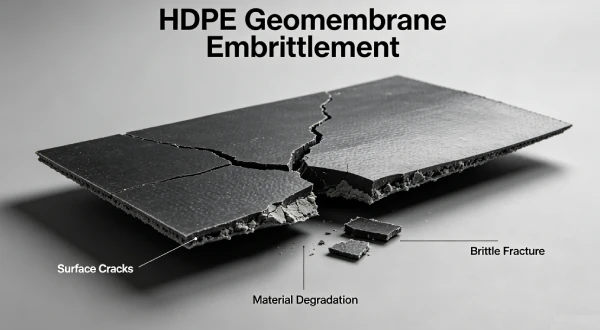
Field Insight — Embrittlement Case:
Australian MSW landfill (2011), 1.5mm HDPE with 300 gsm geotextile over 30mm limestone drainage layer. Subgrade compaction was substandard (85% Standard Proctor). Liner experienced extensive wrinkling during installation. HP-OIT after 8 years measured 80 minutes (initial: 410 minutes). Surface crazing and shallow cracking observed. Lesson: poor subgrade preparation and wrinkling stress accelerated oxidation by creating stress raisers.
7️⃣ Welding and Installation Risks
Installation-induced stress is a major contributor to embrittlement. Welding defects, wrinkles, and handling damage create stress raisers that accelerate crack initiation once the material becomes brittle.
Hot Wedge Welding Parameters by Thickness:
| Thickness | Temperature (°C) | Wedge Speed (m/min) | Pressure (kPa) | Peel Strength (N/25mm) | Risk of Excessive Residual Stress |
|---|---|---|---|---|---|
| 1.5mm | 420–450 | 2.0–3.0 | 200–250 | ≥ 150 | Low (if parameters controlled) |
| 2.0mm | 440–470 | 1.5–2.5 | 250–300 | ≥ 200 | Moderate |
| 2.5mm | 460–490 | 1.0–2.0 | 300–350 | ≥ 250 | High (requires careful control) |
Table scrolls horizontally on mobile
Extrusion Welding: Recommended for details, repairs, and termination points. Filler rod must match sheet resin. Preheat to 200–220°C. Travel speed typically 0.5–0.8 m/min. Extrusion welding of 2.5mm sheets requires additional passes to achieve full penetration.
Climate Risks and Residual Stress:
- Cold Weather (< 5°C): Sheets become stiff. Thermal contraction creates residual stress of up to 5 MPa. This stress, combined with oxidation, accelerates embrittlement.
- Hot Weather (> 35°C): Thermal expansion creates wrinkles. When restrained (by seams or anchors), wrinkles develop high residual stress at tips (stress concentration factors 3–5x).
- Wind: Lifting forces on large panels exceed 5 kN per 100m² at 30 km/h wind speeds. Rapid deployment without ballast creates wrinkles and stress risers.
Wrinkling Prevention and Residual Stress Management:
- Deploy sheets with sufficient slack to accommodate thermal expansion (2–3% of panel length)
- Seam orientation parallel to slope contours to reduce thermal stress
- Use tension relief systems (batten bars, trench anchors) to manage contraction forces
- For 2.5mm sheets, consider double-seaming to reduce stress at corners
Common Seam Failures and Embrittlement Connection:
- Burn-through: Excessive temperature creates localised molecular damage and stress raisers
- Cold weld: Insufficient fusion creates crack initiation sites
- Contaminated seam: Dust or moisture prevents proper fusion, creating weakness
- Stress concentration at corners: Radius must exceed 1m to prevent high localised stress
8️⃣ Real Engineering Failure Cases
Case 1: Thermal Oxidation Embrittlement — California, 2018
Specification used: 2.0mm HDPE, HP-OIT initial = 450 minutes, GRI-GM13 compliant. Waste height 35m. Leachate recirculation system active.
Timeline:
text
2018: 2.0mm HDPE installed, HP-OIT=450min, leachate recirculation active
    ↓ Leachate temperature: 42°C sustained
7 years (2025): HP-OIT testing measured 75 minutes (83% depletion)
    ↓ Surface crazing, 40% reduction in tensile elongation
2025: Stress cracks at wrinkle tips, 3 through-holes detected
    ↓ Cost: $2.1M (repairs + monitoring + remediation planning)
Lesson: Leachate recirculation requires HP-OIT ≥ 500min and annual monitoring
Observed failure: HP-OIT testing at 7 years measured 75 minutes (83% depletion). Field samples showed surface crazing, 40% reduction in tensile elongation, and early stress cracks at wrinkle tips. Leak location survey detected three through-holes at wrinkle locations.
Root cause: Leachate recirculation generated sustained 42°C leachate temperature, accelerating antioxidant depletion. Arrhenius modelling predicted 80% HP-OIT depletion by 7 years at 42°C (versus 20+ years at 25°C). Wrinkles created stress concentrations that initiated cracks once embrittlement began.
Engineering lesson: For leachate recirculation facilities, specify HP-OIT ≥ 500 minutes and implement rigorous temperature monitoring. Consider alternative leachate management strategies to reduce thermal loading. Increase monitoring frequency to annual HP-OIT testing.
Case 2: Stress-Enhanced Oxidation — Brazil, 2020
Specification used: 2.0mm HDPE, HP-OIT initial = 430 minutes, NCTL = 600 hours. Waste height 45m. Subgrade had 50mm stone protrusions.
Timeline:
text
2020: 2.0mm HDPE installed, subgrade stone protrusions 50mm
    ↓ Combined stress + temperature: 38°C leachate
5 years (2025): HP-OIT measured 120 minutes (72% depletion)
    ↓ Stress cracks at bridging locations, 8 through-holes detected
2025: Repairs initiated, subgrade remediation planned
    ↓ Cost: $3.4M (repairs + groundwater remediation)
Lesson: Subgrade preparation + NCTL ≥ 1000hrs for deep landfills
Observed failure: HP-OIT at 5 years measured 120 minutes (72% depletion). Visible stress cracks at bridging locations over stone protrusions. Leak detection survey confirmed eight through-holes.
Root cause: The combination of elevated temperature (38°C leachate) and localised stress from bridging over stone protrusions accelerated oxidation at stress concentration points. The resin’s NCTL of 600 hours was insufficient to resist crack propagation once embrittlement began. Stress-enhanced oxidation increased depletion rate by 2x compared to unstressed material.
Engineering lesson: Subgrade preparation is critical for embrittlement prevention. Specify 6mm maximum particle size. Consider increasing liner thickness to 2.5mm or specifying NCTL ≥ 1000 hours for deep landfills with temperature risk.
Case 3: UV Surface Embrittlement — South Africa, 2022
Specification used: 2.0mm HDPE, carbon black content 2.5%, proper dispersion. Installed over 6-month period with significant UV exposure.
Timeline:
text
2022: 2.0mm HDPE installed over 6 months in tropical climate
    ↓ Significant UV exposure during installation
2023: Surface embrittlement detected before cover placement
    ↓ HP-OIT surface layer: 120min (vs 440min initial)
2023: Cover placed, but surface cracks propagated thermo-oxidatively
    ↓ Cost: $450,000 (repairs + accelerated monitoring)
Lesson: Limit UV exposure to 3 months max, cover within 2 weeks
Observed failure: Surface embrittlement on exposed liner (top 0.2mm) before cover placement. HP-OIT of surface layer was 120 minutes (initial 440 minutes), while HP-OIT of subsurface (2mm depth) remained at 400 minutes. Surface cracking visible under magnification.
Root cause: Extended UV exposure (6 months) caused surface photo-oxidation despite carbon black protection. The surface embrittlement created stress raisers that would propagate thermo-oxidative cracking once covered and heated.
Engineering lesson: Limit storage and installation UV exposure to 3 months maximum. Cover exposed liner within 2 weeks of placement. Carbon black content of 2.5–3.0% provides maximum protection. Accelerate installation schedule or use UV-stabilised materials for tropical climates.
9️⃣ Comparison With Alternative Liner Systems
| Property | HDPE (2.0mm) | LLDPE (1.5mm) | PVC (1.5mm) | EPDM (1.5mm) | GCL |
|---|---|---|---|---|---|
| Oxidation resistance | Good (requires antioxidant) | Moderate | Poor (plasticizer loss) | Fair (requires antioxidant) | N/A (no polymer degradation) |
| Embrittlement mechanism | Thermo-oxidation | Thermo-oxidation | Plasticizer leaching | Thermo-oxidation | N/A |
| Temperature acceleration (Arrhenius) | Doubles per 10°C | Doubles per 10°C | 1.5x per 10°C | Doubles per 10°C | N/A |
| Stress crack resistance (NCTL) | ≥ 500–1500hrs | ≥ 300hrs | ≥ 100hrs | ≥ 200hrs | N/A |
| Field weldability when brittle | Poor (cannot weld) | Poor | Not applicable | Poor | N/A |
| Landfill suitability | ✅ Recommended | ⚠️ Limited | ❌ Not recommended | ❌ Not recommended | ✅ Composite use |
| Cost relative to HDPE | 1.0x | 1.0–1.1x | 1.2–1.5x | 2.0–3.0x | 0.6–0.8x |
Table scrolls horizontally on mobile
🔟 Cost Considerations
Material Cost per m² by Thickness (with HP-OIT Specification):
| Thickness | HP-OIT Specification | Material Cost | Geotextile (400 gsm) | Installed Cost |
|---|---|---|---|---|
| 1.5mm | 400 min | $18–22 | $3–4 | $22–28 |
| 2.0mm | 400 min | $23–28 | $3–4 | $28–35 |
| 2.5mm | 400 min | $28–34 | $3–4 | $35–45 |
| 2.0mm | 500 min (high-temp) | $25–30 | $3–4 | $30–38 |
Cost of Embrittlement Prevention vs Failure:
| Approach | Cost | Effectiveness |
|---|---|---|
| HP-OIT monitoring (annual) | $5,000–15,000/year | Provides early warning for intervention |
| Subgrade preparation (6mm) | $10,000–50,000/ha | Reduces stress raisers by 50–70% |
| NCTL ≥ 1000 hours resin | +5–10% material cost | Delays crack propagation by 2–3x |
| High-temp antioxidant (500 min HP-OIT) | +8–15% material cost | Extends induction phase by 30–50% |
| Failure remediation | $1M–5M | Last resort — extremely costly |
Lifecycle Cost Comparison — Embrittlement Risk Management:
| Strategy | Initial Cost | Monitoring Cost (20yr) | Failure Risk | Total 20-year Cost |
|---|---|---|---|---|
| Standard (1.5mm, 400 min) | $250,000 | $200,000 | 25% | $1,050,000 |
| Enhanced (2.0mm, 400 min) | $320,000 | $200,000 | 10% | $770,000 |
| Premium (2.0mm, 500 min) | $340,000 | $200,000 | 5% | $640,000 |
| Extreme (2.5mm, 500 min) | $420,000 | $200,000 | 3% | $730,000 |
Assumptions: 1 ha liner area, failure cost $3M average, annual monitoring $10,000/year
Monitoring Cost vs Failure Cost Comparison
text
┌─────────────────────────────────────────────────────────────────────────────┐
│                    MONITORING COST vs FAILURE COST                         │
│                                                                             │
│  Cost ($)                                                                   │
│  │                                                                          │
│  5,000,000 ┤  ●                                                            │
│            │  │                                                             │
│  4,000,000 ┤  │                                                             │
│            │  │                                                             │
│  3,000,000 ┤  │  ●   ●                                                     │
│            │  │  │   │                                                      │
│  2,000,000 ┤  │  │   │     ●                                               │
│            │  │  │   │     │                                                │
│  1,000,000 ┤  │  │   │     │        ●                                      │
│            │  │  │   │     │        │                                       │
│    500,000 ┤  │  │   │     │        │   ●                                  │
│            │  │  │   │     │        │   │                                   │
│    100,000 ┤──┼──┼───┼─────┼────────┼───┼───────                          │
│            │  │  │   │     │        │   │                                   │
│     10,000 ┤──┼──┼───┼─────┼────────┼───┼─────── Annual HP-OIT Monitoring │
│            │  │  │   │     │        │   │                                   │
│        0 └──┴──┴───┴─────┴────────┴───┴─────────────────                   │
│               │  │   │     │        │   │                                   │
│               │  │   │     │        │   └─── Catastrophic Failure ($2-5M)  │
│               │  │   │     │        └─────── Major Failure ($1-2M)         │
│               │  │   │     └─────────────── Moderate Failure ($500k-1M)    │
│               │  │   └───────────────────── Minor Failure ($100-500k)      │
│               │  └───────────────────────── Prevention Investment          │
│               └──────────────────────────── Monitoring ($10-15k/year)      │
│                                                                             │
│  ⚠️ Annual HP-OIT monitoring is 0.3-0.5% of potential failure cost         │
│  📌 Prevention: $1 spent on monitoring saves $50-100 in failure costs      │
└─────────────────────────────────────────────────────────────────────────────┘
1️⃣1️⃣ Professional Engineering Recommendation
Embrittlement Risk Management Matrix:
| Embrittlement Risk Level | Recommended Thickness | HP-OIT (Initial) | NCTL | Monitoring Frequency | Geotextile |
|---|---|---|---|---|---|
| Low: < 15m waste, < 25°C, mild leachate | 1.5mm | ≥ 400 min | ≥ 500 hours | Annual HP-OIT | 200–300 gsm |
| Moderate: 15–30m waste, 25–35°C, typical leachate | 1.5–2.0mm | ≥ 400 min | ≥ 750 hours | Annual HP-OIT | 400 gsm |
| High: 30–40m waste, 35–40°C, aggressive leachate | 2.0mm | ≥ 500 min | ≥ 1,000 hours | Semi-annual HP-OIT | 400–600 gsm |
| Extreme: > 40m waste, > 40°C, hazardous leachate | 2.5mm | ≥ 600 min | ≥ 1,500 hours | Quarterly HP-OIT | 600 gsm |
When to Upgrade Antioxidant Package (HP-OIT ≥ 500 minutes):
- Leachate recirculation systems (elevated temperatures)
- Landfills with temperature > 35°C measured at base
- Hazardous waste containment (VOCs present)
- Design life > 50 years without cap
- Deep landfills (> 30m waste height)
Stress Reduction Requirements:
- ✅ Subgrade particles ≤ 6mm (angular crushed stone prohibited)
- ✅ Subgrade compaction ≥ 95% Standard Proctor
- ✅ Geotextile protection per recommendations above
- ✅ Wrinkle management: thermal expansion accommodated (2–3% slack)
- ✅ Seam orientation parallel to slope contours
- ✅ Corner radius ≥ 1m to avoid stress concentration
Monitoring Program for Embrittlement Detection:
- ✅ HP-OIT testing (ASTM D5885): Baseline from material certification, then annual from field samples
- ✅ Density gradient column (ASTM D1505): Molecular weight monitoring every 3 years
- ✅ Tensile elongation (ASTM D638): Ductility retention every 3 years
- ✅ Visual inspection: Quarterly for surface crazing, cracking, discolouration
- ✅ Leak location survey: Annual (ELD) or biennial (dipole) depending on site risk
- ✅ Documentation retention: All results for lifetime of facility
1️⃣2️⃣ FAQ Section
Q1: What is HDPE embrittlement and why does it happen?
HDPE embrittlement is the loss of ductility and transition to brittle behavior resulting from oxidative degradation of polymer chains. Free radicals generated by heat, oxygen, and chemical exposure cause chain scission, reducing molecular weight and eliminating the material’s ability to yield plastically.
Q2: How can I predict when HDPE will become brittle in my landfill?
Use HP-OIT monitoring (ASTM D5885) with Arrhenius modelling. HP-OIT below 100 minutes indicates advanced depletion and high embrittlement risk. Below 50 minutes, embrittlement is imminent. Temperature monitoring is essential for accurate prediction.
Q3: What is the relationship between HP-OIT and antioxidant depletion?
HP-OIT measures remaining antioxidant concentration. Initial HP-OIT ≥ 400 minutes (GRI-GM13). HP-OIT declines exponentially over time (first-order kinetics). HP-OIT < 100 minutes indicates 75–80% depletion. HP-OIT < 50 minutes indicates > 90% depletion and embrittlement risk.
Q4: Can high temperatures accelerate embrittlement?
Yes. Arrhenius kinetics dictate that HDPE oxidation rate doubles per 10°C temperature increase. At 40°C, embrittlement occurs approximately four times faster than at 20°C. Temperature management is critical for embrittlement prevention.
Q5: How does stress affect HDPE embrittlement?
Stress accelerates embrittlement through stress-enhanced oxidation and stress crack propagation. Wrinkles, subgrade irregularities, and thermal contraction create stress concentrations that increase oxidation rate by 2–3x and initiate cracks once the material becomes brittle.
Q6: How can I detect embrittlement in an installed liner?
Detection methods include: HP-OIT testing (ASTM D5885), density gradient column for molecular weight (ASTM D1505), tensile elongation reduction (ASTM D638), visual inspection for surface crazing and cracking, and leak location surveys.
Q7: What antioxidant package should I specify for high-temperature landfills?
Specify HP-OIT ≥ 500 minutes with enhanced antioxidant system (primary hindered phenol + secondary phosphite/thioester). Some suppliers offer specialised high-temperature grades. Confirm with resin supplier datasheet and conduct HP-OIT verification testing.
Q8: Can a brittle HDPE liner be welded or repaired?
No. Brittle HDPE cannot be reliably fusion-welded. The material lacks the ductility required for proper molecular interdiffusion during welding. Repair attempts typically create additional stress concentrations and fail prematurely. Replacement or capping is required.
Q9: What is the difference between OIT and HP-OIT for embrittlement assessment?
OIT (ASTM D3895) tests at 200°C under nitrogen and is a quality control tool. HP-OIT (ASTM D5885) tests at 150°C under 3.5 MPa oxygen and better represents service conditions. HP-OIT is recommended for embrittlement monitoring. GRI-GM13 requires OIT ≥ 100 min or HP-OIT ≥ 400 min for new material.
Q10: How often should I conduct HP-OIT monitoring?
Annual HP-OIT testing is recommended for standard MSW landfills. For high-temperature facilities (> 35°C) or hazardous waste, semi-annual testing is recommended. Quarterly testing is recommended for extreme conditions (> 40°C leachate temperature).
1️⃣3️⃣ Technical Conclusion
HDPE geomembrane embrittlement is a predictable, manageable phenomenon resulting from oxidative degradation of the polymer molecular structure. The transition from ductile to brittle behavior follows a four-phase model: Induction → Depletion → Oxidation → Embrittlement, with kinetics governed by the Arrhenius equation. Temperature is the dominant variable — each 10°C increase doubles the degradation rate, making temperature management and monitoring essential for service life prediction.
Antioxidant depletion monitoring through HP-OIT testing provides the earliest warning of embrittlement risk. HP-OIT values below 100 minutes indicate advanced depletion and require immediate attention. Values below 50 minutes confirm that embrittlement is underway and stress cracking is imminent. The monitoring program should include HP-OIT testing, visual inspection, and leak location surveys, with documentation retained for the facility’s lifetime.
Stress management is equally critical for embrittlement prevention. Wrinkles, subgrade irregularities, and poor seams create stress raisers that accelerate oxidation and provide crack initiation sites once embrittlement begins. Subgrade preparation (≤ 6mm particles, ≥ 95% compaction), geotextile protection, and careful installation with stress reduction are non-negotiable requirements. The industry’s best-performing facilities are characterised by rigorous CQA, stress management, and ongoing monitoring — not by maximum thickness or initial HP-OIT alone.
Thickness provides antioxidant reservoir and stress reduction benefits but does not prevent embrittlement. A 2.5mm liner with poor stress management can embrittle faster than a 1.5mm liner installed with rigorous stress control. The engineer’s judgement must balance material specification, stress management, and monitoring intensity based on site-specific temperature, chemical, and mechanical conditions.
Lifecycle thinking must guide embrittlement prevention strategy. The cost of monitoring and preventive measures ($10,000–50,000/year) is far lower than failure remediation ($1,000,000–5,000,000). HP-OIT monitoring is the most cost-effective embrittlement prevention tool available. The decision on antioxidant package, thickness, and monitoring frequency is ultimately one of risk tolerance, regulatory compliance, and professional engineering judgement applied to site-specific conditions.
📚 Related Technical Guides
HDPE Geomembrane HP-OIT Testing: A Monitoring Engineer's Field ManualLandfill Leachate Temperature Effects on Geomembrane Longevity: Arrhenius Modelling for 30-100 Year Service LifeStress Crack Resistance (NCTL) Testing: Specification and Interpretation for HDPE LinersGeomembrane Installation Stress Management: Wrinkle Prevention and Residual Stress ControlHDPE Geomembrane Failure Investigation: Root Cause Analysis and Prevention Strategies