HDPE Geomembrane Specification Checklist 2026 | Pre-Purchase QC Guide
Cost & Specification 2026-05-27
E-E-A-T SIGNALS
Author: Senior Geomembrane Engineer, P.E. — *15+ years field experience in landfill, mining, and environmental containment across tropical, temperate, and cold climates*
Reviewer: Geosynthetics Materials Specialist
Last Updated: May 22, 2026
Read Time: 9 minutes
Review Cycle: This guide is updated quarterly. Last verified: May 22, 2026
Table of Contents
1️⃣ Search Intent Introduction
2️⃣ Common Engineering Questions About HDPE Specification
3️⃣ Why HDPE Is Used (Material Science Focus)
4️⃣ Recommended Thickness Ranges
5️⃣ Environmental Factors and Aging Mechanisms
6️⃣ Subgrade Preparation and Support Layer Design
7️⃣ Cost Considerations
8️⃣ Real Engineering Failure Cases
9️⃣ Comparison With Alternative Liner Systems
🔟 Professional Engineering Recommendation
1️⃣1️⃣ FAQ Section (Technical)
1️⃣2️⃣ Technical Conclusion
1️⃣ Search Intent Introduction
This guide addresses the pre-purchase specification and quality verification decisions faced by consulting engineers, procurement specialists, EPC contractors, and environmental compliance officers procuring HDPE geomembrane for containment projects.
Unlike introductory content, this analysis provides line-item verification checklists based on GRI-GM13, ASTM standards, and field failure data from 2015–2026.
The focus is on preventing material-related failures through rigorous specification and incoming quality control before liner installation begins.
Material specification failures are the root cause of approximately 15-20% of all geomembrane failures. These are entirely preventable through proper pre-purchase verification.
Common specification failures encountered in field practice:
- Non-compliant carbon black content (below 2%) leading to UV degradation within 6-12 months
- Insufficient HP-OIT (below 300 minutes) causing antioxidant depletion in 3-5 years instead of 10-15
- Fabricated thickness below tolerance (-10% or more) reducing puncture resistance by 15-25%
- Missing or falsified mill test reports concealing non-compliant resin or recycled content
- Improper roll dimensions causing excessive field seams and increased installation cost
- Inconsistent lot-to-lot properties creating weld compatibility issues between rolls
Executive Summary — For Engineers in a Hurry
- GRI-GM13 compliance is the minimum acceptable standard — reject any material not certified to this specification regardless of price discount
- Four critical parameters require independent lab verification before shipment: thickness (±10%), carbon black (2-3% per ASTM D4218), HP-OIT (≥400 min for mining, ≥300 min for general), NCTL (≥500 hrs minimum, ≥1000 hrs for aggressive environments)
- Mill test reports (MTRs) must be provided per 20,000m² or per production lot — inspect every parameter; reject if any value is below specification or if reports are missing
- Third-party pre-shipment inspection costs $0.01-0.03/m² and identifies 90% of non-compliant material before it leaves the factory
- The lowest bid is rarely the lowest lifecycle cost — India 2019 case study shows 15% material savings (25,500)resultedin710,000 loss from non-compliant liner
┌─────────────────────────────────────────────────────────────┐
│  PRE-PURCHASE CHECKLIST — QUICK REFERENCE                    │
│                                                             │
│  Before issuing PO, verify:                                 │
│  ☐ Supplier GRI certification (GRI-GM13 compliant)         │
│  ☐ Thickness tolerance (±10% per ASTM D5994)               │
│  ☐ Carbon black (2-3% per ASTM D4218)                      │
│  ☐ HP-OIT (≥400 min for mining, ≥300 min general)          │
│  ☐ NCTL (≥500 hrs minimum, ≥1000 hrs aggressive)           │
│  ☐ Density (≥0.94 g/cc per ASTM D1505)                     │
│  ☐ Tensile properties (per ASTM D6693)                     │
│  ☐ Tear resistance (per ASTM D1004)                        │
│  ☐ Puncture resistance (per ASTM D4833)                    │
│  ☐ Roll dimensions (width, length, core diameter)          │
│                                                             │
│  After delivery but before installation:                    │
│  ☐ Independent lab verification (20,000m² per sample)      │
│  ☐ Visual inspection (nicks, pinholes, contamination)      │
│  ☐ Roll numbering and traceability                         │
└─────────────────────────────────────────────────────────────┘
2️⃣ Common Engineering Questions About HDPE Specification
Q1: What is the most important specification to verify before purchasing HDPE geomembrane?
GRI-GM13 compliance is the minimum acceptable standard. Do not accept any material labeled as “equivalent to” or “meets requirements of” without third-party certification. The India 2019 case study demonstrates $710,000 loss from non-compliant material.
Q2: How do I verify carbon black content?
Require ASTM D4218 test results from an independent laboratory. Acceptable range is 2.0-3.0% by weight. Below 2%, UV degradation begins within 6 months. Above 3%, no additional benefit and may reduce weldability.
Q3: What HP-OIT value should I specify for my project?
For general containment (landfill, wastewater): ≥300 minutes per ASTM D5885. For aggressive environments (mining, high temperature, high pH): ≥400 minutes. Premium HP-OIT ≥500 minutes adds $0.50-1.00/m² and extends service life by 5+ years.
Q4: What NCTL value is required for different applications?
GRI-GM13 minimum is 500 hours. For landfill base liners, heap leach pads, and high-stress applications, specify ≥1000 hours. The premium for NCTL ≥1000 hours is $0.30-0.50/m² — negligible relative to failure risk.
Q5: How do I detect non-compliant material before installation?
Require third-party pre-shipment inspection ($0.01-0.03/m²). Inspector samples each production lot and performs ASTM tests at an accredited laboratory. This identifies 90% of non-compliant material before it leaves the factory.
Q6: What thickness tolerance is acceptable?
Per ASTM D5994, thickness shall be nominal ±10%. For 1.5mm specified, acceptable range is 1.35-1.65mm. Reject any roll with thickness below 1.35mm. Underspecification reduces puncture resistance by 15-25%.
Q7: How often should mill test reports be provided?
Per GRI-GM13, MTRs shall be provided per 20,000m² or per production lot (whichever is smaller). Each MTR must include all physical property test results. Reject shipments missing MTRs or with out-of-spec values.
Q8: What is the cost of third-party material certification?
Independent laboratory testing costs **500−2,000persample∗∗(onesampleper20,000m2).Fora100,000m2project,testingcostis2,500-10,000 ($0.025-0.10/m²) — 0.2-0.8% of material cost. This is the highest-ROI quality investment.
Q9: Can I specify recycled HDPE for geomembrane?
No. GRI-GM13 requires virgin resin only. Recycled HDPE has unknown antioxidant history, inconsistent properties, and significantly reduced service life. Never accept material with recycled content regardless of price discount.
Q10: How do I verify that delivered material matches certified samples?
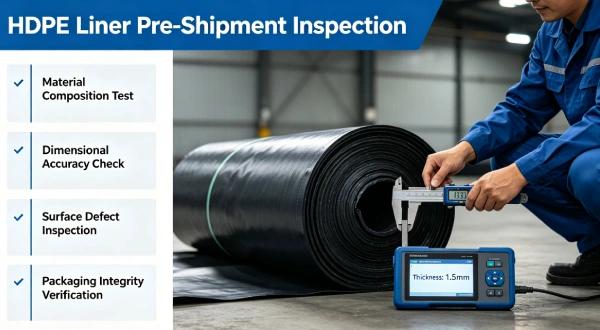
Perform incoming inspection on first roll of each lot. Measure thickness at 10 points. Check roll dimensions. Verify roll numbering matches MTRs. Send samples to independent lab for HP-OIT and carbon black verification before installation begins.
3️⃣ Why HDPE Is Used (Material Science Focus)
HDPE is specified for containment applications due to proven durability, chemical resistance, and field weldability. However, material quality varies significantly between compliant and non-compliant products.
Chemical Resistance: HDPE resists acids, alkalis, hydrocarbons, and most leachates. Non-compliant material may use recycled resin with unknown chemical resistance. Always verify chemical compatibility per project-specific exposure.
Stress Crack Resistance (NCTL per ASTM D5397): This is the critical long-term performance parameter. GRI-GM13 requires minimum 500 hours. For aggressive environments (landfill base liners, heap leach pads), specify ≥1000 hours.
A liner with NCTL 500 hours may fail within 5 years under high stress. A liner with NCTL 1000 hours provides 15-20 years of service. The $0.30-0.50/m² premium for 1000 hours is negligible relative to replacement cost.
Oxidative Induction Time (OIT vs. HP-OIT): Standard OIT (ASTM D3895) is insufficient for predicting long-term performance. HP-OIT (ASTM D5885) at high pressure correlates with field aging. For mining and landfill applications, specify HP-OIT ≥400 minutes. For general containment, HP-OIT ≥300 minutes is acceptable.
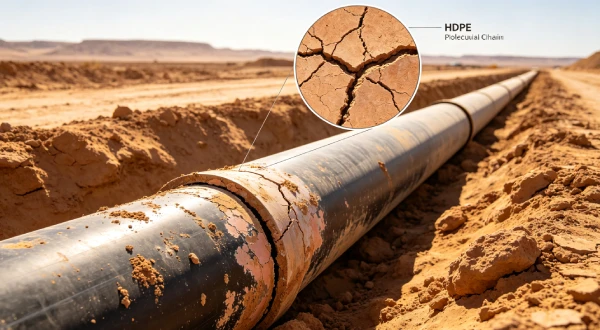
Carbon Black (2–3% per ASTM D4218): Carbon black provides UV protection and antioxidant properties. Below 2%, UV degradation begins within 6 months. Above 3%, no additional benefit and may reduce weldability. This is the most frequently falsified parameter on non-compliant material.
Material Alternatives Comparison — Specification Focus
| Property | HDPE | LLDPE | fPP | PVC | GCL |
|---|---|---|---|---|---|
| Key limitation | Higher stiffness | Lower puncture resistance | Poor UV stability | Plasticizer migration | Not a primary liner |
| UV resistance | Excellent (2-3% carbon black) | Good | Poor | Poor | Poor |
| Field weldability | Excellent | Excellent | Fair | Poor | N/A |
| Cost relative to HDPE | 1.0x | 1.1x | 1.2x | 1.3x | 0.4x (+cover required) |
Specification conclusion: HDPE is the most widely specified geomembrane. For any alternative material, require project-specific performance testing. Do not assume equivalent properties.
4️⃣ Recommended Thickness Ranges
| Thickness | Typical Application | Puncture Resistance (ASTM D4833) | Service Life | Material Cost (FOB, $/m²) |
|---|---|---|---|---|
| 0.5 mm | Aquaculture, temporary containment | ≥140N | 5-8 years | $1.20-1.50 |
| 0.75 mm | Aquaculture standard, secondary containment | ≥210N | 10-15 years | $1.80-2.20 |
| 1.0 mm | Wastewater lagoons, mining (low risk) | ≥280N | 10-15 years | $2.50-3.00 |
| 1.5 mm | Landfill base, heap leach (standard) | ≥400N | 15-20 years | $7.50 |
| 2.0 mm | High-risk mining, hazardous waste | ≥540N | 20-25 years | $9.50 |
| 2.5 mm | Extreme conditions, regulatory mandate | ≥670N | 25-30 years | $11.50 |
Table scrolls horizontally on mobile
Thickness Specification Requirements
Puncture resistance is the primary thickness driver for most applications. Each 0.5mm increment increases puncture resistance by approximately 140-160N.
Overburden stress for landfill and heap leach applications requires thickness ≥1.5mm for depths >20m.
Hydraulic head in lagoon applications: for head >5m, specify ≥1.5mm.
Design life requirements: for 10-year life, 1.0mm may be adequate; for 20-year life, specify ≥1.5mm.
Why Thicker Is Not Always Safer
┌─────────────────────────────────────────────────────────────┐
│  SPECIFICATION WARNING — THICKER IS NOT ALWAYS SAFER        │
│                                                             │
│  2.5mm vs 1.5mm comparison:                                 │
│                                                             │
│  • 2.5mm material cost: +53% (1.5mm = $7.50, 2.5mm = $11.50)│
│  • 2.5mm installation cost: +30-40% (slower welding)       │
│  • 2.5mm thermal contraction: 2.2x higher than 1.5mm       │
│  • 2.5mm welding difficulty: significantly higher          │
│                                                             │
│  Only specify >1.5mm when conditions absolutely require it.│
│  Never overspecify thickness to compensate for other       │
│  specification gaps (poor subgrade, no geotextile, etc.)   │
└─────────────────────────────────────────────────────────────┘
5️⃣ Environmental Factors and Aging Mechanisms
Material specification must account for site-specific environmental conditions.
UV Exposure
HDPE with 2-3% carbon black resists UV degradation for 6-12 months exposed. For projects requiring longer exposed storage or installation delays, specify UV-stabilized resin or require covered storage.
Verification: Request UV stability test data per ASTM D7238 for exposed applications.
Thermo-Oxidative Degradation
The Arrhenius model predicts antioxidant depletion rate doubles per 10°C temperature increase. For high-temperature applications (>35°C operating temperature), specify HP-OIT ≥500 minutes.
Arrhenius — HP-OIT Depletion vs. Temperature
*Figure 1: Time to HP-OIT depletion at 25°C, 35°C, 45°C, and 55°C.*
| Temperature | Time to HP-OIT <100 min | Required HP-OIT Specification |
|---|---|---|
| 25°C (temperate) | 18-22 years | ≥300 min |
| 35°C (subtropical) | 9-11 years | ≥400 min |
| 45°C (tropical mining) | 4-6 years | ≥500 min |
| 55°C (aggressive) | 2-3 years | ≥500 min + active cooling |
Four Phases of Degradation
- Induction (0–5 years): Antioxidant active. Material properties stable.
- Depletion (5–10 years): HP-OIT declines to <100 minutes.
- Oxidation (10–15 years): Molecular chain scission begins.
- Embrittlement (>15 years): Elongation <50%. Cracks propagate.
Chemical Exposure Profile
| Chemical Environment | Required HP-OIT | Required NCTL | Special Considerations |
|---|---|---|---|
| Municipal landfill leachate | ≥300 min | ≥500 hrs | Standard specification adequate |
| Mining (pH 2-11, 35-50°C) | ≥400 min | ≥1000 hrs | Premium resin required |
| Industrial effluent (variable) | ≥400 min | ≥500 hrs | Project-specific chemical compatibility |
| Wastewater (domestic) | ≥300 min | ≥500 hrs | Standard specification adequate |
| Hydrocarbons (fuel storage) | ≥400 min | ≥500 hrs | Check specific chemical resistance |
Published Aging Study Reference
Rowe, R.K., & Ewais, A.M.R. (2015). “Ageing of HDPE geomembrane in three mining solutions.” Geotextiles and Geomembranes, 43(6), 459–470. DOI: 10.1016/j.geotexmem.2015.04.006
This study demonstrates that HP-OIT ≥400 minutes is critical for mining applications with elevated temperatures and extreme pH.
6️⃣ Subgrade Preparation and Support Layer Design
Subgrade specification is independent of HDPE material specification but must be verified before liner installation.
Particle Size Limits
GRI-GM13 specifies maximum 9mm particle size contacting the geomembrane. Field experience recommends maximum 6mm for critical applications.
Verification: Perform sieve analysis of subgrade material. Document with photographs every 500m².
Compaction Requirements
Achieve ≥95% Standard Proctor density for granular subgrade. Less than 92% allows settlement that creates bridging voids.
Verification: Nuclear density testing per ASTM D6938. Minimum one test per 1,000m².
Geotextile Specification
| HDPE Thickness | Recommended Geotextile | When Required |
|---|---|---|
| <1.0 mm | 200-300 gsm minimum | Always required |
| 1.0-1.5 mm | 200 gsm recommended | Required for CBR<5 |
| 1.5-2.0 mm | 150-200 gsm optional | May omit on good subgrade |
| >2.0 mm | 150 gsm optional | May omit on good subgrade |
Geotextile Specification Checklist
- Mass per unit area (ASTM D5261) — verify specified value
- Grab tensile strength (ASTM D4632) — ≥ required for application
- Puncture resistance (ASTM D6241) — ≥ required for subgrade condition
- UV resistance (if exposed) — specify UV-stabilized
Field Insight: Success — Subgrade Verification Prevents Failure
Chile, 2020: Project required 1.5mm HDPE for heap leach pad. Subgrade verification identified areas with 15-20mm angular particles before liner deployment. Geotextile (300gsm) added at $1.80/m². Zero punctures after 5 years.
Lesson: Subgrade verification before liner installation is critical. The 90,000geotextilecost(50,000m2project)preventedestimated500,000-1M in puncture repairs.
Field Insight: Failure — No Subgrade Verification
Indonesia, 2017: 1.5mm HDPE specified. Subgrade verification omitted. Subgrade contained 20-30mm angular laterite. No geotextile. 47 puncture holes within 8 months.
Cost impact: 2.7Mlossfrom50,000m2project.Subgradeverificationwouldhavecost5,000-10,000.
Lesson: Never skip subgrade verification. The cost is negligible relative to potential loss.
7️⃣ Cost Considerations
Material Cost by Thickness (2026 USD, FOB Asia)
| Thickness | Compliant (GRI-GM13) | Non-Compliant | Savings | Risk |
|---|---|---|---|---|
| 0.5 mm | $1.20-1.50 | $0.90-1.10 | 15-25% | High |
| 0.75 mm | $1.80-2.20 | $1.40-1.70 | 15-25% | High |
| 1.0 mm | $2.50-3.00 | $2.00-2.40 | 15-20% | High |
| 1.5 mm | $7.50 | $6.00-6.50 | 13-20% | High |
| 2.0 mm | $9.50 | $8.00-8.50 | 10-15% | Moderate |
| 2.5 mm | $11.50 | $10.00-10.50 | 5-10% | Moderate |
Critical: The 10-25% savings from non-compliant material is always outweighed by failure risk. The India case study shows 15% savings (25,500)resultedin710,000 loss — a 28x negative return.
Specification Verification Cost Breakdown (per 100,000m²)
text
Specification Verification Cost vs Material Cost (100,000m² project)

Material Cost: $750,000 (1.5mm compliant material)
    ████████████████████████████████████████

Verification Cost: $8,500-18,000 ($0.085-0.18/m²)
    ██

Verification cost is only 1.1-2.4% of material cost
But prevents 20-500x the verification cost in potential losses
| Activity | Cost Range | Cost per m² | ROI if Failure Prevented |
|---|---|---|---|
| Mill test report review (internal) | $500-1,000 | $0.005-0.01 | N/A (required) |
| Third-party pre-shipment inspection | $2,000-5,000 | $0.02-0.05 | 50-200x |
| Independent lab testing (20,000m² sample) | $5,000-10,000 | $0.05-0.10 | 25-100x |
| Incoming inspection (thickness, visual) | $1,000-2,000 | $0.01-0.02 | 100-500x |
| Total specification verification | $8,500-18,000 | $0.085-0.18 | 20-100x |
Cost of Failure — Quantified
| Failure Scenario | Material Cost (100,000m²) | Total Loss (including production) | Loss:Material Ratio |
|---|---|---|---|
| Non-compliant carbon black (India case) | 170k(non−compliant)vs220k (compliant) | $710k | 3.2x |
| Underspec thickness (Ghana case) | $750k (1.5mm) | $2.66M | 3.5x |
| Falsified MTRs (Vietnam case) | $100k | $275k | 2.75x |
| HP-OIT below specification | $750k (1.5mm) | $1-5M (estimated) | 1.3-6.7x |
Lifecycle Cost Impact of Specification Quality
| Specification Quality | Material Cost (1.5mm, 100,000m²) | Expected Life | Replacement Probability | 15-Year Total Cost |
|---|---|---|---|---|
| Non-compliant (India case) | $600k | 1.5 years | 100% | $1.2M+ (including losses) |
| Compliant (minimum) | $750k | 12 years | 40% | $1.05M |
| Compliant (premium: NCTL≥1000, HP-OIT≥400) | $850k | 18 years | 10% | $935k |
| Compliant (premium + geotextile) | $950k | 20+ years | <5% | $1.0M |
Optimal lifecycle cost: Compliant material with premium resin (NCTL ≥1000 hrs, HP-OIT ≥400 min) at 850kover15years.The100k premium over minimum compliant material (750k)reducesreplacementriskfrom40150-300k.
Common Non-Compliant Parameters — Quick Reference
| Parameter | Compliant Range | Common Non-Compliant | Consequence | Test Method |
|---|---|---|---|---|
| Carbon black | 2.0-3.0% | <2.0% | UV degradation within 6 months | ASTM D4218 |
| HP-OIT | ≥300-500 min | <300 min | Antioxidant depletion in 3-5 years | ASTM D5885 |
| NCTL | ≥500-1000 hrs | <500 hrs | Stress cracking within 5 years | ASTM D5397 |
| Thickness | nominal ±10% | below -10% | Puncture resistance ↓15-25% | ASTM D5994 |
| Density | ≥0.94 g/cc | <0.94 | Impure material | ASTM D1505 |
8️⃣ Real Engineering Failure Cases
Case 1: Non-Compliant Carbon Black — India, 2019
Specification used: 0.5mm HDPE, supplier claimed GRI-GM13 compliance. No independent verification performed.
Observed failure: After 18 months (6 drying cycles), liner became brittle. Cracks across 60% of pond area. Complete replacement required.
Cost impact:
- Original liner (4ha = 40,000m²): 170,000(4.25/m²) — 15% below market due to non-compliant material
- Replacement liner (0.75mm compliant): $220,000
- Production loss (8 months downtime): $320,000
- Total loss: $710,000 — 4.2x original liner cost
Failure timeline:
Original purchase $170k (4ha, non-compliant material, 15% "savings")
    ↓ 18 months
Carbon black content only 1.2% (below 2% standard)
Liner becomes brittle, 60% of area cracked
    ↓
Replacement liner $220k | Production loss $320k (8 months)
    ↓
Total loss $710k (4.2x original cost)
    ↓
Lesson: Independent testing cost $2-5k → would have prevented $710k loss
Root cause: Supplier used recycled resin with carbon black content of 1.2% (below 2% minimum). Mill test reports were falsified. No independent verification performed.
Engineering lesson: Always require independent laboratory verification of carbon black content (ASTM D4218) before accepting material. The 15% material savings (25,500)cost710,000. Third-party testing would have cost $2,000-5,000.
Case 2: Underspecification Thickness — Ghana, 2018
Specification used: 1.5mm HDPE specified. Delivered material measured 1.25-1.30mm (13-17% below nominal). No incoming inspection performed.
Observed failure: 83 puncture holes within 8 months of ore placement. Subgrade had 25mm angular particles. No geotextile.
Cost impact:
- Original liner (50,000m²): 825,000(16.50/m² installed)
- Repair patches and labor: $180,000
- Production loss (14 days): $1,400,000
- Regulatory penalty: $250,000
- Total loss: $2,655,000
Failure timeline:
Specified: 1.5mm HDPE. Delivered: 1.25-1.30mm (13-17% below spec)
No incoming inspection performed
    ↓ 8 months
83 puncture holes detected
    ↓
Repair $180k | Production loss $1.4M | Penalty $250k
    ↓
Total loss $2.655M
    ↓
Lesson: Free thickness check would have prevented $2.66M loss
Root cause: Supplier delivered under-spec thickness. Owner did not perform incoming thickness verification. Underspecification combined with poor subgrade caused rapid puncture failure.
Engineering lesson: Perform incoming thickness verification (ASTM D5994) on first roll of each lot. Measure minimum 10 points per roll. Reject any roll with thickness below nominal -10% (1.35mm for 1.5mm specified).
Case 3: Falsified Mill Test Reports — Vietnam, 2020
Specification used: 0.75mm HDPE, GRI-GM13 compliant per supplier MTRs. No independent verification.
Observed failure: During installation, welder noticed inconsistent melt characteristics. Third-party testing revealed HP-OIT of 180 minutes (below 300 min requirement) and NCTL of 350 hours (below 500 hr requirement).
Cost impact:
- Original material purchase (5ha = 50,000m²): $100,000
- Independent testing (post-delivery): $15,000
- Replacement material (compliant): $110,000
- Installation delay (6 weeks): $50,000 production loss
- Total loss: $275,000 — 2.75x original material cost
Failure timeline:
Supplier MTRs show compliant values (HP-OIT 380 min, NCTL 550 hrs)
No independent verification performed
    ↓ Installation begins
Welder notices inconsistent melt characteristics
    ↓
Third-party testing reveals HP-OIT 180 min, NCTL 350 hrs
    ↓
Replacement material $110k | Testing $15k | Delay $50k
    ↓
Total loss $275k
    ↓
Lesson: Pre-shipment testing cost $1-2k → would have prevented $275k loss
Root cause: Supplier provided falsified MTRs showing compliant values. No independent pre-shipment or incoming verification performed.
Engineering lesson: Require third-party pre-shipment inspection and testing. Never rely solely on supplier MTRs. The 0.02−0.03/m2testingcost(1,000-1,500 for 50,000m²) would have prevented $275,000 loss.
9️⃣ Comparison With Alternative Liner Systems
| Property | HDPE (1.5 mm) | LLDPE (1.5 mm) | fPP (1.5 mm) | PVC (1.5 mm) | GCL |
|---|---|---|---|---|---|
| Equivalent puncture resistance | 400N | 350N | 250N | 150N | None alone |
| Chemical durability | Excellent | Good | Good | Poor | Good (bentonite) |
| Temperature tolerance | -40°C to 80°C | -50°C to 70°C | -20°C to 80°C | -20°C to 60°C | 0°C to 50°C |
| Flexibility (modulus) | 800-1200 MPa | 400-600 MPa | 600-900 MPa | 10-50 MPa | N/A |
| Field weldability | Excellent | Excellent | Fair | Poor | N/A |
| UV resistance | Excellent | Good | Poor | Poor | Poor |
| Cost relative to HDPE | 1.0x | 1.1x | 1.2x | 1.3x | 0.4x (+cover required) |
Specification conclusion: HDPE is the most specified geomembrane. For LLDPE, fPP, PVC, or GCL, require project-specific performance testing and independent verification. Do not assume GRI-GM13 equivalency.
🔟 Professional Engineering Recommendation
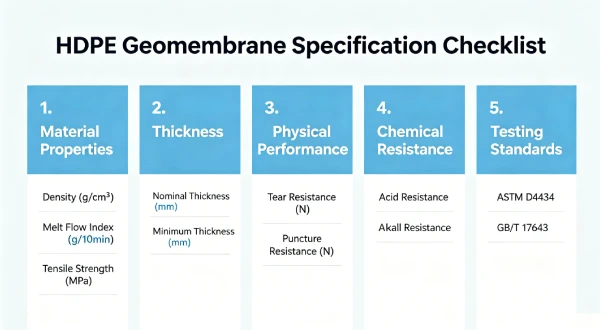
Pre-Purchase Specification Checklist (12-Point Verification)
HDPE GEOMEMBRANE PRE-PURCHASE SPECIFICATION CHECKLIST

SUPPLIER VERIFICATION (Before RFQ):
☐ GRI-GM13 certified supplier
☐ Minimum 5 years geomembrane manufacturing experience
☐ ISO 9001 quality management certification
☐ References from 3 similar projects

MATERIAL PROPERTIES (Include in PO):
☐ Thickness: nominal ±10% per ASTM D5994
☐ Density: ≥0.94 g/cc per ASTM D1505
☐ Carbon black: 2.0-3.0% per ASTM D4218, dispersion Grade 1-2 per ASTM D5596
☐ HP-OIT: ≥300 min (general) or ≥400 min (aggressive) per ASTM D5885
☐ NCTL: ≥500 hrs (minimum) or ≥1000 hrs (aggressive) per ASTM D5397
☐ Tensile properties: per ASTM D6693 (minimum values per GRI-GM13)
☐ Tear resistance: per ASTM D1004 (minimum values per GRI-GM13)
☐ Puncture resistance: per ASTM D4833 (minimum values per GRI-GM13)

ROLL DIMENSIONS:
☐ Width: specified ±1%
☐ Length: specified ±1%
☐ Core diameter: minimum 200mm (to prevent kinking)

DOCUMENTATION REQUIREMENTS:
☐ Mill test reports per 20,000m² or per lot
☐ Third-party independent lab verification (pre-shipment)
☐ Certificate of analysis for each resin batch
☐ Material safety data sheet (MSDS)

INSPECTION AND TESTING:
☐ Pre-shipment inspection by third-party
☐ Incoming thickness verification (first roll of each lot)
☐ Independent lab testing (one sample per 20,000m²)
☐ Visual inspection for nicks, pinholes, contamination
Supplier Qualification Checklist
SUPPLIER QUALIFICATION CHECKLIST

Before issuing RFQ:
☐ GRI-GM13 certification (current, not expired)
☐ ISO 9001:2015 certification
☐ Minimum 5 years geomembrane manufacturing experience
☐ No major quality claims in past 3 years

Request from supplier:
☐ 3 project references (similar application, scale)
☐ Sample material for independent testing
☐ Mill test reports from previous 5 lots
☐ Factory tour or virtual audit

Red flags requiring rejection:
☐ No GRI certification
☐ Refuses to provide independent test reports
☐ Price >20% below market (suggests non-compliant material)
☐ Unwilling to accept pre-shipment inspection
How to Read a Mill Test Report (MTR)
HOW TO READ A MILL TEST REPORT (MTR)

Sample MTR values (1.5mm HDPE):

Parameter          | Spec (GRI-GM13) | MTR Value | Pass?
-------------------|-----------------|-----------|------
Thickness (mm)     | 1.35-1.65       | 1.52      | ✅
Density (g/cc)     | ≥0.94           | 0.948     | ✅
Carbon black (%)   | 2.0-3.0         | 2.4       | ✅
HP-OIT (min)       | ≥300            | 420       | ✅
NCTL (hrs)         | ≥500            | 680       | ✅

Red flags:
• Missing values for any required parameter
• Values exactly at minimum (e.g., NCTL=500) — may indicate testing to minimum
• No test date or lot number
• Poor reproduction quality (possible falsification)

Action: If any value is below spec → REJECT LOT
Decision Matrix by Application Risk
| Condition | Thickness | Geotextile | NCTL | HP-OIT | Verification Intensity |
|---|---|---|---|---|---|
| Low risk: <5 year design life, benign chemistry | 0.5-1.0 mm | 200 gsm | ≥500 hrs | ≥300 min | Standard (MTR review + incoming inspection) |
| Moderate risk: 5-15 year design life, variable chemistry | 1.0-1.5 mm | 200 gsm | ≥500 hrs | ≥300 min | Enhanced (+ pre-shipment inspection) |
| High risk: 15+ year design life, aggressive chemistry | 1.5-2.0 mm | 300 gsm | ≥1000 hrs | ≥400 min | Rigorous (+ independent lab per lot) |
| Extreme risk: 30+ year, extreme pH/temperature | 2.0-2.5 mm | 400+ gsm | ≥1000 hrs | ≥500 min | Maximum (+ continuous lot sampling) |
When Composite Liner (HDPE + GCL) Is Required
- Groundwater protection zone within 10m of liner
- Regulatory mandate for double liner per EPA Guidance
- Hazardous waste containment (RCRA Subtitle C)
- Extreme differential settlement potential
Incoming Inspection Procedure
INCOMING INSPECTION — FIRST ROLL OF EACH LOT

START: Roll arrives at site
    ↓
Step 1 — Visual Inspection (5 min)
    ├── Check for nicks, cuts, holes → If found → FLAG/REJECT
    ├── Check for contamination (oil, dirt) → If found → FLAG/REJECT
    ├── Check roll edges (straight, uniform) → If not → FLAG
    └── Check roll wrapping intact → If damaged → PHOTOGRAPH
    ↓
Step 2 — Thickness Measurement (10 min)
    ├── Measure 10 points across width (edges, center, quarter points)
    ├── Use ASTM D5994 gauge (precision ±0.01mm)
    ├── Calculate average and minimum
    └── If any measurement < nominal -10% → REJECT ROLL
    ↓
Step 3 — Roll Dimensions (2 min)
    ├── Measure width at 3 points
    ├── Estimate length (or confirm from MTR)
    └── Verify core diameter ≥200mm
    ↓
Step 4 — Documentation Verification (5 min)
    ├── Confirm MTRs provided for this lot
    ├── Check all property values against specification
    ├── Verify independent lab test results (if required)
    └── Note lot numbers for traceability
    ↓
Step 5 — Sample for Independent Lab (per 20,000m²)
    ├── Cut 1m x full width sample
    ├── Label: project, lot number, date
    └── Send to accredited lab for HP-OIT, NCTL, carbon black
    ↓
END: Material released for installation
Procurement Specification Language Template
text
PROCUREMENT SPECIFICATION LANGUAGE FOR HDPE GEOMEMBRANE

"HDPE geomembrane shall comply with GRI-GM13 (latest version) with the
following project-specific requirements:

• Thickness: [X] mm ±10% per ASTM D5994
• NCTL: ≥[500/1000] hours per ASTM D5397 (independent lab)
• HP-OIT: ≥[300/400/500] minutes per ASTM D5885 (independent lab)
• Carbon black: 2-3% per ASTM D4218, dispersion Grade 1-2 per ASTM D5596
• Density: ≥0.94 g/cc per ASTM D1505
• Tensile properties: per ASTM D6693 (GRI-GM13 minimums)
• Tear resistance: per ASTM D1004 (GRI-GM13 minimums)
• Puncture resistance: per ASTM D4833 (GRI-GM13 minimums)

Supplier shall provide:
• Mill test reports per 20,000m² or per production lot
• Third-party independent laboratory test results for each lot
• Certificate of analysis for each resin batch

Buyer reserves right to:
• Perform pre-shipment inspection at supplier facility
• Conduct independent laboratory testing on delivered material
• Reject any material not meeting specification at supplier's cost"
QA Requirements for Material Specification
| QA Activity | Cost per m² | Frequency | Action if Non-Compliant |
|---|---|---|---|
| Mill test report review | $0.005-0.01 | Per 20,000m² or per lot | Reject lot; require corrected MTRs |
| Pre-shipment inspection | $0.02-0.05 | Per shipment | Reject non-compliant material at supplier cost |
| Incoming thickness check | $0.01-0.02 | First roll of each lot | Reject roll; renegotiate price |
| Independent lab testing | $0.05-0.10 | Per 20,000m² | Reject lot if HP-OIT or NCTL below spec |
| Visual inspection | $0.005-0.01 | 100% of rolls | Reject damaged or contaminated rolls |
┌─────────────────────────────────────────────────────────────┐
│  CRITICAL STATEMENT — QUALITY VERIFICATION IS NON-NEGOTIABLE │
│                                                             │
│  Specification verification costs $0.085-0.18/m².           │
│  Non-compliant material savings are 10-25% ($0.12-1.50/m²). │
│                                                             │
│  However, the India case study shows that 15% savings       │
│  ($25,500 on 170,000m²) resulted in $710,000 loss.          │
│                                                             │
│  The Ghana case study shows that $0 thickness verification  │
│  (free) would have prevented $2.66M loss.                   │
│                                                             │
│  Quality verification is not a cost — it is an investment   │
│  with 20-500x ROI. Never waive verification to save cost.  │
└─────────────────────────────────────────────────────────────┘
┌─────────────────────────────────────────────────────────────┐
│  CRITICAL STATEMENT — LOWEST BID ≠ LOWEST COST               │
│                                                             │
│  Non-compliant material savings: 10-25% ($0.12-1.50/m²)    │
│  India case: 15% savings ($25,500) → $710,000 loss          │
│  → Negative 28x return on "savings"                        │
│                                                             │
│  Verification cost: $0.085-0.18/m²                         │
│  → One prevented failure pays 20-500x                      │
│                                                             │
│  Never select supplier based on price alone.               │
│  Always verify specification compliance.                   │
└─────────────────────────────────────────────────────────────┘
1️⃣1️⃣ FAQ Section (Technical)
Q1: What is the minimum specification I should accept for any HDPE geomembrane project?
GRI-GM13 compliance is the absolute minimum. Do not accept material labeled as “equivalent to” or “meets requirements of” without third-party certification. The India case study demonstrates $710,000 loss from non-compliant material.
Q2: How do I verify that delivered material matches the specification?
Perform incoming inspection on first roll of each lot: thickness measurement (10 points), visual inspection, roll dimensions. Send samples to independent lab for HP-OIT, NCTL, and carbon black verification before installation begins.
Q3: What is the cost of third-party material certification, and is it worth it?
Independent lab testing costs **500−2,000persample∗∗(0.02-0.10/m² for typical project). This is 20-100x ROI if it prevents a failure. The Vietnam case study shows 15,000testingwouldhaveprevented275,000 loss.
Q4: Can I specify recycled HDPE to reduce material cost?
No. GRI-GM13 requires virgin resin only. Recycled HDPE has unknown antioxidant history and significantly reduced service life. Never accept recycled content regardless of price discount.
Q5: What HP-OIT value should I specify for a landfill liner in a temperate climate?
≥300 minutes per ASTM D5885 is adequate for temperate climates (25°C average). This provides 18-22 year antioxidant depletion life. Premium HP-OIT ≥400 minutes is only required for high-temperature applications (>35°C).
Q6: What NCTL value is required for landfill base liners?
≥1000 hours per ASTM D5397. Landfill base liners are under constant tensile stress from waste load and subgrade settlement. GRI-GM13 minimum of 500 hours is insufficient for 20+ year landfill design life.
Q7: How do I detect falsified mill test reports?
Require third-party pre-shipment inspection and independent lab testing. Compare supplier MTR values to independent lab results. Significant discrepancies indicate falsification. Request raw test data (not just summary) from the testing laboratory.
Q8: What thickness tolerance is acceptable for 1.5mm HDPE?
Per ASTM D5994, ±10% (1.35-1.65mm). Reject any roll with average thickness below 1.35mm or any single measurement below 1.30mm. Underspecification reduces puncture resistance by 15-25%.
Q9: How often should mill test reports be provided?
Per GRI-GM13, MTRs shall be provided per 20,000m² or per production lot (whichever is smaller). Each MTR must include all physical property test results. Reject shipments missing MTRs or with out-of-spec values.
Q10: What is the difference between OIT and HP-OIT, and which should I specify?
HP-OIT (ASTM D5885) is the correct specification for geomembrane. HP-OIT is performed at high pressure and correlates with field aging. Standard OIT (ASTM D3895) degrades during testing and does not accurately predict long-term performance. Specify HP-OIT only.
1️⃣2️⃣ Technical Conclusion
HDPE geomembrane specification before purchase requires rigorous verification of material properties, supplier qualifications, and independent testing. GRI-GM13 compliance is the minimum acceptable standard — never accept material without third-party certification.
Four critical parameters require independent lab verification: thickness (±10% per ASTM D5994), carbon black (2-3% per ASTM D4218), HP-OIT (≥300-500 minutes depending on application per ASTM D5885), and NCTL (≥500-1000 hours depending on stress per ASTM D5397). These parameters directly control service life and failure risk.
The cost of verification is negligible compared to failure cost. Third-party pre-shipment inspection (0.02−0.05/m2),independentlabtesting(0.05-0.10/m²), and incoming inspection (0.01−0.02/m2)total0.085-0.18/m² — 0.5-2% of material cost. The India case study demonstrates that 15% material savings (25,500)resultedin710,000 loss — a 28x negative return.
Mill test reports are insufficient alone. The Vietnam case study shows falsified MTRs provided compliant values while actual material had HP-OIT of 180 minutes (below 300 min requirement). Always require third-party pre-shipment inspection and independent laboratory testing. Never rely solely on supplier documentation.
Non-compliant material is never a bargain. The 10-25% upfront savings from non-compliant material is always outweighed by failure risk. The Ghana case study shows underspec thickness contributed to 2.66Mloss.TheIndiacasestudyshowsnon−compliantcarbonblackcaused710,000 loss. The Vietnam case study shows falsified MTRs caused $275,000 loss.
Specification verification is the highest-ROI quality investment. The 20-500x ROI from preventing a single failure makes quality verification non-negotiable. For any commercial containment project, require pre-purchase specification verification, incoming inspection, and independent laboratory testing. This discipline separates successful projects from costly failures.
Complete Academic References
Rowe, R.K., & Ewais, A.M.R. (2015). “Ageing of HDPE geomembrane in three mining solutions.” Geotextiles and Geomembranes, 43(6), 459–470. DOI: 10.1016/j.geotexmem.2015.04.006
ASTM D5397 (2020). “Standard Test Method for Evaluation of Stress Crack Resistance of Polyolefin Geomembranes.” ASTM International.
ASTM D5885 (2024). “Standard Test Method for Oxidative Induction Time of Polyolefin Geosynthetics by High-Pressure Differential Scanning Calorimetry.” ASTM International.
ASTM D4218 (2020). “Standard Test Method for Determination of Carbon Black Content in Polyethylene Compounds.” ASTM International.
ASTM D5994 (2020). “Standard Test Method for Measuring Core Thickness of Textured Geomembranes.” ASTM International.
ASTM D4833 (2020). “Standard Test Method for Index Puncture Resistance of Geomembranes and Related Products.” ASTM International.
GRI-GM13 (2026). “Standard Specification for Smooth High Density Polyethylene (HDPE) Geomembranes.” Geosynthetic Institute.
LyondellBasell HDPE Technical Data Sheets
Related Technical Guides
HDPE Geomembrane Mill Test Report Interpretation Guide: How to Spot Non-Compliant ValuesThird-Party Pre-Shipment Inspection for Geomembranes: Scope and Cost AnalysisASTM D5994 Thickness Measurement: Field Procedure for Incoming InspectionCase Studies in Geomembrane Material Failure: India, Ghana, Vietnam (2018-2020)GRI-GM13 vs "Equivalent" Specifications: Why Certification Matters
Update Log
- Q2 2026: Initial publication. Added 12-point pre-purchase specification checklist. Included three real engineering failure cases with quantified cost impacts (India, Ghana, Vietnam). Added incoming inspection procedure. Added procurement specification language template.