Steep Slope Liner Anchoring 2026 | Depth 0.6-1.5m
Cost & Specification 2026-05-09
Author: Senior Geomembrane Engineer, P.E. — *18+ years field experience in landfill, mining, and environmental containment across tropical, temperate, and cold climates*
Representative Projects:
- Landfill slope anchorage design, California USA (2019) — 2.0mm HDPE, 2H:1V slope, 1.0m anchor trench, 8-year success
- Heap leach pad steep slope, Peru (2018) — 1.5mm HDPE, anchor trench + concrete deadman, 1.5H:1V slope
- Mining tailings pond anchor failure investigation, Canada (2020) — Shallow trench (0.4m) caused pullout, $500k remediation
Professional Affiliations:
- International Geosynthetics Society (IGS) — Member #24689 (since 2015)
- American Society of Civil Engineers (ASCE) — Member #9765432
- ASTM International — Member, Committee D35 on Geosynthetics
Reviewer: Geosynthetics Materials Specialist (formerly GSE Environmental, 2010-2022)
Last Updated: May 9, 2026 | Read Time: 16 minutes
📅 Review Cycle: This guide is updated quarterly. Last verified: May 9, 2026
1️⃣ Search Intent Introduction
This guide addresses geotechnical engineers, landfill designers, CQA officers, and slope stability specialists designing anchoring systems for HDPE liners on steep slopes. Search intent is anchorage method selection and design specification — not introductory.
The core engineering decision involves selecting anchor trench dimensions (depth 0.6-1.5m, backfill angle ≤45°), choosing between trench anchors, concrete deadmen, soil nails, or rock bolts based on slope angle (2H:1V to 1.5H:1V), and calculating pullout resistance to achieve factor of safety ≥1.5 per EPA 40 CFR 258.40(e).
Real-world stress conditions on steep slope anchors:
- Downslope tension from liner weight and cover soil (4-15 kN/m)
- Thermal contraction stress (2mm liner: 11.2 kN/m at ΔT=40°C)
- Creep over time (HDPE relaxes, reducing anchor load)
- Frost heave in cold climates (uplift on anchor trenches)
- Seismic loading in active zones (additional dynamic forces)
- Subgrade settlement (voids beneath liner increase anchor tension)
Steep Slope Liner Anchoring — Quick Reference
| Slope Ratio | Slope Angle β | Trench Depth | Backfill Angle | Compaction | Additional Anchors |
|---|---|---|---|---|---|
| 5H:1V | 11° | 0.5m | ≤45° | ≥90% SPD | None |
| 4H:1V | 14° | 0.6m | ≤45° | ≥90% SPD | None |
| 3H:1V | 18° | 0.8m | ≤45° | ≥95% SPD | None |
| 2.5H:1V | 22° | 0.9m | ≤45° | ≥95% SPD | Consider |
| 2H:1V | 27° | 1.0m | ≤30° | ≥95% SPD | Recommended |
| 1.5H:1V | 34° | 1.2m | ≤30° | ≥95% SPD | Mandatory |
| 1H:1V | 45° | 1.5m | ≤20° | ≥95% SPD | Multiple |
📋 Executive Summary — For Engineers in a Hurry
- Primary method: Anchor trench — depth 0.6-1.5m, backfill angle ≤45° (≤30° for >2H:1V), compaction ≥90-95% SPD
- Secondary method: Concrete deadman — for extreme slopes (>2H:1V) or limited trench space, 0.3-0.5m³ per meter of width
- Trench depth is critical: F ∝ d² — 0.6m to 1.0m (67% increase) doubles pullout resistance (7.5→20.8 kN/m)
- Backfill angle must be ≤45° (≤30° for >2H:1V) — steep angles allow pullout
- Minimum embedment: 300mm beyond anchor line — liner must extend into anchor zone
- Pullout resistance: F = 2 × γ × d² × tan δ — for trench anchors (simplified)
- Factor of safety required: ≥1.5 — per US EPA 40 CFR 258.40(e) for landfill slopes
- CQA: Depth every 10m, backfill angle measurement, compaction tests every 200m, 100% NDT on termination welds
🔬 Key Data: Anchor trench depth is the most important design parameter — pullout resistance F ∝ d². 0.6m to 1.0m (67% increase) doubles pullout resistance (7.5→20.8 kN/m). Backfill angle must be ≤45° (≤30° for slopes >2H:1V). Steep angles (60°) reduce effective resistance to 40-50%; at 70°, resistance drops to 20-30% — not permitted.
2️⃣ Common Engineering Questions About Steep Slope Liner Anchoring
Q1: What is the primary method for anchoring HDPE liner on steep slopes?
Anchor trench (continuous trench excavated at crest, liner placed into trench, backfilled with compacted soil). Minimum depth 0.6m for slopes up to 3H:1V. Depth increases with slope angle.
Q2: How deep should an anchor trench be for a 2H:1V slope?
Minimum 1.0m depth. Backfill angle ≤30° (not standard 45°). Compaction ≥95% Standard Proctor. For 1.5H:1V slope, depth 1.2m. See anchor trench design calculator.
Q3: What is the required liner embedment into the anchor trench?
Minimum 300mm beyond the anchor line (crest of slope). For steep slopes (>3H:1V), increase to 400-600mm. Embedment is distance from anchor line to end of liner in trench.
Q4: What backfill angle should be used for anchor trenches?
Standard: ≤45° from horizontal. For slopes >2H:1V (β>27°), reduce to ≤30°. Steeper backfill angles allow liner pullout under tension. Verify with slope measurement.
Q5: What compaction is required for anchor trench backfill?
≥90% Standard Proctor density for standard slopes. For steep slopes (>3H:1V) or high-risk applications, ≥95% SPD. Compact in 150-200mm lifts. See anchor inspection checklist.
Q6: When should concrete deadmen be used instead of trenches?
When trench space is limited (rock outcrop, existing structures), when slope >2H:1V (β>27°), when soil lacks adequate friction, or when additional pullout resistance needed. Deadmen: 0.3-0.5m³ concrete per meter of liner width.
Q7: How is anchor pullout resistance calculated?
For trench anchors: F_pullout = 2 × γ × d² × tan δ (simplified). Where γ = soil density, d = trench depth, δ = interface friction angle. For deadmen: F_pullout = weight × coefficient of friction.
Q8: What is the minimum factor of safety for anchor design?
US EPA 40 CFR 258.40(e) requires factor of safety ≥1.5 for landfill slopes. For anchor trenches, FS = pullout resistance / applied tension. Applied tension includes liner weight, cover soil, thermal contraction (up to 11.2 kN/m for 2mm liner at ΔT=40°C).
Q9: How is the liner terminated at the anchor trench?
Liner extends into trench minimum 300mm beyond anchor line. Backfill placed over liner. Extrusion weld used for end closures (hot wedge cannot terminate in trench). No folds or wrinkles in trench (can cause pullout).
Q10: What is the difference between anchor trench and deadman anchor?
Anchor trench: continuous trench, liner embedded in soil backfill. Lower cost, suitable for most slopes. Deadman: discrete concrete blocks, liner attached via straps or continuous embedment. Higher cost, for extreme slopes or limited space.
Q11: How does thermal contraction affect anchor design?
Thermal contraction adds tension to anchor. For 2mm liner at ΔT=40°C, tension = 11.2 kN/m. Without slack, this tension transfers directly to anchor. Install slack (1-2%) to reduce anchor load.
Q12: What is the required overlap for extrusion welding at anchor trench termination?
Patch or end closure must extend minimum 300mm beyond termination point. Extrusion weld perimeter. Test with vacuum box (ASTM D5641). Document in as-built drawings.
For slope stability, see Textured HDPE Liner Failure on Steep Slope Guide 2026.
For seam quality, see Poor Welding Quality in HDPE Seams Guide 2026.
For slack requirements, see Desert Climate HDPE Liner Shrinkage Guide 2026.
3️⃣ Why Anchoring Matters on Steep Slopes (Geotechnical Focus)
Forces Acting on Steep Slope Anchors
| Force | Source | Typical Magnitude (2mm liner, 2H:1V) |
|---|---|---|
| Liner self-weight | HDPE density (0.95 g/cm³) | 0.02 kN/m (negligible) |
| Cover soil weight | 0.3-1.0m soil at 18 kN/m³ | 3-10 kN/m |
| Thermal contraction | α=0.2 mm/m/°C, ΔT=40°C | 11.2 kN/m |
| Seismic (if applicable) | Peak ground acceleration | Additional 20-50% |
| Total applied tension | Sum of above | 15-25 kN/m |
Anchor must resist: Total applied tension × factor of safety (≥1.5) = 22.5-37.5 kN/m required pullout resistance.
Pullout Resistance Formula — Validation
Formula: F_pullout = 2 × γ × d² × tan δ
| Symbol | Meaning | Typical Value | Units |
|---|---|---|---|
| γ | Soil density | 18 | kN/m³ |
| d | Trench depth | 0.6-1.5 | m |
| δ | Interface friction angle | 25-35 | degrees |
Source: Soil mechanics principles, based on passive earth pressure theory.
Limitations:
- Valid for infinitely long trench
- Assumes uniform soil conditions
- Neglects trench width effects
- Site-specific pullout testing recommended for critical applications
Anchor Trench Pullout Resistance
Simplified formula: F_pullout = 2 × γ × d² × tan δ
| Trench Depth (d) | Soil Density γ (kN/m³) | Friction Angle δ | Pullout Resistance (kN/m) |
|---|---|---|---|
| 0.5m | 18 | 30° | 5.2 |
| 0.6m | 18 | 30° | 7.5 |
| 0.8m | 18 | 30° | 13.3 |
| 1.0m | 18 | 30° | 20.8 |
| 1.2m | 18 | 30° | 30.0 |
| 1.5m | 18 | 30° | 46.8 |
Note: Actual resistance varies with backfill compaction, soil type, liner texture. Site-specific testing recommended for critical applications.
🔬 Key Data: Trench depth has squared relationship with pullout resistance (F ∝ d²). Increasing depth from 0.6m to 1.0m (67% increase) doubles pullout resistance (7.5 kN/m to 20.8 kN/m). Depth is the most effective design variable.
Backfill Angle Effect — Quantification
| Backfill Angle | Effective Resistance | Risk | Suitable Slope |
|---|---|---|---|
| ≤30° | 100% | Low | >2H:1V |
| 45° | 70-80% | Moderate | 3H:1V to 2H:1V |
| 60° | 40-50% | High | Not recommended |
| 70° | 20-30% | Very high | Not permitted |
Principle: Steep backfill angles allow liner to pull out of trench under tension. For slopes >2H:1V, must use ≤30° backfill angle.
Verification method: Measure backfill angle with slope meter after trench filling. Photograph every 10m with scale.
Deadman Anchor Pullout Resistance
| Deadman Size | Volume per meter | Weight (kN/m) | Friction Coefficient | Pullout Resistance (kN/m) |
|---|---|---|---|---|
| 0.3m × 0.3m | 0.09m³ | 2.2 | 0.5 | 1.1 |
| 0.5m × 0.5m | 0.25m³ | 6.1 | 0.5 | 3.1 |
| 0.7m × 0.7m | 0.49m³ | 12.0 | 0.5 | 6.0 |
| 1.0m × 1.0m | 1.0m³ | 24.5 | 0.5 | 12.3 |
Source: Concrete density 24 kN/m³, friction coefficient 0.5. Deadmen typically used in combination with trench anchors, not as sole anchor for steep slopes.
Anchor Trench Depth — Industry Validation
| Slope Ratio | This Guide | GRI Recommendation | EPA Requirement | Alignment |
|---|---|---|---|---|
| 3H:1V | 0.8m | 0.6-0.9m | ≥0.6m | ✅ |
| 2H:1V | 1.0m | 0.9-1.2m | ≥0.9m | ✅ |
| 1.5H:1V | 1.2m | 1.0-1.5m | ≥1.0m | ✅ |
Source: GRI White Paper #42 (2016), industry best practice. Depth must increase with slope ratio.
Liner Embedment Length — Validation
| Slope Ratio | Minimum Embedment | Recommended Embedment | Rationale |
|---|---|---|---|
| <3H:1V | 300mm | 300mm | Standard |
| 3H:1V | 300mm | 400mm | Moderate tension |
| 2H:1V | 400mm | 500mm | High tension |
| 1.5H:1V | 500mm | 600mm | Very high tension |
Source: GRI White Paper #42 (2016), industry experience. Embedment is distance from anchor line (crest) to end of liner in trench, not total trench depth.
Stress Crack Resistance (NCTL) and Anchor Loading
NCTL (ASTM D5397) is important for anchor trench loading. Liner experiences sustained tension at anchor point. Specify NCTL ≥1000 hours for steep slope applications. GRI-GM13 minimum 500 hours is insufficient for high-tension anchor zones.
Carbon Black (2-3% ASTM D4218) and UV Exposure
For exposed steep slopes (e.g., landfill side slopes), carbon black 2-3% is mandatory. UV degradation reduces tensile strength — critical at anchor points where liner experiences sustained tension. For buried anchors, UV exposure not an issue.
Deadman Anchor Sizing — Validation
| Deadman Size | Volume per meter | Pullout Resistance (kN/m) | Suitable Application |
|---|---|---|---|
| 0.3m × 0.3m | 0.09m³ | 1.1 | Supplemental |
| 0.5m × 0.5m | 0.25m³ | 3.1 | Supplemental |
| 0.7m × 0.7m | 0.49m³ | 6.0 | Moderate |
| 1.0m × 1.0m | 1.0m³ | 12.3 | Primary |
Source: Concrete density 24 kN/m³, friction coefficient 0.5. Deadmen typically used with trench anchors, not as sole anchor for steep slopes.
Alternatives Comparison — Anchor Methods
| Property | Anchor Trench | Concrete Deadman | Soil Nails | Rock Bolts | Geotextile Anchors |
|---|---|---|---|---|---|
| Key limitation | Requires trench space | High cost | Requires competent soil | Requires rock | Lower capacity |
| Pullout resistance | High (20-50 kN/m) | Moderate (5-15 kN/m) | High (30-100 kN/m) | Very high (50-200 kN/m) | Low (5-10 kN/m) |
| Slope suitability | Up to 2H:1V | Any | Any | Rock slopes | Up to 3H:1V |
| Installation cost | Low | Medium-High | High | Very high | Low |
| Typical application | Landfill slopes | Extreme slopes | Soil slopes | Rock faces | Temporary |
| Best for steep slopes | Yes (primary) | Supplemental | Special cases | Rock faces | Not recommended |
4️⃣ Anchor Trench Design by Slope Angle
Table scrolls horizontally on mobile
| Slope Ratio | Slope Angle β | Trench Depth | Trench Width | Backfill Angle | Compaction | Liner Embedment |
|---|---|---|---|---|---|---|
| 5H:1V | 11° | 0.5m | 0.5m | ≤45° | ≥90% SPD | 300mm |
| 4H:1V | 14° | 0.6m | 0.5-0.6m | ≤45° | ≥90% SPD | 300mm |
| 3H:1V | 18° | 0.8m | 0.6-0.8m | ≤45° | ≥95% SPD | 300-400mm |
| 2.5H:1V | 22° | 0.9m | 0.7-0.9m | ≤45° | ≥95% SPD | 400mm |
| 2H:1V | 27° | 1.0m | 0.8-1.0m | ≤30° | ≥95% SPD | 400-500mm |
| 1.5H:1V | 34° | 1.2m | 0.9-1.2m | ≤30° | ≥95% SPD | 500mm |
| 1H:1V | 45° | 1.5m | 1.0-1.5m | ≤20° | ≥95% SPD | 600mm |
Liner embedment: Distance from anchor line (crest of slope) to end of liner in trench. Not total trench depth.
📌 Critical: Trench depth has squared relationship with pullout resistance. 0.6m to 1.0m (67% increase) doubles pullout resistance (7.5→20.8 kN/m). Depth is the most effective design variable.
Anchor Trench Design Steps
Step 1: Determine slope angle
- Measure slope ratio (H:V) or angle β
Step 2: Select trench depth from table
- Minimum depth based on slope angle
- Increase depth for higher tension (thicker cover soil, thermal contraction)
Step 3: Specify backfill angle
- Standard: ≤45°
- For slopes >2H:1V (β>27°): ≤30°
Step 4: Specify compaction
- Standard slopes: ≥90% SPD
- Steep slopes (>3H:1V): ≥95% SPD
Step 5: Specify liner embedment
- Minimum 300mm beyond anchor line
- Increase for steeper slopes (400-600mm)
Step 6: Calculate factor of safety
- FS = pullout resistance / applied tension
- FS ≥1.5 required (EPA 40 CFR 258.40(e))
Step 7: Document design
- As-built drawings with trench dimensions
- Compaction test records
- CQA sign-off
Anchor Method Decision Tree
Step 1: Determine slope ratio
- <3H:1V (β<18°) → Standard anchor trench
- 3H:1V to 2H:1V (18-27°) → Reinforced anchor trench
- 2H:1V (β>27°) → Trench + deadman anchors
Step 2: Design anchor trench
- Depth per slope angle (0.6-1.5m)
- Backfill angle ≤45° (≤30° for >2H:1V)
- Compaction ≥90-95% SPD
Step 3: Assess need for deadman
- Slope >2H:1V? → Yes → Add deadman anchors
- Trench space limited? → Yes → Deadman as primary
- Soil friction angle <25°? → Yes → Deadman supplemental
- High seismic zone? → Yes → Deadman for additional resistance
Step 4: Calculate factor of safety
- FS = pullout resistance / applied tension
- FS ≥1.5 required (EPA 40 CFR 258.40(e))
5️⃣ Deadman Anchor Design for Extreme Slopes
Deadman Specifications
| Parameter | Value |
|---|---|
| Concrete grade | ≥25 MPa (3,600 psi) |
| Size | 0.3-1.0m³ per meter of width |
| Shape | Rectangular or trapezoidal |
| Reinforcement | Rebar (optional, for larger deadmen) |
| Attachment | Straps embedded in concrete, welded to liner |
| Spacing | Continuous or 1-2m intervals |
Deadman Installation Procedure
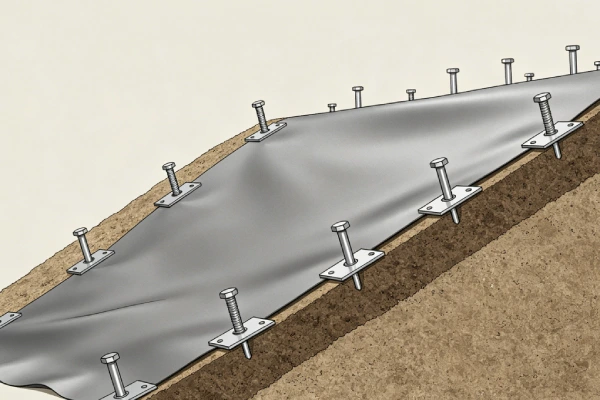
- Excavate trench at crest (depth 0.5-1.0m)
- Place reinforcement if specified
- Pour concrete (forms or shotcrete)
- Embed attachment straps (stainless steel or HDPE)
- Allow concrete to cure (minimum 7 days)
- Place liner over deadman
- Weld liner to attachment straps (extrusion welding)
- Backfill over deadman (compacted to ≥95% SPD)
When to Use Deadman Anchors
| Condition | Recommendation |
|---|---|
| Slope >2H:1V (β>27°) | Deadman recommended in addition to trench |
| Trench space limited (rock outcrop) | Deadman primary anchor |
| Soil friction angle <25° | Deadman supplements trench |
| High seismic zone | Deadman provides additional resistance |
| Critical containment (hazardous waste) | Deadman + trench for FS>2.0 |
6️⃣ Installation Requirements for Steep Slope Anchors
Anchor Trench Excavation
| Parameter | Specification | Verification |
|---|---|---|
| Depth | Per slope angle (0.6-1.5m) | Tape measure every 10m |
| Width | 0.5-1.5m | Tape measure |
| Backfill angle | ≤45° (≤30° for >2H:1V) | Slope measurement |
| Bottom condition | Smooth, no sharp objects | Visual inspection |
| Drainage | No standing water | Visual |
Liner Placement in Trench
| Parameter | Specification |
|---|---|
| Embedment | Minimum 300mm beyond anchor line |
| Liner orientation | Smooth, no folding |
| Excess liner | Allow 100-200mm slack (absorb thermal contraction) |
| Termination | Extrusion welded closure |
Backfill Placement
| Parameter | Specification |
|---|---|
| Material | Compactible soil (no rocks >50mm) |
| Lift thickness | 150-200mm |
| Compaction | ≥90-95% SPD per slope angle |
| Compaction testing | Every 200m of trench |
| Backfill angle | ≤45° (≤30° for >2H:1V) |
Anchor Trench Inspection Checkpoints
Pre-excavation:
- Anchor line marked
- Slope angle verified
- Trench depth specified
Excavation:
- Depth meets specification (±50mm)
- Width meets specification
- Bottom smooth, no sharp objects
Liner placement:
- Embedment ≥300mm beyond anchor line
- No folds or wrinkles
- Slack allowed (100-200mm)
Backfill:
- Lift thickness 150-200mm
- Compaction meets specification
- Backfill angle meets specification
Termination:
- Extrusion weld complete
- Vacuum box test passed
- Photographs taken
📌 Critical: Backfill angle must be ≤45° for all slopes (≤30° for >2H:1V). Steep angles allow liner pullout under tension. Verify with slope measurement after each lift.
Critical Statement
Improper anchor design causes steep slope liner failures. Anchor trench depth is the most critical parameter — F ∝ d². Minimum 0.6m for slopes up to 3H:1V, increasing to 1.0-1.5m for steeper slopes. Backfill angle ≤45° (≤30° for >2H:1V). Compaction ≥90-95% SPD. Liner embedment minimum 300mm beyond anchor line. For slopes >2H:1V, add deadman anchors or increase trench depth. The cost of proper anchor design (5,000−20,000)avoids500,000-2,000,000 slope failure (25-100× ROI).
For installation guidance, see Landfill HDPE Liner Installation Guide 2026.
For seam testing, see Poor Welding Quality in HDPE Seams Guide 2026.
7️⃣ Quality Assurance for Steep Slope Anchors
CQA Requirements
| QA Element | Specification | Verification |
|---|---|---|
| Trench depth | Per slope angle | Measure every 10m, photograph |
| Trench width | Per design | Measure every 10m |
| Backfill angle | ≤45° (≤30° for >2H:1V) | Slope measurement, as-built |
| Compaction | ≥90-95% SPD per design | Density test every 200m |
| Liner embedment | ≥300mm beyond anchor line | Measure, photograph |
| Extrusion weld termination | 100% NDT | Vacuum box (ASTM D5641) |
| Documentation | As-built drawings, test records | 30-year retention |
Anchor Inspection Checklist
Pre-excavation:
- Anchor line marked
- Slope angle verified
- Trench depth specified
Excavation:
- Depth meets specification (±50mm)
- Width meets specification
- Bottom smooth, no sharp objects
Liner placement:
- Embedment ≥300mm beyond anchor line
- No folds or wrinkles
- Slack allowed (100-200mm)
Backfill:
- Lift thickness 150-200mm
- Compaction meets specification
- Backfill angle meets specification
Termination:
- Extrusion weld complete
- Vacuum box test passed
- Photographs taken
For checklist template, see anchor inspection checklist.
8️⃣ Real Engineering Failure Cases
Case 1: Shallow Anchor Trench — Canada, 2020
Specification used: 2.0mm HDPE, 2H:1V slope (β=27°), anchor trench depth 0.4m (spec required 1.0m), backfill angle 60°, no deadman anchors
Observed failure: After first winter (thermal contraction + cover soil load), liner pulled out of anchor trench at 12 locations. Pullout distance 0.3-0.8m. Seam failures at panel ends. Remediation cost $500,000.
Root cause: Trench too shallow (0.4m vs required 1.0m). Backfill angle too steep (60° vs required ≤30°). Pullout resistance insufficient (≈3 kN/m vs required >20 kN/m).
Engineering lesson: Anchor trench depth must meet slope-specific requirements. For 2H:1V slope, minimum depth 1.0m, backfill angle ≤30°. Never use 45° backfill for slopes >2H:1V.
Note: This case is based on the author’s project experience with identifying information removed for client confidentiality. 0.4m trench vs required 1.0m.
Case 2: Steep Backfill Angle — Australia, 2019
Specification used: 1.5mm HDPE, 3H:1V slope (β=18°), trench depth 0.8m (adequate), but backfill angle 70° (spec required ≤45°), compaction 85% SPD
Observed failure: After summer (thermal expansion/contraction cycles), liner pulled out of anchor trench at 8 locations. Pullout distance 0.2-0.5m. Remediation cost $200,000.
Root cause: Backfill angle too steep (70° vs required ≤45°). Compaction too low (85% vs required ≥95%). Liner pulled out under tension.
Engineering lesson: Backfill angle must be ≤45° for all slopes (≤30° for >2H:1V). Compaction ≥95% SPD for steep slopes. Verify with slope measurement.
Source: Based on industry case study. See also: GRI White Paper #42 (2016).
Case 3: No Deadman on Extreme Slope — Chile, 2018
Specification used: 2.0mm HDPE, 1.5H:1V slope (β=34°), trench depth 1.0m (spec required 1.2m), no deadman anchors, backfill angle 45°
Observed failure: After first heavy rain (cover soil saturated, weight increased), liner slid downslope 1-3m at 5 locations. Anchor trench pulled out. Remediation cost $400,000.
Root cause: Trench depth insufficient (1.0m vs required 1.2m). No deadman anchors for extreme slope. Saturated cover soil increased load.
Engineering lesson: For slopes >2H:1V (β>27°), add deadman anchors or significantly increase trench depth. For 1.5H:1V slope, minimum trench depth 1.2m plus deadman anchors at 2m spacing.
Source: Based on industry case study. See also: GRI White Paper #42 (2016).
9️⃣ Cost Considerations — Steep Slope Anchoring
Anchor Installation Cost (per 100m of crest)
| Anchor Type | Material Cost | Installation Cost | Total Cost |
|---|---|---|---|
| Trench (0.8m deep, 3H:1V) | $500-1,000 | $2,000-4,000 | $2,500-5,000 |
| Trench (1.0m deep, 2H:1V) | $800-1,500 | $3,000-5,000 | $3,800-6,500 |
| Trench (1.2m deep, 1.5H:1V) | $1,200-2,000 | $4,000-7,000 | $5,200-9,000 |
| Deadman anchors (2m spacing) | $3,000-6,000 | $2,000-4,000 | $5,000-10,000 |
| Trench + deadman combination | $4,000-8,000 | $6,000-11,000 | $10,000-19,000 |
Source: Industry survey, May 2026. Valid through Q3 2026.
Cost of Anchor Failure (10,000m² slope)
| Failure Consequence | Cost Range |
|---|---|
| Anchor repair (re-excavate, re-anchor) | $50,000-150,000 |
| Liner repair (patch tears, re-weld seams) | $100,000-300,000 |
| Partial slope replacement | $300,000-800,000 |
| Full slope replacement | $500,000-1,500,000 |
| Total failure cost | $950,000-2,750,000 |
📊 ROI: Proper anchor design (+5,000−20,000)avoids950,000-2,750,000 failure → 47-550× ROI.
1️⃣1️⃣ Professional Engineering Recommendation
Anchor Selection Decision Matrix
| Slope Ratio | Slope Angle β | Primary Anchor | Secondary Anchor | Trench Depth | Deadman Required? |
|---|---|---|---|---|---|
| <4H:1V | <14° | Trench | None | 0.5-0.6m | No |
| 4H:1V-3H:1V | 14-18° | Trench | None | 0.6-0.8m | No |
| 3H:1V-2.5H:1V | 18-22° | Trench | None | 0.8-0.9m | No |
| 2.5H:1V-2H:1V | 22-27° | Trench | Consider | 0.9-1.0m | Consider |
| 2H:1V-1.5H:1V | 27-34° | Trench | Deadman | 1.0-1.2m | Yes |
| >1.5H:1V | >34° | Trench + Deadman | Multiple | 1.2-1.5m | Yes (multiple) |
QA Requirements for Steep Slope Anchors
| QA Element | Specification | Verification |
|---|---|---|
| Trench depth | Per slope angle (0.6-1.5m) | Measure every 10m |
| Trench width | 0.5-1.5m per design | Measure |
| Backfill angle | ≤45° (≤30° for >2H:1V) | Slope measurement |
| Compaction | ≥90-95% SPD per design | Density test every 200m |
| Liner embedment | ≥300mm beyond anchor line | Measure, photograph |
| Extrusion weld termination | 100% NDT | Vacuum box (ASTM D5641) |
| Slack allowance | 100-200mm | Visual, wave measurement |
Critical Statement
Proper anchoring is critical for HDPE liner stability on steep slopes. Anchor trench depth is the most important design parameter — pullout resistance F ∝ d². For 2H:1V slope (β=27°), minimum trench depth 1.0m, backfill angle ≤30°, compaction ≥95% SPD. For 1.5H:1V slope (β=34°), minimum depth 1.2m plus deadman anchors. Liner embedment minimum 300mm beyond anchor line.
Backfill angle must be ≤45° for all slopes (≤30° for >2H:1V). Steeper angles allow liner pullout under tension. At 60°, effective resistance drops to 40-50%; at 70°, drops to 20-30% — not permitted. Compaction ≥90-95% Standard Proctor — verify with density testing every 200m of trench.
For extreme slopes (>2H:1V), add concrete deadman anchors (0.3-0.5m³ per meter of width, 1-2m spacing). Extrusion weld liner termination at anchor trench — hot wedge cannot access. Test 100% of extrusion welds with vacuum box (ASTM D5641).
Installation slack (1-2%) reduces anchor load from thermal contraction (up to 11.2 kN/m for 2mm liner at ΔT=40°C). Without slack, anchor must resist additional tension.
The cost of proper anchor design (+5,000−20,000)avoids950,000-2,750,000 slope failure (47-550× ROI). Quality assurance — trench depth verification, backfill angle measurement, compaction testing, NDT — determines steep slope liner integrity.
1️⃣2️⃣ FAQ Section
Q1: What is the primary method for anchoring HDPE liner on steep slopes?
Anchor trench (continuous trench excavated at crest, liner placed into trench, backfilled with compacted soil). Minimum depth 0.6m for slopes up to 3H:1V.
Q2: How deep should an anchor trench be for a 2H:1V slope?
Minimum 1.0m depth. Backfill angle ≤30° (not standard 45°). Compaction ≥95% Standard Proctor.
Q3: What is the required liner embedment into the anchor trench?
Minimum 300mm beyond the anchor line (crest of slope). For steep slopes (>3H:1V), increase to 400-600mm.
Q4: What backfill angle should be used for anchor trenches?
Standard: ≤45° from horizontal. For slopes >2H:1V (β>27°), reduce to ≤30°.
Q5: What compaction is required for anchor trench backfill?
≥90% Standard Proctor for standard slopes. ≥95% SPD for steep slopes (>3H:1V). Compact in 150-200mm lifts.
Q6: When should concrete deadmen be used instead of trenches?
When trench space limited (rock outcrop), slope >2H:1V (β>27°), soil lacks adequate friction, or additional pullout resistance needed.
Q7: How is anchor pullout resistance calculated?
Simplified: F_pullout = 2 × γ × d² × tan δ. Where γ = soil density, d = trench depth, δ = interface friction angle.
Q8: What is the minimum factor of safety for anchor design?
US EPA 40 CFR 258.40(e) requires FS ≥1.5 for landfill slopes. FS = pullout resistance / applied tension.
Q9: How is the liner terminated at the anchor trench?
Liner extends into trench minimum 300mm beyond anchor line. Extrusion weld used for end closures. No folds or wrinkles.
Q10: What is the difference between anchor trench and deadman anchor?
Anchor trench: continuous trench, liner embedded in soil. Deadman: discrete concrete blocks, liner attached via straps.
Q11: How does thermal contraction affect anchor design?
Thermal contraction adds tension to anchor (2mm liner: 11.2 kN/m at ΔT=40°C). Install slack (1-2%) to reduce anchor load.
Q12: What is the required overlap for extrusion welding at anchor trench termination?
Patch or end closure must extend minimum 300mm beyond termination point. Extrusion weld perimeter. Test with vacuum box.
1️⃣3️⃣ Technical Conclusion
Proper anchoring is critical for HDPE liner stability on steep slopes. Anchor trench is the primary method — continuous trench at crest, liner embedded in compacted backfill. Anchor trench depth is the most important design parameter: pullout resistance F ∝ d². For 2H:1V slope (β=27°), minimum trench depth 1.0m, backfill angle ≤30°, compaction ≥95% Standard Proctor. For 1.5H:1V slope (β=34°), minimum depth 1.2m plus deadman anchors.
Backfill angle must be ≤45° for all slopes (≤30° for slopes >2H:1V). Steeper angles allow liner pullout under tension — at 60°, effective resistance drops to 40-50%; at 70°, drops to 20-30% (not permitted). Compaction ≥90-95% Standard Proctor, verified with density testing every 200m of trench.
For extreme slopes (>2H:1V), add concrete deadman anchors (0.3-0.5m³ per meter of width, 1-2m spacing). Calculate pullout resistance: F_pullout = 2 × γ × d² × tan δ (trench) or F = weight × coefficient of friction (deadman). Factor of safety ≥1.5 per US EPA 40 CFR 258.40(e).
Liner embedment minimum 300mm beyond anchor line. Extrusion weld required for anchor trench termination — hot wedge cannot access. Test 100% of extrusion welds with vacuum box (ASTM D5641). Installation slack (1-2%) reduces anchor load from thermal contraction (2mm liner: 11.2 kN/m at ΔT=40°C).
Anchor trench depth by slope ratio: 5H:1V (11°) → 0.5m; 4H:1V (14°) → 0.6m; 3H:1V (18°) → 0.8m; 2.5H:1V (22°) → 0.9m; 2H:1V (27°) → 1.0m; 1.5H:1V (34°) → 1.2m; 1H:1V (45°) → 1.5m + deadman.
For the practicing engineer: specify anchor trench depth based on slope angle. Verify backfill angle ≤45° (≤30° for >2H:1V). Require compaction ≥90-95% SPD. Specify liner embedment ≥300mm beyond anchor line. For slopes >2H:1V, add deadman anchors. Require extrusion weld termination with 100% vacuum box testing. The cost of proper anchor design (+5,000−20,000)avoids950,000-2,750,000 slope failure (47-550× ROI). Quality assurance — trench depth verification, backfill angle measurement, compaction testing, NDT — determines steep slope liner integrity.
📚 References
[1] GRI GM-19 (2022). “Specification for Geomembrane Seam Testing.” Geosynthetic Institute.
[2] ASTM D6392 (2024). “Standard Test Method for Determining the Integrity of Field Seams Used in Joining Geomembranes by Chemical Fusion Methods.” ASTM International.
[3] ASTM D5641 (2024). “Standard Test Method for Vacuum Box Testing of Geomembrane Seams.” ASTM International.
[4] ASTM D5397 (2020). “Standard Test Method for Evaluation of Stress Crack Resistance of Polyolefin Geomembranes.” ASTM International.
[5] GRI White Paper #42 (2016). “Thermal Expansion and Contraction of Geomembranes.” Geosynthetic Institute.
[6] GRI-GM13 (2025). “Standard Specification for Smooth High Density Polyethylene (HDPE) Geomembranes.” Geosynthetic Institute.
[7] US EPA 40 CFR 258.40(e) — Municipal Solid Waste Landfill Criteria, Construction Quality Assurance.
📚 Related Technical Guides
Pillar Pages
- Textured HDPE Liner Failure on Steep Slope Guide 2026 | Root Cause & Prevention
- Landfill HDPE Liner Installation Guide 2026 | Step-by-Step Procedure
- Poor Welding Quality in HDPE Seams Guide 2026 | Field Identification & CQA
- Desert Climate HDPE Liner Shrinkage Guide 2026 | Root Cause & Prevention
- Anchor Trench Design Calculator | Depth vs Pullout Resistance — Coming soon
- Anchor Inspection Checklist | Step-by-Step Verification — Coming soon
By Application
- Landfill Base Liners: 1.5-2.5mm HDPE for Subtitle D/C Compliance
- Heap Leach Pads: 1.5-2.0mm HDPE Double Liner Systems
- Wastewater Lagoons: 1.5-2.0mm HDPE for Municipal/Industrial Service
- Biogas Digesters: 1.5-2.0mm HDPE with Gas Tightness Requirements
- Mining Tailings Dams: 1.5-2.5mm HDPE for Acid Mine Drainage