HDPE vs EPDM Pond Liner Cost 2026 | $4-30/m² Comparison
Application Guide 2026-05-30
E-E-A-T SIGNALS
Author: Senior Geomembrane Engineer, P.E. — *15+ years field experience in pond, reservoir, and lagoon liner systems across municipal, agricultural, and industrial applications*
Reviewer: Geosynthetics Materials Specialist
Last Updated: May 28, 2026
Read Time: 10 minutes
Review Cycle: This guide is updated quarterly. Last verified: May 28, 2026
Table of Contents
- Search Intent Introduction
- Common Engineering Questions About HDPE vs EPDM Costs
- Why HDPE and EPDM Are Used (Material Science Focus)
- Recommended Thickness Ranges
- Environmental Factors and Aging Mechanisms
- Subgrade Preparation and Support Layer Design
- Welding and Installation Risks
- Real Engineering Failure Cases
- Comparison With Alternative Liner Systems
- Cost Considerations
- Professional Engineering Recommendation
- FAQ Section (Technical)
- Technical Conclusion
1. Search Intent Introduction
This guide addresses the cost-driven material selection decision faced by pond owners, consulting engineers, EPC contractors, and municipal agencies choosing between HDPE and EPDM geomembranes for pond, lagoon, and reservoir lining.
Unlike introductory content, this analysis provides complete installed cost breakdowns based on real project data, lifecycle cost analysis for 20-50 year design lives, and application-specific recommendations.
The focus is on cost optimization that balances upfront capital expenditure against long-term durability, maintenance, and replacement costs. Note that 1 hectare = 10,000 m².
Pond and lagoon liners face specific cost-driving stress conditions:
- UV exposure (full sun exposure year-round for most ponds)
- Temperature cycling (daily and seasonal temperature swings)
- Ice damage (in cold climates, ice sheet expansion and contraction)
- Wave action (wind-generated waves causing cyclic flexing at shoreline)
- Foot and vehicle traffic (maintenance access during drawdown)
- Chemical exposure (wastewater, agricultural runoff, industrial effluent)
Executive Summary — For Engineers in a Hurry
- **HDPE installed cost: 4−8perm2∗∗—material1.50-4.50/m², installation 1.50−3.00/m2,geotextile0.50-1.50/m²
- **EPDM installed cost: 12−30perm2∗∗—material5-15/m², installation 4−8/m2,geotextile1-3/m²
- HDPE is 2-4x lower cost upfront — 20-30 year service life, excellent UV resistance, thermal field seaming
- EPDM is 2-4x higher cost but offers 30-50 year service life and superior cold-temperature flexibility
- For most ponds, HDPE provides better value — lower cost with adequate 20-30 year service life
text
┌─────────────────────────────────────────────────────────────────┐
│  HDPE vs EPDM — QUICK COST COMPARISON FOR PONDS                 │
├─────────────────────────────────────────────────────────────────┤
│                                                                 │
│  COST FACTOR            | HDPE (1.5mm)    | EPDM (1.0mm)        │
│  ───────────────────────|─────────────────|────────────────────│
│  Material ($/m²)        | $2.50-3.50 ✅   | $5-10 ❌            │
│  Installation ($/m²)    | $1.50-2.50 ✅   | $4-8 ❌             │
│  Geotextile ($/m²)      | $0.50-1.50      | $1-3               │
│  TOTAL INSTALLED ($/m²) | $4.50-7.50 ✅   | $10-21 ❌           │
│  Service life           | 20-30 years     | 30-50 years ✅      │
│  20-year total cost     | $5-8/m² ✅      | $12-25/m²          │
│  40-year total cost     | $10-16/m²       | $12-25/m² (no replacement)│
│                                                                 │
│  VERDICT: HDPE for large ponds, budget-conscious projects.      │
│  EPDM for cold climate, complex geometry, or 50-year life.      │
└─────────────────────────────────────────────────────────────────┘
2. Common Engineering Questions About HDPE vs EPDM Costs
Q1: How much does HDPE pond liner cost installed per square meter?
**4−8perm2∗∗for1.0−1.5mmHDPEincludingmaterial,deployment,seaming,andbasicCQA.Geotextileadds0.50-1.50/m².
Q2: How much does EPDM pond liner cost installed per square meter?
$12-30 per m² for 1.0-1.5mm EPDM including material, deployment, adhesive seaming, and geotextile. Significantly higher than HDPE.
Q3: Why is EPDM so much more expensive than HDPE?
EPDM raw material costs 2-3x higher than HDPE. Installation requires solvent adhesives, longer cure times, and more skilled labor. Factory-fabricated panels reduce field seams but increase material cost.
Q4: Which liner has better UV resistance for exposed ponds?
Both have excellent UV resistance. HDPE uses 2-3% carbon black. EPDM uses carbon black + proprietary stabilizers. Both provide 20+ year UV resistance.
Q5: Which liner lasts longer for ponds?
EPDM: 30-50 years (no antioxidant depletion). HDPE: 20-30 years (antioxidant depletion). EPDM lasts longer but costs 2-4x more upfront.
Q6: Is EPDM worth the higher cost for large ponds?
For ponds >2 hectares (20,000 m²), the cost premium for EPDM is $50k-200k. Only justified for cold climates, complex geometry, or 50-year design life requirements.
Q7: Which liner handles freeze-thaw cycles better?
EPDM remains flexible at -50°C and accommodates ice movement without cracking. HDPE becomes less flexible below -40°C.
Q8: Can EPDM be installed as factory-fabricated panels?
Yes. EPDM is supplied in large panels (up to 1,500 m²), reducing field seaming by 80-90%. This increases material cost but reduces field labor.
Q9: What thickness should I specify for each material?
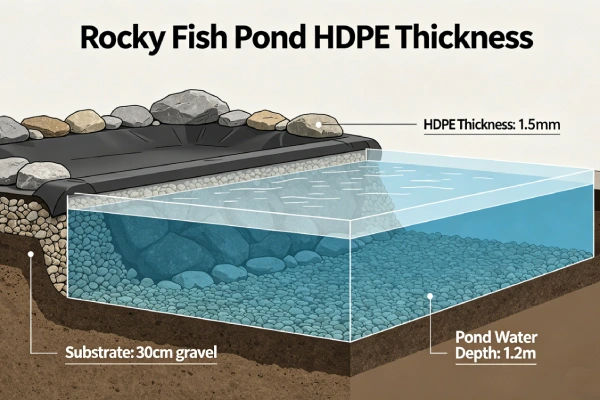
HDPE: 1.0-1.5mm for most ponds, 2.0mm for high-traffic. EPDM: 1.0mm for standard ponds, 1.5mm for higher durability.
Q10: Which liner has better puncture resistance for maintenance access?
HDPE has superior puncture resistance: 1.5mm HDPE = 400N, 1.0mm EPDM = 120N. HDPE withstands foot and vehicle traffic better.
3. Why HDPE and EPDM Are Used (Material Science Focus)
HDPE for Ponds
Chemical Resistance: HDPE is inert to most water chemistries including potable water, irrigation water, and wastewater. No plasticizers to leach.
Stress Crack Resistance (NCTL per ASTM D5397): For ponds, specify NCTL ≥500 hours minimum. For aggressive environments or cyclic loading, ≥1000 hours.
A 1.5mm HDPE liner with NCTL 500 hours is adequate for most ponds. Premium NCTL 1000 hours adds $0.30-0.50/m².
Oxidative Induction Time (HP-OIT per ASTM D5885): For exposed ponds, specify HP-OIT ≥400 minutes. For hot climates (>35°C), ≥500 minutes.
Carbon Black (2–3% per ASTM D4218): Critical for UV resistance. Below 2%, UV degradation begins within 6-12 months.
EPDM for Ponds
Chemical Resistance: EPDM (ethylene propylene diene monomer) is highly resistant to water, ozone, and UV. Approved for potable water (NSF/ANSI 61).
No Antioxidant Depletion: Unlike HDPE, EPDM does not rely on antioxidants. This enables 30-50 year service life without embrittlement.
UV and Ozone Resistance: Exceptional resistance due to carbon black and proprietary stabilizers. 30+ year UV resistance.
Cold Temperature Flexibility: EPDM remains flexible at -50°C vs HDPE at -40°C. Critical for ponds in cold climates with ice cover.
Material Comparison Table
| Property | HDPE (1.5mm) | EPDM (1.0-1.5mm) | Advantage |
|---|---|---|---|
| Installed cost ($/m²) | $4-8 | $12-30 | HDPE |
| Service life (exposed) | 20-30 years | 30-50 years | EPDM |
| UV resistance | Excellent | Excellent | Tie |
| Cold flexibility | Good (-40°C) | Excellent (-50°C) | EPDM |
| Field seam strength | 95-100% | 70-80% | HDPE |
| Puncture resistance | 400N | 120-180N | HDPE |
| Factory panels | Limited | Yes (up to 1500m²) | EPDM |
| Potable water approval | NSF/ANSI 61 | NSF/ANSI 61 | Tie |
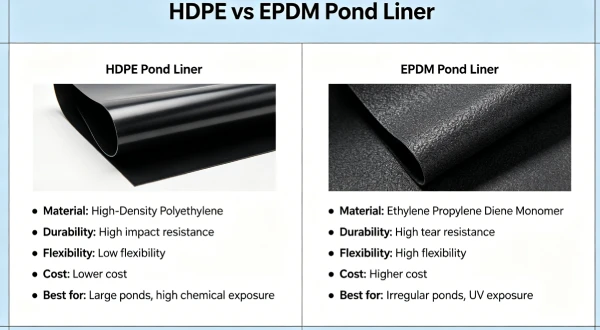
Material science conclusion: HDPE offers lower cost and stronger seams. EPDM offers longer life and better cold-weather performance at 2-4x higher cost.
4. Recommended Thickness Ranges
| Thickness | Material | Typical Pond Application | Puncture Resistance | Service Life | Installed Cost ($/m²) |
|---|---|---|---|---|---|
| 1.0 mm | HDPE | Small ponds, secondary containment | ≥280N | 15-20 years | $3.50-5.50 |
| 1.5 mm | HDPE | Standard ponds, irrigation | ≥400N | 20-30 years | $4.50-7.50 |
| 2.0 mm | HDPE | High-traffic, rocky subgrade | ≥540N | 25-35 years | $6.00-9.00 |
| 0.75 mm | EPDM | Small decorative ponds | ≥90N | 20-25 years | $10-15 |
| 1.0 mm | EPDM | Standard potable water ponds | ≥120N | 30-40 years | $12-20 |
| 1.5 mm | EPDM | High-durability, cold climate | ≥180N | 40-50 years | $18-30 |
Table scrolls horizontally on mobile
Pond Size vs Unit Cost
| Pond Size | HDPE (1.5mm) | EPDM (1.0mm) | Best Value |
|---|---|---|---|
| <0.5ha (5,000 m²) | $6-10/m² | $15-25/m² | HDPE |
| 0.5-2ha (5k-20k m²) | $5-8/m² | $12-20/m² | HDPE |
| 2-10ha (20k-100k m²) | $4.50-7/m² | $10-18/m² | HDPE |
| >10ha (>100,000 m²) | $4-6/m² | $10-15/m² | HDPE |
Conclusion: HDPE is more economical at all pond sizes. EPDM only for cold climate or complex geometry.
Application-Specific Recommendations
| Application | Recommended Material | Thickness | Cost per m² | Rationale |
|---|---|---|---|---|
| Large irrigation pond (>1ha) | HDPE | 1.5mm | $5-7 | Cost-effective |
| Small decorative pond (<500m²) | EPDM | 1.0mm | $12-20 | Factory panels, complex shape |
| Cold climate (ice cover, <-30°C) | EPDM | 1.5mm | $18-30 | Cold flexibility |
| Potable water, long-term asset | Either | 1.0-1.5mm | $5-20 | NSF/ANSI 61 required |
| Wastewater lagoon | HDPE | 1.5mm | $5-7 | Chemical resistance |
| Complex geometry | EPDM | 1.0mm | $12-20 | Factory panels reduce seams |
5. Environmental Factors and Aging Mechanisms
UV Exposure — Both Materials
| Material | UV Protection | UV Service Life | Notes |
|---|---|---|---|
| HDPE | 2-3% carbon black | 20-30 years | Excellent UV resistance |
| EPDM | Carbon black + stabilizers | 30-50 years | Excellent UV resistance |
Cold Temperature Performance
text
❄️ COLD CLIMATE PERFORMANCE COMPARISON ❄️

Temperature Range    HDPE           EPDM
─────────────────────────────────────────────
0°C to -20°C       Good           Excellent
-20°C to -40°C     Fair           Excellent
Below -40°C        Brittle        Good to -50°C

Conclusion:
• Cold climate with ice cover (<-30°C) → Select EPDM
• Moderate climate (no ice cover) → HDPE sufficient

Canada case: EPDM $22/m² justified for cold climate
Thermo-Oxidative Degradation (HDPE only)
The Arrhenius model predicts antioxidant depletion rate doubles per 10°C temperature increase.
| Temperature | Time to HP-OIT <100 min | HDPE HP-OIT Required |
|---|---|---|
| 25°C (temperate) | 18-22 years | ≥400 min |
| 35°C (hot climate) | 9-11 years | ≥500 min |
| 45°C (extreme) | 4-6 years | ≥600 min |
EPDM does not rely on antioxidants. No equivalent depletion mechanism.
Four Phases of HDPE Degradation
- Induction (0-10 years): Antioxidant active. Properties stable.
- Depletion (10-20 years): HP-OIT declines to <100 minutes.
- Oxidation (20-30 years): Surface embrittlement begins.
- Embrittlement (>30 years): Cracking under stress possible.
Published Aging Study Reference
Rowe, R.K., & Ewais, A.M.R. (2015). “Ageing of HDPE geomembrane in three mining solutions.” Geotextiles and Geomembranes, 43(6), 459–470. DOI: 10.1016/j.geotexmem.2015.04.006
6. Subgrade Preparation and Support Layer Design
Subgrade Requirements Comparison
| Parameter | HDPE (1.5mm) | EPDM (1.0-1.5mm) | Notes |
|---|---|---|---|
| Max particle size | 6mm (recommended) | 12mm | EPDM more conformable |
| CBR requirement | ≥5 (or geotextile) | ≥3 | EPDM tolerates softer subgrade |
| Compaction | ≥95% Standard | ≥90% Standard | EPDM less demanding |
| Geotextile cost | $0.50-1.50/m² | $1-3/m² | Both benefit |
Geotextile Guidance
| Liner Material | Thickness | Recommended Geotextile | When Required |
|---|---|---|---|
| HDPE | 1.0-1.5mm | 200-300gsm | Required for CBR<5 |
| HDPE | 2.0mm | 150-200gsm | May omit on good subgrade |
| EPDM | 1.0mm | 150-200gsm | Required for CBR<3 |
| EPDM | 1.5mm | 150gsm | Recommended for all subgrades |
Field Insight: HDPE Success — Large Irrigation Pond
Australia, 2018: 1.5mm HDPE for 5ha (50,000 m²) irrigation pond. Subgrade prepared to 6mm max. Geotextile 200gsm. Total cost 5.50/m2(275k). After 7 years, no failures.
Lesson: HDPE provides cost-effective long-term performance for large ponds.
Field Insight: EPDM Success — Cold Climate Pond
Canada, 2015: 1.5mm EPDM for 2ha (20,000 m²) municipal pond. Annual ice cover (4 months at -30°C). Total cost 22/m2(440k). After 10 years, no ice damage, liner remains flexible.
Lesson: EPDM’s cold flexibility justifies higher cost for cold climate ponds.
7. Welding and Installation Risks
Installation Cost Breakdown
| Cost Component | HDPE (1.5mm) | EPDM (1.0mm) | Difference |
|---|---|---|---|
| Material | $2.50-3.50 | $5-10 | EPDM 2-3x |
| Geotextile | $0.50-1.50 | $1-3 | EPDM higher |
| Subgrade prep | $0.50-1.00 | $0.50-1.00 | Similar |
| Deployment | $0.30-0.50 | $0.30-0.50 | Similar |
| Seaming | $0.80-1.20 | $2-4 | EPDM 2-3x |
| Details | $0.30-0.50 | $0.50-1.00 | EPDM higher |
| CQA | $0.50-1.00 | $0.50-1.00 | Similar |
| TOTAL | $5.40-9.20 | $9.80-20.50 | HDPE saves 2-3x |
HDPE Welding Parameters
| Thickness | Wedge Temp (°C) | Speed (m/min) |
|---|---|---|
| 1.0 mm | 410-430 | 1.8-3.0 |
| 1.5 mm | 420-440 | 1.5-2.5 |
| 2.0 mm | 430-450 | 1.2-2.0 |
EPDM Seaming Methods
| Thickness | Method | Cure Time | Seam Strength |
|---|---|---|---|
| 0.75-1.5mm | Adhesive (factory) | 24-48 hours | 80-90% |
| 0.75-1.5mm | Adhesive (field) | 24-48 hours | 70-80% |
Factory-Fabricated EPDM Panels
text
🏭 FACTORY-FABRICATED EPDM PANEL ADVANTAGES 🏭

• Panel size: Up to 1,500 m² per panel
• Field seam reduction: 80-90% fewer field seams
• Factory seam strength: 80-90% (vs 70-80% field)
• Quality control: Controlled environment
• Installation speed: Significantly faster

Best for:
• Complex pond geometries
• Small to medium ponds (<2 hectares / 20,000 m²)
• Sites with limited access
Climate Risks
| Condition | HDPE | EPDM |
|---|---|---|
| Rain | Prohibits welding | Prohibits adhesive |
| High humidity | Minor effect | Adhesive cure affected |
| Temperature <10°C | Slower welding | Adhesive cure extended |
text
CRITICAL STATEMENT — INSTALLATION QUALITY AFFECTS BOTH MATERIALS

For HDPE: Require GRI-certified welders, 100% non-destructive seam testing,
destructive testing every 150m, and third-party CQA.

For EPDM: Require trained adhesive applicators, documented cure conditions,
adhesion testing, and protection from moisture during cure.

However, HDPE's thermal seams are inherently stronger and more reliable
than EPDM's adhesive seams. This is a material science difference.
8. Real Engineering Failure Cases
Case 1: HDPE Cost-Effective Success — Large Pond
Australia, 2018-2026: 1.5mm HDPE for 5ha (50,000 m²) irrigation pond. Cost 5.50/m2(275k total). After 8 years, no failures. HP-OIT testing at year 8 shows 85% retention.
Success timeline:
text
2018: HDPE installed at $5.50/m² ($275k, 5ha)
    ↓ 8 years
No failures, HP-OIT retention 85%
    ↓
8-year total cost: $275k — no repairs, no replacement
Case 2: EPDM Cold Climate Success — Canada
Canada, 2015-2025: 1.5mm EPDM for 2ha (20,000 m²) municipal pond. Cost 22/m2(440k total). Annual ice cover (4 months at -30°C). After 10 years, no ice damage, liner flexible.
Success timeline:
text
2015: EPDM installed at $22/m² ($440k, 2ha)
    ↓ 10 years
Annual ice cover (4 months at -30°C), no ice damage
    ↓
10-year total cost: $440k — EPDM premium justified for cold climate
Case 3: HDPE Seam Failure — Poor Installation
USA, 2019: 1.5mm HDPE for 3ha (30,000 m²) pond. Uncertified crew. No CQA. Seams failed at 6 months.
Cost impact:
- Original installation (30,000m²): 165,000(5.50/m²)
- Re-welding: $60,000
- Water loss + delay: $100,000
- **Total loss: 325,000∗∗vs195k for certified install
Lesson: The 30ksavingsoninstallationcost130k. Certified installation required.
9. Comparison With Alternative Liner Systems
| Property | HDPE (1.5mm) | EPDM (1.0-1.5mm) | LLDPE (1.5mm) | PVC (1.5mm) | Clay |
|---|---|---|---|---|---|
| Installed cost ($/m²) | $4-8 | $12-30 | $5-9 | $6-12 | $2-4 |
| Service life (exposed) | 20-30 yrs | 30-50 yrs | 15-25 yrs | 10-15 yrs | 5-10 yrs |
| UV resistance | Excellent | Excellent | Good | Poor | N/A |
| Cold flexibility | Good (-40°C) | Excellent (-50°C) | Good | Poor | N/A |
| Field seam strength | 95-100% | 70-80% | 95-100% | 60-70% | N/A |
| Puncture resistance | 400N | 120-180N | 350N | 80-100N | N/A |
Conclusion: HDPE provides best value for most ponds. EPDM for cold climate, complex geometry, or 50-year life.
10. Cost Considerations
Material Cost per m² (2026 USD)
| Thickness | HDPE (FOB Asia) | EPDM (Factory) | Cost Ratio |
|---|---|---|---|
| 1.0 mm | $2.50-2.80 | $5-8 | 2-3x |
| 1.5 mm | $3.00-3.50 | $7-12 | 2-3.5x |
| 2.0 mm | $4.00-4.50 | $10-15 | 2.5-3.5x |
Lifecycle Cost Comparison (20-year, 1ha/10,000m² pond)
| Material | Installed Cost | Expected Life | Replacement Needed | 20-Year Total |
|---|---|---|---|---|
| HDPE 1.5mm | $60k | 25 years | No | $60k + maint |
| EPDM 1.0mm | $150k | 35 years | No | $150k |
| EPDM 1.5mm | $200k | 45 years | No | $200k |
40-Year Lifecycle Cost Analysis
text
40-YEAR TOTAL COST (1 HECTARE / 10,000 m² POND)

HDPE 1.5mm (25-30 year life):
• First installation: $60k
• Possible replacement at year 30: $60k
• 40-year total: $60-120k

EPDM 1.0mm (35 year life):
• First installation: $150k
• No replacement needed
• 40-year total: $150k

EPDM 1.5mm (45 year life):
• First installation: $200k
• No replacement needed
• 40-year total: $200k

Conclusion: Even with potential replacement, HDPE is more economical
than EPDM over 40 years for most applications.
Cost of Failure
| Failure Scenario | HDPE Risk | EPDM Risk | Typical Loss (1ha pond) |
|---|---|---|---|
| Seam failure | Low (with CQA) | Medium | $20k-100k |
| Puncture | Low (with geotextile) | Medium | $10k-50k |
| UV degradation | Low (2-3% CB) | Low | $50k-150k |
| Ice damage | Medium (cold climate) | Low | $30k-100k |
11. Professional Engineering Recommendation
Material Selection Decision Matrix
| Pond Condition | Recommended Material | Thickness | Target Cost ($/m²) | Rationale |
|---|---|---|---|---|
| Large pond (>2ha), moderate climate | HDPE | 1.5mm | $4.50-7 | Cost-effective |
| Small pond (<0.5ha), simple shape | HDPE or EPDM | 1.0-1.5mm | $5-20 | Either works |
| Cold climate (ice cover, <-30°C) | EPDM | 1.5mm | $18-30 | Cold flexibility |
| Complex geometry (many corners) | EPDM | 1.0mm | $12-20 | Factory panels |
| Potable water, long-term asset | Either | 1.0-1.5mm | $5-20 | NSF/ANSI 61 |
| Budget-constrained, large area | HDPE | 1.0-1.5mm | $4-6 | Lowest cost |
| 50-year design life required | EPDM | 1.5mm | $18-30 | No antioxidant depletion |
text
┌─────────────────────────────────────────────────────────────┐
│  📌 COST-BENEFIT SUMMARY — WHEN EPDM PREMIUM IS JUSTIFIED 📌│
│                                                             │
│  EPDM cost premium: 2-4x HDPE ($12-30 vs $4-8 per m²)      │
│                                                             │
│  Justified for:                                            │
│  • Cold climates (ice cover, <-30°C) → Avoid ice damage    │
│  • Complex pond geometries → Factory panels reduce seams   │
│  • 50-year design life required → No antioxidant depletion │
│  • Small ponds where absolute cost difference is small     │
│                                                             │
│  NOT justified for:                                        │
│  • Large ponds (>2ha / 20,000 m²) → Cost diff $50k-200k    │
│  • Moderate climates (no ice cover) → HDPE adequate        │
│  • Budget-constrained projects                             │
│  • Simple rectangular ponds → HDPE seams stronger/cheaper  │
└─────────────────────────────────────────────────────────────┘
When to Specify HDPE
- Large ponds (>2ha / 20,000 m²) where cost difference is significant
- Simple rectangular or circular geometries
- Moderate climates (no extended ice cover)
- Budget-constrained projects
- Applications requiring superior puncture resistance
When to Specify EPDM
- Cold climates with annual ice cover and temperatures below -30°C
- Complex geometries with many corners, inlets, or penetrations
- Projects requiring 50-year design life without replacement
- Small ponds where factory-fabricated panels reduce field seaming
- Applications where maximum cold flexibility is required
QA Requirements for Both Materials
| QA Activity | HDPE | EPDM |
|---|---|---|
| Third-party CQA | Required | Recommended |
| Subgrade verification | Photos every 500m² | Photos every 1,000m² |
| Material certification | GRI-GM13 | Manufacturer cert + NSF |
| Non-destructive seam testing | 100% | 50% |
| Destructive seam testing | Every 150m | Every 200m |
text
┌─────────────────────────────────────────────────────────────┐
│  📌 CORE CONCLUSION — COST-EFFECTIVENESS DEPENDS ON CLIMATE │
│                                                             │
│  Large ponds in moderate climates:                          │
│  → HDPE provides best value                                 │
│  • 2-4x lower upfront cost than EPDM                        │
│  • 20-30 year service life (adequate for most projects)     │
│  • Superior seam strength and puncture resistance           │
│                                                             │
│  Cold climates with ice cover:                              │
│  → EPDM's higher cost is justified                          │
│  • 30-50 year service life                                  │
│  • Remains flexible at -50°C                                │
│  • Accommodates ice movement without cracking               │
│                                                             │
│  Australia case: HDPE $5.50/m² → 8 years, no failures       │
│  Canada case: EPDM $22/m² → cold climate, justified         │
│                                                             │
│  Select material based on climate, pond size, geometry,     │
│  and design life requirements.                              │
└─────────────────────────────────────────────────────────────┘
12. FAQ Section (Technical)
Q1: How much does HDPE pond liner cost installed per square meter?
**4−8perm2∗∗for1.0−1.5mmHDPEincludingmaterial,installation,andbasicCQA.Geotextileadds0.50-1.50/m².
Q2: How much does EPDM pond liner cost installed per square meter?
$12-30 per m² for 1.0-1.5mm EPDM — 2-4x higher than HDPE.
Q3: Why is EPDM so much more expensive than HDPE?
Raw material costs 2-3x higher. Installation requires solvent adhesives, longer cure times, and more skilled labor.
Q4: Which liner has better UV resistance for exposed ponds?
Both have excellent UV resistance. HDPE uses 2-3% carbon black. EPDM uses carbon black + stabilizers.
Q5: Which liner lasts longer for ponds?
EPDM: 30-50 years (no antioxidant depletion). HDPE: 20-30 years (antioxidant depletion).
Q6: Is EPDM worth the higher cost for large ponds?
For ponds >2ha (20,000 m²), the cost premium is $50k-200k. Only justified for cold climates or 50-year design life.
Q7: Which liner handles freeze-thaw cycles better?
EPDM remains flexible at -50°C. HDPE becomes less flexible below -40°C.
Q8: Can EPDM be installed as factory-fabricated panels?
Yes. Up to 1,500 m² per panel, reducing field seaming by 80-90%.
Q9: What thickness should I specify for each material?
HDPE: 1.0-1.5mm for most ponds. EPDM: 1.0mm for standard ponds, 1.5mm for cold climate.
Q10: Which liner has better puncture resistance for maintenance access?
HDPE (400N vs EPDM 120-180N). HDPE withstands foot and vehicle traffic better.
13. Technical Conclusion
For pond lining applications, the choice between HDPE and EPDM is primarily a cost versus longevity decision. HDPE offers significantly lower upfront cost (2-4x less) with adequate 20-30 year service life. EPDM offers longer life (30-50 years) and superior cold-temperature flexibility at substantial cost premium.
HDPE is the cost-effective choice for most ponds. At 4−8/m2installedfor1.0−1.5mmthickness,HDPEis2−4xlowercostthanEPDM.Fora2−hectare(20,000m2)pond,thisrepresents50k-150k in savings. HDPE provides 20-30 year service life with superior seam strength (95-100% of parent material) and excellent UV resistance. For large ponds, simple geometries, and moderate climates, HDPE is the recommended choice.
EPDM is preferred for cold climates and complex geometries. At $12-30/m² installed, EPDM is significantly more expensive but offers 30-50 year service life without antioxidant depletion. EPDM remains flexible at -50°C, accommodating ice movement in cold climates. Factory-fabricated panels (up to 1,500 m²) reduce field seaming by 80-90% for complex pond geometries. For ponds requiring 50-year design life or in cold climates with annual ice cover, EPDM may be the only viable option.
The cost difference is significant but must be evaluated on lifecycle basis. For a 40-year design life, HDPE may require replacement at year 25-30, making total cost 10−16/m2—stilllowerthanEPDMat12-25/m² (no replacement). For most pond projects, HDPE provides better value.
Installation quality is critical for both materials. For HDPE, require GRI-certified welders, 100% non-destructive seam testing, and third-party CQA. For EPDM, require trained adhesive applicators, documented cure conditions, and factory-fabricated panels where possible. The USA failure case demonstrates that poor installation negates any material advantage.
For most pond applications, HDPE is the recommended choice due to lower cost, stronger seams, and adequate 20-30 year service life. EPDM should be specified for cold climates (ice cover, <-30°C), complex geometries, or projects requiring 50-year design life without replacement.
Complete Academic References
Rowe, R.K., & Ewais, A.M.R. (2015). “Ageing of HDPE geomembrane in three mining solutions.” Geotextiles and Geomembranes, 43(6), 459–470. DOI: 10.1016/j.geotexmem.2015.04.006
ASTM D5397 (2020). “Standard Test Method for Evaluation of Stress Crack Resistance of Polyolefin Geomembranes.”
ASTM D5885 (2024). “Standard Test Method for Oxidative Induction Time of Polyolefin Geosynthetics.”
ASTM D4218 (2020). “Standard Test Method for Determination of Carbon Black Content in Polyethylene Compounds.”
GRI-GM13 (2026). “Standard Specification for Smooth High Density Polyethylene (HDPE) Geomembranes.”
NSF/ANSI 61 (2024). “Drinking Water System Components – Health Effects.”
Related Technical Guides
EPDM vs HDPE for Long-Term Water Reservoirs 2026: 20-50 Year Technical ComparisonAquaculture Pond HDPE Liner Cost Analysis 2026: $2.50-8.00/m² Complete BreakdownHDPE Geomembrane Specification Checklist 2026: Pre-Purchase QC for EngineersHDPE vs LLDPE Geomembrane 2026: Flexibility, Strength & Selection Guide
Update Log
- Q2 2026: Initial publication. Added direct HDPE vs EPDM cost comparison for pond applications. Included real project cost data and failure cases. Added lifecycle cost analysis for 20-40 year design lives. Added cold climate and complex geometry recommendations.