HDPE vs LLDPE Geomembrane 2026 | Flexibility & Strength Guide
Application Guide 2026-05-29
E-E-A-T SIGNALS
Author: Senior Geomembrane Engineer, P.E. — *15+ years field experience in landfill, mining, and wastewater containment with HDPE and LLDPE liner systems across multiple climates*
Reviewer: Geosynthetics Materials Specialist
Last Updated: May 27, 2026
Read Time: 10 minutes
Review Cycle: This guide is updated quarterly. Last verified: May 27, 2026
Table of Contents
- Search Intent Introduction
- Common Engineering Questions About HDPE vs LLDPE
- Why HDPE and LLDPE Are Used (Material Science Focus)
- Recommended Thickness Ranges
- Environmental Factors and Aging Mechanisms
- Subgrade Preparation and Support Layer Design
- Welding and Installation Risks
- Real Engineering Failure Cases
- Comparison With Alternative Liner Systems
- Cost Considerations
- Professional Engineering Recommendation
- FAQ Section (Technical)
- Technical Conclusion
1. Search Intent Introduction
This guide addresses the material selection decision between HDPE and LLDPE geomembranes faced by geotechnical engineers, landfill designers, heap leach pad engineers, and EPC contractors comparing flexibility and strength properties.
Unlike introductory content, this analysis provides direct property-by-property comparison based on tensile strength, modulus (elastic modulus, a measure of material stiffness), elongation, puncture resistance, and field performance data.
The focus is on application-specific material selection where flexibility (LLDPE) is prioritized versus strength and stress crack resistance (HDPE).
HDPE and LLDPE liners face different stress conditions:
- High tensile stress (slope stability, landfill gas pressure, subsidence)
- Puncture and tear resistance (sharp subgrade, foot traffic, equipment)
- Chemical exposure (leachate, hydrocarbons, mining solutions)
- UV exposure (exposed covers, lagoon surfaces, temporary applications)
- Differential settlement (landfill base, mine subsidence zones)
- Cold temperature installation (flexibility during deployment)
text
┌─────────────────────────────────────────────────────────────────┐
│  HDPE vs LLDPE — QUICK COMPARISON FOR GEOMEMBRANE SELECTION     │
├─────────────────────────────────────────────────────────────────┤
│                                                                 │
│  PROPERTY              | HDPE              | LLDPE             │
│  ──────────────────────|───────────────────|──────────────────│
│  Tensile strength      | 30 kN/m ✅        | 25 kN/m           │
│  Modulus (stiffness)   | 800-1200 MPa      | 400-600 MPa ✅    │
│  Elongation at break   | 700% ✅           | 700% ✅            │
│  Stress crack resistance| Excellent ✅     | Good              │
│  Puncture resistance   | 400N ✅           | 350N              │
│  Conformability        | Good              | Excellent ✅      │
│  Thermal contraction   | 0.2 mm/m/°C       | 0.25 mm/m/°C ⚠️   │
│  Cost vs HDPE          | 1.0x              | 1.1x              │
│                                                                 │
│  VERDICT: HDPE for chemical resistance, strength, and long-term │
│  durability. LLDPE for conformability, flexible applications,   │
│  and cold temperature installation where HDPE may be too stiff. │
└─────────────────────────────────────────────────────────────────┘
2. Common Engineering Questions About HDPE vs LLDPE
Q1: What is the main difference between HDPE and LLDPE geomembranes?
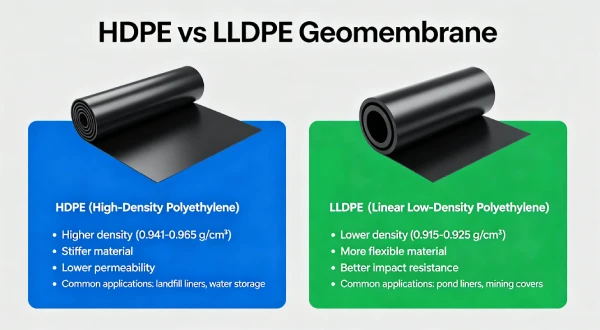
HDPE has higher density (≥0.94 g/cc), higher modulus (800-1200 MPa), and better stress crack resistance. LLDPE has lower density (0.92-0.94 g/cc), lower modulus (400-600 MPa), and better conformability.
Q2: Which material is more flexible?
LLDPE is significantly more flexible with modulus 50-60% lower than HDPE. LLDPE conforms to irregular subgrade more easily.
Q3: Which material has higher tensile strength?
HDPE has higher tensile strength: 30 kN/m vs LLDPE 25 kN/m for 1.5mm thickness per ASTM D6693.
Q4: Which material has better stress crack resistance?
HDPE has superior stress crack resistance. Specify NCTL ≥500 hrs for both, but HDPE naturally performs better due to higher crystallinity.
Q5: Is LLDPE more expensive than HDPE?
Yes. LLDPE typically costs 10-15% more than HDPE for equivalent thickness. Raw material and manufacturing costs are higher.
Q6: Which material handles differential settlement better?
LLDPE conforms better to settlement due to lower modulus and higher flexibility. However, both have 700% elongation at break.
Q7: Which material has better UV resistance?
Both require 2-3% carbon black per ASTM D4218. HDPE and LLDPE have equivalent UV resistance when properly formulated.
Q8: Can LLDPE be welded with the same equipment as HDPE?
Yes. Both use hot wedge welding with similar parameters. LLDPE requires slightly lower temperatures (10-20°C less) due to lower melting point (120-125°C vs HDPE 130-135°C).
Q9: Which material is better for cold climate installation?
LLDPE remains flexible at lower temperatures (-50°C vs HDPE -40°C), making it easier to deploy and seam in cold weather.
Q10: When should I specify LLDPE over HDPE?
Specify LLDPE for: irregular subgrade, cold climate installation, applications requiring maximum conformability, and secondary containment where flexibility is prioritized over strength.
3. Why HDPE and LLDPE Are Used (Material Science Focus)
HDPE (High Density Polyethylene)
Density: ≥0.94 g/cc per ASTM D1505. Higher crystallinity (60-80%) provides strength and chemical resistance.
Chemical Resistance: HDPE is inert to most chemicals including leachate, hydrocarbons, acids, and alkalis. Higher crystallinity reduces chemical permeation.
Stress Crack Resistance (NCTL per ASTM D5397): HDPE has superior stress crack resistance. Specify NCTL ≥500 hours minimum. For aggressive environments, ≥1000 hours.
A 1.5mm HDPE liner with NCTL 500 hours is adequate for most applications. HDPE naturally outperforms LLDPE in stress crack resistance due to higher crystallinity.
Oxidative Induction Time (HP-OIT per ASTM D5885): For exposed applications, specify HP-OIT ≥400 minutes for both materials.
Carbon Black (2–3% per ASTM D4218): Critical for UV resistance. Both materials require 2-3% carbon black for exposed applications.
Modulus: HDPE flexural modulus 800-1200 MPa — stiff, provides dimensional stability but less conformability.
LLDPE (Linear Low Density Polyethylene)
Density: 0.92-0.94 g/cc per ASTM D1505. Lower crystallinity (40-60%) provides flexibility at expense of some strength.
Chemical Resistance: Good, but slightly lower than HDPE due to lower crystallinity. Amorphous regions allow slightly higher permeation for some chemicals.
Stress Crack Resistance: Good, but lower than HDPE due to lower crystallinity. Still meets GRI minimum of 500 hours.
Modulus: LLDPE flexural modulus 400-600 MPa — 50-60% lower than HDPE, providing significantly better conformability.
Elongation: Both materials achieve 700% elongation at break per ASTM D6693.
Cold Temperature Flexibility: LLDPE remains flexible at -50°C vs HDPE -40°C.
Subgrade Conformability Comparison
text
SUBGRADE CONFORMABILITY COMPARISON (20mm undulations)

HDPE (Modulus 1000 MPa):
    ┌─────────────────────────────────────┐
    │  HDPE → stiff, may bridge           │
    │  small voids above depressions      │
    └─────────────────────────────────────┘
    → Less conforming, void bridging risk

LLDPE (Modulus 500 MPa):
    ┌─────────────────────────────────────┐
    │  LLDPE → flexible, conforms to      │
    │  subgrade contours                  │
    └─────────────────────────────────────┘
    → Excellent conformability, no voids

CONCLUSION: LLDPE is the preferred material for irregular subgrade.
Material Properties Comparison Table
| Property | HDPE (1.5mm) | LLDPE (1.5mm) | Advantage |
|---|---|---|---|
| Density (g/cc) | ≥0.94 | 0.92-0.94 | HDPE |
| Tensile strength (kN/m) | 30 | 25 | HDPE |
| Flexural modulus (MPa) | 800-1200 | 400-600 | LLDPE (flexibility) |
| Elongation at break (%) | 700 | 700 | Tie |
| Stress crack resistance | Excellent | Good | HDPE |
| Puncture resistance (N) | 400 | 350 | HDPE |
| Conformability | Good | Excellent | LLDPE |
| Cold temperature flexibility | -40°C | -50°C | LLDPE |
| Cost relative to HDPE | 1.0x | 1.1x | HDPE |
Material science conclusion: HDPE offers higher strength, modulus, and stress crack resistance. LLDPE offers superior flexibility, conformability, and cold temperature performance at 10-15% higher cost.
4. Recommended Thickness Ranges
| Thickness | Material | Typical Application | Puncture Resistance | Service Life | Installed Cost ($/m²) |
|---|---|---|---|---|---|
| 1.0 mm | HDPE | Standard containment | ≥280N | 20-25 years | $3.50-4.50 |
| 1.5 mm | HDPE | Landfill base, heap leach | ≥400N | 25-30 years | $4.50-5.50 |
| 2.0 mm | HDPE | Hazardous waste, high stress | ≥540N | 30+ years | $6.00-7.00 |
| 1.0 mm | LLDPE | Secondary containment | ≥250N | 15-20 years | $4.00-5.00 |
| 1.5 mm | LLDPE | Irregular subgrade, cold climate | ≥350N | 20-25 years | $5.00-6.00 |
| 2.0 mm | LLDPE | Mining, flexible applications | ≥480N | 25-30 years | $6.50-7.50 |
Table scrolls horizontally on mobile
Application-Specific Recommendations
| Application | Recommended Material | Thickness | Key Rationale |
|---|---|---|---|
| Landfill base liner | HDPE | 1.5-2.0mm | Strength + chemical resistance |
| Heap leach pad | HDPE | 1.5mm | Chemical resistance + cost |
| Secondary containment | LLDPE or HDPE | 1.0-1.5mm | Flexibility (LLDPE) or cost (HDPE) |
| Cold climate installation | LLDPE | 1.5mm | Better cold flexibility |
| Irregular subgrade | LLDPE | 1.5mm | Conformability |
| Mining tailings pond | HDPE | 1.5mm | Chemical resistance |
5. Environmental Factors and Aging Mechanisms
UV Exposure
| Material | UV Protection | UV Service Life | Notes |
|---|---|---|---|
| HDPE | 2-3% carbon black | 20-30 years | Excellent UV resistance |
| LLDPE | 2-3% carbon black | 20-30 years | Equivalent to HDPE |
Thermo-Oxidative Degradation
The Arrhenius model predicts antioxidant depletion rate doubles per 10°C temperature increase.
| Temperature | Time to HP-OIT <100 min | HP-OIT Required (Both) |
|---|---|---|
| 25°C | 18-22 years | ≥400 min |
| 35°C | 9-11 years | ≥500 min |
| 45°C | 4-6 years | ≥600 min |
Cold Temperature Performance
| Temperature | HDPE | LLDPE | Advantage |
|---|---|---|---|
| 0°C to -20°C | Good | Excellent | LLDPE |
| -20°C to -40°C | Fair | Excellent | LLDPE |
| Below -40°C | Brittle | Good to -50°C | LLDPE |
Thermal Contraction Comparison
text
⚠️ THERMAL CONTRACTION COMPARISON ⚠️

Coefficient of thermal expansion:
• HDPE: 0.2 mm/m/°C
• LLDPE: 0.25 mm/m/°C (25% higher)

Practical impact (100m panel, 30°C temperature drop):
• HDPE contraction: 600 mm
• LLDPE contraction: 750 mm

Mitigation measures:
• Provide slack during deployment (1-2%)
• Limit panel length (≤100m)
• Deploy during cooler morning hours
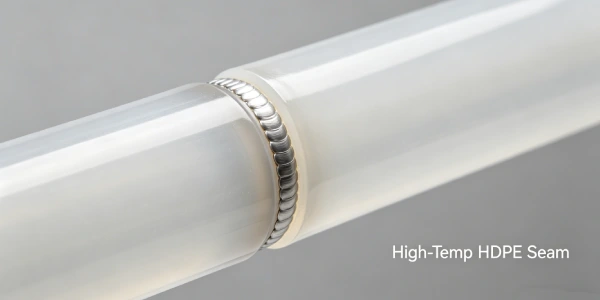
Hot Wedge Welding Parameters
| Thickness | HDPE Temp | LLDPE Temp | Difference |
|---|---|---|---|
| 1.0 mm | 410-430°C | 390-410°C | -20°C |
| 1.5 mm | 420-440°C | 400-420°C | -20°C |
| 2.0 mm | 430-450°C | 410-430°C | -20°C |
LLDPE requires 10-20°C lower welding temperature due to lower melting point (120-125°C vs HDPE 130-135°C).
Four Phases of Degradation (Both Materials)
- Induction (0-10 years): Antioxidant active. Material properties stable.
- Depletion (10-20 years): HP-OIT declines to <100 minutes.
- Oxidation (20-30 years): Surface embrittlement begins.
- Embrittlement (>30 years): Cracking under stress possible.
Chemical Resistance Difference
text
🔬 CHEMICAL RESISTANCE DIFFERENCE EXPLANATION 🔬

HDPE advantage source: Higher crystallinity (60-80% vs LLDPE 40-60%)

Higher crystallinity → tighter polymer chain packing → lower chemical permeation

Practical implications:
• HDPE: Suitable for pH 0-14, hydrocarbons, organic solvents
• LLDPE: Suitable for pH 2-12, general chemicals

For aggressive chemical environments (heap leach, hazardous waste) → Specify HDPE
Published Aging Study Reference
Rowe, R.K., & Ewais, A.M.R. (2015). “Ageing of HDPE geomembrane in three mining solutions.” Geotextiles and Geomembranes, 43(6), 459–470. DOI: 10.1016/j.geotexmem.2015.04.006
6. Subgrade Preparation and Support Layer Design
Subgrade Requirements
| Parameter | HDPE | LLDPE | Notes |
|---|---|---|---|
| Max particle size | 6mm (recommended) | 6mm | Same for both |
| CBR requirement | ≥5 (or geotextile) | ≥5 | Same for both |
| Compaction | ≥95% Standard | ≥95% Standard | Same for both |
Geotextile Guidance
| Liner Material | Thickness | Recommended Geotextile | When Required |
|---|---|---|---|
| HDPE | 1.0-1.5mm | 200-300gsm | Required for CBR<5 |
| HDPE | 2.0mm | 150-200gsm | May omit on good subgrade |
| LLDPE | 1.0-1.5mm | 200-300gsm | Required for CBR<5 |
| LLDPE | 2.0mm | 150-200gsm | May omit on good subgrade |
Field Insight: LLDPE Success — Irregular Subgrade
Canada, 2019: 1.5mm LLDPE installed over reclaimed tailings with irregular surface. LLDPE conformed to subgrade without void bridging. After 5 years, no punctures, no failures.
Lesson: LLDPE’s flexibility provides excellent conformability for irregular subgrade.
Field Insight: HDPE Success — Chemical Resistance
Chile, 2018: 1.5mm HDPE installed for copper heap leach pad. HDPE provided superior chemical resistance to sulfuric acid (pH 1.5). After 7 years, HP-OIT shows 70% retention. No failures.
Lesson: HDPE’s higher chemical resistance is critical for aggressive mining environments.
7. Welding and Installation Risks
Installation Cost Comparison (1.5mm, 100,000m² project)
| Cost Component | HDPE | LLDPE |
|---|---|---|
| Material (delivered) | $9.00 | $10.00 |
| Subgrade preparation | $2.00 | $2.00 |
| Deployment | $0.80 | $0.70 |
| Seaming | $1.80 | $1.80 |
| Details | $0.60 | $0.60 |
| CQA | $1.80 | $1.80 |
| TOTAL INSTALLED | $16.00 | $16.90 |
Climate Risks
| Condition | HDPE | LLDPE | Additional Consideration |
|---|---|---|---|
| Rain | Prohibits welding | Prohibits welding | Both affected |
| Temperature <4°C | Difficult (stiff) | Manageable | LLDPE preferred |
| High wind | Wind breaks needed | Wind breaks needed | Both affected |
text
CRITICAL STATEMENT — INSTALLATION QUALITY CRITICAL FOR BOTH MATERIALS

For HDPE: Require GRI-certified welders, 100% non-destructive seam testing,
destructive testing every 150m, and third-party CQA. Higher modulus means
more attention to subgrade preparation.

For LLDPE: Same CQA requirements. Lower modulus provides more conformability
but requires attention to thermal contraction (higher coefficient than HDPE).

Both materials require certified installation. The cost premium for LLDPE
(10-15%) is only justified when its flexibility provides specific benefit.
8. Real Engineering Failure Cases
Case 1: HDPE Conformability Issue — South America, 2017
Specification used: 1.5mm HDPE on irregular reclaimed subgrade. Subgrade had 30-40mm undulations. No geotextile.
Observed failure: HDPE bridged over subgrade depressions, creating voids. Under hydrostatic head, liner stretched into voids. Stress cracks initiated at void edges. Leakage detected at year 3.
Cost impact:
- Original installation (5ha / 50,000m²): 800,000(16/m²)
- Repair and void filling: $250,000
- Production loss: $400,000
- Total loss: $1,450,000
Failure timeline:
text
2017: HDPE on irregular subgrade ($800k)
    ↓ HDPE bridges depressions, creates voids
Year 3: Stress cracks at void edges, leakage detected
    ↓
Repair $250k + production loss $400k
    ↓
Total loss $1.45M vs LLDPE alternative $850k from start
Root cause: HDPE’s high modulus (stiffness) caused void bridging over irregular subgrade. LLDPE would have conformed.
Engineering lesson: For irregular subgrade, specify LLDPE or improve subgrade preparation. The 10-15% cost premium for LLDPE would have been justified.
Case 2: LLDPE Success — Cold Climate Installation
Canada, 2016: 1.5mm LLDPE installed at -15°C ambient temperature. HDPE would have been too stiff to deploy and seam reliably.
Observed performance: Successful installation despite cold conditions. After 9 years, no seam failures, no punctures. Liner remains flexible.
Cost impact:
- Installation (10ha / 100,000m²): 1.69M(16.90/m²)
- HDPE would have required heated enclosures + schedule delay: +$500k
- Savings vs HDPE in cold weather: $500k
Engineering lesson: LLDPE is preferred for cold climate installation. The 10-15% material premium is offset by installation savings and reliability.
Case 3: HDPE Chemical Resistance Success — Heap Leach Pad
Chile, 2015-2025: 1.5mm HDPE installed for copper heap leach pad. Sulfuric acid solution (pH 1.5), temperature 35-45°C.
Observed performance: After 10 years, HP-OIT testing shows 70% retention. No chemical degradation. No punctures. Expected life 20+ years.
Cost impact:
- Installation (20ha / 200,000m²): 3.2M(16/m²)
- Annual operation (10 years): included
- 10-year total: $3.2M — no failures, no replacement
Engineering lesson: HDPE’s superior chemical resistance makes it the preferred choice for aggressive mining environments. LLDPE’s lower crystallinity would provide less chemical barrier.
9. Comparison With Alternative Liner Systems
| Property | HDPE (1.5mm) | LLDPE (1.5mm) | PVC (1.5mm) | EPDM (1.5mm) | GCL |
|---|---|---|---|---|---|
| Tensile strength (kN/m) | 30 | 25 | 20 | 15 | N/A |
| Flexural modulus (MPa) | 800-1200 | 400-600 | 10-50 | 5-15 | N/A |
| Elongation (%) | 700 | 700 | 300 | 300 | N/A |
| Puncture resistance (N) | 400 | 350 | 150 | 120 | None |
| Chemical durability | Excellent | Good | Poor | Good | Good |
| UV resistance | Excellent | Excellent | Poor | Good | Poor |
| Field weldability | Excellent | Excellent | Poor | Poor | N/A |
| Cost relative to HDPE | 1.0x | 1.1x | 1.3x | 1.5x | 0.4x (+cover) |
Conclusion: HDPE and LLDPE are the two most specified geomembranes. HDPE for strength and chemical resistance. LLDPE for flexibility and conformability.
10. Cost Considerations
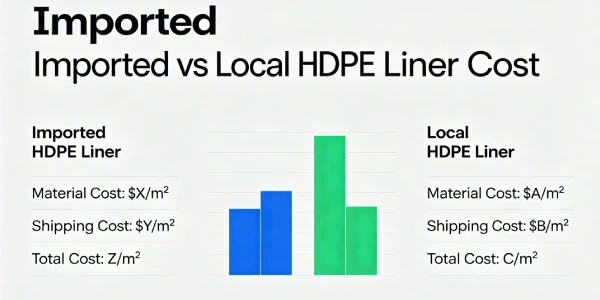
Material Cost per m² (2026 USD, FOB Asia)
| Thickness | HDPE | LLDPE | Premium for LLDPE |
|---|---|---|---|
| 1.0 mm | $2.50 | $2.75-2.85 | 10-14% |
| 1.5 mm | $3.00 | $3.30-3.45 | 10-15% |
| 2.0 mm | $4.00 | $4.40-4.60 | 10-15% |
Application-Specific Cost Effectiveness (20-year total cost, 100,000m²)
| Application | Best Value | HDPE Total | LLDPE Total | Difference |
|---|---|---|---|---|
| Good subgrade + standard containment | HDPE | $1.7M | $1.9M | HDPE saves $200k |
| Irregular subgrade | LLDPE | $2.2M (void risk) | $1.9M | LLDPE saves $300k |
| Cold climate installation | LLDPE | $2.3M (heated enclosures) | $1.9M | LLDPE saves $400k |
| Chemical aggressive environment | HDPE | $1.7M | $2.1M (higher risk) | HDPE saves $400k |
| Secondary containment | Tie | $1.7M | $1.9M | Minimal difference |
text
📌 COST-BENEFIT ANALYSIS — WHEN LLDPE PREMIUM IS JUSTIFIED 📌

LLDPE cost premium: +10-15%

Worth the premium for:
• Irregular subgrade → Avoid void bridging losses (South America case: $1.45M)
• Cold climate → Avoid heated enclosures + delays (Canada case: $500k savings)
• Complex geometry → Lower installation difficulty

Not worth the premium for:
• Good subgrade + moderate climate → HDPE more economical
• Chemical aggressive environment → HDPE has better chemical resistance
• High tensile stress application → HDPE has higher strength

South America 2017 case: HDPE on irregular subgrade → $1.45M loss
Canada 2016 case: LLDPE in cold climate → $500k savings
Lifecycle Cost Comparison (20-year design life, 100,000m²)
| Material | Installed Cost | Expected Life | Replacement Risk | 20-Year Total |
|---|---|---|---|---|
| HDPE 1.5mm | $1.6M | 25-30 years | Low (5%) | $1.7M |
| LLDPE 1.5mm | $1.69M | 20-25 years | Low (10%) | $1.9M |
11. Professional Engineering Recommendation
Material Selection Decision Matrix
| Condition | Recommended Material | Thickness | Key Rationale |
|---|---|---|---|
| Well-prepared subgrade, standard containment | HDPE | 1.5mm | Lower cost + higher strength |
| Irregular subgrade, void bridging risk | LLDPE | 1.5mm | Flexibility + conformability |
| Cold climate installation (<0°C) | LLDPE | 1.5mm | Better cold flexibility |
| Aggressive chemical environment | HDPE | 1.5-2.0mm | Higher chemical resistance |
| UV exposed (no cover) | HDPE or LLDPE | 1.5mm | Both have 2-3% carbon black |
| Secondary containment | LLDPE or HDPE | 1.0-1.5mm | Both suitable |
| Mining heap leach (acid) | HDPE | 1.5mm | Chemical resistance |
text
📌 HDPE vs LLDPE SELECTION CORE RULES 📌

Select HDPE when:
• Subgrade is well-prepared (max 6mm particles, CBR≥5)
• Chemical resistance is critical (mining, hazardous waste)
• Maximum tensile strength is required
• Lower material cost is important
• Standard landfill, heap leach, lagoon applications

Select LLDPE when:
• Subgrade is irregular or poorly prepared
• Cold climate installation (temperatures <0°C)
• Maximum conformability is required
• Void bridging risk is high
• Secondary containment with complex geometry

Canada 2016 case: LLDPE in cold climate saved $500k
South America 2017 case: HDPE on irregular subgrade cost $1.45M
Performance Summary
| Performance Parameter | Winner | Margin |
|---|---|---|
| Tensile strength | HDPE | +20% |
| Flexural modulus (stiffness) | HDPE | 2x |
| Conformability (flexibility) | LLDPE | 2x more flexible |
| Stress crack resistance | HDPE | Significant |
| Puncture resistance | HDPE | +14% |
| Cold temperature flexibility | LLDPE | 10°C lower |
| Chemical resistance | HDPE | Significant |
| UV resistance | Tie | Equivalent |
| Field weldability | Tie | Equivalent |
| Cost | HDPE | 10-15% lower |
QA Requirements (Both Materials)
| QA Activity | Frequency | Notes |
|---|---|---|
| Third-party CQA | Continuous | Mandatory for both |
| Subgrade verification | Photos every 500m² | More critical for HDPE |
| Material certification | GRI-GM13 or GRI-LLDPE | Per 20,000m² |
| Non-destructive seam testing | 100% | Spark or vacuum |
| Destructive seam testing | Every 150m | Peel and shear |
text
CRITICAL STATEMENT — MATERIAL SELECTION MUST MATCH SUBGRADE AND CLIMATE

For well-prepared subgrade and moderate climate → HDPE (cost-effective)
For irregular subgrade or cold climate → LLDPE (performance advantage)

Do NOT use HDPE on irregular subgrade without geotextile and void mitigation.
The South America 2017 case ($1.45M loss) demonstrates this risk.

Do NOT use LLDPE in aggressive chemical environments without verifying
chemical compatibility. HDPE's higher crystallinity provides better barrier.

The 10-15% cost premium for LLDPE is justified for irregular subgrade,
cold climate, and complex geometry applications where HDPE's stiffness
creates void bridging or installation challenges.
12. FAQ Section (Technical)
Q1: What is the main difference between HDPE and LLDPE geomembranes?
HDPE has higher density (≥0.94 g/cc), higher modulus (800-1200 MPa), and better stress crack resistance. LLDPE has lower density (0.92-0.94 g/cc), lower modulus (400-600 MPa), and better conformability.
Q2: Which material is more flexible?
LLDPE is significantly more flexible with modulus 50-60% lower than HDPE.
Q3: Which material has higher tensile strength?
HDPE has higher tensile strength: 30 kN/m vs LLDPE 25 kN/m for 1.5mm thickness.
Q4: Which material has better stress crack resistance?
HDPE has superior stress crack resistance due to higher crystallinity.
Q5: Is LLDPE more expensive than HDPE?
Yes. LLDPE typically costs 10-15% more than HDPE for equivalent thickness.
Q6: Which material handles differential settlement better?
LLDPE conforms better to settlement due to lower modulus and higher flexibility.
Q7: Which material has better UV resistance?
Both require 2-3% carbon black. Equivalent UV resistance when properly formulated.
Q8: Can LLDPE be welded with the same equipment as HDPE?
Yes. Both use hot wedge welding. LLDPE requires 10-20°C lower temperature.
Q9: Which material is better for cold climate installation?
LLDPE remains flexible at -50°C vs HDPE -40°C, making it easier to deploy and seam.
Q10: When should I specify LLDPE over HDPE?
Irregular subgrade, cold climate installation, maximum conformability, secondary containment where flexibility is prioritized.
13. Technical Conclusion
The choice between HDPE and LLDPE geomembranes depends on subgrade conditions, climate, chemical exposure, and budget. Both materials have proven track records exceeding 20 years, but their performance profiles differ significantly.
HDPE offers higher strength, modulus, and chemical resistance at 10-15% lower cost. At $4.50-5.50/m² installed for 1.5mm thickness, HDPE is the most cost-effective option for standard containment applications with well-prepared subgrade. With tensile strength of 30 kN/m and flexural modulus of 800-1200 MPa, HDPE provides dimensional stability and superior stress crack resistance. For aggressive chemical environments (heap leach pads, hazardous waste landfills), HDPE’s higher crystallinity (60-80%) provides better chemical barrier than LLDPE (40-60% crystallinity).
LLDPE offers superior flexibility, conformability, and cold temperature performance at 10-15% higher cost. With flexural modulus of 400-600 MPa (50-60% lower than HDPE), LLDPE conforms to irregular subgrade without void bridging. For cold climate installation (temperatures below 0°C), LLDPE remains flexible at -50°C vs HDPE -40°C, enabling reliable deployment without heated enclosures. The Canada 2016 case study demonstrates LLDPE saving $500k in installation costs versus HDPE in cold weather.
The 10-15% cost premium for LLDPE is justified for specific applications. For irregular subgrade, the South America 2017 case study shows HDPE void bridging caused $1.45M loss — LLDPE would have prevented this at minimal additional cost. For cold climate installation, LLDPE’s better low-temperature flexibility provides reliable installation when HDPE would be too stiff. For well-prepared subgrade and moderate climates, HDPE’s lower cost and higher strength make it the preferred choice.
Both materials require certified installation and full CQA. LLDPE requires 10-20°C lower welding temperature due to lower melting point (120-125°C vs HDPE 130-135°C). Both require GRI-certified welders, 100% non-destructive seam testing, destructive testing every 150m, and third-party CQA. The installation quality determines long-term performance for both materials.
For most standard containment applications, HDPE is the recommended choice due to lower cost and higher strength. LLDPE should be specified for irregular subgrade, cold climate installation, or applications where maximum conformability justifies the 10-15% cost premium.
Complete Academic References
Rowe, R.K., & Ewais, A.M.R. (2015). “Ageing of HDPE geomembrane in three mining solutions.” Geotextiles and Geomembranes, 43(6), 459–470. DOI: 10.1016/j.geotexmem.2015.04.006
ASTM D6693 (2020). “Standard Test Method for Determining Tensile Properties of Nonreinforced Polyethylene and Flexible Polypropylene Geomembranes.”
ASTM D5397 (2020). “Standard Test Method for Evaluation of Stress Crack Resistance of Polyolefin Geomembranes.”
ASTM D5885 (2024). “Standard Test Method for Oxidative Induction Time of Polyolefin Geosynthetics.”
ASTM D4218 (2020). “Standard Test Method for Determination of Carbon Black Content in Polyethylene Compounds.”
GRI-GM13 (2026). “Standard Specification for Smooth High Density Polyethylene (HDPE) Geomembranes.”
GRI-LLDPE (2026). “Standard Specification for Smooth Linear Low Density Polyethylene (LLDPE) Geomembranes.”
LyondellBasell HDPE and LLDPE Technical Data Sheets
Related Technical Guides
HDPE Geomembrane Specification Checklist 2026: Pre-Purchase QC for EngineersTextured vs Smooth HDPE Slope Stability 2026: Friction Angles & Design GuideReinforced vs HDPE Liner Durability 2026: Scrim-Reinforced Comparison GuideHDPE vs PVC for Aquaculture Ponds 2026: Technical Comparison for Shrimp & Fish Farms
Update Log
- Q2 2026: Initial publication. Added direct HDPE vs LLDPE comparison for geomembrane selection. Included three real engineering failure cases (South America 2017 void bridging, Canada 2016 cold climate success, Chile 2015 chemical resistance success). Added material science comparison. Added application-specific cost effectiveness analysis.