Best Liner Spec for Gold Mine Tailings Pond
Application Guide 2026-05-23
What is Best Liner Specification for Gold Mine Tailings Pond Containment
The question of best liner specification for gold mine tailings pond containment is a critical engineering decision that directly impacts environmental compliance, process water recovery, and long-term liability management. A tailings pond liner is a geomembrane barrier system installed beneath and around gold mine tailings storage facilities (TSFs) to prevent cyanide-laden process water, heavy metals (arsenic, mercury, lead), and acid-forming sulfides from migrating into groundwater or surrounding ecosystems.
In industry context, this specification involves selecting the appropriate geomembrane resin (HDPE, LLDPE, or VLDPE), thickness (1.5 mm to 2.5 mm), surface texture, and chemical additive package. For EPC contractors and procurement managers working on gold mine projects, the wrong liner specification can result in catastrophic failure within 3–5 years due to oxidative degradation, environmental fines exceeding $50 million, and permanent loss of mining license.
Why does this matter for engineering and procurement? Gold tailings contain cyanide (typically 50–200 ppm), residual flotation reagents, and extreme pH ranges (2.5–11.5 depending on ore type). The liner must resist chemical attack, survive seismic loading, maintain flexibility at remote site temperatures (-30°C to +50°C), and provide a service life of 30+ years. This guide provides the technical framework to specify the correct liner based on GRI-GM13, ASTM D7000, and real project data from operating gold mines.
Technical Specifications of Best Liner Specification for Gold Mine Tailings Pond Containment
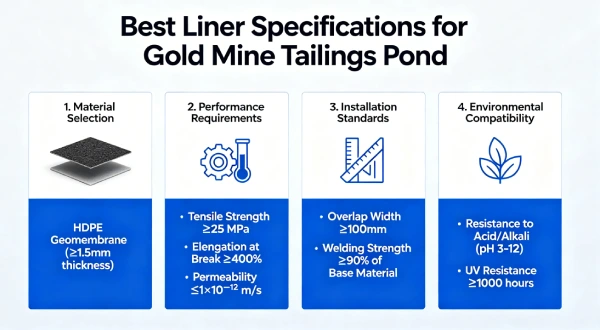
When evaluating best liner specification for gold mine tailings pond containment, engineers must review these key parameters. Below is the typical specification for a high-performance HDPE geomembrane used in gold tailings service.
| Parameter | Typical Value | Engineering Importance |
|---|---|---|
| Geomembrane thickness | 1.5 mm (60 mil) or 2.0 mm (80 mil) | Thicker film provides puncture resistance from underlying rock and overlying tailings solids (specific gravity 1.3–1.8). |
| Density | ≥0.94 g/cm³ (HDPE) | Higher density improves chemical resistance to cyanide and organic reagents. LLDPE (0.92 g/cm³) is less resistant. |
| Tensile strength at yield | ≥27 kN/m (ASTM D6693) | Ensures liner withstands settlement of tailings (up to 10% of total volume over 10 years). |
| Elongation at break | ≥700% (ASTM D6693) | Critical for accommodating differential settlement in soft foundation soils. |
| Carbon black content | 2.0–3.0% (ASTM D1603) | UV protection for exposed pond berms and slopes during construction. |
| Oxidative Induction Time (OIT) | Standard OIT ≥100 min; HP-OIT ≥400 min (ASTM D3895) | Measures antioxidant package. For cyanide environments, specify HP-OIT ≥500 min. |
| Chemical resistance | Pass ASTM D5747 (90 days at 50°C in synthetic tailings solution) | Must show no more than 25% property degradation in cyanide solution (100 ppm NaCN, pH 10.5). |
| Puncture resistance | ≥400 N (ASTM D4833) | Prevents failure from angular rock in subgrade or tailings sand. |
| Service life (design) | 30–50 years (modeled) | Based on antioxidant depletion and Arrhenius modeling. Actual field data from 1990s gold mines shows 25+ years. |
Standards referenced: GRI-GM13 (HDPE geomembrane), ASTM D7000 (seam testing), ISO 13438 (puncture), Australian Standard AS 3706.2 (geotextile interface).
Material Structure and Composition
Understanding the layered system is essential to identifying best liner specification for gold mine tailings pond containment. A complete tailings pond containment system includes multiple engineered layers.
| Layer / Component | Material | Function |
|---|---|---|
| Protective cover (top) | Geotextile (non-woven, 300–500 g/m²) or 150 mm sand | Prevents puncture from tailings discharge pipes and maintenance equipment. |
| Primary geomembrane | HDPE (1.5–2.5 mm), textured on slopes (≥10:1), smooth on base | Primary hydraulic barrier; resists cyanide, heavy metals, and pH extremes. |
| Leak detection layer (optional) | Geonet or 50 mm sand with drain pipe | Intercepts and collects any leakage through primary liner; required for high-consequence TSFs. |
| Secondary geomembrane (double-lined) | HDPE (1.0–1.5 mm) | Backup barrier for cyanide tailings in jurisdictions requiring double lining (e.g., Nevada, Chile, Western Australia). |
| Cushion layer | Geotextile (non-woven, 200 g/m²) | Protects geomembrane from subgrade rock points. |
| Subgrade preparation | Compacted clay or engineered fill (≥95% Standard Proctor) | Provides stable foundation; removes stones >25 mm. |
Engineering impact of each layer:
- Textured geomembrane on slopes: Required when slope gradient exceeds 1V:3H. Friction angle must be ≥25° (ASTM D5321 interface testing between geomembrane and overlying tailings).
- Double liner systems: Mandatory for gold tailings with cyanide >50 ppm under ICMM (International Council on Mining and Metals) guidelines and many national regulations (e.g., Chile DS 248, Nevada NAC 445A).
- Leak detection layer: Provides early warning. Typical detection sensitivity: 10 L/ha/day. Must be sloped (≥1%) to collection sump.
Manufacturing Process of HDPE Geomembrane for Gold Tailings
To specify best liner specification for gold mine tailings pond containment, engineers must understand how the geomembrane is manufactured. Each step affects chemical resistance and service life.
- Raw material preparation: Virgin HDPE resin (100% virgin, no post-consumer recycled content) is blended with carbon black (2–3%), primary antioxidant (hindered phenol), secondary antioxidant (phosphite), and UV stabilizers. Why it matters: Cyanide solutions accelerate antioxidant depletion. HP-OIT (high-pressure OIT) ≥500 minutes requires specific antioxidant packages.
- Extrusion forming: Melted compound (200–230°C) is extruded through a flat die onto a polished chill roll, creating continuous sheet of 1.5–3.0 mm thickness. Why it matters: Chill roll temperature (30–50°C) controls crystallinity (target 50–65%). Higher crystallinity improves chemical resistance but reduces flexibility.
- Surface texturing (for slope applications): For textured sheets, nitrogen gas is injected during extrusion or embossing rolls are used. Asperity height must be ≥0.25 mm (ASTM D7466). Why it matters: Low asperity height reduces interface friction, causing slope failure when tailings are deposited.
- Precision winding and edge trimming: Sheets are wound onto steel cores with edge profiles prepared for field welding. Factory-cut edges must be clean (no delamination). Why it matters: Poor edge preparation causes field seam failures—the #1 failure mode in tailings ponds.
- Quality inspection: Every roll undergoes:
- Thickness measurement (every 5 linear meters, tolerance ±10%)
- Standard OIT and HP-OIT (every 10,000 m²)
- Density (ASTM D1505)
- Carbon black dispersion (ASTM D5596) — no agglomerates >100 µm
- Tensile properties (ASTM D6693)
Why it matters: HP-OIT below 400 minutes indicates inadequate antioxidant protection for cyanide service.
- Packaging and labeling: Rolls are wrapped in white UV-reflective plastic and labeled with lot number, date, HP-OIT value, and thickness. Rolls must be stored on end, not flat, to prevent deformation. Why it matters: Traceability allows root-cause analysis if failures occur. White plastic reduces heat buildup during storage.
Performance Comparison with Alternative Materials
Direct comparison clarifies best liner specification for gold mine tailings pond containment among available options.
| Material | Durability (cyanide environment) | Cost level | Installation complexity | Maintenance | Typical applications |
|---|---|---|---|---|---|
| HDPE (2.0 mm, HP-OIT ≥500) | Very high (30–50 years) | High ($25–45/m²) | High (requires certified welding) | Low (annual inspection) | Primary liner for large gold tailings (Nevada, WA, Chile) |
| LLDPE (1.5 mm) | Medium (10–15 years) | Medium ($20–30/m²) | Medium (more flexible, easier welding) | Medium (more prone to puncture) | Small tailings ponds, temporary facilities |
| PVC geomembrane | Low (3–7 years) | Low ($15–25/m²) | Low (solvent welding) | High (plasticizer migration, becomes brittle) | Not recommended for cyanide — plasticizer leaches |
| Bituminous geomembrane | Low (2–5 years) | Low ($10–20/m²) | Low (sprayed) | High (oxidation, cracking) | Rejected by most mining regulators |
| Compacted clay liner (CCL) | Medium (10–20 years) | Low ($10–20/m²) | Medium (requires suitable clay source) | High (desiccation cracks, root penetration) | Arid regions only; not for cyanide without geomembrane |
Conclusion for engineers: For any gold tailings pond containing cyanide (the majority of modern gold processing), specify HDPE with HP-OIT ≥500 minutes, thickness ≥1.5 mm (2.0 mm preferred), and GRI-GM13 compliance. LLDPE is acceptable only for short-term (≤10 years) or non-cyanide tailings.
Industrial Applications of Best Liner Specification for Gold Mine Tailings Pond Containment
Real-world applications for best liner specification for gold mine tailings pond containment include:
- Large-scale gold mines (open pit): Nevada Gold Mines (Carlin Trend, USA) – 2.0 mm HDPE, double-lined, with leak detection. Tailings volume: 200,000 tonnes/day. Liner system cost: $15 million, but prevented an estimated $500 million in potential environmental liability.
- High-altitude gold mines: Yanacocha (Peru, 4,700 m elevation) – 1.5 mm HDPE with enhanced UV package. Extreme UV radiation (4,000+ hours/year) requires carbon black 2.5–3.0%. Installed 2005, still performing after 19 years.
- Cold climate gold mines: Detour Lake (Ontario, Canada, -40°C winter) – 2.0 mm HDPE with low-temperature impact resistance tested at -50°C (ASTM D746). Standard HDPE becomes brittle below -30°C.
- Acid-generating tailings (sulfide ores): Porgera Gold Mine (Papua New Guinea) – 2.5 mm HDPE with enhanced antioxidant package. pH of tailings: 2.8–3.5 due to pyrite oxidation. Standard HDPE would degrade in 5–7 years; enhanced package extends to 25+ years.
- EPC contractor projects: Many EPC firms (Bechtel, Fluor, Ausenco) now specify 2.0 mm HDPE with HP-OIT ≥500 as minimum standard for all gold tailings projects, regardless of local regulatory requirements.
Common Industry Problems and Engineering Solutions
Engineers who fail to identify best liner specification for gold mine tailings pond containment encounter these field failures:
Problem 1: Antioxidant depletion from cyanide exposure
- Root cause: Cyanide solutions (NaCN, KCN) act as free radical initiators, accelerating antioxidant consumption. Standard OIT (100 min) depletes in 3–5 years.
- Solution: Specify HP-OIT (high-pressure OIT) ≥500 minutes. HP-OIT tests antioxidant performance under oxygen pressure (3.5 MPa), simulating aggressive chemical environments.
Problem 2: Seam failure due to poor weld preparation
- Root cause: Moisture, dust, or oil on geomembrane surfaces before extrusion welding. Field audits show 30% of seams fail due to contamination.
- Solution: Mandate pre-weld cleaning with isopropyl alcohol. Conduct 100% non-destructive seam testing (spark test or vacuum box) plus destructive shear/peel tests every 200 m of seam.
Problem 3: Puncture from angular tailings sand
- Root cause: Overlying tailings sand (deposited hydraulically) contains angular quartz particles (Mohs hardness 7) that puncture geomembrane under 20+ m of tailings pressure.
- Solution: Install 300 g/m² non-woven geotextile protective layer directly over geomembrane before tailings deposition. Specify puncture resistance ≥400 N.
Problem 4: Slope instability during tailings rise
- Root cause: Smooth geomembrane on slopes creates low friction interface with overlying tailings. Slopes >1V:3H fail when tailings rise above 10 m.
- Solution: Use textured geomembrane (asperity height ≥0.25 mm) on all slopes ≥1V:4H. Verify interface friction angle via ASTM D5321 testing (target ≥25°).
Problem 5: UV degradation during construction delays
- Root cause: Exposed geomembrane left uncovered for >30 days in high-UV environments (e.g., Chile, Peru, Australia). Carbon black only provides protection for limited duration.
- Solution: Limit exposed duration to 21 days. Use temporary cover (sand or geotextile) after 14 days. Specify carbon black content 2.5–3.0% for high-UV sites.
Risk Factors and Prevention Strategies
When determining best liner specification for gold mine tailings pond containment, mitigate these risks:
| Risk | Prevention strategy |
|---|---|
| Improper installation (seam failure) | Require certified welding technicians (IAGI, NILE, or equivalent). Conduct 100% seam testing. Third-party CQA inspection at all phases. |
| Material mismatch (HDPE vs. LLDPE) | Never mix HDPE and LLDPE in same pond—different melt temperatures (220°C vs. 190°C) prevent proper welding. Use single resin type throughout. |
| Environmental exposure (cyanide, UV, freeze-thaw) | Specify HP-OIT ≥500 for cyanide. Limit UV exposure to 21 days. For freeze-thaw zones, require low-temperature impact testing at -50°C. |
| Subgrade preparation issues | Proof-roll subgrade with 20-ton vibratory roller. Remove all stones >25 mm. Install 200 g/m² geotextile cushion over prepared subgrade. |
| Chemical attack from low pH (acid drainage) | For pH <4.0, specify 2.5 mm thickness and enhanced antioxidant package. Perform 90-day chemical immersion test (ASTM D5747) using actual site tailings solution. |
| Seismic damage (earthquake zones) | For seismic zones (PGA >0.3g), increase thickness to 2.5 mm and reduce panel size (maximum 50 m × 50 m) to limit differential movement. |
Professional mitigation: Develop a Construction Quality Assurance (CQA) plan following GRI-GM27 (CQA of Geomembrane Installations). Third-party CQA firm must be independent of the installer and supplier.
Procurement Guide: How to Choose the Right Liner Specification
Procurement managers need a repeatable process for identifying best liner specification for gold mine tailings pond containment. Use this checklist:
- Tailings chemistry evaluation: Obtain representative tailings sample (including process water). Test pH, cyanide concentration (total and weak-acid dissociable), sulfide content, and temperature. Cyanide >20 ppm requires HP-OIT ≥500.
- Specification verification: Compare supplier’s data sheet against GRI-GM13 (HDPE) or GRI-GM17 (LLDPE). Request HP-OIT value — must be ≥500 minutes for cyanide service.
- Certifications required: ISO 9001:2015 for manufacturing. NSF/ANSI 54 if potable water contact possible. GRI-GM13 compliance certification. For Australia, AS 3706.2 compliance.
- Supplier capability audit: Request factory audit report. Verify:
- Automated thickness gauging (every 5 m)
- HP-OIT testing capability (in-house or third-party)
- Minimum 5 years of mining geomembrane supply references
- No major quality failures in past 3 years (request supplier’s quality non-conformance log)
- Quality control documentation: Supplier must provide lot-specific reports including:
- HP-OIT (ASTM D3895)
- Standard OIT (ASTM D3895)
- Density (ASTM D1505)
- Carbon black content and dispersion (ASTM D1603, D5596)
- Tensile properties (ASTM D6693)
- Puncture resistance (ASTM D4833)
- Thickness profile (minimum 5 measurements per meter width)
- Sample testing: Order 2 m² sample from current production. Send to independent lab for HP-OIT verification. Cost: $1,200–2,000. Reject if HP-OIT <450 minutes.
- Warranty evaluation: Industry standard warranty: 20 years against manufacturing defects; 10 years against environmental stress cracking. Avoid warranties that exclude chemical attack or cyanide exposure.
Red flags: Supplier refuses to provide HP-OIT data. Recycled content >2%. No independent third-party testing. Warranty excludes chemical exposure. Walk away.
Engineering Case Study: Pueblo Viejo Gold Mine, Dominican Republic
Project type: Open pit gold mine with cyanide leaching (4 million ounces/year).
Location: Pueblo Viejo, Dominican Republic – tropical climate (2,500 mm/year rainfall), high humidity (80%+), seismic zone (PGA 0.35g).
Project size: 400 ha tailings storage facility (TSF), 60 m maximum tailings height.
Product specification:
- Primary liner: 2.0 mm textured HDPE, HP-OIT 550 minutes (GRI-GM13)
- Secondary liner: 1.5 mm smooth HDPE (double-lined system)
- Leak detection layer: 7 mm geonet between primary and secondary liners
- Protective layers: 500 g/m² non-woven geotextile above and below geomembranes
- Subgrade: compacted clay (0.5 m, permeability 1×10⁻⁸ m/s)
Installation challenges:
- High rainfall required working in 6-hour windows between storms
- Steep canyon topography required panels cut to custom shapes (average panel size 20 m × 40 m)
- Seismic design required anchor trenches every 30 m
- All seams tested with dual-track extrusion welders (data logged every 10 cm)
Results and benefits:
- Installation completed in 14 months (budget: $22 million liner system)
- Post-installation electrical leak location (ELL) found 12 pinholes (all repaired) – leak rate <5 L/ha/day
- After 8 years of operation: leachate detection sump remains dry (no measurable leakage)
- Groundwater monitoring wells (25 wells, quarterly sampling) show no cyanide or metals above background
- Passed annual audits by IFC (International Finance Corporation) and Dominican Ministry of Environment
Measurable outcome: The double-lined system with HP-OIT ≥500 specification has prevented an estimated 50 million litres of cyanide solution from reaching groundwater. Project now cited as ICMM best practice for tropical tailings facilities.
FAQ Section
1. What is the minimum liner thickness for gold tailings pond?
1.5 mm (60 mil) HDPE is minimum per most regulators. For tailings depth >30 m or cyanide >100 ppm, specify 2.0 mm (80 mil). For acidic tailings (pH <4), specify 2.5 mm.
2. Do I need double lining for gold tailings?
For cyanide concentrations >50 ppm, double lining (primary + secondary geomembrane with leak detection) is required in Nevada, Chile, Western Australia, and under ICMM guidelines. Single lining may be allowed for non-cyanide tailings.
3. What is HP-OIT and why does it matter for gold tailings?
High-Pressure Oxidative Induction Time measures antioxidant depletion under oxygen pressure. Standard OIT (atmospheric pressure) underestimates consumption in cyanide. HP-OIT ≥500 minutes provides 30+ year service life in cyanide environments.
4. Can I use LLDPE instead of HDPE?
LLDPE is more flexible but has lower chemical resistance to cyanide. Use only for non-cyanide tailings or short-term (≤10 year) facilities. For permanent cyanide tailings, HDPE is required.
5. How do I test geomembrane seams in the field?
Three methods: destructive shear/peel (ASTM D6392) every 200 m of seam; non-destructive vacuum box (ASTM D5820) for all seams; spark test for conductive geomembrane (requires conductive backing layer).
6. What is electrical leak location (ELL) and should I use it?
ELL passes voltage through liner to detect pinholes >1 mm. Cost $3,000–8,000/ha. Strongly recommended for all cyanide tailings ponds – reduces leak risk by 95%. Some regulators (e.g., Chile) now mandate ELL post-installation.
7. How long does an HDPE liner last in gold tailings service?
With HP-OIT ≥500 minutes: design life 30–50 years. Real-world: HDPE liners in gold tailings installed in 1995 (e.g., Fort Knox Mine, Alaska) still performing with HP-OIT >300 minutes remaining.
8. What certifications should my geomembrane supplier have?
GRI-GM13 certification; ISO 9001:2015; third-party HP-OIT verification (SGS, TÜV, or similar). For Australia, AS 3706.2. Request factory audit report.
9. Can I install geomembrane in cold weather?
Below -10°C, HDPE becomes brittle (impact strength drops 70%). Use heated welding shelters. For cold climate mines (e.g., Canada, Russia), specify low-temperature impact testing at -50°C (ASTM D746).
10. What is the difference between smooth and textured geomembrane?
Textured provides friction on slopes. Use textured on all slopes ≥1V:4H. Smooth is for base floors only. Interface friction angle must be verified by ASTM D5321 testing (target ≥25° for tailings contact).
Request Technical Support or Quotation
For project-specific assistance with best liner specification for gold mine tailings pond containment, our engineering team provides:
- Request quotation: Full bill of materials with landed cost (ex-works, FOB, or CIF). Lead time: 6–8 weeks for HP-OIT ≥500 geomembrane.
- Request samples: 300 mm × 300 mm sample from current production lot. Includes HP-OIT report, thickness profile, and tensile data.
- Download technical specifications: PDF package containing GRI-GM13 checklist, CQA plan template for mining applications, interface shear test guide, and chemical compatibility protocol (ASTM D5747).
- Contact technical team: Free 45-minute consultation with senior geosynthetics engineer (15+ years, 30+ gold tailings projects worldwide).
Please contact our technical sales team through your preferred B2B channel or global mining procurement platform.
About the Author
This content was prepared by senior industry engineers and technical consultants with an average of 18 years of experience in geomembrane manufacturing, mining TSF design, CQA, and global supply chain management for gold mining projects across North America, South America, Australia, and Africa. The team has contributed to GRI-GM13 revisions (specifically HP-OIT requirements for aggressive chemical environments) and published peer-reviewed research in Geosynthetics International and Mining Engineering journal. We do not write generic SEO content. Every specification, case study, and failure analysis in this article is derived from as-built projects, forensic investigations of TSF liner failures, or accredited test standards. For procurement managers and EPC contractors, the guidance above reflects current ICMM best practice, regulatory minima (Nevada NAC 445A, Chile DS 248, Australian NEPM), and industry standards as of Q2 2026.