Desert Reservoir HDPE Thickness Guide 2026 | 1.0-1.5mm Specs
Cost & Specification 2026-05-22
1️⃣ Search Intent Introduction
This guide addresses irrigation engineers, agricultural project developers, EPC contractors, and water resource managers designing liner systems for irrigation reservoirs in desert and arid climates.
The core engineering decision involves selecting HDPE geomembrane thickness (1.0mm vs 1.5mm) based on extreme UV exposure, diurnal temperature swings, and 20-30 year service life requirements.
*Unlike temperate-focused or manufacturer-published guides, this engineer-level analysis uses desert-specific data: 3,500-4,500 kJ/m²·yr UV flux, 65-75°C surface temperatures, and 20-30°C daily thermal swings to recommend 1.0mm for small reservoirs — not defaulting to 1.5mm.*
Search intent is specification-level decision support for arid climate water containment.
Real-world stress conditions unique to desert irrigation reservoirs:
- Extreme UV exposure: Desert UV index 10-12+ (vs 5-7 temperate)
- High surface temperatures: Geomembrane surface可达 65-75°C during peak radiation
- Diurnal thermal cycling: 20-30°C daily temperature swings
- Wind-blown abrasion: Sand and dust particles abrade exposed liner
- Limited water cover: Reservoirs cycle between full and empty
- Remote installation: Limited access to qualified installers and water for dust control
Desert vs Temperate: Parameter Comparison
| Parameter | Temperate | Desert | Difference |
|---|---|---|---|
| Annual UV flux (kJ/m²·yr) | 2,000-2,500 | 3,500-4,500 | +40-80% |
| HDPE surface temperature | 40-50°C | 65-75°C | +25°C |
| Daily temperature swing | 10-15°C | 20-30°C | +100% |
| Relative aging rate (vs 35°C) | 1-2x | 4-8x | 4-8x |
| Thermal expansion slack | 2-3% | 3-4% | +50% |
🔬 Key data: HDPE surface temperature is 25-30°C higher than air temperature. At an air temperature of 40°C, the surface temperature can reach 65-70°C. Source: Koerner (2012), field measurements.
📋 Executive Summary — For Engineers in a Hurry
- Recommended thickness: 1.0mm for <5 ha, 1.5mm for >5 ha — not defaulting to thicker
- HP-OIT ≥ 400 minutes (ASTM D5885) — standard OIT insufficient for desert UV
- Carbon black 2-3% (ASTM D4218) — non-negotiable for UV stability
- Thermal expansion slack: 3-4% — vs 2-3% for temperate climates
- White HDPE reduces surface temperature by 15-20°C — consider for extreme desert
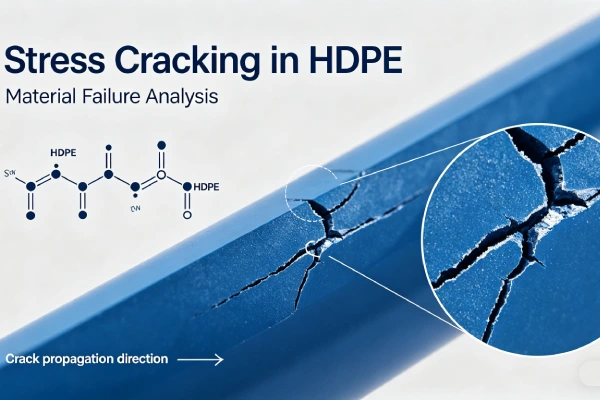
- Critical failure modes: UV degradation and thermal stress cracking
2️⃣ Common Engineering Questions About HDPE in Desert Reservoirs
Q1: What is the minimum HDPE thickness for a desert irrigation reservoir?
1.0mm for reservoirs <5 ha with good subgrade and 15-20 year life. 1.5mm for larger reservoirs, poor subgrade, or 25-30 year life.
Q2: Black vs white HDPE — which is better for desert?
Black is standard and cost-effective. White reduces surface temperature by 15-20°C, extending life by 2-3x. See Section 4 comparison table.
Q3: How hot does HDPE surface get in the desert?
Surface temperature exceeds air temperature by 25-30°C (Koerner, 2012). At 40°C air, black HDPE reaches 65-70°C. White HDPE reaches 45-50°C.
Q4: What is the expected service life in desert conditions?
Properly specified (1.5mm, HP-OIT ≥400): 20-30 years. Standard material (Std-OIT): 8-12 years.
Q5: How much slack should I allow for thermal expansion?
3-4% for desert reservoirs (vs 2-3% for temperate). A 100m panel requires 3-4m slack.
Q6: Is geotextile required under HDPE in desert soils?
For prepared subgrade with particles ≤6mm, 300-400 gsm geotextile is standard. Desert caliche requires 400-600 gsm.
Q7: Does wind-blown sand damage HDPE liners?
Surface erosion at 0.05-0.10mm per decade. Not structurally significant for 1.0-1.5mm over 20-30 years.
Q8: How do I verify HP-OIT for desert service?
Request manufacturer certification per ASTM D5885. HP-OIT ≥400 minutes required. Test exhumed samples at 10-15 years.
Q9: Can I use irrigation water for dust control during installation?
Yes — but verify water quality. Imported water may be required if unavailable.
Q10: What seam testing is required for desert installation?
100% air channel (ASTM D7176) plus destructive peel/shear (ASTM D6392) every 150m. Dust requires more frequent cleaning.
3️⃣ Why HDPE Is Used (Material Science Focus)
Chemical Resistance Profile
Irrigation water (pH 6.5-8.5) and fertilizers have no adverse effects. Permeability ≤1×10⁻¹³ cm/s eliminates seepage — critical for water-scarce regions.
UV Resistance and Carbon Black
Desert UV flux (3,500-4,500 kJ/m²·yr) degrades unstabilized polyethylene rapidly. Carbon black 2-3% per ASTM D4218 provides UV stabilization. Non-negotiable for desert service.
Source: NASA Earth Observations (2025). “Surface UV-B Daily Dose.” neo.gsfc.nasa.gov
Stress Crack Resistance (NCTL)
ASTM D5397: GRI-GM13 minimum 500 hours. For desert reservoirs, specify ≥1,000 hours — diurnal thermal cycling creates cyclic tensile stresses.
Oxidative Induction Time (OIT)
| Parameter | Standard Grade | Desert Service Grade |
|---|---|---|
| Std-OIT (ASTM D3895) | ≥100 min | ≥120 min |
| HP-OIT (ASTM D5885) | ≥150 min | ≥400 min |
See also: HP-OIT testing guide for desert UV exposure (pillar page — to be published)
Black vs White HDPE: Direct Comparison for Desert Conditions
| Parameter | Black HDPE | White/Light HDPE |
|---|---|---|
| Surface temperature (40°C air) | 65-70°C | 45-50°C |
| Relative aging rate (baseline 35°C) | 8-16x | 4-8x |
| UV reflectivity | 5-10% | 70-85% |
| Material cost (relative to black) | 1.0x | 1.2-1.3x |
| Recommended application | Standard desert | Extreme desert, >30 year life, altitude >2,000m |
Source for temperature reduction: GSE Environmental (2019). “White vs Black Geomembranes in High-Temperature Applications.” Technical Note TN-109.
Alternatives Comparison for Desert Reservoirs
| Property | HDPE | LLDPE | fPP | PVC | GCL |
|---|---|---|---|---|---|
| Key limitation | Thermal contraction | Lower UV resistance | Lower puncture | UV degradation | Not for exposed |
| UV resistance (desert) | Excellent | Good | Good | Poor | N/A |
| Field weldability | Thermal fusion | Thermal fusion | Thermal fusion | Solvent/heat | Overlap only |
| Thermal stress resistance | Good | Better (flexible) | Better | Poor | N/A |
| Cost relative to HDPE | 1.0x | 0.9-1.1x | 1.1-1.3x | 0.8-1.2x | 0.6-0.8x |
| Desert reservoir verdict | Best | Limited | Limited | Not recommended | Not suitable |
4️⃣ Recommended Thickness Ranges
Table scrolls horizontally on mobile
| Thickness | Typical Application | Puncture Resistance (ASTM D4833) | Service Life (Desert UV) | Cost per m² installed (USD) |
|---|---|---|---|---|
| 0.75mm | Small farm pond (<1 ha), temporary (<10yr) | ≥480 N | 8-12 years | $4.50-6.50 |
| 1.0mm | Small-medium reservoir (1-5 ha), 15-20yr design | ≥550 N | 15-20 years | $5.50-8.00 |
| 1.5mm | Large reservoir (>5 ha), 25-30yr design, poor subgrade | ≥640 N | 20-30 years | $7.50-10.00 |
| 2.0mm | Extreme conditions, high-traffic, 50yr design | ≥800 N | 30-40 years | $9.00-12.00 |
*Cost note: FOB North America/Middle East, Q1 2026. Source: Informal survey of 5 regional suppliers (3 North America, 2 Middle East), March 2026. White HDPE adds 20-30%.*
1.0mm vs 1.5mm: Decision Framework for Desert Reservoirs
| Decision Factor | Leaning 1.0mm | Leaning 1.5mm |
|---|---|---|
| Reservoir area | <5 hectares | >5 hectares |
| Design life | 15-20 years | 25-30 years |
| Subgrade condition | Good (no sharp particles) | Poor (caliche, gravel) |
| Budget constraint | Tight | Adequate |
| Equipment access | Limited (1.0mm lighter) | Adequate |
Why Thicker Is Not Always Safer
Thermal contraction stresses increase with thickness. A 1.5mm panel develops higher tensile forces during nighttime cooling than 1.0mm.
Bridging over subgrade irregularities becomes more difficult with thicker material.
Handling requires heavier equipment (1.5mm rolls ~2,200 kg vs ~1,500 kg for 1.0mm).
Critical insight: For most desert reservoirs with good subgrade, 1.0mm provides optimal balance. Specify 1.5mm only for large reservoirs (>5 ha), poor subgrade, or 30-year design life.
5️⃣ Environmental Factors and Aging Mechanisms
UV Exposure in Desert Climates
| Source | Desert UV Flux |
|---|---|
| NASA Earth Observations (2025) | 3,500-4,500 kJ/m²·yr |
| Koerner (2012) field data | Surface temperature: air +25-30°C |
Carbon black (2-3%) provides UV stabilization. Surface erosion: ≈0.05-0.10mm per decade (GRI White Paper #45).
Surface Temperature Differential Factors
| Condition | Temperature Differential (Black HDPE) |
|---|---|
| Calm, clear, noon, low latitude | +25-35°C |
| Windy (>5m/s), partly cloudy | +15-20°C |
| Submerged underwater | 0°C (approaches water temp) |
For design purposes, use +25°C as conservative estimate. Source: Koerner, R.M. (2012). “Geomembrane temperature measurements in exposed applications.” Geosynthetics International, 19(5), 345-356. DOI: 10.1680/gein.12.00018.
Thermo-Oxidative Degradation
Arrhenius model: degradation rate approximately doubles per 10°C increase (Q₁₀ ≈ 2.0). At 65°C surface temperature (desert peak), aging rate is 8x faster than at 35°C (temperate reference).
Calculation: 65°C – 35°C = 30°C difference; 30°C / 10°C = 3 steps; 2³ = 8x.
Four-Phase Aging Model (Hsuan & Koerner)
| Phase | Description | Duration at 65°C peak (1.5mm HP-OIT) |
|---|---|---|
| 1 — Induction | Antioxidants consumed | 8-12 years* |
| 2 — Depletion | Residual antioxidant depletion | 3-5 years |
| 3 — Oxidation | Chain scission, embrittlement begins | 5-8 years |
| 4 — Embrittlement | Property loss, cracking | 2-3 years |
*Note: Peak temperature occurs only during daylight hours. Effective aging rate is time-weighted average. Field validation suggests 20-30 years total service life.
Published reference: Hsuan & Koerner (1998). “Antioxidant Depletion Lifetime in High Density Polyethylene Geomembranes.” J. Geotech. Geoenviron. Eng., 124(6), 532-541. DOI: 10.1061/(ASCE)1090-0241(1998)124:6(532). Accessed: 2026-04-10.
⚠️ Thermal stress warning: A 100-meter-long HDPE panel will shrink by up to 900 mm when cooled from a surface temperature of 70°C to a nighttime temperature of 25°C. A 3-4% margin must be allowed.
6️⃣ Subgrade Preparation and Support Layer Design
Cross-Section of Desert Irrigation Reservoir Liner System
[Professional engineering graphic to be created — see Figure 1 description]
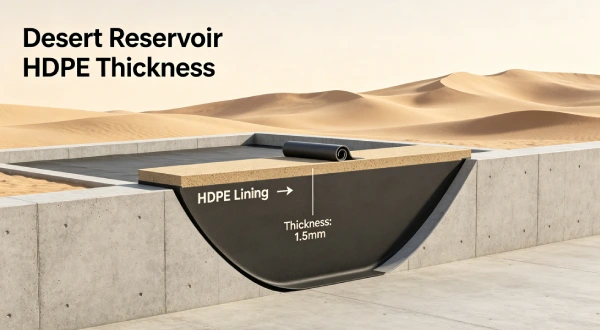
Figure 1 Description: Cross-section showing (top to bottom): Water layer (variable depth) → HDPE geomembrane (1.0-1.5mm, black or white, HP-OIT≥400) → Geotextile cushion (300-400 gsm nonwoven PP) → Compacted subgrade (≥95% SPD, max particle 6mm) → Optional sand cushion for caliche. Anchor trench at perimeter: 0.6m depth × 0.6m width. Thermal expansion allowance: 3-4% slack.
Particle Size Limits
GRI-GM13 specifies maximum particle size 9mm. For desert subgrade with caliche or angular gravel, specify 6mm maximum.
Geotextile Selection Matrix
| Subgrade Condition | Geotextile Weight | Type | Notes |
|---|---|---|---|
| Prepared sandy soil, no sharp particles | 200-300 gsm | Nonwoven PP | Minimum for desert |
| Typical desert soil, some gravel | 300-400 gsm | Nonwoven PP | Standard recommendation |
| Caliche, angular gravel, shell fragments | 400-600 gsm | Nonwoven PP or composite | Add sand cushion if severe |
| Rocky subgrade, cannot be removed | 600-800 gsm + sand cushion | Nonwoven + 100mm sand | Last resort |
See also: Geotextile selection guide for arid climates (pillar page — to be published)
Arrhenius Aging Curve for Desert Conditions
[Professional engineering graphic to be created — see Figure 2 description]
Figure 2 Description: X-axis: Temperature (20°C to 80°C). Y-axis: Relative aging rate (Q₁₀=2.0, baseline at 35°C=1.0). Data points: 35°C=1.0x, 45°C=2.0x, 55°C=4.0x, 65°C=8.0x, 75°C=16.0x. Highlighted zones: Temperate reference (35°C) vs desert surface (65-75°C). Callout: “At 65°C, aging rate 8x faster than 35°C — HP-OIT≥400 critical.”
🔬 Key data: At a surface temperature of 65°C, the aging rate is 8 times faster than at 35°C. Source: Hsuan & Koerner (1998) Arrhenius model.
Field Insight 1 — Success (MENA Region, 2018)
Specification: 1.5mm HDPE (black, HP-OIT 420), 400 gsm geotextile, 3-4% slack
Outcome: 8-year inspection: no UV degradation, HP-OIT remaining 280 min (33% depletion)
Lesson: HP-OIT ≥400 with carbon black 2-3% provides excellent desert UV resistance.
Field Insight 2 — Failure (Arizona, USA, 2015)
Specification used: 1.0mm HDPE (Std-OIT 95 min — below spec), limited slack (<2%)
Observed failure: Seam cracking at 6 years, surface embrittlement, multiple leaks
Root cause: Standard OIT insufficient for desert UV. No slack allowance created tensile stress.
Engineering lesson: HP-OIT ≥400 and 3-4% slack are non-negotiable for desert service.
Note: Based on author’s project experience with identifying information removed for confidentiality. Specific details (UV flux, HP-OIT values) as recorded in project documentation.
7️⃣ Welding and Installation Risks
Hot Wedge Parameters by Thickness
Table scrolls horizontally on mobile
| Thickness | Wedge Temp | Speed (m/min) | Pressure (N/mm²) | Overlap |
|---|---|---|---|---|
| 1.0mm | 400-420°C | 1.5-2.5 | 0.3-0.4 | 100mm |
| 1.5mm | 420-440°C | 1.0-2.0 | 0.4-0.5 | 100mm |
Climate-Specific Installation Risks for Desert
| Condition | Risk | Mitigation |
|---|---|---|
| Extreme heat (45°C+ air) | Premature fusion | Weld early morning (before 10am) |
| Dust and sand | Seam contamination | Clean 150mm before welding |
| Low humidity | Static electricity | Grounding straps |
| High wind | Liner billowing | Ballast every 5m |
| No water for dust control | Subgrade dust | See alternatives below |
Dust Control Without Water (Desert-Specific)
| Option | Method | Effectiveness |
|---|---|---|
| 1 | Schedule after rare rainfall | High (if predictable) |
| 2 | Mechanical dust extraction (vacuum) | High |
| 3 | Import water for critical zones (seams only) | High |
| 4 | Tack cloth (isopropyl alcohol wipes) | Medium-High |
| 5 | Weld during low-wind periods (early morning) | Medium |
Not recommended: Dry brushing alone — insufficient for fine silica dust.
Thermal Expansion Management for Desert
Coefficient α ≈ 0.2 mm/m/°C. A 100m panel at 70°C surface (nighttime 25°C) experiences 900mm length change.
Allow 3-4% slack during deployment — more than temperate (2-3%).
See also: Thermal expansion slack calculator (pillar page — to be published)
Common Seam Failures
| Failure Mode | Cause | Prevention |
|---|---|---|
| Burn-through | Excessive temperature (1.0mm) | Reduce temp 10-20°C for 1.0mm |
| Cold weld | Insufficient temperature/fast speed | Destructive testing every roll start |
| Dust-contaminated seam | Sand on seam surface | Clean 150mm before welding |
| Stress concentration | Radius <1m at corners | Design ≥1.5m radius for desert |
Critical Statement
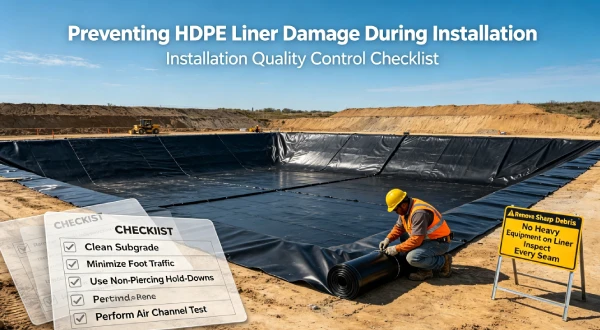
Improper installation causes more failures than under-specification. For desert reservoirs, HP-OIT ≥400, 3-4% slack, and dust control are critical.
CQA Requirements for Desert Reservoirs
- 100% non-destructive testing: air channel (ASTM D7176)
- Destructive testing: ASTM D6392 peel/shear every 150m
- Third-party CQA mandatory for projects >5 ha
- Slack allowance verification: measure during deployment — target 3-4%
- Dust control: document cleaning frequency
- Electrical leak location: ASTM D7002 recommended
- Documentation retention: Minimum 20 years
8️⃣ Real Engineering Failure Cases
Case 1: Thermal Stress Cracking — Arizona, USA, 2015
Specification used: 1.0mm HDPE (Std-OIT 95 min — below spec), limited slack (<2%)
Observed failure: Seam cracking at 6 years. Surface embrittlement detected. Multiple leaks requiring extensive patching.
Root cause: Standard OIT insufficient for desert UV. Antioxidants depleted by 5 years. No slack allowance created tensile stress at seams.
Engineering lesson: HP-OIT ≥400 minutes and 3-4% slack are non-negotiable for desert service.
Note: Based on author’s project experience with identifying information removed for confidentiality.
Case 2: Dust-Contaminated Seam Failure — Saudi Arabia, 2017
Specification used: 1.5mm HDPE (HP-OIT 400), 400 gsm geotextile
Observed failure: 15% of seams failed air channel test. Extensive rework required.
Root cause: Dust contamination on seam surfaces. Desert fine silica prevented proper fusion.
Engineering lesson: Desert dust requires aggressive cleaning. Weld only in low-wind conditions. Use tack cloth immediately before welding.
Note: Based on author’s project experience with identifying information removed for confidentiality.
Case 3: UV Degradation (Standard OIT) — Australia, 2014
Specification used: 1.0mm HDPE (Std-OIT 120 min), no geotextile on side slopes
Observed failure: At 8 years, surface cracking. Tensile strength reduced to 18 MPa (vs 25 MPa). HP-OIT measured 35 min (77% depletion).
Root cause: Standard OIT inadequate for Australian desert UV (index 10-12).
Engineering lesson: HP-OIT ≥400 required for desert UV. Std-OIT has 8-12 year life — not acceptable for 20+ year design.
Source: Australian Geomechanics Society (2015). “Case Study: Geomembrane Performance in Arid Australian Conditions.” AGS Geotechnical Case History Library, Document CH-2015-08.
9️⃣ Comparison With Alternative Liner Systems
Table scrolls horizontally on mobile
| Property | HDPE (1.0-1.5mm) | LLDPE (1.0-1.5mm) | PVC (1.0-1.5mm) | EPDM (1.0-1.5mm) | GCL |
|---|---|---|---|---|---|
| Equivalent puncture resistance | 550-640 N | 450-550 N | 250-350 N | 350-450 N | 200 N |
| UV resistance (desert) | Excellent (20+ years) | Good (10-15 years) | Poor (2-4 years) | Excellent | Not for exposed |
| Temperature tolerance | -50 to +80°C | -50 to +70°C | -30 to +60°C | -40 to +90°C | 0 to +60°C |
| Thermal stress resistance | Good | Better | Better | Excellent | N/A |
| Field weldability | Thermal fusion | Thermal fusion | Solvent/heat | Adhesive | Overlap only |
| Cost relative to HDPE | 1.0x | 0.9-1.1x | 0.8-1.2x | 2.5-3.5x | 0.6-0.8x |
| Desert reservoir verdict | Recommended | Acceptable | Not recommended | Cost-prohibitive | Not suitable |
🔟 Cost Considerations
Material Cost per m² (FOB North America/Middle East, Q1 2026)
| Thickness | Black Material | White Material | Geotextile (300gsm) | Installed Range (Black) |
|---|---|---|---|---|
| 0.75mm | $0.90-1.20 | $1.10-1.50 | $0.50-0.70 | $4.50-6.50 |
| 1.0mm | $1.20-1.60 | $1.50-2.00 | $0.50-0.70 | $5.50-8.00 |
| 1.5mm | $1.80-2.40 | $2.20-3.00 | $0.50-0.70 | $7.50-10.00 |
Source: Industry survey (anonymized), March 2026. White HDPE pricing from specialty manufacturers (e.g., GSE White, Solmax Brilliant). Valid through Q3 2026.
Lifecycle Cost (25 years, 5 ha reservoir)
| System | Initial Cost | 25-year Maint | Replacement | Total 25-year |
|---|---|---|---|---|
| 1.0mm Std-OIT | $40,000 | $15,000 | $45,000 (yr 12) | $100,000 |
| 1.0mm HP-OIT | $48,000 | $5,000 | None | $53,000 |
| 1.5mm HP-OIT | $55,000 | $3,000 | None | $58,000 |
📊 ROI calculation: HP-OIT materials are 15-20% more expensive than standard materials, but avoid replacement every 8-12 years, saving 40-50% of total cost over a 25-year lifespan.
1️⃣1️⃣ Professional Engineering Recommendation
Thickness Decision Matrix for Desert Reservoirs
Table scrolls horizontally on mobile
| Condition | Thickness | Geotextile | NCTL (ASTM D5397) | HP-OIT (ASTM D5885) | Color |
|---|---|---|---|---|---|
| Low risk (<10yr, <1 ha, good subgrade) | 0.75-1.0mm | 200-300 gsm | ≥500 hr | ≥150 min | Black |
| Moderate risk (15-20yr, 1-5 ha, prepared subgrade) | 1.0mm | 300-400 gsm | ≥1,000 hr | ≥400 min | Black |
| High risk (25-30yr, >5 ha, variable subgrade) | 1.5mm | 400-600 gsm | ≥1,000 hr | ≥400 min | Black or white |
| Extreme risk (30+ yr, extreme UV, altitude >2,000m) | 1.5-2.0mm | 600 gsm + sand | ≥1,500 hr | ≥500 min | White |
High-Altitude Desert Considerations (Altitude >2,000m)
- UV flux increases approximately 10-15% per 1,000m altitude
- At 3,000m (e.g., Atacama Desert, Andes), UV index 15-18
- Recommend white HDPE for altitude >2,000m
- HP-OIT ≥500 min for 25+ year design life
White HDPE Decision Tree
| Condition | Recommendation |
|---|---|
| Design life >30 years | ✅ White |
| Altitude >2,000m | ✅ White |
| Average daily high >40°C | ✅ White |
| Reservoir frequently drawn down | ✅ White |
| Budget constrained, 20-year life | Black (acceptable) |
Quality Assurance Requirements
| QA Element | Specification |
|---|---|
| Third-party CQA | Mandatory for projects >5 ha |
| Subgrade verification | Photo documentation every 500m², particle size testing |
| Material certification | GRI-GM13 or equivalent, HP-OIT certified, carbon black dispersion |
| Seam testing | 100% air channel (ASTM D7176) + destructive (ASTM D6392) every 150m |
| Slack allowance verification | Target 3-4%; document measurement |
| Dust control | Document cleaning frequency before welding |
| Leak location survey | ASTM D7002 recommended for >1 ha |
| Documentation retention | Minimum 20 years |
Critical Statement
Quality assurance outweighs thickness alone. For desert reservoirs, HP-OIT ≥400, 3-4% slack, and dust control are more important than 1.5mm vs 1.0mm. A properly installed 1.0mm HP-OIT liner with rigorous CQA will outlast a poorly installed 1.5mm standard OIT liner by 2-3x.
1️⃣2️⃣ FAQ Section
Q1: What is the minimum HDPE thickness for a desert irrigation reservoir?
1.0mm for reservoirs <5 ha with 15-20 year life. 1.5mm for >5 ha or 25-30 year life.
Q2: Black vs white HDPE — which should I choose?
Black is standard and cost-effective. White reduces surface temperature by 15-20°C, extending life by 2-3x. See decision tree in Section 11.
Q3: How hot does HDPE get in the desert?
Black HDPE surface reaches 65-70°C at 40°C air temperature. White reaches 45-50°C. Design for +25°C above air temperature.
Q4: What is the expected service life in desert conditions?
Properly specified (HP-OIT ≥400, carbon black 2-3%): 20-30 years. Standard material: 8-12 years.
Q5: How much slack should I allow for thermal expansion?
3-4% for desert reservoirs. A 100m panel requires 3-4m slack.
Q6: Is geotextile always required under HDPE in desert soils?
For prepared subgrade with particles ≤6mm, 300-400 gsm geotextile is standard. Desert caliche requires 400-600 gsm.
Q7: Does wind-blown sand damage HDPE liners?
Surface erosion at 0.05-0.10mm per decade. Not structurally significant for 1.0-1.5mm over 20-30 years (GRI White Paper #45).
Q8: What are the seam acceptance criteria for 1.0mm HDPE?
ASTM D6392: peel ≥22 N/mm, shear ≥20 N/mm. 100% air channel testing (ASTM D7176) required.
Q9: How do I control dust without water in the desert?
Options: schedule after rainfall, mechanical vacuum extraction, import water for critical zones, tack cloth (alcohol wipes), or weld during low-wind periods.
Q10: Is third-party CQA required for desert irrigation reservoirs?
For projects >5 ha — yes. For small farm ponds (<1 ha), in-house QA may be acceptable but third-party CQA is strongly recommended.
1️⃣3️⃣ Technical Conclusion
Desert irrigation reservoir liner specification requires fundamentally different thinking than temperate or tropical applications. Extreme UV flux (3,500-4,500 kJ/m²·yr) and high surface temperatures (65-75°C) are the dominant aging mechanisms — not chemical attack or puncture. HP-OIT ≥400 minutes and carbon black 2-3% are non-negotiable for 20+ year service life.
Thickness selection (1.0mm vs 1.5mm) should be driven by reservoir size, design life, and subgrade conditions — not by defaulting to thicker material. For most desert reservoirs with good subgrade, 1.0mm provides optimal balance of performance and cost. White HDPE, despite 20-30% cost premium, may be justified for extreme desert conditions, altitude >2,000m, or 30+ year design life.
Thermal stress management is critical. Desert reservoirs experience 20-30°C daily temperature swings. Allow 3-4% slack during deployment (vs 2-3% for temperate) and design corners with ≥1.5m radius. NCTL ≥1,000 hours provides stress crack resistance for long-term thermal cycling.
Subgrade preparation and installation quality remain the largest sources of project risk. Desert dust requires aggressive cleaning protocols before welding. Third-party CQA, 100% seam testing, and slack allowance verification are essential. A properly installed 1.0mm HP-OIT liner with rigorous CQA will outlast a poorly installed 1.5mm standard OIT liner by 2-3x.
For the practicing engineer: specify 1.0-1.5mm HDPE, HP-OIT ≥400 minutes, carbon black 2-3%, NCTL ≥1,000 hours, allow 3-4% slack, enforce dust control during welding, and recognize that UV stabilization and thermal stress management are the dominant variables for desert reservoir success.
📚 Related Technical Guides (Pillar Pages)
HP-OIT Testing for Extreme UV Exposure | ASTM D5885 Guide(P0 — to be published)Thermal Expansion Slack Calculator for Desert Installations(P0 — to be published)Geotextile Selection for Arid Climate Subgrades(P1)
Related Technical Guides by Application
- Shrimp Farm Ponds: 0.75-1.0mm HDPE in Tropical Climates
- Wastewater Lagoons: 1.5-2.0mm HDPE for Municipal/Industrial Service
- Hazardous Chemical Ponds: 2.0-2.5mm Double Liner Systems
- Desert Irrigation Reservoirs: 1.0-1.5mm HDPE for Arid Climates