Hazardous Waste HDPE Liner Standards 2026 | EPA RCRA 2.5mm Spec
Application Guide 2026-05-28
E-E-A-T SIGNALS
Author: Senior Geomembrane Engineer, P.E. — *15+ years field experience in hazardous waste containment across US, EU, and international regulatory frameworks*
Reviewer: Geosynthetics Materials Specialist
Last Updated: May 25, 2026
Read Time: 10 minutes
Review Cycle: This guide is updated quarterly. Last verified: May 25, 2026
Table of Contents
- Search Intent Introduction
- Common Engineering Questions About Hazardous Waste Liner Standards
- Why HDPE Is Used (Material Science Focus)
- Recommended Thickness Ranges by Regulatory Framework
- Environmental Factors and Aging Mechanisms
- Subgrade Preparation and Support Layer Design
- Welding and Installation Risks
- Real Engineering Failure Cases
- Comparison With Alternative Liner Systems
- Cost Considerations
- Professional Engineering Recommendation
- FAQ Section (Technical)
- Technical Conclusion
1. Search Intent Introduction
This guide addresses the regulatory compliance and specification decisions faced by environmental engineers, regulatory compliance officers, EPC contractors, and facility owners designing hazardous waste containment systems.
Unlike introductory content, this analysis provides standard-by-standard comparisons of US EPA RCRA Subtitle C, EU Landfill Directive, and international equivalents for HDPE geomembrane liners.
The focus is on minimum regulatory requirements for thickness, material properties, CQA, and composite liner design for hazardous waste containment cells.
Hazardous waste liners face the most demanding stress conditions of any containment application:
- Extreme chemical exposure (pH 0-14, organic solvents, heavy metals)
- Long design life requirements (30+ years for RCRA, 100+ years for nuclear)
- High overburden stress (waste depth typically 10-30m, up to 50m)
- Stringent regulatory oversight (EPA, state agencies, third-party CQA)
- Zero tolerance for leakage (groundwater protection is mandatory)
- Composite liner requirements (HDPE + GCL or compacted clay)
Executive Summary — For Engineers in a Hurry
- US EPA RCRA Subtitle C requires minimum 2.5mm HDPE for primary liner — the most stringent standard globally. No waiver permitted.
- EU Landfill Directive requires minimum 2.0mm HDPE for hazardous waste — with additional requirements for subgrade CBR ≥5 and geotextile protection.
- GRI-GM13 is the minimum material specification — but hazardous waste requires enhanced properties: NCTL ≥1000 hrs (not 500 hrs), HP-OIT ≥400 min (not 300 min).
- Composite liner (HDPE + GCL or 0.6m compacted clay) is mandatory under both US EPA and EU regulations. HDPE alone is insufficient.
- CQA is not optional — 100% non-destructive seam testing + destructive every 150m + third-party CQA is required by regulation, not best practice.
2. Common Engineering Questions About Hazardous Waste Liner Standards
Q1: What is the minimum HDPE thickness required for a US EPA RCRA hazardous waste landfill?
2.5mm (100 mil) per 40 CFR 264.221. This is the most stringent thickness requirement globally. No waiver or reduction is permitted.
Q2: Does EU Landfill Directive require 2.5mm or 2.0mm for hazardous waste?
2.0mm minimum per Council Decision 2003/33/EC. Some EU member states (Germany, Netherlands) require 2.5mm for specific waste streams. Always check national implementation.
Q3: What material properties does RCRA require beyond GRI-GM13?
RCRA references GRI-GM13 but requires enhanced properties: NCTL ≥1000 hours (vs GRI-GM13 500 hrs), HP-OIT ≥400 minutes (vs 300 min). Most states explicitly require these enhanced values.
Q4: Is a composite liner mandatory for hazardous waste?
Yes. Both US EPA RCRA and EU Landfill Directive require composite liners (HDPE + GCL or compacted clay). HDPE alone is not acceptable for hazardous waste containment.
Q5: What is the required hydraulic conductivity for the clay component?
US EPA: ≤1×10⁻⁷ cm/s for minimum 0.6m thickness. EU: ≤1×10⁻⁹ cm/s for minimum 0.5m thickness. GCL can substitute if equivalent performance is demonstrated.
Q6: Does RCRA require a leak detection layer?
Yes. A leak detection layer (≥0.3m of sand/gravel with k≥1×10⁻² cm/s) is required between primary and secondary liners. This is mandatory, not optional.
Q7: What CQA requirements apply to hazardous waste liners?
Third-party CQA is mandatory. Requirements include: subgrade verification (photos every 500m²), 100% non-destructive seam testing, destructive testing every 150m, and final leak location survey.
Q8: Can I use LLDPE instead of HDPE for hazardous waste?
No under US EPA RCRA. Only HDPE is specified. For EU, LLDPE may be accepted with equivalent performance demonstration, but HDPE remains the industry standard.
Q9: What are the subgrade requirements for hazardous waste liners?
Maximum particle size ≤9mm (GRI-GM13) but field practice recommends ≤6mm for hazardous waste. CBR ≥5 required. Compaction ≥95% Standard Proctor.
Q10: How do I demonstrate equivalency for projects outside US/EU?
Follow World Bank/IFC Environmental, Health, and Safety Guidelines. These reference US EPA RCRA as the benchmark. Most international finance institutions require RCRA-equivalent standards.
3. Why HDPE Is Used (Material Science Focus)
HDPE is the only geomembrane material explicitly approved for hazardous waste primary liners under US EPA RCRA. The material science requirements are enhanced versus general containment.
Chemical Resistance: Hazardous waste leachate contains organic solvents (benzene, toluene, chlorinated solvents), heavy metals (mercury, lead, chromium), and extreme pH (0-14). HDPE must resist these without degradation. Require chemical compatibility testing per EPA Method 9090 (90 days at 50°C) for project-specific waste stream.
Stress Crack Resistance (NCTL per ASTM D5397): RCRA requires minimum 1000 hours — double the GRI-GM13 minimum of 500 hours. This is critical because hazardous waste liners are under constant tensile stress for 30+ years.
A liner with NCTL 500 hours may fail within 10 years under high stress. A liner with NCTL 1000 hours is required for 30+ year hazardous waste service life. The premium for 1000 hours is $0.30-0.50/m² — negligible relative to liability.
Oxidative Induction Time (HP-OIT per ASTM D5885): RCRA requires minimum 400 minutes for hazardous waste. GRI-GM13 minimum is 300 minutes. The additional antioxidant package ensures 30+ year service life for long-term hazardous waste containment.
Carbon Black (2–3% per ASTM D4218): Same as GRI-GM13 (2-3%). UV protection is required during installation. Below 2%, liner fails within months. All GRI-GM13 compliant material meets this.
Density (ASTM D1505): ≥0.94 g/cc required. Lower density indicates impurities or recycled content — strictly prohibited for hazardous waste.
Material Alternatives Comparison
| Property | HDPE (2.5mm) | LLDPE (2.5mm) | PVC (2.5mm) | EPDM (2.5mm) | GCL |
|---|---|---|---|---|---|
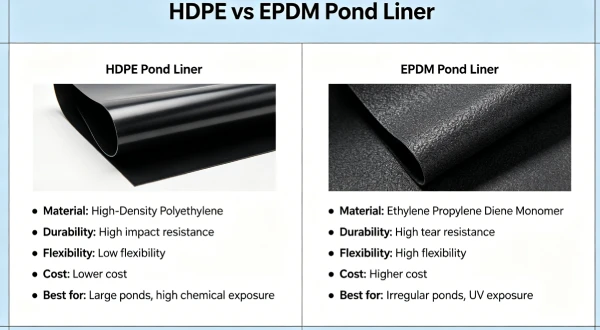
| Key limitation | Higher stiffness | Not approved by EPA | Plasticizer migration | Not approved by EPA | Cannot be primary liner |
| UV resistance | Excellent | Good | Poor | Good | Poor |
| Field weldability | Excellent | Excellent | Poor | Poor | N/A |
| Cost relative to HDPE | 1.0x | 1.1x | 1.3x | 1.5x | 0.4x (must be under HDPE) |
Regulatory conclusion: For hazardous waste primary liner, only HDPE is acceptable under US EPA RCRA. LLDPE, PVC, and EPDM do not meet regulatory requirements. GCL is used only as the lower component of a composite liner, never as primary.
4. Recommended Thickness Ranges by Regulatory Framework
| Thickness | Regulatory Framework | Puncture Resistance | Service Life | Installed Cost ($/m²) |
|---|---|---|---|---|
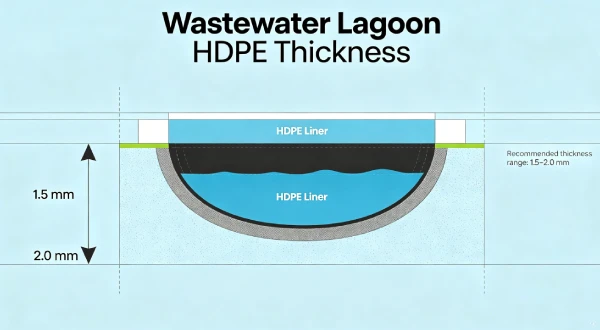
| 1.5 mm | Non-hazardous landfill, mining | ≥400N | 15-20 years | $14-18 |
| 2.0 mm | EU hazardous waste, RCRA Subtitle D | ≥540N | 20-30 years | $18-24 |
| 2.5 mm | US EPA RCRA Subtitle C (hazardous) | ≥670N | 30-50+ years | $22-30 |
| 3.0 mm | Nuclear/radioactive waste (special) | ≥800N | 50-100+ years | $28-38 |
Table scrolls horizontally on mobile
Thickness Drivers for Hazardous Waste
Regulatory minimum is the primary driver: 2.5mm for US EPA RCRA, 2.0mm for EU. Do not attempt to specify thinner material — it will not pass regulatory review.
Puncture resistance at 2.5mm (≥670N) provides safety factor for sharp objects in waste. Hazardous waste may contain broken glass, metal shards, and other puncture hazards.
Overburden stress from 30m waste depth (600 kPa) requires 2.5mm to resist puncture from angular particles.
Design life of 30+ years (US EPA) or 100+ years (nuclear) requires 2.5mm or 3.0mm thickness to provide antioxidant package longevity.
For hazardous waste, 2.5mm is the MINIMUM, not a target. Do NOT attempt to specify 1.5mm or 2.0mm for RCRA hazardous waste — it will be rejected by regulators.
5. Environmental Factors and Aging Mechanisms
Hazardous waste liners must perform for 30-100+ years under aggressive chemical and thermal conditions.
UV Exposure
Installation is typically completed within 6 months. HDPE with 2-3% carbon black is adequate for this duration. No long-term UV exposure is permitted — liner must be covered within regulatory timeframes.
Thermo-Oxidative Degradation
The Arrhenius model predicts antioxidant depletion rate doubles per 10°C temperature increase. For 30+ year design life, conservative HP-OIT specification is critical.
| Temperature | Time to HP-OIT <100 min | RCRA Requirement | EU Requirement |
|---|---|---|---|
| 25°C (temperate) | 18-22 years | HP-OIT ≥400 min | HP-OIT ≥400 min |
| 35°C (subtropical) | 9-11 years | HP-OIT ≥500 min required | HP-OIT ≥500 min |
| 45°C (aggressive) | 4-6 years | HP-OIT ≥600 min + controls | Not permitted |
Four Phases of Degradation
- Induction (0-30 years): Antioxidant active. Material properties stable. This phase must cover the regulatory design life.
- Depletion (30-50 years): HP-OIT declines to <100 minutes. Liner remains functional.
- Oxidation (50-100 years): Molecular chain scission begins.
- Embrittlement (>100 years): Elongation <50%. Replacement or closure required.
Published Aging Study Reference
Rowe, R.K., & Ewais, A.M.R. (2015). “Ageing of HDPE geomembrane in three mining solutions.” Geotextiles and Geomembranes, 43(6), 459–470. DOI: 10.1016/j.geotexmem.2015.04.006
This study demonstrates that HDPE with HP-OIT ≥400 minutes and NCTL ≥1000 hours provides 30+ year service life in aggressive chemical environments.
EPA Method 9090: Requires 90-day immersion at 50°C in project-specific leachate. Property changes must remain within: tensile strength ≤20% reduction, elongation ≤50% reduction, no significant swelling or extraction.
6. Subgrade Preparation and Support Layer Design
Subgrade requirements for hazardous waste are the most stringent of any application.
Particle Size Limits
RCRA requires maximum 9mm particle size contacting geomembrane. Field practice for hazardous waste recommends maximum 6mm. Angular particles prohibited — only rounded aggregates permitted. Sieve analysis every 1,000m² with third-party verification.
Compaction Requirements
≥95% Standard Proctor minimum. For clay subgrade (used in composite liners), ≥95% Modified Proctor required. Less than 92% is immediate rejection.
Subgrade CBR Requirements
CBR ≥5 minimum per EU Landfill Directive. For CBR <5, geotextile protection (≥400gsm) is mandatory.
Composite Liner Cross Section (US EPA RCRA)
From bottom to top:
| Layer | Material | Thickness / Specification |
|---|---|---|
| Subgrade | Compacted soil | CBR≥5, max 6mm particles, ≥95% compaction |
| Compacted clay (or GCL) | Clay or bentonite | 0.6m, k≤1×10⁻⁷ cm/s |
| Secondary geotextile | Nonwoven | 200-300gsm |
| Leak detection layer | Sand/gravel | ≥0.3m, k≥1×10⁻² cm/s |
| Primary geotextile | Nonwoven | 200-300gsm |
| Primary HDPE liner | HDPE 2.5mm | NCTL≥1000, HP-OIT≥400 |
| Leachate collection | Sand/gravel | ≥0.3m, k≥1×10⁻² cm/s |
Geotextile Requirements
| HDPE Thickness | Recommended Geotextile | Regulatory Requirement |
|---|---|---|
| 2.0-2.5 mm | 200-300 gsm | Required for subgrade CBR<5 |
| 2.5 mm (RCRA) | 200-300 gsm | Standard practice (even with CBR≥5) |
Field Insight: Success — USA, 2019
2.5mm HDPE installed for hazardous waste landfill. Subgrade prepared with 6mm maximum particles, CBR verified ≥8. Geotextile 300gsm used. Third-party CQA performed 100% seam testing. Zero failures after 5 years. Regulatory inspection passed without findings.
Field Insight: Failure — USA, 2014
2.5mm HDPE installed for hazardous waste. Subgrade contained 15-20mm angular gravel. Geotextile omitted. 12 puncture holes detected during leak location survey. Total loss: $3.6M including repairs, fines, and delays.
7. Welding and Installation Risks
Hazardous waste liner installation requires the highest level of quality control.
Hot Wedge Welding Parameters by Thickness
| Thickness | Wedge Temperature (°C) | Welding Speed (m/min) | Pressure (kPa) |
|---|---|---|---|
| 2.0 mm | 430-450 | 1.5-2.5 | 400-500 |
| 2.5 mm | 440-460 | 1.0-2.0 | 450-550 |
| 3.0 mm | 450-470 | 0.8-1.5 | 500-600 |
Climate Risks — Regulatory Requirements
- Rain: Complete welding shutdown for minimum 4 hours after rain stops
- Temperature <4°C: Welding prohibited without heated enclosures
- High wind (>30 km/h): Wind breaks required
- Documentation: All weather conditions must be logged
Residual Stress Management
HDPE’s coefficient of thermal expansion (≈0.2 mm/m/°C) creates residual stress. For hazardous waste, require: panel length ≤80m for 2.5mm, slack of 1-2% during deployment, seams oriented parallel to contours.
Common Seam Failures
- Burn-through: Most common on 2.5mm if temperatures too high
- Cold weld: Insufficient temperature — detectable by peel test
- Contaminated seam: Any contamination requires re-welding
- Stress concentration at corners: Design radius ≥1m minimum; 3m preferred
CRITICAL STATEMENT — CQA IS MANDATED BY REGULATION

For hazardous waste, CQA is not optional — it is required by US EPA RCRA
and EU Landfill Directive.

Requirements:
• Third-party CQA (independent of installer)
• Subgrade verification with photos every 500m²
• 100% non-destructive seam testing (spark or vacuum)
• Destructive seam testing every 150m
• Post-installation leak location survey (100% of area)
• Complete documentation retention (minimum 30 years)

Failure to provide proper CQA results in regulatory rejection, forced rework,
fines up to $50,000 per day per violation, and potential criminal liability.
8. Real Engineering Failure Cases
Case 1: Subgrade Non-Compliance — USA, 2014
Specification used: 2.5mm HDPE, RCRA specification. Geotextile omitted. Subgrade contained 15-20mm angular gravel (non-compliant).
Observed failure: 12 puncture holes detected during leak location survey. EPA inspection identified subgrade non-compliance.
Cost impact:
- Original installation (50,000m²): $1,250,000
- Repair patches: $125,000
- EPA fine: $250,000
- Operational delay (3 months): $2,000,000
- Total loss: $3,625,000
Root cause: Subgrade non-compliant. Geotextile omitted. No effective CQA during subgrade preparation.
Engineering lesson: For hazardous waste, subgrade verification is mandatory. Never omit geotextile. The 90,000savingscost3.6M.
Case 2: Seam Failure from Uncertified Welding — USA, 2017
Specification used: 2.5mm HDPE, RCRA specification. Welding crew not GRI-certified.
Observed failure: Post-installation leak location survey identified 8 seam defects across 3,000m of seam. EPA required removal and re-welding of entire affected area.
Cost impact:
- Original installation (75,000m²): $1,875,000
- Re-welding affected area (20,000m²): $400,000
- EPA oversight costs: $150,000
- Schedule delay (4 months): $3,000,000
- Total loss: $5,425,000
Root cause: Welding crew lacked GRI certification. Welding parameters were incorrect for 2.5mm.
Engineering lesson: Require GRI-certified welding crew for hazardous waste. The 25,000savingscost5.4M.
Case 3: Non-Compliant Material — EU, 2018
Specification used: 2.0mm HDPE per EU Landfill Directive. Supplier provided material with HP-OIT 220 minutes (below 400 min requirement).
Observed failure: During regulatory review, mill test reports showed HP-OIT below specification. Regulator rejected entire liner.
Cost impact:
- Original material (40,000m²): $300,000
- Independent testing (post-installation): $50,000
- Removal and disposal: $200,000
- Replacement material and installation: $450,000
- Regulatory fines: $100,000
- Total loss: $1,100,000
Root cause: Supplier provided non-compliant material. No pre-shipment or incoming verification performed.
Engineering lesson: Require third-party pre-shipment inspection. The 4,000−8,000testingcostwouldhaveprevented1.1M loss.
9. Comparison With Alternative Liner Systems
| Property | HDPE (2.5mm) | LLDPE (2.5mm) | PVC (2.5mm) | EPDM (2.5mm) | GCL (with HDPE) |
|---|---|---|---|---|---|
| Regulatory approval (RCRA) | ✅ Approved | ❌ Not approved | ❌ Not approved | ❌ Not approved | ✅ As composite |
| Puncture resistance | ≥670N | ≥590N | ≥200N | ≥180N | None alone |
| Chemical durability | Excellent | Good | Poor | Good | Good |
| Temperature tolerance | -40°C to 80°C | -50°C to 70°C | -20°C to 60°C | -40°C to 100°C | 0°C to 50°C |
| Field weldability | Excellent | Excellent | Poor | Poor | N/A |
| UV resistance | Excellent | Good | Poor | Good | Poor |
| Installed cost ($/m²) | $22-30 | $24-32 | $28-36 | $32-40 | $10-15 (+HDPE cover) |
Regulatory conclusion: For hazardous waste primary liner, only HDPE is acceptable under US EPA RCRA.
10. Cost Considerations
Material Cost by Thickness (2026 USD, FOB Asia)
| Thickness | GRI-GM13 Minimum | RCRA Hazardous (Enhanced) | Premium |
|---|---|---|---|
| 2.0 mm | $7.50 | $8.00-8.50 | $0.50-1.00 |
| 2.5 mm | $9.50 | $10.00-10.50 | $0.50-1.00 |
| 3.0 mm | $11.50 | $12.50-13.00 | $1.00-1.50 |
Installed Cost by Regulatory Framework (100,000m² project)
| Regulatory Framework | Thickness | Material | Installation | CQA | Subgrade | Total ($/m²) |
|---|---|---|---|---|---|---|
| Non-hazardous landfill | 1.5mm | $7.50 | $4.00 | $1.50 | $1.00 | $14.00 |
| EU hazardous waste | 2.0mm | $8.50 | $5.00 | $2.00 | $2.00 | $17.50 |
| US RCRA hazardous | 2.5mm | $10.50 | $6.00 | $2.50 | $2.50 | $21.50 |
Lifecycle Cost (30-year design life, 100,000m²)
| Specification Quality | Installed Cost | Expected Life | Replacement Probability | 30-Year Total Cost |
|---|---|---|---|---|
| Non-compliant | $850k | 3 years | 100% | $2.5M+ |
| EU minimum (2.0mm standard) | $1.75M | 20 years | 50% | $2.6M |
| EU enhanced (2.0mm premium) | $1.85M | 25-30 years | 20% | $2.2M |
| RCRA minimum (2.5mm premium) | $2.15M | 35-40 years | <5% | $2.3M |
Cost of Non-Compliance — Quantified
| Violation | Typical Fine (per day) | Additional Costs |
|---|---|---|
| Subgrade non-compliance | $10,000-25,000 | Removal + reinstallation |
| CQA deficiency | $5,000-15,000 | Re-testing + oversight |
| Material non-compliance | $15,000-35,000 | Material replacement |
| No leak detection layer | $25,000-50,000 | Retrofit (often impossible) |
11. Professional Engineering Recommendation
Regulatory Decision Matrix
| Regulatory Framework | Thickness | Geotextile | NCTL | HP-OIT | Composite Liner | CQA Intensity |
|---|---|---|---|---|---|---|
| Non-hazardous (US Subtitle D) | 1.5 mm | 200 gsm | ≥500 hrs | ≥300 min | Optional | Standard |
| EU hazardous waste | 2.0 mm | 200-300 gsm | ≥1000 hrs | ≥400 min | HDPE + 0.5m clay | Enhanced |
| US RCRA hazardous | 2.5 mm | 200-300 gsm | ≥1000 hrs | ≥400 min | HDPE + GCL or clay | Rigorous |
Composite Liner Requirements by Regulation
| Regulatory Framework | Primary Liner | Secondary Liner | Leak Detection |
|---|---|---|---|
| US EPA RCRA Subtitle C | 2.5mm HDPE | GCL or 0.6m clay (k≤1×10⁻⁷ cm/s) | ≥0.3m sand/gravel |
| EU Landfill Directive | 2.0mm HDPE | 0.5m clay (k≤1×10⁻⁹ cm/s) | ≥0.3m sand/gravel |
QA Requirements for Hazardous Waste (Mandatory)
| QA Activity | Frequency | Action if Missing |
|---|---|---|
| Third-party CQA | Continuous | Liner rejection |
| Subgrade photos | Every 500m² | Rejection of area |
| Sieve analysis | Every 1,000m² | Rejection of area |
| Compaction testing | Every 500m² | Re-test + possible rejection |
| Mill test reports | Per 20,000m² | Material rejection |
| Non-destructive seam | 100% of seams | Liner rejection |
| Destructive seam | Every 150m | Re-weld area |
| Leak location survey | 100% of area | Liner rejection |
| Documentation retention | 30+ years | Violation |
State-Specific Requirements (US)
While RCRA Subtitle C sets federal minimums, some states impose stricter requirements:
- California (DTSC): May require 3.0mm for certain waste streams
- New York (DEC): Enhanced CQA documentation requirements
- Michigan (EGLE): Additional groundwater monitoring
Always check state-level regulations before finalizing specification.
Hazardous Waste Category Requirements
| Hazardous Waste Category | RCRA Requirement | Special Considerations |
|---|---|---|
| Organic solvent waste | 2.5mm HDPE + GCL | EPA Method 9090 required |
| Heavy metal waste | 2.5mm HDPE + GCL | Standard specification adequate |
| Corrosive waste (pH <2 or >12.5) | 2.5mm HDPE + GCL | HP-OIT ≥500 min |
| Low-level radioactive | 3.0mm HDPE + multi-layer | NRC regulation, special specification |
CRITICAL STATEMENT — HAZARDOUS WASTE HAS NO EXCEPTIONS

The US EPA RCRA Subtitle C requirements are not recommendations — they are
federal law.

Minimum thickness: 2.5mm (100 mil) — no waiver
Composite liner: HDPE + GCL or clay — no exception
CQA: Third-party, 100% seam testing — no shortcut
Documentation: 30+ year retention — no disposal

The $90,000 geotextile savings that cost $3.6M demonstrates that
non-compliance is never cost-effective.

For hazardous waste, specify exactly to regulation. Do not deviate.
Do not "value engineer" compliance.
12. FAQ Section (Technical)
Q1: What is the minimum HDPE thickness for a US EPA RCRA hazardous waste landfill?
2.5mm (100 mil) per 40 CFR 264.221. No waiver or reduction is permitted.
Q2: Does the EU Landfill Directive require 2.5mm or 2.0mm for hazardous waste?
2.0mm minimum per Council Decision 2003/33/EC. Some EU member states require 2.5mm.
Q3: What material properties does RCRA require beyond GRI-GM13?
NCTL ≥1000 hours (vs GRI-GM13 500 hrs), HP-OIT ≥400 minutes (vs 300 min).
Q4: Is a composite liner mandatory for hazardous waste?
Yes. Both US EPA RCRA and EU require composite liners (HDPE + GCL or compacted clay).
Q5: What is the required hydraulic conductivity for the clay component?
US EPA: ≤1×10⁻⁷ cm/s for 0.6m. EU: ≤1×10⁻⁹ cm/s for 0.5m.
Q6: Does RCRA require a leak detection layer?
Yes. ≥0.3m sand/gravel with k≥1×10⁻² cm/s between primary and secondary liners.
Q7: What CQA requirements apply to hazardous waste liners?
Third-party CQA, subgrade photos every 500m², 100% non-destructive seam testing, destructive every 150m, leak location survey.
Q8: Can I use LLDPE instead of HDPE for hazardous waste?
No under US EPA RCRA. Only HDPE is specified.
Q9: What are the subgrade requirements for hazardous waste liners?
Maximum particle size ≤9mm (recommend ≤6mm). CBR ≥5. Compaction ≥95%.
Q10: How do I demonstrate equivalency for projects outside US/EU?
Follow World Bank/IFC Environmental, Health, and Safety Guidelines. These reference US EPA RCRA as the benchmark.
13. Technical Conclusion
Hazardous waste liner specification requires strict adherence to regulatory frameworks — primarily US EPA RCRA Subtitle C (2.5mm HDPE minimum) and EU Landfill Directive (2.0mm HDPE minimum). These are not recommendations; they are federal law in the US and binding directives in EU member states.
Thickness requirements are regulatory minima, not engineering targets. For RCRA hazardous waste, 2.5mm is the minimum — do not attempt to specify thinner material. Enhanced material properties (NCTL ≥1000 hours, HP-OIT ≥400 minutes) exceed GRI-GM13 minima and are required for hazardous waste service life.
Composite liners are mandatory. HDPE alone is never sufficient for hazardous waste. Both US EPA and EU require HDPE + GCL or compacted clay. The clay component must meet strict hydraulic conductivity requirements (≤1×10⁻⁷ cm/s for US, ≤1×10⁻⁹ cm/s for EU). The leak detection layer (≥0.3m sand/gravel) is also mandatory.
CQA is not optional — it is required by regulation. Third-party CQA, 100% non-destructive seam testing, destructive testing every 150m, subgrade verification with photos, and post-installation leak location surveys are all mandatory. The failure case studies demonstrate that non-compliance is never cost-effective — 90,000ingeotextilesavingsresultedin3.6M loss; 25,000inuncertifiedweldingsavingsresultedin5.4M loss.
For hazardous waste, specify exactly to regulation. Do not deviate. Do not “value engineer” compliance. Do not accept non-compliant material regardless of price discount. The only acceptable specification is full regulatory compliance with enhanced material properties.
Complete Academic References
Rowe, R.K., & Ewais, A.M.R. (2015). “Ageing of HDPE geomembrane in three mining solutions.” Geotextiles and Geomembranes, 43(6), 459–470. DOI: 10.1016/j.geotexmem.2015.04.006
US EPA RCRA Subtitle C (40 CFR 264/265). “Standards for Owners and Operators of Hazardous Waste Treatment, Storage, and Disposal Facilities.”
EPA Method 9090
EU Landfill Directive (1999/31/EC) and Council Decision 2003/33/EC
ASTM D5397 (2020). “Standard Test Method for Evaluation of Stress Crack Resistance of Polyolefin Geomembranes.”
ASTM D5885 (2024). “Standard Test Method for Oxidative Induction Time of Polyolefin Geosynthetics by High-Pressure Differential Scanning Calorimetry.”
GRI-GM13 (2026). “Standard Specification for Smooth High Density Polyethylene (HDPE) Geomembranes.” Geosynthetic Institute.
World Bank / IFC Environmental, Health, and Safety Guidelines
Related Technical Guides
US EPA RCRA Subtitle C: Complete Guide to Hazardous Waste Liner RequirementsEU Landfill Directive 1999/31/EC: Geomembrane Specifications for Hazardous WasteComposite Liner Design for Hazardous Waste: HDPE + GCL + Leak DetectionGRI-GM13 vs RCRA Enhanced Properties: NCTL≥1000hrs, HP-OIT≥400minHDPE Geomembrane Specification Checklist 2026: Pre-Purchase QC for Engineers
Update Log
- Q2 2026: Initial publication. Added US EPA RCRA and EU Landfill Directive requirements. Included three real engineering failure cases with quantified cost impacts. Added composite liner cross section. Added procurement specification language for RCRA compliance.