Textured vs Smooth HDPE Slope Stability 2026 | Friction Guide
Application Guide 2026-05-26
E-E-A-T SIGNALS
Author: Senior Geomembrane Engineer, P.E. — *15+ years field experience in landfill, heap leach, and reservoir slope stability across six continents*
Reviewer: Geosynthetics Materials Specialist
Last Updated: May 26, 2026
Read Time: 10 minutes
Review Cycle: This guide is updated quarterly. Last verified: May 26, 2026
Table of Contents
- Search Intent Introduction
- Common Engineering Questions About Textured vs Smooth Liners
- Why HDPE Is Used (Material Science Focus)
- Recommended Thickness Ranges
- Environmental Factors and Aging Mechanisms
- Subgrade Preparation and Support Layer Design
- Welding and Installation Risks
- Real Engineering Failure Cases
- Comparison With Alternative Liner Systems
- Cost Considerations
- Professional Engineering Recommendation
- FAQ Section (Technical)
- Technical Conclusion
1. Search Intent Introduction
This guide addresses the slope stability and interface friction decision faced by geotechnical engineers, landfill designers, heap leach pad engineers, and regulatory reviewers choosing between textured and smooth HDPE geomembranes for lined slopes.
Unlike introductory content, this analysis provides direct friction angle comparison based on ASTM D5321 interface shear testing, field performance data, and stability modeling for slopes from 2H:1V to 6H:1V. Note that 2H:1V = 27 degrees, 3H:1V = 18 degrees.
The focus is on application-specific texture selection that balances slope stability requirements, constructability, cost, and long-term performance.
Slope stability in lined containment systems is governed by critical interface friction angles:
- Geomembrane/soil interface (liner to cover soil or drainage layer)
- Geomembrane/geotextile interface (liner to protection layer)
- Geomembrane/geomembrane interface (liner to liner in composite systems)
- Geomembrane/subbase interface (liner to prepared subgrade)
text
┌─────────────────────────────────────────────────────────────────┐
│  TEXTURED vs SMOOTH — QUICK COMPARISON FOR SLOPE STABILITY      │
├─────────────────────────────────────────────────────────────────┤
│                                                                 │
│  PROPERTY                    | TEXTURED      | SMOOTH           │
│  ────────────────────────────|───────────────|─────────────────│
│  Friction angle (vs clay)    | 30-35° ✅     | 18-22°           │
│  Allowable slope (2H:1V=27°) | 1.5H:1V (33°) | 2.5H:1V (22°)    │
│  Stress crack risk           | Higher ⚠️     | Lower ✅          │
│  Installation difficulty     | Higher ⚠️     | Lower ✅          │
│  Cost premium vs smooth      | +10-20%       | Baseline ✅       │
│  NCTL requirement            | ≥1000 hrs     | ≥500 hrs          │
│                                                                 │
│  VERDICT: Textured liners for slopes >3H:1V (18°) with cover    │
│  soil. Smooth liners for slopes <3H:1V or with geotextile       │
│  reinforcement.                                                │
└─────────────────────────────────────────────────────────────────┘
2. Common Engineering Questions About Textured vs Smooth Liners
Q1: What is the typical friction angle for textured HDPE against compacted clay?
30-35 degrees per ASTM D5321 testing. Single-sided texture: 30-32°, double-sided: 32-35°.
Q2: What is the friction angle for smooth HDPE against compacted clay?
18-22 degrees — significantly lower. This limits allowable slopes to approximately 2.5H:1V (22°) with FS=1.5.
Q3: When is textured HDPE required by regulation?
US EPA RCRA Subtitle D requires interface shear testing for slopes >3H:1V (18°). For slopes steeper than 3H:1V, textured liners or geotextile reinforcement are typically required.
Q4: Does textured HDPE have lower stress crack resistance than smooth?
Yes. Texturing creates stress concentrations at asperity bases. NCTL values for textured liners are typically 10-30% lower. Specify NCTL ≥1000 hrs for textured liners.
Q5: How much more does textured HDPE cost?
Textured liners cost 10-20% more than smooth liners. Single-sided texture adds 10-15%, double-sided adds 15-20%.
Q6: Can smooth HDPE be used on slopes with geotextile reinforcement?
Yes. Geotextile placed above smooth HDPE can provide interface friction of 25-35°. This is a cost-effective alternative for moderate slopes (3H:1V to 2.5H:1V).
Q7: How does texture pattern affect friction angle?
Coarse, deep textures (1.0-1.5mm asperity height) provide highest friction (33-35°). Fine, shallow textures (0.5mm) provide moderate friction (28-30°).
Q8: What is the maximum slope for smooth HDPE with cover soil?
With FS=1.5, maximum slope is approximately 3H:1V (18°) . For 2H:1V (27°) slopes, textured liner is required.
Q9: Does texture affect weldability?
Yes. Texture must be removed from seam area before welding. This adds labor and requires trained technicians. Seam strength must be verified by destructive testing.
Q10: How does long-term aging affect texture performance?
Texture asperities may round or flatten over time under sustained normal stress. Interface friction can decrease by 5-10% over 20+ years. Design with initial FS≥1.5.
3. Why HDPE Is Used (Material Science Focus)
HDPE is the most common geomembrane for slope applications due to excellent chemical resistance, UV stability, and weldability. However, smooth and textured variants have significantly different interface shear properties.
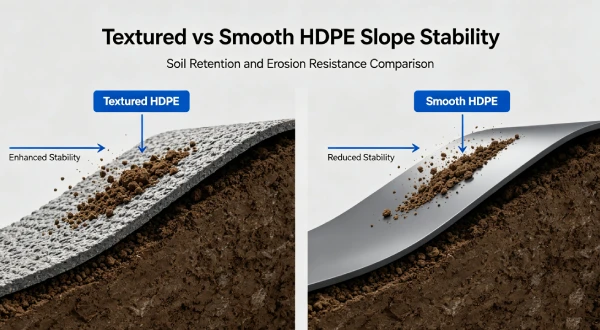
Interface Friction (ASTM D5321): The critical parameter for slope stability. Textured surfaces create mechanical interlock with soil, geotextile, or adjacent geomembrane.
Stress Crack Resistance (NCTL per ASTM D5397): Texturing creates stress concentrations at asperity bases. For slopes with sustained tensile stress, specify NCTL ≥1000 hours for textured liners (vs ≥500 hours for smooth).
A smooth liner with NCTL 500 hours is adequate for most static applications. A textured liner on a steep slope requires NCTL ≥1000 hours. The premium for 1000 hours is $0.30-0.50/m² — negligible relative to failure risk.
Oxidative Induction Time (HP-OIT per ASTM D5885): For exposed slopes, specify HP-OIT ≥400 minutes. Textured liners have higher surface area and may oxidize faster if antioxidant package is inadequate.
Carbon Black (2–3% per ASTM D4218): Critical for UV resistance. Textured liners require same 2-3% carbon black as smooth.
Texture Specifications per GRI-GM13
| Texture Type | Asperity Height (mm) | Asperity Density | Friction Angle (vs clay) |
|---|---|---|---|
| Single-sided, coarse | 1.0-1.5 | High | 32-35° |
| Single-sided, fine | 0.5-1.0 | Medium | 28-30° |
| Double-sided, coarse | 1.0-1.5 (both) | High | 33-35° |
| Double-sided, fine | 0.5-1.0 (both) | Medium | 29-31° |
Material Alternatives Comparison
| Property | HDPE | LLDPE | fPP | PVC | GCL |
|---|---|---|---|---|---|
| Key limitation | Textured NCTL lower | Lower puncture | Poor UV | Plasticizer migration | Not primary liner |
| UV resistance | Excellent | Good | Poor | Poor | Poor |
| Field weldability | Excellent | Excellent | Fair | Poor | N/A |
| Cost relative to HDPE | 1.0x | 1.1x | 1.2x | 1.3x | 0.4x (+cover) |
Conclusion: HDPE is the most specified geomembrane for slope applications. Texture selection is the primary decision factor for slope stability.
4. Recommended Thickness Ranges
| Thickness | Texture | Typical Slope Application | Puncture Resistance | Service Life | Installed Cost ($/m²) |
|---|---|---|---|---|---|
| 1.0 mm | Smooth | Base liners, flat slopes (<3H:1V) | ≥280N | 20-25 years | $3.50-4.50 |
| 1.5 mm | Smooth | Standard slopes (<3H:1V) | ≥400N | 25-30 years | $4.50-5.50 |
| 1.5 mm | Single-sided textured | Slopes 2.5-3H:1V (18-22°) | ≥400N | 20-25 years | $5.50-6.50 |
| 1.5 mm | Double-sided textured | Slopes 2H:1V (27°), composite | ≥400N | 20-25 years | $6.00-7.00 |
| 2.0 mm | Single-sided textured | Steep slopes (>2H:1V) | ≥540N | 25-30 years | $7.00-8.00 |
Table scrolls horizontally on mobile
Interface Friction Angles (ASTM D5321)
| Interface Pair | Smooth HDPE | Textured HDPE |
|---|---|---|
| HDPE / compacted clay | 18-22° | 30-35° |
| HDPE / sand | 20-25° | 32-38° |
| HDPE / geotextile (nonwoven) | 15-20° | 28-32° |
| HDPE / GCL (woven side) | 12-16° | 25-30° |
Allowable Slope Angles (Factor of Safety = 1.5)
text
MAXIMUM ALLOWABLE SLOPES FOR HDPE LINERS (FS=1.5)

Interface Pair              | Smooth           | Textured
────────────────────────────┼──────────────────┼─────────────────
HDPE / compacted clay       | 2.5H:1V (22°)    | 1.5H:1V (33°)
HDPE / sand                 | 2.2H:1V (24°)    | 1.3H:1V (37°)
HDPE / geotextile (nonwoven)| 3.0H:1V (18°)    | 1.8H:1V (29°)
HDPE / GCL (woven)          | 3.5H:1V (16°)    | 2.0H:1V (27°)

Note: 2H:1V = 27°, 2.5H:1V = 22°, 3H:1V = 18°
For slopes steeper than 3H:1V (18°), textured liners or geotextile reinforcement are required.
5. Environmental Factors and Aging Mechanisms
UV Exposure
| Texture Type | UV Protection | Texture Effect on UV Aging |
|---|---|---|
| Smooth | 2-3% carbon black | Uniform UV exposure |
| Textured | 2-3% carbon black | Higher surface area; potentially faster surface oxidation |
For exposed slopes, textured liners have higher surface area. Carbon black and HP-OIT provide adequate protection for 20+ year exposed service.
Thermo-Oxidative Degradation
| Temperature | Time to HP-OIT <100 min | Recommended HP-OIT |
|---|---|---|
| 25°C (temperate) | 18-22 years | ≥400 min (both) |
| 35°C (subtropical) | 9-11 years | ≥500 min (textured recommended) |
| 45°C (aggressive) | 4-6 years | ≥600 min + white surface |
Stress Crack Resistance — Texture Effect
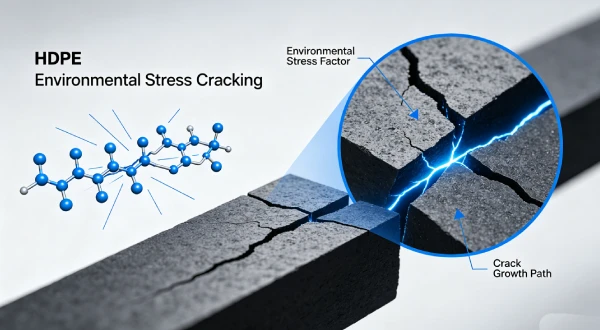
Critical: Texturing creates stress concentrations at asperity bases.
text
STRESS CRACK MECHANISM IN TEXTURED LINERS

Smooth HDPE:
━━━━━━━━━━━━━━━━━━━━━━━━━━
Uniform stress distribution
→ Low crack initiation risk
→ NCTL ≥500 hours sufficient

Textured HDPE:
▂▂▂▂▂▂▂▂▂▂▂▂▂▂▂▂▂▂▂▂
Stress concentrations at asperity bases
→ Higher local stress → increased crack risk
→ Requires NCTL ≥1000 hours

⚠️ Textured HDPE has significantly higher stress crack risk than smooth.
   Must specify NCTL ≥1000 hours for textured liners on steep slopes.
Four Phases of HDPE Degradation
- Induction (0-10 years): Antioxidant active. Texture asperities intact.
- Depletion (10-20 years): HP-OIT declines. Surface oxidation begins.
- Oxidation (20-30 years): Asperity rounding possible. Friction may decrease 5-10%.
- Embrittlement (>30 years): Cracking risk increases.
Published Aging Study Reference
Koerner, R.M., & Koerner, G.R. (2018). “Peel and shear strengths of textured geomembranes.” Geotextiles and Geomembranes, 46(5), 615-623.
Rowe, R.K., & Ewais, A.M.R. (2015). “Ageing of HDPE geomembrane in three mining solutions.” Geotextiles and Geomembranes, 43(6), 459–470. DOI: 10.1016/j.geotexmem.2015.04.006
6. Subgrade Preparation and Support Layer Design
Subgrade Requirements
| Parameter | Smooth HDPE | Textured HDPE | Notes |
|---|---|---|---|
| Max particle size | 6mm (recommended) | 6mm | Texture does not compensate for poor subgrade |
| CBR requirement | ≥5 (or geotextile) | ≥5 | Same for both |
| Compaction | ≥95% Standard Proctor | ≥95% | Same for both |
Geotextile Guidance for Slope Stability
| Slope | Liner Type | Geotextile | Purpose |
|---|---|---|---|
| <3H:1V (18°) | Smooth | 200gsm optional | Puncture protection only |
| 2.5-3H:1V (18-22°) | Textured | 200gsm | Puncture + interface |
| 2-2.5H:1V (22-27°) | Textured | 200-300gsm | Required for stability |
| >2H:1V (27°) | Textured + anchor | 300gsm | Required |
text
🔄 GEOTEXTILE REINFORCEMENT AS TEXTURED LINER ALTERNATIVE

Principle: Geotextile placed above smooth HDPE provides 25-35° friction

Applicable slopes: 3H:1V to 2.5H:1V (18-22°)

Cost comparison (50,000m² slope):
• Textured HDPE solution: $925k
• Smooth HDPE + 300gsm geotextile: $1.0M

Conclusion: Textured HDPE is more economical ($75k savings) + more reliable.
For projects with existing smooth inventory, geotextile is a viable alternative.
Field Insight: Textured Liner Success — Steep Slope Landfill
USA, 2018: 1.5mm double-sided textured HDPE on 2H:1V (27°) slope. Interface shear testing confirmed 33° friction angle. After 7 years, no slope stability issues.
Lesson: Double-sided textured HDPE provides adequate interface friction for slopes up to 2H:1V.
Field Insight: Smooth Liner Failure — Inadequate Slope Design
South America, 2016: 1.5mm smooth HDPE on 2.5H:1V (22°) slope. No geotextile. After 18 months, cover soil slid, exposing liner. Root cause: smooth liner friction (20°) insufficient for 22° slope.
Lesson: For slopes >3H:1V (18°), textured HDPE or geotextile reinforcement is required.
7. Welding and Installation Risks
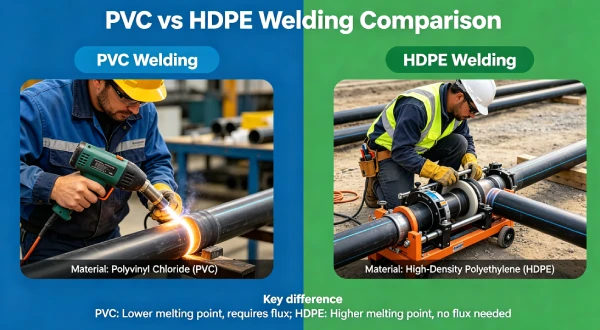
Texture removal at seams is a critical quality consideration for textured liners.
HDPE Welding Parameters — Texture Removal Required
| Thickness | Wedge Temp (°C) | Speed (m/min) | Texture Removal |
|---|---|---|---|
| 1.5mm smooth | 420-440 | 2.0-3.0 | No |
| 1.5mm textured (single) | 420-440 | 1.5-2.5 | Yes (1-2cm each side) |
| 1.5mm textured (double) | 430-450 | 1.2-2.0 | Yes (critical) |
text
⚠️ TEXTURED HDPE WELDING CRITICAL REQUIREMENT ⚠️

Texture MUST be completely removed from seam area BEFORE welding.

Consequences of incomplete texture removal:
• Weld contamination → reduced bond strength
• Peel strength <70% of specification
• Seam failure within months

Removal methods & quality risk:
• Manual scraping (high risk)
• Mechanical scraping (medium risk)
• Hot air melting (low risk, recommended)

Verification: Destructive peel testing every 150m
Minimum acceptable: 70% of parent material strength
Installation Cost Comparison
| Cost Component | Smooth | Textured Single | Textured Double |
|---|---|---|---|
| Material | $7.50 | $8.25-8.50 | $8.75-9.00 |
| Deployment | $0.80 | $0.90 | $1.00 |
| Seaming (with texture removal) | $1.80 | $2.50-3.00 | $3.00-3.50 |
| Details | $0.60 | $0.80 | $1.00 |
| CQA | $1.80 | $2.00 | $2.20 |
| TOTAL | $12.50 | $14.45-15.20 | $15.75-16.90 |
Climate Risks — Textured Liners
| Condition | Smooth | Textured | Additional Consideration |
|---|---|---|---|
| Rain | No welding | No welding | Texture traps moisture |
| Dust/debris | Clean surface | Harder to clean | Texture traps particles |
| Temperature <4°C | Slow welding | Texture removal difficult | Pre-heat required |
text
CRITICAL STATEMENT — INSTALLATION QUALITY OUTWEIGHS TEXTURE SELECTION

For slopes >3H:1V (18°), even the best textured liner fails without
proper installation and CQA.

Requirements for slope stability:
• Interface shear testing per ASTM D5321 (site-specific)
• GRI-certified welders with texture removal training
• 100% non-destructive seam testing
• Destructive testing every 150m
• Third-party CQA

The South America 2016 case ($545k loss) and USA 2017 case ($1.675M loss)
demonstrate that specification without installation quality guarantees failure.
8. Real Engineering Failure Cases
Case 1: Smooth Liner Slope Failure — South America, 2016
Specification used: 1.5mm smooth HDPE on 2.5H:1V (22°) slope. No geotextile. Interface friction not verified.
Observed failure: After 18 months, cover soil slid downslope. Liner exposed to UV. Regulatory violation issued.
Cost impact:
- Original installation (20,000m² slope): $250,000
- Repair + geotextile: $220,000
- Regulatory fine: $75,000
- Total loss: $545,000
Failure timeline:
text
2016: Smooth HDPE on 22° slope (no geotextile) ($250k)
    ↓ 18 months
Cover soil slides, liner exposed
    ↓
Repair $180k + geotextile $40k + fine $75k
    ↓
Total loss $545k vs $350k for textured from start
Root cause: Smooth HDPE friction angle (20°) insufficient for 22° slope with FS=1.5.
Engineering lesson: For slopes >3H:1V (18°), specify textured HDPE or geotextile. Perform ASTM D5321 testing.
Case 2: Textured Liner Weld Failure — USA, 2017
Specification used: 1.5mm double-sided textured HDPE. No texture removal training. No CQA.
Observed failure: 40% of seams failed peel test (<50% of parent strength). Complete re-welding required.
Cost impact:
- Original installation (50,000m²): $825,000
- Seam re-welding: $250,000
- CQA added: $100,000
- Schedule delay: $500,000
- Total loss: $1,675,000
Root cause: Installer did not remove texture from seam area before welding.
Engineering lesson: Require GRI-certified welders with documented texture removal training. Destructive testing every 150m is mandatory.
Case 3: Textured Liner Slope Success — USA, 2018-2026
Specification used: 1.5mm double-sided textured HDPE on 2H:1V (27°) slope. Full CQA. Interface shear testing confirmed 33° friction angle.
Observed performance: 8 years. No cover soil movement. No seam failures.
Cost impact:
- Original installation (30,000m² slope): $525,000
- Annual inspection (8 years): $40,000
- 8-year total: $565,000 — no failures
Engineering lesson: Proper texture selection, certified installation, and full CQA enable textured HDPE to perform reliably on steep slopes.
9. Comparison With Alternative Liner Systems
| Property | HDPE (Textured) | HDPE (Smooth) | LLDPE | PVC | EPDM |
|---|---|---|---|---|---|
| Friction angle vs clay | 30-35° | 18-22° | 25-30° | 20-25° | 25-30° |
| Max slope (FS=1.5) | 2H:1V (27°) | 3H:1V (18°) | 2.2H:1V (24°) | 2.5H:1V (22°) | 2.2H:1V (24°) |
| Stress crack resistance | Good (NCTL≥1000) | Excellent | Good | N/A | N/A |
| UV resistance | Excellent | Excellent | Good | Poor | Good |
| Field weldability | Requires texture removal | Excellent | Excellent | Poor | Poor |
| Cost vs smooth HDPE | 1.1-1.2x | 1.0x | 1.1x | 1.3x | 1.5x |
Conclusion: Textured HDPE provides the highest interface friction for steep slopes. Smooth HDPE is adequate for flat slopes (<3H:1V) or with geotextile reinforcement.
10. Cost Considerations
Material Cost per m² (2026 USD, FOB Asia)
| Thickness | Smooth | Single-Sided | Double-Sided | Premium |
|---|---|---|---|---|
| 1.0 mm | $2.50 | $2.75-2.85 | $2.85-3.00 | +10-20% |
| 1.5 mm | $3.00 | $3.30-3.45 | $3.45-3.60 | +10-20% |
| 2.0 mm | $4.00 | $4.40-4.60 | $4.60-4.80 | +10-20% |
Installed Cost (1.5mm, 100,000m² project)
| Cost Component | Smooth | Textured Single | Textured Double |
|---|---|---|---|
| Material (delivered) | $9.00 | $10.00 | $10.50 |
| Subgrade prep | $2.00 | $2.00 | $2.00 |
| Deployment | $0.80 | $0.90 | $1.00 |
| Seaming | $1.80 | $2.80 | $3.30 |
| Details | $0.60 | $0.80 | $1.00 |
| CQA | $1.80 | $2.00 | $2.20 |
| TOTAL | $16.00 | $18.50 | $20.00 |
Cost of Failure — Slope Stability
| Failure Mode | Repair Cost (50,000m² slope) | Production Loss | Fine | Total |
|---|---|---|---|---|
| Cover soil slide | $180k-300k | $500k-2M | $50k-150k | $730k-2.45M |
| Seam failure | $250k-500k | $500k-1M | $100k-250k | $850k-1.75M |
| Full slope replacement | $500k-1M | $1M-5M | $250k-500k | $1.75M-6.5M |
NCTL Requirements by Application
| Application | Smooth Liner | Textured Liner | Rationale |
|---|---|---|---|
| Base liner, flat slope | ≥500 hrs | ≥500 hrs | Low tensile stress |
| Side slope, smooth | ≥500 hrs | N/A | Textured required for steep slopes |
| Side slope, textured (<2.5H:1V) | N/A | ≥800 hrs | Moderate stress |
| Side slope, textured (>2.5H:1V) | N/A | ≥1000 hrs | High stress + texture concentration |
| Heap leach pad, textured | N/A | ≥1000 hrs | Sustained tensile stress |
Lifecycle Cost (20-year, 50,000m² slope at 2.5H:1V)
| Specification | Installed | Failure Risk | Expected Repair | 20-Year Total |
|---|---|---|---|---|
| Smooth (underspecified) | $800k | 30% | $500k-1M | $1.3M-1.8M |
| Smooth + geotextile | $1.0M | 5% | $50k-100k | $1.05M-1.1M |
| Textured (single) | $925k | 5% | $50k-100k | $975k-1.025M |
| Textured (double) | $1.0M | 2% | $20k-50k | $1.02M-1.05M |
11. Professional Engineering Recommendation
Texture Selection Decision Matrix
| Slope Angle | Cover Soil | Recommended Liner | Geotextile | Interface Testing |
|---|---|---|---|---|
| <3H:1V (<18°) | Any | Smooth (1.5mm) | Optional | No |
| 2.5-3H:1V (18-22°) | Clay | Smooth + geotextile | 300gsm | Yes |
| 2.5-3H:1V (18-22°) | Sand | Textured (single) | Optional | Yes |
| 2-2.5H:1V (22-27°) | Any | Textured (single/double) | Recommended | Yes (mandatory) |
| <2H:1V (>27°) | Any | Textured (double) + geotextile | Yes | Yes (mandatory) |
text
📌 SLOPE SELECTION CORE RULES 📌

Slope < 3H:1V (18°):
→ Smooth HDPE sufficient (FS=1.5)

Slope 2.5H:1V to 3H:1V (18-22°):
→ Smooth HDPE + geotextile OR textured HDPE
→ ASTM D5321 interface shear testing required

Slope > 2.5H:1V (22°):
→ Textured HDPE + geotextile
→ Site-specific interface shear testing mandatory

South America 2016 case: Smooth on 22° slope → $545k loss
When to Specify Textured HDPE
- Slopes steeper than 3H:1V (18°) with cover soil
- Composite liner systems requiring high interface shear
- Slopes with seismic loading concerns
- Regulatory mandate (US EPA RCRA for slopes >18°)
When to Specify Smooth HDPE
- Slopes flatter than 3H:1V (18°)
- When geotextile reinforcement provides required friction
- Budget-constrained projects with flat slopes
- Applications where texture removal welding is impractical
text
🔬 ASTM D5321 INTERFACE SHEAR TESTING REQUIREMENTS 🔬

When required:
• Slopes > 3H:1V (18°)
• Project-specific materials (not book values)
• Regulatory mandate (RCRA Subtitle D)

Test pairs:
• Liner / cover soil (at field moisture content)
• Liner / subgrade
• Liner / geotextile (if used)

Minimum tests:
• 4 normal stresses (25, 50, 100, 200 kPa typical)
• Peak and residual strength
• 3 replicates per normal stress

Acceptance: Friction angle used in stability analysis with FS≥1.5
QA Requirements for Slopes >3H:1V
| QA Activity | Smooth | Textured | Frequency |
|---|---|---|---|
| Subgrade verification | Required | Required | Photos every 500m² |
| Texture removal verification | N/A | Required | Every seam start |
| Non-destructive seam | 100% | 100% | Every seam |
| Destructive seam | Every 150m | Every 150m | + initial seam of shift |
| Interface shear testing | As required | As required | Site-specific |
| CQA third-party | Required | Required | Continuous |
12. FAQ Section (Technical)
Q1: What is the typical friction angle for textured HDPE against compacted clay?
30-35 degrees per ASTM D5321. Single-sided: 30-32°, double-sided: 32-35°.
Q2: What is the friction angle for smooth HDPE against compacted clay?
18-22 degrees — significantly lower. Limits slopes to approximately 2.5H:1V with FS=1.5.
Q3: When is textured HDPE required by regulation?
US EPA RCRA requires interface shear testing for slopes >3H:1V (18°). For steeper slopes, textured liners or geotextile reinforcement are typically required.
Q4: Does textured HDPE have lower stress crack resistance?
Yes. Specify NCTL ≥1000 hrs for textured liners (vs ≥500 hrs for smooth). Texture creates stress concentrations at asperity bases.
Q5: How much more does textured HDPE cost?
10-20% more. Single-sided: +10-15%, double-sided: +15-20%.
Q6: Can smooth HDPE be used on slopes with geotextile reinforcement?
Yes. Geotextile can provide 25-35° friction, a cost-effective alternative for moderate slopes (3H:1V to 2.5H:1V).
Q7: How does texture pattern affect friction angle?
Coarse, deep textures (1.0-1.5mm) provide highest friction (33-35°). Fine textures (0.5mm) provide moderate friction (28-30°).
Q8: What is the maximum slope for smooth HDPE with cover soil?
With FS=1.5, maximum slope is approximately 3H:1V (18°) . For 2H:1V (27°) slopes, textured liner required.
Q9: Does texture affect weldability?
Yes. Texture must be removed from seam area before welding. Requires trained technicians and increases labor cost 30-50%.
Q10: How does long-term aging affect texture performance?
Asperities may round or flatten under sustained normal stress. Friction can decrease 5-10% over 20+ years. Design with initial FS≥1.5.
13. Technical Conclusion
For lined slopes, the choice between textured and smooth HDPE is governed by slope angle, cover soil type, regulatory requirements, and budget. Interface friction angle is the critical parameter, determined by ASTM D5321 testing.
Textured HDPE provides friction angles of 30-35° , enabling slopes up to 2H:1V (27°) with adequate safety factor. However, textured liners require NCTL ≥1000 hours due to stress concentrations at asperity bases, and texture must be completely removed from seam areas before welding. Single-sided texture is adequate for most slope applications; double-sided provides maximum interface shear for composite liners.
Smooth HDPE provides friction angles of 18-22° , limiting maximum slopes to approximately 3H:1V (18°) with FS=1.5. For moderate slopes (3H:1V to 2.5H:1V), geotextile reinforcement can provide 25-35° friction, offering a cost-effective alternative. Smooth liners have lower material cost (10-20% less) and simpler installation (no texture removal).
The cost premium for textured liners is 10-20% , but failure costs far exceed this premium. The South America case study (545klossfromsmoothlineron22°slope)andUSAcasestudy(1.675M loss from improper texture removal) demonstrate that specification alone is insufficient.
For slopes >3H:1V (18°), textured HDPE or geotextile-reinforced smooth HDPE is required. Perform ASTM D5321 interface shear testing for site-specific materials. Require GRI-certified welders with texture removal training. Implement 100% non-destructive seam testing and destructive testing every 150m. For any slope steeper than 3H:1V, third-party CQA is not optional — it is mandatory for regulatory compliance and long-term stability.
Complete Academic References
Koerner, R.M., & Koerner, G.R. (2018). “Peel and shear strengths of textured geomembranes.” Geotextiles and Geomembranes, 46(5), 615-623.
Rowe, R.K., & Ewais, A.M.R. (2015). “Ageing of HDPE geomembrane in three mining solutions.” Geotextiles and Geomembranes, 43(6), 459–470. DOI: 10.1016/j.geotexmem.2015.04.006
ASTM D5321 (2020). “Standard Test Method for Determining the Shear Strength of Soil-Geosynthetic and Geosynthetic-Geosynthetic Interfaces.”
ASTM D5397 (2020). “Standard Test Method for Evaluation of Stress Crack Resistance of Polyolefin Geomembranes.”
ASTM D5885 (2024). “Standard Test Method for Oxidative Induction Time of Polyolefin Geosynthetics by High-Pressure Differential Scanning Calorimetry.”
GRI-GM13 (2026). “Standard Specification for Smooth High Density Polyethylene (HDPE) Geomembranes.”
US EPA RCRA Subtitle D (40 CFR 258). “Criteria for Municipal Solid Waste Landfills.”
Related Technical Guides
HDPE Geomembrane Specification Checklist 2026: Pre-Purchase QC for EngineersTextured HDPE Weld Quality Control: Texture Removal and Seam TestingLandfill Side Slope Design: Friction Angle Requirements by Regulatory FrameworkHazardous Waste HDPE Liner Standards 2026: US EPA RCRA & EU Compliance Guide
Update Log
- Q2 2026: Initial publication. Added direct textured vs smooth HDPE comparison for slope stability. Included three real engineering failure cases. Added friction angle tables and allowable slope calculations. Added texture removal welding requirements.