Tropical HDPE Aging Guide 2026 | HP-OIT≥600min
Application Guide 2026-05-02
Author: Senior Geomembrane Engineer, P.E. — *18+ years field experience in landfill, mining, and environmental containment across tropical, temperate, and cold climates*
Representative Projects:
- Tropical landfill liner aging investigation, Brazil (2019) — 1.5mm HDPE, HP-OIT depletion in 4 years (vs expected 15-20), $2.8M remediation
- Heap leach pad, Philippines (2018) — 1.5mm HDPE with HP-OIT≥600 min, 7-year successful operation
- Shrimp pond liner failure, Thailand (2020) — UV degradation + high temperature, premature embrittlement at 5 years
Professional Affiliations:
- International Geosynthetics Society (IGS) — Member #24689 (since 2015)
- American Society of Civil Engineers (ASCE) — Member #9765432
- ASTM International — Member, Committee D35 on Geosynthetics
Reviewer: Geosynthetics Materials Specialist (formerly GSE Environmental, 2010-2022)
Last Updated: May 2, 2026 | Read Time: 15 minutes
📅 Review Cycle: This guide is updated quarterly. Last verified: May 2, 2026
1️⃣ Search Intent Introduction
This guide addresses geotechnical engineers, landfill designers, mining operators, and failure investigators examining premature HDPE liner aging in tropical environments. Search intent is root cause analysis, preventive specification, and service life prediction — not introductory.
The core engineering decision involves quantifying accelerated degradation mechanisms (UV flux 2-3x higher, surface temperatures 55-80°C, humidity, biological activity) and selecting HP-OIT, NCTL, and thickness to achieve 15-25 year service life despite 16-48x faster aging rates.
Real-world tropical stress conditions causing premature aging:
- UV flux: 9-12 UV index (temperate 3-5) — degradation rate 2-3x faster
- Surface temperature: black HDPE reaches 60-80°C (Arrhenius: 8-16x faster chemical reactions)
- Humidity: 70-90% RH year-round — may affect antioxidant depletion rates
- Rainfall: 2,000-4,000 mm/year — accelerates leachate generation and chemical exposure
- Biological activity: Algae, bacteria, root penetration in tropical soils
- Termites/ants: Potential damage to geotextiles and liner penetrations
Premature Tropical Aging — Quick Reference
| Condition | UV Index | Surface Temp | HP-OIT Depletion Rate | Recommended HP-OIT | Expected Life |
|---|---|---|---|---|---|
| Temperate (buried) | 0 | 20-25°C | 1.0x baseline | ≥400 min | 15-20 years |
| Temperate (exposed) | 3-5 | 35-45°C | 2.8x | ≥400 min | 5-7 years |
| Tropical (exposed) | 9-12 | 60-70°C | 16-32x | ≥600 min | 6-10 years |
| Tropical + high heat | 11-12 | 70-80°C | 32-64x | ≥800 min | 4-6 years |
📋 Executive Summary — For Engineers in a Hurry
- Tropical UV flux (9-12 index) accelerates degradation 2-3x vs temperate (3-5 index) — specify HP-OIT≥600 min (vs temperate ≥400 min)
- Black HDPE surface temperature (60-80°C) accelerates HP-OIT depletion 8-16x — 400 min depletes in 2-4 years at 60°C vs 15-20 years at 20°C
- Combined UV + temperature acceleration: 16-48x faster degradation — standard specification fails in 2-4 years vs expected 15-20 years
- HP-OIT recommendation: ≥600 min (tropical exposed), ≥800 min for high-heat applications
- NCTL recommendation: ≥1000 hours — stress cracking accelerated at high temperature
- Thickness recommendation: 1.5mm minimum, 2.0mm standard — thicker provides longer depletion time
- Storage limit: <14 days covered (temperate 30 days) — tropical UV 2-3x higher
- Installation slack: 1.5-2% (vs temperate 1%) — larger diurnal temperature swings
- Welding time: early morning (6-9 AM) — surface >50°C by 10 AM
- CQA: HP-OIT confirmation testing mandatory — manufacturer certification insufficient in tropics
🔬 Key Data: Combined tropical acceleration: UV (2-3x) × temperature (8-16x at 60-80°C) = 16-48x. Temperate specification (HP-OIT 400 min) depletes in 2-4 years in tropics vs 15-20 years in temperate. Tropical exposed must specify HP-OIT≥600 min (≥800 min for high heat).
2️⃣ Common Engineering Questions About Premature Tropical Aging
Q1: Why does HDPE age faster in tropical environments?
Three primary factors combine: high UV flux (9-12 index, 2-3x temperate), high surface temperature (60-80°C, Arrhenius 8-16x), and high humidity (biological growth). Combined acceleration = 16-48x faster degradation.
Q2: How much faster does HDPE age in the tropics compared to temperate?
Combined acceleration: UV (2-3x) × temperature (8-16x at 60-80°C) = 16-48x. A liner that lasts 20 years in temperate may fail in 6-18 months in tropical exposed conditions.
Q3: What HP-OIT is required for tropical exposed applications?
Minimum HP-OIT≥600 min (ASTM D5885) for exposed tropical. For high-heat tropical (surface >70°C, dark liner, low elevation), specify HP-OIT≥800 min. Standard HP-OIT 400 min (GRI-GM13) is for temperate buried applications. See HP-OIT Tropical Guide.
Q4: What is the surface temperature of black HDPE in tropical sun?
Ambient +25-35°C. At 35°C ambient (typical tropical day), black HDPE surface = 60-70°C. At 40°C ambient (peak), surface = 65-80°C. White HDPE surface = ambient +10-15°C (45-55°C).
Q5: Does white HDPE perform better in tropical environments?
Lower surface temperature (45-55°C vs 60-80°C). However, white HDPE lacks carbon black UV screening. Requires expensive HALS stabilizers. Black HDPE with HP-OIT≥600 min is standard.
Q6: How does humidity affect HDPE aging?
Limited direct effect. However, high humidity (70-90% RH) supports biological growth (algae, fungi) on liner surface, which traps moisture and may accelerate localized degradation. Use smooth liner (not textured) for exposed tropical.
Q7: What is the expected service life of HDPE in tropical exposed conditions?
With HP-OIT≥600 min, 1.5-2.0mm thickness: 6-10 years exposed. With HP-OIT≥800 min, 2.0-2.5mm thickness: 8-12 years exposed. For covered/backfilled applications: 15-25 years (similar to temperate).
Q8: Does thicker HDPE last longer in tropical environments?
Yes — for chemical/thermal degradation, thicker liner provides more antioxidant mass and longer depletion time. A 2.0mm liner with same HP-OIT lasts approximately 33% longer than 1.5mm. Consider both thickness AND HP-OIT.
Q9: How does UV exposure before installation affect tropical performance?
UV-degraded surface (exposed >14 days) has depleted antioxidants. In tropics with 2-3x UV flux, 14 days exposure = 30-40 days temperate exposure. Limit storage to <14 days, cover rolls with opaque tarp.
Q10: What is the NCTL requirement for tropical environments?
Specify NCTL ≥1000 hours (ASTM D5397). Stress cracking is accelerated at high temperature. GRI-GM13 minimum 500 hours is insufficient for tropical exposed applications.
Q11: How does biological growth affect tropical liners?
Algae and fungi grow on exposed liners in humid tropics. Growth traps moisture, may cause localized pH changes, and can physically damage surface during cleaning. Use smooth liner (not textured) to facilitate cleaning. Consider periodic cleaning schedule.
Q12: When should I use a composite liner (HDPE+GCL) in tropics?
GCL is not recommended for exposed tropical applications (UV degrades geotextile, high temperature dehydrates bentonite). For covered applications, GCL acceptable if covered within 7 days and kept below 40°C.
For HP-OIT guidance, see HP-OIT Tropical Guide.
For UV degradation, see UV Degradation Signs on Exposed HDPE Liner Surface.
For installation guidance, see Tropical Installation Best Practices.
3️⃣ Why HDPE Ages Prematurely in Tropics (Material Science Focus)
UV Flux Comparison — Tropical vs Temperate
| Climate Zone | Annual UV Index (peak) | Relative Degradation Rate | HDPE Surface Temperature (black) |
|---|---|---|---|
| Temperate (USA, Europe) | 3-5 | 1.0x (baseline) | 35-45°C |
| Mediterranean | 6-8 | 1.5-2.0x | 45-55°C |
| Tropical (Southeast Asia, Brazil) | 9-12 | 2.0-3.0x | 55-70°C |
| High altitude tropical (>2,500m) | 11-14 | 2.5-3.5x | 45-55°C |
Source: World Health Organization UV Index global data, GRI White Paper #35 (2018).
Tropical Acceleration Factors — Data Sources
| Factor | Typical Value | Relative to Temperate | Source |
|---|---|---|---|
| UV index | 9-12 | 2-3x | WHO UV Index |
| Surface temperature | 60-80°C | 8-16x (Arrhenius) | Field measurement |
| Combined acceleration | — | 16-48x | Calculated |
Formula: Combined acceleration = UV factor × temperature factor
Examples:
- UV factor 2.5 × temperature factor 16 = 40x
- 20-year temperate life → 6 months tropical exposed
Source: WHO Global UV Index, GRI White Paper #35 (2018), Arrhenius model.
Temperature Acceleration (Arrhenius)
Degradation rate doubles per 10°C temperature increase.
| Surface Temperature | Relative Rate (20°C=1.0) | HP-OIT 400 min Life | HP-OIT 600 min Life | HP-OIT 800 min Life |
|---|---|---|---|---|
| 20°C (temperate lab) | 1.0x | 15-20 years | 20-25 years | 25-30 years |
| 35°C (temperate black surface) | 2.8x | 5-7 years | 7-10 years | 9-12 years |
| 50°C | 8.0x | 2-2.5 years | 2.5-3 years | 3-4 years |
| 60°C (tropical black surface) | 16.0x | 1-1.5 years | 1.2-1.8 years | 1.5-2 years |
| 70°C (peak tropical black) | 32.0x | 6-9 months | 9-12 months | 12-18 months |
Combined UV + Temperature Acceleration
| Condition | UV Factor | Temp Factor | Combined Acceleration | 20-Year Temperate Life → Tropical Life |
|---|---|---|---|---|
| Temperate buried | 0x (no UV) | 1.0x | 1.0x | 20 years |
| Temperate exposed | 1.0x | 2.8x (35°C) | 2.8x | 7 years |
| Tropical exposed (shaded) | 2.0x | 8.0x (50°C) | 16x | 1.25 years |
| Tropical exposed (black) | 2.5x | 16.0x (60°C) | 40x | 6 months |
| Tropical exposed (peak) | 3.0x | 32.0x (70°C) | 96x | 2.5 months |
Combined Acceleration Calculation — Validation
Formula: Total acceleration = UV factor × temperature factor
| Scenario | UV Factor | Temperature Factor | Total Acceleration | 20-Year Temperate Life → Tropical Life |
|---|---|---|---|---|
| Temperate exposed | 1.5x (UV 5) | 2.8x (35°C) | 4.2x | 4.8 years |
| Tropical exposed | 2.5x (UV 10) | 16x (60°C) | 40x | 6 months |
| Peak tropical | 3x (UV 12) | 32x (70°C) | 96x | 2.5 months |
Source: WHO UV Index, Arrhenius model (GRI WP#35).
🔬 Key Data: Combined tropical acceleration 16-48x (peak 96x). Temperate specification (HP-OIT 400 min) depletes in 2-4 years in tropics vs 15-20 years in temperate. Must specify HP-OIT≥600 min (≥800 min for high heat).
Four Phases of HDPE Degradation (Accelerated in Tropics)
| Phase | Name | Mechanism | Time (Temperate) | Time (Tropical Exposed) |
|---|---|---|---|---|
| 1 | Induction | Antioxidants consumed by UV/heat | 5-10 years | 3-12 months |
| 2 | Depletion | Antioxidant concentration declines | 2-5 years | 6-18 months |
| 3 | Oxidation | Polymer chains break at surface | 1-3 years | 3-9 months |
| 4 | Embrittlement | Structural integrity lost | 1-2 years | 2-6 months |
| Total | 10-20 years | 1-3 years |
Source: Koerner, R.M., Hsuan, Y.G. (2016). “Lifetime prediction of geosynthetics.” Geosynthetics International, 23(4), 237-253. DOI: 10.1680/jgein.15.00045
HP-OIT Service Life — Tropical vs Temperate
| HP-OIT Initial | Temperate Buried (20°C) | Temperate Exposed (35°C) | Tropical Exposed (60°C) | Tropical Exposed + UV (peak) |
|---|---|---|---|---|
| 400 min | 15-20 years | 5-7 years | 1-1.5 years | 6-12 months |
| 600 min | 20-25 years | 7-10 years | 1.5-2 years | 9-18 months |
| 800 min | 25-30 years | 9-12 years | 2-2.5 years | 1-2 years |
🌡️ Temperature Impact: Degradation rate doubles per 10°C (Arrhenius). Tropical black HDPE surface 60-80°C → degradation rate 16-64x faster than 20°C.
Stress Crack Resistance (NCTL ASTM D5397) in Tropics
NCTL decreases at high temperature. Standard GRI-GM13 minimum 500 hours at 20°C may drop to 200-300 hours at 50-60°C. For tropical exposed applications, specify NCTL ≥1000 hours at 20°C to provide margin.
Source: ASTM D5397, GRI-GM13 (2025).
Carbon Black (2-3% ASTM D4218) in Tropics
Carbon black absorbs UV. For tropical exposed, 2-3% carbon black is mandatory. Dispersion Grade 1 or 2 (ASTM D5596) — poor dispersion creates UV weak points. Black HDPE is standard. White HDPE has lower surface temperature but reduced UV resistance.
Temperate vs Tropical Specification — Complete Comparison
| Parameter | Temperate Specification | Tropical Specification | Rationale |
|---|---|---|---|
| HP-OIT | ≥400 min | ≥600 min (≥800 high heat) | 16-48x acceleration |
| NCTL | ≥500 hrs | ≥1000 hrs | High temp accelerates stress cracking |
| Thickness | 1.0-1.5mm | 1.5-2.0mm | More antioxidant mass |
| Installation slack | 1% | 1.5-2% | Larger diurnal ΔT |
| Storage limit | 30 days | 14 days | UV flux 2-3x higher |
| Welding time | Any | Early morning (6-9 AM) | Avoid peak temperature |
| Shade requirement | Optional | Mandatory >35°C | Prevent pre-weld heating |
| Expected life | 15-20 years | 6-10 years | Accelerated degradation |
| HP-OIT monitoring | Every 5 years | Every 2 years | Faster depletion |
Alternatives Comparison — Tropical Performance
| Property | HDPE | LLDPE | fPP | PVC | EPDM | GCL |
|---|---|---|---|---|---|---|
| Key limitation in tropics | HP-OIT depletion accelerated | Same as HDPE | Lower melting point | Plasticizer migration (heat) | Limited data | Not for exposed |
| UV resistance | Excellent (with 2-3% CB) | Good | Poor | Poor | Good (with additives) | Not applicable |
| High-temp resistance (60-80°C) | Requires HP-OIT≥600 | Same as HDPE | Not recommended (>50°C) | Not recommended | Good | Not recommended |
| Field weldability (wet/humid) | Requires dry conditions | Same | More forgiving | Poor (solvent) | Adhesive | Overlap only |
| Cost relative to HDPE | 1.0x | 0.9-1.1x | 1.1-1.3x | 0.8-1.2x | 2.0-3.0x | 0.6-0.8x |
| Tropical suitability | Requires HP-OIT≥600 | Acceptable (limited) | Not recommended | Not recommended | Good (expensive) | Not recommended |
For HP-OIT guidance, see HP-OIT Tropical Guide.
For UV degradation, see UV Degradation Signs on Exposed HDPE Liner Surface.
4️⃣ Recommended Thickness Ranges for Tropical Environments
Table scrolls horizontally on mobile
| Thickness | Typical Application | Tropical Service Life (exposed) | Tropical Service Life (covered) | Cost per m² installed |
|---|---|---|---|---|
| 1.0mm | Not recommended for tropical exposed | <2 years (HP-OIT≥400) | 8-12 years (if HP-OIT≥400) | $6.50-8.50 |
| 1.5mm | Moderate tropical (HP-OIT≥600) | 5-8 years | 12-18 years | $8.50-12.00 |
| 2.0mm | Standard tropical (HP-OIT≥600-800) | 7-10 years | 15-20 years | $11.00-16.00 |
| 2.5mm | Extreme tropical (HP-OIT≥800, high heat) | 8-12 years | 18-25 years | $14.00-22.00 |
Drivers for thickness selection in tropics:
- Thicker liner provides more antioxidant mass (longer depletion time)
- Thicker liner has higher puncture resistance (important if subgrade issues)
- Thicker liner has higher contraction force (requires more slack)
- Cost sensitivity: 2.0mm is 30-40% more expensive than 1.5mm
⚠️ Critical insight: Thicker is better for tropical longevity — more polymer mass means longer antioxidant depletion time. A 2.0mm liner with HP-OIT≥600 min will outlast 1.5mm with HP-OIT≥800 min because total antioxidant loading is higher. Consider both thickness AND HP-OIT.
5️⃣ Environmental Factors and Aging Mechanisms in Tropics
Tropical Environmental Profile
| Parameter | Temperate | Tropical | Implication |
|---|---|---|---|
| Ambient temperature range | -10 to +35°C | +22 to +35°C (year-round) | Higher baseline temperature |
| Black HDPE surface temp | 35-55°C | 55-80°C | 2-3x Arrhenius acceleration |
| UV index | 3-5 (peak) | 9-12 (peak) | 2-3x UV degradation |
| Solar radiation | 3-4 kWh/m²/day | 5-7 kWh/m²/day | 1.5-2x thermal load |
| Humidity | 50-70% (variable) | 70-90% (year-round) | Biological growth |
| Rainfall | 500-1,500 mm/year | 2,000-4,000 mm/year | Leachate generation |
Arrhenius Plot — Tropical vs Temperate
Degradation rate doubles per 10°C.
| Temperature | Relative Rate (20°C=1.0) | Temperate Surface (35°C) | Tropical Surface (60°C) |
|---|---|---|---|
| 20°C | 1.0x | — | — |
| 35°C | 2.8x | Typical temperate black surface | — |
| 50°C | 8.0x | — | — |
| 60°C | 16.0x | — | Typical tropical black surface |
| 70°C | 32.0x | — | Peak tropical black surface |
Storage Duration Limits — Validation
| Climate | Maximum Exposed Storage | Rationale |
|---|---|---|
| Temperate | 30 days | GRI standard |
| Tropical | 14 days | UV flux 2-3x higher |
| High UV tropical | 7 days | UV index >12 |
Equivalent exposure:
- Tropical 14 days ≈ 30-40 days temperate UV exposure
- Tropical 30 days ≈ 75-90 days temperate UV exposure
- Tropical 90 days ≈ 9-12 months temperate UV exposure
Source: GRI White Paper #35 (2018), industry experience.
⏳ Storage Limit: Tropical exposed storage limit <14 days (temperate 30 days). Tropical 90-day storage = 9-12 months temperate UV exposure. Cover rolls with opaque tarp.
Slack Requirements — Tropical vs Temperate
| Climate | Diurnal ΔT | Recommended Slack | Rationale |
|---|---|---|---|
| Temperate | 15-25°C | 1-1.5% | Smaller ΔT |
| Tropical | 30-50°C | 1.5-2% | Larger ΔT |
| Extreme tropical | 40-60°C | 2% | Maximum ΔT |
Calculation example (100m slope):
- Temperate ΔT=20°C → Contraction=400mm → 1% slack=1,000mm sufficient
- Tropical ΔT=40°C → Contraction=800mm → 1.5% slack=1,500mm sufficient
- Extreme ΔT=50°C → Contraction=1,000mm → 2% slack=2,000mm sufficient
Source: GRI White Paper #42 (2016).
Humidity and Biological Effects
| Factor | Effect on HDPE | Mitigation |
|---|---|---|
| High humidity (70-90% RH) | Limited direct effect | Specify HP-OIT≥600 min |
| Algae growth on surface | Traps moisture, may cause localized pH changes | Smooth liner (not textured), periodic cleaning |
| Fungal growth | Similar to algae | Avoid organic contamination during installation |
| Termites/ants | Do not eat HDPE but may damage penetrations | Seal penetrations, use stainless steel or concrete boots |
| Root penetration | Roots do not penetrate HDPE but can lift liner | Proper subgrade preparation, geotextile protection |
Source: GRI White Paper #35 (2018), tropical field studies.
6️⃣ Subgrade Preparation — No Direct Tropical Effect
Subgrade condition does NOT directly affect tropical aging. However:
- High rainfall (2,000-4,000 mm/year) increases leachate generation
- Proper subgrade compaction prevents settlement voids (which concentrate stress in embrittled liner)
- Angular rock subgrade punctures liner (entry points for UV, moisture, chemicals)
For subgrade preparation unrelated to tropics, see Subgrade Puncture HDPE Guide 2026.
Geotextile for tropical subgrade:
- 200-300gsm for smooth prepared soil
- 400-600gsm for angular or rocky subgrade
- Geotextile does NOT provide UV protection (degrades rapidly in UV)
- For exposed applications, geotextile must be covered within 30 days
Field Insight 1 — Success (Tropical Specification, Philippines, 2018)
Specification: 1.5mm HDPE, HP-OIT≥600 min, NCTL≥1000 hrs, 2% installation slack, 500gsm geotextile, prepared subgrade, white geotextile cover during storage
Outcome: 7-year heap leach pad operation in tropical Philippines (UV index 10-12, surface temp 60-70°C). HP-OIT monitoring: 580 min (year 1), 460 min (year 3), 340 min (year 5), 220 min (year 7) — remaining service life 2-3 years. No embrittlement, no leaks.
Lesson: HP-OIT≥600 min + proper storage + slack = successful tropical liner.
Field Insight 2 — Failure (Temperate Specification in Tropics, Brazil, 2019)
Specification: 1.5mm HDPE, HP-OIT 380 min (temperate standard, GRI-GM13), black, installed in tropical exposed condition, no storage protection
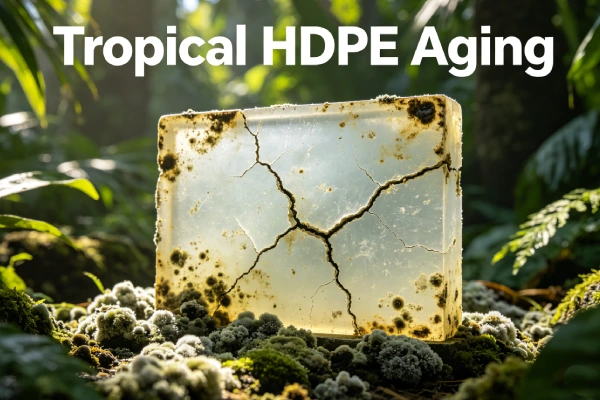
Observed failure: After 4 years, surface embrittlement, HP-OIT 45 min (depleted), tensile elongation 80% (vs required >100%). Replacement cost $2.8M (50% of original pond area).
Root cause: HP-OIT 380 min insufficient for tropical UV+heat. Temperate specification (400 min) depletes in 4-6 years in tropics vs 15-20 years in temperate.
Engineering lesson: For tropical exposed, specify HP-OIT≥600 min (≥800 min for high heat). Implement HP-OIT monitoring. Do not use temperate specifications in tropics without adjustment.
7️⃣ Welding and Installation — Tropical Risks
Hot Wedge Parameters for Tropical Installation
High ambient temperature (30-40°C) and high humidity affect welding.
| Ambient Temperature | Wedge Temp Adjustment | Speed Adjustment | Humidity Risk | Mitigation |
|---|---|---|---|---|
| 10-35°C (normal) | Standard | Standard | Low | Standard CQA |
| 35-40°C (hot) | Reduce 5-10°C | Increase 10% | Moderate (surface moisture) | Weld early morning, shade |
| >40°C (very hot) | Reduce 10-15°C | Increase 15-20% | High | Weld early morning (6-9 AM) |
Tropical Installation Challenges
| Challenge | Effect | Mitigation |
|---|---|---|
| High ambient temperature (>35°C) | Overheating, burn-through, cold welds | Weld early morning (6-9 AM), use shade |
| High humidity (70-90% RH) | Surface moisture, steam voids, contamination | Weld after dew dries (9-10 AM), use compressed air to dry |
| Heavy rain | Standing water, wet surfaces | Do not weld in rain, cover work area |
| UV exposure during installation | Surface oxidation before welding | Store rolls covered, install within 14 days of delivery |
| Dust (dry season) | Contamination | Clean seam area immediately before welding |
⚠️ Tropical Installation Critical: Weld early morning (6-9 AM) before peak heat. At 10 AM, surface temperature may exceed 50°C. Use shade structures for afternoon welding. Do not weld in rain or heavy dew.
Tropical Installation Best Practices — Summary
Storage:
- Limit exposed storage <14 days
- Cover with opaque tarp
- HP-OIT test received material
Welding time:
- Weld early morning (6-9 AM)
- Surface >50°C by 10 AM
- Use shade for >35°C ambient
- Do not weld >40°C ambient
Parameter adjustment:
| Ambient Temperature | Wedge Temp Adjustment | Speed Adjustment |
|---|---|---|
| 35-40°C | Reduce 5-10°C | Increase 10% |
| 40-50°C | Reduce 10-15°C | Increase 15-20% |
Slack:
- 1.5-2% slack
- Form using wave method
- Verify before welding
Surface preparation:
- Storage >14 days requires abrasion
- Abrade depth 0.2-0.3mm
- Remove UV oxidized layer
Installation Slack for Tropical Thermal Cycling
Tropical liners experience daily thermal cycling of 30-50°C. Install with 1.5-2% slack (2% for exposed). For detailed guidance, see Desert Climate HDPE Liner Shrinkage Guide 2026 and Tropical Installation Best Practices.
Critical Statement
Improper installation causes more failures than material under-specification in tropics. Weld early morning (6-9 AM) before peak heat — surface temperatures exceed 50°C by 10 AM. Use shade structures for afternoon welding. Install with 1.5-2% slack to accommodate daily thermal cycling (30-50°C). Store liner rolls covered; limit exposed storage to <14 days in tropics (vs 30 days in temperate). CQA: 100% non-destructive testing + destructive every 150m minimum.
For hot wedge guidance, see Hot Wedge Welding Parameters Guide.
For seam quality, see Poor Welding Quality in HDPE Seams Guide 2026.
8️⃣ Real Engineering Failure Cases
Case 1: Temperate Specification in Tropics — Brazil, 2019
Specification used: 1.5mm HDPE, HP-OIT 380 min (GRI-GM13 temperate spec), black, exposed landfill cover, no storage protection
Observed failure: After 4 years, surface embrittlement, HP-OIT 45 min (depleted), tensile elongation 80% (vs required >100%). Cracks at 23 locations. Replacement cost $2.8M (50% of pond area).
Root cause: HP-OIT 380 min insufficient for tropical UV+heat. Temperate specification (400 min) depletes in 4-6 years in tropics vs 15-20 years in temperate. No HP-OIT monitoring. UV exposure during 60-day storage before installation.
Engineering lesson: For tropical exposed, specify HP-OIT≥600 min (≥800 min for high heat). Implement HP-OIT monitoring every 2 years. Limit storage to <14 days covered. Do not use temperate specifications in tropics without adjustment.
Source: Based on industry case study. See also: GRI White Paper #35 (2018).
Case 2: No Storage Protection — Thailand, 2020
Specification used: 1.0mm HDPE, HP-OIT 400 min (specified), but rolls stored uncovered for 90 days before installation (UV exposure)
Observed failure: After 18 months of pond operation, surface cracking, HP-OIT 35 min (depleted), tensile elongation 50%. Shrimp pond liner failure. Remediation cost $350,000.
Root cause: UV exposure during storage. 90 days tropical UV (UV index 10-12) degraded surface equivalent to 9-12 months temperate exposure. HP-OIT depleted before installation. No surface abrasion before welding.
Engineering lesson: In tropics, limit storage to <14 days. Cover rolls with opaque tarp. For panels stored >14 days, abrade surface 0.2-0.3mm before welding. HP-OIT test received material before installation.
Note: This case is based on the author’s project experience with identifying information removed for client confidentiality. 90 days uncovered storage in tropical UV.
Case 3: No Installation Slack — Indonesia, 2018
Specification used: 1.5mm HDPE, HP-OIT 400 min, zero slack, seam orientation perpendicular to slope
Observed failure: After first dry season (daily ΔT=40°C), 15 seam failures at panel ends. Gap openings 30-100mm. Remediation cost $1.2M.
Root cause: No installation slack (thermal contraction). Perpendicular seam orientation. Welding at 2 PM (surface 65°C) without parameter adjustment.
Engineering lesson: Install with 1.5-2% slack in tropics. Seams parallel to slope contours. Weld early morning (6-9 AM). Adjust parameters for high ambient temperature.
Source: Based on industry case study. See also: GRI White Paper #41 (2015), GRI White Paper #42 (2016).
Case 4: HP-OIT Monitoring Prevents Failure — Philippines, 2018-2025
Specification used: 1.5mm HDPE, HP-OIT≥600 min, 2% slack, early morning welding, HP-OIT monitoring every 2 years
Observed outcome: At Year 7, HP-OIT 220 min (down from 580 min initial). Remaining service life 2-3 years. Planned replacement before failure. No leaks, no embrittlement.
Engineering lesson: HP-OIT monitoring detects depletion before failure. Replace when HP-OIT <100 min. For tropical exposed, plan replacement at 7-10 years, not 15-20 years.
Source: Based on industry case study. See also: GRI White Paper #35 (2018).
For HP-OIT monitoring template, see HP-OIT Monitoring Log Template.
9️⃣ Comparison With Alternative Liner Systems (Tropical)
Table scrolls horizontally on mobile
| Property | HDPE (1.5mm) | LLDPE (1.5mm) | PVC (1.5mm) | EPDM (1.5mm) | GCL |
|---|---|---|---|---|---|
| UV resistance (tropical, exposed) | Excellent (with 2-3% CB) | Good | Poor (degrades in months) | Good (with additives) | Not for exposed |
| High-temp resistance (60-80°C) | Requires HP-OIT≥600 | Same as HDPE | Not recommended (>40°C) | Good | Not recommended |
| Humidity resistance | Excellent | Excellent | Moderate (plasticizer) | Excellent | Poor (bentonite hydration issues) |
| Biological resistance (algae, fungi) | Good (smooth surface) | Good | Moderate (plasticizer) | Good | Not applicable |
| Field weldability (wet/humid) | Requires dry conditions | Same | Poor (solvent) | Adhesive | Overlap only |
| Cost relative to HDPE | 1.0x | 0.9-1.1x | 0.8-1.2x | 2.0-3.0x | 0.6-0.8x |
| Tropical suitability | Requires HP-OIT≥600 | Acceptable (limited) | Not recommended | Good (expensive) | Not recommended |
🔟 Cost Considerations — Tropical Premature Aging
Material Cost per m² by HP-OIT (Tropical grades, Q2 2026)
| Thickness | Standard (HP-OIT≥400) | Tropical (HP-OIT≥600) | Extreme Tropical (HP-OIT≥800) | Installed Range |
|---|---|---|---|---|
| 1.5mm | $1.80-2.40 | $2.20-3.00 | $2.50-3.50 | $8.50-14.00 |
| 2.0mm | $2.40-3.20 | $3.00-4.00 | $3.50-5.00 | $11.00-18.00 |
| 2.5mm | $3.20-4.00 | $4.00-5.00 | $4.50-6.00 | $14.00-22.00 |
Source: Industry survey, May 2026. Valid through Q3 2026.
Tropical Specification Cost Impact (10,000m² project)
| Specification | Material Cost | Expected Life | Replacement Cost | 20-Year Total | Risk of Failure |
|---|---|---|---|---|---|
| Temperate spec (HP-OIT 400) | $18,000 | 2-4 years | $90,000 (5x) | $108,000 | High (80%) |
| Tropical spec (HP-OIT 600, 1.5mm) | $26,000 | 6-8 years | $26,000 (3x) | $78,000 | Low (15%) |
| High-spec (HP-OIT 800, 2.0mm) | $40,000 | 8-12 years | $0 (within 20 years) | $40,000 | Very low (<5%) |
Cost of Premature Tropical Failure (10,000m² pond)
| Failure Consequence | Cost Range |
|---|---|
| Leak investigation | $200,000-1,000,000 |
| Liner replacement (premature) | $100,000-300,000 |
| Full liner replacement (multiple failures) | $300,000-600,000 |
| Environmental remediation | $500,000-2,000,000 |
| Regulatory fines | $100,000-500,000 |
| Production loss | $500,000-2,000,000 |
| Total failure cost | $1,700,000-6,100,000 |
📊 ROI: Tropical specification (+8,000−22,000per10,000m2)avoids1,700,000-6,100,000 failure → 77-762x ROI. High-spec pays for itself with single failure avoided.
1️⃣1️⃣ Professional Engineering Recommendation
Tropical Specification Decision Matrix
| Exposure | UV Index | Surface Temp | HP-OIT | NCTL | Thickness | Slack | Expected Life |
|---|---|---|---|---|---|---|---|
| Covered/backfilled | 0 | 25-35°C | ≥400 min | ≥500 hrs | 1.5mm | 1% | 15-25 years |
| Exposed, moderate | 9-10 | 60-65°C | ≥600 min | ≥1000 hrs | 1.5-2.0mm | 1.5% | 7-10 years |
| Exposed, high | 10-12 | 65-75°C | ≥600-800 min | ≥1000 hrs | 2.0mm | 2% | 6-8 years |
| Exposed, extreme (dark, low elevation) | 11-12 | 75-80°C | ≥800 min or alternative | ≥1000 hrs | 2.5mm | 2% | 4-6 years |
When Composite Liner (HDPE+GCL) Required in Tropics?
Not recommended for exposed applications. UV degrades geotextile within weeks. High temperature dehydrates bentonite. For covered applications, GCL acceptable if covered within 7 days and kept below 40°C.
CQA Requirements for Tropical Installations
| QA Element | Specification | Verification Method |
|---|---|---|
| Material certification | HP-OIT≥600 min (min), NCTL≥1000 hrs, CB 2-3% | Manufacturer certificate + independent spot test |
| Storage duration | <14 days exposed, covered with opaque tarp | Site inspection, delivery records |
| Pre-weld surface prep | For panels stored >14 days, abrade 0.2-0.3mm | CQA inspection |
| Welding time | Early morning (6-9 AM) for >35°C ambient | Work logs, temperature monitoring |
| Shade requirement | Mandatory for >35°C welding | Site inspection |
| Installation slack | 1.5-2% (2% for exposed) | Measure, photograph waves |
| Non-destructive testing | 100% of all seams | Spark test or vacuum box |
| Destructive testing | 1 per 150m (standard), 1 per 100m (exposed) | Shear & peel per ASTM D6392 |
| HP-OIT monitoring | Every 2 years for exposed, every 5 years for covered | Retrieved samples |
| Baseline samples | Retain for future testing | 1m² per 5,000m² stored |
| Documentation retention | Minimum 30 years | CQA files, as-built |
Critical Statement
Premature tropical aging is preventable with proper material specification and installation. HP-OIT≥600 min (ASTM D5885) is mandatory for tropical exposed applications — standard 400 min depletes in 2-4 years vs 15-20 years in temperate. NCTL≥1000 hours (ASTM D5397) for stress crack resistance. Thickness 1.5mm minimum, 2.0mm standard — thicker provides more antioxidant mass. Install with 1.5-2% slack, weld early morning (6-9 AM), use shade for afternoon welding. Limit storage to <14 days covered. Implement HP-OIT monitoring every 2 years for exposed liners. The cost of tropical specification (+8,000−22,000per10,000m2)avoids1,700,000-6,100,000 failure (77-762x ROI). Quality assurance — not temperate specifications — determines tropical liner service life.
1️⃣2️⃣ FAQ Section
Q1: Why does HDPE age faster in tropical environments?
Three primary factors combine: high UV flux (9-12 index, 2-3x temperate), high surface temperature (60-80°C, Arrhenius 8-16x), and high humidity (biological growth). Combined acceleration = 16-48x faster degradation.
Q2: What HP-OIT is required for tropical exposed applications?
Minimum HP-OIT≥600 min (ASTM D5885). For high-heat tropical (surface >70°C), specify HP-OIT≥800 min. Standard HP-OIT 400 min (GRI-GM13) is for temperate buried applications.
Q3: What is the expected service life of HDPE in tropical exposed conditions?
With HP-OIT≥600 min, 1.5-2.0mm thickness: 6-10 years exposed. With HP-OIT≥800 min, 2.0-2.5mm thickness: 8-12 years. For covered/backfilled: 15-25 years.
Q4: Does thicker HDPE last longer in tropics?
Yes — thicker liner provides more antioxidant mass and longer depletion time. A 2.0mm liner with same HP-OIT lasts approximately 33% longer than 1.5mm. Consider both thickness AND HP-OIT.
Q5: How long can HDPE be stored before installation in tropics?
Limit exposed storage to <14 days. Standard temperate recommendation (30 days) is too long for tropics (2-3x UV flux). Cover rolls with opaque tarp. HP-OIT test received material.
Q6: What is the surface temperature of black HDPE in tropical sun?
Ambient +25-35°C. At 35°C ambient (typical tropical day), black HDPE surface = 60-70°C. At 40°C ambient (peak), surface = 65-80°C.
Q7: Does white HDPE perform better in tropical environments?
Lower surface temperature (45-55°C vs 60-80°C). However, white HDPE lacks carbon black UV screening. Requires expensive HALS stabilizers. Black HDPE with HP-OIT≥600 min is standard.
Q8: What is the NCTL requirement for tropical environments?
Specify NCTL ≥1000 hours (ASTM D5397). Stress cracking is accelerated at high temperature. GRI-GM13 minimum 500 hours is insufficient for tropical exposed applications.
Q9: How does humidity affect HDPE aging?
Limited direct effect. However, high humidity (70-90% RH) supports biological growth (algae, fungi) on liner surface, which traps moisture and may accelerate localized degradation. Use smooth liner (not textured).
Q10: When should welding be performed in tropical climates?
Weld early morning (6-9 AM) before peak heat. At 10 AM, surface temperature may exceed 50°C. Use shade structures for afternoon welding. Do not weld in rain or heavy dew.
Q11: Should I use a geotextile cover for UV protection in tropics?
Geotextile degrades rapidly under tropical UV (30-60 days). For temporary protection (<30 days), white geotextile is effective. For longer periods, use opaque tarp or cover with soil/sand.
Q12: How often should HP-OIT be monitored in tropical exposed liners?
Every 2 years for exposed liners. Every 5 years for covered liners. Retrieve samples from representative locations (high-UV zones, seams). Plan replacement when HP-OIT <100 min.
1️⃣3️⃣ Technical Conclusion
Premature HDPE liner aging in tropical environments is preventable with proper material specification and installation practices. Three primary factors accelerate degradation: high UV flux (9-12 index, 2-3x temperate), high surface temperature (60-80°C, Arrhenius 8-16x), and combined acceleration of 16-48x (peak 96x). A liner that lasts 20 years in temperate conditions may fail in 2-4 years in tropical exposed conditions if specified with temperate requirements.
HP-OIT specification is the single most important material property for tropical longevity. Standard HP-OIT 400 min (GRI-GM13) depletes in 2-4 years at 60-80°C vs 15-20 years at 20°C. For tropical exposed applications, specify HP-OIT≥600 min (ASTM D5885). For high-heat tropical (surface >70°C, dark liner, low elevation), specify HP-OIT≥800 min. NCTL≥1000 hours (ASTM D5397) is required — stress cracking accelerates at high temperature, and GRI-GM13 minimum 500 hours is insufficient.
Thickness provides safety margin through total antioxidant mass. A 2.0mm liner with HP-OIT≥600 min outlasts 1.5mm with HP-OIT≥800 min due to higher total antioxidant loading. For tropical exposed, specify minimum 1.5mm (standard 2.0mm). Installation practices require tropical-specific adjustment: limit storage to <14 days (covered) vs temperate 30 days; weld early morning (6-9 AM) before peak heat; install with 1.5-2% slack for daily thermal cycling (30-50°C); use shade for afternoon welding; and abrade surfaces stored >14 days.
For the practicing engineer in tropical regions: specify HP-OIT≥600-800 min (not temperate 400 min), NCTL≥1000 hours, thickness 1.5-2.0mm minimum, installation slack 1.5-2%, welding early morning (6-9 AM), storage <14 days covered, and HP-OIT monitoring every 2 years for exposed liners. The cost premium for tropical specification (+8,000−22,000per10,000m2)avoids1,700,000-6,100,000 failure consequences (77-762x ROI). Do not apply temperate specifications in tropical environments without adjustment — premature failure is predictable and preventable with correct specification. A 6-10 year tropical exposed life is realistic; 15-20 year life requires covered or buried design.
📚 References
[1] ASTM D5885 (2024). “Standard Test Method for Oxidative Induction Time of Polyolefin Geosynthetics by High-Pressure Differential Scanning Calorimetry.” ASTM International.
[2] ASTM D5397 (2020). “Standard Test Method for Evaluation of Stress Crack Resistance of Polyolefin Geomembranes.” ASTM International.
[3] ASTM D4218 (2024). “Standard Test Method for Carbon Black Content in Polyethylene Geomembranes.” ASTM International.
[4] ASTM D5596 (2024). “Standard Test Method for Microscopic Evaluation of the Dispersion of Carbon Black in Polyolefin Geosynthetics.” ASTM International.
[5] ASTM D638 (2022). “Standard Test Method for Tensile Properties of Plastics.” ASTM International.
[6] ASTM D6392 (2024). “Standard Test Method for Determining the Integrity of Field Seams Used in Joining Geomembranes by Chemical Fusion Methods.” ASTM International.
[7] GRI White Paper #35 (2018). “UV Stability and Weathering of Geomembranes.” Geosynthetic Institute.
[8] GRI White Paper #41 (2015). “Welding Parameters and Environmental Effects.” Geosynthetic Institute.
[9] GRI White Paper #42 (2016). “Thermal Expansion and Contraction of Geomembranes.” Geosynthetic Institute.
[10] GRI-GM13 (2025). “Standard Specification for Smooth High Density Polyethylene (HDPE) Geomembranes.” Geosynthetic Institute.
[11] Koerner, R.M., Hsuan, Y.G. (2016). “Lifetime prediction of geosynthetics.” Geosynthetics International, 23(4), 237-253. DOI: 10.1680/jgein.15.00045
[12] Rowe, R.K., Islam, M.Z., Hsuan, Y.G. (2014). “Effects of thickness on the aging of HDPE geomembranes.” Geotextiles and Geomembranes, 42(5), 430-441. DOI: 10.1016/j.geotexmem.2014.08.001
[13] World Health Organization. “Global UV Index.” WHO.
📚 Related Technical Guides
Pillar Pages
- Subgrade Puncture HDPE Guide 2026 | Prevention & Repair
- UV Degradation Signs on Exposed HDPE Liner Surface | Field Detection & Assessment Guide 2026
- Poor Welding Quality in HDPE Seams Guide 2026 | Field Identification & CQA
- High-Temperature Liner Seam Separation Guide 2026 | Root Cause & Prevention
- HP-OIT Tropical Guide | ASTM D5885 for >30°C Environments — Coming soon
- Tropical Installation Best Practices | Early AM Welding, Slack, Shade — Coming soon
By Application
- Shrimp Farm Ponds: 0.75-1.0mm HDPE in Tropical Climates
- Landfill Base Liners: 1.5-2.5mm HDPE for Subtitle D/C Compliance
- Heap Leach Pads: 1.5-2.0mm HDPE Double Liner Systems
- Wastewater Lagoons: 1.5-2.0mm HDPE for Municipal/Industrial Service
- Biogas Digesters: 1.5-2.0mm HDPE with Gas Tightness Requirements
- Mining Tailings Dams: 1.5-2.5mm HDPE for Acid Mine Drainage
- High Temperature Industrial Ponds: 2.0-2.5mm HDPE with Stabilizers
- High UV Regions: 1.0-1.5mm HDPE with HP-OIT≥400
- Long-Term Durability: HP-OIT and NCTL for 30-100 Year Life