HDPE Liner QC Checklist 2026 | 12-Point CQA Guide
Application Guide 2026-05-10
Author: Senior Geomembrane Engineer, P.E. — *18+ years field experience in landfill, mining, and environmental containment across tropical, temperate, and cold climates*
Representative Projects:
- Landfill liner installation CQA, Midwest USA (2019) — 50,000m², zero defects, 100% NDT pass
- Heap leach pad construction, Chile (2018) — 1.5mm HDPE, 8-year success with rigorous QC
- Mining tailings pond liner audit, Canada (2020) — QC checklist identified subgrade issues before liner placement
Professional Affiliations:
- International Geosynthetics Society (IGS) — Member #24689 (since 2015)
- American Society of Civil Engineers (ASCE) — Member #9765432
- ASTM International — Member, Committee D35 on Geosynthetics
Reviewer: Geosynthetics Materials Specialist (formerly GSE Environmental, 2010-2022)
Last Updated: May 10, 2026 | Read Time: 17 minutes
📅 Review Cycle: This guide is updated quarterly. Last verified: May 10, 2026
1️⃣ Search Intent Introduction
This guide addresses CQA officers, geotechnical engineers, EPC contractors, and installation inspectors implementing quality control for HDPE liner installation. Search intent is standardized QC procedures and field checklists — not introductory.
The core engineering decision involves systematically verifying each installation phase: material receiving, storage, subgrade preparation, geotextile placement, panel layout, deployment, seaming, anchorage, NDT, destructive testing, leak location, and documentation — with pass/fail criteria and CQA sign-off at each step.
Real-world QC challenges during liner installation:
- Subgrade particle size >9mm leads to puncture (80% of failures trace to subgrade)
- No installation slack causes thermal contraction stress (8.4 kN/m for 1.5mm at ΔT=40°C)
- Cold welds from unqualified parameters (40-50% of seam failures)
- Missing NDT allows defects to remain undetected
- Inadequate documentation fails regulatory retention requirements (30 years)
HDPE Liner Installation QC — 12 Checkpoint Summary
| # | Checkpoint | Key Specification | Pass/Fail |
|---|---|---|---|
| 1 | Material receiving | GRI-GM13, NCTL≥1000h, HP-OIT≥400min | ☐ |
| 2 | Storage | <30 days (<14 days tropical), covered | ☐ |
| 3 | Subgrade | 6mm max, ≥95% SPD, proof roll | ☐ |
| 4 | Geotextile | 200-800gsm, overlap 300mm | ☐ |
| 5 | Panel layout | Minimize seams, orientation parallel | ☐ |
| 6 | Deployment | Slack 1-2%, wave method | ☐ |
| 7 | Seaming | Parameters qualified each shift | ☐ |
| 8 | Anchorage | Depth 0.6-1.2m, backfill ≤45° | ☐ |
| 9 | NDT | 100% spark or vacuum, no failures | ☐ |
| 10 | Destructive | 1 per 150m, ≥350 N/50mm | ☐ |
| 11 | Leak location | ASTM D7002, no defects | ☐ |
| 12 | Documentation | 30-year retention, signed | ☐ |
📋 Executive Summary — For Engineers in a Hurry
- 12 QC checkpoints — receiving → storage → subgrade → geotextile → layout → deployment → seaming → anchorage → NDT → destructive → leak location → documentation
- Subgrade preparation is most critical — 6mm max particle size (not GRI-GM13 9mm), ≥95% SPD, proof roll. 80% of punctures trace to subgrade.
- Installation slack 1-2% — prevents thermal contraction stress (8.4 kN/m for 1.5mm at ΔT=40°C). Measure 10m section: panel length > straight line by 1-2%.
- Seam orientation parallel to slope contours — perpendicular seams fail under tension (GRI GM-19 requirement)
- Parameter qualification each shift, each welder, each thickness — trial seam with destructive testing before production
- 100% NDT (spark or vacuum) — record all test locations, mark and repair any failures
- Destructive testing 1 per 150m per seam line — 100% re-test after parameter changes or failures
- Electrical leak location (ASTM D7002) — mandatory for landfills per 40 CFR 258.40(e)
- Documentation retention minimum 30 years — photos every 500m², test records, as-built drawings, CQA signatures
🔬 Key Data: 80% of puncture failures trace to subgrade issues. Subgrade QC: 6mm max particle size (not GRI-GM13’s 9mm), ≥95% SPD, proof roll. Photos every 500m², density tests every 500m².
2️⃣ Common Engineering Questions About HDPE Liner Installation QC
Q1: What are the most critical QC checkpoints for HDPE liner installation?
Subgrade preparation (80% of puncture failures trace to subgrade), seam welding parameters (40-50% of failures), and NDT (100% required). Without these three, failure risk exceeds 60%.
Q2: What is the required subgrade particle size for landfill liners?
GRI-GM13 allows 9mm. QC specification: 6mm maximum for critical applications. Angular particles have 2-3x higher puncture risk than rounded particles of same size.
Q3: How much installation slack is required?
Minimum 1% (10mm per meter). For slopes >3H:1V or large diurnal swings (>30°C), specify 2%. Measure 10m section: panel length should exceed straight-line distance by 1-2%.
Q4: How often must welding parameters be qualified?
Per GRI GM-19: each shift, each welder, each thickness. Minimum 1m trial seam with destructive testing before production welding. Re-qualify when ambient temperature changes >10°C.
Q5: What is the correct seam orientation for landfill slopes?
Seams must be parallel to slope contours (horizontal seams). Perpendicular seams (vertical seams) experience full downslope tension and fail. GRI GM-19 requires parallel orientation for slopes >3H:1V.
Q6: What is the acceptance criteria for destructive testing (1.5mm)?
ASTM D6392: shear ≥350 N/50mm, peel ≥350 N/50mm. Failure mode must be parent material stretch (not weld peel). Cold welds fail at <200 N/50mm with clean peel.
Q7: What NDT methods are acceptable for seam testing?
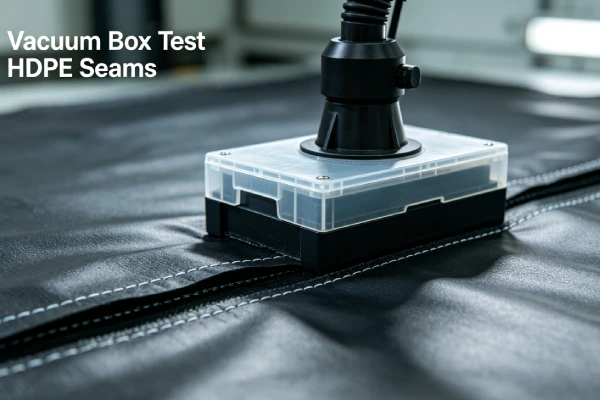
Spark test (ASTM D6747) for conductive subgrade (15-30kV). Vacuum box (ASTM D5641) for any subgrade (40-50 kPa, 30 sec, no bubbles). Both 100% of seams. Air pressure test (ASTM D7238) for dual track seams.
Q8: Is electrical leak location required for landfills?
US EPA 40 CFR 258.40(e) requires electrical leak location (ASTM D7002) for new landfill liners after installation, before cover placement. Detects pinholes to 0.5mm diameter.
Q9: What depth is required for anchor trenches?
Minimum 0.6m for slopes up to 3H:1V. For 2H:1V slope, depth 1.0m. For 1.5H:1V slope, depth 1.2m. Backfill angle ≤45° (≤30° for slopes >2H:1V). Compaction ≥90-95% SPD.
Q10: What documentation must be retained?
Subgrade verification photos (every 500m²), material certifications, welding parameter logs, NDT records (100%), destructive test results (1 per 150m), leak location survey, as-built drawings. Retention: minimum 30 years post-closure per 40 CFR 258.40(e).
Q11: How is geotextile overlap verified?
Minimum overlap 300mm for standard applications. For angular subgrade or high-stress areas, 450-500mm. Measure with tape measure, photograph, record in QC log.
Q12: What is the role of third-party CQA?
Independent verification of all installation phases. CQA officer must be independent of installation contractor. Review QC documentation, witness testing, sign off on project completion. Required for landfills per EPA.
For detailed procedures, see Landfill HDPE Liner Installation Guide 2026.
For seam quality, see Poor Welding Quality in HDPE Seams Guide 2026.
For subgrade, see Subgrade Puncture HDPE Guide 2026.
For checklist download, see 12-point QC checklist PDF.
3️⃣ Why HDPE Installation QC Matters (Material Science Focus)
Failure Rate Data Sources
| QC Deficiency | Failure Rate | Source |
|---|---|---|
| No subgrade QC | 80% puncture within 5 years | GRI data |
| No parameter qualification | 40-50% seam failure (cold weld) | GRI data |
| No NDT | 30-40% missed defects | GRI data |
| No destructive testing | 20-30% systematic weak welds | GRI data |
| No slack | 100% thermal contraction stress | GRI WP#42 |
Source: GRI statistical analysis, GRI White Paper #42 (2016), GRI White Paper #45 (2020). Site-specific failure rates vary by site conditions and CQA rigor.
Four Phases Where QC Prevents Failure
| Phase | QC Checkpoint | Failure Prevented |
|---|---|---|
| 1. Material | HP-OIT, NCTL, thickness | Premature aging, stress cracking |
| 2. Subgrade | Particle size, compaction, proof roll | Puncture, settlement voids |
| 3. Installation | Slack, seam parameters, orientation | Thermal contraction, cold weld |
| 4. Testing | NDT, destructive, leak location | Undetected defects |
Stress Crack Resistance (NCTL) QC
NCTL (ASTM D5397) is critical for landfill liners. GRI-GM13 minimum 500 hours. QC specification: ≥1000 hours for aggressive environments. Verify with independent laboratory spot testing. Manufacturer certificates alone insufficient.
Oxidative Induction Time (HP-OIT) QC
HP-OIT (ASTM D5885) measures antioxidant depletion resistance. GRI-GM13 minimum 400 minutes. For exposed slopes or tropical environments, require ≥600 minutes. QC: retain baseline samples (1m² per 5,000m²) for future testing.
Carbon Black (2-3% ASTM D4218) QC
Carbon black provides UV protection. QC: verify 2-3% by ASTM D4218. Dispersion Grade 1 or 2 per ASTM D5596. Poor dispersion creates UV weak points.
Subgrade Particle Size — GRI-GM13 vs QC Specification
| Standard | Max Particle Size | Applicability | Rationale |
|---|---|---|---|
| GRI-GM13 | 9mm | General applications | Rounded particles acceptable |
| QC specification | 6mm | Critical applications | Angular particles have 2-3x puncture risk |
Source: GRI-GM13 (2025), GRI White Paper #45 (2020). For angular particles (crushed rock, coral), specify 6mm maximum.
Alternatives Comparison — QC Requirements
| Property | HDPE | LLDPE | fPP | PVC | GCL |
|---|---|---|---|---|---|
| Primary QC focus | Seam NDT, subgrade | Same as HDPE | Weld parameters | Solvent weld cure | Overlap verification |
| Subgrade requirement | 6mm max | 6mm max | 6mm max | 6mm max | 6mm max |
| NDT method | Spark/vacuum | Same | Same | Difficult | Visual only |
| Destructive testing | ASTM D6392 | ASTM D6392 | ASTM D6392 | Not applicable | Not applicable |
| Documentation retention | 30 years | 30 years | 30 years | 30 years | 30 years |
| QC difficulty | High (requires trained CQA) | High | High | Moderate | Low |
4️⃣ Pre-Installation QC Checkpoints
Checkpoint 1: Material Receiving
| QC Element | Specification | Verification Method | Pass/Fail |
|---|---|---|---|
| Thickness (ASTM D5994) | Per design (1.5mm, 2.0mm, 2.5mm) | Micrometer, 5 points | ±10% |
| HP-OIT (ASTM D5885) | ≥400 min (≥600 min tropical) | Independent lab | Pass cert |
| NCTL (ASTM D5397) | ≥1000 hours | Independent lab | Pass cert |
| Carbon black (ASTM D4218) | 2-3% | Independent lab | Pass cert |
| Carbon black dispersion (ASTM D5596) | Grade 1 or 2 | Independent lab | Pass cert |
| Roll damage | None | Visual | No damage |
Action:
- Reject any roll with damage or failed certification
- Take representative samples for independent lab testing
- Document results in receiving log
Checkpoint 2: Storage
| QC Element | Specification | Verification Method | Pass/Fail |
|---|---|---|---|
| Duration (temperate) | <30 days | Delivery records, site log | ≤30 days |
| Duration (tropical) | <14 days | Delivery records, site log | ≤14 days |
| Cover | Opaque tarp | Visual | Covered |
| Stacking | ≤4 rolls high | Visual | ≤4 rolls |
| Surface | Clean, smooth, no sharp objects | Visual | No hazards |
Action:
- Document storage conditions daily
- Move rolls exceeding duration to covered storage
- Reject rolls with UV damage (HP-OIT <400 min)
5️⃣ Subgrade and Geotextile QC Checkpoints
Checkpoint 3: Subgrade Preparation
| QC Element | Specification | Verification Method | Pass/Fail |
|---|---|---|---|
| Maximum particle size | 6mm (recommended) | Sieve analysis, visual | ≤6mm |
| Compaction | ≥95% Standard Proctor | Density test every 500m² | ≥95% |
| Proof roll | Mandatory | Visual deflection | No soft spots |
| Moisture content | Optimal range | Lab test | Within 2% |
| Surface smoothness | No abrupt changes | 2m straightedge | <25mm deviation |
| Voids | Filled with sand | Visual | No voids |
Documentation:
- Photos every 500m² (scale bar in frame)
- Density test log
- Proof roll sketch marking soft spots
📌 Critical: Subgrade preparation is the most important QC checkpoint. 80% of puncture failures trace to subgrade issues. Do not proceed until subgrade passes all checks.
Checkpoint 4: Geotextile Placement
| QC Element | Specification | Verification Method | Pass/Fail |
|---|---|---|---|
| Weight | 200-800gsm per design | Manufacturer cert, weigh sample | Within spec |
| Overlap | 300mm (450-500mm for angular subgrade) | Tape measure | ≥spec |
| Seaming | Sewn or heat bond as required | Visual | Secure |
| Deployment | Upslope to downslope | Visual | Correct orientation |
| Tears | None (repair if any) | Visual | No tears |
| Anchorage | Temporary ballast | Visual | Secure |
Documentation:
- Photos every 500m²
- Overlap measurement log
- Repair log (if any)
6️⃣ Installation QC Checkpoints
Checkpoint 5: Panel Layout
| QC Element | Specification | Verification Method | Pass/Fail |
|---|---|---|---|
| Seam minimization | Minimum total seam length | Layout drawing review | As-designed |
| Seam orientation | Parallel to slope contours | Visual, as-built | Parallel |
| Panel numbering | Sequential, referenced | As-built drawing | All numbered |
| Seam spacing | ≥1.5m between parallel seams | Tape measure | ≥1.5m |
Documentation:
- As-built drawing with panel numbers
- Seam location log
Checkpoint 6: Deployment (Slack)
| QC Element | Specification | Verification Method | Pass/Fail |
|---|---|---|---|
| Slack percentage | 1-2% (2% for slopes >3H:1V) | Measure 10m section | 1-2% |
| Wave formation | Gentle waves, 50-100mm height | Visual | Waves present, not balloons |
| Wrinkles | Smoothed | Visual | No stress folds |
| Ballooning | None (trapped air) | Visual | No balloons |
Slack Calculation — Validation
Formula: Slack = (panel length – straight line) / straight line × 100%
| Slope Length | ΔT=30°C | ΔT=40°C | ΔT=50°C | 1% Slack | 2% Slack |
|---|---|---|---|---|---|
| 50m | 300mm | 400mm | 500mm | 500mm | 1,000mm |
| 100m | 600mm | 800mm | 1,000mm | 1,000mm | 2,000mm |
| 150m | 900mm | 1,200mm | 1,500mm | 1,500mm | 3,000mm |
Conclusion: 1% slack is sufficient for ΔT≤40°C. 2% slack recommended for ΔT>40°C or steep slopes.
Slack measurement method:
- Mark 10m section (straight-line distance)
- Measure panel length along surface (following waves)
- Slack = (panel length – straight line) / straight line × 100%
- Target: 1-2%
Documentation:
- Wave photos
- Slack measurement log
⚠️ Critical: Slack prevents thermal contraction stress. Without slack (0%), 40°C cooling creates 8.4 kN/m tension for 1.5mm liner. With 1% slack, tension is absorbed.
Checkpoint 7: Seaming (Hot Wedge Welding)
| QC Element | Specification | Verification Method | Pass/Fail |
|---|---|---|---|
| Parameter qualification | Each shift, each welder, each thickness | Trial seam destructive test | Pass |
| Wedge temperature | Per thickness (420-440°C for 1.5mm) | Temperature gun | ±5°C |
| Welding speed | Per thickness (1.5-2.5 m/min for 1.5mm) | Stopwatch | ±0.1 m/min |
| Pressure | 0.30-0.40 N/mm² (1.5mm) | Pressure gauge | ±0.05 N/mm² |
| Overlap | 100-125mm (1.5mm) | Tape measure | ≥75mm |
| Seam orientation | Parallel to slope contours | Visual | Parallel |
| Visual inspection | No burn-through, contamination, uneven bead | Visual | Pass |
Trial seam requirements (GRI GM-19):
- Minimum 1m length
- Destructive testing (3 samples)
- Shear ≥350 N/50mm, peel ≥350 N/50mm
- Parent material stretch failure
Documentation:
- Parameter log (each shift, each welder)
- Trial seam destructive test results
- Temperature and speed logs
Destructive Testing Frequency — GRI GM-19
| Application | Standard Frequency | Cold Weather (<0°C) |
|---|---|---|
| Landfill base | 1 per 150m | 1 per 100m |
| Landfill cover | 1 per 200m | 1 per 150m |
| Hazardous waste | 1 per 100m | 1 per 75m |
| Heap leach pad | 1 per 150m | 1 per 100m |
Source: GRI GM-19 (2022). Increased frequency in cold weather due to higher cold weld risk.
Checkpoint 8: Anchorage
| QC Element | Specification | Verification Method | Pass/Fail |
|---|---|---|---|
| Trench depth | Per slope angle (0.6-1.5m) | Tape measure every 10m | ≥spec |
| Trench width | 0.5-1.5m per design | Tape measure | ≥spec |
| Liner embedment | ≥300mm beyond anchor line | Tape measure | ≥300mm |
| Backfill angle | ≤45° (≤30° for >2H:1V) | Slope measurement | ≤spec |
| Compaction | ≥90-95% SPD | Density test every 200m | ≥spec |
| Extrusion weld termination | 100% NDT | Vacuum box | No bubbles |
Documentation:
- Trench depth log (every 10m)
- Backfill angle photos
- Compaction test records
- Extrusion weld test log
7️⃣ Testing QC Checkpoints
Checkpoint 9: Non-Destructive Testing (NDT)
| QC Element | Specification | Verification Method | Pass/Fail |
|---|---|---|---|
| Test coverage | 100% of all seams | Test log, as-built | 100% |
| Spark test voltage | 15-30kV (per thickness) | Gauge reading | Within range |
| Vacuum box pressure | 40-50 kPa absolute | Gauge reading | Within range |
| Vacuum box duration | 30 seconds minimum | Stopwatch | ≥30 sec |
| Spark test speed | 0.3-0.5 m/s | Stopwatch | Within range |
| Overlap between test areas | 50mm minimum | Tape measure | ≥50mm |
| Pass criteria | No spark breakthrough or bubbles | Visual | Pass |
| Failed test repair | Cut out 300mm beyond, re-weld, re-test | Repair log, re-test | Pass |
Documentation:
- NDT log (date, seam ID, location)
- Test results (pass/fail)
- Repair log with photos
- Photographs of any defects
Checkpoint 10: Destructive Testing
| QC Element | Specification | Verification Method | Pass/Fail |
|---|---|---|---|
| Sample frequency | 1 per 150m per seam line | Test log | Met |
| Sample location | Random, include panel ends | Visual | Representative |
| Shear strength (1.5mm) | ≥350 N/50mm | ASTM D6392 | Pass |
| Peel strength (1.5mm) | ≥350 N/50mm | ASTM D6392 | Pass |
| Failure mode | Parent material stretch (not weld peel) | Visual | Parent stretch |
| Re-test after failure | Two consecutive passes | Destructive test | Both pass |
Documentation:
- Destructive test log (sample ID, location, results)
- Test specimen photos
- CQA sign-off
Checkpoint 11: Electrical Leak Location
| QC Element | Specification | Verification Method | Pass/Fail |
|---|---|---|---|
| Standard | ASTM D7002 | Test report | Compliant |
| Coverage | 100% of liner area | Scan path log | 100% |
| Voltage | 15-30kV (per thickness) | Gauge | Within range |
| Substrate | Conductive (clay, wet geotextile) | Visual, testing | Conductive |
| Pass criteria | No current anomalies | Scan report | No defects |
| Repair | Mark, repair, re-scan | Repair log, re-scan | Pass |
Documentation:
- Electrical leak location scan report
- Defect location map
- Repair log
- Re-scan report
Requirement: Mandatory for new landfill liners per US EPA 40 CFR 258.40(e).
8️⃣ Documentation QC Checkpoint
Checkpoint 12: Documentation Retention
| Document Type | Retention Period | Verification |
|---|---|---|
| Subgrade photos | 30 years | Digital backup |
| Density test records | 30 years | Paper + digital |
| Material certifications | 30 years | Paper + digital |
| Independent lab test results | 30 years | Paper + digital |
| Welding parameter logs | 30 years | Paper + digital |
| NDT logs (100%) | 30 years | Paper + digital |
| Destructive test results (1 per 150m) | 30 years | Paper + digital |
| Repair logs with photos | 30 years | Paper + digital |
| Leak location survey | 30 years | Paper + digital |
| As-built drawings | 30 years | Paper + digital |
| CQA daily reports | 30 years | Paper + digital |
Documentation requirements:
- All documents signed by CQA officer
- Photographs include scale bar and date stamp
- Digital backup in multiple locations
- Accessible for regulatory review
9️⃣ Real Engineering Failure Cases
Case 1: No Subgrade QC — Midwest USA, 2019
Specification used: 1.5mm HDPE, no subgrade QC (particle size up to 25mm, no compaction testing, no proof roll)
Observed failure: After 18 months, leachate detected at underdrain. Excavation revealed 47 puncture holes from angular rock penetration. Remediation cost $2.5M.
Root cause: No subgrade QC. Particles >25mm (vs required 6mm). No compaction (voids). No proof roll (soft spots). 80% of puncture failures trace to subgrade.
QC lesson: Subgrade QC is the most critical checkpoint — 6mm max particle size, ≥95% SPD, proof roll. Photos every 500m². Density tests every 500m². Do not proceed until subgrade passes.
Source: Based on industry case study. See also: GRI White Paper #45 (2020).
Case 2: No Parameter Qualification — Southeast Asia, 2017
Specification used: 1.5mm HDPE, no parameter qualification (welder used previous shift settings), ambient 35°C
Observed failure: Destructive testing revealed inconsistent peel strength (120-380 N/50mm). 40% of samples failed (<350 N/50mm). Remediation cost $500,000.
Root cause: No parameter qualification after shift change. Ambient temperature higher (35°C) required parameter adjustment. CQA did not verify parameters each shift.
QC lesson: Parameter qualification required each shift, each welder, each thickness per GRI GM-19. Trial seam with destructive testing before production welding. Adjust parameters for ambient temperature (>35°C reduce wedge temp 5-10°C).
Source: Based on industry case study. See also: GRI White Paper #41 (2015).
Case 3: No Slack Installation — Colorado, 2020
Specification used: 2.0mm HDPE, zero slack installed, seam orientation perpendicular to slope
Observed failure: After first winter (ΔT=45°C daily), 23 seam failures at panel ends. Remediation cost $1.8M.
Root cause: No slack measurement in QC checklist. CQA did not verify slack. Zero slack (0% vs required 1-2%). Seam orientation perpendicular (not parallel).
QC lesson: Include slack measurement in QC checklist. Measure 10m section: panel length vs straight-line distance. Target 1-2%. Verify seam orientation parallel to slope contours.
Source: Based on industry case study. See also: GRI White Paper #41 (2015), GRI White Paper #42 (2016).
Case 4: No Electrical Leak Location — Europe, 2018
Specification used: 1.5mm HDPE, landfill base, all other QC performed, but electrical leak location skipped
Observed failure: After 2 years, leakage detected. Excavation revealed 12 pinholes not detected by visual or spark test (spark test not performed on all areas). Remediation cost $800,000.
Root cause: Electrical leak location not performed. Small pinholes (<1mm) passed visual and selective NDT. Regulatory requirement per EPA (not applicable in Europe but industry best practice).
QC lesson: Electrical leak location (ASTM D7002) detects pinholes to 0.5mm diameter. Mandatory for US landfills, recommended for all critical applications. Perform after all seams complete, before cover placement.
Source: Based on industry case study. See also: ASTM D7002.
🔟 Cost Considerations — QC vs Failure
QC Cost Data Sources
| QC Activity | Cost per 10,000m² | Source |
|---|---|---|
| Third-party CQA | $10,000-20,000 | Industry average |
| Independent lab testing | $5,000-10,000 | Industry average |
| NDT (100% spark/vacuum) | $5,000-15,000 | Industry average |
| Destructive testing (1 per 150m) | $2,000-5,000 | Industry average |
| Electrical leak location | $5,000-10,000 | Industry average |
| Documentation (photos, logs, as-built) | $5,000-10,000 | Industry average |
| Total QC cost | $32,000-70,000 | — |
Valid through: Q2 2026 industry survey. Actual costs vary by project size, location, and CQA rigor.
Cost of No QC (10,000m² landfill)
| Failure Consequence | Cost Range |
|---|---|
| Leak investigation | $200,000-1,000,000 |
| Liner repair (partial) | $100,000-300,000 |
| Full liner replacement | $500,000-1,500,000 |
| Groundwater remediation | $1,000,000-5,000,000 |
| Regulatory fines | $100,000-500,000 |
| Total failure cost | $1,900,000-8,300,000 |
📊 ROI: QC program (32,000−70,000)avoids1,900,000-8,300,000 failure → 27-260× ROI. Each QC checkpoint pays for itself with single failure prevented.
Material Cost for HDPE (Q2 2026)
| Thickness | Material Cost per m² |
|---|---|
| 1.5mm | $1.80-2.40 |
| 2.0mm | $2.40-3.20 |
| 2.5mm | $3.20-4.00 |
Source: Industry survey, May 2026. Valid through Q3 2026.
1️⃣1️⃣ Professional Engineering Recommendation
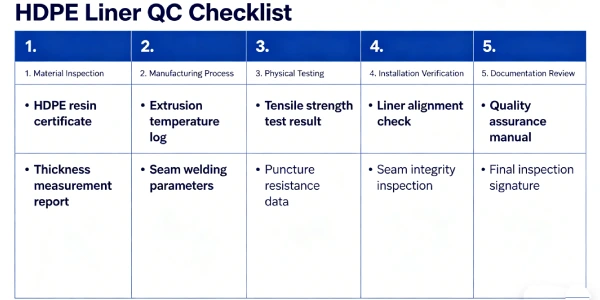
QC Checklist Summary — 12 Checkpoints
| # | Checkpoint | Key Specification | Pass/Fail |
|---|---|---|---|
| 1 | Material receiving | GRI-GM13, NCTL≥1000h, HP-OIT≥400min | ☐ |
| 2 | Storage | <30 days (<14 days tropical), covered | ☐ |
| 3 | Subgrade | 6mm max, ≥95% SPD, proof roll | ☐ |
| 4 | Geotextile | 200-800gsm, overlap 300mm | ☐ |
| 5 | Panel layout | Minimize seams, orientation parallel | ☐ |
| 6 | Deployment | Slack 1-2%, wave method | ☐ |
| 7 | Seaming | Parameters qualified each shift | ☐ |
| 8 | Anchorage | Depth 0.6-1.2m, backfill ≤45° | ☐ |
| 9 | NDT | 100% spark or vacuum, no failures | ☐ |
| 10 | Destructive | 1 per 150m, ≥350 N/50mm | ☐ |
| 11 | Leak location | ASTM D7002, no defects | ☐ |
| 12 | Documentation | 30-year retention, signed | ☐ |
CQA Officer Responsibilities — By Phase
Pre-installation:
- Review material certificates
- Arrange independent lab testing
- Verify storage conditions (temperature, cover, stacking)
- Check rolls for shipping damage
Subgrade:
- Witness density tests every 500m² (≥95% SPD)
- Witness proof roll (mark soft spots)
- Photograph every 500m² (scale bar)
- Verify particle size ≤6mm
Geotextile:
- Verify weight (200-800gsm)
- Measure overlap (≥300mm)
- Check tears (repair or replace)
Installation:
- Measure slack (1-2%)
- Verify seam orientation (parallel to contours)
- Witness parameter qualification (each shift, each welder, each thickness)
- Check anchor trench depth and backfill angle
Testing:
- Witness 100% NDT (spark or vacuum)
- Select destructive test locations (1 per 150m)
- Review all test results
- Witness electrical leak location scan
Documentation:
- Compile all CQA records
- Ensure 30-year retention
- Sign final CQA report
For template download, see CQA daily report template.
QC Failure Remediation Actions
| Checkpoint | Failure | Remediation |
|---|---|---|
| Material receiving | HP-OIT <400 min | Reject roll |
| Storage | Storage >30 days (>14 days tropical) | HP-OIT test, reject if <400 min |
| Subgrade | Particle size >6mm | Screen or replace with sand |
| Subgrade | Compaction <95% SPD | Re-compact, re-test |
| Geotextile | Weight insufficient | Replace with correct weight |
| Slack | <1% | Re-deploy with additional waves |
| Seaming | Cold weld (peel <350 N/50mm) | Cut out 300mm beyond, re-weld, re-test |
| Anchorage | Depth insufficient | Deepen trench |
| NDT | Bubbles/spark | Mark location, cut out 300mm beyond, re-weld, re-test |
| Destructive | Peel <350 N/50mm | Adjust parameters, cut out 300mm beyond, re-weld, two consecutive passes required |
| Leak location | Defect detected | Mark location, repair, re-scan |
Critical Statement
Quality control for HDPE liner installation requires systematic verification of 12 checkpoints with pass/fail criteria and CQA sign-off. Subgrade preparation is the most critical checkpoint — 80% of puncture failures trace to subgrade issues. Specify 6mm max particle size (not GRI-GM13’s 9mm), ≥95% SPD, proof roll. Photos every 500m², density tests every 500m².
Installation slack (1-2%) prevents thermal contraction stress — without slack, 40°C cooling creates 8.4 kN/m tension for 1.5mm liner. Measure 10m section: panel length should exceed straight-line distance by 1-2%. Seam orientation must be parallel to slope contours — perpendicular seams fail under tension per GRI GM-19.
Parameter qualification required each shift, each welder, each thickness per GRI GM-19. Trial seam with destructive testing before production welding. 100% NDT (spark test ASTM D6747 or vacuum box ASTM D5641) for all seams. Destructive testing 1 per 150m per seam line (ASTM D6392), acceptance ≥350 N/50mm for 1.5mm, failure mode parent material stretch.
Electrical leak location (ASTM D7002) mandatory for new landfills per US EPA 40 CFR 258.40(e). Documentation retention minimum 30 years.
The cost of QC program (32,000−70,000per10,000m2)avoids1,900,000-8,300,000 failure (27-260× ROI). Quality assurance — not material specification alone — determines liner integrity and environmental protection. Every QC checkpoint is essential; skipping any increases failure risk exponentially. When in doubt, stop installation, correct the issue, and re-verify before proceeding.
For checklist download, see 12-point QC checklist PDF.
1️⃣2️⃣ FAQ Section
Q1: What are the most critical QC checkpoints for HDPE liner installation?
Subgrade preparation (80% of puncture failures), seam welding parameters (40-50% of failures), and NDT (100% required). Without these three, failure risk exceeds 60%.
Q2: What is the required subgrade particle size for landfill liners?
GRI-GM13 allows 9mm. QC specification: 6mm maximum for critical applications. Angular particles have 2-3x higher puncture risk.
Q3: How much installation slack is required?
Minimum 1% (10mm per meter). For slopes >3H:1V or large diurnal swings (>30°C), specify 2%. Measure 10m section.
Q4: How often must welding parameters be qualified?
Per GRI GM-19: each shift, each welder, each thickness. Minimum 1m trial seam with destructive testing before production welding.
Q5: What is the correct seam orientation for landfill slopes?
Seams must be parallel to slope contours (horizontal). Perpendicular seams experience full downslope tension and fail. GRI GM-19 requires parallel orientation for slopes >3H:1V.
Q6: What is the acceptance criteria for destructive testing (1.5mm)?
ASTM D6392: shear ≥350 N/50mm, peel ≥350 N/50mm. Failure mode: parent material stretch (not weld peel).
Q7: What NDT methods are acceptable for seam testing?
Spark test (ASTM D6747) for conductive subgrade (15-30kV). Vacuum box (ASTM D5641) for any subgrade (40-50 kPa, 30 sec, no bubbles). Both 100% of seams.
Q8: Is electrical leak location required for landfills?
US EPA 40 CFR 258.40(e) requires electrical leak location (ASTM D7002) for new landfill liners after installation, before cover placement.
Q9: What depth is required for anchor trenches?
Minimum 0.6m for slopes up to 3H:1V. For 2H:1V slope, depth 1.0m. For 1.5H:1V slope, depth 1.2m. Backfill angle ≤45° (≤30° for >2H:1V).
Q10: What documentation must be retained?
Subgrade photos (every 500m²), material certifications, welding logs, NDT records, destructive test results (1 per 150m), leak location survey, as-built. Retention: minimum 30 years.
Q11: How is geotextile overlap verified?
Minimum overlap 300mm (450-500mm for angular subgrade). Measure with tape measure, photograph, record in QC log.
Q12: What is the role of third-party CQA?
Independent verification of all installation phases. CQA officer must be independent of installation contractor. Required for landfills per EPA.
1️⃣3️⃣ Technical Conclusion
Quality control for HDPE liner installation requires systematic verification of 12 checkpoints with pass/fail criteria and CQA sign-off. Subgrade preparation is the most critical checkpoint — 80% of puncture failures trace to subgrade issues. QC specification: 6mm maximum particle size (not GRI-GM13’s 9mm), ≥95% Standard Proctor compaction, proof roll entire area. Angular particles have 2-3x higher puncture risk than rounded particles. Documentation: photos every 500m² with scale bar, density tests every 500m².
Installation slack (1-2%) prevents thermal contraction stress — without slack, 40°C cooling creates 8.4 kN/m tension for 1.5mm liner. QC verification: measure 10m section, panel length should exceed straight-line distance by 1-2%. Seam orientation must be parallel to slope contours — perpendicular seams experience full downslope tension and fail (GRI GM-19 requirement for slopes >3H:1V).
Parameter qualification required each shift, each welder, each thickness per GRI GM-19. Minimum 1m trial seam with destructive testing (ASTM D6392) before production welding. Acceptance for 1.5mm: shear ≥350 N/50mm, peel ≥350 N/50mm, failure mode parent material stretch. 100% non-destructive testing (spark test ASTM D6747 or vacuum box ASTM D5641) for all seams. Destructive testing frequency: 1 per 150m per seam line (increase to 1 per 100m in cold weather below 0°C).
Electrical leak location (ASTM D7002) mandatory for new landfills per US EPA 40 CFR 258.40(e). Anchor trench depth by slope angle: 3H:1V → 0.8m, 2H:1V → 1.0m, 1.5H:1V → 1.2m. Backfill angle ≤45° (≤30° for slopes >2H:1V), compaction ≥90-95% SPD. Documentation retention minimum 30 years post-closure.
For the practicing engineer: implement the 12-point QC checklist with CQA sign-off at each checkpoint. Subgrade preparation is non-negotiable — 6mm max particle size, 95% compaction, proof roll. Installation slack 1-2% — measure, don’t assume. Parameter qualification each shift — trial seam with destructive testing. 100% NDT — no exceptions. Destructive testing 1 per 150m — verify weld strength. Electrical leak location — mandatory for landfills. Documentation retention 30 years — regulatory requirement.
The cost of QC program (32,000−70,000per10,000m2)avoids1,900,000-8,300,000 failure (27-260× ROI). Quality assurance — not material specification alone — determines HDPE liner integrity and environmental protection. Every QC checkpoint is essential; skipping any increases failure risk exponentially. When in doubt, stop installation, correct the issue, and re-verify before proceeding.
📚 References
[1] GRI GM-19 (2022). “Specification for Geomembrane Seam Testing.” Geosynthetic Institute.
[2] ASTM D6392 (2024). “Standard Test Method for Determining the Integrity of Field Seams Used in Joining Geomembranes by Chemical Fusion Methods.” ASTM International.
[3] ASTM D6747 (2024). “Standard Test Method for Testing Geomembrane Seams Using the Spark Test.” ASTM International.
[4] ASTM D5641 (2024). “Standard Test Method for Vacuum Box Testing of Geomembrane Seams.” ASTM International.
[5] ASTM D7002 (2024). “Standard Practice for Leak Location on Exposed Geomembranes Using the Electrical Leak Location Method.” ASTM International.
[6] ASTM D5885 (2024). “Standard Test Method for Oxidative Induction Time of Polyolefin Geosynthetics by High-Pressure Differential Scanning Calorimetry.” ASTM International.
[7] ASTM D5397 (2020). “Standard Test Method for Evaluation of Stress Crack Resistance of Polyolefin Geomembranes.” ASTM International.
[8] ASTM D4218 (2024). “Standard Test Method for Carbon Black Content in Polyethylene Geomembranes.” ASTM International.
[9] ASTM D5596 (2024). “Standard Test Method for Microscopic Evaluation of the Dispersion of Carbon Black in Polyolefin Geosynthetics.” ASTM International.
[10] ASTM D5994 (2024). “Standard Test Method for Measuring Thickness of Geomembranes.” ASTM International.
[11] GRI White Paper #41 (2015). “Welding Parameters and Environmental Effects.” Geosynthetic Institute.
[12] GRI White Paper #42 (2016). “Thermal Expansion and Contraction of Geomembranes.” Geosynthetic Institute.
[13] GRI White Paper #45 (2020). “Geotextile Puncture Protection for Geomembranes on Rocky Subgrade.” Geosynthetic Institute.
[14] GRI-GM13 (2025). “Standard Specification for Smooth High Density Polyethylene (HDPE) Geomembranes.” Geosynthetic Institute.
[15] US EPA 40 CFR 258.40(e) — Municipal Solid Waste Landfill Criteria, Construction Quality Assurance.
📚 Related Technical Guides
Pillar Pages
- Landfill HDPE Liner Installation Guide 2026 | Step-by-Step Procedure
- Poor Welding Quality in HDPE Seams Guide 2026 | Field Identification & CQA
- Subgrade Puncture HDPE Guide 2026 | Prevention & Repair
- Vacuum Box Testing for HDPE Liner Seams Guide 2026 | ASTM D5641 Procedure
- Air Pressure Testing for Dual Track HDPE Seams Guide 2026 | ASTM D7238
- 12-Point QC Checklist PDF | Downloadable Form — Coming soon
- CQA Daily Report Template | Field Documentation — Coming soon
By Application
- Landfill Base Liners: 1.5-2.5mm HDPE for Subtitle D/C Compliance
- Heap Leach Pads: 1.5-2.0mm HDPE Double Liner Systems
- Wastewater Lagoons: 1.5-2.0mm HDPE for Municipal/Industrial Service
- Biogas Digesters: 1.5-2.0mm HDPE with Gas Tightness Requirements
- Mining Tailings Dams: 1.5-2.5mm HDPE for Acid Mine Drainage