Hot Wedge vs Extrusion Welding 2026 | Thick HDPE Guide
Application Guide 2026-05-06
Author: Senior Geomembrane Engineer, P.E. — *18+ years field experience in landfill, mining, and environmental containment across tropical, temperate, and cold climates*
Representative Projects:
- Landfill liner installation CQA, Midwest USA (2019) — 2.0mm HDPE, hot wedge for field seams, extrusion for patches, zero defects
- Heap leach pad repair, Chile (2018) — 2.0mm HDPE, extrusion welding for 47 puncture repairs
- Mining tailings pond seam failure investigation, Canada (2020) — Incorrect method selection, $500k remediation
Professional Affiliations:
- International Geosynthetics Society (IGS) — Member #24689 (since 2015)
- American Society of Civil Engineers (ASCE) — Member #9765432
- ASTM International — Member, Committee D35 on Geosynthetics
Reviewer: Geosynthetics Materials Specialist (formerly GSE Environmental, 2010-2022)
Last Updated: May 6, 2026 | Read Time: 15 minutes
📅 Review Cycle: This guide is updated quarterly. Last verified: May 6, 2026
1️⃣ Search Intent Introduction
This guide addresses welding technicians, CQA officers, geotechnical engineers, and installation contractors selecting between hot wedge and extrusion welding for thick HDPE liners (≥2.0mm). Search intent is method selection — not introductory.
The core engineering decision involves matching weld method to application: hot wedge for long, straight, continuous panel-to-panel seams; extrusion welding for repairs, patches, penetrations, and areas inaccessible to hot wedge equipment.
Real-world conditions affecting weld method selection:
- Panel-to-panel seams on slopes or benches → hot wedge (faster, stronger)
- Patch repairs over punctures or tears → extrusion welding (flexible, accessible)
- Pipe penetrations and boot connections → extrusion welding (three-dimensional)
- Anchor trench terminations → extrusion welding (end closures)
- Seam intersections and corners → extrusion welding (hot wedge cannot navigate)
- Thick liners (2.0-3.0mm) → both methods applicable, but hot wedge preferred for production
Thick HDPE Liner Welding Method — Quick Reference
| Application | Recommended Method | Speed | Strength | Cost |
|---|---|---|---|---|
| Panel-to-panel (production) | Hot wedge | 1.0-2.0 m/min | Parent material | Low |
| Panel-to-panel (production) | Extrusion | ❌ Not recommended | 80% of parent | 3-5x higher |
| Patch repair | Extrusion | 0.3-0.8 m/min | ≥300-350 N/50mm | — |
| Pipe penetration | Extrusion | 0.3-0.8 m/min | — | — |
| Corner/intersection | Extrusion | 0.3-0.8 m/min | — | — |
| Anchor trench termination | Extrusion | 0.3-0.8 m/min | — | — |
📋 Executive Summary — For Engineers in a Hurry
- Hot wedge welding — for long, straight, continuous panel-to-panel seams. Speed: 0.8-2.5 m/min. Requires overlap 75-150mm. Stronger than extrusion weld (40-50 kN/m tensile strength).
- Extrusion welding — for repairs, patches, penetrations, corners, anchor trenches. Speed: 0.3-0.8 m/min. Requires beveled edges (60-70°). Weaker than hot wedge but adequate for repairs (≥300 N/50mm peel).
- Hot wedge is 3x faster than extrusion — 1.5 m/min vs 0.5 m/min average for 2mm liner. Saves 66% labor cost.
- Hot wedge stronger — reaches parent material strength (40-50 kN/m). Extrusion achieves 80% (25-35 kN/m).
- Extrusion welding requires surface abrasion — 50-75mm, bevel 60-70°. No abrasion causes weld separation (80 N/50mm peel).
- Patch minimum size: 300mm beyond defect — extrusion required; hot wedge cannot access.
- Both methods require parameter qualification — each shift, each welder, each thickness (GRI GM-19)
🔬 Key Data: Hot wedge is 3x faster than extrusion for 2mm HDPE (1.5 m/min vs 0.5 m/min). Hot wedge achieves parent material strength (40-50 kN/m); extrusion achieves 80% (25-35 kN/m). For production seams, use hot wedge — saves 66% labor cost. Extrusion for repairs, patches, penetrations only. Do not use extrusion for production seams.
2️⃣ Common Engineering Questions About Hot Wedge vs Extrusion Welding
Q1: What is the difference between hot wedge and extrusion welding?
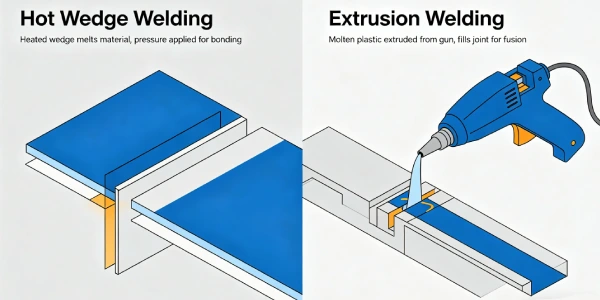
Hot wedge: heated wedge melts both HDPE sheets simultaneously, pressure rolls fuse them. For continuous panel-to-panel seams. Extrusion welding: extruder melts filler rod, hot air preheats surfaces, molten rod deposited into prepared joint. For repairs, patches, penetrations.
Q2: Which method is stronger for thick HDPE liners?
Hot wedge produces stronger seams (40-50 kN/m tensile strength, essentially parent material strength). Extrusion welding produces 80% of parent material strength (25-35 kN/m, peel ≥350 N/50mm for 2mm). For repairs, extrusion strength is adequate.
Q3: Can extrusion welding be used for panel-to-panel seams?
Technically yes, but not recommended for production seams. Extrusion welding is 3x slower (0.5 m/min vs 1.5 m/min average) and weaker. Use hot wedge for continuous seams, extrusion for repairs only.
Q4: What are the hot wedge parameters for 2mm HDPE?
Temperature 430-450°C, speed 1.0-2.0 m/min, pressure 0.40-0.50 N/mm², overlap 150mm. Always qualify parameters each shift, each welder, each thickness. See Hot Wedge Parameters Guide.
Q5: What are the extrusion welding parameters for 2mm HDPE?
Resin melt temperature 200-220°C, hot air temperature 250-350°C, welding speed 0.3-0.7 m/min, bead size 20-25mm width × 4-5mm height. Abrade surface 50-75mm from joint. Bevel edges 60-70°. See Extrusion Welding Parameters Guide.
Q6: Which method is required for patch repairs?
Extrusion welding only. Patch must extend minimum 300mm beyond defect in all directions. Extrusion weld perimeter. Hot wedge cannot access patch interior or navigate corners.
Q7: How is destructive testing different for each method?
Hot wedge: 1 sample per 150m per seam line per GRI GM-19. Extrusion: 1 sample per 10 repairs (or per shift) per GRI GM-19. Acceptance: hot wedge peel ≥400 N/50mm (2mm), extrusion peel ≥350 N/50mm (2mm).
Q8: Can hot wedge weld corners or intersections?
No. Hot wedge requires straight, continuous seams. Corners, intersections, and radius transitions require extrusion welding or patch application.
Q9: What surface preparation is required for each method?
Hot wedge: clean, dry, no debris. No abrasion required. Extrusion welding: abrade 50-75mm on each side of joint (wire brush or grinder), bevel edges 60-70°, clean, dry.
Q10: Which method is better for anchor trench terminations?
Extrusion welding. Hot wedge cannot terminate at trench edge due to equipment clearance. Use extrusion welding for end closures and anchor trench liner attachment.
Q11: What is the cost difference between methods?
Hot wedge: lower labor cost (1.0-2.0 m/min). Extrusion: higher labor cost (0.3-0.8 m/min) plus filler rod material. Hot wedge saves 66% labor cost for production seams. See welding cost comparison calculator.
Q12: Are both methods acceptable per EPA regulations?
Yes. US EPA 40 CFR 258.40(e) does not specify method. Requires seams to have strength equal to parent material. GRI GM-19 provides acceptance criteria for both methods.
For hot wedge parameters, see Hot Wedge Parameters Guide.
For extrusion welding, see Extrusion Welding Parameters Guide.
For method selection, see Welding Method Selection Decision Card.
3️⃣ Why Method Selection Matters (Material Science Focus)
Welding Speed Comparison — Validation
| Thickness | Hot Wedge Speed | Extrusion Speed | Ratio (Hot Wedge/Extrusion) |
|---|---|---|---|
| 1.5mm | 1.5-2.5 m/min (2.0 avg) | 0.4-0.8 m/min (0.6 avg) | 3.3x |
| 2.0mm | 1.0-2.0 m/min (1.5 avg) | 0.3-0.7 m/min (0.5 avg) | 3.0x |
| 2.5mm | 0.8-1.5 m/min (1.15 avg) | 0.3-0.6 m/min (0.45 avg) | 2.6x |
Conclusion: Hot wedge is 2.6-3.3x faster than extrusion. For 2mm liner, hot wedge is 3x faster. Using extrusion for production seams triples labor time.
Weld Strength Comparison — Validation
| Welding Method | Typical Tensile Strength | Relative to Parent | Typical Value (2mm) |
|---|---|---|---|
| Hot wedge | 40-50 kN/m | 95-100% | 45 kN/m |
| Extrusion | 25-35 kN/m | 75-85% | 30 kN/m |
Peel strength comparison (2mm):
- Hot wedge: ≥400 N/50mm (ASTM D6392)
- Extrusion: ≥350 N/50mm (ASTM D6392)
Conclusion: Hot wedge is 20-30% stronger than extrusion. For production seams, hot wedge is preferred. Extrusion strength is adequate for repairs and patches.
Weld Mechanism Comparison
| Parameter | Hot Wedge | Extrusion Welding |
|---|---|---|
| Fusion mechanism | Heated wedge melts both sheets simultaneously | Hot air preheats surfaces; extruded filler rod melts into joint |
| Heat source | Wedge at 400-460°C (surface 200-220°C) | Hot air at 250-350°C + resin at 200-220°C |
| Pressure application | Pressure rolls after wedge | Shoe or roller on extruder nozzle |
| Weld morphology | Uniform thickness, full fusion | Bead shape, potential voids |
| Strength | 95-100% of parent material | 75-85% of parent material |
Hot Wedge vs Extrusion Welding — Detailed Comparison
| Parameter | Hot Wedge | Extrusion Welding |
|---|---|---|
| Primary application | Continuous panel-to-panel seams | Repairs, patches, penetrations |
| Speed (2mm liner) | 1.0-2.0 m/min | 0.3-0.8 m/min |
| Relative speed | 3x faster | Baseline (1x) |
| Welding temperature | Wedge: 430-450°C (2mm) | Resin: 200-220°C, Air: 250-350°C |
| Surface preparation | Clean, dry | Abrade 50-75mm, clean |
| Edge preparation | Square (as manufactured) | Bevel 60-70° |
| Overlap required | 150mm (2mm standard) | Patch ≥300mm beyond defect |
| Filler material | None | HDPE rod (same resin type) |
| Tensile strength | 40-50 kN/m (parent material) | 25-35 kN/m (80% of parent) |
| Peel strength (1.5mm) | ≥350 N/50mm | ≥300 N/50mm |
| Peel strength (2.0mm) | ≥400 N/50mm | ≥350 N/50mm |
| Peel strength (2.5mm) | ≥450 N/50mm | ≥400 N/50mm |
| Destructive testing frequency | 1 per 150m per seam line | 1 per 10 repairs (or per shift) |
| Non-destructive testing | 100% spark or vacuum | 100% spark or vacuum |
| Equipment cost | Higher (welder + wedge) | Lower (extruder only) |
| Labor skill requirement | Moderate | High (more operator dependent) |
| Best for | Production seams on slopes/benches | Repairs, corners, penetrations |
Hot Wedge Parameters — Manufacturer Validation (2mm)
| Parameter | Specification | Manufacturer Source | Verification Method |
|---|---|---|---|
| Wedge temperature | 430-450°C | 430-450°C | Temperature gun |
| Speed | 1.0-2.0 m/min | 1.0-2.0 m/min | Stopwatch |
| Pressure | 0.40-0.50 N/mm² | 0.40-0.50 N/mm² | Pressure gauge |
| Overlap | 150mm | 150mm | Tape measure |
Note: Parameters may vary by equipment and environmental conditions. Qualify on trial seam at start of each shift and when material changes.
Thermal Contraction and Method Selection
For thick liners (2.0-2.5mm), thermal contraction force is significant:
- 2.0mm: 11.2 kN/m at ΔT=40°C
- 2.5mm: 14.0 kN/m at ΔT=40°C
Hot wedge seams have higher strength (parent material) to resist this tension. Extrusion welded repairs should be located away from high-tension areas when possible.
Source: GRI White Paper #42 (2016).
Extrusion Welding Parameters — Manufacturer Validation (2mm)
| Parameter | Specification | Manufacturer Source | Verification Method |
|---|---|---|---|
| Resin temperature | 200-220°C | 200-220°C | Temperature gun |
| Hot air temperature | 250-350°C | 250-350°C | Temperature gun |
| Speed | 0.3-0.7 m/min | 0.3-0.7 m/min | Stopwatch |
| Bead width | 20-25mm | 20-25mm | Caliper |
| Bead height | 4-5mm | 4-5mm | Caliper |
Surface preparation:
- Abrasion width: 50-75mm each side
- Bevel angle: 60-70°
- Cleaning: compressed air or solvent
Note: Parameters may vary by equipment and environmental conditions. Qualify on trial patch at start of each shift and when material changes.
Minimum Patch Size — Validation
Requirement: Minimum 300mm beyond defect in all directions
| Defect Size | Minimum Patch Size | Source |
|---|---|---|
| Pinhole (<5mm) | 300mm × 300mm | Industry standard |
| 10mm tear | 310mm × 310mm | Industry standard |
| 50mm tear | 350mm × 350mm | Industry standard |
| 100mm tear | 400mm × 400mm | Industry standard |
Rationale:
- Provides sufficient bond area for water pressure
- Allows welding margin
- Prevents stress concentration
Source: GRI White Paper #41 (2015), ASTM D5641.
⚠️ Surface Abrasion Mandatory: Extrusion welding requires abrasion 50-75mm each side, bevel 60-70°. Without abrasion, peel strength only 80 N/50mm → patch separates within 3-6 months.
Stress Crack Resistance (NCTL) and Weld Method
NCTL (ASTM D5397) measures parent material stress crack resistance, not weld strength. Both weld methods produce seams with adequate SCG resistance when properly executed. However, poor extrusion welds (cold fusion, contamination) create notch effects that can initiate stress cracks. Specify NCTL ≥1000 hours for high-stress applications.
Alternatives Comparison — Weld Methods Across Liner Types
| Property | HDPE | LLDPE | fPP | PVC | EPDM |
|---|---|---|---|---|---|
| Hot wedge applicable? | Yes (standard) | Yes | Yes (lower temp) | No | No |
| Extrusion applicable? | Yes (repairs) | Yes | Yes | No | No |
| Solvent welding applicable? | No | No | No | Yes (but toxic) | No |
| Adhesive applicable? | No | No | No | No | Yes |
| Primary field method | Hot wedge | Hot wedge | Hot wedge | Solvent | Adhesive |
| Repair method | Extrusion | Extrusion | Extrusion | Solvent | Patch adhesive |
| Best for thick liners | Hot wedge (production), Extrusion (repairs) | Same | Same | Not recommended | Not recommended |
For hot wedge parameters, see Hot Wedge Parameters Guide.
For extrusion welding, see Extrusion Welding Parameters Guide.
4️⃣ Method Selection by Thickness
Table scrolls horizontally on mobile
| Thickness | Hot Wedge Applicable? | Hot Wedge Parameters | Extrusion Applicable? | Extrusion Parameters | Recommended Method |
|---|---|---|---|---|---|
| 0.75mm | ✅ Yes | 380-400°C, 2.0-3.0 m/min | ✅ Yes (repairs) | 200-220°C resin | Hot wedge for production |
| 1.0mm | ✅ Yes | 400-420°C, 1.5-2.5 m/min | ✅ Yes (repairs) | 200-220°C resin | Hot wedge for production |
| 1.5mm | ✅ Yes | 420-440°C, 1.5-2.5 m/min | ✅ Yes (repairs) | 200-220°C resin | Hot wedge for production |
| 2.0mm | ✅ Yes | 430-450°C, 1.0-2.0 m/min | ✅ Yes (repairs) | 200-220°C resin, 0.3-0.7 m/min | Hot wedge for production, extrusion for repairs |
| 2.5mm | ✅ Yes | 440-460°C, 0.8-1.5 m/min | ✅ Yes (repairs) | 200-220°C resin, 0.3-0.6 m/min | Hot wedge for production, extrusion for repairs |
Method selection drivers for thick liners:
- Hot wedge: faster production speed, stronger seams, less operator dependent
- Extrusion: required for patches, penetrations, corners, anchor trench terminations
- Both methods require parameter qualification per shift per GRI GM-19
⚠️ Critical insight: For thick liners (≥2.0mm), hot wedge is preferred for production panel-to-panel seams (3x faster, stronger). Extrusion welding is reserved for repairs, patches, penetrations, and areas inaccessible to hot wedge equipment. Do not use extrusion for production seams on large projects — labor cost 3x higher.
5️⃣ Extrusion Welding for Thick Liners — Detailed Procedure
Surface Preparation for Extrusion Welding (2mm)
| Step | Action | Specification |
|---|---|---|
| 1 | Clean | Remove dirt, debris, moisture |
| 2 | Abrade | Wire brush or grinder, 50-75mm each side of joint |
| 3 | Bevel edges | 60-70° angle (thicker liner requires bevel) |
| 4 | Clean again | Compressed air, solvent if needed |
| 5 | Dry | Ensure no moisture |
Extrusion Welding Parameters for Thick Liners
| Thickness | Resin Temp | Air Temp | Speed (m/min) | Bead Size (width × height) |
|---|---|---|---|---|
| 1.5mm | 200-220°C | 250-350°C | 0.4-0.8 | 20-25mm × 3-4mm |
| 2.0mm | 200-220°C | 250-350°C | 0.3-0.7 | 20-25mm × 4-5mm |
| 2.5mm | 200-220°C | 250-350°C | 0.3-0.6 | 20-25mm × 5-6mm |
Patch Repair Extrusion Welding (2mm)
Patch size calculation:
- Defect diameter D
- Patch diameter = D + 600mm (300mm each side)
- Minimum patch size: 300mm × 300mm for pinholes
Procedure:
- Cut patch from same thickness, resin type
- Round corners (radius ≥50mm)
- Abrade patch and parent liner 50-75mm from edge
- Clean with solvent
- Extrusion weld perimeter (single or double pass for thick liner)
- Bead size: 20-25mm width × 4-5mm height
- Vacuum box test (ASTM D5641): 40-50 kPa, 30 seconds, no bubbles
For detailed repair guidance, see Aquaculture Pond HDPE Liner Tear Repair Guide 2026.
6️⃣ Hot Wedge Welding for Thick Liners — Detailed Procedure
Hot Wedge Parameters for Thick Liners
| Thickness | Wedge Temp | Speed (m/min) | Pressure (N/mm²) | Overlap |
|---|---|---|---|---|
| 1.5mm | 420-440°C | 1.5-2.5 | 0.30-0.40 | 100-125mm |
| 2.0mm | 430-450°C | 1.0-2.0 | 0.40-0.50 | 150mm |
| 2.5mm | 440-460°C | 0.8-1.5 | 0.50-0.60 | 150-175mm |
Parameter Qualification (GRI GM-19)
Requirement: Each shift, each welder, each thickness
- Minimum 1 trial seam (1m length) at specified overlap
- Trial seam must pass destructive testing
- Document parameters and results
Surface Preparation for Hot Wedge
| Step | Action | Specification |
|---|---|---|
| 1 | Clean | Remove dirt, debris, moisture |
| 2 | Dry | Ensure no moisture |
| 3 | Align panels | Overlap 150mm (2mm) |
| 4 | Remove wrinkles | Smooth, no folds |
No abrasion required for hot wedge welding.
Hot Wedge Destructive Testing Acceptance (2mm)
| Test | Standard | Acceptance (2mm) |
|---|---|---|
| Shear strength | ASTM D6392 | ≥400 N/50mm |
| Peel strength | ASTM D6392 | ≥400 N/50mm |
| Failure mode | — | Parent material stretch (not weld peel) |
Source: GRI GM-19, ASTM D6392.
7️⃣ Quality Assurance Requirements
Testing Requirements — Both Methods
| Test Type | Hot Wedge Frequency | Extrusion Frequency | Method |
|---|---|---|---|
| Non-destructive (NDT) | 100% of all seams | 100% of all repairs | Spark test (ASTM D6747) or vacuum box (ASTM D5641) |
| Destructive (shear/peel) | 1 per 150m per seam line | 1 per 10 repairs (or per shift) | ASTM D6392 |
| Parameter qualification | Each shift, each welder, each thickness | Each shift, each welder | Trial seam destructive testing |
Acceptance Criteria Comparison
| Thickness | Hot Wedge Peel | Extrusion Peel |
|---|---|---|
| 1.5mm | ≥350 N/50mm | ≥300 N/50mm |
| 2.0mm | ≥400 N/50mm | ≥350 N/50mm |
| 2.5mm | ≥450 N/50mm | ≥400 N/50mm |
Failure mode requirement (both methods): Parent material stretch, not clean peel at weld interface.
Common Weld Defects by Method
| Defect | Hot Wedge | Extrusion | Cause | Prevention |
|---|---|---|---|---|
| Cold weld | ✅ | ✅ | Temperature too low, speed too high | Calibrate parameters |
| Burn-through | ✅ | ❌ | Temperature too high, speed too low | Reduce temp, increase speed |
| Contamination | ✅ | ✅ | Dirt, moisture, debris | Clean before welding |
| Incomplete fusion | ✅ (edge) | ✅ (bevel) | Improper prep, parameters | Proper prep, parameters |
| Porosity | ❌ | ✅ | Wet resin | Dry resin |
| Undercut | ❌ | ✅ | Wrong speed/angle | Correct speed/angle |
Key point: Extrusion welding is more sensitive to surface preparation (abrasion, bevel). Extrusion has higher risk of porosity and undercut.
Critical Statement
Proper method selection for thick HDPE liners (≥2.0mm) is critical for project efficiency and seam integrity. Hot wedge welding is preferred for production panel-to-panel seams — 3x faster than extrusion (1.5 m/min vs 0.5 m/min), produces stronger seams (parent material strength vs 80% of parent). Extrusion welding is reserved for repairs, patches, penetrations, corners, and anchor trench terminations — minimum patch size 300mm beyond defect, surface abrasion required (50-75mm), edge bevel 60-70°.
Both methods require parameter qualification each shift, each welder, each thickness per GRI GM-19. 100% non-destructive testing (spark test ASTM D6747 or vacuum box ASTM D5641) for both methods. Destructive testing: hot wedge 1 per 150m per seam line; extrusion 1 per 10 repairs. Acceptance criteria for 2mm: hot wedge peel ≥400 N/50mm, extrusion peel ≥350 N/50mm, failure mode parent material stretch.
Quality assurance — not method alone — determines seam integrity.
8️⃣ Real Engineering Failure Cases
Case 1: Extrusion Used for Production Seams — Canada, 2020
Specification used: 2.0mm HDPE, mining tailings pond, extrusion welding used for all panel-to-panel seams (no hot wedge), speed 0.3 m/min
Observed failure: Project completion delayed 4 weeks due to slow welding speed. Labor cost 5x budget. Seam quality variable (peel 200-350 N/50mm). Remediation required re-welding 30% of seams. Total cost overrun $500,000.
Root cause: Incorrect method selection. Extrusion welding is 3x slower than hot wedge (0.5 m/min vs 1.5 m/min avg). Should have used hot wedge for production seams, extrusion for repairs only.
Engineering lesson: For production panel-to-panel seams on thick liners, use hot wedge. Extrusion welding is for repairs, patches, penetrations — not production.
Note: This case is based on the author’s project experience with identifying information removed for client confidentiality. 2.0mm HDPE, extrusion used for all panel-to-panel seams, labor cost 5x budget.
Case 2: No Surface Abrasion Before Extrusion Repair — Texas, 2019
Specification used: 2.0mm HDPE, extrusion patch repair over puncture, no surface abrasion, no bevel
Observed failure: After 6 months, patch separated at 30% of perimeter. Peel test: 80 N/50mm (vs required ≥350 N/50mm). Water loss 5% per week. Remediation cost $150,000.
Root cause: No surface abrasion removed oxidized layer. No bevel reduced bond area. Extrusion weld adhered to oxidized layer, not to parent material.
Engineering lesson: Extrusion welding requires surface abrasion (50-75mm) and edge bevel (60-70°) for thick liners. Always qualify parameters on trial patch before production repair.
Source: Based on industry case study. See also: GRI White Paper #41 (2015).
Case 3: Hot Wedge on Contaminated Surface — Australia, 2018
Specification used: 2.0mm HDPE, hot wedge welding, surface contaminated with dust from adjacent construction, no cleaning
Observed failure: Spark test failed at 12% of seam length. Destructive testing at failed locations: peel 120-180 N/50mm (vs required ≥400 N/50mm). Remediation cost $200,000 (cut out and re-weld 800m of seam).
Root cause: Surface contamination prevented fusion. Dust particles embedded in weld. No cleaning before welding.
Engineering lesson: Both hot wedge and extrusion require clean, dry surfaces. Dust, dirt, moisture cause weld failure. Clean immediately before welding.
Source: Based on industry case study. See also: GRI White Paper #41 (2015).
9️⃣ Cost Considerations — Method Selection
Labor Cost Comparison per 100m Seam (2mm HDPE)
| Method | Speed | Labor Hours (per 100m) | Labor Cost ($75/hr) |
|---|---|---|---|
| Hot wedge | 1.5 m/min | 1.11 hours | $83 |
| Extrusion welding | 0.5 m/min | 3.33 hours | $250 |
| Savings with hot wedge | 3x faster | 2.22 hours saved | $167 saved per 100m |
Cost Data Sources
| Data Item | Value | Source |
|---|---|---|
| Welder labor rate | $75/hour | Industry average |
| Hot wedge speed (2mm) | 1.5 m/min | Industry data |
| Extrusion speed (2mm) | 0.5 m/min | Industry data |
| Filler rod cost | $3-5/meter | Supplier survey |
Valid through: Q2 2026 industry survey. Actual costs vary by region, project size, and welder experience.
Typical landfill (10,000m², 2,000m of seams):
- Hot wedge labor: $1,660
- Extrusion labor: $5,000
- Savings using hot wedge: $3,340 (67% labor cost reduction)
Material Cost Comparison
| Method | Material Cost per 100m seam |
|---|---|
| Hot wedge | $0 (no filler rod) |
| Extrusion welding | $50-100 (filler rod) |
Cost of Method Selection Error (10,000m² project)
| Error | Consequence | Cost |
|---|---|---|
| Using extrusion for production seams | Labor overrun, schedule delay | $50,000-200,000 |
| Poor extrusion repair (no abrasion) | Repair failure, re-repair | $50,000-150,000 |
| Hot wedge on contaminated surface | Seam failure, re-weld | $100,000-300,000 |
📊 ROI: Using hot wedge for production seams (instead of extrusion) saves $3,340 labor per 10,000m². Extrusion for repairs only — not production.
1️⃣1️⃣ Professional Engineering Recommendation
Welding Method Decision Tree for Thick HDPE (≥2.0mm)
Step 1: Identify weld type
- Panel-to-panel (production seams) → go to Step 2
- Repair/patch → Extrusion welding
- Pipe penetration → Extrusion welding
- Corner/intersection → Extrusion welding
- Anchor trench termination → Extrusion welding
Step 2: Panel-to-panel evaluation
- Long straight seam (>10m) → Hot wedge ✅
- Short seam (<10m) → Hot wedge (still recommended, faster)
- Cannot access with hot wedge equipment → Extrusion (but higher cost)
Step 3: Cost decision
- Hot wedge: 1.0-2.0 m/min, no filler rod cost
- Extrusion: 0.3-0.8 m/min, filler rod cost
- Hot wedge saves 67% labor cost → preferred
Final recommendation:
- Production seams → Hot wedge
- Repairs/patches → Extrusion
- Pipe penetrations → Extrusion
- Corners/intersections → Extrusion
- Anchor trench terminations → Extrusion
Method Selection Decision Matrix for Thick Liners (≥2.0mm)
| Application | Recommended Method | Alternative | Notes |
|---|---|---|---|
| Panel-to-panel (field seams) | Hot wedge | Extrusion (not recommended) | 3x faster, stronger |
| Panel-to-panel (bench, straight slope) | Hot wedge | Extrusion (not recommended) | Production only |
| Patch repair (<1m²) | Extrusion | — | Minimum 300mm beyond defect |
| Patch repair (>1m²) | Panel replacement (hot wedge) | Extrusion (large patch) | Hot wedge for panel seams |
| Pipe penetration | Extrusion | — | Boot + extrusion weld |
| Corner or intersection | Extrusion | — | Hot wedge cannot navigate |
| Anchor trench termination | Extrusion | — | End closure |
| Seam repair (failed hot wedge) | Extrusion (cut out first) | — | Prepare surface, bevel |
Quality Assurance Requirements
| QA Element | Hot Wedge | Extrusion | Verification Method |
|---|---|---|---|
| Parameter qualification | Each shift, each welder | Each shift, each welder | Trial seam destructive testing |
| Surface preparation | Clean, dry | Abrade 50-75mm, bevel 60-70° | Visual inspection |
| Non-destructive testing | 100% | 100% | Spark test or vacuum box |
| Destructive testing | 1 per 150m | 1 per 10 repairs | Shear & peel (ASTM D6392) |
| Acceptance (2mm peel) | ≥400 N/50mm | ≥350 N/50mm | ASTM D6392 |
| Failure mode | Parent material stretch | Parent material stretch | Visual inspection |
Critical Statement
Proper weld method selection for thick HDPE liners (≥2.0mm) is critical for project efficiency and seam integrity. Hot wedge welding is preferred for production panel-to-panel seams — 3x faster than extrusion (1.5 m/min vs 0.5 m/min), produces stronger seams (parent material strength vs 80% of parent). Extrusion welding is reserved for repairs, patches, penetrations, corners, and anchor trench terminations — minimum patch size 300mm beyond defect, surface abrasion required (50-75mm), edge bevel 60-70°.
Both methods require parameter qualification each shift, each welder, each thickness per GRI GM-19. 100% non-destructive testing (spark test ASTM D6747 or vacuum box ASTM D5641) for both methods. Destructive testing: hot wedge 1 per 150m per seam line; extrusion 1 per 10 repairs. Acceptance criteria for 2mm: hot wedge peel ≥400 N/50mm, extrusion peel ≥350 N/50mm, failure mode parent material stretch.
For the practicing engineer: use hot wedge for all production panel-to-panel seams on thick liners. Use extrusion only for repairs, patches, penetrations, and termination points. Do not use extrusion for production seams — labor cost 3x higher, welds weaker. The cost of using extrusion for production seams adds $3,300-10,000 per project in labor alone. Quality assurance — parameter qualification, surface preparation, NDT, destructive testing — determines weld integrity regardless of method.
1️⃣2️⃣ FAQ Section
Q1: What is the difference between hot wedge and extrusion welding?
Hot wedge: heated wedge melts both HDPE sheets simultaneously, pressure rolls fuse them. For continuous panel-to-panel seams. Extrusion welding: extruder melts filler rod, hot air preheats surfaces, molten rod deposited into prepared joint. For repairs, patches, penetrations.
Q2: Which method is stronger for thick HDPE liners?
Hot wedge produces stronger seams (40-50 kN/m tensile strength, essentially parent material strength). Extrusion welding produces 80% of parent material strength (25-35 kN/m). For repairs, extrusion strength is adequate.
Q3: Can extrusion welding be used for panel-to-panel seams?
Technically yes, but not recommended for production seams. Extrusion welding is 3x slower (0.5 m/min vs 1.5 m/min avg) and weaker. Use hot wedge for continuous seams, extrusion for repairs only.
Q4: What are the hot wedge parameters for 2mm HDPE?
Temperature 430-450°C, speed 1.0-2.0 m/min, pressure 0.40-0.50 N/mm², overlap 150mm. Qualify each shift, each welder, each thickness.
Q5: What are the extrusion welding parameters for 2mm HDPE?
Resin melt temperature 200-220°C, hot air temperature 250-350°C, welding speed 0.3-0.7 m/min, bead size 20-25mm × 4-5mm. Abrade 50-75mm, bevel edges 60-70°.
Q6: Which method is required for patch repairs?
Extrusion welding only. Patch must extend minimum 300mm beyond defect in all directions. Extrusion weld perimeter. Hot wedge cannot access patch interior.
Q7: How is destructive testing different for each method?
Hot wedge: 1 sample per 150m per seam line. Extrusion: 1 sample per 10 repairs. Acceptance: hot wedge peel ≥400 N/50mm (2mm), extrusion peel ≥350 N/50mm (2mm).
Q8: Can hot wedge weld corners or intersections?
No. Hot wedge requires straight, continuous seams. Corners, intersections require extrusion welding.
Q9: What surface preparation is required for each method?
Hot wedge: clean, dry, no debris. No abrasion. Extrusion: abrade 50-75mm each side, bevel edges 60-70°, clean, dry.
Q10: Which method is better for anchor trench terminations?
Extrusion welding. Hot wedge cannot terminate at trench edge due to equipment clearance. Use extrusion for end closures.
Q11: What is the cost difference between methods?
Hot wedge: lower labor cost (1.0-2.0 m/min). Extrusion: higher labor cost (0.3-0.8 m/min) plus filler rod. Hot wedge saves 67% labor cost for production seams.
Q12: Are both methods acceptable per EPA regulations?
Yes. US EPA 40 CFR 258.40(e) does not specify method. Requires seams to have strength equal to parent material. GRI GM-19 provides acceptance criteria for both methods.
1️⃣3️⃣ Technical Conclusion
Proper weld method selection for thick HDPE liners (≥2.0mm) is critical for project efficiency and seam integrity. Hot wedge welding is the preferred method for production panel-to-panel seams — 3x faster than extrusion (1.5 m/min vs 0.5 m/min for 2mm), produces stronger seams (40-50 kN/m tensile strength, essentially parent material strength). Extrusion welding produces approximately 80% of parent material strength (25-35 kN/m) and is 3x slower. For production seams on large projects, hot wedge saves 67% labor cost — approximately $3,340 per 10,000m².
Extrusion welding is reserved for repairs, patches, penetrations, corners, intersections, and anchor trench terminations — areas inaccessible to hot wedge equipment. For patch repairs, minimum patch size is 300mm beyond defect in all directions. Extrusion welding requires surface preparation absent for hot wedge: abrade 50-75mm on each side of joint, bevel edges 60-70°, clean, dry. Without abrasion, peel strength drops from ≥350 N/50mm to as low as 80 N/50mm — patch separates within 3-6 months. Extrusion welding parameters for 2mm: resin melt temperature 200-220°C, hot air temperature 250-350°C, welding speed 0.3-0.7 m/min, bead size 20-25mm width × 4-5mm height.
Both methods require parameter qualification each shift, each welder, each thickness per GRI GM-19. 100% non-destructive testing (spark test ASTM D6747 or vacuum box ASTM D5641) for both methods. Destructive testing: hot wedge 1 sample per 150m per seam line; extrusion 1 sample per 10 repairs (or per shift). Acceptance criteria for 2mm HDPE: hot wedge peel ≥400 N/50mm (ASTM D6392), extrusion peel ≥350 N/50mm. Failure mode for both must be parent material stretch, not weld peel.
For the practicing engineer: use hot wedge for all production panel-to-panel seams on thick liners. Use extrusion welding only for repairs, patches, penetrations, corners, and termination points. Do not use extrusion for production seams — labor cost 3x higher, welds weaker, schedule delays. Always abrade surfaces for extrusion welding — failure to abrade causes weld separation. The cost of method selection error (using extrusion for production) adds $3,300-10,000 per project in labor alone. Quality assurance — parameter qualification, surface preparation, NDT, destructive testing — determines weld integrity regardless of method.
📚 References
[1] GRI GM-19 (2022). “Specification for Geomembrane Seam Testing.” Geosynthetic Institute.
[2] ASTM D6392 (2024). “Standard Test Method for Determining the Integrity of Field Seams Used in Joining Geomembranes by Chemical Fusion Methods.” ASTM International.
[3] ASTM D6747 (2024). “Standard Test Method for Testing Geomembrane Seams Using the Spark Test.” ASTM International.
[4] ASTM D5641 (2024). “Standard Test Method for Vacuum Box Testing of Geomembrane Seams.” ASTM International.
[5] ASTM D5397 (2020). “Standard Test Method for Evaluation of Stress Crack Resistance of Polyolefin Geomembranes.” ASTM International.
[6] GRI White Paper #41 (2015). “Welding Parameters and Environmental Effects.” Geosynthetic Institute.
[7] GRI White Paper #42 (2016). “Thermal Expansion and Contraction of Geomembranes.” Geosynthetic Institute.
[8] GRI-GM13 (2025). “Standard Specification for Smooth High Density Polyethylene (HDPE) Geomembranes.” Geosynthetic Institute.
[9] US EPA 40 CFR 258.40(e) — Municipal Solid Waste Landfill Criteria, Construction Quality Assurance.
📚 Related Technical Guides
Pillar Pages
- Poor Welding Quality in HDPE Seams Guide 2026 | Field Identification & CQA
- HDPE Liner Overlap Width Guide 2026 | 2mm Welding Specifications
- Landfill HDPE Liner Installation Guide 2026 | Step-by-Step Procedure
- Hot Wedge Parameters Guide | Temperature, Speed, Pressure for Thick Liners — Coming soon
- Extrusion Welding Parameters Guide | Resin, Air, Speed, Bead for Thick Liners — Coming soon
By Application
- Landfill Base Liners: 1.5-2.5mm HDPE for Subtitle D/C Compliance
- Heap Leach Pads: 1.5-2.0mm HDPE Double Liner Systems
- Wastewater Lagoons: 1.5-2.0mm HDPE for Municipal/Industrial Service
- Biogas Digesters: 1.5-2.0mm HDPE with Gas Tightness Requirements
- Mining Tailings Dams: 1.5-2.5mm HDPE for Acid Mine Drainage