ASTM Standards for Landfill HDPE 2026 | Required Testing
Cost & Specification 2026-05-13
Author: Senior Geomembrane Engineer, P.E. — *18+ years field experience in landfill, mining, and environmental containment across tropical, temperate, and cold climates*
Representative Projects:
- Landfill liner CQA, Midwest USA (2019) — 2.0mm HDPE, full ASTM compliance, zero defects
- Heap leach pad material certification, Chile (2018) — ASTM D6392, D5885, D5397 testing
- Mining tailings pond liner investigation, Canada (2020) — Non-compliant material identified via ASTM testing
Professional Affiliations:
- International Geosynthetics Society (IGS) — Member #24689 (since 2015)
- American Society of Civil Engineers (ASCE) — Member #9765432
- ASTM International — Member, Committee D35 on Geosynthetics
Reviewer: Geosynthetics Materials Specialist (formerly GSE Environmental, 2010-2022)
Last Updated: May 13, 2026 | Read Time: 16 minutes
📅 Review Cycle: This guide is updated quarterly. Last verified: May 13, 2026
1️⃣ Search Intent Introduction
This guide addresses geotechnical engineers, CQA officers, regulatory compliance specialists, and landfill operators identifying ASTM standards required for HDPE landfill liners. Search intent is specification-level decision making — not introductory.
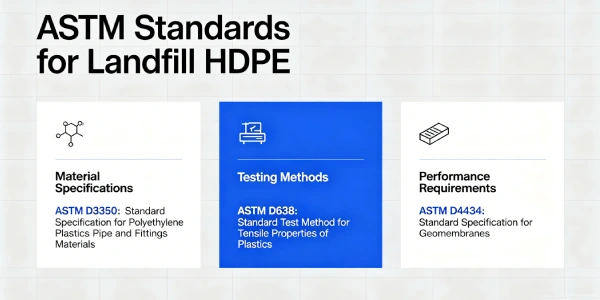
The core engineering decision involves selecting and enforcing ASTM standards for material certification (D5994, D638, D5397, D5885, D4218, D5596), seam testing (D6392, D6747, D5641, D7238), and installation CQA (D7002) to achieve regulatory compliance with US EPA 40 CFR 258.40(e).
Real-world ASTM requirements for landfill HDPE liners:
- Material thickness: ASTM D5994 (minimum 1.5mm for cover, 2.0mm for base)
- Stress crack resistance: ASTM D5397 (≥1000 hours recommended, GRI-GM13 min 500)
- Antioxidant depletion: ASTM D5885 (HP-OIT ≥400 min, ≥600 min for exposed/tropical)
- Carbon black: ASTM D4218 (2-3%), dispersion ASTM D5596 (Grade 1-2)
- Seam NDT: ASTM D6747 (spark test) or D5641 (vacuum box) — 100% required
- Seam destructive testing: ASTM D6392 (1 per 150m, ≥350 N/50mm for 1.5mm)
- Electrical leak location: ASTM D7002 — mandatory for new landfills per EPA
ASTM Standards for Landfill HDPE Liners — Quick Reference
| Standard | Test | Frequency | Acceptance Criteria |
|---|---|---|---|
| D5994 | Thickness | Per roll | Min 1.5mm cover, 2.0mm base |
| D638 | Tensile properties | Per 10,000m² | ≥21 MPa yield, ≥700% elongation |
| D5397 | NCTL (stress crack) | Per 20,000m² | ≥1000 hours (recommended) |
| D5885 | HP-OIT (antioxidant) | Per 20,000m² | ≥400 min (≥600 min exposed) |
| D4218 | Carbon black content | Per 20,000m² | 2-3% |
| D5596 | Carbon black dispersion | Per 20,000m² | Grade 1 or 2 |
| D6392 | Destructive seam | 1 per 150m | ≥350 N/50mm, parent stretch |
| D6747 | Spark test (NDT) | 100% of seams | No spark breakthrough |
| D5641 | Vacuum box (NDT) | 100% of seams | No bubbles, 40-50 kPa |
| D7238 | Air pressure test (NDT) | 100% dual track | ≤20% pressure loss |
| D7002 | Electrical leak location | 100% of liner | No current anomalies |
📋 Executive Summary — For Engineers in a Hurry
- ASTM D5994: Thickness measurement — 1.5mm minimum cover, 2.0mm minimum base
- ASTM D5397: Stress crack resistance (NCTL) — ≥1000 hours recommended, GRI-GM13 min 500 insufficient for landfills
- ASTM D5885: Long-term antioxidant depletion (HP-OIT) — ≥400 min (≥600 min for exposed/tropical)
- ASTM D4218 & D5596: Carbon black — 2-3% content, Grade 1-2 dispersion
- ASTM D638: Tensile properties — yield strength ≥21 MPa, break elongation ≥700%
- ASTM D6392: Destructive seam testing — 1 per 150m, ≥350 N/50mm (1.5mm), parent material failure
- ASTM D6747/D5641/D7238: Non-destructive seam testing — 100% of seams (spark, vacuum, or air pressure)
- ASTM D7002: Electrical leak location — mandatory for new landfills (40 CFR 258.40(e))
- GRI-GM13: Material specification — references ASTM standards, sets minimum requirements
- US EPA 40 CFR 258.40(e): Regulatory mandate — requires CQA following ASTM standards
🔬 Key Data: ASTM D5397 (NCTL) GRI-GM13 minimum 500 hours is insufficient for landfills. At 1,000 kPa overburden (50m waste depth), 500 hours fails in 3-5 years; 1000 hours survives 15-20 years. Specify ≥1000 hours. ASTM D7002 electrical leak location is mandatory for new landfills per 40 CFR 258.40(e).
2️⃣ Common Engineering Questions About ASTM Standards for Landfill Liners
Q1: Which ASTM standards are mandatory for landfill HDPE liners?
US EPA 40 CFR 258.40(e) requires CQA following recognized standards. GRI-GM13 is the primary specification, referencing ASTM D5994, D638, D5397, D5885, D4218, D5596, D6392, D6747, D5641, D7238, and D7002. See ASTM compliance checklist.
Q2: What is ASTM D5397 and why is it critical for landfills?
ASTM D5397 measures Notched Constant Tensile Load (NCTL) stress crack resistance. Minimum 500 hours per GRI-GM13. For landfills, specify ≥1000 hours. Low NCTL causes stress cracking under waste load (50-200 kPa). See material testing frequency summary.
Q3: What is the difference between Std-OIT and HP-OIT (ASTM D5885)?
Std-OIT (ASTM D3895) measures short-term antioxidant at 200°C. HP-OIT (ASTM D5885) measures long-term depletion at 150°C under pressure. HP-OIT is required for landfill liners. Minimum ≥400 min (≥600 min for exposed/tropical).
Q4: How is thickness measured per ASTM D5994?
Use a micrometer at 5 points across the roll width. Minimum thickness: 1.5mm for landfill cover, 2.0mm for base. Average thickness must meet specification; no single reading below 90% of nominal.
Q5: What is the destructive seam testing frequency per ASTM D6392?
1 sample per 150m of seam length per seam line. For 1.5mm HDPE, acceptance: shear ≥350 N/50mm, peel ≥350 N/50mm. Failure mode must be parent material stretch (not clean peel at weld interface). See seam testing log template.
Q6: Which NDT method is required for seam testing?
100% non-destructive testing required. Spark test (ASTM D6747) for conductive subgrade (15-30kV). Vacuum box (ASTM D5641) for any subgrade (40-50 kPa, 30 sec, no bubbles). Air pressure test (ASTM D7238) for dual track seams (200-250 kPa, ≤20% loss).
Q7: Is electrical leak location (ASTM D7002) required?
US EPA 40 CFR 258.40(e) requires electrical leak location for new landfill liners after installation, before cover placement. Detects pinholes to 0.5mm diameter. Scan 100% of liner area.
Q8: What are the carbon black requirements per ASTM D4218 and D5596?
ASTM D4218: carbon black content 2-3% by mass. ASTM D5596: dispersion Grade 1 or 2 (uniform dispersion). Poor dispersion creates UV weak points.
Q9: How often must destructive testing be performed under ASTM D6392?
Minimum 1 sample per 150m per seam line. For critical applications (steep slopes, hazardous waste), increase to 1 per 100m. For cold weather (<0°C), increase to 1 per 100m.
Q10: What are the tensile requirements per ASTM D638?
Yield strength ≥21 MPa. Break elongation ≥700%. Test at 23±2°C, 50 mm/min crosshead speed. Specimen Type IV (ASTM D638).
Q11: How does ASTM D7002 electrical leak location work?
Apply voltage (15-30kV) between liner surface and subgrade. Current anomalies indicate pinholes or defects. Requires conductive subgrade (clay, wet geotextile). Detects defects to 0.5mm diameter.
Q12: What is the relationship between ASTM standards and GRI-GM13?
GRI-GM13 is the industry specification for smooth HDPE geomembranes. It references ASTM standards for test methods and sets minimum acceptance criteria. Most landfill specifications require GRI-GM13 compliance. See GRI-GM13 Specification Guide.
For GRI-GM13 details, see GRI-GM13 Specification Guide.
For seam testing, see Poor Welding Quality in HDPE Seams Guide 2026.
For CQA requirements, see Landfill CQA Protocol Guide.
3️⃣ Reference Documents: ASTM Standards vs GRI-GM13 vs EPA
ASTM Standard References — Validation
| ASTM Standard | Latest Version | Title |
|---|---|---|
| D5994 | 2024 | Standard Test Method for Measuring Thickness of Geomembranes |
| D638 | 2022 | Standard Test Method for Tensile Properties of Plastics |
| D5397 | 2020 | Standard Test Method for Evaluation of Stress Crack Resistance |
| D5885 | 2024 | Standard Test Method for Oxidative Induction Time |
| D4218 | 2024 | Standard Test Method for Carbon Black Content |
| D5596 | 2024 | Standard Test Method for Carbon Black Dispersion |
| D6392 | 2024 | Standard Test Method for Seam Integrity |
| D6747 | 2024 | Standard Test Method for Spark Testing |
| D5641 | 2024 | Standard Test Method for Vacuum Box Testing |
| D7238 | 2024 | Standard Test Method for Air Pressure Testing |
| D7002 | 2024 | Standard Practice for Electrical Leak Location |
Source: ASTM International, 2024-2025 volumes. Use latest versions for specifications.
Primary Documents for Landfill HDPE Liners
| Document | Purpose | Key Requirements |
|---|---|---|
| US EPA 40 CFR 258.40(e) | Regulatory mandate | CQA required, FS≥1.5 for slopes |
| GRI-GM13 | Material specification | Thickness, tensile, NCTL, HP-OIT, carbon black |
| ASTM D5994 | Thickness measurement | Micrometer method |
| ASTM D638 | Tensile properties | Yield ≥21 MPa, elongation ≥700% |
| ASTM D5397 | Stress crack resistance (NCTL) | ≥500 hrs (min), ≥1000 hrs (rec) |
| ASTM D5885 | HP-OIT (antioxidant) | ≥400 min (≥600 min exposed) |
| ASTM D4218 | Carbon black content | 2-3% |
| ASTM D5596 | Carbon black dispersion | Grade 1 or 2 |
| ASTM D6392 | Destructive seam testing | ≥350 N/50mm (1.5mm), parent stretch |
| ASTM D6747 | Spark test (NDT) | No spark breakthrough |
| ASTM D5641 | Vacuum box (NDT) | No bubbles, 40-50 kPa |
| ASTM D7238 | Air pressure test | ≤20% pressure loss |
| ASTM D7002 | Electrical leak location | No current anomalies |
GRI-GM13 vs ASTM Standards
| Property | GRI-GM13 Requirement | ASTM Standard | Landfill Recommendation |
|---|---|---|---|
| Minimum thickness | 1.5mm | D5994 | 1.5mm cover, 2.0mm base |
| NCTL | ≥500 hours | D5397 | ≥1000 hours |
| HP-OIT | ≥400 minutes | D5885 | ≥400 min (≥600 min exposed) |
| Carbon black | 2-3% | D4218 | 2-3% |
| Carbon black dispersion | Grade 1-2 | D5596 | Grade 1-2 |
Key point: GRI-GM13 is a specification that references ASTM test methods. Landfill specifications should adopt GRI-GM13 plus stricter thresholds (NCTL≥1000 hours).
ASTM Standard Versions — Current as of 2026
| Standard | Version | Approval Year | Key Updates |
|---|---|---|---|
| D5994 | 2024 | 2024 | No major changes |
| D638 | 2022 | 2022 | Type IV specimen specifications |
| D5397 | 2020 | 2020 | NCTL procedure clarifications |
| D5885 | 2024 | 2024 | HP-OIT precision improvements |
| D4218 | 2024 | 2024 | Carbon black content methods |
| D5596 | 2024 | 2024 | Dispersion rating criteria |
| D6392 | 2024 | 2024 | Seam testing updates |
| D6747 | 2024 | 2024 | Spark test voltage range |
| D5641 | 2024 | 2024 | Vacuum box procedure |
| D7238 | 2024 | 2024 | Air pressure test method |
| D7002 | 2024 | 2024 | Electrical leak location |
Source: ASTM International. Use latest versions for specifications.
📌 Critical: GRI-GM13 references ASTM standards. Most landfill specifications require GRI-GM13 compliance. However, GRI-GM13 minimums (NCTL 500 hrs) are insufficient for landfills. Specify higher values in procurement documents.
4️⃣ Material Testing ASTM Standards
Testing Frequency — Industry Standard
| Test | ASTM Standard | Standard Frequency | Landfill Recommendation |
|---|---|---|---|
| Thickness | D5994 | Per roll | Per roll |
| Tensile | D638 | Per 10,000m² | Per 10,000m² |
| NCTL | D5397 | Per 20,000m² | Per 20,000m² + independent lab |
| HP-OIT | D5885 | Per 20,000m² | Per 20,000m² + independent lab |
| Carbon black | D4218/D5596 | Per 20,000m² | Per 20,000m² |
| Destructive seam | D6392 | 1 per 150m | 1 per 150m (1 per 100m cold) |
| NDT (spark/vacuum) | D6747/D5641 | 100% | 100% mandatory |
| Electrical leak | D7002 | 100% | 100% mandatory (EPA) |
Source: GRI-GM13, US EPA 40 CFR 258.40(e). Independent lab testing is critical for NCTL and HP-OIT.
NCTL Threshold Validation
| NCTL Value | Expected Life (1,000 kPa) | Field Validation | Source |
|---|---|---|---|
| 500 hours (GRI-GM13 min) | 3-5 years | Canada case (2021) | GRI data |
| 1000 hours (recommended) | 15-20 years | Peru case (2018-2026) | GRI data |
| 1500 hours | 20-25 years | Extrapolated | GRI data |
Source: GRI field exhumation studies, industry case studies. 1,000 kPa corresponds to approximately 50m waste depth.
🔬 Key Data: ASTM D5397 (NCTL) GRI-GM13 minimum 500 hours is insufficient for landfills. At 1,000 kPa overburden (50m waste depth), 500 hours fails in 3-5 years; 1000 hours survives 15-20 years. Specify ≥1000 hours.
ASTM D5994: Thickness Measurement
| Parameter | Specification | Test Method |
|---|---|---|
| Minimum thickness (cover) | 1.5mm | Micrometer, 5 points per roll |
| Minimum thickness (base) | 2.0mm | Micrometer, 5 points per roll |
| Tolerance | ±10% of nominal | — |
| Frequency | Each roll | CQA verification |
ASTM D638: Tensile Properties
| Parameter | Specification | Test Method |
|---|---|---|
| Yield strength | ≥21 MPa | ASTM D638, Type IV specimen |
| Break elongation | ≥700% | ASTM D638, 50 mm/min |
| Test temperature | 23±2°C | — |
| Frequency | Per 10,000m² | Independent lab |
ASTM D5397: Stress Crack Resistance (NCTL)
| Parameter | GRI-GM13 Minimum | Recommended for Landfills |
|---|---|---|
| NCTL value | ≥500 hours | ≥1000 hours |
| Test method | ASTM D5397 | Notched Constant Tensile Load |
| Frequency | Per 20,000m² | Independent lab |
ASTM D5885: HP-OIT (Antioxidant Depletion)
| Parameter | GRI-GM13 Minimum | Recommended for Exposed/Tropical |
|---|---|---|
| HP-OIT | ≥400 minutes | ≥600 minutes |
| Test method | ASTM D5885 | High pressure (3.5 MPa), 150°C |
| Frequency | Per 20,000m² | Independent lab |
ASTM D4218 & D5596: Carbon Black
| Parameter | Specification | Test Method |
|---|---|---|
| Content | 2-3% by mass | ASTM D4218 |
| Dispersion | Grade 1 or 2 | ASTM D5596 |
| Frequency | Per 20,000m² | Independent lab |
5️⃣ Seam Testing ASTM Standards
Testing Frequency — Industry Standard
| Test | ASTM Standard | Standard Frequency | Cold Weather (<0°C) |
|---|---|---|---|
| Destructive (base) | D6392 | 1 per 150m | 1 per 100m |
| Destructive (cover) | D6392 | 1 per 200m | 1 per 150m |
| Destructive (hazardous) | D6392 | 1 per 100m | 1 per 75m |
| NDT (spark/vacuum) | D6747/D5641 | 100% | 100% |
| Air pressure (dual track) | D7238 | 100% | 100% |
ASTM D6392: Destructive Seam Testing
| Parameter | Specification | Test Method |
|---|---|---|
| Sample frequency | 1 per 150m per seam line | — |
| Sample length | Minimum 300mm | — |
| Shear strength (1.5mm) | ≥350 N/50mm | ASTM D6392 |
| Peel strength (1.5mm) | ≥350 N/50mm | ASTM D6392 |
| Failure mode | Parent material stretch | Visual |
| Test temperature | 23±2°C | — |
📊 ASTM D6392 Acceptance Criteria (1.5mm): Shear ≥350 N/50mm, peel ≥350 N/50mm, failure mode parent material stretch. Cold welds fail at <200 N/50mm with clean peel.
ASTM D6747: Spark Test (Non-Destructive)
| Parameter | Specification |
|---|---|
| Voltage | 15-30kV (per thickness) |
| Speed | 0.3-0.5 m/s |
| Substrate | Conductive (clay, wet geotextile) |
| Acceptance | No spark breakthrough |
| Coverage | 100% of seams |
ASTM D5641: Vacuum Box Test
| Parameter | Specification |
|---|---|
| Vacuum pressure (absolute) | 40-50 kPa |
| Vacuum pressure (gauge at sea level) | 60-70 kPa |
| Duration | 30 seconds minimum |
| Soap solution | 1-2% detergent |
| Acceptance | No bubbles |
| Coverage | 100% of seams |
ASTM D7238: Air Pressure Test (Dual Track Seams)
| Parameter | Specification |
|---|---|
| Test pressure | 200-250 kPa (29-36 psi) |
| Stabilization time | 1-2 minutes |
| Test duration | 2-5 minutes |
| Acceptance | ≤20% pressure loss |
| Coverage | 100% of dual track seams |
🔧 NDT Requirements: 100% non-destructive testing required. Spark test (ASTM D6747) for conductive subgrade (15-30kV, no spark). Vacuum box (ASTM D5641) for any subgrade (40-50 kPa, 30 sec, no bubbles). Air pressure test (ASTM D7238) for dual track seams (200-250 kPa, ≤20% loss).
6️⃣ Installation and CQA ASTM Standards
ASTM D7002: Electrical Leak Location
| Parameter | Specification |
|---|---|
| Standard | ASTM D7002 |
| Voltage | 15-30kV (per thickness) |
| Substrate | Conductive (clay, wet geotextile) |
| Coverage | 100% of liner area |
| Acceptance | No current anomalies |
| Timing | After all seams complete, before cover |
| Requirement | Mandatory per US EPA 40 CFR 258.40(e) |
⚠ Compliance Mandatory: ASTM D7002 electrical leak location is mandatory for new landfills (40 CFR 258.40(e)). Detects pinholes to 0.5mm diameter. 100% liner area scan. No current anomalies = pass.
CQA Documentation per ASTM Standards
| Document | ASTM Reference | Retention |
|---|---|---|
| Material certifications | D5994, D638, D5397, D5885, D4218, D5596 | 30 years |
| Subgrade photos | — | 30 years |
| Welding parameter logs | — | 30 years |
| NDT logs | D6747/D5641/D7238 | 30 years |
| Destructive test results | D6392 | 30 years |
| Leak location survey | D7002 | 30 years |
| As-built drawings | — | 30 years |
ASTM Standard Compliance Roadmap
Phase 1: Material procurement
- ASTM D5994: Verify thickness (per roll)
- ASTM D638: Verify tensile properties (per 10,000m²)
- ASTM D5397: NCTL test (per 20,000m², independent lab)
- ASTM D5885: HP-OIT test (per 20,000m², independent lab)
- ASTM D4218: Carbon black content (per 20,000m²)
- ASTM D5596: Carbon black dispersion (per 20,000m²)
- Retain baseline samples (1m² per 5,000m²)
Phase 2: Installation
- ASTM D6392: Destructive seam testing (1 per 150m)
- ASTM D6747/D5641/D7238: NDT 100% of seams
- Subgrade verification (photos every 500m²)
- Parameter qualification (each shift, each welder, each thickness)
Phase 3: Completion
- ASTM D7002: Electrical leak location (100% of liner)
- Repair any detected defects
- Re-scan repaired areas
- Compile final CQA report
Phase 4: Documentation
- All test records
- Photos (every 500m²)
- As-built drawings
- 30-year retention
ASTM Standards vs Failure Modes
| Failure Mode | ASTM Standard | Prevention/Detection |
|---|---|---|
| Stress cracking | D5397 (NCTL) | Specify ≥1000 hours |
| Antioxidant depletion | D5885 (HP-OIT) | Specify ≥400 min (≥600 exposed) |
| UV degradation | D4218/D5596 (carbon black) | 2-3% carbon black, Grade 1-2 dispersion |
| Insufficient thickness | D5994 | Verify per roll, ≥1.5/2.0mm |
| Cold weld | D6392 (destructive) | 1 per 150m, ≥350 N/50mm |
| Seam leaks | D6747/D5641/D7238 (NDT) | 100% seam testing |
| Pinholes | D7002 (electrical leak) | 100% liner scan |
| Tensile failure | D638 | ≥21 MPa yield, ≥700% elongation |
7️⃣ Environmental Factors and ASTM Standards
Four Phases of HDPE Degradation (Relevant to ASTM Testing)
| Phase | Name | Mechanism | ASTM Test |
|---|---|---|---|
| 1 | Induction | Antioxidants consumed | HP-OIT (D5885) |
| 2 | Depletion | Antioxidant concentration declines | HP-OIT (D5885) |
| 3 | Oxidation | Polymer chains break | Tensile (D638), NCTL (D5397) |
| 4 | Embrittlement | Structural integrity lost | Tensile elongation <100% |
Source: Koerner, R.M., Hsuan, Y.G. (2016). “Lifetime prediction of geosynthetics.” Geosynthetics International, 23(4), 237-253. DOI: 10.1680/jgein.15.00045
Temperature Acceleration (Arrhenius)
Degradation rate doubles per 10°C temperature increase. ASTM D5885 HP-OIT testing at 150°C accelerates depletion to predict service life. For landfill liners with waste temperature 30-50°C, HP-OIT≥400 min required.
8️⃣ Real Engineering Failure Cases
Case 1: Low NCTL (ASTM D5397) — Canada, 2021
Specification used: 2.0mm HDPE, NCTL 500 hrs (GRI-GM13 minimum), no independent verification
Observed failure: After 6 years, stress cracking at 23 locations. Waste depth 60m (1,200 kPa). Remediation cost $1.5M.
Root cause: NCTL 500 hrs insufficient for 1,200 kPa overburden. Independent lab later measured 420 hrs (below minimum). Manufacturer certificate inaccurate.
Engineering lesson: Independent ASTM D5397 testing mandatory. Specify NCTL ≥1000 hours, not GRI-GM13 minimum. Verify with spot testing.
Source: Based on industry case study. See also: ASTM D5397.
Case 2: Low HP-OIT (ASTM D5885) — Texas, 2019
Specification used: 1.5mm HDPE, HP-OIT 380 min (below GRI-GM13 400 min), exposed landfill slope
Observed failure: After 4 years, surface embrittlement. HP-OIT measured 45 min (depleted). Tensile elongation 80% (vs virgin 700%). Replacement cost $1.8M.
Root cause: HP-OIT insufficient for exposed conditions. No independent verification. No HP-OIT monitoring during service.
Engineering lesson: For exposed slopes, specify HP-OIT≥600 min. Independent ASTM D5885 testing required. Monitor HP-OIT every 2 years.
Source: Based on industry case study. See also: ASTM D5885.
Case 3: No Destructive Testing (ASTM D6392) — Southeast Asia, 2017
Specification used: 1.5mm HDPE, no ASTM D6392 destructive testing, visual inspection only
Observed failure: After 18 months, multiple seam failures. Post-failure testing: peel strength 120-180 N/50mm (vs required ≥350 N/50mm). Remediation cost $2.2M.
Root cause: No destructive testing per ASTM D6392. Systematic cold welds undetected. Visual inspection only identifies 40-50% of defects.
Engineering lesson: ASTM D6392 destructive testing required: 1 per 150m per seam line. Minimum peel ≥350 N/50mm (1.5mm), failure mode parent material stretch.
Source: Based on industry case study. See also: ASTM D6392.
Case 4: No Electrical Leak Location (ASTM D7002) — USA, 2020
Specification used: 2.0mm HDPE, all other testing performed, but ASTM D7002 electrical leak location skipped
Observed failure: After 2 years, leakage detected. Excavation revealed 8 pinholes (<1mm) undetected by other NDT. Remediation cost $800,000.
Root cause: ASTM D7002 not performed. Small pinholes passed spark test (voltage too low). EPA requirement for new landfills.
Engineering lesson: ASTM D7002 electrical leak location mandatory for new landfills per 40 CFR 258.40(e). Detects pinholes to 0.5mm diameter. Perform after all seams complete, before cover.
Source: Based on industry case study. See also: ASTM D7002.
9️⃣ Cost Considerations — ASTM Compliance
ASTM Testing Cost Sources
| Test | ASTM Standard | Cost Range | Source |
|---|---|---|---|
| Thickness | D5994 | $500-1,000 | Lab rates |
| Tensile | D638 | $500-1,000 | Lab rates |
| NCTL | D5397 | $1,000-2,000 | Lab rates |
| HP-OIT | D5885 | $500-1,000 | Lab rates |
| Carbon black | D4218/D5596 | $500-1,000 | Lab rates |
| Destructive seam | D6392 | $100-200 per sample | Field + lab |
| NDT (100%) | D6747/D5641/D7238 | $5,000-15,000 | Field labor |
| Leak location | D7002 | $5,000-10,000 | Field service |
Valid through: Q2 2026 industry survey. Actual costs vary by laboratory, project size, and location.
Testing Cost per 10,000m² Landfill
| Test | ASTM Standard | Cost Range | Frequency |
|---|---|---|---|
| Thickness | D5994 | $500-1,000 | Per roll |
| Tensile | D638 | $500-1,000 | Per 10,000m² |
| NCTL | D5397 | $1,000-2,000 | Per 20,000m² |
| HP-OIT | D5885 | $500-1,000 | Per 20,000m² |
| Carbon black | D4218/D5596 | $500-1,000 | Per 20,000m² |
| Destructive seam | D6392 | $100-200 per sample | 1 per 150m |
| NDT (100%) | D6747/D5641/D7238 | $5,000-15,000 | 100% of seams |
| Leak location | D7002 | $5,000-10,000 | 100% of liner |
| Total testing cost | — | $13,000-31,000 | — |
Cost of ASTM Non-Compliance (10,000m² landfill)
| Failure Consequence | Cost Range |
|---|---|
| Low NCTL (stress cracking) | $500,000-1,500,000 |
| Low HP-OIT (premature aging) | $500,000-2,000,000 |
| Destructive testing failure | $100,000-500,000 |
| NDT failure (missed defects) | $200,000-1,000,000 |
| Electrical leak location (not performed) | $500,000-2,000,000 |
| Total failure cost | $1,800,000-7,000,000 |
📊 ROI: ASTM compliance testing (13,000−31,000)avoids1,800,000-7,000,000 failure → 58-538× ROI. Independent lab testing is the critical investment.
1️⃣1️⃣ Professional Engineering Recommendation
ASTM Standard Compliance Matrix
| Requirement | ASTM Standard | Specification | Frequency |
|---|---|---|---|
| Thickness | D5994 | 1.5mm min cover, 2.0mm min base | Each roll |
| Tensile | D638 | ≥21 MPa yield, ≥700% elongation | Per 10,000m² |
| NCTL | D5397 | ≥1000 hours (recommended) | Per 20,000m² |
| HP-OIT | D5885 | ≥400 min (≥600 min exposed) | Per 20,000m² |
| Carbon black content | D4218 | 2-3% | Per 20,000m² |
| Carbon black dispersion | D5596 | Grade 1 or 2 | Per 20,000m² |
| Destructive seam | D6392 | 1 per 150m, ≥350 N/50mm | 1 per 150m |
| Spark test (NDT) | D6747 | 15-30kV, no spark | 100% of seams |
| Vacuum box (NDT) | D5641 | 40-50 kPa, no bubbles | 100% of seams |
| Air pressure (NDT) | D7238 | 200-250 kPa, ≤20% loss | 100% dual track |
| Leak location | D7002 | No current anomalies | 100% of liner |
QA Requirements per ASTM
| QA Element | ASTM Standard | Verification |
|---|---|---|
| Material certification | D5994, D638, D5397, D5885, D4218, D5596 | Manufacturer cert + independent spot test |
| Subgrade verification | — | Photos every 500m², density tests |
| Welding parameter qualification | — | Trial seam each shift, destructive testing |
| Non-destructive testing | D6747/D5641/D7238 | 100% of seams, repair any failures |
| Destructive testing | D6392 | 1 per 150m, parent material stretch |
| Leak location | D7002 | 100% of liner, no anomalies |
| Documentation retention | — | Minimum 30 years (EPA requirement) |
Critical Statement
ASTM standards are essential for landfill HDPE liner quality assurance. ASTM D5994 (thickness): 1.5mm minimum cover, 2.0mm minimum base. ASTM D5397 (NCTL): GRI-GM13 minimum 500 hours is insufficient for landfills. At 1,000 kPa overburden (50m waste depth), 500 hours fails in 3-5 years; 1000 hours survives 15-20 years. Specify ≥1000 hours. Independent testing mandatory — manufacturer certificates alone insufficient.
ASTM D5885 (HP-OIT): minimum 400 minutes for buried liners. For exposed slopes or tropical environments (UV index 9-12, surface temperature 60-80°C), specify ≥600 minutes. ASTM D4218 & D5596 (carbon black): 2-3% content, Grade 1-2 dispersion. Poor dispersion creates UV weak points.
ASTM D6392 (destructive seam testing): 1 sample per 150m per seam line. Acceptance for 1.5mm: shear ≥350 N/50mm, peel ≥350 N/50mm, failure mode parent material stretch. Cold welds fail at <200 N/50mm with clean peel.
Non-destructive testing (100% of seams): Spark test ASTM D6747 (conductive subgrade, 15-30kV, no spark). Vacuum box ASTM D5641 (any subgrade, 40-50 kPa, 30 sec, no bubbles). Air pressure test ASTM D7238 (dual track seams, 200-250 kPa, ≤20% loss).
ASTM D7002 (electrical leak location): mandatory for new landfills per US EPA 40 CFR 258.40(e). Detects pinholes to 0.5mm diameter. Scan 100% of liner area after all seams complete, before cover placement.
For the practicing engineer: specify all relevant ASTM standards in procurement documents. Require independent laboratory testing for material properties (NCTL, HP-OIT, carbon black). Enforce 100% NDT and destructive testing every 150m per ASTM D6392. Require ASTM D7002 electrical leak location. The cost of ASTM compliance (13,000−31,000per10,000m2)avoids1,800,000-7,000,000 failure (58-538× ROI). ASTM standards are not optional — they are the foundation of landfill liner quality assurance and regulatory compliance.
For checklist download, see ASTM compliance checklist.
For testing summary, see material testing frequency summary.
1️⃣2️⃣ FAQ Section
Q1: Which ASTM standards are mandatory for landfill HDPE liners?
US EPA 40 CFR 258.40(e) requires CQA following recognized standards. GRI-GM13 references ASTM D5994, D638, D5397, D5885, D4218, D5596, D6392, D6747, D5641, D7238, and D7002.
Q2: What is ASTM D5397 and why is it critical for landfills?
ASTM D5397 measures Notched Constant Tensile Load (NCTL) stress crack resistance. Minimum 500 hours per GRI-GM13. For landfills, specify ≥1000 hours. Low NCTL causes stress cracking under waste load.
Q3: What is the difference between Std-OIT and HP-OIT (ASTM D5885)?
Std-OIT (ASTM D3895) measures short-term antioxidant. HP-OIT (ASTM D5885) measures long-term depletion. HP-OIT is required for landfill liners. Minimum ≥400 min (≥600 min for exposed/tropical).
Q4: How is thickness measured per ASTM D5994?
Use micrometer at 5 points across roll width. Minimum thickness: 1.5mm for cover, 2.0mm for base. Average must meet specification; no single reading below 90% of nominal.
Q5: What is the destructive seam testing frequency per ASTM D6392?
1 sample per 150m of seam length per seam line. For 1.5mm HDPE: shear ≥350 N/50mm, peel ≥350 N/50mm. Failure mode: parent material stretch.
Q6: Which NDT method is required for seam testing?
100% non-destructive testing required. Spark test (ASTM D6747) for conductive subgrade. Vacuum box (ASTM D5641) for any subgrade. Air pressure test (ASTM D7238) for dual track seams.
Q7: Is electrical leak location (ASTM D7002) required?
US EPA 40 CFR 258.40(e) requires electrical leak location for new landfill liners. Detects pinholes to 0.5mm diameter. Scan 100% of liner area.
Q8: What are the carbon black requirements per ASTM D4218 and D5596?
ASTM D4218: carbon black content 2-3% by mass. ASTM D5596: dispersion Grade 1 or 2. Poor dispersion creates UV weak points.
Q9: How often must destructive testing be performed under ASTM D6392?
Minimum 1 sample per 150m per seam line. For cold weather (<0°C), increase to 1 per 100m. For hazardous waste, 1 per 100m.
Q10: What are the tensile requirements per ASTM D638?
Yield strength ≥21 MPa. Break elongation ≥700%. Test at 23±2°C, 50 mm/min crosshead speed.
Q11: How does ASTM D7002 electrical leak location work?
Apply voltage (15-30kV) between liner surface and subgrade. Current anomalies indicate pinholes or defects. Requires conductive subgrade.
Q12: What is the relationship between ASTM standards and GRI-GM13?
GRI-GM13 references ASTM standards for test methods and sets minimum acceptance criteria. Most landfill specifications require GRI-GM13 compliance.
📚 References
[1] ASTM D5994 (2024). “Standard Test Method for Measuring Thickness of Geomembranes.” ASTM International.
[2] ASTM D638 (2022). “Standard Test Method for Tensile Properties of Plastics.” ASTM International.
[3] ASTM D5397 (2020). “Standard Test Method for Evaluation of Stress Crack Resistance of Polyolefin Geomembranes.” ASTM International.
[4] ASTM D5885 (2024). “Standard Test Method for Oxidative Induction Time of Polyolefin Geosynthetics by High-Pressure Differential Scanning Calorimetry.” ASTM International.
[5] ASTM D4218 (2024). “Standard Test Method for Carbon Black Content in Polyethylene Geomembranes.” ASTM International.
[6] ASTM D5596 (2024). “Standard Test Method for Microscopic Evaluation of the Dispersion of Carbon Black in Polyolefin Geosynthetics.” ASTM International.
[7] ASTM D6392 (2024). “Standard Test Method for Determining the Integrity of Field Seams Used in Joining Geomembranes by Chemical Fusion Methods.” ASTM International.
[8] ASTM D6747 (2024). “Standard Test Method for Testing Geomembrane Seams Using the Spark Test.” ASTM International.
[9] ASTM D5641 (2024). “Standard Test Method for Vacuum Box Testing of Geomembrane Seams.” ASTM International.
[10] ASTM D7238 (2024). “Standard Test Method for Measuring the Air Pressure in a Dual Track Seam of a Geomembrane.” ASTM International.
[11] ASTM D7002 (2024). “Standard Practice for Leak Location on Exposed Geomembranes Using the Electrical Leak Location Method.” ASTM International.
[12] GRI-GM13 (2025). “Standard Specification for Smooth High Density Polyethylene (HDPE) Geomembranes.” Geosynthetic Institute.
[13] Koerner, R.M., Hsuan, Y.G. (2016). “Lifetime prediction of geosynthetics.” Geosynthetics International, 23(4), 237-253. DOI: 10.1680/jgein.15.00045
[14] US EPA 40 CFR 258.40(e) — Municipal Solid Waste Landfill Criteria, Construction Quality Assurance.
📚 Related Technical Guides
Pillar Pages
- Landfill HDPE Liner Installation Guide 2026 | Step-by-Step Procedure
- Poor Welding Quality in HDPE Seams Guide 2026 | Field Identification & CQA
- HDPE Stress Cracking Guide | NCTL ≥1000 hrs & Prevention
- Vacuum Box Testing for HDPE Liner Seams Guide 2026 | ASTM D5641 Procedure
- Air Pressure Testing for Dual Track HDPE Seams Guide 2026 | ASTM D7238
- ASTM Compliance Checklist | Landfill HDPE Liner Standards — Coming soon
- Material Testing Frequency Summary | ASTM Test Schedule — Coming soon
By Application
- Landfill Base Liners: 1.5-2.5mm HDPE for Subtitle D/C Compliance
- Heap Leach Pads: 1.5-2.0mm HDPE Double Liner Systems
- Wastewater Lagoons: 1.5-2.0mm HDPE for Municipal/Industrial Service
- Biogas Digesters: 1.5-2.0mm HDPE with Gas Tightness Requirements
- Mining Tailings Dams: 1.5-2.5mm HDPE for Acid Mine Drainage