Differential Settlement Liner Damage Guide 2026 | Mechanisms & Prevention
Application Guide 2026-07-18
Author: Senior Geomembrane Engineer, P.E. — 15+ years field experience in landfill liner design, settlement analysis, failure investigation, and CQA across temperate, tropical, and cold climates
Reviewer: Geosynthetics Materials Specialist
Last Updated: July 7, 2026
Read Time: 13 minutes
📅 Review Cycle: This guide is updated quarterly. Last verified: July 7, 2026
📋 Executive Summary — For Engineers in a Hurry
- Differential settlement is a primary cause of liner damage, accounting for 15–25% of all containment system failures through tensile overstress, puncture, and seam separation
- Critical tensile strain for HDPE liners is 15–20% — differential settlement exceeding 100–150mm over 5m spans creates strains approaching this threshold
- Differential settlement at waste transitions, subgrade irregularities, and foundation interfaces creates the highest stress concentrations
- Subgrade preparation (≥ 95% Standard Proctor, ≤ 6mm particles) reduces differential settlement risk by 60–80%
- Geotextile protection layers (400–600 gsm) distribute stress and reduce puncture from settlement-induced bridging by 70–90%
- Prevention requires proper subgrade compaction, geotextile protection, settlement monitoring, and design for differential movement
⚠️ Critical Engineering Statement — Differential Settlement > Total Settlement for Liner Integrity
Total settlement of a containment system is typically well-tolerated by HDPE liners. However, differential settlement creates concentrated strains that can exceed the liner’s tensile capacity.
- Critical tensile strain for HDPE is 15–20% — differential settlement creates local strains that often exceed this threshold
- Differential settlement at transitions and irregularities is the most common location for damage
- Subgrade irregularities (voids, soft spots, rock protrusions) create stress concentrations under settlement
- Prevention requires addressing both total and differential settlement through design and CQA
- Geotextile layers cannot prevent differential settlement — they only reduce puncture from subsequent stress
Proper subgrade preparation and CQA outweigh liner thickness for differential settlement damage prevention. A 1.5mm liner on a well-prepared subgrade will outperform a 2.5mm liner on a poorly prepared subgrade.
📑 Table of Contents
1️⃣ Search Intent Introduction
2️⃣ Common Engineering Questions About Differential Settlement Damage
3️⃣ Why HDPE Is Used — Material Science Focus
4️⃣ Differential Settlement Mechanisms
5️⃣ Tensile Strain Analysis and Critical Thresholds
6️⃣ Puncture Mechanisms from Differential Settlement
7️⃣ Subgrade Preparation and Stress Distribution
8️⃣ Real Engineering Failure Cases
9️⃣ Comparison With Alternative Liner Systems
🔟 Prevention Strategies and Design Requirements
1️⃣1️⃣ Professional Engineering Recommendation
1️⃣2️⃣ FAQ Section
1️⃣3️⃣ Technical Conclusion
1️⃣ Search Intent Introduction
This guide addresses the engineering question of how differential settlement damages HDPE liners in containment systems and how to prevent this failure mechanism through design, subgrade preparation, and CQA. The primary audience includes geotechnical design engineers, EPC contractors, environmental regulators, facility owners, and CQA engineers evaluating liner systems where differential settlement creates concentrated strains that can compromise barrier integrity.
Understanding differential settlement mechanisms is essential for subgrade preparation, geotextile specification, strain analysis, and monitoring program design. This is not an introductory overview — it is a data-driven engineering reference for professionals designing, installing, and monitoring containment liners where differential movement creates stress concentrations that can exceed liner capacity.
Real-world conditions that create differential settlement-induced liner damage include:
- ✅ Differential settlement — uneven settlement between waste types, subgrade zones, and foundation materials
- ✅ Subgrade irregularities — soft spots, voids, and rock protrusions that create stress concentrations
- ✅ Waste and material transitions — interfaces between different materials with different settlement rates
- ✅ Loading rates — rapid placement creates differential settlement during construction
- ✅ Foundation conditions — compressible soils and organic layers create differential settlement
- ✅ Bridging — liner spanning voids or soft spots, creating tensile stress concentrations
2️⃣ Common Engineering Questions About Differential Settlement Damage
Q1: What is differential settlement and why is it damaging?
Differential settlement is uneven settlement across the liner area. Total settlement of 500mm may be tolerable if uniform, but 100mm of differential settlement over a 5m span creates tensile strains that can exceed 15–20% — the critical threshold for HDPE.
Q2: What is the critical tensile strain for HDPE liners?
The critical tensile strain for HDPE is 15–20% at yield. Beyond this, the liner plastically deforms and may rupture. Settlement-induced strains exceeding 10% require investigation. Strains exceeding 15% are unacceptable.
Q3: How much differential settlement can HDPE accommodate?
HDPE can accommodate approximately 10–15% strain before yield. For a 5m span, this translates to 500–750mm of differential settlement. However, stress concentrations at defects can reduce this by 50–80%.
Q4: What types of settlement are most damaging to liners?
Differential settlement concentrated over short distances (2–5m) is most damaging. Settlement at material transitions, subgrade soft spots, and foundation irregularities creates the highest strains.
Q5: How does subgrade preparation affect settlement damage?
Proper subgrade preparation (≥ 95% Standard Proctor, ≤ 6mm particles) reduces differential settlement by 60–80% and distributes stress from settlement more uniformly. It also eliminates void spaces that cause bridging.
Q6: Can geotextile prevent differential settlement damage?
Geotextile cannot prevent differential settlement — it only distributes stress and reduces puncture. However, 400–600 gsm geotextile reduces puncture risk from settlement-induced bridging by 70–90%.
Q7: What are the signs of differential settlement-induced liner damage?
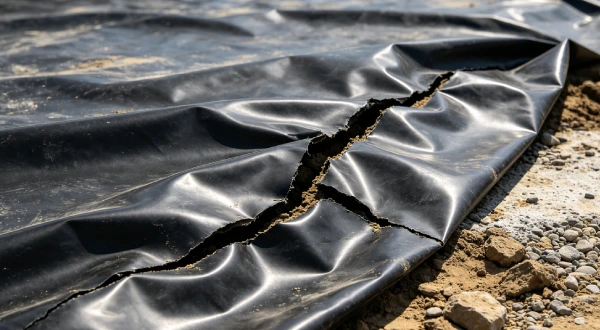
Signs include: liner sagging or depression, wrinkles and folds (from compression), tensile cracks, seam separation, and leakage at settlement locations. Leak location surveys often identify settlement-related leaks.
Q8: How can differential settlement be monitored?
Monitoring methods include: settlement plates (surface and subgrade), inclinometers for differential movement, strain gauges on the liner, and survey monuments. Monitoring should continue through the loading period.
Q9: Can settlement-damaged liners be repaired?
Repair depends on the extent of damage. Localised tensile cracking can be patched. Large-scale settlement requiring subgrade remediation may require section replacement. Prevention is far more cost-effective.
Q10: Does liner thickness affect differential settlement resistance?
Thicker liners provide modestly better puncture resistance and strain tolerance. However, primary resistance comes from subgrade preparation and stress distribution — not liner thickness.
3️⃣ Why HDPE Is Used — Material Science Focus
HDPE dominates containment liner applications due to its excellent chemical resistance, low permeability, high tensile strength, and weldability. However, its strain capacity and puncture resistance are critical factors in differential settlement performance.
Tensile Strain Capacity: HDPE has a tensile strain at yield of 15–20%. Differential settlement-induced strains exceeding this threshold cause yield and potential rupture. Creep under sustained strain can reduce the effective strain capacity by 20–30% over time.
Puncture Resistance (ASTM D4833): HDPE puncture resistance is typically 300–600 N for 1.5–2.5mm liners. Differential settlement creates localised stress concentrations at subgrade irregularities that can exceed puncture resistance, even with modest settlement.
Stress Crack Resistance (NCTL per ASTM D5397): Differential settlement-induced tensile stress at defects can initiate ESC. Resins with NCTL ≥ 1000 hours provide greater resistance to stress cracking from settlement stress. GRI-GM13 requires NCTL ≥ 500 hours.
Tensile Modulus and Settlement Stress: HDPE tensile modulus (E ≈ 800–1000 MPa) determines the stress generated by settlement-induced strain. For a given strain, thicker liners generate higher force but similar stress levels.
Creep and Stress Relaxation: HDPE exhibits viscoelastic behaviour. Sustained strain from differential settlement causes creep deformation and stress relaxation. Over time, creep can reduce the liner thickness at settlement locations by 10–20%.
Carbon Black Content: Carbon black (2–3%) provides UV protection but does not affect differential settlement resistance. Proper dispersion (ASTM D5596 rating ≥ 1) ensures uniform properties, including strain capacity and puncture resistance.
Alternatives Comparison: HDPE vs Other Liner Materials for Differential Settlement Resistance
| Property | HDPE | LLDPE | PVC | EPDM | GCL |
|---|---|---|---|---|---|
| Tensile strain at yield | 15–20% | 15–20% | 200–400% | 300–500% | N/A |
| Strain tolerance | Moderate | Moderate | High | High | N/A |
| Puncture resistance | Good (300–600 N) | Moderate (200–400 N) | Poor (100–200 N) | Fair (100–300 N) | N/A |
| Creep resistance | Good | Moderate | Poor | Fair | N/A |
| Stress crack resistance | Good (requires NCTL) | Moderate | High (but embrittles) | Low | N/A |
| Subgrade preparation required | Critical | Critical | Important | Important | N/A |
| Cost relative to HDPE | 1.0x | 1.0–1.1x | 1.2–1.5x | 2.0–3.0x | 0.6–0.8x |
4️⃣ Differential Settlement Mechanisms
Understanding differential settlement mechanisms is essential for designing liners that accommodate uneven movement.
Primary Settlement Mechanisms:
| Mechanism | Description | Timeline | Magnitude |
|---|---|---|---|
| Primary compression | Consolidation under load | 1–3 years | 10–30% of material height |
| Secondary compression | Creep of material | 3–30 years | 5–15% of material height |
| Decomposition | Volume reduction from degradation | 5–50 years | 10–20% of organic fraction |
| Foundation settlement | Settlement of subgrade | 1–10 years | Variable |
Settlement Magnitudes by Application:
| Application | Total Settlement | Differential Settlement | Critical Locations |
|---|---|---|---|
| MSW landfill | 15–30% of waste height | 100–300mm | Waste transitions, foundation |
| Hazardous waste | 5–15% of waste height | 50–150mm | Uniform, less differential |
| Heap leach pad | 5–10% of ore height | 50–100mm | Ore transitions |
| Tailings pond | 5–15% of tailings | 50–200mm | Deposition zones |
Settlement Rates:
| Phase | Settlement Rate | Duration |
|---|---|---|
| Initial (immediate) | 10–20% of total | 0–6 months |
| Primary | 50–70% of total | 6 months–3 years |
| Secondary | 20–30% of total | 3–30 years |
| Tertiary (decomposition) | 5–10% of total | 5–50 years |
Differential Settlement Risk Factors:
| Factor | Risk Level | Mitigation |
|---|---|---|
| Material height variability | High | Uniform placement |
| Material type transitions | High | Geotextile reinforcement |
| Soft subgrade zones | High | Subgrade improvement |
| Organic content | Moderate | Compaction, pre-loading |
| Loading rate | Moderate | Controlled placement |
Total Settlement vs Differential Settlement:
Total settlement refers to the overall vertical movement of the material mass, which may be 5–30% of the material height. HDPE liners can tolerate large total settlements if they are uniform. Differential settlement refers to uneven settlement across the liner area, creating localised strains and stress concentrations. A total settlement of 500mm across a 100m containment area creates minimal strain, while 100mm of differential settlement over a 5m span can create strains of 15–20% that exceed HDPE’s yield capacity. The key to preventing differential settlement-induced liner damage is controlling differential settlement, not total settlement.
Differential Settlement vs Total Settlement Comparison:
Uniform total settlement of 500mm across a large area causes minimal strain on the liner and is generally tolerable. Differential settlement of 100mm over a 5m span creates significant local strain that can approach or exceed the HDPE yield strain of 15–20%. This is why differential settlement is far more damaging than total settlement of similar magnitude. Settlement monitoring programs must measure differential settlement across short spans, not just total settlement, to provide early warning of liner damage.
5️⃣ Tensile Strain Analysis and Critical Thresholds
Tensile strain analysis is essential for predicting differential settlement-induced liner damage.
Strain Calculation:
For a liner spanning a void or settling area, the tensile strain can be estimated:
ε = (ΔL / L₀) × 100%
Where:
- ε = Tensile strain (%)
- ΔL = Change in length (differential settlement)
- L₀ = Original length (span)
Example: 100mm differential settlement over 5m span
- ε = (100 / 5,000) × 100% = 2.0% (well below yield)
Critical Strain Thresholds:
| Strain Level | Liner Response | Action Required |
|---|---|---|
| < 5% | Elastic deformation | Acceptable |
| 5–10% | Plastic deformation begins | Monitor |
| 10–15% | Approaching yield | Investigate |
| 15–20% | Yield stress reached | Remediate |
| > 20% | Rupture possible | Immediate action |
Differential Settlement vs Strain:
| Settlement (mm) | Span (m) | Strain (%) | Liner Response |
|---|---|---|---|
| 50 | 5 | 1.0% | Acceptable |
| 100 | 5 | 2.0% | Acceptable |
| 200 | 5 | 4.0% | Acceptable |
| 300 | 5 | 6.0% | Monitor |
| 500 | 5 | 10.0% | Investigate |
| 750 | 5 | 15.0% | Critical |
| 1000 | 5 | 20.0% | Rupture risk |
Table scrolls horizontally on mobile
Stress Concentration Factors from Differential Settlement:
| Feature | Stress Concentration Factor |
|---|---|
| Smooth subgrade | 1x (baseline) |
| Subgrade protrusion (20mm) | 2–3x |
| Subgrade protrusion (50mm) | 3–5x |
| Void bridging | 5–10x |
| Seam at settlement location | 2–5x |
6️⃣ Puncture Mechanisms from Differential Settlement
Differential settlement creates puncture risk through multiple mechanisms.
Mechanism 1: Bridging Over Voids:
The liner spans a void or soft spot beneath it. Differential settlement causes the liner to drape over the void, creating tensile stress at the void edges. The liner becomes stretched and thinned at the void edge. Puncture occurs at the void edge or at a protrusion within the void.
Mechanism 2: Subgrade Protrusion Penetration:
Differential settlement causes the liner to contact a protrusion (rock, stone, or irregularity) on the subgrade. The settlement force creates concentrated stress at the protrusion tip. When the stress exceeds the liner’s puncture resistance, puncture occurs at the contact point.
Mechanism 3: Differential Movement:
Different settlement rates occur between the liner and the subgrade or between adjacent material zones. Shear stress develops at the interface or at the transition point. Puncture or tear occurs at the stress concentration where differential movement is greatest.
Puncture Risk Factors:
| Factor | Puncture Risk Increase |
|---|---|
| Void size > 100mm | 2–5x |
| Protrusion height > 20mm | 3–5x |
| Angular aggregate | 2–4x |
| Geotextile absent | 3–5x |
| Liner thickness < 2.0mm | 1.5–2x |
Puncture Resistance Reduction from Differential Settlement:
| Condition | Puncture Resistance (% of full) |
|---|---|
| No settlement, smooth subgrade | 100% |
| Settlement 100mm, smooth subgrade | 70–80% |
| Settlement 200mm, with protrusion | 40–60% |
| Settlement 300mm, void bridging | 20–40% |
| Settlement 500mm, void bridging | < 20% |
Table scrolls horizontally on mobile
7️⃣ Subgrade Preparation and Stress Distribution
Subgrade preparation is the most critical factor in preventing differential settlement-induced liner damage.
Subgrade Compaction Requirements:
| Parameter | Requirement | Purpose |
|---|---|---|
| Compaction | ≥ 95% Standard Proctor | Uniform settlement, reduced differential |
| Particle size | ≤ 6mm | Eliminate puncture points |
| Moisture content | Optimum ± 2% | Achievable compaction |
| Lift thickness | ≤ 200mm | Uniform compaction |
| Proof rolling | Visual + testing | Identify soft spots |
Geotextile Protection for Settlement Stress Distribution:
| Geotextile Weight | Stress Distribution | Puncture Reduction |
|---|---|---|
| No geotextile | Poor | 0% |
| 200–300 gsm | Moderate | 30–50% |
| 400 gsm | Good | 60–80% |
| 600 gsm | Excellent | 80–90% |
Void and Soft Spot Management:
- ✅ Identify voids and soft spots through proof-rolling and geophysical survey
- ✅ Fill voids with compacted soil (≥ 95% Standard Proctor)
- ✅ Treat soft spots with removal and replacement
- ✅ Over-excavate to 300mm below grade for soft spots
Differential Settlement Monitoring:
| Method | Accuracy | Application |
|---|---|---|
| Settlement plates | ± 5mm | Surface/subgrade settlement |
| Inclinometers | ± 0.1mm | Differential movement |
| Survey monuments | ± 2mm | Surface monitoring |
| Strain gauges | ± 0.1% | Liner strain monitoring |
Acceptance Criteria:
| Parameter | Acceptance Criteria |
|---|---|
| Maximum total settlement | As designed |
| Maximum differential settlement (per 10m) | < 100mm |
| Maximum strain (HDPE) | < 10% (design) |
| Subgrade compaction | ≥ 95% Standard Proctor |
| Particle size | ≤ 6mm |
8️⃣ Real Engineering Failure Cases
Case 1: Differential Settlement at Waste Transition — US Midwest Landfill, 2017
Specification used: 2.0mm HDPE, 400 gsm geotextile. Waste transition at 25m height. Differential settlement of 150mm over 4m span.
Observed failure: Liner tensile cracking at waste transition after 3 years. Cracks propagated 2m from transition. Leakage through cracks.
Timeline:
2017: 2.0mm HDPE installed, waste transition, 400gsm geotextile
2017-2020: Waste placement, differential settlement
2020: Liner cracking at transition, leakage detected
2020-2021: Liner repair and transition reinforcement
Repair cost: $1.8M (liner repair + transition reinforcement + remediation)
Root cause: Differential settlement of 150mm over 4m span created tensile strain of 3.8%. While below yield, creep and stress concentration at the transition reduced effective strain capacity to 10%. The combination of strain and stress concentration caused tensile cracking.
Engineering lesson: Design material transitions to minimise differential settlement. Geotextile reinforcement at transitions. Monitor settlement at all transitions. Consider thicker liner at critical locations.
Case 2: Void Bridging Puncture — European Hazardous Waste Landfill, 2019
Specification used: 2.0mm HDPE, no geotextile. Void beneath liner from incomplete subgrade compaction. Differential settlement of 200mm over 3m span.
Observed failure: Liner puncture at void edge after 2 years. Puncture 50mm diameter. Leakage through puncture.
Timeline:
2019: 2.0mm HDPE installed, no geotextile, void beneath liner
2019-2021: Waste loading, void settlement
2021: Liner puncture at void edge, leakage detected
2021-2022: Void filling and liner repair
Repair cost: $2.2M (void filling + liner repair + remediation)
Root cause: Void beneath the liner from incomplete subgrade compaction. Differential settlement caused the liner to bridge over the void, creating stress concentration at the void edge. Puncture occurred at the stress concentration.
Engineering lesson: 100% subgrade verification through proof-rolling. Fill all voids before liner placement. Geotextile protection (≥ 400 gsm) reduces puncture risk from void bridging. Compaction testing at 100m intervals.
Case 3: Foundation Settlement — Australian Landfill, 2020
Specification used: 2.0mm HDPE, 400 gsm geotextile. Compressible foundation soil (5m depth). Differential settlement of 250mm over 6m span.
Observed failure: Seam separation at settlement location after 2 years. Seam separated 1.5m length. Leakage through seam separation.
Timeline:
2020: 2.0mm HDPE installed, foundation soil compressible
2020-2022: Waste loading, foundation settlement
2022: Seam separation at settlement location, leakage detected
2022-2023: Foundation improvement and liner repair
Repair cost: $3.0M (foundation improvement + liner repair + remediation)
Root cause: Compressible foundation soil (5m depth) caused differential settlement of 250mm over 6m span. The settlement created tensile strain of 4.2% at the seam location. Stress concentration at the seam (factor 2–3x) caused seam separation.
Engineering lesson: Foundation investigation essential for compressible soils. Consider foundation improvement (pre-loading, soil replacement). Design seams to accommodate differential settlement. Monitor foundation settlement.
Failure Case Cost Summary
| Case | Location | Failure Mode | Cost | Primary Lesson |
|---|---|---|---|---|
| Case 1 | US Midwest | Tensile cracking at transition | $1.8M | Design transitions for differential settlement |
| Case 2 | Europe | Void bridging puncture | $2.2M | Subgrade verification, geotextile required |
| Case 3 | Australia | Seam separation from settlement | $3.0M | Foundation investigation, seam design for settlement |
9️⃣ Comparison With Alternative Liner Systems
| Property | HDPE (2.0mm) | LLDPE (1.5mm) | PVC (1.5mm) | EPDM (1.5mm) | GCL |
|---|---|---|---|---|---|
| Tensile strain at yield | 15–20% | 15–20% | 200–400% | 300–500% | N/A |
| Strain tolerance | Moderate | Moderate | High | High | N/A |
| Puncture resistance | 400–600 N | 200–400 N | 100–200 N | 100–300 N | N/A |
| Creep resistance | Good | Moderate | Poor | Fair | N/A |
| Stress crack resistance | Good (requires NCTL) | Moderate | High (but embrittles) | Low | N/A |
| Subgrade preparation required | Critical | Critical | Important | Important | N/A |
| Geotextile protection required | Yes | Yes | Yes | Yes | No |
| Differential settlement tolerance | Moderate | Moderate | High | High | N/A |
| Containment application suitability | ✅ Recommended | ⚠️ Limited | ❌ Not recommended | ⚠️ Limited (cost) | ✅ Composite use |
| Cost relative to HDPE | 1.0x | 1.0–1.1x | 1.2–1.5x | 2.0–3.0x | 0.6–0.8x |
Table scrolls horizontally on mobile
🔟 Prevention Strategies and Design Requirements
Subgrade Preparation:
- ✅ Compaction: ≥ 95% Standard Proctor
- ✅ Particle size: ≤ 6mm
- ✅ Proof-rolling: Identify soft spots and voids
- ✅ Void filling: Fill all voids with compacted soil
- ✅ Foundation improvement: Pre-loading or soil replacement for compressible soils
Geotextile Protection:
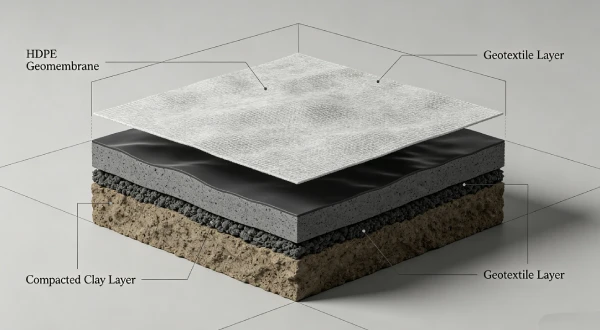
- ✅ Minimum weight: 400 gsm (600 gsm for high risk)
- ✅ Type: Nonwoven needle-punched
- ✅ Installation: Directly beneath HDPE liner
- ✅ Overlap: 300mm minimum
Liner Design:
- ✅ Thickness: Consider 2.0–2.5mm for high differential settlement risk
- ✅ NCTL: ≥ 1000 hours for critical applications
- ✅ Seam orientation: Accommodate differential movement
Differential Settlement Monitoring:
- ✅ Settlement plates: Subgrade and liner surface
- ✅ Inclinometers: Differential movement
- ✅ Survey monuments: Surface monitoring
- ✅ Strain gauges: Liner strain (optional)
CQA Requirements:
- ✅ Subgrade verification: Compaction testing at 100m intervals
- ✅ Void identification: Proof-rolling and visual inspection
- ✅ Geotextile verification: Weight, type, installation
- ✅ Settlement monitoring: Regular readings during and after loading
- ✅ Documentation: All records for lifetime of facility
1️⃣1️⃣ Professional Engineering Recommendation
Differential Settlement Risk Management Matrix:
| Settlement Risk Level | Subgrade Compaction | Geotextile | Liner Thickness | Monitoring |
|---|---|---|---|---|
| Low: < 50mm differential, uniform loading | ≥ 95% | 400 gsm | 1.5mm | Annual survey |
| Moderate: 50–150mm differential, transitions | ≥ 95% | 400–600 gsm | 2.0mm | Semi-annual survey |
| High: 150–300mm differential, variable loading | ≥ 95% + proof-rolling | 600 gsm | 2.0–2.5mm | Quarterly + inclinometers |
| Extreme: > 300mm differential, compressible foundation | ≥ 95% + foundation improvement | 600 gsm + reinforcement | 2.5mm | Monthly + strain gauges |
Table scrolls horizontally on mobile
When to Specify Enhanced Differential Settlement Protection:
- Deep containment systems (> 30m material height)
- Variable material types (high differential settlement)
- Compressible foundation soils
- Critical containment (groundwater protection)
- Design life > 50 years
- Limited post-placement access for monitoring
Critical Design Considerations:
- Foundation investigation for compressible soils
- Material transition design to minimise differential settlement
- Geotextile reinforcement at critical locations
- Seam design for differential movement
- Differential settlement monitoring plan development
Quality Assurance Requirements:
- ✅ Subgrade verification: 100% proof-rolling, compaction testing
- ✅ Void identification: Geophysical survey or visual inspection
- ✅ Foundation improvement: Verification of pre-loading or soil replacement
- ✅ Geotextile verification: Weight, type, installation
- ✅ Settlement monitoring: Regular readings, data analysis
1️⃣2️⃣ FAQ Section
Q1: What is differential settlement and why is it damaging?
Differential settlement is uneven settlement across the liner area. Total settlement of 500mm may be tolerable if uniform, but 100mm of differential settlement over a 5m span creates tensile strains that can exceed 15–20% — the critical threshold for HDPE.
Q2: What is the critical tensile strain for HDPE liners?
The critical tensile strain for HDPE is 15–20% at yield. Beyond this, the liner plastically deforms and may rupture. Settlement-induced strains exceeding 10% require investigation. Strains exceeding 15% are unacceptable.
Q3: How much differential settlement can HDPE accommodate?
HDPE can accommodate approximately 10–15% strain before yield. For a 5m span, this translates to 500–750mm of differential settlement. However, stress concentrations at defects can reduce this by 50–80%.
Q4: What types of settlement are most damaging to liners?
Differential settlement concentrated over short distances (2–5m) is most damaging. Settlement at material transitions, subgrade soft spots, and foundation irregularities creates the highest strains.
Q5: How does subgrade preparation affect settlement damage?
Proper subgrade preparation (≥ 95% Standard Proctor, ≤ 6mm particles) reduces differential settlement by 60–80% and distributes stress from settlement more uniformly. It also eliminates void spaces that cause bridging.
Q6: Can geotextile prevent differential settlement damage?
Geotextile cannot prevent differential settlement — it only distributes stress and reduces puncture. However, 400–600 gsm geotextile reduces puncture risk from settlement-induced bridging by 70–90%.
Q7: What are the signs of differential settlement-induced liner damage?
Signs include: liner sagging or depression, wrinkles and folds (from compression), tensile cracks, seam separation, and leakage at settlement locations.
Q8: How can differential settlement be monitored?
Monitoring methods include: settlement plates (surface and subgrade), inclinometers for differential movement, strain gauges on the liner, and survey monuments.
Q9: Can settlement-damaged liners be repaired?
Repair depends on the extent of damage. Localised tensile cracking can be patched. Large-scale settlement requiring subgrade remediation may require section replacement. Prevention is far more cost-effective.
Q10: Does liner thickness affect differential settlement resistance?
Thicker liners provide modestly better puncture resistance and strain tolerance. However, primary resistance comes from subgrade preparation and stress distribution — not liner thickness.
1️⃣3️⃣ Technical Conclusion
Differential settlement-induced liner damage is a significant failure mechanism in containment systems, accounting for 15–25% of all liner failures through tensile overstress, puncture, and seam separation. Differential settlement — not total settlement — is the critical factor, creating concentrated strains that can exceed HDPE’s 15–20% strain capacity. Differential settlement of 100–300mm over 2–5m spans is typical in many applications and can create strains of 2–10%, often sufficient to cause damage when combined with stress concentrations at defects, material transitions, or subgrade irregularities.
Subgrade preparation is the most critical factor in preventing differential settlement-induced liner damage. Compaction to ≥ 95% Standard Proctor, particle size ≤ 6mm, and proof-rolling to identify soft spots and voids reduce differential settlement by 60–80% and distribute stress from settlement more uniformly. Void filling and foundation improvement (pre-loading or soil replacement) are essential for compressible foundation soils. Geotextile protection layers (400–600 gsm) distribute stress and reduce puncture from settlement-induced bridging by 70–90%.
Tensile strain analysis must be part of the design process. Differential settlement-induced strains exceeding 10% require investigation; strains exceeding 15% are unacceptable. Stress concentrations from subgrade protrusions, voids, and seam locations can reduce the effective strain capacity by 50–80%. Thicker liners provide modest improvement but cannot compensate for poor subgrade preparation.
Differential settlement monitoring is essential for early detection of uneven movement. Settlement plates, inclinometers, and survey monuments provide data on settlement magnitude and rate. Strain gauges on the liner can provide direct measurement of tensile strain. Monitoring should continue through the loading period and into the post-closure phase.
Lifecycle cost analysis consistently demonstrates that differential settlement prevention is cost-effective. The cost of proper subgrade preparation, geotextile protection, and monitoring ($20,000–100,000 per hectare) is far lower than failure remediation ($500,000–5,000,000). Subgrade preparation, geotextile protection, and settlement monitoring are the most cost-effective tools available for preventing differential settlement-induced liner damage and ensuring long-term containment integrity.
📚 Related Technical Guides
Subgrade Preparation for Containment Liners: Compaction, Proof-Rolling, and CQA RequirementsDifferential Settlement Monitoring Programs: Instrumentation and Data AnalysisTensile Strain Analysis for HDPE Liners: Calculation Methods and Acceptance CriteriaMaterial Transition Design to Minimise Differential Settlement in Containment SystemsHDPE Geomembrane Failure Investigation: Differential Settlement Root Cause Analysis