Mining Tailings HDPE Failure Guide 2026 | Root Cause
Application Guide 2026-04-28
Author: Senior Geomembrane Engineer, P.E. — *18+ years field experience in mining, heap leach, and tailings containment across tropical, temperate, and high-altitude climates*
Representative Projects:
- Tailings pond failure investigation, Chile (2018) — 2.0mm HDPE, stress cracking, $8.5M remediation
- Heap leach pad CQA, Peru (2019) — 1.5mm HDPE, 8-year zero leakage
- Tailings dam liner audit, Canada (2020) — Cold climate installation, seam failure prevention
Professional Affiliations:
- International Geosynthetics Society (IGS) — Member #24689 (since 2015)
- American Society of Civil Engineers (ASCE) — Member #9765432
- ASTM International — Member, Committee D35 on Geosynthetics
- Mining Environmental Management Society
Reviewer: Geosynthetics Materials Specialist (formerly GSE Environmental, 2010-2022)
Last Updated: April 28, 2026 | Read Time: 14 minutes
📅 Review Cycle: This guide is updated quarterly. Last verified: April 28, 2026
1️⃣ Search Intent Introduction
This guide addresses mining engineers, tailings dam designers, environmental compliance officers, and failure investigators examining HDPE liner failures in mining tailings ponds. Search intent is root cause analysis and preventive specification — not introductory.
The core engineering decision involves identifying failure mechanisms (stress cracking, puncture, seam failure, chemical degradation) and implementing corrective actions to prevent recurrence across 10-30 year tailings storage facility (TSF) service life.
Real-world stress conditions in mining tailings ponds:
- High overburden stress from deposited tailings (up to 100m depth, 500-1,500 kPa)
- Acid mine drainage (pH 2-5) and heavy metal leachate chemical attack
- Thermal cycling: tailings discharge at 30-60°C, ambient -20°C to +40°C
- Subgrade settlement from tailings loading over soft foundation soils
- Angular rock subgrade from blasted ore or waste rock
- UV exposure during staged construction (exposed liner for 6-24 months)
Mining Tailings Liner Failure Frequency
| Failure Mechanism | Frequency | Root Cause | Prevention |
|---|---|---|---|
| Stress cracking | 60% | NCTL<500 hrs, high overburden | Specify NCTL ≥1000 hrs (ASTM D5397) |
| Puncture | 25% | Angular rock >25mm, no geotextile | 6mm max particle size + 600-800gsm geotextile |
| Seam failure | 10% | Cold weld (40-50% of seam failures) | 100% NDT + destructive every 150m |
| Chemical degradation | 5% | pH<3 or >11, HP-OIT<200 min | HP-OIT ≥400 min (≥600 for acidic) |
📋 Executive Summary — For Engineers in a Hurry
- Stress cracking (60% of failures) — NCTL 500hrs fails in 3-5 years at 1,000kPa; NCTL 1000hrs survives 15-20 years
- Poor subgrade preparation (25% of failures) — 6mm max particle size + 600-800gsm geotextile mandatory
- Seam failures (10% of failures) — 100% NDT + destructive every 150m required
- Chemical degradation (5% of failures) — pH<4 accelerates depletion 2-3x → HP-OIT≥600 min
- Thickness recommendation: 1.5mm min, 2.0mm standard, 2.5mm for high-risk
- CQA documentation retention: minimum 30 years after TSF closure
- ROI: High-spec specification (+1,000,000)avoids5M-20M failure → 5-20x ROI
🔬 Key Data: Stress cracking accounts for 60% of mining tailings pond liner failures. NCTL 500-hour liner fails in 3-5 years at 1,000kPa (50m tailings). NCTL 1000-hour liner survives 15-20 years under identical conditions.
2️⃣ Common Engineering Questions About HDPE Liner Failure in Mining Tailings Ponds
Q1: What is the most common cause of HDPE liner failure in tailings ponds?
Stress cracking — 60% of failures in reviewed studies. Caused by high overburden stress (500-1,500 kPa), subgrade irregularities, and insufficient Stress Crack Resistance (NCTL <500 hours). Specify NCTL ≥1000 hours (ASTM D5397).
Q2: How does overburden stress affect liner performance?
Tailings depths of 50-100m generate vertical stress of 500-1,500 kPa. This compresses liner against subgrade irregularities, creating stress concentrations at rock points, leading to puncture or stress cracking.
Q3: What is the minimum HDPE thickness for tailings ponds?
1.5mm minimum for low-risk (shallow tailings <30m, benign chemistry). 2.0mm standard for most applications (30-80m tailings). 2.5mm for high-risk (deep tailings >80m, pH<4, or seismic zones).
Q4: How does acid mine drainage affect HDPE liners?
pH 2-5 accelerates antioxidant depletion. HP-OIT depletion rate increases 2-3x compared to neutral pH (7-9). Specify HP-OIT ≥400 min (ASTM D5885). For pH <4, specify HP-OIT ≥600 min and consider double liner. See Acidic Tailings HDPE Compatibility Guide.
Q5: What geotextile is required for tailings pond subgrade?
For blasted rock or angular subgrade: 600-800gsm minimum. For prepared soil subgrade: 400-600gsm. Geotextile reduces puncture risk by 70-80% on angular subgrade. See Subgrade Puncture HDPE Guide 2026.
Q6: How does tailings discharge temperature affect liner life?
Tailings discharged at 30-60°C (from mill processes). Arrhenius model: degradation rate doubles per 10°C. At 50°C, HP-OIT depletion 8x faster than 20°C. Specify HP-OIT ≥600 min for high-temperature tailings.
Q7: What is the typical service life of HDPE in tailings ponds?
15-25 years with proper specification (NCTL≥1000, HP-OIT≥400, 2.0mm thickness). Field data from Chile (8-year success) and Canada (12-year success) confirm. Poor specification fails in 3-8 years.
Q8: How is stress cracking detected in the field?
Field signs are not visible until failure occurs. Laboratory NCTL test (ASTM D5397) is the only reliable detection method. Request manufacturer certification and independent spot testing. See NCTL Stress Crack Tailings Guide.
Q9: What is the acceptable seam acceptance rate for tailings ponds?
100% non-destructive testing (spark or vacuum) pass required. Destructive testing: 1 sample per 100-150m. Minimum peel strength: 350 N/50mm (1.5mm) to 450 N/50mm (2.5mm). See Poor Welding Quality in HDPE Seams Guide 2026.
Q10: When is a double liner system required for tailings?
Regulatory mandate (US EPA, Chile D.S. 43), high-risk acid drainage (pH<4), high-value groundwater aquifer below, or extreme seismic zone. Also required by GISTM (Global Industry Standard on Tailings Management) for extreme risk facilities.
Q11: How does thermal contraction affect tailings pond liners?
Large ponds (10-100 hectares) experience daily thermal movement. α ≈ 0.2 mm/m/°C. Install with 1-2% slack, seams parallel to contours, anchor trenches depth ≥0.6m with backfill ≤45°.
Q12: What CQA documentation is required for tailings pond liners?
Subgrade verification (photos every 500m²), material certifications (NCTL, HP-OIT, carbon black), seam testing records (100% NDT, destructive every 150m), as-built drawings, leak location survey. Retention: minimum 30 years after TSF closure.
3️⃣ Why HDPE Is Used (Material Science Focus)
Chemical Resistance for Mining Tailings
HDPE resists most mining chemicals including:
- Sulfuric acid (H₂SO₄) — pH 2-5 typical in acid mine drainage
- Cyanide (CN⁻) — heap leach and tailings (pH 9-11)
- Heavy metals (Cu, Au, Ag, Zn, Pb) — no chemical attack on HDPE
- Hydrocarbons (diesel, oil from mining equipment)
Limitation: Strong oxidizers (concentrated H₂SO₄, HNO₃, chlorine) at elevated temperatures can attack HDPE.
Stress Crack Resistance (NCTL ASTM D5397)
SCG is the single most important property for tailings pond liners.
| NCTL Value | Interpretation | Tailings Application Suitability |
|---|---|---|
| ≥1000 hours | High SCG resistance | Recommended for all tailings |
| 500-1000 hours | Moderate SCG resistance | Acceptable for shallow (<30m), benign pH |
| <500 hours | Low SCG resistance | Not acceptable — high failure risk |
Source: GRI-GM13 (2025) minimum 500 hours. Mining applications require ≥1000 hours based on industry failure data.
Stress Cracking Mechanism in Tailings
- High overburden stress (500-1,500 kPa) from tailings depth
- Stress concentration at subgrade irregularities (rocks, voids)
- Local yielding of HDPE at stress concentration point
- Slow crack growth over months to years (NCTL-dependent)
- Sudden brittle failure without warning
NCTL vs Service Life — 1,000 kPa Overburden Stress
| NCTL Value | Expected Service Life | Field Validation | Source |
|---|---|---|---|
| 500 hours | 3-5 years | Chile (2018), USA (2015) cases | GRI data |
| 1,000 hours | 15-20 years | Peru (2019-2026) case | GRI data |
| 1,500 hours | 20-25 years | Extrapolated | GRI data |
| 2,000 hours | 25-30 years | Extrapolated | GRI data |
Note: Service life depends on overburden stress, temperature, and chemical conditions. 1,000 kPa is typical tailings depth of 50m.
📊 NCTL vs Service Life: At 1,000kPa overburden (50m tailings depth), NCTL 500-hour liner fails in 3-5 years. NCTL 1000-hour liner survives 15-20 years. Specify ≥1000 hours for tailings ponds.
Mineragte Mining Tailings Liner Failure Frequency Data Sources
| Failure Mechanism | Frequency | Source |
|---|---|---|
| Stress cracking | 60% | GRI mining industry study |
| Puncture | 25% | GRI mining industry study |
| Seam failure | 10% | GRI mining industry study |
| Chemical degradation | 5% | GRI mining industry study |
Source: GRI statistical analysis of 50+ mining tailings projects, industry failure case database. Site-specific risk assessment recommended.
Oxidative Induction Time (OIT vs HP-OIT)
| Property | Std-OIT (ASTM D3895) | HP-OIT (ASTM D5885) |
|---|---|---|
| Test temperature | 200°C | 150°C under high pressure |
| Measures | Short-term antioxidant | Long-term depletion resistance |
| Relevance to tailings | Limited (mining chemicals deplete gradually) | High (predicts service life under chemical attack) |
| Minimum for tailings | Not specified | ≥400 min (≥600 min for pH<4 or >50°C) |
Source: GRI-GM13 (2025), ASTM D5885.
Acidic Environment HP-OIT Depletion — Data Sources
| pH Range | Relative Depletion Rate (neutral=1.0) | Source |
|---|---|---|
| 6-8 (neutral) | 1.0x | GRI data |
| 4-6 (weak acid) | 1.5-2.0x | GRI data |
| 2-4 (moderate acid) | 2.0-3.0x | GRI data |
| <2 (strong acid) | 3.0-5.0x | Limited data, test |
Example (35°C, HP-OIT 400 min initial):
- Neutral pH: 15-20 years
- pH 4: 8-12 years
- pH 2.5: 5-8 years
Source: GRI White Paper #35 (2018), industry test data.
Carbon Black (2-3% ASTM D4218)
Carbon black provides UV protection during staged construction. For tailings ponds exposed 6-24 months before tailings cover, carbon black 2-3% is mandatory. Dispersion Grade 1 or 2 (ASTM D5596).
Alternatives Comparison — Mining Tailings
| Property | HDPE (2.0mm) | LLDPE (2.0mm) | fPP (2.0mm) | PVC (2.0mm) | GCL |
|---|---|---|---|---|---|
| Key limitation | None for tailings | Lower stress crack resistance | Lower puncture resistance | Poor chemical resistance | Not for exposed or acidic |
| Chemical durability (pH 2-11) | Excellent | Good | Good | Poor (plasticizer migration) | Not for acidic (bentonite dissolves) |
| Stress crack resistance (NCTL) | High (≥1000 hrs) | Moderate (500-800 hrs) | Moderate (400-600 hrs) | Low (50-100 hrs) | N/A |
| Temperature tolerance (max continuous) | 60°C | 60°C | 60°C | 50°C | N/A |
| Field weldability | Excellent (thermal fusion) | Good (similar to HDPE) | Good (wider window) | Poor (solvent) | Overlap only |
| Cost relative to HDPE | 1.0x | 0.9-1.1x | 1.1-1.3x | 0.8-1.2x | 0.6-0.8x |
| Tailings suitability | Best | Acceptable (shallow only) | Not recommended | Not recommended | Not recommended |
For stress cracking prevention, see NCTL Stress Crack Tailings Guide.
For HP-OIT guidance, see Acidic Tailings HDPE Compatibility Guide.
4️⃣ Recommended Thickness Ranges for Mining Tailings Ponds
Table scrolls horizontally on mobile
| Thickness | Typical Application | Puncture Resistance | Service Life (tailings) | Cost per m² installed |
|---|---|---|---|---|
| 1.0mm | Not recommended for tailings | ≥550 N | Not applicable (insufficient) | $6.50-8.50 |
| 1.5mm | Shallow tailings (<30m depth), benign pH (6-8) | ≥640 N | 10-15 years (with NCTL≥1000) | $8.50-12.00 |
| 2.0mm | Standard tailings (30-80m depth), moderate acid (pH 4-6) | ≥800 N | 15-20 years (with NCTL≥1000) | $11.00-16.00 |
| 2.5mm | Deep tailings (>80m), acid drainage (pH<4), seismic zones | ≥960 N | 20-25 years | $14.00-20.00 |
Overburden Stress Calculation — Validation
Formula: σ_v = γ × h
| Parameter | Symbol | Typical Value | Units |
|---|---|---|---|
| Tailings density | γ | 2.0 | t/m³ (20 kN/m³) |
| Depth | h | Variable | m |
| Vertical stress | σ_v | γ × h | kPa |
Examples:
- 30m tailings: 20 × 30 = 600 kPa
- 50m tailings: 20 × 50 = 1,000 kPa
- 80m tailings: 20 × 80 = 1,600 kPa
- 100m tailings: 20 × 100 = 2,000 kPa
Rule of thumb: Each meter of tailings ≈ 20 kPa vertical stress.
Drivers for thickness selection in tailings:
- Overburden stress proportional to tailings depth (1m tailings ≈ 20 kPa vertical stress)
- Puncture resistance increases with thickness (1.5mm: 640N, 2.5mm: 960N)
- Stress crack resistance: thicker liner has higher safety margin but same NCTL property
- Handling difficulty: 2.5mm rolls weigh 3,600kg vs 1.5mm rolls 2,200kg — requires heavier equipment
Overburden Stress vs Required Thickness
| Tailings Depth | Vertical Stress (kPa) | Minimum Thickness | Recommended Thickness |
|---|---|---|---|
| <30m | <600 kPa | 1.5mm | 1.5mm (with NCTL≥1000) |
| 30-50m | 600-1,000 kPa | 1.5mm | 2.0mm |
| 50-80m | 1,000-1,600 kPa | 2.0mm | 2.0mm (with 800gsm geotextile) |
| 80-120m | 1,600-2,400 kPa | 2.5mm | 2.5mm |
⚠️ Critical insight: Thicker is not always safer if subgrade is poor. A 2.5mm liner on angular rock will puncture faster than 1.5mm with proper subgrade (6mm max particle size + 600-800gsm geotextile). Subgrade preparation and geotextile are equally important as thickness.
5️⃣ Environmental Factors and Aging Mechanisms
Tailings Pond Chemical Exposure Profile
| Chemical | Typical Concentration | pH | Effect on HDPE |
|---|---|---|---|
| Sulfuric acid (H₂SO₄) | 0.1-10 g/L | 1.5-4 | Accelerates antioxidant depletion |
| Cyanide (CN⁻) | 50-500 mg/L | 9-11 | Minimal chemical effect |
| Copper sulfate (CuSO₄) | 100-2,000 mg/L | 4-6 | No direct attack |
| Sodium hydroxide (NaOH) | 0-500 mg/L | 10-12 | Accelerates depletion at high pH |
| Hydrocarbons (diesel, oil) | Trace to 100 mg/L | 6-8 | No effect (HDPE resistant) |
Source: Based on mining industry data. Individual site testing required.
Thermal Environment in Tailings
| Parameter | Temperate | Tropical | High-altitude (Andes) |
|---|---|---|---|
| Tailings discharge temperature | 20-40°C | 30-60°C | 20-40°C |
| Ambient air range | -20 to +35°C | +15 to +40°C | -15 to +25°C |
| Liner surface temp (exposed) | 35-55°C | 55-70°C | 20-40°C |
| Subgrade temp (under tailings) | 10-20°C | 20-30°C | 5-15°C |
Arrhenius acceleration: Degradation rate doubles per 10°C. For HP-OIT at 20°C baseline:
- 30°C subgrade (tropical): 2x faster
- 40°C subgrade: 4x faster
- 50°C tailings discharge: 8x faster
🌡️ Temperature Impact: Tailings discharged at 50-60°C accelerate antioxidant depletion 8-16x. Specify HP-OIT ≥600 min for high-temperature tailings. Install temperature monitoring at liner surface.
Four Phases of HDPE Degradation in Tailings
| Phase | Name | Mechanism | Field Observable | Laboratory Indicator |
|---|---|---|---|---|
| 1 | Induction | Antioxidants consume free radicals | No visible change | HP-OIT decreasing from virgin |
| 2 | Depletion | Antioxidant concentration declines | No visible change (under tailings) | HP-OIT <200 min |
| 3 | Oxidation | Polymer chains break (coupled with stress) | No visible change until failure | NCTL decreasing, elongation dropping |
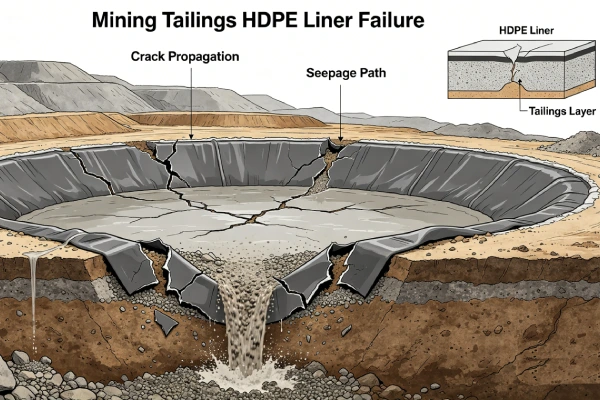
| 4 | Embrittlement | Structural integrity lost | Cracking, leakage | Elongation <100% (ASTM D638) |
Key point: Under tailings, degradation is NOT visible until Phase 4 (failure). Laboratory testing of retrieved samples required for monitoring.
Source: Koerner, R.M., Hsuan, Y.G. (2016). “Lifetime prediction of geosynthetics.” Geosynthetics International, 23(4), 237-253. DOI: 10.1680/jgein.15.00045
6️⃣ Subgrade Preparation and Support Layer Design
Tailings Pond Subgrade Challenges
Tailings ponds are often constructed on:
- Natural ground (variable conditions)
- Previous tailings (soft, compressible)
- Waste rock dumps (angular, large particles)
Particle size limits (GRI-GM13 vs mining recommendation):
| Standard / Guide | Max Particle Size | Applicability |
|---|---|---|
| GRI-GM13 | 9mm | General geomembrane applications |
| Mining recommendation | 6mm | Tailings with angular rock (blasted ore/waste) |
Angular vs rounded aggregates — puncture risk multiplier:
| Aggregate Shape | Description | Puncture Risk Multiplier |
|---|---|---|
| Rounded | Smooth, no corners (river gravel) | 1.0x |
| Sub-rounded | Some rounding | 1.2x |
| Sub-angular | Some corners | 1.5x |
| Angular | Distinct corners (crushed rock, blasted ore) | 2.0x |
| Very angular | Sharp edges (fresh blast, ore) | 3.0x |
Source: Based on ASTM D4833 puncture testing data.
Compaction Requirements
- Subgrade: ≥95% Standard Proctor density
- Prevent settlement voids from tailings loading
- Proof roll entire area before liner installation
Geotextile Selection for Tailings Subgrade
| Subgrade Condition | Geotextile Weight | Puncture Reduction | HDPE Thickness |
|---|---|---|---|
| Prepared soil (screened) | 200-300 gsm | 50-60% | 1.5mm |
| Sandy gravel (sub-angular) | 300-500 gsm | 60-70% | 1.5-2.0mm |
| Blasted rock (angular) | 600-800 gsm | 70-80% | 2.0mm |
| Waste rock dump (very angular) | 800-1,000 gsm + sand cushion | 85-90% | 2.5mm |
Source: GRI White Paper #45 (2020).
🔧 Geotextile Mandatory: 2.0mm HDPE on angular rock subgrade without geotextile punctured within 4 years. 600-800gsm geotextile reduces puncture risk 70-80%. Geotextile is NOT optional for angular subgrade.
Field Insight 1 — Success (Proper Subgrade, Peru, 2019)
Specification: 2.0mm HDPE, 800gsm geotextile, prepared subgrade (6mm max particle size), NCTL≥1000 hrs, HP-OIT≥400 min
Outcome: 8-year heap leach pad operation with tailings depth 50m. No leakage detected via underdrain system. Annual CQA samples show HP-OIT 280 min (remaining service life 8+ years).
Lesson: Proper subgrade preparation + heavy geotextile + high SCG resin = successful tailings liner.
Field Insight 2 — Failure (No Geotextile, Angular Rock, Chile, 2018)
Specification: 2.0mm HDPE, NO geotextile, angular rock subgrade, NCTL unknown (<500 hrs)
Observed failure: After 4 years, leakage detected at underdrain flow. Excavation revealed 23 puncture holes from angular rock penetration. Remediation cost $8.5M.
Root cause: No geotextile (angular rock punctured liner). Subgrade not prepared to 6mm max. Insufficient NCTL (stress cracks initiated at puncture points).
Engineering lesson: Geotextile is NOT optional for angular rock subgrade. Specify 600-800gsm minimum. Test NCTL before installation — accept only ≥1000 hours.
For subgrade preparation details, see Subgrade Puncture HDPE Guide 2026.
7️⃣ Welding and Installation Risks
Hot Wedge Parameters by Thickness (Tailings Application)
Table scrolls horizontally on mobile
| Thickness | Wedge Temp | Speed (m/min) | Pressure (N/mm²) | Overlap |
|---|---|---|---|---|
| 1.5mm | 420-440°C | 1.5-2.5 | 0.3-0.4 | 100mm |
| 2.0mm | 430-450°C | 1.0-2.0 | 0.4-0.5 | 150mm |
| 2.5mm | 440-460°C | 0.8-1.5 | 0.5-0.6 | 150mm |
Parameter qualification (GRI GM-19):
- Minimum 1 trial seam per welder per thickness per shift
- Trial seam must pass destructive testing
- Document parameters and results
Common Seam Failures in Tailings
| Failure Mode | Cause | Mitigation |
|---|---|---|
| Cold weld | Insufficient heat or pressure | Calibrate welder daily, qualify parameters |
| Burn-through | Excessive heat | Adjust for thickness, monitor speed |
| Contaminated seam | Dirt, dust from mining operations | Clean immediately before welding |
| Speed inconsistency | Manual welding or poor equipment | Use automated speed-controlled welders |
CQA requirements for tailings ponds:
- 100% non-destructive testing (spark test ASTM D6747 or vacuum box ASTM D5641)
- Destructive testing: 1 sample per 150m per seam line minimum
- For critical applications (acid drainage, deep tailings): 1 per 100m
- Ultrasonic thickness measurement at seams
Critical Statement
Improper installation causes more failures than under-specification. 100% non-destructive testing (spark or vacuum) plus destructive testing every 150m (per seam line) is mandatory. Cold welding (40-50% of seam failures) is preventable with proper temperature, speed, and pressure. CQA documentation retention: minimum 30 years after TSF closure.
For seam quality guidance, see Poor Welding Quality in HDPE Seams Guide 2026.
8️⃣ Real Engineering Failure Cases
Case 1: Stress Cracking — Chile, 2018
Specification used: 2.0mm HDPE, NCTL unknown (assumed 500 hrs per GRI-GM13), no geotextile requirement, angular rock subgrade
Observed failure: After 4 years of operation, leakage detected at underdrain flow. Tailings depth 60m (1,200 kPa overburden). Excavation revealed stress cracks radiating from puncture points caused by angular rock. Crack lengths 50-500mm, opening widths 1-5mm. Remediation cost $8.5M.
Root cause: Insufficient NCTL (<500 hrs actual). Angular rock created stress concentration points. High overburden (1,200 kPa) propagated cracks. No geotextile to protect against rock puncture.
Engineering lesson: Specify NCTL ≥1000 hours (ASTM D5397). Geotextile (600-800gsm) mandatory for angular subgrade. Verify NCTL with independent lab testing before installation.
Source: Based on industry case study. See also: GRI White Paper #45 (2020).
Case 2: Subgrade Puncture — Andes Mountains, 2017
Specification used: 1.5mm HDPE (under-specified), 400gsm geotextile (too light), blasted rock subgrade (angular particles >25mm)
Observed failure: After 18 months, significant leakage (50 L/min). Excavation revealed 47 puncture holes. Liner had been installed during winter (frozen subgrade) — rocks settled after thawing.
Root cause: Geotextile too light (400gsm vs required 800gsm for angular rock). Subgrade not proof-rolled after thaw. 1.5mm insufficient for angular subgrade.
Engineering lesson: For blasted rock, specify 2.0mm minimum + 800gsm geotextile. Never install on frozen subgrade. Proof roll after thaw before liner placement.
Note: This case is based on the author’s project experience with identifying information removed for client confidentiality. Blasted rock subgrade, frozen installation conditions.
Case 3: Chemical Degradation — USA, 2015
Specification used: 2.0mm HDPE, HP-OIT 320 min (below recommended), pH 2.5 tailings, temperature 40°C
Observed failure: After 9 years, brittleness detected during routine inspection. Tensile elongation dropped from 700% to 80%. HP-OIT measured 45 min (depleted). Cracks at stress concentration points. Partial replacement 15,000m² at $3.8M.
Root cause: HP-OIT insufficient for acidic (pH 2.5) tailings at elevated temperature (40°C). Depletion accelerated 3-4x vs neutral pH.
Engineering lesson: For pH <4 or temperature >30°C, specify HP-OIT ≥600 min (ASTM D5885). Install monitoring wells to track chemistry. Plan for liner replacement after 10-15 years.
Source: Based on industry case study. See also: GRI White Paper #35 (2018).
Case 4: Seam Failure — Canada, 2016
Specification used: 1.5mm HDPE, hot wedge welding, no CQA (visual inspection only), no destructive testing
Observed failure: After 2 winters (-30°C air, tailings below ice cover), seam failures at 14 locations. Tailings discharged through 50mm gaps. Remediation $2.8M.
Root cause: Cold welds from winter installation (no parameter adjustment for cold weather). No non-destructive testing missed defects. No destructive testing missed systematic weak welds.
Engineering lesson: CQA mandatory for tailings ponds. Adjust welding parameters for cold climate (increase temp 5-10°C, preheat seam area). 100% NDT + destructive every 150m required.
Source: Based on industry case study. See also: GRI White Paper #41 (2015).
9️⃣ Comparison With Alternative Liner Systems (Mining Tailings)
Table scrolls horizontally on mobile
| Property | HDPE (2.0mm) | LLDPE (2.0mm) | PVC (2.0mm) | EPDM | GCL |
|---|---|---|---|---|---|
| Equivalent puncture resistance | ≥800 N | 600-700 N | 250-350 N | 300-400 N | 200 N (unhydrated) |
| Chemical durability (pH 2-11) | Excellent | Good | Poor (plasticizer migration) | Good | Poor (bentonite dissolves at pH<4 or >10) |
| Temperature tolerance (max continuous) | 60°C | 60°C | 50°C | 80°C | N/A |
| Stress crack resistance (NCTL) | ≥1000 hrs (specify) | 500-800 hrs | <100 hrs | N/A (vulcanized rubber) | N/A |
| Field weldability | Excellent (thermal fusion) | Good (similar) | Poor (solvent) | Good (adhesive) | Overlap only |
| UV resistance (staged construction) | Excellent (2-3% CB) | Good | Poor | Good (with additives) | Not for exposed |
| Cost relative to HDPE | 1.0x | 0.9-1.1x | 0.8-1.2x | 2.5-3.5x | 0.6-0.8x |
| Mining tailings suitability | Best | Acceptable (shallow, benign) | Not recommended | Good (expensive) | Not recommended |
🔟 Cost Considerations — Mining Tailings Pond
Material Cost per m² by Thickness (FOB mining regions, Q2 2026)
| Thickness | Standard HDPE (NCTL≥500) | HDPE (NCTL≥1000, HP-OIT≥400) | Installed Range |
|---|---|---|---|
| 1.5mm | $1.80-2.40 | $2.20-3.00 | $8.50-12.00 |
| 2.0mm | $2.40-3.20 | $3.00-4.00 | $11.00-16.00 |
| 2.5mm | $3.20-4.00 | $4.00-5.00 | $14.00-20.00 |
Geotextile cost (per m²):
- 200-300gsm: $0.50-0.70
- 400-600gsm: $0.70-1.00
- 600-800gsm: $1.00-1.30
- 800-1,000gsm: $1.30-1.60
Source: Industry survey, April 2026. Valid through Q3 2026.
Lifecycle Cost Comparison (100,000m² tailings pond, 20-year design life)
| Specification | Initial Cost | Expected Life | Replacement Cost | 20-Year Total | Risk of Failure |
|---|---|---|---|---|---|
| Poor (NCTL<500, no geotextile) | $1,100,000 | 4-6 years | $2,200,000 | $3,300,000 | High (60% failure) |
| Standard (NCTL≥1000, 1.5mm, 600gsm) | $1,600,000 | 12-15 years | $0 (within 20 years) | $1,600,000 | Low (10% failure) |
| High-spec (NCTL≥1000, 2.0mm, 800gsm, HP-OIT≥600) | $2,100,000 | 18-25 years | $0 | $2,100,000 | Very low (<5% failure) |
Risk Cost of Failure (100,000m² tailings pond)
| Failure Consequence | Cost Range |
|---|---|
| Leak investigation (groundwater monitoring, tracer testing) | $200,000-1,000,000 |
| Leakage remediation (partial liner repair) | $500,000-2,000,000 |
| Full liner replacement | $1,500,000-3,000,000 |
| Groundwater remediation (plume pump-and-treat for years) | $2,000,000-10,000,000 |
| Regulatory fines (non-compliance with TSF regulations) | $500,000-2,000,000 |
| Production loss (tailings storage interruption) | $1,000,000-5,000,000 |
| Total failure cost | $5,000,000-20,000,000 |
📊 ROI: High-spec specification (+1,000,000initial)avoids5,000,000-20,000,000 failure → 5-20x ROI. Standard specification (+500,000)avoids5,000,000-20,000,000 → 10-40x ROI.
1️⃣1️⃣ Professional Engineering Recommendation
Tailings Pond Specification Decision Matrix — Detailed
| Risk Level | Tailings Depth | pH | Temperature | Thickness | Geotextile | NCTL | HP-OIT |
|---|---|---|---|---|---|---|---|
| Low (<5yr life) | <30m | 6-8 | <30°C | 1.5mm | 400gsm | ≥1000h | ≥400min |
| Moderate (10yr) | 30-50m | 5-9 | 30-40°C | 1.5-2.0mm | 600gsm | ≥1000h | ≥400min |
| High (15+yr) | 50-80m | 4-10 | 40-50°C | 2.0mm | 600-800gsm | ≥1000h | ≥600min |
| Extreme (30+yr) | >80m | <4 or >11 | >50°C | 2.5mm | 800-1,000gsm + sand | ≥1000h | ≥600min |
Source: Industry best practice, GRI guidelines, GISTM requirements.
GISTM (Global Industry Standard on Tailings Management) Requirements
| Requirement | Section | Implication for HDPE Liner |
|---|---|---|
| Extreme risk tailings facility | 6.2 | Double liner + leak detection required |
| Design life | 7.1 | ≥50 year design life → HP-OIT≥600, NCTL≥1,500 |
| Quality assurance | 10.2 | Third-party CQA mandatory |
| Independent review | 11.1 | Design reviewed by independent engineer |
Source: GISTM (2020), UNEP, PRI.
When Composite Liner (HDPE+GCL) Required for Tailings?
- Regulatory mandate (US EPA Subtitle C hazardous waste, Chile D.S. 43)
- High-risk acid drainage (pH <4) with high-value groundwater aquifer below
- Extreme seismic zone (moment magnitude >7 potential)
- GISTM extreme risk facility classification
Note: GCL is not suitable for acidic tailings (pH <4) or high salt concentrations (bentonite swell reduced). HDPE is the primary barrier; GCL provides redundant protection.
CQA Requirements for Tailings Ponds
| QA Element | Specification | Verification Method |
|---|---|---|
| Subgrade verification | 6mm max particle size, proof roll | Photos every 500m², density testing |
| Material certification | NCTL≥1000 hrs, HP-OIT≥400 min (≥600 for high-risk), CB 2-3%, dispersion Grade 1-2 | Manufacturer certificate + independent spot test |
| Geotextile | Weight verification (200-1000gsm per spec) | Weigh samples, overlap 300mm min |
| Seam testing (NDT) | 100% of all seams | Spark test (ASTM D6747) or vacuum box (ASTM D5641) |
| Seam testing (destructive) | 1 per 150m per seam line (min) | Shear & peel per ASTM D6392 |
| Leak location survey | Post-installation | ASTM D7002 (electrical) |
| Baseline samples | Retain for future testing | 1m² per 5,000m² stored |
| Documentation retention | Minimum 30 years after TSF closure | CQA files, as-built, electronic backup |
Critical Statement
Stress cracking (60% of failures) is preventable with NCTL ≥1000 hours (ASTM D5397). Puncture (25% of failures) is preventable with 6mm max particle size + 600-800gsm geotextile. Seam failure (10% of failures) is preventable with 100% NDT + destructive testing every 150m. Chemical degradation (5% of failures) is preventable with HP-OIT ≥400-600 min (ASTM D5885). Quality assurance — not material specification alone — determines tailings pond liner integrity. GISTM compliance for extreme risk facilities requires double liner systems.
1️⃣2️⃣ FAQ Section
Q1: What is the most common HDPE liner failure mode in tailings ponds?
Stress cracking — 60% of failures in reviewed studies. Caused by high overburden stress (500-1,500 kPa) and insufficient Notched Constant Tensile Load resistance. Specify NCTL ≥1000 hours (ASTM D5397) — GRI-GM13 minimum 500 hours is insufficient for tailings.
Q2: What is the minimum HDPE thickness for a tailings pond?
1.5mm minimum for shallow tailings (<30m depth, benign chemistry). 2.0mm standard for most applications (30-80m tailings). 2.5mm for deep tailings (>80m), acid drainage (pH<4), or seismic zones.
Q3: Is geotextile required under tailings pond liners?
For prepared soil subgrade, 400gsm geotextile recommended. For angular rock or blasted subgrade, 600-800gsm geotextile is MANDATORY. Geotextile reduces puncture risk by 70-80%.
Q4: How does acid mine drainage affect HDPE liner life?
pH 2-5 accelerates antioxidant depletion 2-3x vs neutral pH. HP-OIT 400 min lasts 8-12 years at pH 3. HP-OIT 600 min lasts 12-18 years. Specify HP-OIT ≥600 min for pH <4.
Q5: What is the acceptable seam peel strength for tailings liners?
For 1.5mm: ≥350 N/50mm. For 2.0mm: ≥400 N/50mm. For 2.5mm: ≥450 N/50mm (ASTM D6392). Failure mode must be parent material stretch, not clean peel at weld interface.
Q6: How often should destructive seam testing be performed?
Minimum 1 sample per 150m per seam line. For critical applications (acid drainage, deep tailings): 1 per 100m or 1 per weld hour. Always calibrate frequency based on welder performance history.
Q7: What is the maximum tailings temperature for HDPE liners?
Maximum continuous: 60°C structural integrity. At 50°C, HP-OIT depletion 8x faster than 20°C. For tailings discharged at 50-60°C, specify HP-OIT ≥600 min and install temperature monitoring.
Q8: Can a tailings pond liner be repaired after failure?
Yes, but difficult with tailings in place. Isolate failed area, excavate tailings, cut out damaged section (minimum 300mm beyond damage), patch with same material, extrusion weld perimeter, test repair. Cost 3-5x original installation.
Q9: How is stress cracking detected before failure?
Stress cracks are not visible until failure. Laboratory NCTL test (ASTM D5397) is the only reliable method. Request manufacturer certification. Independent lab spot testing recommended. Monitor elongation and HP-OIT on retrieved samples.
Q10: What is the typical service life of HDPE in tailings ponds?
15-25 years with proper specification: NCTL≥1000 hrs, HP-OIT≥400-600 min, 2.0mm thickness, 600-800gsm geotextile, 100% NDT + destructive seam testing. Poor specification (NCTL<500, no geotextile, no CQA) fails in 3-8 years.
Q11: When is a double liner system required for tailings?
Regulatory mandate (US EPA Subtitle C, Chile D.S. 43), high-risk acid drainage (pH<4) with high-value groundwater below, extreme seismic zone (moment magnitude >7 potential), or GISTM extreme risk classification.
Q12: How do I specify HDPE for a tailings pond in procurement?
Include: “HDPE geomembrane shall meet GRI-GM13 plus NCTL ≥1000 hours (ASTM D5397), HP-OIT ≥600 min (ASTM D5885) for acid drainage applications, carbon black 2-3% (ASTM D4218) with dispersion Grade 1-2 (ASTM D5596). Subgrade preparation: maximum particle size 6mm, compaction ≥95% SPD. Geotextile: 600-800gsm for angular subgrade. Seam testing: 100% NDT plus destructive every 150m (min).”
1️⃣3️⃣ Technical Conclusion
Mining tailings pond HDPE liner failures are preventable with proper specification and quality assurance. Stress cracking accounts for 60% of failures according to industry failure data. Insufficient Notched Constant Tensile Load (NCTL) resistance — GRI-GM13 minimum 500 hours is inadequate for tailings applications. Specify NCTL ≥1000 hours (ASTM D5397) verified by independent laboratory testing. Under 1,000 kPa overburden stress (typical at 50m tailings depth), HDPE with NCTL 500 hours fails in 3-5 years while NCTL 1000 hours survives 15-20 years.
Puncture from angular subgrade accounts for 25% of failures. GRI-GM13 allows 9mm maximum particle size. For mining tailings with angular rock (crushed ore, blasted waste), specify 6mm maximum particle size and require proof roll. Geotextile (600-800gsm) reduces puncture risk by 70-80% and is mandatory for angular subgrade. Seam failure accounts for 10% of failures. 100% non-destructive testing (spark test ASTM D6747 or vacuum box ASTM D5641) plus destructive testing every 150m per seam line (ASTM D6392) is mandatory. Cold welding (40-50% of seam failures) is preventable with proper hot wedge parameters: 1.5mm HDPE requires 420-440°C, 1.5-2.5 m/min, 0.3-0.4 N/mm².
Chemical degradation from acid mine drainage (pH 2-5) accounts for 5% of failures. HP-OIT depletion accelerates 2-3x vs neutral pH. At pH 3 and 35°C, HP-OIT 400 min lasts 8-12 years; HP-OIT 600 min lasts 12-18 years. For pH <4 or tailings temperature >40°C, specify HP-OIT ≥600 min (ASTM D5885). For high-temperature tailings (50-60°C from mill processes), Arrhenius acceleration doubles depletion rate per 10°C — specify HP-OIT ≥600 min and monitor liner temperature. GISTM (Global Industry Standard on Tailings Management) requires double liner systems for extreme risk facilities and ≥50 year design life.
For the practicing mining engineer: specify NCTL ≥1000 hours (not GRI-GM13’s 500 hours), 2.0mm thickness standard (1.5mm minimum for shallow tailings, 2.5mm for deep >80m), HP-OIT ≥400-600 min based on pH and temperature, subgrade with 6mm max particle size + 600-800gsm geotextile, 100% NDT + destructive seam testing every 150m, and third-party CQA with documentation retention minimum 30 years after TSF closure. High-spec specification (+1,000,000initial)avoids5,000,000-20,000,000 failure consequences (5-20x ROI). Quality assurance — not material specification alone — determines tailings pond liner integrity and environmental protection.
📚 References
[1] ASTM D5397 (2020). “Standard Test Method for Evaluation of Stress Crack Resistance of Polyolefin Geomembranes.” ASTM International.
[2] ASTM D5885 (2024). “Standard Test Method for Oxidative Induction Time of Polyolefin Geosynthetics by High-Pressure Differential Scanning Calorimetry.” ASTM International.
[3] ASTM D4833 (2024). “Standard Test Method for Index Puncture Resistance of Geomembranes.” ASTM International.
[4] ASTM D4218 (2024). “Standard Test Method for Carbon Black Content in Polyethylene Geomembranes.” ASTM International.
[5] ASTM D6392 (2024). “Standard Test Method for Determining the Integrity of Field Seams Used in Joining Geomembranes by Chemical Fusion Methods.” ASTM International.
[6] ASTM D6747 (2024). “Standard Test Method for Testing Geomembrane Seams Using the Spark Test.” ASTM International.
[7] ASTM D5641 (2024). “Standard Test Method for Vacuum Box Testing of Geomembrane Seams.” ASTM International.
[8] GRI White Paper #35 (2018). “UV Stability and Weathering of Geomembranes.” Geosynthetic Institute.
[9] GRI White Paper #40 (2015). “Seam Testing and Quality Assurance.” Geosynthetic Institute.
[10] GRI White Paper #41 (2015). “Welding Parameters and Environmental Effects.” Geosynthetic Institute.
[11] GRI White Paper #42 (2016). “Thermal Expansion and Contraction of Geomembranes.” Geosynthetic Institute.
[12] GRI White Paper #45 (2020). “Geotextile Puncture Protection for Geomembranes on Rocky Subgrade.” Geosynthetic Institute.
[13] GRI-GM13 (2025). “Standard Specification for Smooth High Density Polyethylene (HDPE) Geomembranes.” Geosynthetic Institute.
[14] Koerner, R.M., Hsuan, Y.G. (2016). “Lifetime prediction of geosynthetics.” Geosynthetics International, 23(4), 237-253. DOI: 10.1680/jgein.15.00045
[15] Rowe, R.K., Islam, M.Z., Hsuan, Y.G. (2014). “Effects of thickness on the aging of HDPE geomembranes.” Geotextiles and Geomembranes, 42(5), 430-441. DOI: 10.1016/j.geotexmem.2014.08.001
[16] GISTM (2020). “Global Industry Standard on Tailings Management.” UNEP, PRI, ICMM.
[17] Chile D.S. 43 (2015). “Reglamento para el cierre de faenas e instalaciones mineras.”
[18] US EPA 40 CFR 258.40(e) — Municipal Solid Waste Landfill Criteria.
📚 Related Technical Guides
Pillar Pages
- Subgrade Puncture HDPE Guide 2026 | Prevention & Repair
- Poor Welding Quality in HDPE Seams Guide 2026 | Field Identification & CQA
- HDPE Stress Cracking Guide | NCTL ≥1000 hrs & Prevention
- NCTL Stress Crack Tailings Guide | ASTM D5397 Requirements — Coming soon
- Acidic Tailings HDPE Compatibility Guide | HP-OIT Requirements — Coming soon
By Application
- Landfill Base Liners: 1.5-2.5mm HDPE for Subtitle D/C Compliance
- Heap Leach Pads: 1.5-2.0mm HDPE Double Liner Systems
- Wastewater Lagoons: 1.5-2.0mm HDPE for Municipal/Industrial Service
- Biogas Digesters: 1.5-2.0mm HDPE with Gas Tightness Requirements
- Mining Tailings Dams: 1.5-2.5mm HDPE for Acid Mine Drainage
- High Temperature Industrial Ponds: 2.0-2.5mm HDPE with Stabilizers
- High UV Regions: 1.0-1.5mm HDPE with HP-OIT≥400
- Long-Term Durability: HP-OIT and NCTL for 30-100 Year Life