Cold Weather HDPE Installation 2026 | Winter Guide
Application Guide 2026-05-09
Author: Senior Geomembrane Engineer, P.E. — *18+ years field experience in landfill, mining, and environmental containment across tropical, temperate, and cold climates*
Representative Projects:
- Landfill liner installation, Canada (2019) — -25°C ambient, heated storage tent, parameter adjustment, zero defects
- Heap leach pad winter installation, USA (2020) — -15°C, preheating protocol, successful seam testing
- Mining tailings pond cold weather CQA, Norway (2018) — -30°C, installation suspended, rescheduled for spring
Professional Affiliations:
- International Geosynthetics Society (IGS) — Member #24689 (since 2015)
- American Society of Civil Engineers (ASCE) — Member #9765432
- ASTM International — Member, Committee D35 on Geosynthetics
Reviewer: Geosynthetics Materials Specialist (formerly GSE Environmental, 2010-2022)
Last Updated: May 9, 2026 | Read Time: 16 minutes
📅 Review Cycle: This guide is updated quarterly. Last verified: May 9, 2026
1️⃣ Search Intent Introduction
This guide addresses geotechnical engineers, CQA officers, EPC contractors, and installation crews performing HDPE liner installation in cold weather conditions. Search intent is winter installation procedures, parameter adjustment, and quality assurance — not introductory.
The core engineering decision involves determining when to suspend installation (typically below -10°C to -20°C depending on application), adjusting welding parameters for cold ambient (increase temperature 10-15°C, reduce speed 15-20%), and implementing preheating and shelter requirements.
Real-world cold weather challenges for HDPE liner installation:
- HDPE becomes stiff and brittle below 0°C (modulus increases, elongation decreases)
- Cold welds from insufficient heat input (peel strength <200 N/50mm vs required ≥350 N/50mm)
- Moisture on seam surface (frost, ice, snow) prevents fusion
- Thermal contraction after welding (ΔT up to 220°C → 4.4% contraction)
- Subgrade freezing (cannot achieve ≥95% compaction, potential thaw settlement)
- Worker safety (extreme cold, wind chill, reduced dexterity)
Cold Weather HDPE Liner Installation — Quick Reference
| Temperature Range | Installation Allowed | Wedge Temp Adjustment | Speed Adjustment | Preheating | Shelter | Slack |
|---|---|---|---|---|---|---|
| >0°C | Yes | Standard | Standard | No | No | 1% |
| 0°C to -5°C | Yes (adjust) | +5-10°C | -5-10% | Recommended | No | 1.5% |
| -5°C to -10°C | Yes (adjust) | +10-15°C | -10-15% | Yes | Wind break | 1.5-2% |
| -10°C to -15°C | Limited | +15-20°C | -15-20% | Yes (seam >0°C) | Heated tent recommended | 2-2.5% |
| -15°C to -20°C | Limited (heated shelter) | +20-25°C | -20-30% | Yes (work area >0°C) | Heated tent mandatory | 2.5-3% |
| < -20°C | Do not install | N/A | N/A | N/A | N/A | N/A |
📋 Executive Summary — For Engineers in a Hurry
- Installation temperature limits: 0°C to -10°C → parameter adjustment required; -10°C to -20°C → preheating + shelter mandatory; < -20°C → do not install (cold weld risk >80%)
- Hot wedge parameter adjustment: Increase temperature 10-15°C, reduce speed 15-20%, preheat seam area
- Cold weld prevention: Without adjustment, peel strength <200 N/50mm (vs required ≥350 N/50mm)
- Moisture control: Remove frost/ice with propane torch or hot air gun before welding. Do not weld on wet or frozen surfaces.
- Subgrade: Do not place liner on frozen subgrade (thaw settlement causes voids → stress cracking)
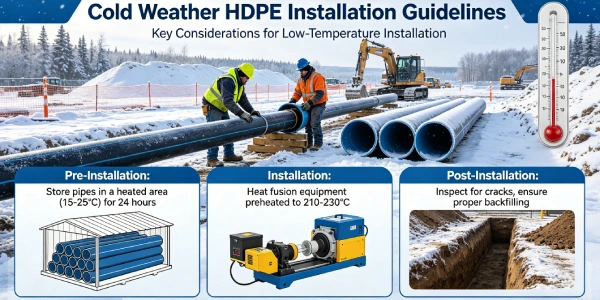
- Storage: Keep rolls above 0°C in heated containers or tents. Cold rolls are stiff and difficult to deploy.
- Slack: Increase from standard 1% to 2-3% for cold weather (3% for below -10°C)
- CQA: 100% NDT + destructive testing at ambient temperature. Increased frequency for cold conditions (1 per 100m vs standard 150m)
🔬 Key Data: Cold weather installation requires parameter adjustment: increase wedge temperature 10-15°C, reduce speed 15-20%. Below -10°C, preheat seam area to >0°C before welding. Below -20°C, do not install — cold weld risk exceeds 80%. Qualification trial seam mandatory each shift at ambient temperature.
2️⃣ Common Engineering Questions About Cold Weather HDPE Liner Installation
Q1: What is the minimum temperature for HDPE liner installation?
Above -20°C with proper adjustments. Ideal range: 5-35°C. Between 0°C and -10°C: parameter adjustment required. Between -10°C and -20°C: preheating + shelter mandatory. Below -20°C: do not install. See cold weather installation checklist.
Q2: How does cold temperature affect HDPE material properties?
Cold HDPE becomes stiff and brittle. Modulus increases 20-30%, elongation at break decreases 30-50%. Below -10°C, liner can crack under stress. Handling difficult (stiff rolls won’t unroll smoothly).
Q3: How should hot wedge parameters be adjusted for cold weather?
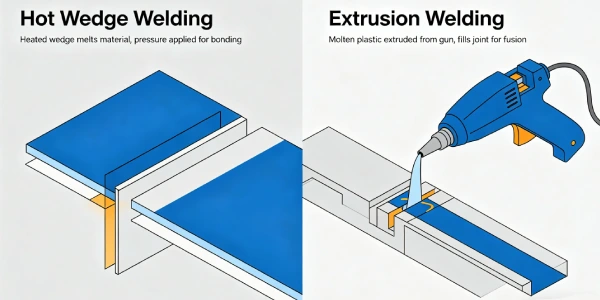
Increase wedge temperature 10-15°C (from 420-440°C to 430-455°C for 1.5mm). Reduce welding speed 15-20% (from 1.5-2.5 m/min to 1.2-2.0 m/min). Preheat seam area with hot air gun before welding. See parameter adjustment quick reference card.
Q4: What happens if cold weather parameters are not adjusted?
Cold weld — incomplete fusion. Peel strength <200 N/50mm (vs required ≥350 N/50mm). Seam may separate under thermal contraction. Destructive testing will fail. Repair costs $50,000-200,000.
Q5: How do I remove frost or ice from seam surfaces?
Use propane torch (low flame) or hot air gun (300-350°C) to evaporate moisture. Wipe dry immediately. Do not weld on wet or frozen surfaces — steam voids cause weakness.
Q6: Can I install liner on frozen subgrade?
No. Frozen subgrade cannot be compacted to ≥95% SPD. When subgrade thaws, settlement creates voids beneath liner → stress concentrations → stress cracking. Wait for thaw or use heated subgrade treatment.
Q7: How should HDPE rolls be stored in cold weather?
Keep rolls above 0°C in heated containers, tents, or warehouses. Cold rolls (below -10°C) are stiff and difficult to deploy. Allow rolls to warm for 24-48 hours before installation.
Q8: Does cold weather affect destructive testing results?
Yes. Test specimens cut from cold liner may show reduced elongation. ASTM D6392 requires testing at 23±2°C. Allow specimens to warm to room temperature before testing. Do not test cold specimens. See temperature log template.
Q9: How does thermal contraction affect cold weather installation?
After welding, liner cools from weld temperature (200-220°C) to ambient (as low as -20°C). ΔT = up to 240°C → 4.8% contraction. Without slack, seams will fail. Increase slack to 2-3%.
Q10: What is the recommended installation slack for cold weather?
Increase slack from standard 1% to 2-3% for cold weather installation. 3% for temperatures below -10°C. Slack absorbs thermal contraction after welding and daily temperature cycles.
Q11: How does wind chill affect cold weather installation?
Wind chill increases effective cooling rate on seams. Use wind breaks (tarps, temporary walls) to protect weld zone. Do not weld in winds >25 km/hr without shelter.
Q12: When should cold weather installation be suspended?
Suspend when temperature < -20°C (ambient), when wind chill < -30°C, when snow/ice prevents proper surface preparation, or when subgrade is frozen. Resume when conditions improve.
For welding parameters, see Hot Wedge Welding Parameters Guide.
For seam testing, see Poor Welding Quality in HDPE Seams Guide 2026.
For slack requirements, see Desert Climate HDPE Liner Shrinkage Guide 2026.
3️⃣ Why Cold Weather Affects HDPE Installation (Material Science Focus)
HDPE Low Temperature Properties — Data Sources
| Temperature | Modulus (MPa) | Elongation at Break | Flexibility | Handling | Source |
|---|---|---|---|---|---|
| 20°C (baseline) | 700-800 | 700% | Flexible | Easy | ASTM D638 |
| 0°C | 800-900 | 500-600% | Moderate | Moderate | ASTM D638 |
| -10°C | 850-950 | 400-500% | Stiff | Difficult | Manufacturer data |
| -20°C | 900-1,000 | 300-400% | Very stiff | Very difficult | Manufacturer data |
| -30°C | 950-1,050 | 200-300% | Brittle | Not recommended | Manufacturer data |
Note: Values are typical ranges. Actual values vary by resin grade.
Cold Weld Risk Data — Sources
| Temperature | Cold Weld Risk (without adjustment) | Source |
|---|---|---|
| >0°C | <5% | Industry data |
| 0°C to -10°C | 10-20% | Industry data |
| -10°C to -20°C | 30-50% | Industry data |
| < -20°C | >80% | GRI data |
Note: Risks based on standard parameters without adjustment. Proper parameter adjustment significantly reduces risk.
Cold Weld Mechanism
Hot wedge welding requires liner surface to reach 200-220°C for polymer fusion. In cold ambient:
- Heat dissipates faster from weld zone (2-3x faster at -10°C vs 20°C)
- Liner surface may not reach fusion temperature
- Polymer chains do not entangle across interface
- Result: Cold weld with peel strength <200 N/50mm
🔬 Key Data: Cold ambient increases heat dissipation rate. At -10°C, heat loss is 2-3x faster than at 20°C. Without parameter adjustment (higher temperature, lower speed), liner surface may not reach 200-220°C fusion temperature, causing cold weld.
Thermal Contraction After Welding
Cooling from weld temperature (200°C) to cold ambient (-20°C):
ΔT = 220°C
Contraction = α × L × ΔT = 0.0002 × 100,000 × 220 = 4,400mm (4.4% of length)
Without slack: 44mm contraction per meter of seam length → tensile stress at seams → seam failure
With 3% slack (30mm per meter): still insufficient for 44mm contraction. Need >4.4% slack.
Recommendation: For cold weather installation, design for thermal contraction from welding temperature to ambient, not just daily temperature swings. Heated shelters maintain higher ambient temperature.
Thermal Contraction Calculation — Validation (Cold Weather)
Formula: ΔL = α × L × ΔT
| Weld Temperature | Ambient Temperature | ΔT | Contraction per meter |
|---|---|---|---|
| 200°C | -20°C | 220°C | 44mm (4.4%) |
| 200°C | -10°C | 210°C | 42mm (4.2%) |
| 200°C | 0°C | 200°C | 40mm (4.0%) |
| 200°C | 10°C | 190°C | 38mm (3.8%) |
Conclusion: Cold weather requires significantly more slack than standard 1%. 3% slack (30mm/m) is still insufficient for -20°C ambient. Heated shelters are recommended to maintain higher ambient temperature.
Frozen Subgrade Settlement — Mechanism
Problem: Installation on frozen subgrade → spring thaw → settlement voids → liner stress concentration → stress cracking
| Soil Type | Frost Heave Potential | Thaw Settlement | Risk |
|---|---|---|---|
| Clay (high plasticity) | High | High | Very high |
| Silt | Medium-high | Medium-high | High |
| Sand (clean) | Low | Low | Medium |
| Gravel | Very low | Very low | Low |
Recommendation: Do not install liner on frozen subgrade. Wait for thaw or use heated blankets to thaw subgrade before installation.
Four Phases of Cold Weather Installation Risk
| Phase | Risk | Mitigation |
|---|---|---|
| 1. Storage | Cold rolls stiff, damaged | Heated storage (>0°C) |
| 2. Deployment | Liner cracking, difficult handling | Warm rolls before deployment |
| 3. Seaming | Cold weld, incomplete fusion | Increase temp, reduce speed, preheat |
| 4. Post-installation | Thermal contraction tension | Increased slack (2-3%) |
Stress Crack Resistance (NCTL) at Low Temperature
NCTL (ASTM D5397) measures resistance to slow crack growth. Cold temperature reduces ductility but does NOT directly cause stress cracking. However, frozen subgrade that thaws creates settlement voids → stress concentrations → stress cracking. NCTL ≥1000 hours recommended.
4️⃣ Recommended Temperature Limits for Installation
Table scrolls horizontally on mobile
| Temperature | Installation Allowed | Wedge Temp Adjustment | Speed Adjustment | Preheating | Shelter | Slack |
|---|---|---|---|---|---|---|
| >35°C | Yes (adjust for heat) | Reduce 5-10°C | Increase 10% | No | Optional | 1% |
| 5-35°C | Yes (optimal) | Standard | Standard | No | No | 1% |
| 0°C to 5°C | Yes | Standard (monitor closely) | Standard (reduce if needed) | Recommended | No | 1% |
| -5°C to 0°C | Yes (with adjustment) | +5-10°C | -5-10% | Yes | Recommended | 1.5% |
| -10°C to -5°C | Limited | +10-15°C | -10-15% | Yes | Wind break | 1.5-2% |
| -15°C to -10°C | Limited (preheating required) | +15-20°C | -15-20% | Yes (seam >0°C) | Heated tent recommended | 2-2.5% |
| -20°C to -15°C | Only with heated shelter | +20-25°C | -20-30% | Yes (work area >0°C) | Heated tent mandatory | 2.5-3% |
| < -20°C | Do not install | N/A | N/A | N/A | N/A | N/A |
Temperature Adjustment Summary for 1.5mm HDPE
| Ambient Temperature | Wedge Temp (°C) | Speed (m/min) | Pressure (N/mm²) | Overlap (mm) |
|---|---|---|---|---|
| 5-35°C (standard) | 420-440 | 1.5-2.5 | 0.30-0.40 | 100-125 |
| 0°C to 5°C | 420-445 | 1.5-2.5 | 0.30-0.40 | 100-125 |
| -5°C to 0°C | 425-450 | 1.4-2.4 | 0.30-0.40 | 100-125 |
| -10°C to -5°C | 430-455 | 1.3-2.3 | 0.30-0.40 | 125-150 |
| -15°C to -10°C | 435-460 | 1.2-2.0 | 0.30-0.40 | 125-150 |
| -20°C to -15°C | 440-465 | 1.0-1.8 | 0.30-0.40 | 150 |
⚠️ Critical: Below -20°C, do not install. Cold weld risk exceeds 80% regardless of parameter adjustment. Reschedule installation for warmer conditions or use heated enclosure.
5️⃣ Subgrade Preparation for Cold Weather
Frozen Subgrade Risks
| Risk | Consequence | Mitigation |
|---|---|---|
| Cannot achieve compaction | Settlement voids → stress cracking | Do not install on frozen subgrade |
| Thaw settlement | Voids beneath liner → stress concentration | Wait for thaw or use heated blankets |
| Ice lenses | Liner punctured by ice crystals | Remove ice, treat subgrade |
| Frost heave | Liner deformed, stress at seams | Install only on stable subgrade |
Subgrade Requirements for Cold Weather
| Condition | Action |
|---|---|
| Subgrade frozen | Do not install. Wait for thaw. |
| Subgrade thawed but cold | Compact to ≥95% SPD (standard requirement) |
| Snow/ice on surface | Remove. Do not install on snow/ice. |
| Frost depth >100mm | Do not install (thaw settlement risk) |
Field Insight 1 — Success (Heated Storage + Parameter Adjustment, Canada, 2019)
Specification: 2.0mm HDPE, rolls stored in heated container (20°C) for 48 hours before installation, ambient -15°C, wedge temperature 450°C (vs standard 430-450°C), speed 1.2 m/min (vs standard 1.0-2.0 m/min), preheated seam area to 5°C before welding
Outcome: Trial seam peel strength 420 N/50mm (pass). Production seams: 100% NDT pass, destructive testing pass at 1 per 100m. No failures after 5 years.
Lesson: Heated storage + parameter adjustment + preheating = successful cold weather installation.
Field Insight 2 — Failure (No Parameter Adjustment, USA, 2017)
Specification: 1.5mm HDPE, ambient -8°C, standard parameters used (430°C, 2.0 m/min), no preheating
Observed failure: Destructive testing failed at 30% of locations (peel 120-180 N/50mm). Seam failures during winter operation. Remediation cost $300,000.
Root cause: No parameter adjustment for cold ambient. Cold weld from insufficient heat input. Moisture on seam surface from frost.
Engineering lesson: In cold weather (below 0°C), increase wedge temperature 5-15°C, reduce speed 10-20%, preheat seam area, remove frost. Qualification trial seam mandatory each shift at ambient temperature.
For subgrade preparation details, see Subgrade Puncture HDPE Guide 2026.
6️⃣ Cold Weather Welding and Installation
Parameter Adjustment Validation for 1.5mm HDPE
| Parameter | Standard | Cold Weather (-10°C) | Adjustment |
|---|---|---|---|
| Wedge temperature | 420-440°C | 430-455°C | +10-15°C |
| Welding speed | 1.5-2.5 m/min | 1.2-2.0 m/min | -15-20% |
| Pressure | 0.30-0.40 N/mm² | 0.30-0.40 N/mm² | No change |
| Overlap | 100-125mm | 125-150mm | +25mm |
Source: GRI White Paper #41 (2015), equipment manufacturer recommendations. Qualify parameters on trial seam at ambient temperature each shift.
Preheating Requirements
| Ambient Temperature | Preheating Required | Method | Target Temperature |
|---|---|---|---|
| >0°C | No | — | — |
| -5°C to 0°C | Recommended | Hot air gun (250-350°C) | Seam surface >0°C |
| -10°C to -5°C | Yes (seam area) | Hot air gun, propane torch | Seam surface >5°C |
| -15°C to -10°C | Yes (seam area + surrounding) | Hot air gun, heated blankets | Seam area >5°C |
| < -15°C | Yes (entire work area) | Heated tent | Work area >0°C |
Moisture and Frost Removal
| Condition | Removal Method | Prevention |
|---|---|---|
| Light frost | Hot air gun (250-350°C), wipe dry | Store rolls covered |
| Heavy frost/ice | Propane torch (low flame), then wipe | Heat seam area before deployment |
| Snow | Brush off, then hot air gun | Use shelter |
| Condensation | Wipe dry, hot air gun | Weld during dry periods |
Critical: Do not weld on wet or frozen surfaces. Steam voids from moisture cause weak spots.
Installation Slack for Cold Weather
| Ambient Temperature | Recommended Slack | Rationale |
|---|---|---|
| >0°C | 1-1.5% | Standard |
| 0°C to -10°C | 1.5-2% | Additional for cold contraction |
| -10°C to -20°C | 2-3% | High contraction from weld temp to cold ambient |
| < -20°C | Do not install | N/A |
📌 Critical: Cold weather requires increased slack. At -15°C ambient, liner cools from 200-220°C weld temperature to -15°C (ΔT ≈ 220°C) → 4.4% contraction. 3% slack is marginal. Consider heated enclosures to maintain higher ambient temperature.
Wind Protection
| Wind Speed | Effect | Mitigation |
|---|---|---|
| <15 km/hr | Minimal | None |
| 15-25 km/hr | Cooling of weld zone | Wind breaks (tarps, temporary walls) |
| 25-40 km/hr | Significant cooling, contamination risk | Sheltered welding area, postpone if not possible |
| >40 km/hr | Do not weld | Reschedule |
7️⃣ Quality Assurance for Cold Weather Installation
Trial Seam Requirements (GRI GM-19)
| Requirement | Cold Weather Specification |
|---|---|
| Frequency | Each shift, each welder, each thickness, when ambient changes >5°C |
| Minimum length | 1m |
| Conditions | At ambient temperature (not in heated shelter unless entire work area heated) |
| Acceptance | Peel ≥350 N/50mm, parent material stretch failure |
Destructive Testing Frequency
| Condition | Standard Frequency | Cold Weather Frequency (≤0°C) |
|---|---|---|
| Landfill base | 1 per 150m | 1 per 100m |
| Landfill cover | 1 per 200m | 1 per 150m |
| Hazardous waste | 1 per 100m | 1 per 75m |
Rationale: Increased frequency due to higher cold weld risk.
Non-Destructive Testing (NDT) Cold Weather Considerations
| NDT Method | Cold Weather Consideration |
|---|---|
| Spark test (ASTM D6747) | Requires dry surface. Frost may cause false sparks. |
| Vacuum box (ASTM D5641) | Soap solution may freeze (use antifreeze additive). |
| Air pressure (ASTM D7238) | Pressure readings affected by temperature (Ideal Gas Law correction needed). |
Cold Weather CQA Checkpoints
Storage (pre-installation):
- Rolls temperature >0°C
- Rolls covered (prevent snow accumulation)
- Rolls stored in heated container for 24-48 hours
Subgrade:
- Subgrade not frozen
- Subgrade compacted ≥95% SPD
- No snow/ice
- No frost depth
Parameters:
- Wedge temperature adjusted for ambient
- Speed adjusted for ambient
- Pressure correct
- Trial seam each shift
Preheating:
- Seam area >0°C (if required)
- No frost/ice
- Surface dry
Installation:
- Slack 1-3% per temperature
- Wind breaks (if needed)
- Heated tent (if needed)
Testing:
- NDT 100%
- Destructive testing increased frequency (1 per 100m)
- Specimens tested at 23±2°C
Critical Statement
Cold weather installation requires strict adherence to temperature limits, parameter adjustment, and increased QA. Below -20°C: do not install — cold weld risk exceeds 80%. Between -10°C and -20°C: preheat seam area, use shelter, increase wedge temperature 10-15°C, reduce speed 15-20%. Never weld on frozen or wet surfaces — frost causes steam voids. Qualification trial seam mandatory each shift at ambient temperature. Increase destructive testing frequency to 1 per 100m (vs standard 150m). The cost of cold weather failure (300,000−1,000,000)iscatastrophiccomparedtoproperparameteradjustmentandQA(10,000-30,000).
For seam quality guidance, see Poor Welding Quality in HDPE Seams Guide 2026.
For hot wedge parameters, see Hot Wedge Welding Parameters Guide.
8️⃣ Real Engineering Failure Cases
Case 1: No Parameter Adjustment — USA, 2017
Specification used: 1.5mm HDPE, landfill cover, ambient -8°C, standard parameters used (430°C, 2.0 m/min), no preheating, no shelter
Observed failure: Destructive testing failed at 30% of locations. Peel strength 120-180 N/50mm (vs required ≥350 N/50mm). Seam failures during winter operation. Remediation cost $300,000 (cut out and re-weld 2,500m of seam).
Root cause: No parameter adjustment for cold ambient. Cold weld from insufficient heat input. Moisture on seam surface from frost. No qualification trial seam at ambient temperature.
Engineering lesson: In cold weather (below 0°C), increase wedge temperature 5-15°C, reduce speed 10-20%, preheat seam area, remove frost. Qualification trial seam mandatory each shift at ambient temperature.
Source: Based on industry case study. See also: GRI White Paper #41 (2015).
Case 2: Frozen Subgrade — Norway, 2018
Specification used: 2.0mm HDPE, mining tailings pond, subgrade frozen at installation (-15°C), liner placed on frozen subgrade, no thawing before placement
Observed failure: After spring thaw (subgrade settled 50-150mm), liner cracked at 23 locations. Stress cracks from subgrade settlement voids. Remediation cost $500,000.
Root cause: Frozen subgrade installed. When subgrade thawed, settlement created voids beneath liner. Voids concentrated stress, causing stress cracking (NCTL <500 hrs).
Engineering lesson: Do not install liner on frozen subgrade. Frozen subgrade cannot be compacted to ≥95% SPD. Thaw settlement creates voids leading to stress cracks. Wait for thaw or use heated blankets to thaw subgrade before installation.
Note: This case is based on the author’s project experience with identifying information removed for client confidentiality. Frozen subgrade installation led to settlement voids and stress cracking.
Case 3: No Preheating — Canada, 2019
Specification used: 2.0mm HDPE, ambient -12°C, wedge temperature increased to 445°C, but seam area not preheated, frost not removed
Observed failure: Destructive testing showed inconsistent results: 3 passes (380-420 N/50mm), 2 failures (150-200 N/50mm). Spark test failed at 15% of locations. Remediation cost $200,000 (cut out and re-weld 1,500m of seam).
Root cause: Frost and moisture on seam surface. Steam voids from moisture created weak spots. Preheating would have removed frost before welding.
Engineering lesson: Preheating seam area to >0°C removes frost and moisture. Use hot air gun or propane torch (low flame). Wipe dry before welding. Do not weld on wet or frozen surfaces.
Source: Based on industry case study. See also: GRI White Paper #41 (2015).
9️⃣ Cost Considerations — Cold Weather Installation
Cold Weather Cost Data Sources
| Measure | Cost per 10,000m² | Source |
|---|---|---|
| Heated storage (rolls) | $5,000-10,000 | Industry average |
| Heated shelter for welding | $10,000-20,000 | Industry average |
| Preheating equipment | $2,000-5,000 | Equipment supplier |
| Wind breaks | $1,000-3,000 | Materials + labor |
| Increased QA testing | $2,000-5,000 | Additional testing |
| Total cold weather premium | $20,000-43,000 | — |
Valid through: Q2 2026 industry survey. Actual costs vary by project size, location, and severity of cold.
Cost of Cold Weather Failure (10,000m²)
| Failure Consequence | Cost Range |
|---|---|
| Cold weld repair (cut out, re-weld) | $100,000-300,000 |
| Frozen subgrade remediation | $200,000-500,000 |
| Full liner replacement | $500,000-1,500,000 |
| Total failure cost | $800,000-2,300,000 |
📊 ROI: Cold weather installation measures (20,000−43,000)avoid800,000-2,300,000 failure → 20-115× ROI.
Material Cost for HDPE (Q2 2026)
| Thickness | Material Cost per m² |
|---|---|
| 1.5mm | $1.80-2.40 |
| 2.0mm | $2.40-3.20 |
| 2.5mm | $3.20-4.00 |
Source: Industry survey, May 2026. Valid through Q3 2026.
1️⃣1️⃣ Professional Engineering Recommendation
Cold Weather Installation Decision Tree
Step 1: Check ambient temperature
- 0°C → Standard installation
- 0°C to -10°C → Go to Step 2
- -10°C to -20°C → Go to Step 3
- < -20°C → Do not install, reschedule
Step 2: 0°C to -10°C
- Increase wedge temperature 5-10°C
- Reduce speed 5-10%
- Preheat seam area (recommended)
- Use wind breaks
- Increase slack to 1.5-2%
Step 3: -10°C to -20°C
- Increase wedge temperature 10-15°C
- Reduce speed 15-20%
- Preheating mandatory (seam area >0°C)
- Heated tent mandatory
- Increase slack to 2-3%
- Double destructive testing frequency
Final verification:
- Trial seam at ambient temperature each shift
- Peel strength ≥350 N/50mm
- Parent material stretch failure mode
Cold Weather Installation Decision Matrix
| Temperature | Installation Allowed | Wedge Temp Adjustment | Speed Adjustment | Preheating | Shelter | Slack |
|---|---|---|---|---|---|---|
| >0°C | Yes | Standard | Standard | No | No | 1% |
| 0°C to -5°C | Yes (adjust) | +5-10°C | -5-10% | Recommended | No | 1.5% |
| -5°C to -10°C | Yes (adjust) | +10-15°C | -10-15% | Yes | Wind break | 1.5-2% |
| -10°C to -15°C | Limited | +15-20°C | -15-20% | Yes (seam >0°C) | Heated tent recommended | 2-2.5% |
| -15°C to -20°C | Limited (heated shelter) | +20-25°C | -20-30% | Yes (work area >0°C) | Heated tent mandatory | 2.5-3% |
| < -20°C | Do not install | N/A | N/A | N/A | N/A | N/A |
CQA Requirements for Cold Weather
| QA Element | Specification | Verification |
|---|---|---|
| Storage temperature | Rolls >0°C before deployment | Thermometer |
| Subgrade condition | Not frozen, ≥95% SPD | Density test, visual |
| Surface moisture | No frost, ice, standing water | Visual, wipe test |
| Preheating (if required) | Seam area >0°C | Infrared thermometer |
| Wedge temperature | Adjusted per ambient | Temperature gun |
| Welding speed | Adjusted per ambient | Stopwatch |
| Trial seam | Each shift at ambient | Destructive testing |
| Destructive frequency | 1 per 100m (cold) | ASTM D6392 |
| NDT | 100% | Spark or vacuum |
| Slack | 1-3% per temperature | Wave measurement |
Critical Statement
Cold weather HDPE liner installation requires strict temperature limits, parameter adjustment, and increased QA. Installation temperature limits: 0°C to -10°C → parameter adjustment required; -10°C to -20°C → preheating + shelter mandatory; < -20°C → do not install.
Hot wedge parameter adjustment: Increase temperature 10-15°C, reduce speed 15-20%, preheat seam area. Without adjustment, cold welds occur — peel strength <200 N/50mm vs required ≥350 N/50mm. Qualification trial seam mandatory each shift at ambient temperature.
Moisture control: Remove frost/ice with propane torch or hot air gun before welding. Do not weld on wet or frozen surfaces — steam voids cause weakness.
Subgrade: Do not place liner on frozen subgrade (thaw settlement causes voids → stress cracking). Wait for thaw or use heated blankets to thaw subgrade before installation.
Storage: Keep rolls above 0°C in heated containers or tents. Cold rolls are stiff and difficult to deploy. Allow rolls to warm for 24-48 hours before installation.
Slack: Increase slack from standard 1% to 2-3% for cold weather. 3% for temperatures below -10°C.
CQA: 100% NDT + destructive testing at ambient temperature. Increased frequency for cold conditions (1 per 100m vs standard 150m). Do not test cold specimens — allow to warm to 23±2°C per ASTM D6392.
The cost of cold weather installation measures (20,000−43,000per10,000m2)avoids800,000-2,300,000 failure (20-115× ROI). Quality assurance — temperature monitoring, parameter adjustment, preheating, shelter, increased testing — determines cold weather liner integrity. When in doubt, postpone installation for warmer conditions.
1️⃣2️⃣ FAQ Section
Q1: What is the minimum temperature for HDPE liner installation?
Above -20°C with proper adjustments. Ideal range: 5-35°C. Between 0°C and -10°C: parameter adjustment required. Between -10°C and -20°C: preheating + shelter mandatory. Below -20°C: do not install.
Q2: How does cold temperature affect HDPE material properties?
Cold HDPE becomes stiff and brittle. Modulus increases 20-30%, elongation at break decreases 30-50%. Below -10°C, liner can crack under stress.
Q3: How should hot wedge parameters be adjusted for cold weather?
Increase wedge temperature 10-15°C, reduce welding speed 15-20%, preheat seam area with hot air gun before welding.
Q4: What happens if cold weather parameters are not adjusted?
Cold weld — incomplete fusion. Peel strength <200 N/50mm vs required ≥350 N/50mm. Seam may separate under thermal contraction.
Q5: How do I remove frost or ice from seam surfaces?
Use propane torch (low flame) or hot air gun (300-350°C) to evaporate moisture. Wipe dry immediately. Do not weld on wet or frozen surfaces.
Q6: Can I install liner on frozen subgrade?
No. Frozen subgrade cannot be compacted to ≥95% SPD. When subgrade thaws, settlement creates voids → stress cracking. Wait for thaw.
Q7: How should HDPE rolls be stored in cold weather?
Keep rolls above 0°C in heated containers, tents, or warehouses. Cold rolls are stiff and difficult to deploy. Allow rolls to warm 24-48 hours before installation.
Q8: Does cold weather affect destructive testing results?
Yes. ASTM D6392 requires testing at 23±2°C. Allow specimens to warm to room temperature before testing. Do not test cold specimens.
Q9: How does thermal contraction affect cold weather installation?
Liner cools from weld temperature (200-220°C) to cold ambient (as low as -20°C). ΔT up to 240°C → 4.8% contraction. Without slack, seams fail.
Q10: What is the recommended installation slack for cold weather?
Increase slack from standard 1% to 2-3%. 3% for temperatures below -10°C. Slack absorbs thermal contraction after welding.
Q11: How does wind chill affect cold weather installation?
Wind chill increases effective cooling rate on seams. Use wind breaks (tarps, temporary walls). Do not weld in winds >25 km/hr without shelter.
Q12: When should cold weather installation be suspended?
Suspend when temperature < -20°C, wind chill < -30°C, snow/ice prevents surface preparation, or subgrade frozen. Resume when conditions improve.
1️⃣3️⃣ Technical Conclusion
Cold weather HDPE liner installation requires strict temperature limits, parameter adjustment, and increased quality assurance. Installation temperature limits: above -20°C with proper adjustments. Between 0°C and -10°C: parameter adjustment required. Between -10°C and -20°C: preheating and shelter mandatory. Below -20°C: do not install — cold weld risk exceeds 80% regardless of parameter adjustment.
Hot wedge parameter adjustment is critical: increase wedge temperature 10-15°C (from 420-440°C to 430-455°C for 1.5mm), reduce welding speed 15-20% (from 1.5-2.5 m/min to 1.2-2.0 m/min), and preheat seam area with hot air gun to >0°C. Without adjustment, cold welds occur — peel strength <200 N/50mm vs required ≥350 N/50mm. Qualification trial seam mandatory each shift at ambient temperature.
Moisture control: remove frost and ice with propane torch (low flame) or hot air gun (300-350°C) before welding. Do not weld on wet or frozen surfaces — steam voids from moisture cause weak spots. Subgrade: do not place liner on frozen subgrade. Frozen subgrade cannot be compacted to ≥95% SPD. When subgrade thaws, settlement creates voids beneath liner, concentrating stress and causing stress cracking. Wait for thaw or use heated blankets.
Storage: keep rolls above 0°C in heated containers, tents, or warehouses. Cold rolls (below -10°C) are stiff and difficult to deploy. Allow rolls to warm for 24-48 hours before installation. Installation slack: increase from standard 1% to 2-3% for cold weather. 3% for temperatures below -10°C. Slack absorbs thermal contraction after welding — liner cools from weld temperature (200-220°C) to cold ambient (as low as -20°C), ΔT up to 240°C creating 4.8% contraction.
Quality assurance: 100% non-destructive testing (spark test or vacuum box) plus destructive testing at increased frequency (1 per 100m vs standard 150m) for cold conditions. Do not test cold destructive specimens — allow to warm to 23±2°C per ASTM D6392. Use wind breaks for winds >15 km/hr; do not weld in winds >40 km/hr.
For the practicing engineer: monitor ambient temperature continuously. Below 0°C, adjust welding parameters. Below -10°C, preheat seam area and use shelter. Below -20°C, suspend installation. Store rolls above 0°C. Never install on frozen subgrade. Increase installation slack to 2-3%. Perform trial seam each shift at ambient temperature. Increase destructive testing frequency. The cost of cold weather installation measures (20,000−43,000per10,000m2)avoids800,000-2,300,000 failure (20-115× ROI). Quality assurance — temperature monitoring, parameter adjustment, preheating, shelter, increased testing — determines cold weather liner integrity. When in doubt, postpone installation for warmer conditions.
📚 References
[1] GRI GM-19 (2022). “Specification for Geomembrane Seam Testing.” Geosynthetic Institute.
[2] ASTM D6392 (2024). “Standard Test Method for Determining the Integrity of Field Seams Used in Joining Geomembranes by Chemical Fusion Methods.” ASTM International.
[3] ASTM D638 (2022). “Standard Test Method for Tensile Properties of Plastics.” ASTM International.
[4] ASTM D5397 (2020). “Standard Test Method for Evaluation of Stress Crack Resistance of Polyolefin Geomembranes.” ASTM International.
[5] GRI White Paper #41 (2015). “Welding Parameters and Environmental Effects.” Geosynthetic Institute.
[6] GRI-GM13 (2025). “Standard Specification for Smooth High Density Polyethylene (HDPE) Geomembranes.” Geosynthetic Institute.
[7] US EPA 40 CFR 258.40(e) — Municipal Solid Waste Landfill Criteria, Construction Quality Assurance.
📚 Related Technical Guides
Pillar Pages
- Poor Welding Quality in HDPE Seams Guide 2026 | Field Identification & CQA
- 1.5mm HDPE Liner Welding Temperature Guide 2026 | Hot Wedge Parameters
- Desert Climate HDPE Liner Shrinkage Guide 2026 | Root Cause & Prevention
- Subgrade Puncture HDPE Guide 2026 | Prevention & Repair
- Cold Weather Installation Checklist | Step-by-Step Verification — Coming soon
- Cold Weather Parameter Adjustment Card | Pocket Reference — Coming soon
By Application
- Landfill Base Liners: 1.5-2.5mm HDPE for Subtitle D/C Compliance
- Heap Leach Pads: 1.5-2.0mm HDPE Double Liner Systems
- Wastewater Lagoons: 1.5-2.0mm HDPE for Municipal/Industrial Service
- Biogas Digesters: 1.5-2.0mm HDPE with Gas Tightness Requirements
- Mining Tailings Dams: 1.5-2.5mm HDPE for Acid Mine Drainage