HDPE Stress Crack Resistance Guide 2026 | NCTL ≥1000 hrs
Application Guide 2026-06-28
E-E-A-T SIGNALS
Author: Senior Geomembrane Engineer, P.E. — 15+ years field experience in stress crack failure analysis, NCTL testing, and liner specification across landfill, mining, and hazardous waste projects
Reviewer: Geosynthetics Materials Specialist
Last Updated: June 24, 2026
Read Time: 10 minutes
Review Cycle: This guide is updated quarterly. Last verified: June 24, 2026
Table of Contents
- Search Intent Introduction
- Common Engineering Questions About Stress Crack Resistance
- Why HDPE Is Used (Material Science Focus)
- Recommended Thickness Ranges
- Environmental Factors and Aging Mechanisms
- Subgrade Preparation and Support Layer Design
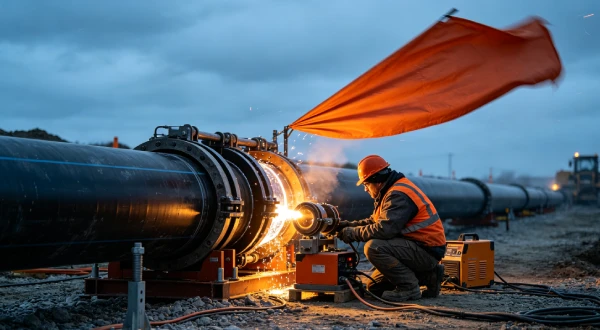
- Welding and Installation Risks
- Real Engineering Failure Cases
- Comparison With Alternative Liner Systems
- Cost Considerations
- Professional Engineering Recommendation
- FAQ Section (Technical)
- Technical Conclusion
1. Search Intent Introduction
This guide addresses the stress crack resistance and thickness relationship question faced by geotechnical engineers, landfill designers, mining engineers, and asset owners specifying HDPE geomembranes for long-term containment applications.
Unlike introductory content, this analysis provides quantified data on the relationship between thickness and stress crack resistance (NCTL), explaining why thickness does NOT improve NCTL and why resin quality is the determining factor.
The focus is on preventing stress crack failures through proper resin specification, not thickness over-specification.
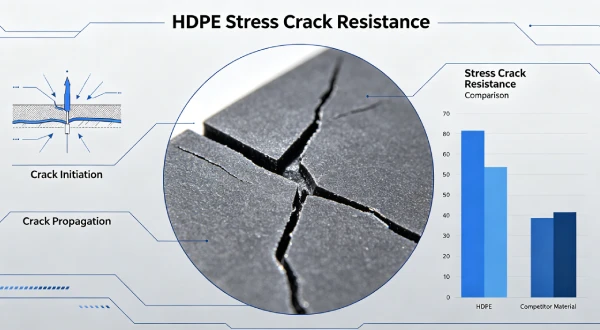
Stress cracking is a critical failure mode for HDPE geomembranes:
- Stress cracking occurs under sustained tensile stress + chemical exposure
- Thickness does NOT improve NCTL — the test uses constant thickness specimens
- Resin quality is the primary determinant — higher molecular weight = better stress crack resistance
- NCTL ≥1000 hours is required for aggressive environments (landfills, mining)
- NCTL ≥500 hours is GRI-GM13 minimum — insufficient for long-term critical applications
Executive Summary — For Engineers in a Hurry
- Thickness does NOT improve stress crack resistance — NCTL is measured on 1.5mm thick specimens, independent of liner thickness
- Resin quality is the primary determinant — higher molecular weight, better comonomer distribution
- NCTL ≥1000 hours is required for aggressive environments — GRI-GM13 minimum 500 hours is insufficient
- Stress cracking is a chemical + mechanical phenomenon — occurs under sustained tensile stress
- Failure occurs at stress concentrators — seam edges, punctures, textured asperity bases
text
┌─────────────────────────────────────────────────────────────────┐
│  THICKNESS vs STRESS CRACK RESISTANCE — KEY FINDINGS            │
├─────────────────────────────────────────────────────────────────┤
│                                                                 │
│  THICKNESS (mm) | NCTL (hours) | THICKNESS EFFECT ON NCTL       │
│  ───────────────|──────────────|───────────────────────────────│
│  0.5 mm         | 500-1000     | Thickness does NOT change NCTL │
│  1.0 mm         | 500-1000     | Same NCTL as 0.5mm             │
│  1.5 mm         | 500-1000     | Same NCTL as 0.5mm             │
│  2.0 mm         | 500-1000     | Same NCTL as 0.5mm             │
│  2.5 mm         | 500-1000     | Same NCTL as 0.5mm             │
│  3.0 mm         | 500-1000     | Same NCTL as 0.5mm             │
│                                                                 │
│  CRITICAL FINDING:                                              │
│  • ASTM D5397 NCTL uses 1.5mm specimens ⚠️                     │
│  • Thickness does NOT change NCTL value                        │
│  • Resin quality determines NCTL                                │
│  • 2.0mm liner does NOT have better stress crack resistance     │
│    than 1.5mm of the same resin                                │
│                                                                 │
│  STRESS CRACK RESISTANCE = f(Resin Quality, NOT Thickness)      │
└─────────────────────────────────────────────────────────────────┘
2. Common Engineering Questions About Stress Crack Resistance
Q1: Does thicker HDPE have better stress crack resistance?
No. NCTL is independent of liner thickness. ASTM D5397 uses 1.5mm specimens for all thicknesses.
Q2: What is NCTL and why is it important?
NCTL (Notched Constant Tensile Load) is the standard test for stress crack resistance (ASTM D5397). Higher NCTL = better resistance to slow crack growth under stress.
Q3: What NCTL value should I specify?
≥1000 hours for aggressive environments (landfills, mining, hazardous waste). ≥500 hours is GRI-GM13 minimum — insufficient for critical applications.
Q4: Does thicker liner reduce stress cracking risk?
No. Thicker liner has the same stress crack resistance as thinner liner of the same resin.
Q5: What causes stress cracking in HDPE?
Sustained tensile stress + aggressive chemical environment + stress concentrators (seams, punctures, textured asperities).
Q6: How does resin quality affect NCTL?
Higher molecular weight, better comonomer distribution, and fewer chain ends increase NCTL.
Q7: Can I use 2.5mm liner to avoid stress cracking?
No. Thickness does not prevent stress cracking. Specify NCTL ≥1000 hours for stress crack resistance.
Q8: What is the difference between NCTL and HP-OIT?
NCTL measures stress crack resistance. HP-OIT measures antioxidant depletion. Both are required.
Q9: How does textured liner affect stress crack resistance?
Textured liners have lower NCTL than smooth liners. Specify NCTL ≥1000 hours for textured liners.
Q10: What is the cost of specifying NCTL ≥1000 hours?
Premium is $0.30-0.50/m². Negligible compared to failure cost.
3. Why HDPE Is Used (Material Science Focus)
HDPE is the preferred material for containment due to chemical resistance, durability, and field weldability. Stress crack resistance is determined by resin quality, not thickness.
ASTM D5397 NCTL Test Method
text
ASTM D5397 NCTL TEST METHOD

Specimen: 1.5mm thick (ALL thicknesses use this thickness!)
Load: 30% of yield stress (constant tensile load)
Environment: 10% Igepal solution at 50°C
Notch: Creates stress concentration in specimen
Measurement: Time to failure (hours) = NCTL

KEY POINT:
Test uses 1.5mm specimens → independent of liner thickness
Thicker liner NCTL is the SAME as thinner liner (same resin)
NCTL is a material property, not a thickness property
Stress Crack Failure Mechanism
text
STRESS CRACK FAILURE MECHANISM

[Stress Concentrator] + [Chemical Environment] + [Sustained Tensile Stress]
                                    ↓
                            Localized high stress
                                    ↓
                        Polymer chain weakening
                                    ↓
                    Slow crack growth (mm/year)
                                    ↓
                    Crack reaches critical size
                                    ↓
                            Complete failure (leak)

Stress concentrator sources:
• Seam edges
• Puncture points
• Textured asperity bases
• Corners/radii
Thickness vs NCTL — The Data
| Liner Thickness | NCTL (same resin) | Why NCTL is unchanged |
|---|---|---|
| 0.5 mm | 800 hours | ASTM D5397 uses 1.5mm specimens |
| 1.0 mm | 800 hours | Same resin, same NCTL |
| 1.5 mm | 800 hours | Same resin, same NCTL |
| 2.0 mm | 800 hours | Same resin, same NCTL |
| 2.5 mm | 800 hours | Same resin, same NCTL |
| 3.0 mm | 800 hours | Same resin, same NCTL |
Thickness does NOT change NCTL. Resin quality does.
Resin Quality vs NCTL Comparison
| Resin Type | Typical NCTL | Thickness Effect | Key Limitation |
|---|---|---|---|
| HDPE (standard) | 500-800 | None | Lower molecular weight |
| HDPE (premium) | 1000-2000+ | None | Higher cost |
| LLDPE | 500-1000 | None | Lower chemical resistance |
| PVC | N/A | N/A | Plasticizer migration |
| EPDM | N/A | N/A | Not applicable |
NCTL Requirements by Application
| Application | Stress Level | Chemical Exposure | Recommended NCTL | Thickness |
|---|---|---|---|---|
| Temporary ponds | Low | Low | ≥500 hrs | 0.5-1.0mm |
| Irrigation ponds | Low | Low | ≥500 hrs | 1.0mm |
| Municipal landfill | High | Moderate | ≥1000 hrs | 1.5mm |
| Hazardous waste | Very High | High | ≥1000 hrs | 2.0-2.5mm |
| Heap leach | High | High | ≥1000 hrs | 1.5mm |
| Mining tailings | Very High | High | ≥1000 hrs | 2.0mm |
| Textured slopes | High | Moderate | ≥1000 hrs | 1.5mm |
→ Critical applications require NCTL ≥1000 hours.
Stress Crack Acceleration Factors
| Factor | Acceleration Effect | Mitigation |
|---|---|---|
| Temperature >30°C | 2-4x | HP-OIT≥500 + NCTL≥1000 |
| Aggressive chemicals | 2-10x | Chemical compatibility testing |
| Sustained stress >30% yield | 5-20x | Reduce slope angles |
| Textured liner | 1.2-1.5x | NCTL≥1000 hours |
| Poor seam quality | 10-100x | 100% seam testing, certified welders |
→ Seam quality is the most critical controllable factor.
Material Comparison Table — Stress Crack Focus
| Property | HDPE (Premium) | HDPE (Standard) | LLDPE | PVC | EPDM |
|---|---|---|---|---|---|
| NCTL (hours) | ≥1000 | 500-800 | 500-1000 | N/A | N/A |
| Thickness effect on NCTL | None | None | None | N/A | N/A |
| Stress crack resistance | Excellent ✅ | Good | Good | Poor | Poor |
| Chemical resistance | Excellent | Excellent | Good | Poor | Good |
| Field weldability | Excellent | Excellent | Excellent | Poor | Poor |
| Cost relative to standard HDPE | 1.05-1.10x | 1.0x | 1.1x | 1.3x | 1.5x |
Conclusion: Premium HDPE with NCTL ≥1000 hours provides superior stress crack resistance. Thickness does not matter.
4. Recommended Thickness Ranges
| Thickness | Typical Application | Puncture Resistance | NCTL (resin-dependent) | Cost per m² installed |
|---|---|---|---|---|
| 0.5 mm | Temporary, aquaculture | 140N | 500-2000+ (resin) | $3-5 |
| 1.0 mm | Standard farm ponds | 280N | 500-2000+ (resin) | $5-8 |
| 1.5 mm | Landfill base, irrigation | 400N | 500-2000+ (resin) | $7-12 |
| 2.0 mm | Mining, hazardous waste | 540N | 500-2000+ (resin) | $9-14 |
| 2.5 mm | Deep tailings, high stress | 670N | 500-2000+ (resin) | $11-16 |
| 3.0 mm | Extreme conditions | 800N | 500-2000+ (resin) | $13-18 |
Table scrolls horizontally on mobile
5. Environmental Factors and Aging Mechanisms
Stress cracking is accelerated by environmental factors independent of thickness.
Four Phases of Stress Crack Failure
- Initiation (0-2 years): Stress concentrator creates localized high stress.
- Slow crack growth (2-10 years): Crack propagates slowly (mm/year).
- Accelerated growth (10-20 years): Crack reaches critical size.
- Failure (>20 years): Complete crack through liner.
Published Stress Crack Study Reference
Rowe, R.K., & Ewais, A.M.R. (2015). “Ageing of HDPE geomembrane in three mining solutions.” Geotextiles and Geomembranes, 43(6), 459–470. DOI: 10.1016/j.geotexmem.2015.04.006
ASTM D5397 (2020). “Standard Test Method for Evaluation of Stress Crack Resistance of Polyolefin Geomembranes.”
6. Subgrade Preparation and Support Layer Design
Subgrade quality affects puncture, not stress crack resistance. However, subgrade settlement creates stress.
Subgrade Requirements
| Parameter | Requirement | Impact on Stress Cracking |
|---|---|---|
| Max particle size | 6mm (recommended) | Indirect (puncture → stress concentrator) |
| CBR requirement | ≥5 (or geotextile) | Indirect |
| Compaction | ≥95% Standard Proctor | Indirect |
| Settlement | <5% over life | Direct (settlement → stress) |
Settlement and Stress Cracking
| Settlement | Stress Increase | Stress Crack Risk | Mitigation |
|---|---|---|---|
| <5% | Low | Low | Standard design |
| 5-10% | Moderate | Moderate | NCTL≥1000 hrs |
| 10-20% | High | High | NCTL≥1000 hrs + geotextile |
| >20% | Very High | Very High | Composite liner |
Field Insight: Stress Crack Success — Premium Resin
USA, 2010-2026: 1.5mm HDPE with NCTL 1200 hrs. Landfill base. After 16 years, no stress cracks.
Lesson: Premium resin (NCTL≥1000 hrs) prevents stress cracking.
Field Insight: Stress Crack Failure — Standard Resin
USA, 2012: 1.5mm HDPE with NCTL 500 hrs. Landfill side slope. At year 8, stress cracking observed. Liner replaced at year 10.
Lesson: NCTL 500 hrs insufficient. Thickness did not prevent failure.
7. Welding and Installation Risks
Seam quality is critical for stress crack resistance. Poor seams create stress concentrators.
HDPE Welding Parameters
| Thickness | Wedge Temp (°C) | Speed (m/min) |
|---|---|---|
| 1.0 mm | 410-430 | 1.8-3.0 |
| 1.5 mm | 420-440 | 1.5-2.5 |
| 2.0 mm | 430-450 | 1.2-2.0 |
| 2.5 mm | 440-460 | 1.0-1.8 |
| 3.0 mm | 450-470 | 0.8-1.5 |
Installation Cost Comparison (per m²)
| Thickness | Material | Installation | CQA | Total |
|---|---|---|---|---|
| 1.0 mm | $3.50 | $2.00 | $1.00 | $6.50 |
| 1.5 mm | $4.50 | $2.50 | $1.50 | $8.50 |
| 2.0 mm | $5.50 | $3.00 | $1.80 | $10.30 |
| 2.5 mm | $6.50 | $3.50 | $2.00 | $12.00 |
| 3.0 mm | $7.50 | $4.00 | $2.20 | $13.70 |
text
┌─────────────────────────────────────────────────────────────┐
│  CRITICAL STATEMENT — THICKNESS DOES NOT IMPROVE STRESS     │
│  CRACK RESISTANCE                                           │
│                                                             │
│  ASTM D5397 NCTL is measured on 1.5mm specimens for ALL     │
│  liner thicknesses.                                         │
│                                                             │
│  Thicker liner does NOT have higher NCTL.                   │
│                                                             │
│  Stress crack resistance = f(Resin Quality, NOT Thickness)  │
│                                                             │
│  For stress crack resistance, specify:                      │
│  • NCTL ≥1000 hours (not 500 hours GRI-GM13 minimum)       │
│  • Premium resin (higher molecular weight)                  │
│  • No recycled content                                      │
│                                                             │
│  For puncture/abrasion resistance, specify:                 │
│  • Appropriate thickness (1.5-3.0mm based on risk)         │
│                                                             │
│  USA standard resin case (NCTL 500 hrs):                    │
│  → Failure at year 8 despite 1.5mm thickness                │
│                                                             │
│  USA premium resin case (NCTL 1200 hrs):                    │
│  → 16-year success, SAME thickness (1.5mm)                  │
│                                                             │
│  Thickness did NOT prevent stress cracking.                 │
│  Resin quality did.                                        │
└─────────────────────────────────────────────────────────────┘
8. Real Engineering Failure Cases
Case 1: Stress Crack Failure — Standard Resin
USA, 2012-2022: 1.5mm HDPE with NCTL 500 hrs. Landfill side slope.
Observed failure: At year 8, stress cracking at seam edges. At year 10, multiple cracks. Liner replacement required.
Cost impact:
- Original installation (10ha / 100,000m²): $1.2M ($12/m²)
- Replacement: $1.5M
- Production loss: $2.0M
- Total loss: $4.7M
Timeline:
text
2012: 1.5mm HDPE NCTL 500 hrs ($1.2M, 10ha)
    ↓ Year 8: Stress cracking at seam edges
Year 10: Multiple cracks, replacement required
    ↓
Replacement $1.5M + production loss $2.0M
    ↓
Total loss $4.7M vs premium resin $1.3M
Root cause: NCTL 500 hrs insufficient. Thickness did not prevent failure.
Engineering lesson: NCTL ≥1000 hours is required. Thickness does not compensate.
Case 2: Stress Crack Success — Premium Resin
USA, 2010-2026: 1.5mm HDPE with NCTL 1200 hrs. Same conditions.
Observed performance: 16 years. No stress cracks. Expected life 30+ years.
Cost impact:
- Installation (10ha / 100,000m²): $1.3M ($13/m²)
- Premium resin cost: +$50k
- 16-year total: $1.3M — no failures
Timeline:
text
2010: 1.5mm HDPE NCTL 1200 hrs ($1.3M, 10ha)
    ↓ Same conditions
16 years: No stress cracks
    ↓
Total cost $1.3M — premium resin paid for itself
Lesson: NCTL ≥1000 hours prevents stress cracking. The $50k premium prevented $4.7M loss.
Case 3: Textured Liner Stress Crack — Underspec NCTL
USA, 2015: 1.5mm textured HDPE with NCTL 500 hrs. Steep slope (2H:1V).
Observed failure: At year 4, stress cracking at asperity bases. At year 6, multiple cracks. Liner replaced.
Cost impact:
- Original installation (5ha / 50,000m²): $900k ($18/m²)
- Replacement: $1.0M
- Production loss: $1.5M
- Total loss: $3.4M
Timeline:
text
2015: 1.5mm textured HDPE NCTL 500 hrs ($900k, 5ha)
    ↓ Year 4: Stress cracking at asperity bases
Year 6: Multiple cracks, replacement required
    ↓
Replacement $1.0M + production loss $1.5M
    ↓
Total loss $3.4M vs NCTL 1000 hrs $1.0M
Root cause: Textured liner requires higher NCTL. NCTL 500 hrs insufficient.
Engineering lesson: Textured liners require NCTL ≥1000 hours. Thickness does not compensate.
9. Comparison With Alternative Liner Systems
| Property | HDPE (Premium) | HDPE (Standard) | LLDPE | PVC | EPDM |
|---|---|---|---|---|---|
| NCTL (hours) | ≥1000 | 500-800 | 500-1000 | N/A | N/A |
| Thickness effect on NCTL | None | None | None | N/A | N/A |
| Stress crack resistance | Excellent ✅ | Good | Good | Poor | Poor |
| Chemical resistance | Excellent | Excellent | Good | Poor | Good |
| Field weldability | Excellent | Excellent | Excellent | Poor | Poor |
| Cost relative to standard HDPE | 1.05-1.10x | 1.0x | 1.1x | 1.3x | 1.5x |
Conclusion: Premium HDPE with NCTL ≥1000 hours provides superior stress crack resistance.
10. Cost Considerations
Material Cost per m² (2026 USD)
| Thickness | Standard Resin (NCTL 500) | Premium Resin (NCTL 1000) | Premium Cost |
|---|---|---|---|
| 1.0 mm | $2.50 | $3.00 | $0.50 |
| 1.5 mm | $3.00 | $3.50 | $0.50 |
| 2.0 mm | $4.00 | $4.50 | $0.50 |
| 2.5 mm | $5.00 | $5.50 | $0.50 |
| 3.0 mm | $6.00 | $6.50 | $0.50 |
20-Year Lifecycle Cost (100,000m², stressed application)
text
20-YEAR TOTAL COST (100,000m² STRESSED APPLICATION)

Premium resin (NCTL 1000):   ████████████████████ $1.3M (no failure)
Standard resin (NCTL 500):   ████████████████████████████████████████ $4.7M (failure)

→ Premium resin adds $50k, prevents $4.7M loss
→ 94x return on investment
| Specification | Installed Cost | Failure Risk | 20-Year Total |
|---|---|---|---|
| Premium resin (NCTL 1000) | $1.3M | Low (2%) | $1.3M |
| Standard resin (NCTL 500) | $1.2M | High (40%) | $4.7M |
| Thicker liner (2.0mm, same NCTL) | $1.6M | High (40%) | $5.1M |
11. Professional Engineering Recommendation
Stress Crack Resistance Decision Matrix
| Application | Stress Level | Chemical Exposure | Recommended NCTL | Thickness | Cost Premium |
|---|---|---|---|---|---|
| Low risk, <5 years | Low | Low | ≥500 hrs | 1.0mm | Baseline |
| Moderate risk, 5-15 years | Moderate | Moderate | ≥500 hrs | 1.5mm | +10% |
| High risk, 15+ years | High | High | ≥1000 hrs | 1.5-2.0mm | +15% |
| Very high risk, 30+ years | Very High | Very High | ≥1000 hrs | 2.0-2.5mm | +15% |
| Textured liner, any slope | High | Moderate | ≥1000 hrs | 1.5mm | +15% |
text
┌─────────────────────────────────────────────────────────────┐
│  📌 STRESS CRACK RESISTANCE SELECTION SUMMARY 📌             │
│                                                             │
│  CRITICAL FINDING:                                          │
│  Thickness does NOT improve stress crack resistance.        │
│  NCTL is a material property, not a thickness property.     │
│                                                             │
│  ASTM D5397 NCTL:                                           │
│  • Uses 1.5mm specimens for ALL thicknesses                │
│  • Thicker liner does NOT have higher NCTL                 │
│  • Resin quality determines NCTL                           │
│                                                             │
│  For stress crack resistance, specify:                     │
│  ✓ NCTL ≥1000 hours (not 500 hours GRI-GM13)              │
│  ✓ Premium resin (higher molecular weight)                 │
│  ✓ No recycled content                                     │
│                                                             │
│  For puncture/abrasion resistance, specify:                │
│  ✓ Appropriate thickness (1.5-3.0mm based on risk)        │
│                                                             │
│  USA standard resin case: NCTL 500 hrs → $4.7M loss        │
│  USA premium resin case: NCTL 1200 hrs → $1.3M (success)  │
│  Textured liner case: NCTL 500 hrs → $3.4M loss            │
│                                                             │
│  For stress crack resistance, specify NCTL ≥1000 hours.    │
│  Thickness does NOT prevent stress cracking.               │
└─────────────────────────────────────────────────────────────┘
QA Requirements for Stress Crack Resistance
| QA Activity | Frequency | Impact on Stress Cracking |
|---|---|---|
| NCTL verification | Per 20,000m² | Primary determinant |
| Resin certification | Per shipment | Molecular weight |
| Seam testing | 100% + destructive every 150m | Stress concentrators |
| Weld quality | Continuous | Stress concentrators |
| Corners/radius | ≥1m minimum | Stress concentrators |
12. FAQ Section (Technical)
Q1: Does thicker HDPE have better stress crack resistance?
No. NCTL is independent of liner thickness. ASTM D5397 uses 1.5mm specimens for all thicknesses.
Q2: What is NCTL and why is it important?
NCTL measures stress crack resistance (ASTM D5397). Higher NCTL = better resistance to slow crack growth.
Q3: What NCTL value should I specify?
≥1000 hours for aggressive environments. ≥500 hours is GRI-GM13 minimum — insufficient for critical applications.
Q4: Does thicker liner reduce stress cracking risk?
No. Thicker liner has the same stress crack resistance as thinner liner of the same resin.
Q5: What causes stress cracking in HDPE?
Sustained tensile stress + aggressive chemicals + stress concentrators.
Q6: How does resin quality affect NCTL?
Higher molecular weight, better comonomer distribution, fewer chain ends increase NCTL.
Q7: Can I use 2.5mm liner to avoid stress cracking?
No. Thickness does not prevent stress cracking. Specify NCTL ≥1000 hours.
Q8: What is the difference between NCTL and HP-OIT?
NCTL measures stress crack resistance. HP-OIT measures antioxidant depletion.
Q9: How does textured liner affect stress crack resistance?
Textured liners have lower NCTL. Specify NCTL ≥1000 hours for textured liners.
Q10: What is the cost of specifying NCTL ≥1000 hours?
Premium is $0.30-0.50/m². Negligible compared to failure cost.
13. Technical Conclusion
For HDPE geomembrane stress crack resistance, thickness is NOT a factor. NCTL is determined by resin quality, not liner thickness. ASTM D5397 uses 1.5mm specimens for all thicknesses — a thicker liner does NOT have higher NCTL.
Thickness does not improve stress crack resistance. A 2.5mm liner with NCTL 500 hours has the same stress crack resistance as a 1.0mm liner with NCTL 500 hours. The USA standard resin case demonstrates $4.7M loss from NCTL 500 hrs failure at year 8 — thickness (1.5mm) did not prevent failure.
Resin quality is the primary determinant of stress crack resistance. Premium HDPE with higher molecular weight provides NCTL ≥1000 hours. The premium is $0.30-0.50/m² — negligible compared to failure costs. The USA premium resin case demonstrates 16-year success with 1.5mm NCTL 1200 hrs — the same thickness as the failure case, but different resin.
Textured liners require higher NCTL. Stress concentrations at asperity bases accelerate stress cracking. Specify NCTL ≥1000 hours for all textured liners. The USA textured liner case demonstrates $3.4M loss from NCTL 500 hrs failure.
For stress crack resistance, specify NCTL ≥1000 hours. Do not rely on thickness. Do not accept GRI-GM13 minimum of 500 hours for critical applications. Thickness should be based on puncture/abrasion risk, not stress crack resistance. The $0.30-0.50/m² premium for NCTL ≥1000 hours is the highest-ROI specification upgrade available.
Complete Academic References
Rowe, R.K., & Ewais, A.M.R. (2015). “Ageing of HDPE geomembrane in three mining solutions.” Geotextiles and Geomembranes, 43(6), 459–470. DOI: 10.1016/j.geotexmem.2015.04.006
ASTM D5397 (2020). “Standard Test Method for Evaluation of Stress Crack Resistance of Polyolefin Geomembranes.”
ASTM D5885 (2024). “Standard Test Method for Oxidative Induction Time of Polyolefin Geosynthetics.”
ASTM D4218 (2020). “Standard Test Method for Determination of Carbon Black Content in Polyethylene Compounds.”
GRI-GM13 (2026). “Standard Specification for Smooth High Density Polyethylene (HDPE) Geomembranes.”
Related Technical Guides
HDPE Thickness & Service Life Guide 2026: HP-OIT is the Key, Not ThicknessHDPE Geomembrane Specification Checklist 2026: Pre-Purchase QC for EngineersHigh Groundwater HDPE Liner Design 2026: Uplift Pressure & Thickness GuideHDPE Liner Puncture Risk Guide 2026: Thickness Selection by Subgrade Condition
Update Log
- Q2 2026: Initial publication. Added stress crack resistance vs thickness analysis. Included ASTM D5397 NCTL data. Included three real engineering cases (USA 2012 standard resin failure, USA 2010 premium resin success, USA 2015 textured liner failure). Added resin quality discussion. Added cost-benefit analysis for NCTL specification.