HDPE Environmental Stress Cracking Guide 2026 | ESC Mechanisms & Prevention
Application Guide 2026-07-02
Author: Senior Geomembrane Engineer, P.E. — 15+ years field experience in HDPE liner failure investigation, stress crack analysis, resin specification, and CQA across landfill, mining, and hazardous waste applications
Reviewer: Geosynthetics Materials Specialist
Last Updated: June 29, 2026
Read Time: 13 minutes
📅 Review Cycle: This guide is updated quarterly. Last verified: June 29, 2026
📋 Executive Summary — For Engineers in a Hurry
- Environmental stress cracking (ESC) is the most common failure mode of HDPE geomembranes in containment applications, responsible for approximately 40–60% of field failures
- NCTL (ASTM D5397) is the critical specification — GRI-GM13 requires ≥ 500 hours, but aggressive environments demand ≥ 1000 hours for adequate protection
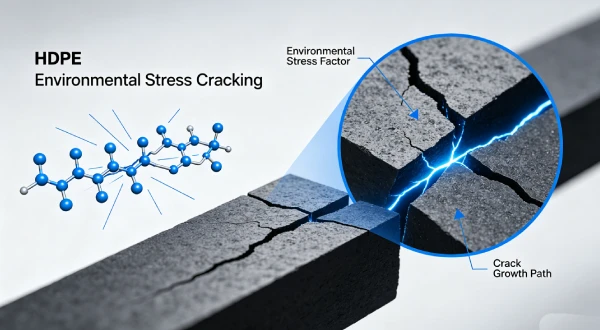
- ESC requires three factors simultaneously: tensile stress, a chemical environment, and susceptible resin morphology
- Resin molecular weight and comonomer distribution determine intrinsic ESC resistance — higher molecular weight and uniform comonomer distribution improve performance
- Installation stress (wrinkles, sharp corners) is the primary field trigger — stress management during installation is as important as resin specification
- Thicker liners provide greater ESC resistance through reduced stress intensity at flaw tips, but do not eliminate the mechanism
⚠️ Critical Engineering Statement — NCTL Specification + Stress Management = ESC Prevention
ESC prevention requires both proper resin specification AND installation stress management. Neither alone is sufficient.
- NCTL ≥ 1000 hours for aggressive environments, ≥ 1500 hours for hazardous waste
- Wrinkle elimination is non-negotiable — stress concentration factors of 3–10x
- Corner radius ≥ 1m to prevent stress concentrations (5–15x factor)
- Installation CQA with 100% wrinkle inspection and corrective action
A 2.0mm liner with NCTL = 1500 hours and proper stress management will outperform a 2.5mm liner with NCTL = 500 hours and poor installation. Specification and installation quality are equally critical.
📑 Table of Contents
1️⃣ Search Intent Introduction
2️⃣ Common Engineering Questions About Environmental Stress Cracking
3️⃣ Why HDPE Is Used — Material Science Focus
4️⃣ ESC Mechanisms — The Three-Factor Model
5️⃣ NCTL Testing and Interpretation (ASTM D5397)
6️⃣ Chemical Environments That Accelerate ESC
7️⃣ Stress Sources in Containment Liners
8️⃣ Real Engineering Failure Cases
9️⃣ Comparison With Alternative Liner Systems
🔟 Prevention Strategies and Resin Specification
1️⃣1️⃣ Professional Engineering Recommendation
1️⃣2️⃣ FAQ Section
1️⃣3️⃣ Technical Conclusion
1️⃣ Search Intent Introduction
This guide addresses the engineering question of why HDPE geomembranes experience environmental stress cracking (ESC) in containment applications and how to prevent it. The primary audience includes geotechnical design engineers, EPC contractors, environmental regulators, compliance officers, facility owners, and failure investigators evaluating liner system performance for landfills, heap leach pads, mining tailings ponds, wastewater lagoons, and hazardous waste containment cells.
Understanding ESC mechanisms is essential for resin specification, stress management design, monitoring program development, and failure root cause analysis. This is not an introductory overview — it is a data-driven engineering reference for professionals investigating or preventing environmental stress cracking in geomembrane installations where stress and chemical exposure combine to create crack propagation.
Real-world stress conditions that drive ESC in containment liners include:
- ✅ Sustained tensile stress from waste loading, thermal contraction, and subgrade settlement
- ✅ Chemical exposure to leachate constituents (organic acids, VOCs, surfactants) that accelerate crack growth
- ✅ Stress concentrators from wrinkles, sharp corners, subgrade irregularities, and seam defects
- ✅ Thermal cycling creating cyclic stress that promotes fatigue and crack propagation
- ✅ Weld residual stress from hot wedge or extrusion welding
- ✅ Molecular weight distribution — lower molecular weight resins are more susceptible
2️⃣ Common Engineering Questions About Environmental Stress Cracking
Q1: What is environmental stress cracking in HDPE liners?
Environmental stress cracking (ESC) is a failure mechanism where a susceptible HDPE resin, under tensile stress, develops cracks when exposed to specific chemical environments. Cracks initiate at stress concentration points and propagate through the liner thickness. ESC is a brittle failure — the material shows little or no ductility at the crack surface.
Q2: What are the three factors required for ESC?
ESC requires the simultaneous presence of: (1) tensile stress exceeding a threshold value, (2) a chemical environment that promotes crack growth, and (3) a susceptible resin morphology (lower molecular weight, poor comonomer distribution). Removal of any one factor prevents ESC.
Q3: How is ESC resistance measured?
ESC resistance is measured by the Notched Constant Tensile Load (NCTL) test per ASTM D5397. The test applies a constant tensile load to a notched specimen immersed in a surfactant solution (10% Igepal CO-630) at 50°C. Time to failure is recorded. GRI-GM13 requires NCTL ≥ 500 hours. Aggressive environments require ≥ 1000 hours.
Q4: What chemicals cause ESC in HDPE liners?
Common ESC agents include: surfactants (Igepal CO-630), organic acids (acetic, propionic, butyric), aromatic hydrocarbons (benzene, toluene, xylene), chlorinated solvents, and some leachate constituents. The specific chemical environment of each site must be evaluated for ESC potential.
Q5: Does thicker HDPE resist ESC better?
Thicker liners provide greater ESC resistance through reduced stress intensity at flaw tips and longer crack propagation path. However, thickness does not change the intrinsic ESC resistance of the resin. A 2.5mm liner with poor resin (NCTL 500 hours) will still crack, while a 1.5mm liner with excellent resin (NCTL 1500 hours) will outperform it.
Q6: Can ESC be prevented through installation practices?
Yes. Stress management during installation is critical. Eliminating wrinkles, using proper seam parameters, avoiding sharp corners (radius ≥ 1m), and ensuring smooth subgrade reduce stress concentration points. Installation stress is the primary field trigger for ESC.
Q7: How does temperature affect ESC?
ESC is thermally activated. Higher temperatures accelerate crack growth by increasing molecular mobility and reducing yield stress. The ESC threshold stress decreases with temperature. At 40°C, ESC propagation rates are approximately 3–5x faster than at 20°C.
Q8: What is the relationship between resin molecular weight and ESC resistance?
Higher molecular weight resins have greater tie-molecule density between crystalline regions, providing stronger resistance to crack propagation. Molecular weight distribution (MWD) — the range of chain lengths — also affects ESC. Narrower MWD with higher average molecular weight provides optimal ESC resistance.
Q9: How can I detect ESC in the field?
ESC detection methods include: visual inspection for surface cracks (often at wrinkles, corners, or seams), leak location surveys to identify through-holes, destructive sampling for microtome analysis (crack morphology), and HP-OIT testing (oxidation accelerates ESC). Cracks typically show brittle fracture surfaces with little deformation.
Q10: Can ESC be repaired?
Small ESC cracks can be patched with extrusion welding if the liner still has sufficient ductility. Extensive ESC requires liner replacement or capping. Cracks at seams often require section replacement. Prevention through specification and installation is the most effective strategy.
3️⃣ Why HDPE Is Used — Material Science Focus
HDPE dominates containment liner applications due to its excellent chemical resistance, low permeability, high tensile strength, and cost-effectiveness. However, ESC susceptibility varies significantly between resin grades, making specification critical.
Chemical Resistance in Containment Applications: HDPE resists the full range of leachate and process solution constituents, including acids, bases, salts, and many organics. However, certain chemicals (surfactants, organic acids, aromatic hydrocarbons) can act as ESC agents when combined with tensile stress.
Stress Crack Resistance (NCTL per ASTM D5397): The Notched Constant Tensile Load test measures the intrinsic ESC resistance of the resin. GRI-GM13 requires NCTL ≥ 500 hours. For aggressive environments with ESC agents present, NCTL ≥ 1000 hours is recommended. High-performance resins can achieve NCTL > 2000 hours.
Resin Molecular Structure: ESC resistance is governed by the polymer’s molecular structure:
- Molecular weight: Higher molecular weight (MI < 1.0 g/10min) provides greater tie-molecule density
- Comonomer distribution: Uniform short-chain branching improves tie-molecule density
- Crystallinity: Lower crystallinity (50–60%) provides more amorphous tie-molecules
- Molecular weight distribution: Narrower MWD (polydispersity < 5) improves performance
Tie-Molecule Density: Tie-molecules connect adjacent crystalline lamellae, providing resistance to crack propagation. Higher tie-molecule density correlates with longer NCTL times. Resin manufacturers optimise tie-molecule density through comonomer selection and polymerisation conditions.
Oxidative Induction Time (OIT vs HP-OIT): While OIT addresses antioxidant protection, not ESC resistance, oxidation reduces molecular weight and increases ESC susceptibility. HP-OIT monitoring (ASTM D5885) tracks antioxidant depletion. Once HP-OIT drops below 100 minutes, ESC resistance decreases significantly.
Carbon Black Content (ASTM D4218): Carbon black (2–3%) provides UV protection but also affects ESC resistance. Poorly dispersed carbon black can create stress concentrators that initiate ESC. Proper dispersion (ASTM D5596 rating ≥ 1) is essential.
Alternatives Comparison: HDPE vs Other Liner Materials for ESC Resistance
| Property | HDPE | LLDPE | fPP | PVC | GCL |
|---|---|---|---|---|---|
| Key limitation | ESC susceptibility | Lower ESC resistance | Lower tensile strength | Plasticizer loss | N/A (not a polymer liner) |
| ESC resistance range | 500–2000+ hrs NCTL | 300–800 hrs NCTL | 500–1000 hrs NCTL | Poor (plasticizer-dependent) | N/A |
| Resin specification critical | Critical (NCTL) | Important | Important | Not applicable | N/A |
| Field weldability | Excellent | Excellent | Fair | Good (solvent) | N/A |
| Chemical resistance to ESC agents | Good to Excellent | Good | Good | Poor | N/A |
| Cost relative to HDPE | 1.0x | 1.0–1.1x | 1.5–2.0x | 1.2–1.5x | 0.6–0.8x |
4️⃣ ESC Mechanisms — The Three-Factor Model
Environmental stress cracking in HDPE requires three factors to occur simultaneously. Understanding this model is essential for prevention.
Factor 1: Tensile Stress
Tensile stress exceeding the ESC threshold (typically 2–5 MPa for most HDPE grades at 20°C) is required. Stress can be:
- Applied stress: Waste loading, hydrostatic pressure, earth pressure
- Residual stress: Thermal contraction, welding residual stress, wrinkle stress
- Stress concentration: Magnified stress at wrinkles, corners, notches, defects
The ESC threshold decreases with temperature and exposure to aggressive chemicals. At 40°C, the threshold may drop to 1–2 MPa.
Factor 2: Chemical Environment
Specific chemicals accelerate ESC by:
- Plasticisation: Reducing intermolecular forces, lowering yield stress
- Surface wetting: Allowing chemical penetration into crack tips
- Surfactant action: Reducing surface energy, promoting crack growth
- Chain scission: Direct chemical attack on tie-molecules
Factor 3: Susceptible Resin Morphology
Resin susceptibility is determined by:
- Molecular weight: Lower molecular weight = more susceptible
- Tie-molecule density: Lower density = more susceptible
- Crystallinity: Higher crystallinity = more susceptible (fewer tie-molecules)
- Comonomer distribution: Poor distribution = more susceptible
ESC Three-Factor Model
text
┌─────────────────────────────────────────────────────────────────────────────┐
│                    ESC THREE-FACTOR MODEL                                  │
│                                                                             │
│                       ┌─────────────────────┐                               │
│                       │   TENSILE STRESS    │                               │
│                       │  (≥ threshold)      │                               │
│                       └─────────────────────┘                               │
│                                │                                            │
│                                ↓                                            │
│                    ┌───────────────────────┐                               │
│                    │    ESC FAILURE        │                               │
│                    │  (Crack propagation)  │                               │
│                    └───────────────────────┘                               │
│                          ↑           ↑                                      │
│  ┌───────────────────────┘           └───────────────────────────┐        │
│  │                                                                 │        │
│  ↓                                                                 ↓        │
│  ┌─────────────────────┐           ┌──────────────────────────────┐        │
│  │  CHEMICAL ENVIRONMENT│           │  SUSCEPTIBLE RESIN           │        │
│  │  • Surfactants       │           │  • Low molecular weight      │        │
│  │  • Organic acids     │           │  • Low tie-molecule density  │        │
│  │  • Aromatics         │           │  • High crystallinity        │        │
│  │  • Chlorinated       │           │  • Poor comonomer distribution│        │
│  └─────────────────────┘           └──────────────────────────────┘        │
│                                                                             │
│  ⚠️ All three factors must be present for ESC to occur                     │
│  📌 Removing ANY one factor prevents ESC failure                          │
└─────────────────────────────────────────────────────────────────────────────┘
ESC Propagation Mechanism:
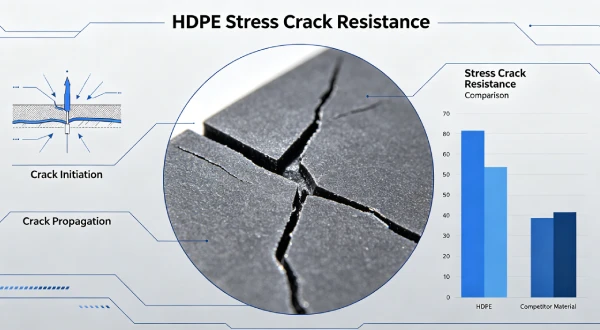
- Crack Initiation: Stress concentration at a flaw (wrinkle, notch, inclusion) exceeds the ESC threshold
- Craze Formation: Localised plastic deformation creates micro-voids (crazes) perpendicular to the stress direction
- Tie-Molecule Breakdown: Chemical environment attacks tie-molecules in the craze
- Crack Propagation: Cracks grow through the craze, stepwise, creating characteristic “brittle” fracture surfaces
- Through-Thickness Failure: Crack propagates through the liner thickness
Crack Morphology: ESC cracks are characterised by:
- Brittle fracture surfaces (no ductile deformation)
- Crack propagation perpendicular to stress direction
- Multiple parallel crack fronts (stepwise growth)
- Smooth fracture surfaces at microscopic scale
5️⃣ NCTL Testing and Interpretation (ASTM D5397)
The Notched Constant Tensile Load (NCTL) test is the primary method for measuring ESC resistance of HDPE resins and is specified in GRI-GM13.
Test Method Overview (ASTM D5397):
- Specimen Preparation: 25mm wide, 200mm long strips from compression-moulded or exhumed HDPE
- Notching: A sharp notch (≈ 0.5mm depth) is introduced using a scalpel blade
- Immersion: Specimens are immersed in 10% Igepal CO-630 solution at 50°C
- Loading: Constant tensile load is applied (typically 30–70% of yield stress)
- Failure Time: Time to complete fracture is recorded
- Report: NCTL value in hours for each load level
GRI-GM13 Requirements:
| Parameter | Requirement | Importance |
|---|---|---|
| NCTL (hours) | ≥ 500 hours | Minimum for general applications |
| Test temperature | 50°C | Accelerated condition |
| Chemical | 10% Igepal CO-630 | Standard ESC agent |
| Failure mode | Brittle fracture | Confirms ESC mechanism |
Interpretation of NCTL Results:
| NCTL (hours) | ESC Resistance Level | Recommended Application |
|---|---|---|
| < 300 hours | Poor | Not acceptable for containment |
| 300–500 hours | Marginal | Covered, mild chemical environments |
| 500–1000 hours | Good (GRI minimum) | Standard landfill, water applications |
| 1000–2000 hours | Very Good | Aggressive leachate, high stress |
| > 2000 hours | Excellent | Hazardous waste, high temperature, critical |
NCTL Test Schematic
text
┌─────────────────────────────────────────────────────────────────────────────┐
│                    NCTL TEST SCHEMATIC (ASTM D5397)                        │
│                                                                             │
│                      ┌───────────────────────────┐                          │
│                      │   Constant Load (≈ 30-70% │                          │
│                      │   of yield stress)        │                          │
│                      └───────────────────────────┘                          │
│                                 │                                           │
│                                 ↓                                           │
│                      ┌───────────────────────────┐                          │
│                      │   Grip                     │                          │
│                      └───────────────────────────┘                          │
│                                 │                                           │
│                      ┌───────────────────────────┐                          │
│                      │   HDPE Specimen            │                          │
│                      │   (25mm width, 200mm       │                          │
│                      │    length, notch depth     │                          │
│                      │    ≈ 0.5mm)                │                          │
│                      └───────────────────────────┘                          │
│                                 │                                           │
│                      ┌───────────────────────────┐                          │
│                      │   Notch                    │                          │
│                      └───────────────────────────┘                          │
│                                 │                                           │
│                      ┌───────────────────────────┐                          │
│                      │   10% Igepal CO-630        │                          │
│                      │   Solution at 50°C         │                          │
│                      │   (Environmental chamber)  │                          │
│                      └───────────────────────────┘                          │
│                                 │                                           │
│                      ┌───────────────────────────┐                          │
│                      │   Grip                     │                          │
│                      └───────────────────────────┘                          │
│                                                                             │
│  ⚠️ Time to failure recorded as NCTL (hours)                               │
│  📌 Higher NCTL = Better ESC resistance                                    │
└─────────────────────────────────────────────────────────────────────────────┘
Resin Certification Requirements: All HDPE supplied for containment applications should include:
- ✅ NCTL test results from independent laboratory (not just manufacturer data)
- ✅ Melt Index (MI) — typical 0.5–1.0 g/10min for high-ESC resins
- ✅ Density — typical 0.940–0.950 g/cm³ for geomembrane grades
- ✅ HP-OIT and OIT results (ASTM D5885, D3895)
- ✅ Carbon black content and dispersion rating (ASTM D4218, D5596)
Exhumed Liner Testing: NCTL testing can be performed on exhumed liner samples to assess remaining ESC resistance. This is valuable for:
- Service life assessment of aged liners
- Failure investigation (comparing failed vs unfailed material)
- Monitoring programs for long-term facilities
6️⃣ Chemical Environments That Accelerate ESC
Understanding the chemical environment is essential for ESC risk assessment and resin specification.
Leachate Chemistry: Municipal solid waste leachate contains numerous ESC agents:
- Organic acids: Acetic acid (100–1000 mg/L), propionic acid, butyric acid
- Surfactants: From household detergents, industrial cleaners (10–50 mg/L)
- Aromatic hydrocarbons: Benzene, toluene, xylene (BTEX) at < 1–100 mg/L
- Chlorinated hydrocarbons: Chloroform, TCE at < 1–10 mg/L
- Alcohols: Methanol, ethanol, ethylene glycol at 10–100 mg/L
Industrial Process Solutions: Heap leach and mining applications may contain:
- Cyanide solutions: Contain trace organics and surfactants
- Acid mine drainage: Low pH (2–4), high metal concentrations
- Flotation reagents: Surfactants, collectors, frothers
- Solvent extraction reagents: Kerosene, surfactants
Chemical ESC Severity Classification
| Chemical Class | Examples | ESC Severity | Typical Concentration (mg/L) |
|---|---|---|---|
| Surfactants | Igepal CO-630, detergents | Very High | 10–100+ |
| Organic acids | Acetic, propionic, butyric | High | 100–10,000 |
| Aromatic hydrocarbons | Benzene, toluene, xylene (BTEX) | High | 1–100 |
| Chlorinated solvents | Methylene chloride, TCE | Very High | 1–50 |
| Alcohols | Methanol, ethanol, glycol | Moderate | 10–1,000 |
| Esters | Phthalates, adipates | Moderate-High | 1–100 |
| Ketones | Acetone, MEK | High | 1–100 |
| Hydrocarbons (aliphatic) | Hexane, heptane | Low-Moderate | 1–100 |
Table scrolls horizontally on mobile
Chemical Concentration Effects:
| Chemical | Concentration (mg/L) | ESC Acceleration |
|---|---|---|
| Igepal CO-630 (test) | 100,000 (10%) | Standard (100x) |
| Acetic acid | 1,000 | 2–3x |
| Acetic acid | 10,000 | 5–8x |
| Benzene | 100 | 3–5x |
| Benzene | 1,000 | 8–15x |
| Surfactants (mixed) | 50 | 1.5–3x |
Temperature Effects on ESC Rate:
| Temperature | Relative ESC Rate (20°C = 1x) |
|---|---|
| 20°C | 1x |
| 30°C | 2–3x |
| 40°C | 4–8x |
| 50°C | 10–20x |
| 60°C | 25–50x |
7️⃣ Stress Sources in Containment Liners
Understanding and managing stress sources is critical for ESC prevention. Installation stress is the primary field trigger.
Wrinkle Stress: Wrinkles create high localised stress at the apex. Stress concentration factors of 3–10x are common. Wrinkle stress is the most frequent ESC initiation site in field failures.
- Thermal expansion wrinkles: From high-temperature installation without slack
- Wind-induced wrinkles: From panel lifting during deployment
- Subgrade settlement wrinkles: From differential subgrade movement
Thermal Contraction Stress: HDPE has a coefficient of thermal expansion (α ≈ 0.2 mm/m/°C). Temperature decreases create contraction stress:
- Formula: σ = E × α × ΔT (E ≈ 800–1000 MPa)
- ΔT = 30°C: σ ≈ 4.8–6 MPa (exceeds typical ESC threshold)
Welding Residual Stress: Hot wedge and extrusion welding create residual stress:
- Hot wedge: Cool-down of weld area creates thermal stress
- Extrusion: Filler rod cooling creates differential stress
- Weld orientation: Transverse stress at welds from thermal contraction
Applied Stress from Loading:
| Loading Condition | Typical Stress (MPa) |
|---|---|
| Waste overburden (30m) | 0.5–1.0 |
| Waste overburden (60m) | 1.0–2.0 |
| Hydrostatic head (1m) | 0.01 |
| Side slope gravitational | 0.2–0.5 |
| Seam thermal contraction | 2–6 |
Stress Concentration Factors
| Feature | Stress Concentration Factor | Typical Resulting Stress (MPa)* |
|---|---|---|
| Smooth subgrade | 1x | Baseline (1–2 MPa) |
| Subgrade protrusion | 2–4x | 2–8 MPa |
| Wrinkle apex | 3–10x | 3–20 MPa |
| Sharp corner (radius < 1m) | 5–15x | 5–30 MPa |
| Seam defect (cold weld) | 5–20x | 5–40 MPa |
| Notch (scratches, etc.) | 10–30x | 10–60 MPa |
Based on baseline applied stress of 1–2 MPa
Table scrolls horizontally on mobile
Temperature vs ESC Rate
text
┌─────────────────────────────────────────────────────────────────────────────┐
│                    TEMPERATURE vs ESC RATE                                 │
│                                                                             │
│  Relative ESC Rate (20°C = 1x)                                             │
│  │                                                                          │
│  50 ┤                                                                       │
│      │                                                                      │
│  45 ┤                                                                       │
│      │                                                                      │
│  40 ┤                                                                       │
│      │                                                                      │
│  35 ┤                                                                       │
│      │                                                                      │
│  30 ┤     ●  (60°C, 25-50x)                                                │
│      │    │                                                                 │
│  25 ┤    │                                                                  │
│      │    │                                                                 │
│  20 ┤    │                                                                  │
│      │    │    ●  (50°C, 10-20x)                                          │
│  15 ┤    │   │                                                              │
│      │    │   │                                                             │
│  10 ┤    │   │    ●  (40°C, 4-8x)                                         │
│      │    │   │   │                                                         │
│   5 ┤    │   │   │    ●  (30°C, 2-3x)                                     │
│      │    │   │   │   │                                                    │
│   2 ┤    │   │   │   │    ●  (25°C, 1.5-2x)                               │
│      │    │   │   │   │   │                                                │
│   1 ┤    │   │   │   │   │    ●  (20°C, 1x)                               │
│      │    │   │   │   │   │   │                                            │
│   0 └────┴───┴───┴───┴───┴───┴─────────────────                           │
│      20°C 25°C 30°C 35°C 40°C 45°C 50°C 55°C 60°C                        │
│                          Temperature                                        │
│                                                                             │
│  ⚠️ ESC rate increases by 3-5x per 10°C temperature increase               │
│  📌 Critical: ESC threshold stress decreases with temperature              │
└─────────────────────────────────────────────────────────────────────────────┘
8️⃣ Real Engineering Failure Cases
Case 1: Wrinkle-Induced ESC — US Midwest Landfill, 2017
Specification used: 2.0mm HDPE, NCTL = 600 hours (GRI-GM13 minimum). Waste height 35m. Hot weather installation (38°C) without adequate slack.
Observed failure: Surface cracking at wrinkle apexes after 3 years. Cracks propagated through 2.0mm liner. Leakage rate increased from 2 L/day to 180 L/day. Six through-holes identified at wrinkle locations.
Timeline:
text
2017: 2.0mm HDPE installed, NCTL=600hrs, installation temp 38°C
    ↓ No slack provided for thermal contraction
2017-2020: Thermal cycling (day 50°C → night 10°C)
    ↓ Wrinkle stress concentration factors 5-10x
2020: ESC cracks initiated at wrinkle apexes
    ↓ Cracks propagated through 2.0mm liner
2020-2021: Leakage 2 L/day → 180 L/day, 6 through-holes
    ↓
    ↓ Repair cost: $1.8M (patch repairs + monitoring)
    ↓
    ↓ Lesson: Wrinkle prevention is critical for ESC mitigation
Root cause: Hot weather installation without thermal slack created severe wrinkles. Thermal cycling generated stress concentration factors of 5–10x at wrinkle apexes. The resin’s NCTL of 600 hours was insufficient to resist stress crack propagation under these conditions.
Engineering lesson: Provide 2–3% thermal slack during hot weather installation. Eliminate wrinkles through proper deployment and ballasting. For high-stress applications, specify NCTL ≥ 1000 hours.
Case 2: Chemical-Accelerated ESC — European Hazardous Waste Landfill, 2019
Specification used: 2.0mm HDPE, NCTL = 750 hours. Leachate with high organic acid content (acetic acid 5,000 mg/L) and temperature 35°C.
Observed failure: Multiple ESC cracks at base liner after 2 years. Cracks primarily at seam intersections and corner radii. Leachate breakthrough detected in groundwater monitoring.
Timeline:
text
2019: 2.0mm HDPE installed, NCTL=750hrs, leachate high organic acids
    ↓ Leachate temp 35°C, acetic acid 5,000 mg/L
2021: ESC cracks at seam intersections, corner radii
    ↓ Cracks propagated through liner
2021: Leachate breakthrough detected
    ↓
    ↓ Repair cost: $2.2M (section replacement + groundwater remediation)
    ↓
    ↓ Lesson: Aggressive chemical + temperature requires NCTL ≥ 1000hrs
Root cause: High organic acid concentration (acetic acid 5,000 mg/L) accelerated ESC. The 35°C leachate temperature increased crack propagation rate by 2–3x. The resin’s NCTL of 750 hours was insufficient for the aggressive chemical and thermal environment.
Engineering lesson: For aggressive leachate (high organic acid, VOC) or elevated temperature, specify NCTL ≥ 1000 hours. Confirm resin compatibility with specific chemical environment. Increase monitoring frequency.
Case 3: Welding Residual Stress ESC — Australian Mining Tailings Dam, 2020
Specification used: 2.0mm HDPE, NCTL = 900 hours. Extrusion welding used for seams, with inadequate stress relief at weld terminations.
Observed failure: Cracking at extrusion weld terminations after 18 months. Cracks propagated along the weld interface. Leakage through weld zones.
Timeline:
text
2020: 2.0mm HDPE installed, extrusion welded, NCTL=900hrs
    ↓ No stress relief at weld terminations
2021-2022: Thermal cycling + tailings loading
    ↓ Weld residual stress + applied stress
2022: Cracks at weld terminations, propagated along welds
    ↓ Leakage through weld zones
2022: Weld replacement and stress relief installed
    ↓
    ↓ Repair cost: $1.5M
    ↓
    ↓ Lesson: Extrusion welding requires stress relief at terminations
Root cause: Extrusion welding created residual stress at weld terminations. Thermal cycling and tailings loading combined with residual stress exceeded the ESC threshold. Cracks initiated at weld termination points where stress concentration was highest.
Engineering lesson: Provide stress relief at extrusion weld terminations (radius ≥ 1m). Consider hot wedge welding for seams where possible. Specify resin with NCTL ≥ 1000 hours for high-stress applications.
Failure Case Cost Comparison
text
┌─────────────────────────────────────────────────────────────────────────────┐
│                    ESC FAILURE CASE COST COMPARISON                        │
│                                                                             │
│  Cost ($M)                                                                  │
│  │                                                                          │
│  2.5 ┤                                                                      │
│      │                                                                      │
│  2.0 ┤    ●  (Europe, $2.2M)    ●  (US, $1.8M)                            │
│      │   │                       │                                          │
│  1.5 ┤   │                       │    ●  (Australia, $1.5M)                │
│      │   │                       │   │                                      │
│  1.0 ┤   │                       │   │                                      │
│      │   │                       │   │                                      │
│  0.5 ┤   │                       │   │                                      │
│      │   │                       │   │                                      │
│    0 └───┴───────────────────────┴───┴─────────────────                   │
│           Europe               US    Australia                             │
│           (Chemical)          (Wrinkle) (Weld Stress)                      │
│                                                                             │
│  ⚠️ Average ESC failure cost: $1.8M                                        │
│  📌 Prevention: NCTL ≥ 1000hrs + stress management = 5-10% of failure cost│
└─────────────────────────────────────────────────────────────────────────────┘
9️⃣ Comparison With Alternative Liner Systems for ESC Resistance
| Property | HDPE (2.0mm) | LLDPE (1.5mm) | PVC (1.5mm) | EPDM (1.5mm) | GCL |
|---|---|---|---|---|---|
| ESC resistance range | 500–2000+ hrs NCTL | 300–800 hrs NCTL | Poor (plasticizer-dependent) | Fair (200–500 hrs) | N/A |
| Resin specification critical | Critical (NCTL) | Important | Not applicable | Important | N/A |
| Chemical resistance to ESC agents | Good to Excellent | Good | Poor | Fair | N/A |
| Field weldability | Excellent | Excellent | Good (solvent) | Poor (adhesive) | N/A |
| Stress management required | Critical | Critical | Important | Important | N/A |
| Temperature tolerance (ESC) | 60°C | 50°C | 40°C | 60°C | N/A |
| Containment application suitability | ✅ Recommended (with NCTL) | ⚠️ Limited | ❌ Not recommended | ⚠️ Limited (cost) | ✅ Composite use |
| Cost relative to HDPE | 1.0x | 1.0–1.1x | 1.2–1.5x | 2.0–3.0x | 0.6–0.8x |
Table scrolls horizontally on mobile
🔟 Prevention Strategies and Resin Specification
Resin Specification for ESC Prevention:
- ✅ NCTL (ASTM D5397): ≥ 1000 hours for aggressive environments, ≥ 1500 hours for hazardous waste
- ✅ Melt Index (MI): ≤ 1.0 g/10min (higher molecular weight)
- ✅ Density: 0.940–0.948 g/cm³ (optimal ESC-crystallinity balance)
- ✅ Tie-molecule density: Confirmed by resin supplier (typically > 2.5%)
- ✅ HP-OIT: ≥ 400 minutes (ASTM D5885) for antioxidant protection
- ✅ Carbon black: 2.5–3.0% (ASTM D4218), dispersion rating ≥ 1 (ASTM D5596)
Stress Management During Installation:
- ✅ Wrinkle prevention: 2–3% thermal slack during deployment
- ✅ Wrinkle elimination: Flatten all wrinkles before seaming
- ✅ Corner radius: ≥ 1m for all changes in direction
- ✅ Seam stress relief: Tension relief at weld terminations
- ✅ Subgrade: ≤ 6mm particle size, ≥ 95% Standard Proctor compaction
- ✅ Anchorage: Trench anchors, batten bars to manage contraction
Chemical Compatibility Assessment:
- ✅ Identify all chemicals: Full leachate or process solution analysis
- ✅ ESC agent assessment: Evaluate concentration of surfactants, organic acids, aromatics
- ✅ Temperature profile: Assess maximum operating temperature
- ✅ Resin selection: Match NCTL to chemical exposure intensity
- ✅ Confirmation testing: Consider site-specific ESC testing
Monitoring for ESC:
- ✅ Visual inspection: Monthly for surface cracks at wrinkles, seams, corners
- ✅ Leak location survey: Annual or biennial
- ✅ Exhumed sample testing: NCTL on exhumed samples every 5–10 years
- ✅ Documentation: All inspection and test results retained
1️⃣1️⃣ Professional Engineering Recommendation
ESC Risk Management Matrix:
| ESC Risk Level | NCTL Requirement | Thickness | Stress Management | Monitoring Frequency |
|---|---|---|---|---|
| Low: Mild leachate, < 25°C, no surfactants/VOCs | ≥ 500 hours (GRI minimum) | 1.5mm | Standard CQA | Annual inspection |
| Moderate: Typical MSW leachate, 25–30°C | ≥ 750 hours | 1.5–2.0mm | Enhanced CQA + wrinkle prevention | Annual + leak survey |
| High: Aggressive leachate (VOCs, surfactants), 30–35°C | ≥ 1000 hours | 2.0mm | Critical stress management | 6-month inspection |
| Extreme: Hazardous waste, > 35°C, high VOCs/surfactants | ≥ 1500 hours | 2.0–2.5mm | Comprehensive stress program | Quarterly + exhumed testing |
Table scrolls horizontally on mobile
When to Specify NCTL ≥ 1000 Hours:
- Leachate with organic acids > 1,000 mg/L
- Leachate with VOCs (BTEX, chlorinated solvents) > 10 mg/L
- Surfactant concentrations > 50 mg/L
- Operating temperature > 30°C
- Waste height > 30m (high overburden stress)
- Critical containment (hazardous waste, drinking water protection)
- Design life > 50 years without cap
Quality Assurance Requirements for ESC Prevention:
- ✅ Resin certification: NCTL test results from independent laboratory
- ✅ Material verification: MI, density, HP-OIT, carbon black on all lots
- ✅ Installation CQA: Third-party inspection of all seaming and stress management
- ✅ Wrinkle elimination: 100% visual inspection with corrective action
- ✅ Corner radius verification: Confirm all radii ≥ 1m
- ✅ Documentation retention: All records for lifetime of facility
1️⃣2️⃣ FAQ Section
Q1: What is environmental stress cracking in HDPE liners?
Environmental stress cracking (ESC) is a failure mechanism where a susceptible HDPE resin, under tensile stress, develops cracks when exposed to specific chemical environments. Cracks initiate at stress concentration points and propagate through the liner thickness. ESC is a brittle failure with little ductility at the crack surface.
Q2: What are the three factors required for ESC?
ESC requires the simultaneous presence of: (1) tensile stress exceeding a threshold value, (2) a chemical environment that promotes crack growth, and (3) a susceptible resin morphology (lower molecular weight, poor comonomer distribution). Removal of any one factor prevents ESC.
Q3: How is ESC resistance measured?
ESC resistance is measured by the Notched Constant Tensile Load (NCTL) test per ASTM D5397. The test applies a constant tensile load to a notched specimen immersed in 10% Igepal CO-630 solution at 50°C. Time to failure is recorded. GRI-GM13 requires NCTL ≥ 500 hours.
Q4: What NCTL value should I specify for my application?
For standard MSW landfills with mild leachate, NCTL ≥ 500 hours (GRI minimum) is acceptable. For aggressive leachate with organic acids, VOCs, or surfactants, specify NCTL ≥ 1000 hours. For hazardous waste or high-temperature applications, specify NCTL ≥ 1500 hours.
Q5: What chemicals cause ESC in HDPE liners?
Common ESC agents include: surfactants (Igepal CO-630), organic acids (acetic, propionic, butyric), aromatic hydrocarbons (benzene, toluene, xylene), chlorinated solvents, and some leachate constituents. The specific chemical environment of each site must be evaluated for ESC potential.
Q6: Does thicker HDPE resist ESC better?
Thicker liners provide greater ESC resistance through reduced stress intensity at flaw tips and longer crack propagation path. However, thickness does not change the intrinsic ESC resistance of the resin. A 2.5mm liner with poor resin (NCTL 500 hours) will still crack, while a 1.5mm liner with excellent resin (NCTL 1500 hours) will outperform it.
Q7: Can ESC be prevented through installation practices?
Yes. Stress management during installation is critical. Eliminating wrinkles, using proper seam parameters, avoiding sharp corners (radius ≥ 1m), and ensuring smooth subgrade reduce stress concentration points. Installation stress is the primary field trigger for ESC.
Q8: How does temperature affect ESC?
ESC is thermally activated. Higher temperatures accelerate crack growth by increasing molecular mobility and reducing yield stress. The ESC threshold stress decreases with temperature. At 40°C, ESC propagation rates are approximately 3–5x faster than at 20°C.
Q9: How can I detect ESC in the field?
ESC detection methods include: visual inspection for surface cracks (often at wrinkles, corners, or seams), leak location surveys to identify through-holes, destructive sampling for microtome analysis (crack morphology), and HP-OIT testing (oxidation accelerates ESC).
Q10: Can ESC be repaired?
Small ESC cracks can be patched with extrusion welding if the liner still has sufficient ductility. Extensive ESC requires liner replacement or capping. Cracks at seams often require section replacement. Prevention through specification and installation is the most effective strategy.
1️⃣3️⃣ Technical Conclusion
Environmental stress cracking remains the most common failure mechanism of HDPE geomembranes in containment applications, responsible for an estimated 40–60% of field failures. The three-factor model — tensile stress, chemical environment, and susceptible resin morphology — provides the framework for understanding and preventing ESC. The presence of any one factor alone does not cause ESC; removal of any one factor prevents it.
NCTL testing (ASTM D5397) is the critical specification for ESC resistance. While GRI-GM13 requires NCTL ≥ 500 hours, aggressive environments demand ≥ 1000 hours for adequate protection. Resin molecular weight, tie-molecule density, and comonomer distribution determine intrinsic ESC resistance. High-performance resins with NCTL > 1500 hours are available and should be specified for critical or aggressive applications.
Stress management during installation is the most effective field prevention strategy. Wrinkles, sharp corners, and welding residual stress create stress concentration factors of 5–20x that trigger ESC initiation. Thermal slack (2–3%), wrinkle elimination, corner radius ≥ 1m, and proper welding parameters are non-negotiable requirements. Installation quality — stress management — outweighs thickness specification for ESC prevention.
Chemical environment assessment must be part of the specification process. Leachate analysis identifying organic acids, VOCs, and surfactants guides resin selection. Temperature effects must be considered — ESC propagation rates increase by 3–5x per 10°C. For elevated temperature applications, higher NCTL specifications are required.
Lifecycle thinking must guide ESC prevention strategy. The cost of monitoring and prevention ($10,000–50,000 per installation) is far lower than failure remediation ($1,000,000–5,000,000). NCTL specification, stress management, and monitoring are the most cost-effective ESC prevention tools available. The decision on resin specification, installation practices, and monitoring frequency is ultimately one of risk tolerance, regulatory compliance, and professional engineering judgement applied to site-specific conditions.
📚 Related Technical Guides
HDPE Geomembrane NCTL Testing: A Specification Engineer's Guide to ASTM D5397Landfill Leachate Chemical Analysis: Identifying ESC Agents in MSW and Hazardous WasteGeomembrane Wrinkle Prevention: Thermal Stress Management During InstallationStress Crack Resistance Resin Selection: Specification Guide for Containment ApplicationsHDPE Geomembrane Failure Investigation: ESC Root Cause Analysis