HDPE Root Penetration Damage Guide 2026 | Prevention & Control
Application Guide 2026-07-09
Author: Senior Geomembrane Engineer, P.E. — 15+ years field experience in geomembrane liner design for ponds, reservoirs, and lagoons across tropical, temperate, and arid climates with extensive vegetation management expertise
Reviewer: Geosynthetics Materials Specialist
Last Updated: July 6, 2026
Read Time: 12 minutes
📅 Review Cycle: This guide is updated quarterly. Last verified: July 6, 2026
📋 Executive Summary — For Engineers in a Hurry
- Root penetration is a significant threat to pond liner integrity, particularly in warm, moist climates where aggressive root growth can occur through minimal openings in the liner or its protective layers
- Roots can generate pressures exceeding 2–5 MPa at growing tips, sufficient to penetrate HDPE liners through existing defects or stress concentrators
- Geotextile protection layers (≥ 400 gsm) reduce root penetration risk by 70–90% by providing a mechanical barrier and limiting root access to the liner surface
- Chemical root inhibitors (trifluralin, dinitroaniline compounds) can provide long-term protection when incorporated into the subgrade or applied as a pre-emergent treatment
- Prevention requires vegetation management (clearing, herbicide application), geotextile protection, and regular inspection of the pond perimeter for encroaching vegetation
- Root damage is typically progressive — early detection through visual inspection and leak location surveys is essential for preventing catastrophic failure
⚠️ Critical Engineering Statement — Vegetation Management + Geotextile Protection > Liner Thickness for Root Penetration Prevention
Root penetration can compromise HDPE liner integrity regardless of thickness. Roots can exploit even minimal defects in the liner or its protective layers.
- Root pressure at growing tips can exceed 2–5 MPa — sufficient to penetrate HDPE through small defects or stress concentrators
- Geotextile protection layers (≥ 400 gsm) reduce root penetration risk by 70–90%
- Chemical root inhibitors provide long-term protection when properly specified and applied
- Vegetation management (clearing, ongoing maintenance) is non-negotiable for pond integrity
- Prevention is far more cost-effective than remediation of root-damaged liners
A properly managed pond with vegetation control and geotextile protection and a 1.5mm liner will outperform an unprotected pond with a 2.5mm liner. Vegetation management and geotextile protection outweigh liner thickness for root penetration prevention.
📑 Table of Contents
1️⃣ Search Intent Introduction
2️⃣ Common Engineering Questions About Root Penetration Damage
3️⃣ Why HDPE Is Used — Material Science Focus
4️⃣ Root Growth Mechanisms and Penetration Forces
5️⃣ Root Penetration Risk Assessment
6️⃣ Geotextile Protection Layers for Root Resistance
7️⃣ Chemical Root Inhibition Strategies
8️⃣ Real Engineering Failure Cases
9️⃣ Comparison With Alternative Liner Systems
🔟 Prevention Strategies and CQA Requirements
1️⃣1️⃣ Professional Engineering Recommendation
1️⃣2️⃣ FAQ Section
1️⃣3️⃣ Technical Conclusion
1️⃣ Search Intent Introduction
This guide addresses the engineering question of how root penetration damages HDPE pond liners and how to prevent this failure mechanism through design, vegetation management, and protective measures. The primary audience includes geotechnical design engineers, EPC contractors, environmental regulators, facility owners, and pond operators evaluating liner systems in vegetated areas where root growth poses a significant threat to barrier integrity.
Understanding root penetration mechanisms is essential for vegetation management planning, geotextile specification, chemical root inhibitor selection, and inspection program design. This is not an introductory overview — it is a data-driven engineering reference for professionals designing, installing, and maintaining pond liners where adjacent vegetation creates root penetration risk.
Real-world conditions that create root penetration risk include:
- ✅ Aggressive root systems — trees and shrubs with deep taproots (willows, poplars, eucalyptus) that can extend 5–10m from the trunk
- ✅ Warm, moist climates — tropical and subtropical regions where root growth is continuous year-round
- ✅ Liner defects — seams, punctures, and stress concentrators provide entry points for roots
- ✅ Geotextile failure — inadequate protection layers allow roots to reach the liner
- ✅ Perimeter vegetation — trees and shrubs growing adjacent to the pond
- ✅ Subgrade organic matter — roots exploiting organic material in the foundation
2️⃣ Common Engineering Questions About Root Penetration Damage
Q1: Can roots actually penetrate intact HDPE liners?
Intact HDPE liners are generally resistant to root penetration. However, roots can exploit existing defects (seam defects, punctures, stress cracks) or penetrate through areas where the liner has been thinned or degraded. Root pressure at growing tips can exceed 2–5 MPa, sufficient to penetrate weakened material.
Q2: What types of roots are most damaging to pond liners?
Aggressive taproots from trees such as willows, poplars, eucalyptus, and cottonwoods pose the greatest threat. These roots can extend 5–10m from the trunk and penetrate to depths of 2–5m. Woody roots have the highest penetration pressure and can exploit defects.
Q3: How does geotextile protect against root penetration?
Geotextile (400–600 gsm) provides a mechanical barrier that prevents roots from reaching the liner surface. The geotextile also distributes root pressure over a larger area, reducing stress concentration on the liner. Nonwoven geotextiles with high puncture resistance are most effective.
Q4: What chemical root inhibitors are effective for pond liners?
Trifluralin, dinitroaniline compounds (pendimethalin, oryzalin), and isoxaben are effective pre-emergent herbicides for root inhibition. These chemicals prevent root growth at the root tip by disrupting cell division. Application must be to the subgrade before liner placement.
Q5: How far from a pond should trees be cleared?
A minimum clearance of 10–15m from the pond perimeter is recommended for large trees (> 10m height). For smaller trees and shrubs, 5–10m clearance is typically sufficient. Root zones extend approximately 1.5–2x the canopy radius.
Q6: Can roots penetrate through geotextile?
Some geotextiles can be penetrated by aggressive roots if the geotextile is thin (< 300 gsm) or has large openings. Nonwoven geotextiles ≥ 400 gsm provide the best root barrier. Woven geotextiles with large apertures can allow roots to pass through.
Q7: What are the signs of root penetration damage?
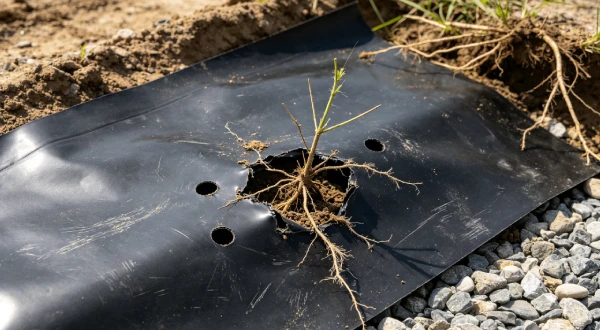
Signs include: liner bulging or displacement, seam separation, leakage at root penetration points, visible roots through the liner, and vegetation growing through the liner. Leak location surveys can identify root-related leaks.
Q8: How long does it take for roots to damage a liner?
Root damage is typically progressive over 3–10 years. Initial root contact with the liner may not cause immediate failure. However, continued root growth pressure and chemical interaction can lead to failure within 5–15 years.
Q9: Can root-damaged liners be repaired?
Repair depends on the extent of damage. Small punctures can be patched with extrusion welding. Extensive root damage or multiple penetration points may require section replacement. If roots have penetrated the liner, the root material must be removed and the area repaired.
Q10: What is the role of chemical root barriers in liner protection?
Chemical root barriers (impregnated geotextiles or membranes) contain root-inhibiting chemicals that prevent root growth at the barrier surface. These are particularly useful for critical applications where vegetation cannot be completely removed.
3️⃣ Why HDPE Is Used — Material Science Focus
HDPE dominates pond liner applications due to its excellent chemical resistance, low permeability, high tensile strength, and weldability. However, its susceptibility to punctures and stress cracking makes it vulnerable to root penetration through defects.
Puncture Resistance: HDPE puncture resistance (ASTM D4833) is typically 300–600 N for 1.5–2.5mm liners. Roots can exert pressures exceeding 2–5 MPa at growing tips — sufficient to penetrate through small defects or degraded areas.
Stress Crack Resistance (NCTL per ASTM D5397): Roots can exploit stress cracks and seam defects to initiate penetration. Resins with NCTL ≥ 1000 hours provide greater resistance to stress cracking from root pressure. GRI-GM13 requires NCTL ≥ 500 hours.
Chemical Resistance to Root Exudates: HDPE resists chemical attack from root exudates (organic acids, enzymes, growth regulators). However, some aggressive root species produce exudates that can accelerate degradation at root contact points.
Tensile Strength and Root Stress: HDPE tensile strength is approximately 20–25 MPa. Root pressure at growing tips can create localised stress exceeding tensile strength at defect locations. Stress concentration from root pressure can also initiate ESC.
Carbon Black Content: Carbon black (2–3%) provides UV protection but does not affect root resistance. Proper dispersion (ASTM D5596 rating ≥ 1) ensures uniform properties, including resistance to stress cracking from root pressure.
Abrasion Resistance: Root movement against the liner surface can cause abrasion. Thicker liners provide greater abrasion resistance. Geotextile protection reduces abrasion from root movement.
Alternatives Comparison: HDPE vs Other Liner Materials for Root Resistance
| Property | HDPE | LLDPE | PVC | EPDM | GCL |
|---|---|---|---|---|---|
| Puncture resistance | Good (300–600 N) | Moderate (200–400 N) | Poor (100–200 N) | Fair (100–300 N) | N/A |
| Root penetration resistance | Good (with protection) | Moderate | Poor | Fair | N/A (not a barrier) |
| Chemical resistance to root exudates | Excellent | Good | Poor | Fair | N/A |
| Abrasion resistance | Good | Moderate | Poor | Fair | N/A |
| Geotextile protection required | Yes | Yes | Yes | Yes | No |
| Chemical root inhibitor compatibility | Good | Good | Poor | Good | N/A |
| Cost relative to HDPE | 1.0x | 1.0–1.1x | 1.2–1.5x | 2.0–3.0x | 0.6–0.8x |
4️⃣ Root Growth Mechanisms and Penetration Forces
Understanding root growth mechanisms is essential for designing effective protection systems.
Root Growth Mechanism:
- Root initiation: Roots grow from the plant toward water and nutrients
- Root tip pressure: The growing root tip exerts pressure of 2–5 MPa
- Pathway development: Roots follow lines of least resistance (defects, seams, soil cracks)
- Penetration: Root pressure exceeds material resistance at defect locations
- Expansion: Roots expand within the defect, increasing pressure
Root Penetration Forces:
| Root Type | Diameter | Pressure at Tip | Penetration Force |
|---|---|---|---|
| Fine roots | < 2mm | 2–3 MPa | 6–25 N |
| Medium roots | 2–5mm | 3–4 MPa | 25–100 N |
| Coarse roots | 5–10mm | 4–5 MPa | 100–400 N |
| Woody taproots | 10–25mm | 5–8 MPa | 400–2,500 N |
Table scrolls horizontally on mobile
HDPE Puncture Resistance Comparison:
| Thickness | Puncture Resistance (ASTM D4833) |
|---|---|
| 1.0mm | 200–300 N |
| 1.5mm | 300–450 N |
| 2.0mm | 400–600 N |
| 2.5mm | 500–750 N |
A medium root (2–5mm) exerts 25–100 N, which is below the puncture resistance of intact HDPE. However, stress concentration at defects can reduce puncture resistance by 50–80%.
Root Penetration Timeline:
| Root Type | Time to Liner Contact | Time to Penetration |
|---|---|---|
| Fine roots | 1–3 years | 3–5 years |
| Medium roots | 2–5 years | 5–10 years |
| Coarse roots | 5–10 years | 10–15 years |
Root Penetration Sequence:
The root penetration process follows a typical sequence: (1) Root approaches liner following path of least resistance through soil, (2) Root encounters geotextile (if present) and must penetrate or bypass it, (3) Root reaches liner surface at a defect or stress concentrator, (4) Root tip pressure applies concentrated force at the defect, (5) If pressure exceeds material resistance, root penetrates the liner, (6) Root expands within the defect, increasing damage, (7) Leakage occurs through the penetration point, potentially leading to soil erosion and further damage.
5️⃣ Root Penetration Risk Assessment
Risk assessment is essential for determining the required level of protection.
Risk Factors:
| Factor | Low Risk | Medium Risk | High Risk |
|---|---|---|---|
| Climate | Cold/dry | Temperate | Warm/moist |
| Vegetation type | Grass/shrubs | Small trees | Large trees |
| Vegetation proximity | > 20m | 10–20m | < 10m |
| Root type | Fibrous | Shallow tap | Deep tap |
| Soil type | Compacted clay | Sandy clay | Loose soil |
| Liner thickness | ≥ 2.5mm | 2.0mm | < 2.0mm |
| Geotextile | ≥ 600 gsm | 400–600 gsm | < 400 gsm |
Table scrolls horizontally on mobile
Risk Classification:
| Risk Level | Description | Required Protection |
|---|---|---|
| Low | No trees within 20m, grass only, compacted soil | 400 gsm geotextile + 1.5mm liner |
| Moderate | Trees 10–20m, shrubs, seasonal growth | 600 gsm geotextile + 2.0mm liner + herbicide |
| High | Trees < 10m, aggressive species, year-round growth | 600 gsm geotextile + chemical barrier + 2.5mm liner |
| Extreme | Multiple trees < 5m, tropical climate, taproot species | Specialist review + enhanced barriers |
Critical Species to Avoid:
| Species | Root Type | Maximum Root Spread |
|---|---|---|
| Willow (Salix) | Aggressive tap | 10–20m |
| Poplar/Cottonwood | Aggressive tap | 10–25m |
| Eucalyptus | Deep tap | 10–20m |
| Bamboo | Rhizome | 5–15m |
| Oak | Taproot | 10–20m |
| Pine | Shallow tap | 5–15m |
Table scrolls horizontally on mobile
6️⃣ Geotextile Protection Layers for Root Resistance
Geotextile protection is the most effective physical barrier against root penetration.
Geotextile Requirements for Root Protection:
| Parameter | Recommendation |
|---|---|
| Geotextile type | Nonwoven (needle-punched) |
| Mass per unit area | ≥ 400 gsm (600 gsm for high risk) |
| Thickness | ≥ 3mm (5mm for high risk) |
| Puncture resistance (CBR) | ≥ 2,000 N |
| Permeability | > 10⁻² cm/s |
| Opening size (O95) | < 0.1mm (prevents root passage) |
Geotextile Root Protection Performance:
| Geotextile Weight | Root Penetration Resistance | Protection Level |
|---|---|---|
| No geotextile | Poor | None |
| 200–300 gsm | Low | Minimal |
| 400 gsm | Good | Standard |
| 600 gsm | Excellent | Enhanced |
| 600 gsm + chemical | Exceptional | Critical |
Root Penetration Risk Reduction:
| Protection Layer | Root Penetration Risk Reduction |
|---|---|
| No geotextile | 0% (baseline) |
| 200 gsm geotextile | 30–50% |
| 400 gsm geotextile | 70–85% |
| 600 gsm geotextile | 85–95% |
| 600 gsm + chemical | 95–99% |
Geotextile Installation for Root Protection:
- ✅ Place directly beneath the HDPE liner
- ✅ Overlap seams by minimum 300mm
- ✅ Extend beyond the liner perimeter by 1–2m
- ✅ Protect from UV during installation (cover promptly)
- ✅ Secure with staples or weights to prevent movement
Geotextile Maintenance:
- Inspect exposed geotextile for root penetration annually
- Repair damaged geotextile sections
- Ensure geotextile remains covered and protected
- Monitor for geotextile degradation from UV or chemicals
7️⃣ Chemical Root Inhibition Strategies
Chemical root inhibitors provide long-term protection when properly specified and applied.
Effective Root Inhibitors:
| Chemical | Mechanism | Application | Duration |
|---|---|---|---|
| Trifluralin | Disrupts cell division | Pre-emergent | 1–2 years |
| Pendimethalin | Disrupts cell division | Pre-emergent | 1–2 years |
| Oryzalin | Disrupts cell division | Pre-emergent | 1–2 years |
| Isoxaben | Inhibits cell wall synthesis | Pre-emergent | 1–2 years |
| Copper compounds | Toxic to roots | Soil treatment | 3–5 years |
Table scrolls horizontally on mobile
Application Methods:
| Method | Application | Effectiveness |
|---|---|---|
| Subgrade application | Mixed into soil before liner placement | High (uniform distribution) |
| Geotextile impregnation | Pre-treated geotextile | High (focused protection) |
| Surface application | Applied after liner placement | Limited (root exposure) |
| Perimeter trench | Applied in trench around pond | Moderate (barrier) |
Chemical Root Barrier Specification:
text
Chemical Root Barrier Specification

Geotextile: 600 gsm nonwoven, impregnated with trifluralin
Active ingredient: Trifluralin (≥ 5% by weight)
Application rate: 100–200 g/m² of geotextile
Lifespan: 5–10 years (depending on soil conditions)
Installation: Directly beneath HDPE liner
Handling: Protect from UV, follow SDS requirements
Chemical Compatibility:
- ✅ Confirm compatibility with HDPE (test for chemical attack)
- ✅ Confirm compatibility with geotextile (no degradation)
- ✅ Confirm environmental acceptability (regulatory compliance)
- ✅ Confirm effectiveness against target species
Chemical Root Barrier Limitations:
- Not effective against all species (some are resistant)
- Requires careful application for uniform distribution
- May require reapplication after 5–10 years
- Environmental concerns (groundwater, aquatic toxicity)
- May not be permitted in some jurisdictions
8️⃣ Real Engineering Failure Cases
Case 1: Willow Root Penetration — Australian Wastewater Lagoon, 2016
Specification used: 1.5mm HDPE, 300 gsm geotextile. Willow trees within 5m of lagoon perimeter. No chemical root inhibition. Warm, moist climate.
Observed failure: Multiple root penetration points after 5 years. Roots penetrated through seam defects and small punctures. Leakage through root penetration points. Six penetration points identified.
Timeline:
2016: 1.5mm HDPE installed, 300gsm geotextile, willow trees adjacent
2016-2021: Root growth toward lagoon, root pressure increasing
2021: Multiple root penetration points detected
2021: Leakage through penetration points
2021-2022: Liner repair and vegetation removal
Repair cost: $1.8M (liner repairs + vegetation removal + geotextile upgrade)
Root cause: Willow roots (aggressive taproot species) grew toward the lagoon seeking water. The 300gsm geotextile provided insufficient protection. Roots penetrated through seam defects and small punctures in the 1.5mm liner.
Engineering lesson: Remove aggressive root species within 20m of pond perimeter. Specify ≥ 600gsm geotextile for root protection. Consider chemical root inhibitors for high-risk areas. Regular vegetation monitoring required.
Case 2: Taproot Penetration — US Midwest Industrial Pond, 2018
Specification used: 2.0mm HDPE, 400 gsm geotextile. Oak trees within 10m of pond perimeter. No chemical root inhibition. Temperate climate.
Observed failure: Oak taproot penetrated through liner at seam intersection after 7 years. Penetration point 100mm diameter. Leakage through penetration.
Timeline:
2018: 2.0mm HDPE installed, 400gsm geotextile, oak trees adjacent
2018-2025: Oak taproot growth toward pond
2025: Taproot penetrated at seam intersection
2025: Leakage detected at penetration point
2025-2026: Liner repair and tree removal
Repair cost: $1.2M (liner repair + tree removal + monitoring)
Root cause: Oak taproot exploited a stress concentration at a seam intersection. The 400gsm geotextile was insufficient to stop the aggressive taproot. Root pressure at the taproot tip exceeded the liner’s puncture resistance at the defect location.
Engineering lesson: Remove all large trees (oak, poplar, willow) within 15–20m of pond perimeter. Specify 600gsm geotextile for areas with tree proximity. Design seam intersections to avoid stress concentrations.
Case 3: Rhizome Penetration — Southeast Asian Wastewater Pond, 2020
Specification used: 1.5mm HDPE, 200 gsm geotextile. Bamboo within 5m of pond perimeter. Tropical climate with year-round growth.
Observed failure: Bamboo rhizomes penetrated through liner after 3 years. Multiple penetration points along a 10m section of pond perimeter. Extensive leakage.
Timeline:
2020: 1.5mm HDPE installed, 200gsm geotextile, bamboo adjacent
2020-2023: Bamboo rhizome growth toward pond
2023: Rhizome penetration along 10m section
2023: Extensive leakage
2023-2024: Liner replacement and bamboo removal
Repair cost: $2.5M (liner replacement + bamboo removal + remediation)
Root cause: Bamboo rhizomes (aggressive spreading root system) grew toward the pond seeking water. The 200gsm geotextile was easily penetrated by rhizomes. The 1.5mm liner was punctured by the sharp rhizome tips.
Engineering lesson: Remove bamboo within 20m of pond perimeter (minimum). Bamboo requires rhizome barriers (concrete or metal) if removal is not possible. Specify ≥ 600gsm geotextile for tropical climates with aggressive species.
Failure Case Cost Summary
| Case | Location | Failure Mode | Cost | Primary Lesson |
|---|---|---|---|---|
| Case 1 | Australia | Willow root penetration | $1.8M | Remove aggressive species within 20m, ≥ 600gsm geotextile |
| Case 2 | US Midwest | Taproot penetration | $1.2M | Remove large trees within 15-20m, ≥ 600gsm geotextile |
| Case 3 | SE Asia | Rhizome penetration | $2.5M | Remove bamboo within 20m, rhizome barriers required |
9️⃣ Comparison With Alternative Liner Systems
| Property | HDPE (2.0mm) | LLDPE (1.5mm) | PVC (1.5mm) | EPDM (1.5mm) | GCL |
|---|---|---|---|---|---|
| Puncture resistance | 400–600 N | 200–400 N | 100–200 N | 100–300 N | N/A |
| Root penetration resistance | Good (with protection) | Moderate | Poor | Fair | N/A (not a barrier) |
| Chemical resistance to root exudates | Excellent | Good | Poor | Fair | N/A |
| Abrasion resistance | Good | Moderate | Poor | Fair | N/A |
| Geotextile protection required | Yes | Yes | Yes | Yes | No |
| Chemical root inhibitor compatibility | Good | Good | Poor | Good | N/A |
| Geotextile weight required | ≥ 400 gsm | ≥ 400 gsm | ≥ 400 gsm | ≥ 400 gsm | N/A |
| Containment application suitability | ✅ Recommended | ⚠️ Limited | ❌ Not recommended | ⚠️ Limited (cost) | ✅ Composite use |
| Cost relative to HDPE | 1.0x | 1.0–1.1x | 1.2–1.5x | 2.0–3.0x | 0.6–0.8x |
Table scrolls horizontally on mobile
🔟 Prevention Strategies and CQA Requirements
Vegetation Management:
- ✅ Clearance zone: Minimum 10–15m from pond perimeter for all trees
- ✅ Aggressive species: Remove willows, poplars, eucalyptus, bamboo within 20m
- ✅ Ongoing maintenance: Regular inspection and removal of new growth
- ✅ Root barriers: Consider concrete, metal, or chemical barriers for critical areas
Geotextile Protection:
- ✅ Minimum weight: 400 gsm (600 gsm for high risk)
- ✅ Type: Nonwoven needle-punched for root resistance
- ✅ Installation: Directly beneath HDPE liner, overlapping seams
- ✅ Extent: Extend beyond pond perimeter by 1–2m
Chemical Root Inhibition:
- ✅ Application: Pre-emergent herbicide to subgrade before liner placement
- ✅ Geotextile impregnation: Pre-treated geotextile for enhanced protection
- ✅ Reapplication: Schedule reapplication based on product lifespan (1–5 years)
Inspection and Monitoring:
- ✅ Vegetation inspection: Monthly perimeter inspection for new growth
- ✅ Liner inspection: Annual visual inspection of exposed liner areas
- ✅ Leak location survey: Biennial or after significant vegetation growth
- ✅ Root barrier inspection: Annual inspection of geotextile and chemical barriers
CQA Requirements:
- ✅ Vegetation clearing verification: Confirm clearance zone and species removal
- ✅ Geotextile placement verification: Confirm weight, type, and installation
- ✅ Chemical inhibitor application verification: Confirm application rate and coverage
- ✅ Documentation: All vegetation removal, geotextile installation, and chemical application records retained
1️⃣1️⃣ Professional Engineering Recommendation
Root Penetration Risk Management Matrix:
| Root Risk Level | Geotextile Weight | Chemical Inhibitor | Vegetation Clearance | Inspection Frequency |
|---|---|---|---|---|
| Low: No trees, grass only | 400 gsm | Optional | 5m (grass) | Annual |
| Moderate: Small trees 10–20m | 400–600 gsm | Recommended | 10m | Semi-annual |
| High: Large trees < 10m, aggressive species | 600 gsm | Required | 15m | Quarterly |
| Extreme: Multiple aggressive species, tropical | 600 gsm + chemical barrier | Required + impregnated geotextile | 20m | Monthly |
Table scrolls horizontally on mobile
When to Specify Enhanced Root Protection:
- Tropical and subtropical climates (year-round growth)
- Aggressive root species (willows, poplars, bamboo, eucalyptus)
- Proximity to existing vegetation (< 10m)
- Critical containment (groundwater protection, hazardous waste)
- Design life > 30 years
- Limited access for ongoing vegetation management
Recommended Specification for Root Protection:
text
Root Protection Specification

Vegetation clearing: Clear all trees within 15m of perimeter
Aggressive species: Remove willows, poplars, bamboo within 20m
Geotextile: 600 gsm nonwoven needle-punched
Geotextile installation: Directly beneath HDPE liner, 300mm overlaps
Chemical inhibitor: Trifluralin (5% by weight) impregnated geotextile
Chemical application: Pre-emergent herbicide to subgrade
Inspection: Monthly perimeter inspection, annual liner inspection
Documentation: All vegetation removal and geotextile installation records
Quality Assurance Requirements:
- ✅ Vegetation clearing verification: Confirm all required trees removed
- ✅ Geotextile verification: Confirm weight, type, and installation
- ✅ Chemical inhibitor verification: Confirm application rate and coverage
- ✅ Documentation: All records for lifetime of facility
1️⃣2️⃣ FAQ Section
Q1: Can roots actually penetrate intact HDPE liners?
Intact HDPE liners are generally resistant to root penetration. However, roots can exploit existing defects (seam defects, punctures, stress cracks) or penetrate through areas where the liner has been thinned or degraded. Root pressure at growing tips can exceed 2–5 MPa, sufficient to penetrate weakened material.
Q2: What types of roots are most damaging to pond liners?
Aggressive taproots from trees such as willows, poplars, eucalyptus, and cottonwoods pose the greatest threat. These roots can extend 5–10m from the trunk and penetrate to depths of 2–5m. Woody roots have the highest penetration pressure.
Q3: How does geotextile protect against root penetration?
Geotextile (400–600 gsm) provides a mechanical barrier that prevents roots from reaching the liner surface. The geotextile also distributes root pressure over a larger area, reducing stress concentration on the liner. Nonwoven geotextiles with high puncture resistance are most effective.
Q4: What chemical root inhibitors are effective for pond liners?
Trifluralin, dinitroaniline compounds (pendimethalin, oryzalin), and isoxaben are effective pre-emergent herbicides for root inhibition. These chemicals prevent root growth at the root tip by disrupting cell division.
Q5: How far from a pond should trees be cleared?
A minimum clearance of 10–15m from the pond perimeter is recommended for large trees (> 10m height). For smaller trees and shrubs, 5–10m clearance is typically sufficient. Root zones extend approximately 1.5–2x the canopy radius.
Q6: Can roots penetrate through geotextile?
Some geotextiles can be penetrated by aggressive roots if the geotextile is thin (< 300 gsm) or has large openings. Nonwoven geotextiles ≥ 400 gsm provide the best root barrier. Woven geotextiles with large apertures can allow roots to pass through.
Q7: What are the signs of root penetration damage?
Signs include: liner bulging or displacement, seam separation, leakage at root penetration points, visible roots through the liner, and vegetation growing through the liner.
Q8: How long does it take for roots to damage a liner?
Root damage is typically progressive over 3–10 years. Initial root contact with the liner may not cause immediate failure. However, continued root growth pressure and chemical interaction can lead to failure within 5–15 years.
Q9: Can root-damaged liners be repaired?
Repair depends on the extent of damage. Small punctures can be patched with extrusion welding. Extensive root damage or multiple penetration points may require section replacement. If roots have penetrated the liner, the root material must be removed and the area repaired.
Q10: What is the role of chemical root barriers in liner protection?
Chemical root barriers (impregnated geotextiles or membranes) contain root-inhibiting chemicals that prevent root growth at the barrier surface. These are particularly useful for critical applications where vegetation cannot be completely removed.
1️⃣3️⃣ Technical Conclusion
Root penetration is a significant threat to pond liner integrity, particularly in warm, moist climates where aggressive root growth can occur through minimal openings in the liner or its protective layers. Roots can generate pressures exceeding 2–5 MPa at growing tips — sufficient to penetrate HDPE liners through existing defects or stress concentrators. Root damage is typically progressive over 3–10 years, making early detection through visual inspection and leak location surveys essential for preventing catastrophic failure.
Geotextile protection layers (≥ 400 gsm) are the most effective physical barrier against root penetration, reducing risk by 70–90%. Nonwoven needle-punched geotextiles with high puncture resistance provide the best protection. Geotextile should be placed directly beneath the HDPE liner and extend beyond the pond perimeter by 1–2m. For high-risk applications, 600 gsm geotextile with chemical root inhibition provides exceptional protection.
Chemical root inhibitors (trifluralin, pendimethalin, oryzalin) provide long-term protection when properly specified and applied. Application can be to the subgrade before liner placement or through impregnated geotextiles. Chemical root barriers are particularly useful for critical applications where vegetation cannot be completely removed. However, chemical compatibility with HDPE and environmental acceptability must be confirmed.
Vegetation management is non-negotiable for pond integrity. Trees must be cleared from a minimum 10–15m radius around the pond perimeter. Aggressive species (willows, poplars, bamboo, eucalyptus) require 20m clearance. Ongoing vegetation inspection and removal of new growth is essential. Monthly perimeter inspection and annual liner inspection are recommended.
Lifecycle cost analysis consistently demonstrates that root protection measures are cost-effective. The cost of vegetation clearing, geotextile protection, and chemical inhibitors ($20,000–100,000 per pond) is far lower than failure remediation ($500,000–5,000,000). Vegetation management, geotextile protection, and chemical root inhibition are the most cost-effective tools available for preventing root penetration damage and ensuring long-term pond liner integrity.
📚 Related Technical Guides
Geotextile Protection Layers for Pond Liners: Root Resistance Specification and InstallationVegetation Management for Pond Liners: Clearing Requirements and Ongoing MaintenanceChemical Root Inhibitors for Geomembrane Applications: Selection and Application GuideRoot Penetration Risk Assessment: Species Identification and Risk ClassificationHDPE Geomembrane Failure Investigation: Root Penetration Root Cause Analysis