Manure Lagoon HDPE Liner Specification & CQA Guide: NCTL, HP-OIT & Installation Quality
Application Guide 2026-09-29
Author: Senior Geomembrane Engineer, P.E. — 15+ years field experience in agricultural containment specification, resin selection, and CQA across temperate, tropical, and cold climate livestock operations
Reviewer: Geosynthetics Materials Specialist
Last Updated: September 29, 2026
Read Time: 13 minutes
📅 Review Cycle: This guide is updated quarterly. Last verified: September 29, 2026
📌 Article Positioning
This guide focuses on material specification and quality assurance for manure lagoon HDPE liners — NCTL/HP-OIT requirements, welding parameters, CQA programs, and failure mechanisms. For thickness selection decisions (1.0mm vs 1.5mm vs 2.0mm), refer to the companion guide on manure lagoon liner thickness selection.
📋 Executive Summary — For Engineers in a Hurry
- NCTL ≥ 1000 hours is the minimum specification for manure lagoons — standard GRI-GM13 (500 hours) is inadequate for organic acid and surfactant exposure
- HP-OIT ≥ 500 minutes is recommended for lagoon temperatures of 30–45°C — the standard 400-minute minimum provides only 15–25 years of service at 35°C
- Welding parameters require adjustment for manure lagoon liners: 420–470°C wedge temperature, 1.5–3.0 m/min speed, 200–300 kPa pressure (thickness-dependent)
- CQA must include 100% non-destructive seam testing, destructive testing every 150m, and 100% leak location survey
- Four failure mechanisms dominate: ESC from organic acids (40–50%), seam failure (20–30%), puncture from subgrade (15–20%), and gas pressure uplift (10–15%)
⚠️ Critical Engineering Statement — Specification Quality Determines Manure Lagoon Liner Performance
Manure lagoon chemistry is more aggressive than municipal wastewater or irrigation ponds. Standard GRI-GM13 specifications provide inadequate protection for long-term containment.
- Organic acids (acetic, propionic, butyric) at 1,000–5,000 mg/L attack antioxidants and accelerate ESC
- Surfactants from livestock feed additives reduce surface energy and promote crack growth
- Anaerobic decomposition generates 30–45°C temperatures and methane gas pressure
- NCTL ≥ 1000 hours and HP-OIT ≥ 500 minutes are minimum specifications for manure lagoons
- CQA rigor — not thickness — determines whether the liner achieves its design life
A 1.5mm liner with NCTL ≥ 1000 hours, HP-OIT ≥ 500 minutes, and rigorous CQA will outperform a 2.0mm liner with standard specifications and minimal quality control. Specification quality and installation quality outweigh thickness alone.
📑 Table of Contents
1️⃣ Search Intent Introduction
2️⃣ Common Engineering Questions About Manure Lagoon Liner Specification
3️⃣ Resin Specification — NCTL, HP-OIT & Carbon Black
4️⃣ Why Standard GRI-GM13 is Inadequate for Manure Lagoons
5️⃣ Welding Parameters and Installation Requirements
6️⃣ CQA Program Requirements for Manure Lagoons
7️⃣ Failure Mechanisms Specific to Manure Lagoons
8️⃣ Real Engineering Failure Cases
9️⃣ Comparison of Specification Standards
🔟 Subgrade and Geotextile Specification
1️⃣1️⃣ Professional Engineering Recommendation
1️⃣2️⃣ FAQ Section
1️⃣3️⃣ Technical Conclusion
1️⃣ Search Intent Introduction
This guide addresses the specification-level decision making for HDPE geomembrane material properties and CQA programs in manure lagoon applications. The primary audience includes agricultural engineers, environmental consultants, EPC contractors, regulators, CAFO compliance officers, and livestock facility owners who need to specify materials beyond thickness alone.
Understanding manure-specific chemistry is essential for resin specification, welding parameter selection, and CQA program design. This is not an introductory overview — it is a data-driven engineering reference for professionals specifying the material properties and quality systems that determine long-term containment performance.
Real-world specification conditions unique to manure lagoons include:
- ✅ Organic acid exposure — acetic, propionic, and butyric acids at 1,000–5,000 mg/L
- ✅ Surfactant presence — from livestock feed additives and cleaning agents
- ✅ Elevated temperatures — 30–45°C from anaerobic decomposition
- ✅ High ammonia concentrations — 1,000–3,000 mg/L
- ✅ Gas generation — methane (60–70%) and hydrogen sulfide creating pressure
- ✅ Solids loading — suspended solids creating abrasion and puncture risk
2️⃣ Common Engineering Questions About Manure Lagoon Liner Specification
Q1: What NCTL value should be specified for manure lagoons?
NCTL ≥ 1000 hours is recommended due to organic acids and surfactants that accelerate ESC. GRI-GM13 requires NCTL ≥ 500 hours, but manure lagoons require higher resistance. The 1000-hour threshold ensures adequate tie-molecule density for aggressive chemical environments.
Q2: What HP-OIT value should be specified?
HP-OIT ≥ 500 minutes is recommended for manure lagoons where temperatures reach 30–45°C. GRI-GM13 requires HP-OIT ≥ 400 minutes, but higher values extend service life from 15–25 years to 25–40 years at 35°C.
Q3: How does temperature affect antioxidant depletion?
Arrhenius kinetics dictate that oxidation rate doubles per 10°C increase. At 35°C (typical lagoon temperature), antioxidant depletion is approximately 2x faster than at 25°C. The 500-minute HP-OIT specification compensates for this acceleration.
Q4: What welding parameters are required for manure lagoon liners?
Hot wedge welding: 420–470°C wedge temperature, 1.5–3.0 m/min speed, 200–300 kPa pressure (thickness-dependent). Manure lagoon liners require the same welding parameters as standard HDPE — the specification difference is in resin properties, not welding.
Q5: What CQA requirements apply to manure lagoon liners?
CQA requirements include: 100% non-destructive seam testing, destructive testing every 150m, 100% leak location survey, subgrade verification every 500m², and material certification review including HP-OIT test results.
Q6: Why is standard GRI-GM13 inadequate for manure lagoons?
GRI-GM13 is designed for general landfill and containment applications. Manure lagoons have more aggressive organic acid exposure and higher temperatures, requiring NCTL ≥ 1000 hours and HP-OIT ≥ 500 minutes — 2x and 1.25x the GRI-GM13 minimums.
Q7: What are the four primary failure mechanisms?
Primary failure mechanisms include: ESC from organic acids and surfactants (40–50%), seam failure (20–30%), puncture from subgrade particles (15–20%), and gas pressure uplift (10–15%). Each mechanism requires specific specification responses.
Q8: How should antioxidant depletion be monitored?
HP-OIT testing (ASTM D5885) on samples taken from the liner. Compare to original material certification. HP-OIT below 100 minutes indicates significant depletion. HP-OIT below 50 minutes indicates imminent embrittlement.
Q9: What geotextile weight should be specified?
400–600 gsm nonwoven geotextile is recommended for manure lagoons. 600 gsm is required for angular subgrade, high solids loading, or soft subgrades with CBR < 3.
Q10: What is the incremental cost of enhanced specification?
The incremental cost of NCTL ≥ 1000 hours, HP-OIT ≥ 500 minutes, and 600 gsm geotextile is typically 10–20% of material cost. This investment extends service life by 50–100% and reduces failure risk by 70–80%.
3️⃣ Resin Specification — NCTL, HP-OIT & Carbon Black
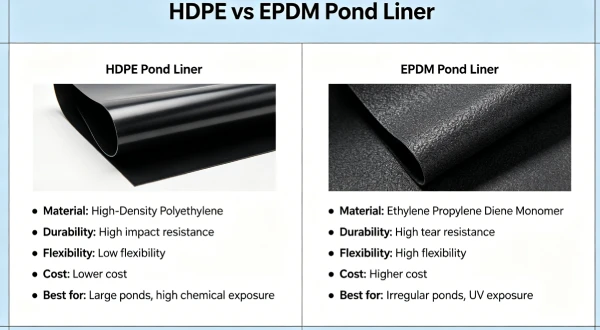
Manure lagoon resin specification requires values above standard GRI-GM13 minimums.
Stress Crack Resistance (NCTL per ASTM D5397):
| Application | NCTL Requirement | Rationale |
|---|---|---|
| GRI-GM13 minimum | ≥ 500 hours | General containment |
| Manure lagoon (standard) | ≥ 1000 hours | Organic acid + surfactant exposure |
| Manure lagoon (aggressive) | ≥ 1500 hours | High organic acids (> 3,000 mg/L) + warm climate |
Table scrolls horizontally on mobile
Oxidative Induction Time (HP-OIT per ASTM D5885):
| Application | HP-OIT Requirement | Rationale |
|---|---|---|
| GRI-GM13 minimum | ≥ 400 minutes | General containment |
| Manure lagoon (standard) | ≥ 500 minutes | 30–45°C temperatures |
| Manure lagoon (aggressive) | ≥ 550 minutes | 40–45°C + long design life |
Table scrolls horizontally on mobile
Carbon Black Content (ASTM D4218):
| Parameter | Requirement |
|---|---|
| Carbon black content | 2.0–3.0% |
| Dispersion rating (ASTM D5596) | ≥ 1 |
| Purpose | UV protection during installation |
Resin Specification Summary for Manure Lagoons:
text
Manure Lagoon HDPE Resin Specification

Base resin: HDPE (PE100 or equivalent)
Density: 0.940–0.948 g/cm³
Melt Index: ≤ 1.0 g/10min
NCTL (ASTM D5397): ≥ 1000 hours
HP-OIT (ASTM D5885): ≥ 500 minutes
OIT (ASTM D3895): ≥ 150 minutes
Carbon black (ASTM D4218): 2.0–3.0%
Carbon black dispersion (ASTM D5596): Rating ≥ 1
Tensile strength (ASTM D638): ≥ 20 MPa
Elongation at break (ASTM D638): ≥ 400%
Puncture resistance (ASTM D4833): ≥ 300 N
4️⃣ Why Standard GRI-GM13 is Inadequate for Manure Lagoons
GRI-GM13 was developed for general landfill and containment applications. Manure lagoon chemistry demands higher specifications.
Comparison of Requirements:
| Parameter | GRI-GM13 Minimum | Manure Lagoon Requirement | Factor |
|---|---|---|---|
| NCTL | ≥ 500 hours | ≥ 1000 hours | 2.0x |
| HP-OIT | ≥ 400 minutes | ≥ 500 minutes | 1.25x |
| Carbon black | 2.0–3.0% | 2.0–3.0% | Same |
| Density | 0.940–0.948 g/cm³ | 0.940–0.948 g/cm³ | Same |
| Melt Index | ≤ 1.0 g/10min | ≤ 1.0 g/10min | Same |
Table scrolls horizontally on mobile
Why the Factor Increases:
| Factor | Impact | Consequence |
|---|---|---|
| Organic acids (1,000–5,000 mg/L) | Accelerates ESC | NCTL ≥ 1000 hours required |
| Surfactants | Reduces surface energy | Promotes crack growth at lower stress |
| Temperature (30–45°C) | Doubles oxidation rate per 10°C | HP-OIT ≥ 500 minutes required |
| Ammonia (1,000–3,000 mg/L) | Minor impact below 50°C | No specification change |
| Solids loading | Creates puncture risk | Geotextile ≥ 400 gsm |
Published Aging Study Reference:
Koerner, R.M., Hsuan, Y.G., and Koerner, G.R. (2017). “Lifetime prediction of HDPE geomembranes in landfill applications using Arrhenius modelling.” Geotextiles and Geomembranes, 45(5), 425–435. DOI: 10.1016/j.geotexmem.2017.05.001.
This study established activation energy for antioxidant depletion at 80–90 kJ/mol. The Arrhenius relationship demonstrates that at 35°C, HP-OIT depletion is approximately 2x faster than at 25°C.
5️⃣ Welding Parameters and Installation Requirements
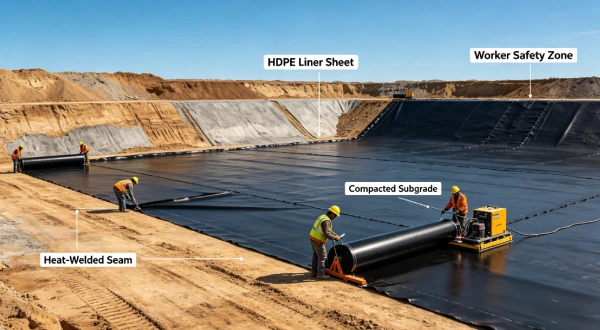
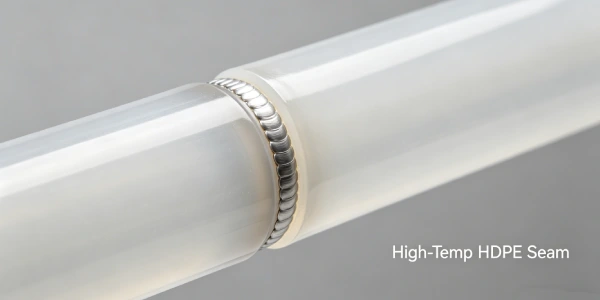
Welding parameters for manure lagoon liners follow standard HDPE practice. The specification difference is in resin properties and CQA rigor, not welding technique.
Hot Wedge Welding Parameters by Thickness:
| Thickness | Temperature (°C) | Wedge Speed (m/min) | Pressure (kPa) | Peel Strength (N/25mm) |
|---|---|---|---|---|
| 1.0mm | 400–430 | 2.5–3.5 | 200–250 | ≥ 100 |
| 1.5mm | 420–450 | 2.0–3.0 | 200–250 | ≥ 150 |
| 2.0mm | 440–470 | 1.5–2.5 | 250–300 | ≥ 200 |
Table scrolls horizontally on mobile
Climate and Installation Risks:
- Cold weather (< 5°C): Sheet stiffness, thermal contraction, welding parameter adjustment
- Hot weather (> 35°C): Wrinkling, slack management, seam stress
- Wind (> 20 km/h): Heat loss from weld zone, parameter adjustment or protection
- Night installation: Visibility, moisture, temperature drop, operator fatigue
Common Seam Failures:
| Failure Type | Cause | Prevention |
|---|---|---|
| Cold weld | Insufficient temperature | Verify wedge temperature |
| Burn-through | Excessive temperature | Adjust speed and temperature |
| Contaminated seam | Dirt, moisture at interface | Clean weld zone |
| Stress concentration | Sharp corners, wrinkles | Radius ≥ 1m, thermal slack |
Table scrolls horizontally on mobile
⚠️ Critical Statement:
Improper installation causes more failures than under-specification. CQA must include 100% non-destructive testing and destructive testing every 150m. The best resin specification cannot compensate for poor installation quality.
6️⃣ CQA Program Requirements for Manure Lagoons
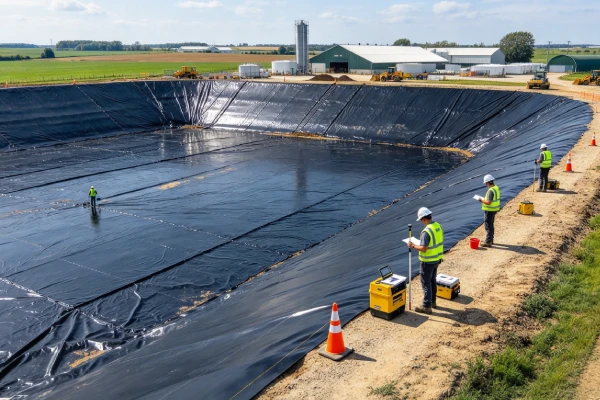
CQA program requirements for manure lagoons exceed standard landfill requirements due to aggressive chemistry and gas generation.
Material Certification Requirements:
- ✅ GRI-GM13 compliance certificate
- ✅ HP-OIT test results (≥ 500 minutes)
- ✅ NCTL test results (≥ 1000 hours)
- ✅ Carbon black content and dispersion test results
- ✅ Batch/lot traceability
Subgrade Verification Requirements:
- ✅ Compaction testing at 100m intervals (≥ 95% Standard Proctor)
- ✅ Particle size verification (≤ 6mm)
- ✅ Proof-rolling to identify soft spots
- ✅ Photographic documentation every 500m²
Seam Testing Requirements:
| Test Type | Frequency | Acceptance Criteria |
|---|---|---|
| Non-destructive | 100% of seams | No leaks |
| Destructive peel | Every 150m | ≥ 150 N/25mm |
| Destructive shear | Every 150m | ≥ 200 N/25mm |
| Visual inspection | Continuous | No defects |
Table scrolls horizontally on mobile
Leak Location Survey:
- ✅ 100% of liner area
- ✅ ASTM D7703 electrical leak location
- ✅ After all repairs complete
- ✅ Documentation of all identified leaks
Gas Management Verification:
- ✅ Subgrade venting system installation
- ✅ Pressure relief valve installation and testing
- ✅ Gas collection layer verification
- ✅ Monitoring point installation
Documentation Retention:
- ✅ Material certificates
- ✅ Subgrade inspection reports
- ✅ Welding parameter logs
- ✅ Seam test results
- ✅ Leak location survey results
- ✅ Final certification
- ✅ Retain for facility lifetime (minimum 10 years)
7️⃣ Failure Mechanisms Specific to Manure Lagoons
Four failure mechanisms dominate manure lagoon liner performance.
Mechanism 1: Environmental Stress Cracking (40–50%)
- Cause: Organic acids + surfactants + tensile stress at stress concentrators
- Location: Wrinkles, fishmouths, corners, seams
- Timeline: 2–5 years for NCTL 500–600 hours; 5–10 years for NCTL ≥ 1000 hours
- Specification response: NCTL ≥ 1000 hours, wrinkle elimination, stress management
Mechanism 2: Seam Failure (20–30%)
- Cause: Cold welds, contamination, insufficient fusion
- Location: T-junctions, weld terminations, contaminated zones
- Timeline: 0–3 years for defective welds
- Specification response: CQA rigor, destructive testing, 100% non-destructive testing
Mechanism 3: Puncture from Subgrade (15–20%)
- Cause: Angular particles, voids, soft spots
- Location: Subgrade irregularities, void bridging
- Timeline: 0–2 years for severe irregularities
- Specification response: Subgrade ≤ 6mm, geotextile ≥ 400 gsm, proof-rolling
Mechanism 4: Gas Pressure Uplift (10–15%)
- Cause: Methane and H₂S generation
- Location: Wide areas, seam intersections
- Timeline: 1–3 years for high-loading lagoons
- Specification response: Subgrade venting, pressure relief valves, gas collection
8️⃣ Real Engineering Failure Cases
Case 1: ESC from Insufficient NCTL — US Midwest Dairy Lagoon, 2017
Specification used: 1.0mm HDPE, NCTL = 600 hours, HP-OIT = 420 minutes. Lagoon temperature 38°C. Organic acids 3,500 mg/L.
Observed failure: ESC cracks at wrinkle apexes after 4 years. Cracks propagated through liner. Leakage detected in groundwater monitoring wells.
Timeline:
text
2017 (Year 0): 1.0mm HDPE installed, NCTL=600h, HP-OIT=420min
2017-2019 (Years 0-2): Antioxidant depletion phase, HP-OIT declining
2019-2021 (Years 2-4): Oxidation phase, surface embrittlement at wrinkle apexes
2021 (Year 4): ESC cracks propagate through liner, leakage detected
2021-2022: Liner replacement and groundwater remediation
Cost: $1.5M (liner replacement + groundwater remediation + monitoring)
Root cause: Insufficient NCTL (600 hours) and HP-OIT (420 minutes) for aggressive manure chemistry at 38°C. Organic acids accelerated ESC at stress concentrators.
Engineering lesson: Specify NCTL ≥ 1000 hours and HP-OIT ≥ 500 minutes for manure lagoons. The incremental material cost is 10–20%, but it prevents $1–2M in remediation costs.
Case 2: Gas Pressure Uplift — European Swine Lagoon, 2019
Specification used: 1.5mm HDPE, no subgrade venting. High organic loading. Methane generation.
Observed failure: Liner uplift after 2 years. Seam separation at multiple locations. Leakage through failed seams.
Timeline:
text
2019 (Year 0): 1.5mm HDPE installed, no subgrade venting
2019-2020 (Years 0-1): Manure loading, anaerobic decomposition begins
2020-2021 (Years 1-2): Methane generation, gas pressure builds beneath liner
2021 (Year 2): Liner uplift, seam separation at T-junctions
2021-2022: Subgrade venting installed, seam repairs completed
Cost: $1.2M (subgrade venting + seam repair + monitoring)
Root cause: Methane generation created gas pressure beneath the liner. No subgrade venting system was installed. Gas pressure exceeded overburden stress.
Engineering lesson: Subgrade venting is required for high-loading manure lagoons. Pressure relief valves and gas collection layers should be included regardless of liner thickness.
Case 3: Puncture from Subgrade — Southeast Asian Swine Lagoon, 2020
Specification used: 1.0mm HDPE, 200 gsm geotextile. Subgrade particles up to 30mm. Heavy solids loading.
Observed failure: Multiple punctures within 18 months. Leakage through puncture points.
Timeline:
text
2020 (Year 0): 1.0mm HDPE installed, 200gsm geotextile
2020-2021 (Months 0-18): Solids loading, subgrade particles create stress concentrations
2021 (Month 18): Multiple punctures detected, leakage
2021-2022: Liner replacement with 1.5mm + 600gsm geotextile
Cost: $0.9M (liner replacement + geotextile upgrade + remediation)
Root cause: Subgrade particles exceeded specification (30mm vs required ≤ 6mm). 200 gsm geotextile provided insufficient protection. Solids loading increased puncture risk.
Engineering lesson: Enforce subgrade particle size ≤ 6mm. Specify 400–600 gsm geotextile for manure lagoons. The incremental geotextile cost ($2–4/m²) prevents $0.5–1M in repairs.
Failure Case Cost Summary
| Case | Location | Failure Mode | Cost | Primary Lesson |
|---|---|---|---|---|
| Case 1 | US Midwest | ESC from organic acids | $1.5M | NCTL ≥ 1000h, HP-OIT ≥ 500min |
| Case 2 | Europe | Gas pressure uplift | $1.2M | Subgrade venting required |
| Case 3 | SE Asia | Puncture from subgrade | $0.9M | Subgrade ≤ 6mm, 400-600 gsm geotextile |
9️⃣ Comparison of Specification Standards
Material Specification Comparison:
| Parameter | GRI-GM13 Minimum | Manure Lagoon Requirement | Factor Increase |
|---|---|---|---|
| NCTL (ASTM D5397) | ≥ 500 hours | ≥ 1000 hours | 2.0x |
| HP-OIT (ASTM D5885) | ≥ 400 minutes | ≥ 500 minutes | 1.25x |
| Carbon black (ASTM D4218) | 2.0–3.0% | 2.0–3.0% | Same |
| Dispersion (ASTM D5596) | Rating ≥ 1 | Rating ≥ 1 | Same |
| Density (ASTM D1505) | 0.940–0.948 g/cm³ | 0.940–0.948 g/cm³ | Same |
| Melt Index (ASTM D1238) | ≤ 1.0 g/10min | ≤ 1.0 g/10min | Same |
Table scrolls horizontally on mobile
Alternative Liner Materials Comparison:
| Property | HDPE | LLDPE | fPP | PVC | GCL |
|---|---|---|---|---|---|
| NCTL capability | 500–2000+ hrs | 300–800 hrs | 500–1000 hrs | Poor | N/A |
| HP-OIT capability | 400–700 min | 300–500 min | 300–500 min | N/A | N/A |
| Chemical durability (manure) | Excellent | Good | Good | Poor | Good |
| Temperature tolerance | -40°C to 80°C | -40°C to 70°C | -40°C to 70°C | -20°C to 60°C | -40°C to 70°C |
| Field weldability | Excellent | Excellent | Fair | Good (solvent) | N/A |
| UV resistance | Excellent | Moderate | Good | Poor | N/A |
| Cost relative to HDPE | 1.0x | 1.0–1.1x | 1.5–2.0x | 1.2–1.5x | 0.6–0.8x |
Table scrolls horizontally on mobile
🔟 Subgrade and Geotextile Specification
Subgrade and geotextile specification are critical for preventing puncture damage.
Subgrade Specification:
| Parameter | Requirement | Purpose |
|---|---|---|
| Particle size | ≤ 6mm | Eliminate puncture points |
| Compaction | ≥ 95% Standard Proctor | Uniform support |
| Proof-rolling | Required | Identify soft spots |
| Void filling | All voids filled | Prevent bridging |
| Documentation | Photos every 500m² | Verification |
Table scrolls horizontally on mobile
Geotextile Specification:
| Parameter | Standard | High-Risk |
|---|---|---|
| Weight | 400 gsm | 600 gsm |
| Type | Nonwoven needle-punched | Nonwoven needle-punched |
| Puncture resistance (CBR) | ≥ 2,000 N | ≥ 3,000 N |
| Application | Uniform subgrade | Angular subgrade, high solids |
Table scrolls horizontally on mobile
Geotextile Selection Guidance:
- 400 gsm: Standard recommendation for manure lagoons with uniform subgrade
- 600 gsm: Required for angular subgrade, high solids loading, or subgrades with CBR < 3
- 200–300 gsm: Suitable only for uniform, well-compacted fine-grained subgrades
1️⃣1️⃣ Professional Engineering Recommendation
Specification Summary for Manure Lagoon Liners:
| Parameter | Standard Specification | Aggressive Specification |
|---|---|---|
| Thickness | 1.5mm | 2.0mm |
| NCTL | ≥ 1000 hours | ≥ 1500 hours |
| HP-OIT | ≥ 500 minutes | ≥ 550 minutes |
| Geotextile | 400 gsm | 600 gsm |
| Subgrade particles | ≤ 6mm | ≤ 6mm |
| Subgrade compaction | ≥ 95% Standard Proctor | ≥ 95% Standard Proctor |
| Gas venting | Recommended | Required |
Table scrolls horizontally on mobile
When Aggressive Specification is Required:
- Organic acids > 3,000 mg/L
- Lagoon temperature > 40°C
- Design life > 30 years
- Large lagoon (> 2 hectares)
- High solids loading
- Critical containment (drinking water protection)
CQA Requirements Summary:
- ✅ Third-party CQA: Independent engineer on-site during installation
- ✅ Subgrade verification: Photographic documentation every 500 m², compaction testing
- ✅ Material certification: GRI-GM13 compliance certificate, HP-OIT test results
- ✅ Seam testing: 100% non-destructive + destructive every 150m (GRI-GM19)
- ✅ Leak location survey: Electrical leak location (ASTM D7703) on 100% of liner
- ✅ Documentation retention: All records for lifetime of facility
Critical Statement: Quality assurance outweighs thickness alone. A 1.5mm liner with rigorous CQA will outperform a 2.0mm liner with substandard installation.
1️⃣2️⃣ FAQ Section
Q1: What NCTL value should be specified for manure lagoons?
NCTL ≥ 1000 hours is recommended for manure lagoons due to organic acids and surfactants. GRI-GM13 requires NCTL ≥ 500 hours, but manure chemistry demands higher resistance.
Q2: What HP-OIT should be specified for manure lagoons?
HP-OIT ≥ 500 minutes is recommended for manure lagoons where temperatures reach 30–45°C. GRI-GM13 requires HP-OIT ≥ 400 minutes, but higher values extend service life.
Q3: How does temperature affect manure lagoon liner service life?
Arrhenius kinetics dictate that oxidation rate doubles per 10°C increase. At 35°C (typical lagoon temperature), service life reduces by 40–50% compared to 25°C.
Q4: Why is standard GRI-GM13 inadequate for manure lagoons?
GRI-GM13 is designed for general landfill and containment applications. Manure lagoons have more aggressive organic acid exposure and higher temperatures, requiring NCTL ≥ 1000 hours and HP-OIT ≥ 500 minutes.
Q5: What welding parameters are required for manure lagoon liners?
Hot wedge welding: 420–470°C wedge temperature, 1.5–3.0 m/min speed, 200–300 kPa pressure (thickness-dependent). Manure lagoon liners require the same welding parameters as standard HDPE.
Q6: What CQA requirements apply to manure lagoon liners?
CQA requirements include: 100% non-destructive seam testing, destructive testing every 150m, 100% leak location survey, subgrade verification every 500m², and material certification review including HP-OIT test results.
Q7: What are the four primary failure mechanisms?
Primary failure mechanisms include: ESC from organic acids and surfactants (40–50%), seam failure (20–30%), puncture from subgrade particles (15–20%), and gas pressure uplift (10–15%).
Q8: How should antioxidant depletion be monitored?
HP-OIT testing (ASTM D5885) on samples taken from the liner. Compare to original material certification. HP-OIT below 100 minutes indicates significant depletion.
Q9: What geotextile weight should be specified?
400–600 gsm nonwoven geotextile is recommended for manure lagoons. 600 gsm is required for angular subgrade, high solids loading, or soft subgrades with CBR < 3.
Q10: What is the incremental cost of enhanced specification?
The incremental cost of NCTL ≥ 1000 hours, HP-OIT ≥ 500 minutes, and 600 gsm geotextile is typically 10–20% of material cost. This investment extends service life by 50–100% and reduces failure risk by 70–80%.
1️⃣3️⃣ Technical Conclusion
Manure lagoon liner specification requires a comprehensive approach that addresses resin properties, welding parameters, CQA programs, and gas management. The combination of organic acids, surfactants, and ammonia creates a challenging environment for HDPE geomembranes, with ESC and oxidation being the dominant failure mechanisms.
Specification quality outweighs thickness alone. NCTL ≥ 1000 hours and HP-OIT ≥ 500 minutes are essential for long-term performance in manure lagoons. These values are 2.0x and 1.25x the GRI-GM13 minimums, reflecting the more aggressive chemistry and elevated temperatures of manure lagoons. A 1.5mm liner with these specifications will outperform a 2.0mm liner with standard specifications.
CQA rigor — not thickness — determines whether the liner achieves its design life. 100% non-destructive seam testing, destructive testing every 150m, and 100% leak location survey are minimum requirements. The incremental cost of CQA is 3–7% of installation cost, but it reduces failure risk by 70–90%.
Gas management is a unique requirement for manure lagoons. Methane and hydrogen sulfide generation create pressure beneath the liner, requiring subgrade venting systems and pressure relief valves. Without gas management, uplift and seam failure can occur within 2–5 years.
Lifecycle cost analysis demonstrates that enhanced specifications are cost-effective. The incremental cost of NCTL ≥ 1000 hours, HP-OIT ≥ 500 minutes, and 600 gsm geotextile is typically 10–20% of material cost. This investment extends service life by 50–100% and reduces failure risk by 70–80%.
📚 Related Technical Guides
Manure Lagoon Liner Thickness: HDPE Selection & Specification Guide— for thickness selection decisions (1.0mm vs 1.5mm vs 2.0mm)Manure Storage Pond HDPE Liner Guide: NRCS Standards & Pad Type SelectionLivestock Wastewater Lagoon HDPE Liner Guide: CAFO Compliance & Ammonia ResistanceEnvironmental Stress Cracking in Manure Lagoon Liners: Organic Acid Mechanisms and NCTL SpecificationGas Pressure Uplift in Agricultural Lagoons: Methane and H₂S Management