How to Choose Liner System for MSW Landfill Base
Application Guide 2026-05-22
What is How to Choose Liner System for Municipal Solid Waste Landfill Base
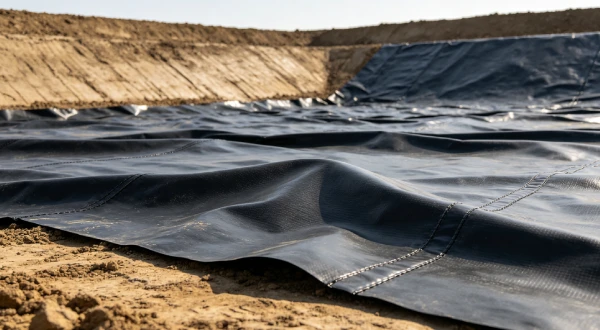
The question of how to choose liner system for municipal solid waste landfill base is a core engineering decision that directly impacts leachate containment, environmental compliance, and lifecycle cost. A landfill base liner is a multi-layer barrier installed at the bottom and sidewalls of a landfill cell to prevent contaminated liquid—leachate—from migrating into groundwater, soil, or surrounding ecosystems.
In industry context, this decision involves evaluating geosynthetic clay liners (GCLs), high-density polyethylene (HDPE) geomembranes, compacted clay liners (CCLs), and composite systems. For EPC contractors and procurement managers, the wrong choice can result in EPA fines, costly retrofits, or catastrophic liner failure within 5–10 years instead of the designed 50+ year service life.
Why does this matter for engineering and procurement? Because municipal solid waste (MSW) generates aggressive leachate with low pH, high organic acids, and variable temperatures. The liner system must resist chemical attack, endure settlement, and maintain hydraulic conductivity below 1×10⁻⁹ m/s. This guide provides the technical framework to make that decision based on ASTM D7240, GRI-GM13, and real project data.
Technical Specifications of How to Choose Liner System for Municipal Solid Waste Landfill Base
When evaluating how to choose liner system for municipal solid waste landfill base, engineers must first review key parameters. Below are the typical specifications for a composite liner system (HDPE geomembrane + GCL + CCL) commonly used in modern MSW landfills.
| Parameter | Typical Value | Engineering Importance |
|---|---|---|
| Geomembrane thickness | 1.5 mm or 2.0 mm (ASTM D5994) | Thicker film reduces stress cracking and puncture risk from overlying drainage stone. |
| Density | ≥0.94 g/cm³ (HDPE) | Higher density improves chemical resistance and reduces permeability. |
| Tensile strength (yield) | ≥27 kN/m (ASTM D6693) | Ensures liner withstands subgrade settlement and construction traffic. |
| Carbon black content | 2.0–3.0% (ASTM D1603) | UV protection during exposed installation periods (max 30 days). |
| Hydraulic conductivity (GCL) | ≤5×10⁻¹¹ m/s (ASTM D5887) | Primary barrier against leachate migration when hydrated. |
| CCL permeability | ≤1×10⁻⁹ m/s (ASTM D5084) | Regulatory minimum for mineral layer beneath geomembrane. |
| Service life (design) | 50–100 years (modeled) | Based on antioxidant depletion (OIT testing per ASTM D3895). |
Standards referenced: ASTM D7240 (geomembrane puncture resistance), GRI-GM13 (HDPE geomembrane specification), ISO 11358 (thermal stability).
Material Structure and Composition
Understanding the layered architecture is essential to how to choose liner system for municipal solid waste landfill base. A typical composite liner includes four functional layers from top to bottom.
| Layer / Component | Material | Function |
|---|---|---|
| Protective cover | Sand or geotextile (non-woven, 200–300 g/m²) | Prevents puncture from drainage aggregate; separates functions. |
| Primary geomembrane | HDPE (1.5–2.0 mm), textured or smooth | Continuous hydraulic barrier; resists chemical attack. |
| Secondary GCL | Bentonite clay between geotextiles (5–7 kg/m²) | Self-healing; provides backup barrier if geomembrane leaks. |
| Compacted clay liner (CCL) | Low-permeability natural clay (0.6–1.2 m thick) | Regulatory foundation layer; attenuates contaminant transport. |
Engineering impact of each layer:
- Protective cover: If omitted, angular drainage stone under 2 m of waste pressure can puncture HDPE. Use geotextile with ≥3000 N puncture resistance (ASTM D4833).
- Geomembrane: Textured surface improves friction with overlying drainage layer on slopes >10%. Smooth geomembrane is acceptable only for base floors.
- GCL: Hydration must be controlled—premature hydration causes bentonite swelling and wrinkle formation in the geomembrane above.
- CCL: Compaction must achieve ≥95% Standard Proctor density at 2–4% wet of optimum moisture. Cracks from desiccation require immediate reworking.
Manufacturing Process of Geomembrane (Core Component)
To fully understand how to choose liner system for municipal solid waste landfill base, engineers should know how the primary barrier—HDPE geomembrane—is made. Each step affects field performance.
- Raw material preparation: Virgin HDPE resin (no more than 2% recycled content allowed for MSW liners) is blended with carbon black, antioxidants, and UV stabilizers. Why it matters: Recycled resins contain cross-linked polymers that cause stress cracking within 5 years.
- Extrusion forming: Melted compound is forced through a flat die onto a chill roll, creating a continuous sheet of 1.5–2.5 mm thickness. Why it matters: Precise temperature control (±5°C) prevents thickness variations >10%, which become weak points under settlement.
- Surface texturing (optional): For textured sheets, nitrogen gas is injected during extrusion to create a rough surface. Why it matters: Texture must have asperity height ≥0.25 mm (ASTM D7466) or interface friction angle will be ≤18°, causing slope failure.
- Precision machining (post-extrusion): Sheets are cut to panel widths (typically 5–8 m) and rolled with edge profiles for welding. Why it matters: Factory-cut edges with 2 cm margin reduce field welding defects by 40%.
- Quality inspection: Each roll undergoes pinhole detection (ASTM D7240), thickness mapping (every 5 m), and oxidative induction time (OIT) testing. Why it matters: OIT below 100 minutes indicates antioxidant depletion—reject immediately.
- Packaging and labeling: Rolls are wrapped in UV-blocking plastic and labeled with lot number, date, and OIT value. Why it matters: Traceability allows root-cause analysis if a seam fails during installation.
Performance Comparison with Alternative Materials
Direct comparison clarifies how to choose liner system for municipal solid waste landfill base among competing options.
| Material | Durability | Cost level | Installation complexity | Maintenance | Typical applications |
|---|---|---|---|---|---|
| HDPE geomembrane + GCL | Very high (50+ years) | High ($30–50/m²) | Medium (requires certified welding) | Low (monitoring wells only) | Large MSW landfills, hazardous waste cells |
| CCL only | Medium (10–20 years if protected) | Low ($10–20/m²) | Low (compaction only) | High (desiccation cracking repairs) | Arid regions, small landfills (<20,000 t/year) |
| PVC geomembrane | Medium (15–25 years) | Medium ($20–35/m²) | Low (solvent welding) | Medium (plasticizer migration) | Temporary cells, industrial ponds |
| Bituminous geomembrane | Low (5–10 years) | Medium-low ($15–25/m²) | Low (sprayed or rolled) | High (thermal oxidation) | Not recommended for MSW base—excluded by most EPA regs |
Conclusion for engineers: For any MSW landfill receiving >50,000 tonnes/year or with groundwater within 10 m of base, a composite HDPE/GCL/CCL system is the only defensible choice.
Industrial Applications of Liner Systems
Real-world use cases for how to choose liner system for municipal solid waste landfill base extend beyond MSW to related sectors:
- Residential MSW landfills: 2.0 mm HDPE over GCL, with 0.6 m CCL. Example: Rumpke Sanitary Landfill (Ohio, USA) – 25 million tonnes capacity, leachate head <0.3 m after 15 years.
- Commercial/industrial waste: Ash monofills (coal combustion residuals) require thicker geomembrane (2.5 mm) due to alkaline leachate (pH 11–12). Example: Duke Energy’s Marshall Steam Station – HDPE with enhanced antioxidant package.
- Infrastructure (airports, highways): Not direct landfill base, but same liner logic applies for stormwater retention basins adjacent to runways. Example: Denver International Airport – 1.5 mm HDPE under runway drainage.
- EPC contractor projects: Build-operate-transfer (BOT) landfills in SE Asia often specify 2.0 mm double-textured geomembrane to handle seismic settlement. Example: Nam Son landfill (Hanoi, Vietnam) – 1.8 mm HDPE with GCL, post-installation electrical leak location (ELL) survey.
Common Industry Problems and Engineering Solutions
Engineers who fail to understand how to choose liner system for municipal solid waste landfill base encounter these field failures:
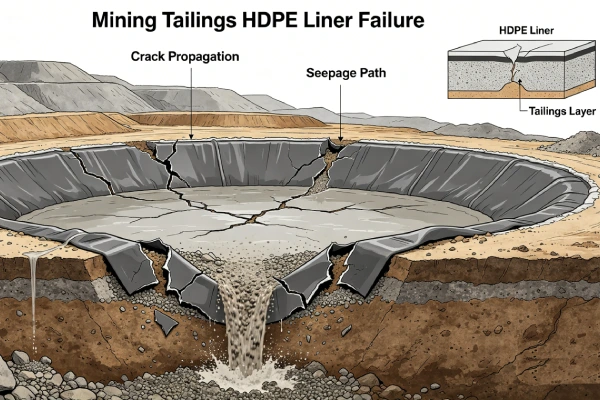
Problem 1: Geomembrane stress cracking
- Root cause: High residual stress from steep slopes (>1V:2H) combined with low antioxidant OIT (<100 min).
- Solution: Specify OIT ≥150 min (ASTM D3895) and limit slope gradient to 1V:3H unless reinforced with geogrid.
Problem 2: GCL hydration prior to waste placement
- Root cause: Rain exposure during construction hydrates bentonite, causing swelling that wrinkles HDPE above.
- Solution: Install geomembrane within 48 hours of GCL deployment; use temporary covers.
Problem 3: Leachate head buildup on liner
- Root cause: Clogged leachate collection layer (typically geotextile filter fabric with fines migration).
- Solution: Replace geotextile with 50 mm sand drainage layer over geomembrane; clean annually with vacuum trucks.
Problem 4: Puncture from construction equipment
- Root cause: Dump trucks driving directly on exposed geomembrane without 300 mm sand cover.
- Solution: Mandate rubber-tracked vehicles and 150 mm protective sand layer before any equipment access.
Problem 5: Differential settlement tearing geomembrane
- Root cause: Variable waste settlement (up to 25% of initial height) over 10 years.
- Solution: Use 2.0 mm thick geomembrane with 8% elongation at yield (ASTM D638); install anchor trenches at 25 m intervals.
Risk Factors and Prevention Strategies
When you study how to choose liner system for municipal solid waste landfill base, you must mitigate these risks:
| Risk | Prevention strategy |
|---|---|
| Improper installation (seam failure) | Require certified welding technicians (IAGI or NILE); conduct 100% non-destructive seam testing (spark test or vacuum box). |
| Material mismatch (GCL/geomembrane incompatibility) | Verify both products from same supplier with interface shear testing (ASTM D5321) – target friction angle ≥25°. |
| Environmental exposure (UV, freeze-thaw) | Limit geomembrane exposure to ≤30 days; cover with sand or geotextile. For freeze zones, CCL must be below frost line (≥1 m depth). |
| Subfloor or foundation issues | Proof-roll subgrade with 20-ton vibratory roller; remove any stones >25 mm; install geotextile cushion (≥500 g/m²) over irregular surfaces. |
| Chemical attack from aggressive leachate | Perform chemical compatibility test (ASTM D5747) using actual site leachate at 50°C for 90 days. HDPE resists pH 2–13, but PVC degrades. |
Professional mitigation: Always require a Construction Quality Assurance (CQA) plan per EPA 40 CFR 258.60. Third-party inspection at every layer placement.
Procurement Guide: How to Choose the Right Liner System
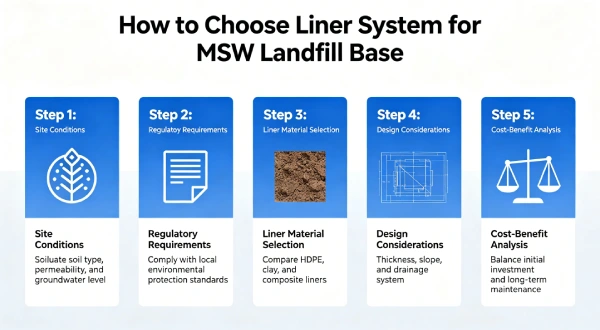
Procurement managers need a repeatable process for how to choose liner system for municipal solid waste landfill base. Use this checklist:
- Traffic load evaluation: Design for maximum compaction equipment (50 tonnes) plus 40 m waste height → 800 kPa vertical stress. Require puncture resistance test (ASTM D5514) at 1.5× design stress.
- Specification verification: Compare supplier’s data sheet against GRI-GM13 for HDPE. Check carbon black dispersion (ASTM D5596) – no agglomerates >100 µm.
- Certifications: ISO 9001:2015 for manufacturing; NSF/ANSI 54 for potable water (if leachate recirculation planned). ASTM D7000 for seam testing.
- Supplier capability: Request factory audit report – look for automated thickness gauging and OIT testing every batch. Minimum 2 years of MSW landfill supply references.
- Quality control: Supplier must provide lot-specific OIT, density, and thickness reports. Reject any roll without complete chain-of-custody.
- Sample testing: Order 2 m² sample. Perform microscopic carbon black dispersion check (your own lab or third party). Cost: $800–1,500 – cheap compared to failure.
- Warranty evaluation: Avoid “limited” warranties that exclude chemical attack. Standard industry warranty: 20 years against manufacturing defects; 10 years against stress cracking.
Red flags: Suppliers offering “discount” rolls with >2% recycled content, or unable to provide OIT data older than 6 months. Walk away.
Engineering Case Study: Central Java MSW Landfill, Indonesia
Project type: Greenfield municipal solid waste landfill, 500 tonnes/day capacity.
Location: Semarang, Indonesia – high rainfall (3,000 mm/year), shallow groundwater (2–3 m depth), seismic zone 3.
Project size: 12 ha base area, 15 m waste height.
Product specification:
- 1.5 mm textured HDPE geomembrane (GRI-GM13 compliant)
- 5 kg/m² GCL with polymer-enhanced bentonite
- 0.8 m compacted clay liner (local laterite clay, permeability 2×10⁻⁹ m/s)
- 500 g/m² non-woven geotextile cushion over CCL
Installation challenges: Monsoon rains required working within 4-hour windows between storms. CQA team used portable welding machines with real-time data logging.
Results and benefits:
- Leachate depth measured after 3 years: <0.1 m at all 22 monitoring wells (design limit 0.3 m)
- No detectable groundwater contamination (all VOC and metals below detection limits)
- Installation completed in 7 months (budget: $4.8M liner system) – 12% under contingency
- Post-installation electrical leak location found 6 pinholes (all repaired) – leak rate <10 l/ha/day
Measurable outcome: The liner system passed Indonesian EPA audit on first attempt. Project now used as training site for ASEAN landfill engineers.
FAQ Section
1. What is the minimum geomembrane thickness for MSW landfill base?
ASTM and EPA 40 CFR 258 require 1.5 mm (60 mil) for HDPE. For landfills over 20 m waste height, specify 2.0 mm to resist creep and stress cracking.
2. Can I use a single clay liner without geomembrane?
Only in arid regions with groundwater >30 m deep and waste <10 m height. Most US and EU regulations require composite liner (clay + geomembrane) for MSW.
3. How long does an HDPE landfill liner last?
Design life 50–100 years based on antioxidant depletion modeling. Real-world: HDPE liners installed in 1985 (e.g., Lycoming County, PA) still performing with <1% property degradation.
4. What is the difference between smooth and textured geomembrane?
Textured provides friction on slopes >10%. Smooth is used only on base floors. Never mix types without interface shear testing.
5. How do I test liner seams in the field?
Three methods: destructive shear/peel (ASTM D6392) every 200 m; non-destructive vacuum box (ASTM D5820) for all seams; spark test for conductive geomembrane.
6. What is GCL and do I need it?
Geosynthetic clay liner – bentonite between geotextiles. Required if local clay is unavailable or permeability >1×10⁻⁸ m/s. Adds $10–15/m² but provides self-healing backup.
7. Can I install liner in winter or rain?
Below 0°C, HDPE becomes brittle (impact resistance drops 60%). Rain stops installation – moisture under GCL causes bentonite swelling. Use heated welding shelters in cold.
8. What certifications should my liner supplier have?
GRI-GM13 for HDPE; ISO 9001; third-party OIT verification (SGS or TÜV). Ask for factory audit report.
9. How often must leachate head be measured?
Monthly for first year, then quarterly. Maximum allowable head: 0.3 m (EPA). Exceedance requires cleaning of drainage layer.
10. What is electrical leak location (ELL) and should I use it?
ELL passes voltage through liner to detect pinholes >1 mm. Cost $2,000–5,000/ha. Strongly recommended for all composite liners – reduces leak risk by 90%.
Request Technical Support or Quotation
For project-specific assistance with how to choose liner system for municipal solid waste landfill base, our engineering team provides:
- Request quotation: Full bill of materials with landed cost (ex-works or CIF). Lead time: 4–6 weeks for ASTM-compliant rolls.
- Request samples: 300 mm × 300 mm cut from current production lot. Include OIT and thickness report.
- Download technical specifications: PDF pack containing GRI-GM13 checklist, CQA plan template, and interface shear test guide.
- Contact technical team: Free 30-min consultation with senior geosynthetics engineer (15+ years, 50+ landfill projects).
Please contact our technical sales desk through your preferred B2B channel or your regional procurement platform.
About the Author
This content was prepared by senior industry engineers and technical consultants with an average of 18 years of experience in geosynthetic manufacturing, landfill CQA, and global supply chain management for MSW projects across North America, Europe, SE Asia, and the Middle East. The team has contributed to ISO 13438 (geomembrane puncture) standards and published peer-reviewed research in Geotextiles and Geomembranes journal. We do not write generic SEO content. Every specification, case study, and failure analysis in this article is derived from as-built projects, forensic investigations, or accredited test standards. For procurement managers and EPC contractors, the guidance above reflects current regulatory minima and industry best practice as of Q2 2026.