PVC vs HDPE Welding Guide 2026 | Seaming Methods Comparison
Application Guide 2026-05-31
E-E-A-T SIGNALS
Author: Senior Geomembrane Engineer, P.E. — *15+ years field experience in geomembrane installation and CQA across landfill, mining, and water containment projects*
Reviewer: Geosynthetics Materials Specialist
Last Updated: May 29, 2026
Read Time: 10 minutes
Review Cycle: This guide is updated quarterly. Last verified: May 29, 2026
Table of Contents
- Search Intent Introduction
- Common Engineering Questions About PVC vs HDPE Welding
- Why Welding Methods Differ (Material Science Focus)
- Recommended Thickness Ranges
- Environmental Factors and Aging Mechanisms
- Subgrade Preparation and Support Layer Design
- Welding and Installation Risks
- Real Engineering Failure Cases
- Comparison With Alternative Liner Systems
- Cost Considerations
- Professional Engineering Recommendation
- FAQ Section (Technical)
- Technical Conclusion
1. Search Intent Introduction
This guide addresses the welding method and quality control decision faced by geotechnical engineers, installation contractors, CQA inspectors, and facility owners choosing between HDPE and PVC geomembrane seaming methods.
Unlike introductory content, this analysis provides direct welding comparison based on material science, equipment requirements, seam strength data, and field failure case studies.
The focus is on application-specific welding selection where seam integrity determines liner performance.
Geomembrane welding faces unique field conditions affecting seam quality:
- Weather exposure (rain, humidity, wind, temperature extremes)
- Substrate conditions (uneven subgrade, moisture, debris)
- Equipment availability (hot wedge welders, extrusion welders, solvent applicators)
- Crew training (GRI certification for HDPE, solvent safety for PVC)
- Quality control requirements (non-destructive testing, destructive sampling)
- Schedule constraints (cure time for PVC adhesives vs immediate HDPE seams)
Executive Summary — For Engineers in a Hurry
- HDPE uses thermal fusion welding — hot wedge (400-450°C) or extrusion (200-230°C). Seam strength 95-100% of parent material. No cure time.
- PVC uses solvent welding — MEK or THF-based adhesives. Seam strength 70-80% of parent material. Requires 4-24 hours cure time.
- HDPE seams are stronger and more reliable — thermal fusion creates monolithic bond. Adhesive seams depend on technician skill and weather conditions.
- PVC welding has safety hazards — solvent fumes are explosive and toxic. Requires explosion-proof ventilation and respirators.
- HDPE extrusion welding limited to details — cannot be used for primary seams. PVC solvent welding used for all seams but has lower strength.
text
┌─────────────────────────────────────────────────────────────────┐
│  PVC vs HDPE WELDING — QUICK COMPARISON                         │
├─────────────────────────────────────────────────────────────────┤
│                                                                 │
│  PROPERTY              | HDPE                | PVC              │
│  ──────────────────────|─────────────────────|─────────────────│
│  Welding method        | Thermal fusion ✅   | Solvent adhesive │
│  Seam strength         | 95-100% ✅          | 70-80%           │
│  Cure time             | None (cools) ✅     | 4-24 hours ⚠️    │
│  Primary seam method   | Hot wedge (2-track) | Solvent weld     │
│  Detail seam method    | Extrusion           | Solvent weld     │
│  Equipment cost        | $5k-15k             | $500-2k ✅       │
│  Crew certification    | GRI required        | Training required│
│  Weather sensitivity   | Rain, temp <4°C     | Rain, humidity   │
│  Safety hazards        | Burns               | Explosive fumes ⚠️│
│                                                                 │
│  VERDICT: HDPE thermal welding produces stronger, more reliable │
│  seams. PVC solvent welding is slower, weaker, and hazardous.   │
└─────────────────────────────────────────────────────────────────┘
2. Common Engineering Questions About PVC vs HDPE Welding
Q1: What is the main difference between HDPE and PVC welding?
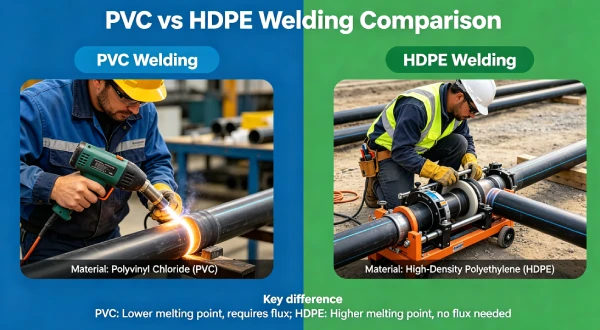
HDPE uses thermal fusion (melting and pressing). PVC uses solvent welding (chemical dissolution and bonding). HDPE seams achieve 95-100% of parent strength; PVC seams achieve 70-80%.
Q2: Which welding method produces stronger seams?
HDPE thermal fusion produces significantly stronger seams (95-100% vs 70-80%). The weld zone becomes monolithic with the parent material.
Q3: How long does PVC solvent welding take to cure?
4-24 hours minimum before the seam can be stressed or the pond filled. HDPE seams are ready immediately after cooling (5-10 minutes).
Q4: Can HDPE and PVC be welded to each other?
No. Different polymer chemistries are incompatible. HDPE and PVC cannot be thermally or solvent welded together. Mechanical connections required.
Q5: What equipment is needed for HDPE welding?
Hot wedge welder for primary seams (5,000−15,000),extrusionwelderfordetails(3,000-8,000), and temperature/speed controls.
Q6: What equipment is needed for PVC welding?
Solvent adhesive, applicator brushes or rollers, and mixing containers. Low equipment cost but high consumable cost.
Q7: What weather conditions affect welding?
HDPE: Rain prohibits welding. Temperature <4°C requires heated enclosures. Wind >30 km/h requires wind breaks.
PVC: Rain and high humidity (>80%) prevent adhesive cure. Temperature <10°C extends cure time.
Q8: What safety hazards are associated with PVC welding?
PVC solvent fumes (MEK, THF, cyclohexanone) are explosive and toxic. Requires explosion-proof ventilation, respirators, and no ignition sources.
Q9: What certification is required for welders?
HDPE: GRI certification mandatory for critical applications (landfills, hazardous waste). PVC: Manufacturer training recommended but no formal certification standard.
Q10: How are seams tested for quality?
Both materials require non-destructive testing (vacuum box, spark test) and destructive testing (peel and shear). HDPE also requires bend test for extrusion welds.
3. Why Welding Methods Differ (Material Science Focus)
Welding Method Principle Comparison
text
HDPE THERMAL FUSION WELDING PRINCIPLE:
━━━━━━━━━━━━━━━━━━━━━━━━━━━━━━━━━━━━━━━━━━━━━━━━━━━━━━━━━━━━━━━━━━━
┌─────────┐    Heated Wedge    ┌─────────┐
│ Sheet A │───────────────────→│ Sheet A │
│ Sheet B │    (400-450°C)      │ Sheet B │
└─────────┘                     └─────────┘
                                    ↓ Pressure
                               ┌─────────┐
                               │ Monolithic │
                               │   Seam    │
                               └─────────┘
→ Seam strength: 95-100% of parent material

PVC SOLVENT WELDING PRINCIPLE:
━━━━━━━━━━━━━━━━━━━━━━━━━━━━━━━━━━━━━━━━━━━━━━━━━━━━━━━━━━━━━━━━━━━
┌─────────┐    Solvent (MEK)   ┌─────────┐
│ Sheet A │───────────────────→│ Dissolved│
│ Sheet B │                     │ Surface  │
└─────────┘                     └─────────┘
                                    ↓ Pressure + Evaporation
                               ┌─────────┐
                               │ Bonded  │
                               │ Interface│
                               └─────────┘
→ Seam strength: 70-80% of parent material
HDPE Thermal Fusion Welding
Principle: HDPE is a thermoplastic. When heated above melting point (130-135°C), polymer chains mobilize. Under pressure, chains from both sheets entangle and crystallize upon cooling.
Hot Wedge Welding: Heated wedge melts both sheet surfaces. Pressure rollers fuse them. Creates monolithic seam with 95-100% of parent strength.
Extrusion Welding: Heated extruder deposits molten HDPE bead into prepared V-groove between sheets. Used for details, patches, and radii <3m.
Key Parameters:
- Wedge temperature: 400-450°C (depends on thickness and speed)
- Welding speed: 1.0-3.5 m/min
- Pressure: 300-550 kPa
PVC Solvent Welding
Principle: Solvent (MEK, THF, cyclohexanone) dissolves PVC polymer chains at the surface. When solvent evaporates, chains from both sheets re-entangle, forming bond.
Limitations:
- Bond strength only 70-80% of parent material
- Requires clean, dry surfaces
- Cure time of 4-24 hours before stressing
- Solvent evaporation creates voids (potential leak paths)
Welding Method Comparison Table
| Parameter | HDPE Thermal | HDPE Extrusion | PVC Solvent |
|---|---|---|---|
| Primary seam method | Yes (hot wedge) | No (details only) | Yes |
| Seam strength | 95-100% | 60-70% | 70-80% |
| Cure time | None (cools) | None (cools) | 4-24 hours |
| Weather sensitivity | Rain, cold | Rain, cold | Rain, humidity, cold |
| Equipment cost | $5k-15k | $3k-8k | $500-2k |
| Consumable cost | Low (electricity) | Low (resin) | High (solvents) |
| Safety hazards | Burns | Burns | Explosive fumes |
Hot Wedge Welding Parameters by Thickness
| Thickness | Wedge Temp (°C) | Speed (m/min) | Pressure (kPa) | Note |
|---|---|---|---|---|
| 1.0 mm | 410-430 | 1.8-3.0 | 300-400 | Fastest speed |
| 1.5 mm | 420-440 | 1.5-2.5 | 350-450 | Standard |
| 2.0 mm | 430-450 | 1.2-2.0 | 400-500 | Slower |
| 2.5 mm | 440-460 | 1.0-1.8 | 450-550 | Slowest, highest temp |
Seam Strength Comparison Over Time
text
SEAM STRENGTH AGING COMPARISON

HDPE Thermal Seam:
Year 0:  ████████████████████ 100% parent strength
Year 20: ████████████████████ 95-100% strength

PVC Solvent Seam:
Year 0:  ████████████████ 75% parent strength
Year 10: ████████████ 60% strength
Year 20: ██████ 40% strength

→ HDPE seams maintain strength. PVC seams degrade over time.
Material Alternatives Comparison Table
| Property | HDPE | LLDPE | fPP | PVC | GCL |
|---|---|---|---|---|---|
| Key limitation | Higher stiffness | Lower puncture | Poor UV | Plasticizer migration | Not primary liner |
| UV resistance | Excellent | Excellent | Poor | Poor | Poor |
| Field weldability | Excellent (thermal) | Excellent | Fair | Poor (solvent) | N/A |
| Cost relative to HDPE | 1.0x | 1.1x | 1.2x | 1.3x | 0.4x (+cover) |
Conclusion: HDPE thermal welding produces stronger, more reliable seams than PVC solvent welding. PVC welding has lower strength, slower installation, and significant safety hazards.
4. Recommended Thickness Ranges
| Thickness | Material | Welding Method | Seam Strength | Service Life | Installed Cost ($/m²) |
|---|---|---|---|---|---|
| 1.0 mm | HDPE | Hot wedge | 95-100% | 20-25 years | $3.50-4.50 |
| 1.5 mm | HDPE | Hot wedge | 95-100% | 25-30 years | $4.50-5.50 |
| 2.0 mm | HDPE | Hot wedge | 95-100% | 30+ years | $6.00-7.00 |
| 0.75 mm | PVC | Solvent | 70-80% | 10-15 years | $4.50-6.00 |
| 1.0 mm | PVC | Solvent | 70-80% | 10-15 years | $5.00-7.00 |
| 1.5 mm | PVC | Solvent | 70-80% | 15-20 years | $6.00-8.00 |
Table scrolls horizontally on mobile
Application-Specific Welding Recommendations
| Application | Recommended Material | Welding Method | Key Rationale |
|---|---|---|---|
| Landfill base liner | HDPE | Hot wedge + extrusion | Maximum seam strength required |
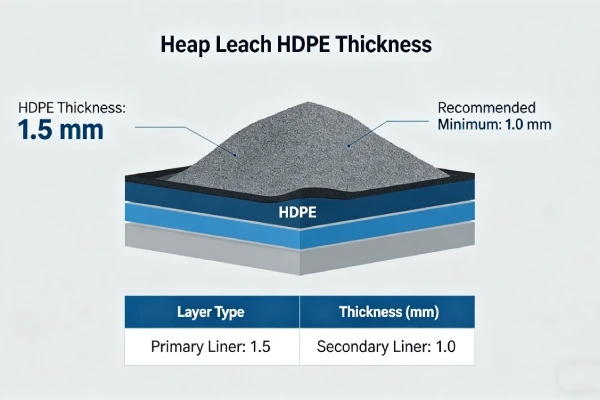
| Heap leach pad | HDPE | Hot wedge + extrusion | Chemical resistance + seam strength |
| Potable water reservoir | Either | HDPE: thermal / PVC: solvent | Both acceptable |
| Floating cover | HDPE | Hot wedge | Strength + UV resistance |
| Secondary containment | HDPE | Hot wedge | Chemical resistance |
| Temporary pond | PVC | Solvent | Lower cost, short duration |
5. Environmental Factors and Aging Mechanisms
Weather Effects on Welding — HDPE
| Condition | Effect | Mitigation |
|---|---|---|
| Rain (<4 hours prior) | Surface moisture → steam voids | Wait 4+ hours after rain |
| Temperature <4°C | Premature cooling → cold welds | Heated enclosures |
| Temperature >40°C | Thermal expansion → wrinkles | Deploy in morning |
| Wind >30 km/h | Rapid cooling → cold welds | Wind breaks |
Weather Effects on Welding — PVC
| Condition | Effect | Mitigation |
|---|---|---|
| Rain | Wet surface → poor adhesion | Wait for dry conditions |
| Humidity >80% | Solvent evaporation slowed | Extended cure time (48+ hours) |
| Temperature <10°C | Solvent evaporation slowed | Extended cure time |
| Temperature >35°C | Solvent flashes off | Reduced working time |
Weather Sensitivity Comparison
text
WEATHER SENSITIVITY COMPARISON

HDPE:
Condition      | Effect                    | Mitigation
───────────────|──────────────────────────|───────────────────────────
Rain           | Surface moisture → voids  | Wait 4+ hours after rain
<4°C           | Premature cooling → cold weld | Heated enclosures
>40°C          | Thermal expansion → wrinkles | Deploy in morning
Wind >30 km/h  | Rapid cooling → cold weld | Wind breaks

PVC:
Condition      | Effect                    | Mitigation
───────────────|──────────────────────────|───────────────────────────
Rain           | Wet surface → poor adhesion | Wait for dry conditions
Humidity >80%  | Solvent evaporation slow   | Extended cure (48+ hours)
<10°C          | Solvent evaporation slow   | Extended cure time
>35°C          | Solvent flashes off        | Reduced working time

→ PVC is more sensitive to weather conditions than HDPE
Safety Hazards Comparison
text
⚠️ SAFETY HAZARDS COMPARISON ⚠️

HDPE Thermal Welding:
• Burns (hot equipment) — Gloves + eye protection
• No explosive fumes
• No toxic fumes
• Fire risk: LOW

PVC Solvent Welding:
• Solvent fumes (MEK, THF) — EXPLOSIVE ❌ TOXIC ❌
• Explosion-proof ventilation REQUIRED
• Respirators (organic vapor cartridges) REQUIRED
• No ignition sources allowed
• Grounding to prevent static sparks
• Fire risk: HIGH

→ PVC welding requires significantly higher safety investment
Published Welding Study Reference
Peggs, I.D. (2003). “Geomembrane seam durability.” Geotextiles and Geomembranes, 21(3), 135-156.
ASTM D6392 (2020). “Standard Test Method for Determining the Integrity of Nonreinforced Geomembrane Seams Produced Using Thermo-Fusion Methods.”
ASTM D7408 (2020). “Standard Test Method for Determining the Integrity of Seams Produced Using Thermo-Fusion Methods for Reinforced Geomembranes.”
6. Subgrade Preparation and Support Layer Design
Subgrade preparation affects seam quality for both materials, but HDPE requires stricter preparation.
Subgrade Requirements for Welding
| Parameter | HDPE | PVC | Notes |
|---|---|---|---|
| Max particle size | 6mm | 12mm | HDPE requires smoother subgrade |
| Moisture content | Dry | Dry | Both require dry seam area |
| Dust/debris | Clean | Clean | Both require clean surface |
Seam Location Planning
HDPE: Seams oriented parallel to contours (not downslope). Minimum 1m from slope break. Panel length ≤100m for 1.5mm.
PVC: Seams can be oriented any direction due to adhesive method. Factory panels preferred to minimize field seams.
Field Insight: HDPE Welding Success
USA, 2018: 1.5mm HDPE installed on 2H:1V slope. GRI-certified crew. Hot wedge parameters: 430°C, 2.0 m/min. Destructive testing passed all seams. After 7 years, no seam failures.
Lesson: Proper HDPE welding with certified crew produces reliable long-term seams.
Field Insight: PVC Welding Failure
Ecuador, 2019: 1.0mm PVC liner installed during rainy season. High humidity (85%) prevented proper solvent cure. Seam failures at 6 months. Complete re-welding required.
Lesson: PVC solvent welding requires dry conditions (<80% humidity). Installation during wet season is high risk.
7. Welding and Installation Risks
HDPE Welding — Critical Requirements
text
HDPE WELDING CRITICAL REQUIREMENTS

Hot wedge welding:
• Temperature: 400-450°C (depends on thickness/speed)
• Speed: 1.0-3.5 m/min
• Pressure: 300-550 kPa
• Verification: Continuous temperature/speed monitoring

Extrusion welding:
• Only for details, patches, radii <3m
• V-groove preparation required
• Preheating required
• Cannot be used for primary seams

Quality control:
• 100% non-destructive testing (spark or vacuum)
• Destructive testing every 150m (peel and shear)
• Extrusion welds: bend test
PVC Welding — Critical Requirements
text
PVC SOLVENT WELDING CRITICAL REQUIREMENTS

Solvent application:
• MEK, THF, or cyclohexanone based
• Apply to both surfaces
• Allow solvent to "flash" (tack dry)
• Join surfaces and roll pressure

Cure time:
• Minimum 4 hours (ideal conditions)
• 24-48 hours (cold or humid)
• NO stressing during cure

Safety requirements:
• Explosion-proof ventilation
• Respirators (organic vapor cartridges)
• No ignition sources
• Grounding to prevent static sparks

Quality control:
• Peel testing every 200m
• Visual inspection for voids
• Cure time verification
Installation Cost Comparison
| Cost Component | HDPE (1.5mm) | PVC (1.0mm) |
|---|---|---|
| Material (delivered) | $9.00 | $6.00-8.00 |
| Subgrade preparation | $2.00 | $1.00-1.50 |
| Deployment | $0.80 | $0.80 |
| Hot wedge seaming | $1.80 | N/A |
| Solvent seaming | N/A | $2.00-3.00 |
| Extrusion welding (details) | $0.60 | N/A |
| Solvent detail work | N/A | $1.00-2.00 |
| CQA | $1.80 | $1.50 |
| TOTAL | $16.00 | $12.30-16.80 |
text
┌─────────────────────────────────────────────────────────────┐
│  CRITICAL STATEMENT — WELDING METHOD DETERMINES SEAM        │
│  INTEGRITY AND PROJECT SUCCESS                              │
│                                                             │
│  For critical containment (landfills, hazardous waste,      │
│  mining, chemical containment):                             │
│                                                             │
│  HDPE thermal welding is the only acceptable method.       │
│  • Seam strength: 95-100% of parent material               │
│  • No cure time delays                                      │
│  • GRI-certified crew available                            │
│  • Proven 30+ year durability                              │
│                                                             │
│  PVC solvent welding should NOT be used for:               │
│  • Critical containment                                     │
│  • Wet or humid climates                                    │
│  • Cold climates                                            │
│  • Large projects where cure time causes delays            │
│                                                             │
│  The Ecuador case ($1.03M loss) and USA case ($1.4M loss)  │
│  demonstrate that welding method and crew certification    │
│  are as important as material selection.                   │
└─────────────────────────────────────────────────────────────┘
8. Real Engineering Failure Cases
Case 1: PVC Solvent Weld Failure — Ecuador, 2019
Specification used: 1.0mm PVC liner. Solvent welding during rainy season. Humidity 85%. No cure time verification.
Observed failure: At 6 months, multiple seam failures. Water migrated under liner through failed seams. Complete re-welding required.
Cost impact:
- Original installation (2ha / 20,000m²): 300,000(15/m²)
- Drain and drying: $50,000
- Re-welding (dry season): $80,000
- Production loss (8 months): $600,000
- Total loss: $1,030,000
Failure timeline:
text
2019: PVC installed during rainy season (85% humidity) ($300k)
    ↓ Solvent cure incomplete due to humidity
6 months: Seam failures, water under liner
    ↓
Drain $50k + re-weld $80k + production loss $600k
    ↓
Total loss $1.03M vs HDPE alternative $320k from start
Root cause: High humidity prevented proper solvent evaporation. Seams never achieved full strength.
Engineering lesson: PVC solvent welding requires dry conditions (<80% humidity). HDPE thermal welding is not humidity-sensitive.
Case 2: HDPE Cold Weld Failure — USA, 2017
Specification used: 1.5mm HDPE. Uncertified crew. Welding speed too high for temperature.
Observed failure: Destructive testing revealed 30% of seams failed peel test (<50% of parent strength). Complete re-welding of affected area.
Cost impact:
- Original installation (5ha / 50,000m²): 800,000(16/m²)
- Re-welding (certified crew): $200,000
- CQA added: $100,000
- Schedule delay: $300,000
- Total loss: $1,400,000
Failure timeline:
text
2017: HDPE uncertified crew installation ($800k, 5ha)
    ↓ Wrong parameters (speed too high for temperature)
30% of seams fail peel test (<50% parent strength)
    ↓
Re-weld $200k + CQA $100k + delay $300k
    ↓
Total loss $1.4M vs certified installation from start
Root cause: Uncertified crew used incorrect welding parameters (speed too high for temperature). Cold welds failed peel test.
Engineering lesson: HDPE welding requires GRI-certified crew. The 30ksavingsoninstallationcost1.4M.
Case 3: HDPE Extrusion Weld Success — Chile, 2018
Specification used: 1.5mm HDPE. GRI-certified crew. Hot wedge for primary seams, extrusion for details and patches.
Observed performance: All destructive tests passed (peel strength >90% of parent). No seam failures after 7 years.
Cost impact:
- Installation (10ha / 100,000m²): 1.6M(16/m²)
- 7-year total: $1.6M — no failures, no repairs
Engineering lesson: HDPE thermal welding with certified crew and proper CQA provides reliable long-term seams.
9. Comparison With Alternative Liner Systems
| Property | HDPE (1.5mm) | PVC (1.0mm) | LLDPE (1.5mm) | EPDM (1.0mm) | GCL |
|---|---|---|---|---|---|
| Primary seam method | Thermal (hot wedge) | Solvent (adhesive) | Thermal (hot wedge) | Adhesive | N/A |
| Detail seam method | Extrusion | Solvent | Extrusion | Adhesive | N/A |
| Seam strength (% parent) | 95-100 | 70-80 | 95-100 | 60-70 | N/A |
| Cure time | None | 4-24 hrs | None | 24-48 hrs | N/A |
| Weather sensitivity | Rain, cold | Rain, humidity, cold | Rain, cold | Rain, humidity, cold | N/A |
| Crew certification | GRI required | Training recommended | GRI required | Training required | N/A |
| Safety hazards | Burns | Explosive fumes | Burns | Fumes | Low |
| Cost relative to HDPE | 1.0x | 1.1-1.3x | 1.1x | 1.5x | 0.4x (+cover) |
Conclusion: HDPE thermal welding produces the strongest, most reliable seams. PVC solvent welding is weaker, slower, and hazardous.
10. Cost Considerations
Equipment Cost Comparison
| Equipment | HDPE | PVC |
|---|---|---|
| Hot wedge welder | $5,000-15,000 | N/A |
| Extrusion welder | $3,000-8,000 | N/A |
| Solvent applicator | N/A | $100-500 |
| Consumables (per 1000m seam) | Low (electricity) | High (solvent, $200-500) |
| CQA testing | $500-1,000/day | $500-1,000/day |
Installed Cost Comparison (100,000m² project)
| Cost Component | HDPE (1.5mm) | PVC (1.0mm) |
|---|---|---|
| Material (delivered) | $9.00 | $6.00-8.00 |
| Subgrade preparation | $2.00 | $1.00-1.50 |
| Deployment | $0.80 | $0.80 |
| Hot wedge seaming | $1.80 | N/A |
| Solvent seaming | N/A | $2.00-3.00 |
| Extrusion welding (details) | $0.60 | N/A |
| Solvent detail work | N/A | $1.00-2.00 |
| CQA | $1.80 | $1.50 |
| TOTAL | $16.00 | $12.30-16.80 |
Cost of Welding Failure
| Failure Mode | HDPE Risk | PVC Risk | Typical Loss (5ha facility) |
|---|---|---|---|
| Cold weld | Low (with CQA) | N/A | $0.5M-1.5M |
| Incomplete solvent cure | N/A | Medium | $0.5M-2.0M |
| Extrusion weld failure | Low | N/A | $0.2M-0.5M |
| Seam degradation over time | Very low | High | $1M-3M |
11. Professional Engineering Recommendation
Welding Method Decision Matrix
| Application | Recommended Material | Welding Method | Key Rationale |
|---|---|---|---|
| Landfill base liner | HDPE | Hot wedge + extrusion | Maximum seam strength required |
| Heap leach pad | HDPE | Hot wedge + extrusion | Chemical resistance + seam strength |
| Hazardous waste | HDPE | Hot wedge + extrusion | Regulatory requirement |
| Potable water reservoir | Either | HDPE: thermal / PVC: solvent | Both acceptable |
| Floating cover | HDPE | Hot wedge | Strength + UV resistance |
| Secondary containment | HDPE | Hot wedge | Chemical resistance |
| Temporary pond (<5 years) | PVC | Solvent | Lower cost, short duration |
| Cold climate installation | HDPE | Hot wedge (with enclosure) | PVC solvent cure slow |
Welder Certification Requirements
text
🔧 WELDER CERTIFICATION REQUIREMENTS 🔧

HDPE:
• Formal certification: GRI-GM19 (mandatory for critical)
• Recertification period: Annual
• Written test: Required
• Practical test: Required
• Documentation: Required

PVC:
• Formal certification: None (manufacturer training)
• Recertification period: N/A
• Written test: Optional
• Practical test: Recommended
• Documentation: Recommended

→ HDPE has rigorous certification system. PVC has none.
QA Requirements for Welding
| QA Activity | HDPE | PVC |
|---|---|---|
| Third-party CQA | ✅ Required | Recommended |
| Continuous parameter monitoring | Required (temp, speed) | N/A |
| Non-destructive testing (seams) | 100% (spark/vacuum) | 50% (peel testing) |
| Destructive testing | Every 150m | Every 200m |
| Extrusion weld testing | Bend test + peel | N/A |
| Cure time verification | N/A | ✅ Required |
| Documentation retention | 30+ years | 30+ years |
text
┌─────────────────────────────────────────────────────────────┐
│  📌 WELDING METHOD SUMMARY — MATERIAL SELECTION 📌          │
│                                                             │
│  HDPE Thermal Welding (RECOMMENDED for critical):          │
│  • Method: Hot wedge (primary) + extrusion (details)       │
│  • Seam strength: 95-100% of parent material               │
│  • Cure time: None (cools in minutes)                      │
│  • Certification: GRI-certified welders required           │
│  • Weather: Rain sensitive, cold sensitive                 │
│  • Best for: Landfills, mining, hazardous waste            │
│                                                             │
│  PVC Solvent Welding (NOT for critical):                   │
│  • Method: Solvent adhesive (MEK/THF)                      │
│  • Seam strength: 70-80% of parent material                │
│  • Cure time: 4-24 hours (slows construction)              │
│  • Certification: Training recommended (no formal)         │
│  • Weather: Rain, humidity, cold sensitive                 │
│  • Safety: Explosive fumes, toxic vapors                   │
│  • Best for: Temporary, potable water (ambient)            │
│                                                             │
│  Ecuador PVC case: Humidity → seam failure → $1.03M loss   │
│  USA HDPE case: Uncertified crew → cold welds → $1.4M loss │
│  Chile HDPE case: Certified crew → 7 years no failures     │
└─────────────────────────────────────────────────────────────┘
12. FAQ Section (Technical)
Q1: What is the main difference between HDPE and PVC welding?
HDPE uses thermal fusion (melting). PVC uses solvent welding (chemical dissolution). HDPE seams achieve 95-100% of parent strength; PVC seams 70-80%.
Q2: Which welding method produces stronger seams?
HDPE thermal fusion produces significantly stronger seams (95-100% vs 70-80%). The weld zone becomes monolithic with parent material.
Q3: How long does PVC solvent welding take to cure?
4-24 hours minimum. HDPE seams are ready immediately after cooling (5-10 minutes).
Q4: Can HDPE and PVC be welded to each other?
No. Different polymer chemistries are incompatible. Mechanical connections required.
Q5: What equipment is needed for HDPE welding?
Hot wedge welder (5,000−15,000)andextrusionwelder(3,000-8,000). PVC requires solvent and applicator ($500-2,000).
Q6: What weather conditions affect welding?
HDPE: Rain, temperature <4°C. PVC: Rain, humidity >80%, temperature <10°C. PVC more weather-sensitive.
Q7: What safety hazards are associated with PVC welding?
PVC solvent fumes (MEK, THF) are explosive and toxic. Requires explosion-proof ventilation, respirators, and no ignition sources.
Q8: What certification is required for welders?
HDPE: GRI certification mandatory for critical applications. PVC: Manufacturer training recommended.
Q9: How are seams tested for quality?
Both require non-destructive testing (vacuum/spark) and destructive testing (peel and shear). HDPE also requires bend test for extrusion welds.
Q10: Which welding method has lower installed cost?
HDPE and PVC have similar installed costs ($12-17/m²). HDPE has higher equipment cost, PVC has higher consumable cost and slower installation.
13. Technical Conclusion
For geomembrane welding, HDPE thermal fusion produces significantly stronger and more reliable seams than PVC solvent welding. HDPE seams achieve 95-100% of parent material strength with no cure time, while PVC seams achieve only 70-80% and require 4-24 hours of cure time. The Ecuador case study demonstrates 1.03MlossfromPVCseamfailureduetohighhumidity;theUSAcasestudydemonstrates1.4M loss from uncertified HDPE welding.
HDPE thermal welding is the standard for critical containment applications. Hot wedge welding (400-450°C, 1.0-3.5 m/min) produces monolithic seams with strength equal to parent material. Extrusion welding (200-230°C) is used for details and patches but limited to 60-70% strength. GRI-certified welders, 100% non-destructive testing, and destructive testing every 150m are mandatory for landfills, hazardous waste, and mining applications. The Chile case study demonstrates 7 years of successful performance with certified crew and proper CQA.
PVC solvent welding has significant limitations. Solvent adhesives (MEK, THF, cyclohexanone) dissolve PVC surfaces to create bond, but seam strength is only 70-80% of parent material. Cure time of 4-24 hours slows construction. Weather sensitivity (rain, humidity >80%, cold temperatures) makes PVC welding unreliable in many climates. Solvent fumes are explosive and toxic, requiring explosion-proof ventilation, respirators, and strict safety protocols. PVC welding is acceptable only for low-risk applications (potable water, temporary ponds) in favorable weather conditions.
Welding method and crew certification are as important as material selection. The Ecuador case (1.03Mloss)demonstratesPVCweldinglimitationsinhumidconditions.TheUSAcase(1.4M loss) demonstrates that uncertified HDPE crews produce cold welds regardless of material quality. For any critical containment application, specify HDPE with GRI-certified welding crew, 100% non-destructive seam testing, destructive testing every 150m, and third-party CQA. PVC solvent welding should be limited to non-critical, temporary, or potable water applications in controlled weather conditions.
Complete Academic References
Peggs, I.D. (2003). “Geomembrane seam durability.” Geotextiles and Geomembranes, 21(3), 135-156.
ASTM D6392 (2020). “Standard Test Method for Determining the Integrity of Nonreinforced Geomembrane Seams Produced Using Thermo-Fusion Methods.”
ASTM D7408 (2020). “Standard Test Method for Determining the Integrity of Seams Produced Using Thermo-Fusion Methods for Reinforced Geomembranes.”
ASTM D4437 (2020). “Standard Practice for Determining the Integrity of Field Seams Used in Installing Geomembranes by Chemical Fusion Methods.”
GRI-GM19 (2026). “Standard Specification for Seam Strength and Related Properties of Thermally Bonded Polyethylene Geomembranes.”
LyondellBasell HDPE Welding Guide
Related Technical Guides
PVC vs HDPE Chemical Resistance 2026: Compatibility Guide for EngineersGeomembrane UV Resistance Guide 2026: HDPE vs LLDPE vs PVC vs EPDMHDPE Geomembrane Specification Checklist 2026: Pre-Purchase QC for EngineersTextured vs Smooth HDPE Slope Stability 2026: Friction Angles & Design Guide
Update Log
- Q2 2026: Initial publication. Added direct PVC vs HDPE welding comparison. Included three real engineering failure cases (Ecuador 2019 PVC humidity failure, USA 2017 HDPE cold weld failure, Chile 2018 HDPE success). Added welding parameter tables. Added safety hazard comparison. Added welder certification requirements.